EU Packaging Rules Take Effect, Forcing a Rethink of Sleeving Machine Lines
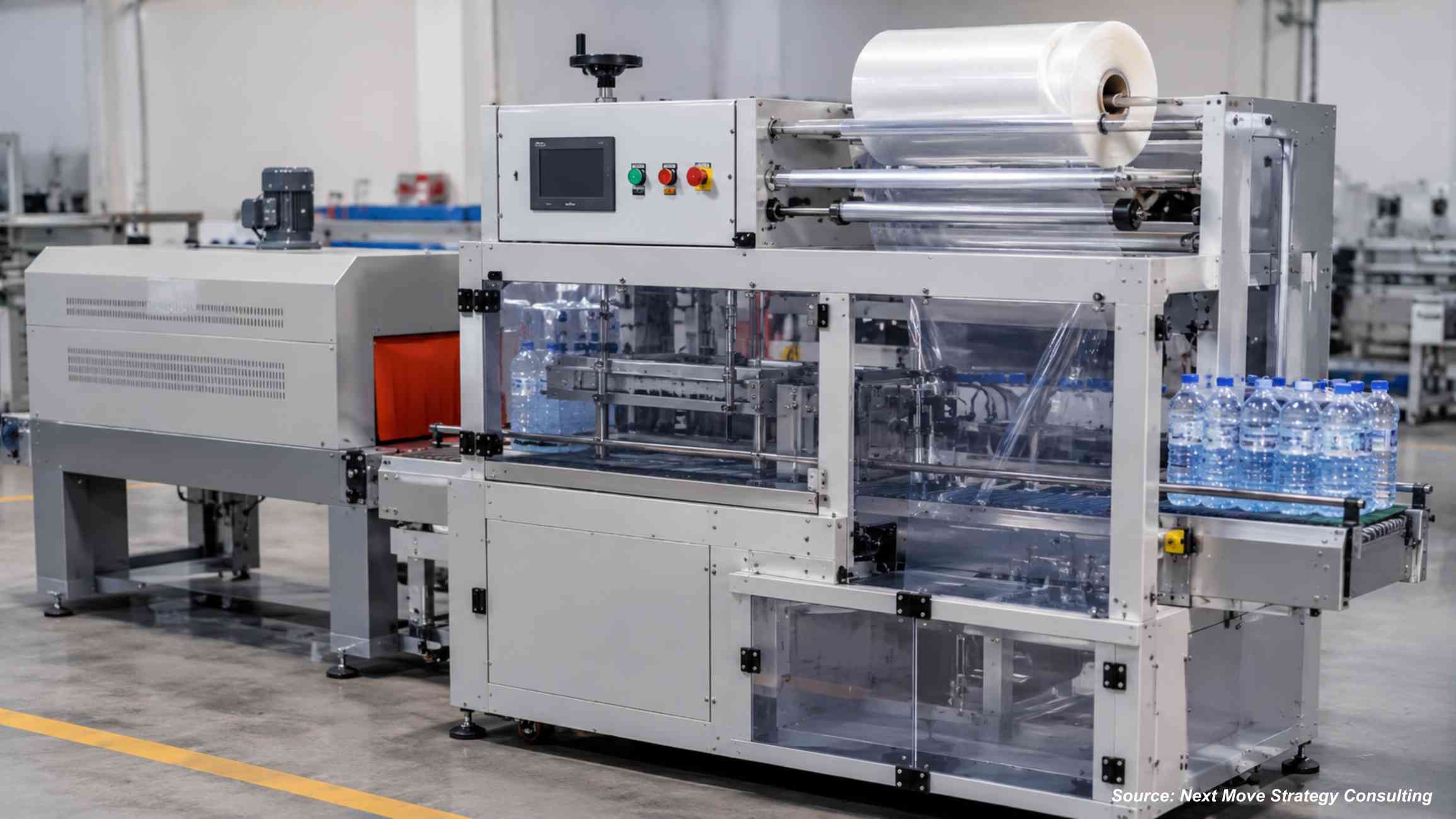
The EU’s Packaging Regulation Began Applying on 12 August, and Sleeve Labeling Equipment Makers Are Already Selling Modular Lines Built for Thinner, Recyclable Films
On 12 August 2026, Regulation (EU) 2025/40, the Packaging and Packaging Waste Regulation (PPWR), began to apply across the European Union, replacing the 1994 packaging directive with one directly applicable rulebook for every pack placed on the EU market. Announcing the start of application in a news article dated 11 August 2026, the European Commission’s Directorate-General for Environment said that, without action, packaging waste in the EU was projected to grow by 19% by 2030 and plastic packaging waste by as much as 46%. For sleeve labeling the timetable matters because the harmonised labelling and recyclability obligations that follow in 2028 and 2030 will govern how bottles are decorated, and a sleeving line ordered now will still be running when those dates arrive.
According to Next Move Strategy Consulting’s Sleeving Machine Market report, the global sleeving machine market was valued at USD 3.26 billion in 2025 and is projected to reach USD 3.88 billion by 2030, growing at a CAGR of 3.5% from 2025 to 2030. NextMSC primary research and analysis points to three demand forces behind that trajectory: rising packaged food and beverage consumption, automation of labeling lines, and a shift toward recyclable and fibre-based packaging materials, set against high upfront capital cost as the main brake on adoption among small and mid-sized manufacturers.
For More Information: Download FREE Sample on Sleeving Machine Market Report
What Changed on 12 August, and What Follows
The European Commission’s announcement identified one measure that took effect immediately: a restriction on per- and polyfluoroalkyl substances (PFAS) in food-contact packaging, so that food-contact packaging above strict limits can no longer be placed on the EU market. The remaining obligations are staged. The Commission states that a harmonised labelling system for packaging, designed to ease waste sorting, will apply from 2028, and that limits on empty space, restrictions on certain single-use plastic packaging, reuse targets, mandatory recycled content in new plastic packaging and the requirement that all packaging be recyclable will apply from 2030.
Jessika Roswall, the Commissioner responsible for the file, framed the regulation as a long-term investment in the same statement:
“The new Packaging and Packaging Waste Regulation is an investment in Europe’s future”
— Jessika Roswall, Commissioner for Environment, Water Resilience and a Competitive Circular Economy, European Commission, European Commission, Directorate-General for Environment, news article on the start of application of the PPWR, 11 August 2026.
Roswall added that new rules come with adjustment costs and that the Commission had worked with market operators to apply them in a pragmatic way. The staging is what makes the regulation a procurement question for equipment buyers: the first binding date has passed, and the dates that touch labels and sleeves are still ahead.
PPWR Application Timeline Announced by the European Commission
|
Date |
Measure |
Practical effect on packaging |
|
12 August 2026 |
General application of the PPWR, including the PFAS restriction in food-contact packaging |
Food-contact packaging above strict PFAS limits can no longer be placed on the EU market |
|
2028 |
Harmonised labelling system for packaging |
Common EU labelling to facilitate waste sorting |
|
2030 |
Limits on empty space, restrictions on certain single-use plastic packaging, reuse targets |
Measures to reduce the generation of packaging waste |
|
2030 |
Mandatory recycled plastic waste in new plastic packaging; requirement that all packaging is recyclable |
Circular-economy measures for packaging materials |
The Volume Behind the Rule: What Eurostat Counts
Eurostat’s figures show the scale of the material the regulation targets. In 2023, the latest year reported, the EU generated 79.7 million tonnes of packaging waste, or 177.8 kg per inhabitant, which was 8.7 kg per capita lower than in 2022 but 21.2 kg higher than in 2013, according to the Eurostat news article Plastic packaging waste in the EU: 35.3 kg per person of 22 October 2025. Paper and cardboard made up 40.4% of the total, plastic 19.8%, glass 18.8%, wood 15.8% and metal 4.9%. Each EU resident generated an average of 35.3 kg of plastic packaging waste in 2023, of which 14.8 kg was recycled, a plastic recycling rate of 42.1% compared with 38.2% in 2013.
The national spread is wide. Eurostat recorded the highest plastic packaging recycling rates in 2023 in Belgium (59.5%), Latvia (59.2%) and Slovakia (54.1%), and the lowest in Hungary (23.0%), France (25.7%) and Austria (26.9%).
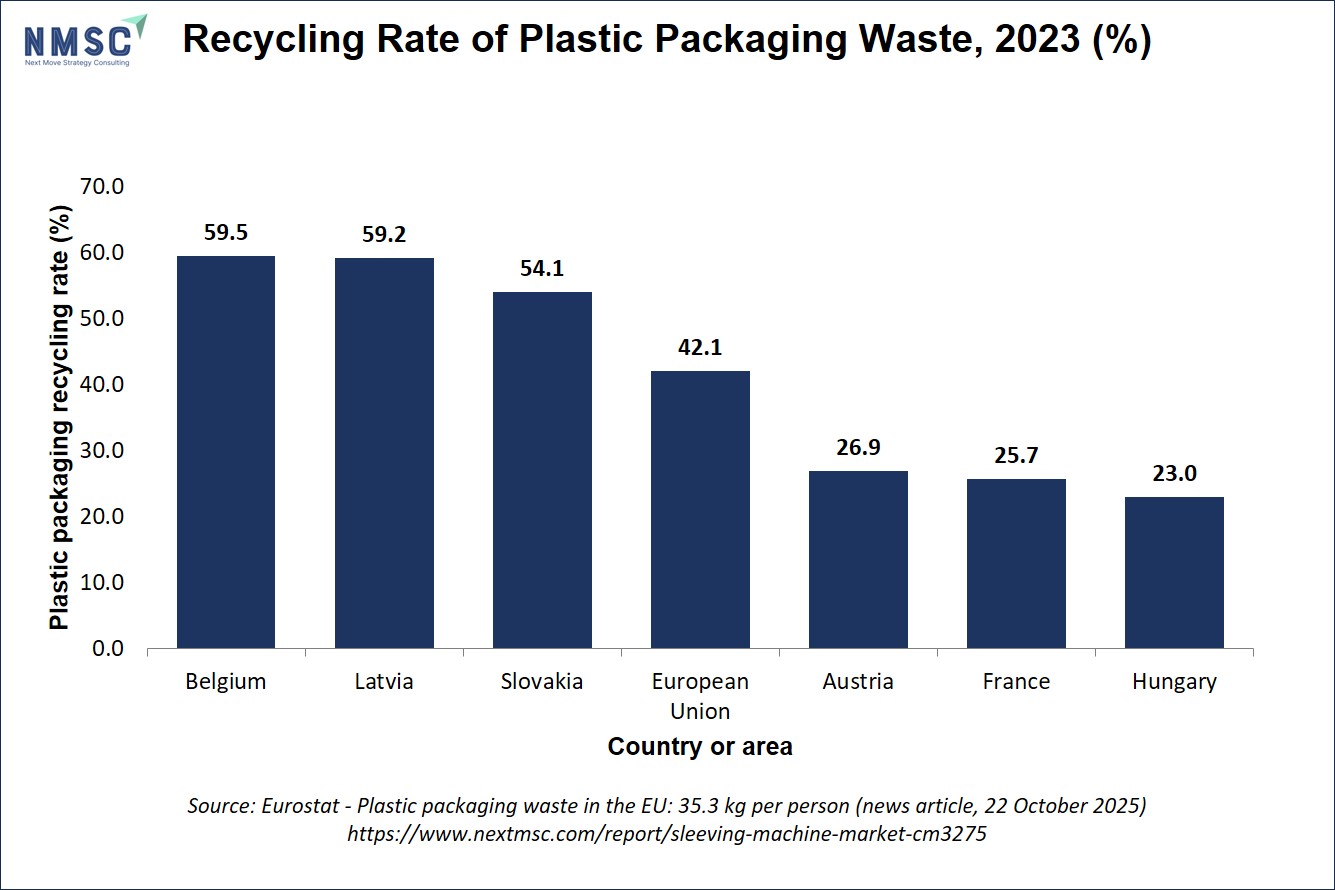
The chart uses only Eurostat's published rates and shows a spread of 36.5 percentage points between Belgium at 59.5% and Hungary at 23.0%, with the EU at 42.1%.
Eurostat Statistics Explained adds per-inhabitant detail for the largest generators and recyclers of packaging waste. Ireland generated the most per inhabitant in 2023, at 223.1 kg, while Italy recycled the most, at 162.2 kg per inhabitant. Eurostat adds that the EU as a whole was close to the 2030 packaging recycling target of 70%, with an overall recycling rate of 67.5%.
Packaging Waste per Inhabitant, 2023
|
Country or area |
Generated (kg per inhabitant) |
Recycled (kg per inhabitant) |
|
Ireland |
223.1 |
131.6 |
|
Italy |
219.5 |
162.2 |
|
Germany |
215.2 |
149.3 |
|
Luxembourg |
204.5 |
132.4 |
|
European Union |
177.8 |
120.0 |
Key Industry Developments: Sleeves, Machines and the Recycling Stream
Label makers moved ahead of the deadline. In October 2025, CCL Label launched a portfolio to help dairy brands comply with the PPWR, according to Packaging Insights, including EcoFloat, a floatable shrink sleeve material designed to detach cleanly from PET bottles in the sink-float recycling process, and stretch sleeves made from low-density polyethylene with up to 75% recycled content that use decoration technology requiring no adhesives or heat. Marika Knorr, head of sustainability at CCL Label, described the range as a step toward customers meeting the recyclability criteria in the PPWR proposal.
On the day the regulation applied, 12 August 2026, Packaging Insights reported that the PPWR was already shaping packaging strategies, material innovation and compliance discussions across the industry, and noted that industry bodies and non-governmental organisations have contested parts of the text, including through the debate over the Commission’s Environmental Omnibus.
Equipment makers are responding with flexibility. In a Beverage Industry report of 4 September 2026, Mike Soloway, director of labeling technology at Krones Inc., said older machines built for dedicated applications are being replaced by modular machines that run several labeling technologies on one line, and that Krones has adapted its labeling and sleeving machines to run very thin label materials at very high speeds.
“Flexibility and modularity in labeling equipment are becoming more standardized”
— Mike Soloway, Director of Labeling Technology, Krones Inc., Beverage Industry, Labeling equipment adapts to growing beverage portfolios, customer needs, 4 September 2026.
Justin Slarks of Sleeve Seal, Little Rock, Arkansas, told Beverage Industry that plants are producing more SKUs, so the ability to change formats painlessly is increasingly part of the buying conversation, and that sustainability changes are mostly changes to label substrates and containers, which Sleeve Seal weighs when engineering its labelers.
At interpack in Düsseldorf in May 2026, Packaging Insights reported that suppliers showed single-polymer flexible structures able to replace multi-layer laminates, driven by the PPWR’s requirement for recyclability at scale by 2030, and Fuji Seal demonstrated a server-controlled linear system for labeling and shrink sleeve applications, presented by Markus Haag, head of sales for labels. The machinery sector entered that show in good order. VDMA reported at its interpack press conference that German packaging machinery output rose 8% to EUR 9 billion in 2025, and that packaging machinery, including beverage filling machines, accounted for almost 70% of the sector’s EUR 11 billion in exports.
German Food Processing and Packaging Machinery Exports by Destination, 2025
|
Destination |
Share of German exports |
Detail published by VDMA |
|
Europe |
48% |
Of which 35% went to the EU-27 |
|
United States |
16% |
Almost EUR 1.8 billion in machinery exports |
|
Asia |
14% |
Exports to China fell 8% to EUR 409 million |
Segment Dynamics
NextMSC primary research and analysis segments the sleeving machine market by type (shrink, stretch, rotary, linear, roll-fed labeling and others), by automation level (automatic, semi-automatic and others) and by end user (food and beverage, pharmaceuticals, cosmetics and personal care, chemical, automotive and others). The PPWR timetable bears most directly on the type and automation cuts. A stretch sleeve applied without heat, as in the CCL Label range, removes the shrink tunnel from the line, while a floatable shrink film keeps it. A machine builder that must serve both needs a platform on which the application station can be exchanged, which is the modular approach Krones describes, and NextMSC primary research and analysis reads that requirement as the main technical consequence of the regulation for this equipment category.
Regional Outlook
NextMSC primary research and analysis describes Europe as a region where circular-economy targets are steering buyers toward fibre-based and recyclable sleeve materials, with major European players investing in hybrid sleeving systems compatible with cellulose-based formats. North America is described as growing steadily on labeling regulation, labor cost concerns and demand for flexible packaging in food and beverage, and Asia-Pacific as the most dynamic region as the FMCG, pharmaceutical and dairy sectors expand. The VDMA export data supports a global reading: Europe took 48% of German machinery exports in 2025, but the United States (16%) and Asia (14%) together took 30%, and VDMA noted double-digit export growth in individual markets including Mexico, Egypt, Algeria, South Africa, Japan and Brazil.
Growth Drivers and Restraints
Three externally documented forces support equipment demand. The first is the regulatory calendar: the Commission’s 2028 and 2030 milestones give brand owners a fixed horizon for redesigning decoration. The second is SKU proliferation, which Sleeve Seal’s Justin Slarks identified as raising the value of fast format changeover. The third is the scale of packaging in circulation, which Eurostat measures at 177.8 kg of packaging waste per EU inhabitant in 2023.
The restraints are equally documented. Christian Traumann, chairman of the VDMA Food Processing and Packaging Machinery Association, said at the interpack press conference that geopolitical crises, economic weakness in important sales markets, US customs policy, the war in Ukraine and developments in Iran were causing uncertainty and delaying investment decisions, and that first-quarter 2026 incoming orders for food processing and packaging machinery had not met expectations. The Commission itself acknowledged adjustment costs. NextMSC primary research and analysis adds that high upfront cost and a shortage of skilled technicians remain the central barriers for small and mid-sized manufacturers.
NMSC Strategic Perspective
NextMSC primary research and analysis reads the 12 August start of application as a procurement signal more than a compliance event. The binding labelling and recyclability dates sit in 2028 and 2030, yet a sleeving line commissioned in the coming purchasing cycle will still be in service when they arrive. Buyers therefore face a decision on how much material flexibility to pay for today. The Krones and Sleeve Seal commentary points toward modular application stations and tolerance for thin films, while CCL Label’s range shows the sleeve materials themselves dividing between shrink and stretch formats.
NextMSC primary research and analysis also sees a cost-allocation gap. High upfront capital cost, a restraint identified in the report, falls hardest on small and mid-sized manufacturers, and VDMA’s account of delayed investment decisions shows that larger buyers are holding back as well. The regulation shortens the time a buyer can wait without risking an asset that cannot run the next generation of materials, but it does not lower the price of the machine. NextMSC primary research and analysis therefore reads the 3.5% CAGR as consistent with replacement-led demand, in which the PPWR timetable changes the mix of machines sold toward modular, film-flexible platforms rather than lifting volumes sharply.
The main uncertainty is regulatory detail. Packaging Insights recorded that EUROPEN, the European Organisation for Packaging and the Environment, said the Commission’s guidance does not sufficiently address recycling rules and PFAS compliance for investment decisions. The 2030 recyclability requirement is fixed in principle, and NextMSC primary research and analysis treats its technical criteria as the variable that could still move equipment specifications.
Competitive Positioning
CCL Label moved earliest on materials, with its October 2025 dairy portfolio of floatable and heat-free sleeves. Krones positions its Ergomodul platform for modular labeling and its sleeving machines for very thin films, and in September 2025 showed InkPression and DecoBeam at drinktec in Munich, two technologies that decorate bottles without a label substrate, according to Beverage Industry. Sleeve Seal emphasises operator-friendly, format-flexible labelers. Fuji Seal presented a server-controlled linear system for labeling and shrink sleeve applications at interpack in May 2026. Each event above is traceable to the named report in the text, and none is an NMSC estimate.
Bottom Line
The EU Packaging and Packaging Waste Regulation began to apply on 12 August 2026, but the dates that matter most to sleeve labeling sit later: harmonised packaging labelling in 2028 and recyclability and recycled-content requirements in 2030, according to the European Commission. Eurostat’s 2023 data shows why plastics are in focus: 35.3 kg of plastic packaging waste per EU inhabitant, with 42.1% recycled. Label makers such as CCL Label have already launched floatable and heat-free sleeve materials, and equipment makers including Krones and Sleeve Seal describe modular lines that change formats quickly and run thinner films. Against that, VDMA reports delayed investment decisions and weaker first-quarter order intake. NextMSC primary research and analysis places the global sleeving machine market at USD 3.26 billion in 2025, rising to USD 3.88 billion by 2030 at a 3.5% CAGR, and reads that pace as replacement-led demand in which format flexibility, not raw capacity, decides which suppliers win orders.
About Next Move Strategy Consulting
Next Move Strategy Consulting is a premier market research and management consulting firm that has been committed to provide strategically analysed well documented latest research reports to its clients. The research industry is flooded with many firms to choose from, what makes NMSC different from the rest is its top-quality research and the obsession of turning data into knowledge by dissecting every bit of it and providing fact-based research recommendation that is supported by information collected from over 500 million websites, paid databases, industry journals and one on one consultations with industry experts across a diverse range of industry sectors. The high-quality customized research reports with actionable insights and excellent end-to-end customer service help our clients to take critical business decisions that enables them to move beyond time and have competitive edge in the industry.
We have been servicing over 1000 customers globally that includes 90% of the Fortune 500 companies over a decade. Our analysts are constantly tracking various high growth markets and identifying hidden opportunities in each sector or the industry. We provide one of the industry’s best quality syndicate as well as custom research reports across 10 different industry verticals. We are committed to deliver high quality research solutions in accordance to your business needs. Our industry standard delivery solutions that ranges from the pre consultation to after-sales services, provide an excellent client experience and ensure right strategic decision making for businesses.
For more information, please contact:
Next Move Strategy Consulting
5th Floor 867 Boylston St, STE 500,
Boston, MA 02116, U.S.
E-Mail: [email protected]
Direct: +1-217-650-7991
Website: www.nextmsc.com
About the Author
 Priyanshu Das
— Priyanshu Das is SEO Executive at Next Move Strategy Consulting, where he has led on-page and off-page SEO, keyword research, and SEO audits for the firm's B2B market research publications for 2 years. His audit process combines technical crawl analysis, backlink profile review, and competitor keyword gap mapping — using tools including Screaming Frog and Google Search Console — to prioritize fixes by organic search-visibility impact, informed by his own prior in-house and agency SEO experience.
About the Reviewer
 Sanyukta Deb
— Sanyukta Deb is Digital Marketing Team Lead at Next Move Strategy Consulting, where she has led content strategy and technical SEO for the firm's B2B market research publications for over 2 years. Her editorial process translates NextMSC's primary and secondary research — spanning technology, industrial, and consumer sectors — into commercial narratives, backed by search-intent, keyword, and competitive analysis. She brings 5 years of overall experience in digital marketing and content strategy.












Add Comment