EU Right-to-Repair Rules Take Effect, Reshaping Global Returns Logistics
With Repair Now a Legal Option for Covered Products Across the EU, Returns Networks Built Only to Restock or Dispose Face a Structural Gap Against Providers That Add Inspection, Parts and Repair Capacity
On 31 July 2026, the European Union's right-to-repair rules took effect, requiring manufacturers to repair technically repairable household and electronic products, including washing machines, vacuum cleaners, mobile phones and tablets, either free of charge or at a reasonable price and within a reasonable time. According to the European Commission's announcement of that date, a consumer who chooses repair over replacement during the legal liability period receives a guarantee extension of at least 12 months, manufacturers must make repair information easily accessible and provide spare parts at a reasonable price, and a European online repair platform is expected to be operational in 2027. The Commission cites expected growth and investment of €4.8 billion in the EU from the new rules. For retailers, brands and logistics operators, the change gives the repair branch of every returns decision a statutory footing: a failed or returned product in a covered category now has a legal route back to the customer that runs through inspection, parts and repair rather than only through restock, resale or disposal.
According to Next Move Strategy Consulting's Reverse Logistics and Distribution Market report, the global reverse logistics and distribution market was valued at USD 42.80 billion in 2025 and is projected to reach USD 138.60 billion by 2035, growing at a CAGR of 12.7% from 2026 to 2035. NextMSC primary research and analysis places the 2026 value at USD 47.10 billion and ties the trajectory to rising e-commerce return volumes, extended producer responsibility regulation, AI-enabled returns processing and electric-vehicle battery recycling demand.
For More Information: Download FREE Sample on Reverse Logistics and Distribution Market Report
The Financial Logic: What Returns Cost the Retail System
The volume entering reverse networks is large and measurable. In its release of October 15, 2025, prepared with Happy Returns, a UPS company, the National Retail Federation projected that consumers would return USD 849.9 billion of merchandise in 2025, equal to 15.8% of annual sales, down from USD 890 billion and 16.9% in 2024. The online return rate stood at 19.3% of online sales, and 9% of all returns were fraudulent. The research drew on two summer 2025 surveys: one of 2,006 consumers who had returned at least one online purchase in the past year and one of 358 e-commerce professionals at U.S. merchants with more than USD 500 million in revenue.
“Returns are no longer the end point of a transaction.”
- Katherine Cullen, Vice President of Industry and Consumer Insights, National Retail Federation, NRF and Happy Returns release on 2025 retail returns, October 15, 2025.
The 3.5-percentage-point gap between the online return rate of 19.3% and the all-channel rate of 15.8% matters operationally because an online return re-enters the network as an individually shipped parcel that must be received, inspected, graded and routed to restock, repair, resale or disposal, before it can generate any recovered value. The fraud share adds a second cost layer, since 9% of all returns were fraudulent in the National Retail Federation's findings.
U.S. Retail Returns Benchmarks, 2024 and 2025
|
Metric |
Value |
Reference period |
|
Total merchandise returns |
USD 849.9 billion |
2025 (projected) |
|
Total merchandise returns |
USD 890 billion |
2024 |
|
Share of annual sales returned |
15.8% |
2025 (projected) |
|
Share of annual sales returned |
16.9% |
2024 |
|
Online return rate (share of online sales) |
19.3% |
2025 (projected) |
|
Share of returns that are fraudulent |
9% |
2025 |
|
Consumers surveyed (returned at least one online purchase) |
2,006 |
Summer 2025 |
|
E-commerce professionals surveyed at large U.S. merchants |
358 |
Summer 2025 |
The upstream demand keeps compounding. The U.S. Census Bureau's Quarterly Retail E-Commerce Sales report for the second quarter of 2026, released on August 18, 2026 (CB26-133), put seasonally adjusted e-commerce sales at USD 340.2 billion, equal to 17.1% of total retail sales and 12.2% above the second quarter of 2025. Across the five quarters in the Census series, from the second quarter of 2025 to the second quarter of 2026, e-commerce sales rose in every quarter.
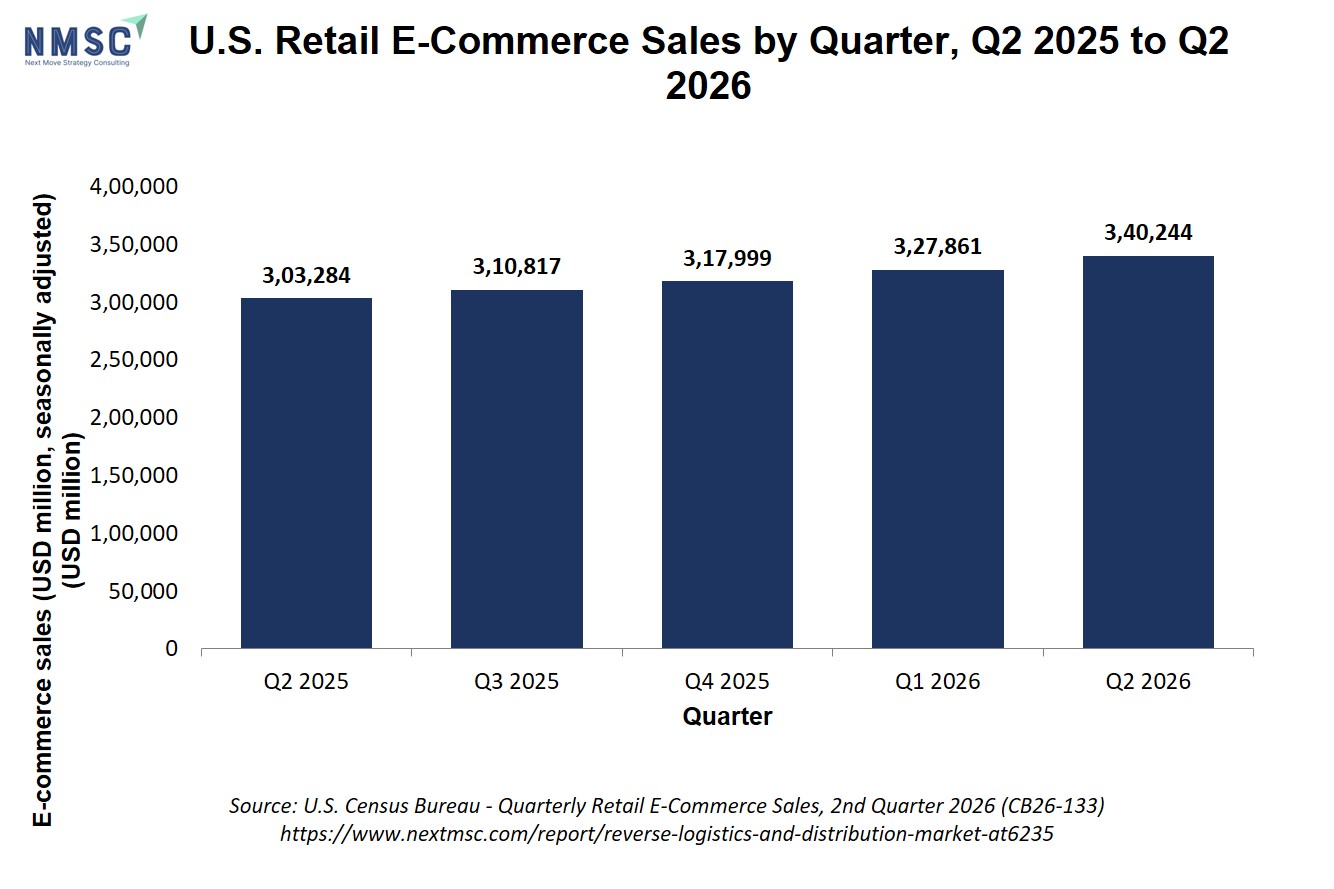
The Census Bureau series rises from USD 303,284 million in the second quarter of 2025 to USD 340,244 million in the second quarter of 2026, a higher figure in each consecutive quarter.
That share matters for reverse logistics because online orders carry the higher return rate. With 17.1% of U.S. retail sales now transacted online according to the Census Bureau, and the National Retail Federation measuring a 19.3% return rate on those sales, a growing slice of retail revenue arrives with a built-in probability of reverse movement.
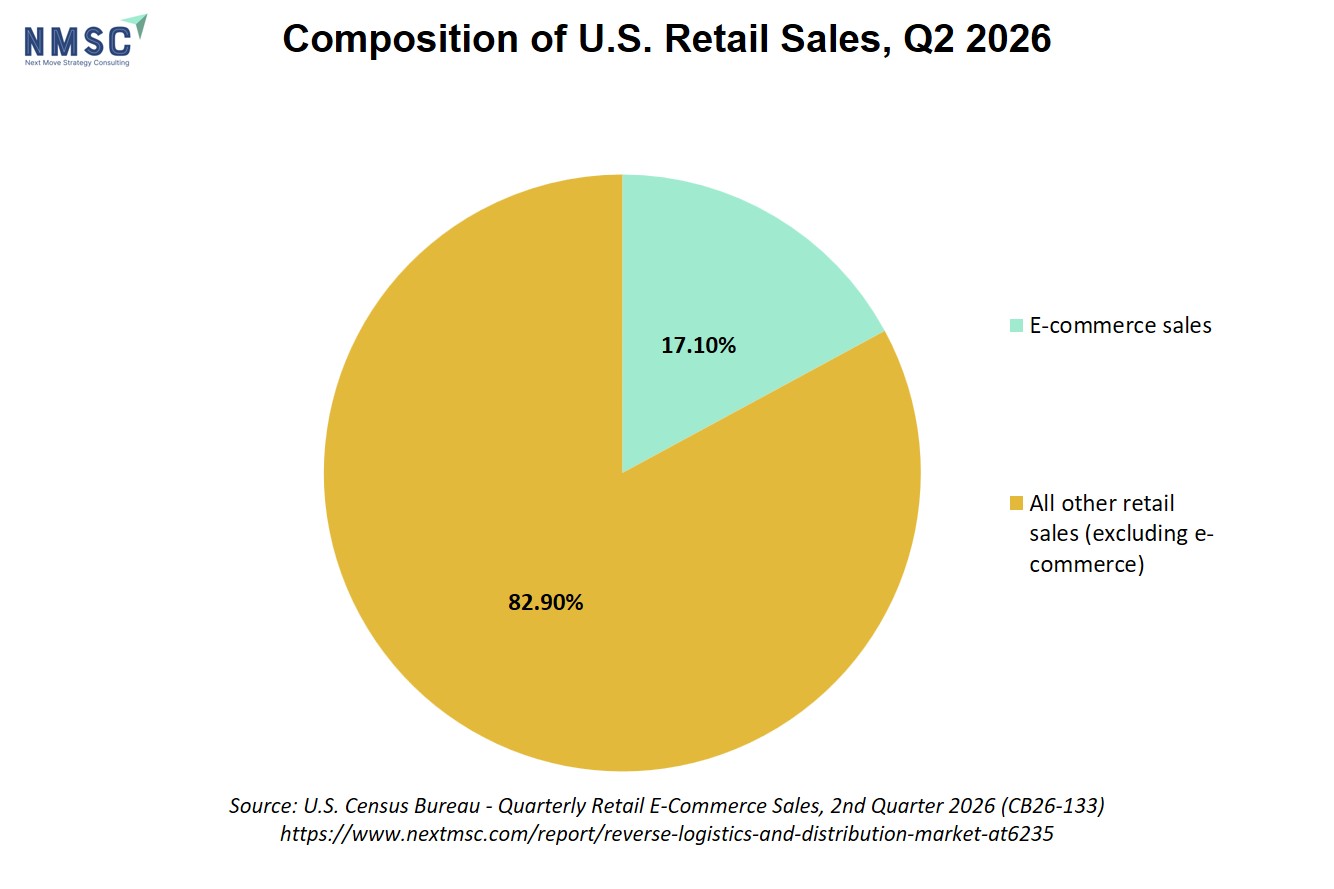
E-commerce accounted for 17.1% of U.S. retail sales in the second quarter of 2026; the remaining 82.9% is the balance of total retail sales as published by the Census Bureau.
Key Industry Developments: Network Scale and Long-Term Contracts
On April 21, 2026, UPS and Happy Returns announced that the Return Bar network had reached 10,000 drop-off locations across the United States, adding more than 1,700 sites mainly through partnerships with Annex Brands and PackageHub Business Centers. UPS stated that 79% of the U.S. population now lives within five miles of a Return Bar, up from 76%, that returns can move from shopper drop-off back to retailers in as little as 3.6 days, and that the average return transit time across customers is seven days. UPS also said the network is more than three times the size of the next-largest alternative.
“We are putting our customers – and their consumers – at the center of our reverse logistics business.”
- Matt Guffey, Executive Vice President, Chief Commercial and Strategy Officer, UPS, UPS and Happy Returns press release, April 21, 2026.
UPS and Happy Returns Return Bar Network, April 2026
|
Metric |
Figure |
|
Drop-off locations nationwide |
10,000 |
|
Locations added in the expansion |
More than 1,700 |
|
U.S. population within five miles of a Return Bar |
79% (up from 76%) |
|
Fastest drop-off-to-retailer transit |
As little as 3.6 days |
|
Average return transit time |
Seven days |
|
Size relative to the next-largest network (UPS statement) |
More than three times |
Contract logistics operators are securing the other end of the chain. On July 8, 2026, GXO announced from Paris the renewal of its partnership with Castorama, the home-improvement retailer, and the launch of new services, including returns management. At the Moissy-Cramayel site, GXO continues to manage all logistics for Castorama's project category and orchestrates nationwide transportation for store and home deliveries, and it is adding automation, digitisation and heavy-load fulfilment solutions. The announcement marks 30 years of partnership in France, where GXO reports more than 60 warehouses and nearly 9,000 employees, and where Castorama operates 93 stores.
Regulatory Pressure: Repair Rights Meet a Collection Gap
The repair mandate lands in a region where formal collection of end-of-life electronics remains incomplete. Eurostat's waste statistics for electrical and electronic equipment, which carry data for reference year 2024 published in October 2026, show that EU countries collected 5.5 million tonnes of waste electrical and electronic equipment and that 4.5 million tonnes were recycled or prepared for reuse. The EU average collection rate was 39.0% against a target of 65%, equal to 12.3 kg per inhabitant, with Bulgaria the highest named performer at 83.1%.
EU Waste Electrical and Electronic Equipment, Reference Year 2024
|
Indicator |
Value |
|
WEEE collected (EU) |
5.5 million tonnes |
|
WEEE recycled or prepared for reuse (EU) |
4.5 million tonnes |
|
EU average collection rate |
39.0% (target: 65%) |
|
WEEE collected per inhabitant |
12.3 kg |
|
Highest national collection rate (Bulgaria) |
83.1% |
NextMSC primary research and analysis reads the gap between a 39.0% collection rate and a 65% target as a supply-side opening: every unit that moves from informal storage or household disposal into a manufacturer-run repair or take-back flow adds volume to the reverse networks that can inspect, repair and route it. The Commission's rules do not set a collection target, but they give brands a reason to build the intake side, since a repaired unit extends the legal guarantee by at least 12 months and keeps the customer relationship with the manufacturer.
Segment Dynamics: Where NextMSC Sees the Value Pools
NextMSC primary research and analysis shows Return Transportation as the largest service type in 2025 at USD 10.27 billion, approximately 24% of the market, while Recycling Services is the fastest-growing service type at a 15.8% CAGR from 2026 to 2035 as electronics and battery recycling volumes scale under extended producer responsibility rules. By return type, Customer Returns held the largest share in 2025 at approximately 32%, or USD 13.70 billion, and End-of-Life Returns is the fastest-growing at an 18.7% CAGR. By end user, Electronics led in 2025 at approximately 24%, or USD 10.27 billion, and Automotive is the fastest-growing at 15.5%, driven by electric-vehicle component and battery reverse flows.
By delivery model, Dedicated Operations held approximately 38% in 2025, or USD 16.26 billion, while Specialized Logistics is the fastest-growing at 19.1%. By customer type, Retailers led with approximately 34%, or USD 14.55 billion, and Service Providers is the fastest-growing at 17.7%. The Electronics result connects directly to the Commission's rules: mobile phones and tablets are named covered products, and Electronics is both the largest end-user segment in NextMSC's model and the category where repair-led returns processing is most likely to add volume first.
Regional Outlook: North America Leads, Asia-Pacific Grows Fastest
NextMSC primary research and analysis shows North America leading in 2025 with USD 14.55 billion, approximately 34% of global revenue, growing at a 10.7% CAGR through 2035, supported by high e-commerce return rates and a mature contract logistics outsourcing base. Europe followed at USD 11.56 billion with an 11.2% CAGR, shaped by the Ecodesign for Sustainable Products Regulation, the Waste Electrical and Electronic Equipment Directive and the repair rules that took effect on 31 July 2026. Asia-Pacific stood at USD 10.27 billion and is the fastest-growing region at a 15.0% CAGR, propelled by e-commerce expansion and extended producer responsibility adoption across China and India. Middle East & Africa reached USD 3.42 billion at a 13.8% CAGR and Latin America USD 3.00 billion at a 14.0% CAGR. At country level, the U.S. led with approximately USD 11.79 billion in 2025, and India is the fastest-growing country at approximately 18.0%.
Growth Drivers and Restraints: What the Independent Evidence Shows
-
Driver, return intensity: the National Retail Federation measured an online return rate of 19.3% against 15.8% for all channels in its October 15, 2025 release, so each additional point of e-commerce share adds disproportionate reverse volume.
-
Driver, regulation: the European Commission confirmed on 31 July 2026 that repair must be offered free or at a reasonable price, with spare-parts access, accessible repair information and a guarantee extension of at least 12 months when a consumer chooses repair.
-
Driver, network density: UPS reported on April 21, 2026 that 79% of the U.S. population lives within five miles of a Return Bar, up from 76%, which shortens the first mile of every consumer return.
-
Driver, online demand: the U.S. Census Bureau recorded e-commerce at 17.1% of retail sales in the second quarter of 2026, up from 16.3% a year earlier in its revised series.
-
Restraint, collection gap: Eurostat's 2024 reference-year data show a 39.0% EU collection rate against a 65% target, which limits how much end-of-life volume enters formal channels.
-
Restraint, return fraud: the National Retail Federation found that 9% of all returns are fraudulent, adding authentication cost before a unit can be restocked.
-
Restraint, platform timing: the Commission expects the European online repair platform to be operational in 2027, after the rules began to apply, so repairer discovery lags the legal right by months.
NMSC Strategic Perspective: Repair Becomes a Routing Decision
NextMSC primary research and analysis finds that the central shift is in the disposition decision, not the transport leg. Until now, the routing choice for a returned electronics or appliance unit was largely restock, liquidate or recycle. With repair statutory for covered products in the EU, a fourth branch carries legal volume, and the provider that holds spare-parts access, inspection capability and tracking on one platform can process that branch without handing the unit to a second vendor. NextMSC primary research shows contract logistics providers already bundling returns management with forward fulfilment under a single technology platform, a shift that is reshaping vendor selection criteria; the EU repair mandate adds certified repair and component recovery to those criteria.
The network evidence supports that reading. UPS's 10,000-location Return Bar network addresses the first mile, and the average return transit time of seven days across its customers shows how much of the cycle sits between drop-off and the decision point. GXO's July 8, 2026 renewal with Castorama, which pairs a 30-year relationship with new automation and returns management services, shows retailers extending outsourcing rather than reversing it. In NextMSC's regional model, Asia-Pacific is the fastest-growing region at a 15.0% CAGR, while Europe, at 11.2%, is the region where the repair mandate applies directly.
The risks that NextMSC primary research and analysis tracks are concentrated in cost and compliance rather than demand: fragmented customs and duty drawback requirements for cross-border returns across Europe and Asia-Pacific, high labour and facility costs in mature markets, and limited formal reverse infrastructure in Middle East & Africa and Latin America. Providers that combine dense intake networks, certified repair and refurbishment capability, and automated customs documentation hold the stronger position against those constraints.
Competitive Landscape: Integrators, Contract Specialists and Recovery Platforms
NextMSC primary research and analysis describes the market as moderately consolidated, with global parcel integrators competing alongside contract logistics specialists and circular economy and IT asset disposition providers. The report profiles 17 companies, including Deutsche Post AG, United Parcel Service, Inc., FedEx Corporation, DSV A/S, CEVA Logistics SA, Kuehne + Nagel International AG, GXO Logistics, Inc., XPO, Inc., GEODIS SA, C.H. Robinson Worldwide, Inc., Ryder System, Inc., Yusen Logistics Co., Ltd., Kintetsu World Express, Inc., Reconomy Group Limited, Iron Mountain Incorporated, NFI Industries, Inc. and Safexpress Private Limited.
Competition centres on network scale, technology-enabled disposition and cross-border customs expertise. The two dated company events above show the split: UPS, through Happy Returns, is scaling consumer-facing intake, as its April 21, 2026 announcement states, while GXO is extending long-term retail contracts that bundle automation with returns management, as its July 8, 2026 announcement states.
Bottom Line
The EU's right-to-repair rules, in application since 31 July 2026, move repair from a goodwill gesture to a legal obligation for covered household and electronic products, so returns networks must now carry repair-ready inventory alongside restock and disposal flows. The independent evidence points the same way: the National Retail Federation counts USD 849.9 billion of projected U.S. returns in 2025 with a 19.3% online return rate, the Census Bureau puts U.S. e-commerce at 17.1% of retail sales in the second quarter of 2026, UPS reports 10,000 U.S. drop-off locations, and Eurostat shows the EU collecting 39.0% of electronic waste against a 65% target. NextMSC primary research and analysis values the global reverse logistics and distribution market at USD 42.80 billion in 2025, rising to USD 138.60 billion by 2035 at a 12.7% CAGR. Providers that combine network density, certified repair and disciplined cross-border customs handling are best placed to capture the shift.
About Next Move Strategy Consulting
Next Move Strategy Consulting is a premier market research and management consulting firm that has been committed to provide strategically analysed well documented latest research reports to its clients. The research industry is flooded with many firms to choose from, what makes NMSC different from the rest is its top-quality research and the obsession of turning data into knowledge by dissecting every bit of it and providing fact-based research recommendation that is supported by information collected from over 500 million websites, paid databases, industry journals and one on one consultations with industry experts across a diverse range of industry sectors. The high-quality customized research reports with actionable insights and excellent end-to-end customer service help our clients to take critical business decisions that enables them to move beyond time and have competitive edge in the industry.
We have been servicing over 1000 customers globally that includes 90% of the Fortune 500 companies over a decade. Our analysts are constantly tracking various high growth markets and identifying hidden opportunities in each sector or the industry. We provide one of the industry’s best quality syndicate as well as custom research reports across 10 different industry verticals. We are committed to deliver high quality research solutions in accordance to your business needs. Our industry standard delivery solutions that ranges from the pre consultation to after-sales services, provide an excellent client experience and ensure right strategic decision making for businesses.
For more information, please contact:
Next Move Strategy Consulting
5th Floor 867 Boylston St, STE 500,
Boston, MA 02116, U.S.
E-Mail: [email protected]
Direct: +1-217-650-7991
Website: www.nextmsc.com
About the Author
 Sanyukta Deb
— Sanyukta Deb is Digital Marketing Team Lead at Next Move Strategy Consulting, where she has led content strategy and technical SEO for the firm's B2B market research publications for over 2 years. Her editorial process translates NextMSC's primary and secondary research — spanning technology, industrial, and consumer sectors — into commercial narratives, backed by search-intent, keyword, and competitive analysis. She brings 5 years of overall experience in digital marketing and content strategy.
About the Reviewer
 Debashree Dey
— Debashree Dey is Assistant Manager at Next Move Strategy Consulting, where she supports cross-vertical market content and communications across diverse industries for 6 years. Her professional background includes senior content writing, communications, and published manuscript authorship, with experience developing audience-focused business narratives and maintaining clear, consistent messaging. Her role supports research-led content development and editorial quality across NextMSC publications.














Add Comment