KONE Gains Six TKE Clearances as Retrofits Drive Commercial Elevator Orders
KONE Clears Six Merger Reviews, Otis Posts 20% Modernization Backlog Growth and Schindler Lifts Its Margin Target in One Week of Elevator Earnings
On October 28, 2026, KONE Corporation reported in its interim report for January–September 2026 that it has received six unconditional merger-control clearances for its planned combination with TK Elevator (TKE) and that completion is expected no earlier than the second quarter of 2027. MLex, in its October 28, 2026 article “Kone has secured six merger clearances for TK Elevator deal, CEO says,” described the transaction as a EUR 29.4 billion acquisition that is still in European Commission prenotification discussions. Otis Worldwide Corporation published its third-quarter 2026 results the same day, reporting net sales of USD 3.9 billion, up 6%, with modernization orders up 10% at constant currency and modernization backlog up 20%. Schindler Group, in its nine-month results of October 2026, raised its 2026 EBIT margin outlook. The disclosures place service and retrofit work at the center of KONE’s and Otis’s growth while the TKE combination moves through regulatory review.
According to Next Move Strategy Consulting’s Commercial Elevator Market report, the global commercial elevator market was valued at USD 64.80 billion in 2025 and is projected to reach USD 141.13 billion by 2035, growing at a CAGR of 8.0% from 2026 to 2035. NextMSC primary research and analysis places the 2026 value at USD 70.60 billion and finds the fastest segment growth in modernization services (12.6% CAGR) and machine room-less elevators (11.7% CAGR), with modernization being the line in which both KONE and Otis reported their strongest order growth in the third quarter.
For More Information: Download FREE Sample on Commercial Elevator Market Report
The Financial Logic: Service Annuities and Retrofit Orders Outrun New Construction
KONE’s interim report, published on October 28, 2026, supplies the clearest ledger. Third-quarter orders received grew 7.2% to EUR 2,292.9 million (5.5% at comparable exchange rates), the order book stood at EUR 9,804.6 million on September 30, 2026, up 12.5% year on year, and adjusted EBIT margin improved to 12.7% from 12.3%. Modernization sales rose 9.5% to EUR 547.4 million and Service sales rose 7.0% to EUR 1,328.3 million, while New Building Solutions sales rose 1.0% to EUR 1,030.3 million and fell 0.9% at comparable rates because of lower deliveries in Greater China. KONE narrowed its 2026 outlook to sales growth of 4–6% at comparable exchange rates and an adjusted EBIT margin of 12.5–12.9%.
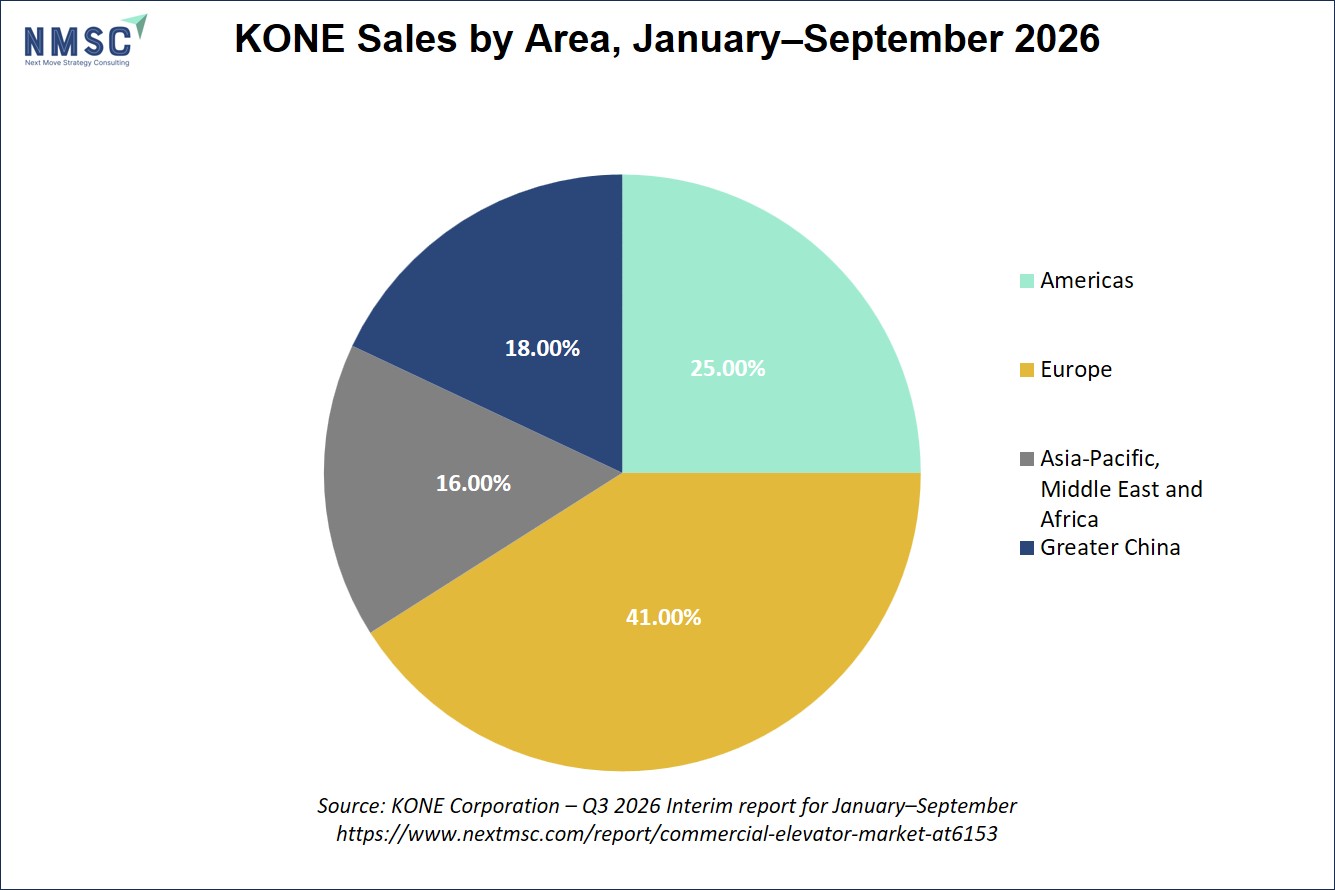
Service and Modernization together contributed EUR 5,563.8 million of KONE’s EUR 8,552.0 million in sales for January–September 2026, against EUR 2,988.2 million from New Building Solutions.
Otis Worldwide Corporation’s third-quarter release of October 28, 2026 shows the same pattern. Service net sales rose 8% and New Equipment net sales rose 3%, with growth in the Americas, EMEA and Asia Pacific partly offset by a decline in China. Modernization orders rose 10% at constant currency and modernization backlog rose 20%, while New Equipment orders rose 1% and New Equipment backlog rose 4%. Chair, CEO and President Judy Marks attributed the double-digit modernization growth to investment in field capability and AI-enabled pricing.
Schindler Group’s nine-month results, reported in October 2026, point the same way on orders and margin. Order intake reached CHF 8.74 billion, up 2.5% (5.2% in local currencies), while revenue of CHF 8.16 billion was up 0.1% (2.6% in local currencies). Schindler raised its 2026 EBIT margin outlook to about 13.5% from about 13.0%.
Three Elevator Majors’ Latest Reported Signals
|
Company |
Reporting period |
Order and backlog signal |
Revenue and margin signal |
|
KONE Corporation |
July–September 2026 |
Orders EUR 2,292.9 million (+7.2%); order book EUR 9,804.6 million (+12.5%) |
Sales EUR 2,906.0 million (+5.2%); adjusted EBIT margin 12.7% (12.3% a year earlier) |
|
Otis Worldwide Corporation |
July–September 2026 |
Modernization orders +10% and modernization backlog +20% at constant currency; New Equipment orders +1% |
Net sales USD 3.9 billion (+6%); Service net sales +8%; New Equipment net sales +3% |
|
Schindler Group |
January–September 2026 |
Order intake CHF 8.74 billion (+2.5%; +5.2% in local currencies) |
Revenue CHF 8.16 billion (+0.1%; +2.6% in local currencies); 2026 EBIT margin outlook raised to about 13.5% from about 13.0% |
China is the counterweight. The National Bureau of Statistics of China reported on October 20, 2026 that real estate development investment for January–September 2026 fell 20.6% year on year to CNY 5,336.4 billion. Within that total, investment in office buildings fell 21.0% to CNY 200.1 billion and investment in buildings for commercial business fell 25.9% to CNY 350.9 billion, while floor space under construction was down 12.8% at 5,652.21 million square meters. KONE described the Chinese new-equipment market as weak and its pricing as intensely competitive, and its Greater China sales fell 5.4% in the quarter.
Key Industry Developments: Three Disclosures That Define the Quarter
October 28, 2026 — KONE sets out the TKE terms. KONE’s interim report states that it would acquire TKE for EUR 5 billion in cash and a maximum of 270 million newly issued class B shares, and refinance the majority of about EUR 9.2 billion of TKE’s interest-bearing net debt. KONE targets EUR 700 million in annual run-rate pre-tax cost synergies by the end of year three after completion, and on an illustrative basis the combined group would have had about EUR 20.5 billion in annual sales, of which about 65% in Service and Modernization, with about 3.2 million units under maintenance. KONE has submitted prenotification filings to the European Commission and merger-control filings in all other required jurisdictions, and its report says the regulatory review is progressing as planned.
October 1, 2026 — Reuters reports a European divestment plan. Reuters reported on October 1, 2026 that KONE is preparing to sell most of TKE’s European operations to ease competition concerns. According to Reuters, TKE generated about EUR 2.5 billion of revenue in Europe last year, roughly 27% of its total sales, and Citigroup analysts estimate that European asset sales could raise about EUR 2.1 billion. Reuters also reported that Schindler told it in July 2026 that it could consider buying businesses made available through regulatory remedies. KONE’s own interim report does not address divestments.
October 28, 2026 — Otis reports a 20% rise in modernization backlog. Otis’s third-quarter release of October 28, 2026 recorded modernization backlog growth of 20% at both actual and constant currency, double the 10% growth in modernization orders. NextMSC primary research and analysis reads a backlog growing twice as fast as orders as a sign that contracted retrofit work is accumulating faster than it is being delivered.
“Modernization once again served as the key driver of order growth”
— Philippe Delorme, President and CEO, KONE Corporation, KONE Q3 2026 Interim report for January–September, October 28, 2026.
Segment Dynamics: Machine Room-Less and Modernization Outgrow the Core
NextMSC primary research and analysis shows traction elevators holding the largest technology share in 2025 at USD 37.58 billion, but growing at 6.2% a year through 2035, while machine room-less elevators grow at 11.7% from USD 18.14 billion in 2025 to USD 53.63 billion in 2035, nearly tripling. By service type, new installation remained the largest line in 2025 at USD 29.81 billion, while modernization is the fastest-growing at a 12.6% CAGR from 2026 to 2035, against 8.0% for the market as a whole.
Commercial Elevator Market by Technology: 2025 Value, 2035 Forecast and CAGR
|
Technology |
2025 (USD billion) |
2035 (USD billion) |
CAGR 2026–2035 |
|
Traction Elevator |
37.58 |
70.56 |
6.2% |
|
Machine Room-Less Elevator |
18.14 |
53.63 |
11.7% |
|
Hydraulic Elevator |
9.08 |
16.94 |
6.2% |
|
Total market |
64.80 |
141.13 |
8.0% |
The service shift has a measurable digital layer. KONE’s interim report states that connected elevators represented over 45% of its service base at the end of the third quarter of 2026, and that its launch of a one-week modernization approach in Europe is designed to cut installation time and building disruption. NextMSC primary research and analysis treats the adoption of IoT-enabled predictive maintenance platforms as a +1.6% driver on the market CAGR through 2032.
Regional Outlook: Asia-Pacific Leads in Value, Middle East and Africa Leads in Growth
NextMSC primary research and analysis values Asia-Pacific at USD 27.22 billion in 2025, the largest regional share, growing at 8.8% to USD 63.51 billion by 2035. The Middle East and Africa is the fastest-growing region at 10.2%, from USD 6.48 billion in 2025 to USD 16.94 billion in 2035. At country level, NextMSC projects China from USD 13.07 billion in 2025 to USD 29.50 billion by 2035 at 8.4%, India from USD 4.36 billion to USD 12.20 billion at 11.0%, the UAE from USD 1.43 billion to USD 4.05 billion at 11.2%, and Saudi Arabia from USD 1.56 billion to USD 4.35 billion at 11.0%.
Commercial Elevator Market by Region: 2025 Value, 2035 Forecast and CAGR
|
Region |
2025 (USD billion) |
2035 (USD billion) |
CAGR 2026–2035 |
|
Asia-Pacific |
27.22 |
63.51 |
8.8% |
|
North America |
14.26 |
25.40 |
5.6% |
|
Europe |
12.31 |
23.99 |
6.7% |
|
Middle East & Africa |
6.48 |
16.94 |
10.2% |
|
Latin America |
4.53 |
11.29 |
9.6% |
|
Global |
64.80 |
141.13 |
8.0% |
KONE’s report supplies the external corroboration. Its Asia-Pacific, Middle East and Africa sales grew 15.8% in the third quarter, with the report citing impressive growth in the Middle East and healthy momentum in India and Australia, while Greater China sales fell 5.4%. Otis, for its part, reported a decline in China offsetting growth in the Americas, EMEA and Asia Pacific.
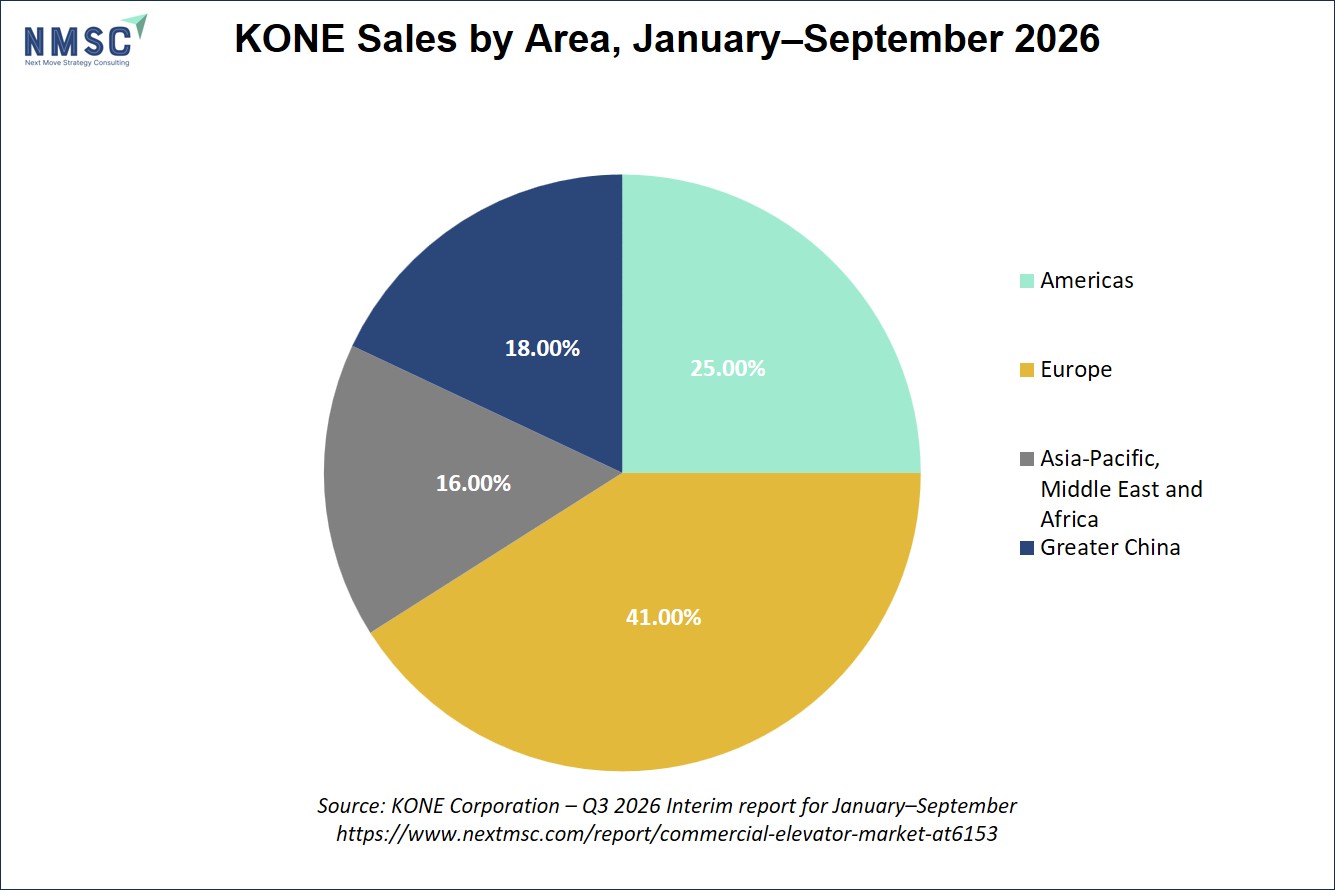
Greater China contributed 18% of KONE’s January–September 2026 sales, against 20% a year earlier, while Europe contributed 41%, the Americas 25% and Asia-Pacific, Middle East and Africa 16%.
Growth Drivers and Restraints
Commercial Elevator Market: Growth Driver and Restraint Matrix
|
Factor |
Type |
Impact on CAGR |
Geography |
Timeline |
|
Rising high-rise commercial construction in Asia-Pacific |
Driver |
+2.4% |
Asia-Pacific, Global |
2026–2035 |
|
Expanding modernization demand across aging installed base |
Driver |
+2.1% |
North America, Europe |
2026–2035 |
|
Growing adoption of IoT-enabled predictive maintenance platforms |
Driver |
+1.6% |
Global |
2026–2032 |
|
Rising smart city and mixed-use development investment |
Driver |
+1.5% |
Middle East & Africa, Asia-Pacific |
2026–2035 |
|
Expanding hospitality and healthcare infrastructure development |
Driver |
+1.2% |
Global |
2026–2032 |
|
Increasing accessibility regulation compliance requirements |
Driver |
+1.0% |
North America, Europe |
2026–2035 |
|
High capital cost of new elevator installation and modernization |
Restraint |
−1.1% |
Latin America, Middle East & Africa |
2026–2032 |
|
Industry consolidation creating regulatory and integration uncertainty |
Restraint |
−0.8% |
Europe, Global |
2026–2028 |
|
Volatility in steel and raw material input costs |
Restraint |
−0.6% |
Global |
2026–2030 |
NMSC Strategic Perspective: Installed-Base Economics Now Set the Pace
NextMSC primary research and analysis identifies three shifts in the October 2026 disclosures, each with a mechanism, evidence and a measurable consequence.
Retrofit work is outgrowing new construction. NextMSC models expanding modernization demand across North America and Europe at +2.1% on the market’s CAGR, second only to Asia-Pacific high-rise construction at +2.4%. KONE’s report of significant modernization order growth in volume business, and Otis’s 20% backlog growth, are consistent with that weighting. The measurable gap is 4.6 percentage points: modernization is forecast at a 12.6% CAGR against 8.0% for the market.
Consolidation is a timing risk, not yet a demand risk. NextMSC applies a −0.8% impact on CAGR to regulatory and integration uncertainty over 2026–2028, concentrated in Europe and global operations. The evidence is KONE’s statement that completion cannot occur before the second quarter of 2027 and Reuters’ October 1, 2026 report of a planned European divestment. NextMSC primary research and analysis indicates that building owners are reassessing long-term service contracts as consolidation reshapes vendor negotiating leverage, and the −0.8% impact is confined to the 2026–2028 window rather than extended through 2035.
New-installation demand is rotating away from China. The National Bureau of Statistics of China recorded a 25.9% fall in commercial-building investment for January–September 2026, and both KONE and Otis reported weakness in China’s new-equipment business. In the third quarter, KONE’s Asia-Pacific, Middle East and Africa sales grew 15.8%. NextMSC’s country models carry India at 11.0%, the UAE at 11.2% and Saudi Arabia at 11.0%, faster than China at 8.4%, and NextMSC primary research and analysis reads this divergence as a rotation of incremental new-installation demand toward those markets.
Competitive Landscape: Four Majors, One Pending Combination
NextMSC primary research and analysis describes the industry as highly consolidated and profiles 20 companies, including Otis Worldwide, KONE, Schindler, TK Elevator and Mitsubishi Electric. Reuters describes the global industry as concentrated among KONE, TKE, Otis and Schindler. The October 2026 reports show how each is positioned. KONE has a EUR 9,804.6 million order book, six clearances in hand and European Commission prenotification under way for TKE. Otis reported Service net sales growth of 8% alongside a 20% rise in modernization backlog. Schindler is raising margin guidance while order intake grows 5.2% in local currencies. TKE’s European business is the asset Reuters reports KONE is preparing to sell, and Schindler has said it could consider buying businesses released through remedies. The regulatory review has not concluded, and KONE’s report identifies it as the primary uncertainty for the transaction.
Bottom Line
The October 2026 earnings cycle shows the commercial elevator industry earning its growth where the installed base already stands. KONE reported a EUR 9,804.6 million order book and named Modernization the key driver of its order growth. Otis reported a 20% rise in modernization backlog. Schindler lifted its 2026 margin outlook. Against that, China’s National Bureau of Statistics recorded a 25.9% fall in investment in commercial business buildings for January–September 2026, and both KONE and Otis reported weakness in China’s new-equipment business. NextMSC primary research and analysis values the global commercial elevator market at USD 64.80 billion in 2025 and USD 141.13 billion by 2035, with modernization at a 12.6% CAGR and machine room-less systems at 11.7%. The principal uncertainty is regulatory: KONE’s TKE combination cannot close before the second quarter of 2027. NextMSC primary research and analysis indicates that suppliers with dense service networks and connected fleets are best placed as modernization outgrows the market.
About Next Move Strategy Consulting
Next Move Strategy Consulting is a premier market research and management consulting firm that has been committed to provide strategically analysed well documented latest research reports to its clients. The research industry is flooded with many firms to choose from, what makes NMSC different from the rest is its top-quality research and the obsession of turning data into knowledge by dissecting every bit of it and providing fact-based research recommendation that is supported by information collected from over 500 million websites, paid databases, industry journals and one on one consultations with industry experts across a diverse range of industry sectors. The high-quality customized research reports with actionable insights and excellent end-to-end customer service help our clients to take critical business decisions that enables them to move beyond time and have competitive edge in the industry.
We have been servicing over 1000 customers globally that includes 90% of the Fortune 500 companies over a decade. Our analysts are constantly tracking various high growth markets and identifying hidden opportunities in each sector or the industry. We provide one of the industry’s best quality syndicate as well as custom research reports across 10 different industry verticals. We are committed to deliver high quality research solutions in accordance to your business needs. Our industry standard delivery solutions that ranges from the pre consultation to after-sales services, provide an excellent client experience and ensure right strategic decision making for businesses.
For more information, please contact:
Next Move Strategy Consulting
5th Floor 867 Boylston St, STE 500,
Boston, MA 02116, U.S.
E-Mail: [email protected]
Direct: +1-217-650-7991
Website: www.nextmsc.com
About the Author
 Priyanshu Das
— Priyanshu Das is SEO Executive at Next Move Strategy Consulting, where he has led on-page and off-page SEO, keyword research, and SEO audits for the firm's B2B market research publications for 2 years. His audit process combines technical crawl analysis, backlink profile review, and competitor keyword gap mapping — using tools including Screaming Frog and Google Search Console — to prioritize fixes by organic search-visibility impact, informed by his own prior in-house and agency SEO experience.
About the Reviewer
 Debashree Dey
— Debashree Dey is Assistant Manager at Next Move Strategy Consulting, where she supports cross-vertical market content and communications across diverse industries for 6 years. Her professional background includes senior content writing, communications, and published manuscript authorship, with experience developing audience-focused business narratives and maintaining clear, consistent messaging. Her role supports research-led content development and editorial quality across NextMSC publications.
















Add Comment