FAO Soil Alarm and USDA's Billion-Dollar Pilot Reshape Conditioner Demand
FAO's 58% Deterioration Finding, a USD 1 Billion USDA Regenerative Pilot and BASF-IRRI's Biochar Trials Point to Soil Conditioners Becoming Funded Farm Infrastructure
On August 27, 2026, the Food and Agriculture Organization of the United Nations (FAO) presented its Status of the World's Soil Resources 2026 report at the seventeenth session of the UN Convention to Combat Desertification Conference of the Parties in Ulaanbaatar, concluding that soil degradation is still worsening in many regions while proven restoration practices are not being scaled quickly enough. The assessment draws on scientific literature published between 2015 and 2025 and on expertise from 75 countries. FAO found that more than half of the regional and subregional assessments reviewed record low or very low adoption of sustainable soil management, that 58% report a deteriorating trend since 2015, and that only about 10% report improvement. Organic amendments sit on FAO's own list of proven practices, next to reduced tillage, cover crops and integrated nutrient management, which places amendment-based soil management inside the practice set that the world's leading food agency is urging governments to scale.
According to Next Move Strategy Consulting's Soil Conditioners Market report, the global soil conditioners market was valued at USD 8.24 billion in 2025 and is projected to reach USD 21.78 billion by 2035, growing at a CAGR of 9.54% from 2026 to 2035. NextMSC primary research and analysis estimates the market at USD 9.60 billion in 2026 and attributes the trajectory to three forces now visible in public policy: accelerating soil degradation, regulatory mandates to cut fertilizer use, and government conservation payments that reward documented soil-health improvement.
For More Information: Download FREE Sample on Soil Conditioners Market Report
The Policy Logic: Degradation Evidence Meets Public Funding
FAO identified soil erosion as the most severe and interconnected threat. Across the seven regions assessed, 81% of assessments rate erosion management as poor or very poor, and 65% report a deteriorating trend since 2015. Over the same period the global population has grown by 800 million people and the harvested area of major crops has expanded by 80 million hectares, so a larger food output is being drawn from soils that FAO says are losing function. Soils produce more than 95% of the food people eat, according to the agency's release.
“proven solutions are still not being adopted at the pace and scale required”
- Beth Bechdol, Deputy Director-General, Food and Agriculture Organization of the United Nations (FAO), FAO release, "FAO at COP17: New report warns soil degradation worsening as adoption of proven solutions lags", August 27, 2026.
Funding is following that evidence. On September 29, 2026, the U.S. Department of Agriculture's Natural Resources Conservation Service (NRCS) raised the Regenerative Pilot Program to USD 1 billion for fiscal year 2027, up from USD 700 million, split between USD 650 million through the Environmental Quality Incentives Program and USD 350 million through the Conservation Stewardship Program. The release lowers the Conservation Stewardship Program resource-concern threshold from 100% to 75% and lets producers bundle several practices into one application. NRCS Chief Colton L. Buckley stated in the same release that the agency obligated more than 5,100 contracts worth more than USD 851 million in the last fiscal year for whole-farm regenerative practices. For soil conditioner suppliers the mechanism is direct: cost-share payments tied to documented soil outcomes turn organic-matter and pH-correction products from discretionary spending into an eligible conservation input, and NextMSC primary research and analysis assigns a +1.2% CAGR contribution to U.S. conservation programs in North America over 2026 to 2035.
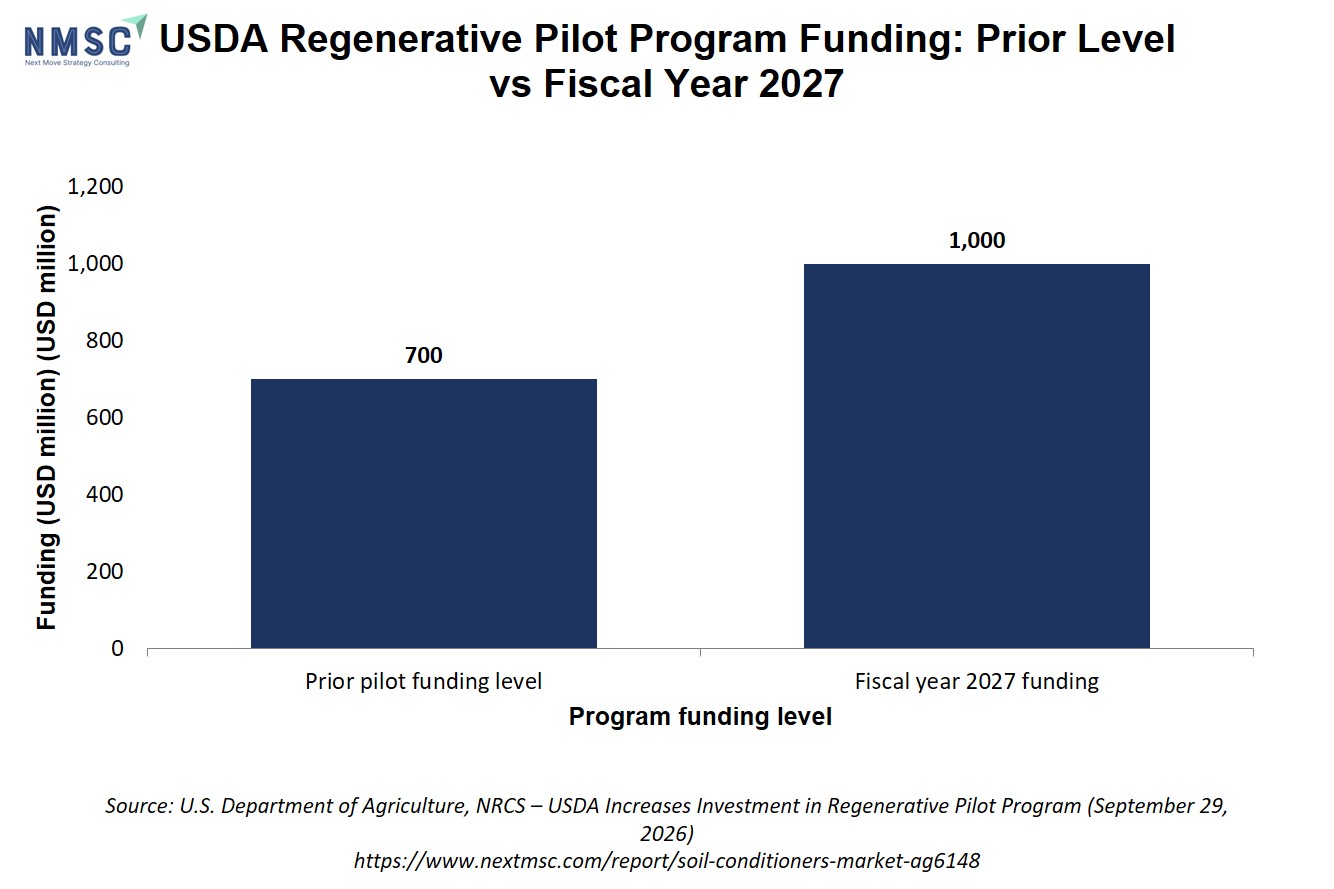
The chart shows announced program allocations, not disbursed payments, and both figures come from the same NRCS release.
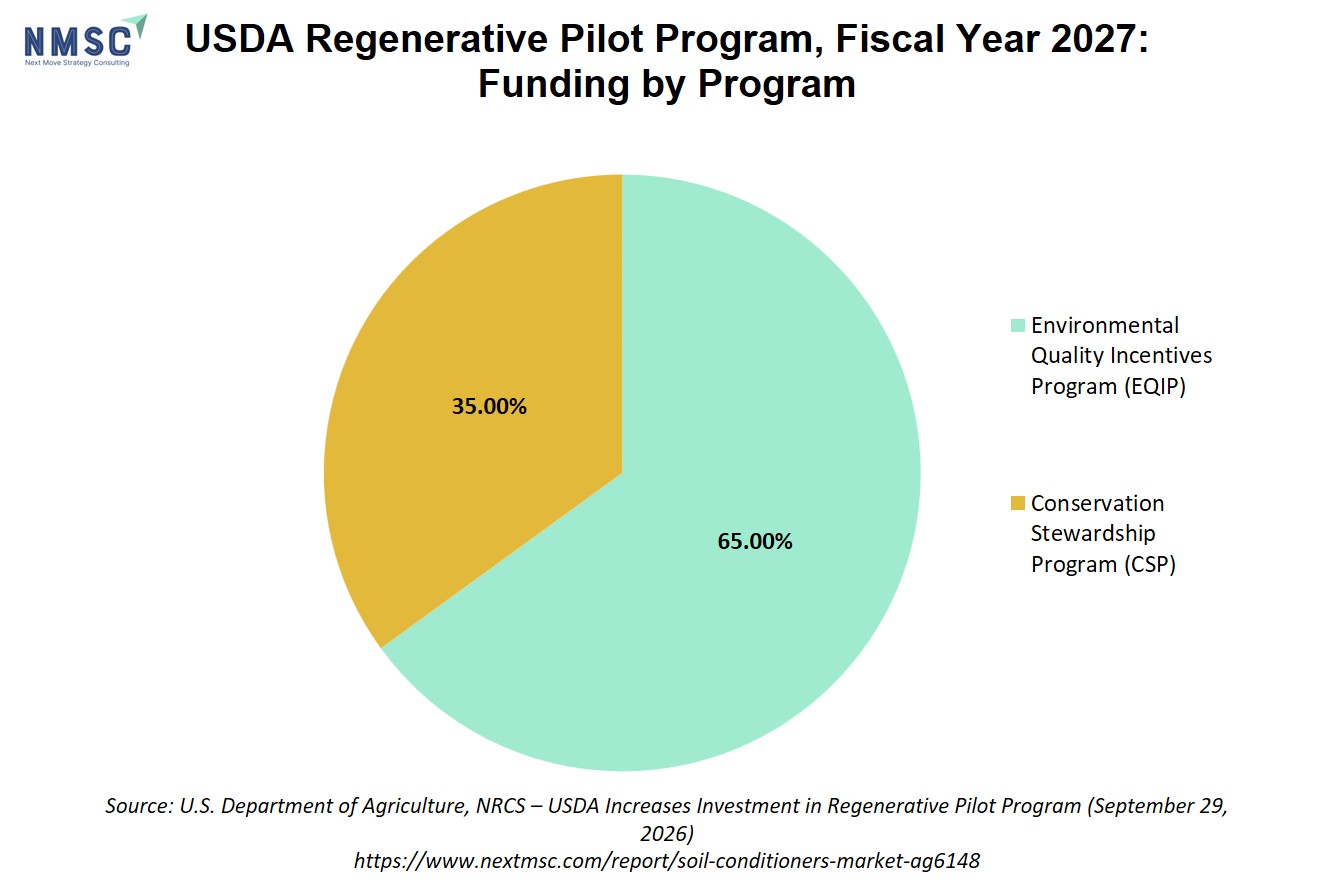
Of the USD 1 billion fiscal year 2027 allocation, USD 650 million (65.0%) flows through the Environmental Quality Incentives Program and USD 350 million (35.0%) through the Conservation Stewardship Program. The shares are calculated from the two dollar amounts stated in the NRCS release.
A second USDA announcement followed on October 27, 2026, when NRCS committed more than USD 325 million to 42 Regional Conservation Partnership Program projects. Fertilizer Daily reported the same day that NRCS ranked proposals by their potential to improve soil health, water quality and wildlife habitat.
In Europe the signal is legislative. The European Parliament adopted the Soil Monitoring Law in October 2025, setting an objective of healthy European soils by 2050 and obliging member states to monitor soil health and support landowners in improving it. On February 3, 2026, the European Commission adopted the first certification methodologies under its Carbon Removals and Carbon Farming Regulation, covering biochar carbon removal alongside direct air capture and biogenic emission capture with storage, and stated that biochar projects could begin applying for EU certification. NextMSC primary research and analysis assigns +1.8% of CAGR impact to EU fertilizer-reduction and soil-health mandates in Europe over 2026 to 2032, and +0.7% to carbon-credit recognition of biochar and humic acid products globally over 2027 to 2035.
Key Industry Developments: Biochar, Liquid Formats and Carbon Evidence
On September 9, 2026, BASF Agricultural Solutions and the International Rice Research Institute (IRRI) extended their OPTIMA Rice collaboration into a second phase centred on soil health, the role of soil carbon and nitrogen, and biochar. Launched in 2024 with field trials in the Philippines, the first phase found that alternate wetting and drying, enabled by direct-seeded rice, can significantly reduce methane emissions and water use without compromising yields, according to the partners. Global Agriculture reported on October 6, 2026 that the second phase is set to run for two years from the 2026 wet season and will examine how straw and biochar interact with water management to influence productivity and carbon accumulation.
“Climate-smart rice systems must work on the farm, not just on paper.”
- Marko Grozdanovic, Senior Vice President, Global Strategic Marketing & Sustainability, BASF Agricultural Solutions, BASF news release P-26-160, September 9, 2026.
Product development is adapting to existing farm infrastructure. ICL's June 30, 2025 launch of BIOZ Jet, a liquid biochar extract developed with EVOIA and designed for in-furrow and fertigation use, shows suppliers packaging biochar to fit equipment that growers already operate. NextMSC primary research and analysis lists the launch among recent developments and identifies the liquid form as the fastest-growing at an 11.03% CAGR from 2026 to 2035, against a granular form that remains the largest at USD 4.12 billion in 2025.
Policy and Industry Signals Shaping Soil Conditioner Demand
|
Date |
Institution |
Action |
Scale |
|
February 3, 2026 |
European Commission |
First certification methodologies under the Carbon Removals and Carbon Farming Regulation, including biochar carbon removal |
Biochar projects eligible to apply for EU certification |
|
August 27, 2026 |
FAO |
Status of the World's Soil Resources 2026 presented at UNCCD COP17 |
75 countries' expertise; 58% of assessments report deterioration since 2015 |
|
September 9, 2026 |
BASF Agricultural Solutions and IRRI |
OPTIMA Rice extended into a second phase covering soil carbon, nitrogen and biochar |
Two-year second phase (Global Agriculture, October 6, 2026) |
|
September 29, 2026 |
USDA NRCS |
Regenerative Pilot Program funding raised for fiscal year 2027 |
USD 1 billion: USD 650 million EQIP and USD 350 million CSP |
|
October 27, 2026 |
USDA NRCS |
Regional Conservation Partnership Program project investment announced |
More than USD 325 million across 42 projects |
Segment Dynamics: Organic Leads, Synthetic Polymers Grow Fastest
According to NextMSC primary research and analysis, Organic Soil Conditioners are the largest type segment at USD 4.28 billion in 2025, about 52% of market revenue, and are projected to reach USD 11.44 billion by 2035 at a 10.33% CAGR. The segment spans compost, humic and fulvic acid products, biochar, peat-based conditioners and seaweed extracts, and its growth tracks the sustainable-agriculture mandates and carbon-sequestration objectives described above. Synthetic Polymer Conditioners are the fastest-growing type at an 11.82% CAGR, rising from USD 1.82 billion in 2025 to USD 5.00 billion by 2035, as polyacrylamide and superabsorbent polymer products gain adoption in water-stressed irrigated agriculture across the Middle East, Australia and the western United States. Inorganic Soil Conditioners, including gypsum, lime, zeolite and bentonite, grow from USD 2.14 billion to USD 5.34 billion at 9.57%.
Soil Conditioners Market by Type
|
Type |
2025 (USD Bn) |
2035 (USD Bn) |
CAGR (2026-2035) |
|
Organic Soil Conditioners |
4.28 |
11.44 |
10.33% |
|
Inorganic Soil Conditioners |
2.14 |
5.34 |
9.57% |
|
Synthetic Polymer Conditioners |
1.82 |
5.00 |
11.82% |
|
Total |
8.24 |
21.78 |
9.54% |
By application, NextMSC primary research and analysis shows Agricultural use leading at USD 5.43 billion in 2025, while Landscaping and Turf is the fastest-growing application at a 10.74% CAGR, supported by urban green-infrastructure programs and sports-turf specifications in Asia-Pacific and Middle East cities. By channel, Distributors lead at USD 3.54 billion in 2025, reflecting the agronomist-recommended purchasing route for bulk field crops, while Retail is the fastest-growing channel at 10.88%, as e-commerce and garden-centre sales reach small-scale growers.
Soil Conditioners Market by Application and Distribution Channel
|
Segment |
2025 (USD Bn) |
2035 (USD Bn) |
CAGR (2026-2035) |
|
Application: Agricultural |
5.43 |
14.51 |
10.30% |
|
Application: Horticultural |
1.73 |
4.44 |
9.89% |
|
Application: Landscaping and Turf |
1.08 |
2.83 |
10.74% |
|
Channel: Direct Sales |
2.80 |
7.26 |
9.98% |
|
Channel: Distributors |
3.54 |
9.37 |
10.22% |
|
Channel: Retail |
1.90 |
5.15 |
10.88% |
Regional Outlook
Asia-Pacific is the largest regional market at USD 3.05 billion in 2025, roughly 37% of global revenue, and is projected to reach USD 8.47 billion by 2035 at an 11.03% CAGR. According to NextMSC primary research and analysis, China's market was valued at USD 1.37 billion in 2025 and is projected to reach USD 4.03 billion by 2035 at 11.37%, supported by national soil organic matter restoration targets, while India grows from USD 0.76 billion to USD 2.34 billion at 11.88%, the fastest rate among the countries profiled.
Latin America is the fastest-growing region at an 11.59% CAGR, rising from USD 0.66 billion in 2025 to USD 1.99 billion by 2035, led by Brazil, which expands from USD 0.40 billion to USD 1.22 billion at 11.77% on acidic-soil lime and gypsum conditioning in soybean, corn and sugarcane zones. North America grows from USD 1.73 billion to USD 4.36 billion at 9.67%, with the U.S. at USD 1.40 billion in 2025 and a 9.76% CAGR. Europe moves from USD 1.98 billion to USD 4.88 billion at 9.44%, with Germany at USD 0.45 billion in 2025, and Middle East & Africa from USD 0.82 billion to USD 2.08 billion at 9.74%.
Soil Conditioners Market by Region
|
Region |
2025 (USD Bn) |
2035 (USD Bn) |
CAGR (2026-2035) |
|
North America |
1.73 |
4.36 |
9.67% |
|
Asia-Pacific |
3.05 |
8.47 |
11.03% |
|
Europe |
1.98 |
4.88 |
9.44% |
|
Middle East & Africa |
0.82 |
2.08 |
9.74% |
|
Latin America |
0.66 |
1.99 |
11.59% |
Growth Drivers and Restraints
Soil Conditioners Market — Growth Catalyst & Risk Assessment Matrix
|
Factor |
Type |
Impact on CAGR |
Geography |
Timeline |
|
Accelerating soil degradation and declining soil organic matter driving remediation investment |
Driver |
+2.3% |
Global |
2026–2035 |
|
EU Farm to Fork and Soil Strategy 2030 mandating fertilizer reduction and soil health improvement |
Driver |
+1.8% |
Europe |
2026–2032 |
|
USDA conservation programs providing financial incentives for soil conditioner adoption |
Driver |
+1.2% |
North America |
2026–2035 |
|
Rising adoption of precision agriculture enabling targeted and efficacious soil conditioner application |
Driver |
+1.0% |
Asia-Pacific, North America, Europe |
2026–2035 |
|
Growing carbon credit market recognizing biochar and humic acid soil conditioners as removal assets |
Driver |
+0.7% |
Global |
2027–2035 |
|
High per-hectare cost of premium organic and biochar conditioners limiting smallholder adoption |
Restraint |
−0.8% |
Asia-Pacific, MEA, Latin America |
2026–2032 |
|
Lack of standardized soil conditioner product quality and efficacy certification frameworks |
Restraint |
−0.5% |
Global |
2026–2030 |
|
Availability of subsidised synthetic fertilizers crowding out organic soil amendment investment |
Restraint |
−0.4% |
Asia-Pacific, Latin America |
2026–2031 |
|
Limited agronomist awareness and extension service capacity to advise on soil conditioner selection |
Restraint |
−0.2% |
MEA, Latin America |
2026–2030 |
NMSC Strategic Perspective: From Optional Input to Funded Infrastructure
NextMSC primary research and analysis reads the FAO assessment, the USDA funding expansion and the EU soil and carbon-removal measures as one sequence: evidence of degradation, then public payment for remediation, then procurement of certified products. That sequence is what separates the current demand base from the early phase of the category, when purchases rested on opportunistic product trials. Soil degradation carries the largest single CAGR contribution in the NMSC risk matrix at +2.3% globally through 2035, and the policy drivers that follow it, EU mandates at +1.8% and U.S. conservation programs at +1.2%, are tied to legislated or appropriated funding rather than to commodity-price cycles.
The principal restraint is cost. NextMSC primary research and analysis estimates biochar application costs of USD 150 to USD 400 per tonne of carbon applied, roughly 5 to 10 times the per-hectare cost of conventional lime and gypsum conditioning, which makes smallholder adoption in Asia-Pacific, Middle East & Africa and Latin America dependent on crop price premiums or direct carbon payments. The matrix assigns this restraint a −0.8% CAGR impact through 2032. The EU carbon-removal certification pathway for biochar and the carbon-credit recognition of biochar and humic acid products are the mechanisms most likely to narrow that gap, because they add a second revenue line to the farmer's return calculation.
NextMSC primary research and analysis calculates an absolute growth opportunity of USD 12.18 billion between 2026 and 2035, the difference between the USD 21.78 billion forecast and the USD 9.60 billion 2026 estimate. It identifies three whitespace pathways: biochar products with verifiable carbon-permanence documentation; synthetic polymer conditioners that NextMSC estimates can reduce crop irrigation water requirements by 20% to 40% per growing season in water-constrained regions; and integration of product data with precision-agriculture platforms to generate variable-rate application prescriptions. For vendors, NextMSC's recommendation is to build documented field-trial evidence, which its research links to premium pricing of 30% to 80% above commodity amendments, and to prepare product dossiers that comply with EU Regulation 2019/1009 on fertilising products, which is emerging as an entry barrier in European procurement.
Competitive Landscape
According to NextMSC primary research and analysis, the soil conditioners market is moderately fragmented: the ten largest companies hold roughly 35% to 45% of global share and no single company exceeds 12%. Multinational crop-nutrition groups including Compo, ICL Group and Evonik Industries compete through integrated conditioner and plant-nutrition portfolios and technical agronomy networks aligned with EU regulatory frameworks, while humic-substance specialists including HUMINTECH, Humus Up and ILSA compete on trial evidence and direct agronomist relationships. NMSC's report profiles 20 companies, including BASF, whose OPTIMA Rice extension with IRRI (September 9, 2026) and ICL, whose BIOZ Jet launch (June 30, 2025) are both documented in company releases cited above.
NextMSC primary research and analysis identifies three innovation tracks across the competitive set: biologically active compound formulations that combine several soil-function mechanisms in one product, fertigation-compatible liquid formats that use existing irrigation infrastructure, and carbon-credit documentation that lets farmers offset part of a premium product's cost. Its analysis also records strategic acquisitions of specialist biochar producers and humic acid extractors by larger agribusiness and specialty nutrition groups, alongside partnerships between conditioner makers and precision-agriculture platform providers.
Bottom Line
FAO's August 27, 2026 finding that 58% of reviewed assessments show a worsening soil trend since 2015, together with USDA's expansion of its Regenerative Pilot Program to USD 1 billion for fiscal year 2027 and the European Commission's certification pathway for biochar carbon removal, moves soil conditioners from a discretionary farm input toward a policy-supported one. According to NextMSC primary research and analysis, the global soil conditioners market will grow from USD 8.24 billion in 2025 to USD 21.78 billion by 2035 at a 9.54% CAGR, with organic conditioners holding about 52% of 2025 revenue and synthetic polymers expanding fastest at 11.82%. Asia-Pacific is the largest region at USD 3.05 billion, while Latin America grows fastest at 11.59%. The largest restraint remains the high per-hectare cost of premium organic and biochar products for smallholders. Suppliers that pair documented field-trial evidence, fertigation-ready liquid formats and verifiable carbon documentation are best placed to capture the USD 12.18 billion absolute growth opportunity between 2026 and 2035.
About Next Move Strategy Consulting
Next Move Strategy Consulting is a premier market research and management consulting firm that has been committed to provide strategically analysed well documented latest research reports to its clients. The research industry is flooded with many firms to choose from, what makes NMSC different from the rest is its top-quality research and the obsession of turning data into knowledge by dissecting every bit of it and providing fact-based research recommendation that is supported by information collected from over 500 million websites, paid databases, industry journals and one on one consultations with industry experts across a diverse range of industry sectors. The high-quality customized research reports with actionable insights and excellent end-to-end customer service help our clients to take critical business decisions that enables them to move beyond time and have competitive edge in the industry.
We have been servicing over 1000 customers globally that includes 90% of the Fortune 500 companies over a decade. Our analysts are constantly tracking various high growth markets and identifying hidden opportunities in each sector or the industry. We provide one of the industry’s best quality syndicate as well as custom research reports across 10 different industry verticals. We are committed to deliver high quality research solutions in accordance to your business needs. Our industry standard delivery solutions that ranges from the pre consultation to after-sales services, provide an excellent client experience and ensure right strategic decision making for businesses.
For more information, please contact:
Next Move Strategy Consulting
5th Floor 867 Boylston St, STE 500,
Boston, MA 02116, U.S.
E-Mail: [email protected]
Direct: +1-217-650-7991
Website: www.nextmsc.com
About the Author
 Sanyukta Deb
— Sanyukta Deb is Digital Marketing Team Lead at Next Move Strategy Consulting, where she has led content strategy and technical SEO for the firm's B2B market research publications for over 2 years. Her editorial process translates NextMSC's primary and secondary research — spanning technology, industrial, and consumer sectors — into commercial narratives, backed by search-intent, keyword, and competitive analysis. She brings 5 years of overall experience in digital marketing and content strategy.
About the Reviewer
 Debashree Dey
— Debashree Dey is Assistant Manager at Next Move Strategy Consulting, where she supports cross-vertical market content and communications across diverse industries for 6 years. Her professional background includes senior content writing, communications, and published manuscript authorship, with experience developing audience-focused business narratives and maintaining clear, consistent messaging. Her role supports research-led content development and editorial quality across NextMSC publications.














Add Comment