Soil Conditioners Market Global Industry Analysis and Forecast (2026-2035)

Soil Conditioners Market size is estimated at USD 9.60 billion in 2026, projected to reach USD 21.78 billion by 2035, growing at a CAGR of 9.54% from 2026 to 2035. Key drivers include accelerating soil degradation, rising sustainable agriculture initiatives, and increasing precision agriculture adoption, with Asia-Pacific leading the market and Latin America registering the fastest growth.
Download Free Sample PDF
Base Year (2025)
$8.24 Billion
Forecast (2035)
$21.78 Billion
CAGR (2026-2035)
9.5%
Top Region
Asia-Pacific

What Is the Soil Conditioners Market Size?
The global Soil Conditioners Market size reached USD 8.24 Billion in 2025 and is estimated at USD 9.60 Billion in 2026, forecast to reach USD 21.78 Billion by 2035 at a CAGR of 9.54% between 2026 and 2035. Asia-Pacific leads with approximately 37% regional revenue share in 2025, while Organic Soil Conditioners dominate the type axis at approximately 52% share.
Soil Conditioners Market Global Industry Analysis and Forecast (2026-2035) Revenue Forecast
Values in USD Billion

2025 $8.24 Billion
2025
2026 $9.60 Billion
2026
2027 $10.52 Billion
2027
2028 $11.52 Billion
2028
2029 $12.62 Billion
2029
2030 $13.82 Billion
2030
2031 $15.14 Billion
2031
2032 $16.58 Billion
2032
2033 $18.17 Billion
2033
2034 $19.90 Billion
2034
2035 $21.78 Billion
2035

Key Takeaways

By Type: Organic Soil Conditioners held the largest share, expanding from USD 4.28 Billion in 2025 to USD 11.44 Billion by 2035; Synthetic Polymer Conditioners is the fastest-growing sub-segment at 11.82% CAGR from 2026–2035.

By Form: Granular held the largest share, expanding from USD 4.12 Billion in 2025 to USD 10.67 Billion by 2035; Liquid is the fastest-growing form at 11.03% CAGR from 2026–2035.

By Application: Agricultural held the largest share, expanding from USD 5.43 Billion in 2025 to USD 14.51 Billion by 2035; Landscaping and Turf is the fastest-growing application at 10.74% CAGR from 2026–2035.

By Crop Type: Fruits and Vegetables held the largest share, expanding from USD 2.55 Billion in 2025 to USD 6.76 Billion by 2035; Oilseeds and Pulses is the fastest-growing crop type at 10.32% CAGR from 2026–2035.

By Distribution Channel: Distributors held the largest share, expanding from USD 3.54 Billion in 2025 to USD 9.37 Billion by 2035; Retail is the fastest-growing channel at 10.88% CAGR from 2026–2035.

Dominant Region: Asia-Pacific dominated with approximately 37% revenue share in 2025.

Fastest-Growing Region: Asia-Pacific is also expected to register the highest CAGR of 11.03% during 2026–2035.

Dominant Country: China led the market, anchored by its large arable land base and government-backed soil restoration investment programs.

Fastest-Growing Country: India is the fastest-growing country, driven by rising adoption of sustainable farming practices and government subsidy programs for soil health improvement.

Market Opportunity: The Soil Conditioners Market presents an absolute investment opportunity of approximately USD 12.18 Billion between 2026 and 2035, calculated as the difference between the 2035 forecast of USD 21.78 Billion and the 2026 estimate of USD 9.60 Billion, positioning soil amendment manufacturers and precision agriculture solution providers for sustained long-horizon revenue compounding across agricultural, horticultural, and landscaping end markets.
According to Next Move Strategy Consulting analysis, the convergence of accelerating soil degradation across the world's prime agricultural zones with rising regulatory mandates for chemical input reduction is creating a structural and non-cyclical demand base for biologically active and mineralogical soil conditioner solutions that extends well beyond the opportunistic product trial purchasing patterns that characterised the category's early growth phase.

What Does the Soil Conditioners Market Encompass?

The Soil Conditioners Market covers products applied to soil to improve its physical, chemical, and biological properties for agricultural, horticultural, and landscape use, spanning organic conditioners including compost, humic acid, biochar, peat, and seaweed extracts; inorganic conditioners including gypsum, lime, zeolite, and bentonite; and synthetic polymer conditioners including polyacrylamide and superabsorbent polymer systems. The scope encompasses products sold in liquid, granular, and powder forms through direct sales, distributor networks, and retail channels to crop farmers, greenhouse operators, landscape contractors, and turf managers globally, capturing revenue at the point of first commercial sale.

The Soil Conditioners Market has evolved from a commodity lime and gypsum amendment category into a multi-technology segment driven by biologically active formulations, precision application systems, and regulatory compliance requirements that reward documented soil health improvement. The European Union's Farm to Fork Strategy mandates a 20% reduction in fertilizer use by 2030 and actively incentivises soil organic matter improvement, while the U.S. Department of Agriculture's Conservation Reserve Program and Soil Health Initiative provide direct financial incentives for soil conditioner adoption across commodity crop farming operations. Technology adoption is advancing through liquid humic acid injection systems integrated with precision irrigation networks and drone-applied granular biochar programmes.

Market Drivers & Dynamics

Interactive Dataset
Accelerating soil degradation and declining soil organic matter driving remediation investment driver +2.3% Global 2026–2035
EU Farm to Fork and Soil Strategy 2030 mandating fertilizer reduction and soil health improvement driver +1.8% Europe 2026–2032
USDA Conservation programs providing financial incentives for soil conditioner adoption driver +1.2% North America 2026–2035
Rising adoption of precision agriculture enabling targeted and efficacious soil conditioner application driver +1.0% Asia-Pacific, North America, Europe 2026–2035
Growing carbon credit market recognizing biochar and humic acid soil conditioners as removal assets driver +0.7% Global 2027–2035
High per-hectare cost of premium organic and biochar conditioners limiting smallholder adoption restraint −0.8% Asia-Pacific, MEA, Latin America 2026–2032
Lack of standardized soil conditioner product quality and efficacy certification frameworks restraint −0.5% Global 2026–2030
Availability of subsidised synthetic fertilizers crowding out organic soil amendment investment restraint −0.4% Asia-Pacific, Latin America 2026–2031
Limited agronomist awareness and extension service capacity to advise on soil conditioner selection restraint −0.2% MEA, Latin America 2026–2030
Source: Next Move Strategy Consulting

Growth Drivers

What Is the Primary Growth Driver in the Soil Conditioners Market?

Accelerating soil degradation across the world's major agricultural zones is the primary growth driver for the Soil Conditioners Market, contributing an estimated +2.3% incremental CAGR impact through 2035. The FAO's official State of the World's Land and Water Resources report documents that approximately 33% of global soils are moderately to highly degraded, directly expanding the population of farming operations facing measurable yield limitation from soil organic matter loss, compaction, and pH imbalance that soil conditioner application can address. Degradation severity is highest in Asia-Pacific and Sub-Saharan Africa, which are simultaneously the fastest-growing soil conditioner demand regions.

How Is EU Regulatory Policy Driving the Soil Conditioners Market Growth?

Our analysis shows that the European Union's Farm to Fork Strategy and EU Soil Strategy 2030 are creating legally mandated and subsidy-incentivised demand for soil conditioners at a scale that converts soil amendment from discretionary agronomy investment into regulatory compliance expenditure for EU member state farming operations. The EU Regulation 2019/1009 on EU Fertilising Products, published by the European Commission, includes soil conditioners as a defined product category with mandatory quality and safety criteria, providing a legal framework that enables specification and procurement of certified soil conditioners through public and private farm advisory programs funded under the Common Agricultural Policy.

Growth Inhibitors

What Is Restraining the Soil Conditioners Market?

The high per-hectare application cost of premium organic soil conditioners including biochar and concentrated humic acid products represents the most significant structural restraint on mass-market adoption in smallholder-dominated farming systems across Asia-Pacific, Sub-Saharan Africa, and Latin America, where farm gate prices and working capital availability severely constrain agrochemical and soil amendment expenditure per hectare. Industry derived estimates indicate that biochar application costs of USD 150–400 per tonne of carbon applied are approximately 5–10 times the per-hectare cost of conventional lime and gypsum conditioning, making the economic return case for smallholder adoption dependent on premium crop price premiums or direct carbon payment supplementation.

What Are the Growth Opportunities?

Can Biochar-Based Carbon Credit Integration Unlock a Premium Pricing Model for Soil Conditioner Manufacturers?

Soil conditioner manufacturers that develop biochar products with verifiable carbon permanence documentation aligned with Verra Verified Carbon Standard or Gold Standard methodologies can offer farmer customers a dual-benefit purchase: documented soil performance improvement plus carbon credit generation revenue that partially or fully offsets the biochar application cost. This opportunity primarily benefits the Organic Soil Conditioners type segment and the Agricultural application segment, where field-scale biochar application at commercially viable carbon removal volumes generates carbon credit revenue streams that fundamentally change the return-on-investment calculation for smallholder and mid-scale farmer adoption.

Does the Water-Stressed Irrigated Agriculture Segment Offer a Differentiated Market for Synthetic Polymer Conditioners?

Polyacrylamide and superabsorbent polymer soil conditioners that reduce crop irrigation water requirement by 20–40% per growing season represent a high-value proposition in water constrained irrigated agriculture across the Middle East, Australia, India, and western North America, where water scarcity is directly constraining agricultural productivity. This opportunity benefits the Synthetic Polymer Conditioners type segment and the Direct Sales channel, where water utility linked agronomy advisory programs are creating direct farmer-to-manufacturer procurement relationships driven by documented irrigation efficiency outcomes rather than competitive agrochemical price negotiation.

How Can Precision Agriculture Platform Integration Accelerate Variable-Rate Soil Conditioner Market Penetration?

Soil conditioner manufacturers that integrate product data packages application rate tables, soil response coefficients, carbon credit documentation with leading precision agriculture field management platforms can enable automated variable-rate soil conditioner prescription generation that removes the agronomist knowledge barrier currently limiting adoption beyond early-adopter farming operations. This opportunity benefits the Liquid form segment and the Horticultural and Agricultural application segments, where precision application through fertigation and variable-rate spreader systems is already infrastructure-ready across high-value crop production operations in North America, Europe, and Australia.

Segmentation Analysis

2025 (USD Billion)
2035 (USD Billion)
Organic Soil Conditioners 2025: $4.28 Billion | 2035: $11.44 Billion
Organic Soil
Inorganic Soil Conditioners 2025: $2.14 Billion | 2035: $5.34 Billion
Inorganic So
Synthetic Polymer Conditioners 2025: $1.82 Billion | 2035: $5.00 Billion
Synthetic Po
Organic Soil Conditioners $4.28 Billion $11.44 Billion 10.33%
Inorganic Soil Conditioners $2.14 Billion $5.34 Billion 9.57%
Synthetic Polymer Conditioners $1.82 Billion $5.00 Billion 11.82%

Which Type Segment Dominates the Soil Conditioners Market?

Organic Soil Conditioners dominate at USD 4.28 Billion in 2025, expanding to USD 11.44 Billion by 2035, reflecting their alignment with sustainable agriculture mandates, carbon sequestration objectives, and certified organic food production requirements that are growing fastest across both premium consumer markets and regulated farming systems. Synthetic Polymer Conditioners is the fastest-growing type at 11.82% CAGR, driven by polyacrylamide and superabsorbent polymer adoption in water-stressed irrigated agriculture across the Middle East, Australia, and western U.S., where water retention enhancement per dollar invested is the primary procurement criterion for soil amendment selection.

2025 (USD Billion)
2035 (USD Billion)
Liquid
Soluble Conc
Ready-to-Use
Granular
Standard Gra
Segment Item 2025 (USD Billion) 2035 (USD Billion) CAGR
Liquid $10.0 USD Billion $40.0 USD Billion 25.0%
Soluble Concentrate $17.1 USD Billion $51.1 USD Billion 11.0%
Ready-to-Use Liquid $24.2 USD Billion $62.2 USD Billion 25.0%
Granular $31.3 USD Billion $73.3 USD Billion 11.0%
Standard Granules $38.4 USD Billion $84.4 USD Billion 16.0%

Segment-wise data is locked

Unlock complete segment-wise numbers for By Form.

Unlock Full Data
2025 (USD Billion)
2035 (USD Billion)
Agricultural
Dryland Farm
Irrigated Fa
Horticultura
Greenhouse a
Segment Item 2025 (USD Billion) 2035 (USD Billion) CAGR
Agricultural $10.0 USD Billion $40.0 USD Billion 27.0%
Dryland Farming $17.1 USD Billion $51.1 USD Billion 9.0%
Irrigated Farming $24.2 USD Billion $62.2 USD Billion 19.0%
Horticultural $31.3 USD Billion $73.3 USD Billion 17.0%
Greenhouse and Protected Cultivation $38.4 USD Billion $84.4 USD Billion 18.0%

Segment-wise data is locked

Unlock complete segment-wise numbers for By Application.

Unlock Full Data

Which Application Segment Leads and Which Grows Fastest?

Agricultural applications lead at USD 5.43 Billion in 2025, anchored by field crop, fruit, and vegetable farming operations that represent the largest installed base of soil conditioner procurement across all five regional markets. Landscaping and Turf is the fastest-growing application segment at 10.74% CAGR, driven by expanding urban green infrastructure investment programs, golf course soil management quality standards, and sports turf management specifications in rapidly urbanising Asia-Pacific and Middle East markets where municipal landscaping budgets are growing significantly ahead of traditional agricultural market expenditure growth rates.

2025 (USD Billion)
2035 (USD Billion)
Cereals and
Wheat
Rice
Maize
Fruits and V
Segment Item 2025 (USD Billion) 2035 (USD Billion) CAGR
Cereals and Grains $10.0 USD Billion $40.0 USD Billion 14.0%
Wheat $17.1 USD Billion $51.1 USD Billion 24.0%
Rice $24.2 USD Billion $62.2 USD Billion 22.0%
Maize $31.3 USD Billion $73.3 USD Billion 12.0%
Fruits and Vegetables $38.4 USD Billion $84.4 USD Billion 27.0%

Segment-wise data is locked

Unlock complete segment-wise numbers for By Crop Type.

Unlock Full Data
2025 (USD Billion)
2035 (USD Billion)
Direct Sales
Manufacturer
Contract and
Distributors
Agricultural
Segment Item 2025 (USD Billion) 2035 (USD Billion) CAGR
Direct Sales $10.0 USD Billion $40.0 USD Billion 24.0%
Manufacturer-to-Farmer Direct $17.1 USD Billion $51.1 USD Billion 22.0%
Contract and Tender Supply $24.2 USD Billion $62.2 USD Billion 20.0%
Distributors $31.3 USD Billion $73.3 USD Billion 22.0%
Agricultural Input Wholesalers $38.4 USD Billion $84.4 USD Billion 13.0%

Segment-wise data is locked

Unlock complete segment-wise numbers for By Distribution Channel.

Unlock Full Data

Which Distribution Channel Dominates and Which Grows Fastest?

Distributors lead at USD 3.54 Billion in 2025, reflecting the established role of agricultural input distributor networks as the primary route-to-market for soil conditioner products across bulk field crop farming operations in North America, Europe, and Asia-Pacific, where agronomist-recommended product selection through regional distributor relationships remains the dominant procurement pattern. Retail is the fastest-growing distribution channel at 10.88% CAGR, driven by growing e-commerce and garden centre retail demand for consumer and small-scale horticultural soil conditioner products from urban and peri-urban growers across developed economies seeking sustainable soil management inputs for home food production and garden improvement.

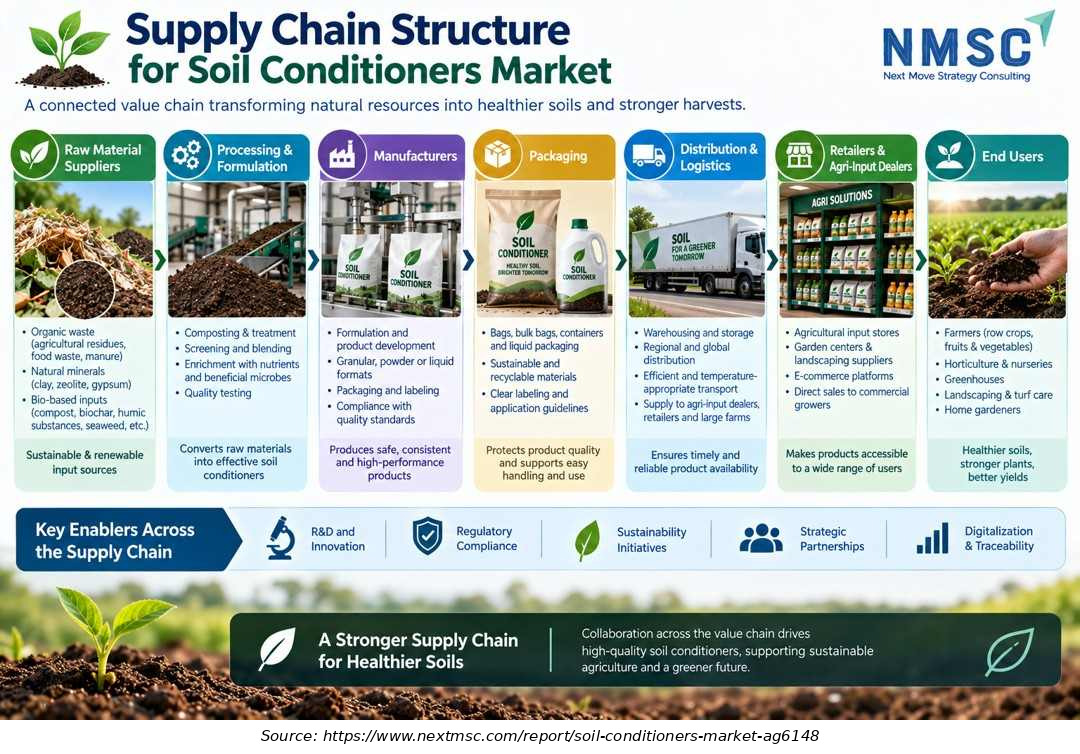
Supply Chain Structure for the Soil Conditioners Market

Supply Chain Structure for the Soil Conditioners Market

The infographic illustrates the supply chain structure of the Soil Conditioners Market, covering raw material suppliers, processing and formulation, manufacturers, packaging, distribution and logistics, retailers, and end users. It highlights key inputs such as organic waste and natural minerals, alongside sustainability, regulatory compliance, R&D, strategic partnerships, and digital traceability. The connected value chain supports efficient product delivery, healthier soils, improved plant growth, and sustainable agricultural practices.
Which Type Segment Dominates the Soil Conditioners Market?
Organic Soil Conditioners dominate at USD 4.28 Billion in 2025, expanding to USD 11.44 Billion by 2035, reflecting their alignment with sustainable agriculture mandates, carbon sequestration objectives, and certified organic food production requirements that are growing fastest across both premium consumer markets and regulated farming systems. Synthetic Polymer Conditioners is the fastest-growing type at 11.82% CAGR, driven by polyacrylamide and superabsorbent polymer adoption in water-stressed irrigated agriculture across the Middle East, Australia, and western U.S., where water retention enhancement per dollar invested is the primary procurement criterion for soil amendment selection.

Segment Sizing: By Application

Segment 2025 (USD Bn) 2035 (USD Bn) CAGR% (2026–2035)
Agricultural 5.43 14.51 10.30%
Horticultural 1.73 4.44 9.89%
Landscaping and Turf 1.08 2.83 10.74%
Total 8.24 21.78 9.54%
Source: www.nextmsc.com

Which Application Segment Leads and Which Grows Fastest?

Agricultural applications lead at USD 5.43 Billion in 2025, anchored by field crop, fruit, and vegetable farming operations that represent the largest installed base of soil conditioner procurement across all five regional markets. Landscaping and Turf is the fastest-growing application segment at 10.74% CAGR, driven by expanding urban green infrastructure investment programs, golf course soil management quality standards, and sports turf management specifications in rapidly urbanising Asia-Pacific and Middle East markets where municipal landscaping budgets are growing significantly ahead of traditional agricultural market expenditure growth rates.

Segment Sizing: By Distribution Channel

Segment 2025 (USD Bn) 2035 (USD Bn) CAGR% (2026–2035)
Direct Sales 2.80 7.26 9.98%
Distributors 3.54 9.37 10.22%
Retail 1.90 5.15 10.88%
Total 8.24 21.78 9.54%
Source: www.nextmsc.com

Which Distribution Channel Dominates and Which Grows Fastest?

Distributors lead at USD 3.54 Billion in 2025, reflecting the established role of agricultural input distributor networks as the primary route-to-market for soil conditioner products across bulk field crop farming operations in North America, Europe, and Asia-Pacific, where agronomist-recommended product selection through regional distributor relationships remains the dominant procurement pattern. Retail is the fastest-growing distribution channel at 10.88% CAGR, driven by growing e-commerce and garden centre retail demand for consumer and small-scale horticultural soil conditioner products from urban and peri-urban growers across developed economies seeking sustainable soil management inputs for home food production and garden improvement.

Growth Opportunities

Next Move Strategy Consulting's analysis identifies three distinct whitespace opportunities that represent the highest-conviction growth pathways for Soil Conditioners Market participants with the right product, channel, and application positioning through 2035.

Can Biochar-Based Carbon Credit Integration Unlock a Premium Pricing Model for Soil Conditioner Manufacturers?

Soil conditioner manufacturers that develop biochar products with verifiable carbon permanence documentation aligned with Verra Verified Carbon Standard or Gold Standard methodologies can offer farmer customers a dual-benefit purchase: documented soil performance improvement plus carbon credit generation revenue that partially or fully offsets the biochar application cost. This opportunity primarily benefits the Organic Soil Conditioners type segment and the Agricultural application segment, where field-scale biochar application at commercially viable carbon removal volumes generates carbon credit revenue streams that fundamentally change the return-on-investment calculation for smallholder and mid-scale farmer adoption.

Does the Water-Stressed Irrigated Agriculture Segment Offer a Differentiated Market for Synthetic Polymer Conditioners?

Polyacrylamide and superabsorbent polymer soil conditioners that reduce crop irrigation water requirement by 20–40% per growing season represent a high-value proposition in water constrained irrigated agriculture across the Middle East, Australia, India, and western North America, where water scarcity is directly constraining agricultural productivity. This opportunity benefits the Synthetic Polymer Conditioners type segment and the Direct Sales channel, where water utility linked agronomy advisory programs are creating direct farmer-to-manufacturer procurement relationships driven by documented irrigation efficiency outcomes rather than competitive agrochemical price negotiation.

How Can Precision Agriculture Platform Integration Accelerate Variable-Rate Soil Conditioner Market Penetration?

Soil conditioner manufacturers that integrate product data packages application rate tables, soil response coefficients, carbon credit documentation with leading precision agriculture field management platforms can enable automated variable-rate soil conditioner prescription generation that removes the agronomist knowledge barrier currently limiting adoption beyond early-adopter farming operations. This opportunity benefits the Liquid form segment and the Horticultural and Agricultural application segments, where precision application through fertigation and variable-rate spreader systems is already infrastructure-ready across high-value crop production operations in North America, Europe, and Australia.

Regional Outlook

2025 (USD Billion)
2035 (USD Billion)
North Americ
Asia-Pacific
Europe
Middle East
Latin Americ
Region 2025 (USD Billion) 2035 (USD Billion) CAGR (%)
North America $10.0 USD Billion $40.0 USD Billion 9.0%
Asia-Pacific $17.1 USD Billion $51.1 USD Billion 27.0%
Europe $24.2 USD Billion $62.2 USD Billion 25.0%
Middle East & Africa $31.3 USD Billion $73.3 USD Billion 23.0%
Latin America $38.4 USD Billion $84.4 USD Billion 12.0%

Regional data is locked

Unlock complete regional numbers for this market.

Unlock Full Data

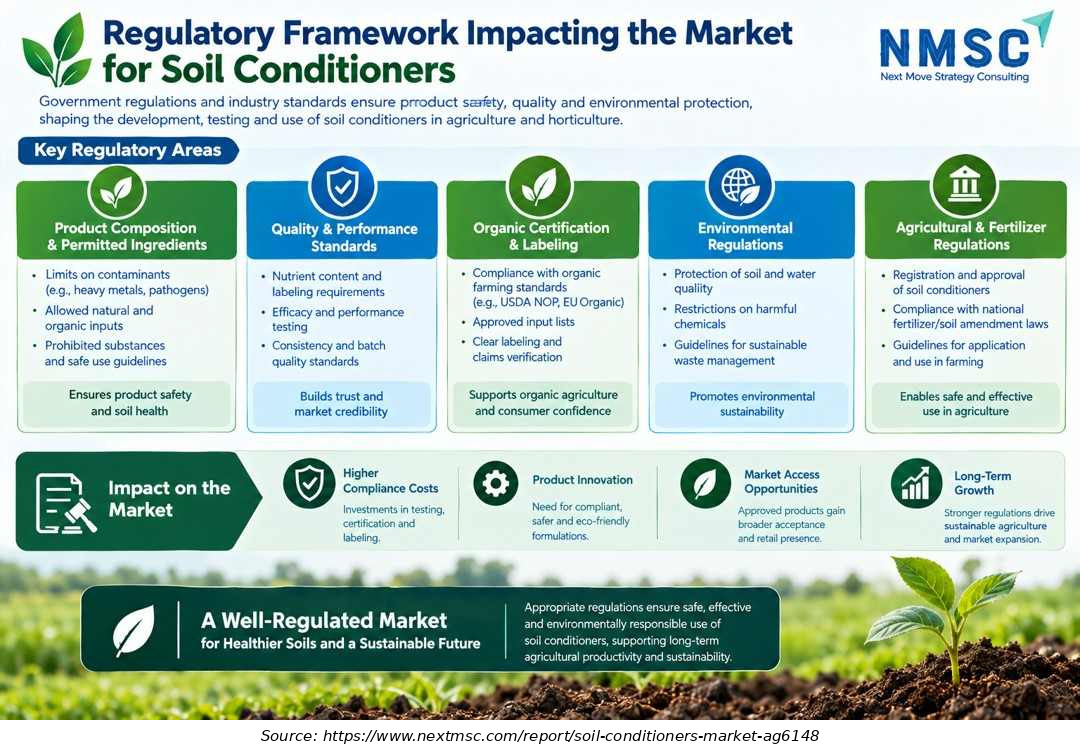
Regulatory Framework Impacting the Soil Conditioner Market

The infographic presents the regulatory framework impacting the Soil Conditioners Market, highlighting product composition, quality and performance standards, organic certification, environmental regulations, and agricultural and fertilizer requirements. It explains how compliance influences product safety, testing, labeling, innovation, market access, and long-term growth. The framework supports responsible use of soil conditioners while promoting soil health, environmental sustainability, and safer agricultural practices.

Competitive Landscape

Dimension Description
Market Structure Moderately fragmented; top 10 companies hold approximately 35–45% combined global market share, with no single company exceeding 12% share, reflecting the diversity of product types, application markets, and regional supply chain structures across organic, inorganic, and synthetic polymer conditioner categories
Innovation Focus Biochar production technology and carbon credit documentation; liquid humic and fulvic acid formulation for fertigation compatibility; synthetic polymer water-retention product development for water-stressed agriculture; biologically active compound conditioner development integrating soil microbiome stimulation with physical amendment functions
M&A Activity Strategic acquisitions of specialist biochar producers and humic acid extractors by larger agribusiness and specialty nutrition groups; partnership agreements between soil conditioner manufacturers and precision agriculture platform providers enabling variable-rate product recommendation integration

How Do Companies Compete in the Soil Conditioners Market?

Companies compete primarily on documented agronomic efficacy evidence, product certification alignment with emerging regulatory frameworks, and technical agronomy service capability that builds farmer loyalty beyond transactional price competition. We observed that companies with the most robust documented field trial databases demonstrating quantifiable soil health improvement and yield response benefits are consistently able to sustain premium pricing 30–80% above commodity soil amendment alternatives, as farmer purchase decisions at premium price points require documented product performance evidence that matches the specificity of their own soil and crop management objectives.

Which Competitive Archetypes Dominate the Soil Conditioners Industry?

Multinational specialty crop nutrition companies including Compo GmbH, ICL Group, and Evonik Industries dominate through integrated soil conditioner and plant nutrition portfolios, global technical agronomy networks, and certified product pipelines that align with EU regulatory frameworks and international organic farming certification standards. Specialist bio stimulant and soil amendment companies including HUMINTECH GmbH, Humus Up, and ILSA Spa compete through technical depth in humic substance chemistry, documented trial evidence networks, and direct agronomist relationship models that command premium farm input positioning across European and North American high-value crop farming operations.

What Innovation and Differentiation Strategies Are Companies Pursuing?

Our findings suggest that leading soil conditioner companies are pursuing three parallel innovation tracks: biologically active compound formulation combining multiple soil function improvement mechanisms in a single product; fertigation compatible liquid format development enabling precision application through existing irrigation infrastructure; and carbon credit documentation capability enabling carbon market revenue integration that improves farmer return on investment from premium soil conditioner application. Differentiation through EU Fertilising Products Regulation compliant product dossier development is emerging as a competitive entry barrier in European markets where regulatory non-compliance disqualifies products from government-incentivised adoption programmes.

Key Market Players

Our assessment indicates that the following companies represent the validated set of leading soil conditioner producers and product brand owners active across the global Soil Conditioners Market as of 2026, ranked by market-specific revenue and product portfolio breadth.
BASF SE Solvay SA Evonik Industries AG ICL Group Ltd. Nufarm Limited Compo GmbH & Co. KG ILSA Spa HUMINTECH GmbH Humus Up (a brand of Agri power France SAS) Valagro SpA (a Syngenta Group company; listed separately as its core business is bio stimulant and soil amendment products) Lallemand Plant Care Inc. Tessenderlo Group NV Biochar Now, LLC Pacific Biochar Benefit Corporation Black Bear Carbon BV Premier Tech Horticulture Sun Gro Horticulture Profile Products LLC Verdesian Life Sciences LLC CARGILL INCORPORATED

Latest Developments

During our market evaluation, we noticed that the most significant recent activity across the Soil Conditioners Market reflects accelerating biochar commercialisation, regulatory-driven organic conditioner certification program launches, and precision agriculture soil amendment integration partnerships through 2025 and 2026.

Date Event
September 2026 BASF and IRRI extended their OPTIMA Rice collaboration into a second phase.
June 2025 ICL launched BIOZ Jet, a soil-applied liquid biochar extract developed with EVOIA's patented FYR technology

Investment Opportunities

Where Are Capital Inflows Concentrating in the Soil Conditioners Market?

Capital inflows are concentrating in biochar production infrastructure investment, liquid humic acid and bio stimulant formulation technology development, and precision agriculture platform integration capabilities that enable variable-rate soil conditioner prescription and carbon credit documentation. Private equity and corporate venture capital from both agribusiness and climate technology investment funds is accelerating into biochar and organic soil conditioner companies simultaneously meeting agronomic performance and verified carbon removal criteria, recognising that the voluntary carbon market premium on verified soil carbon sequestration creates a second revenue stream that materially improves financial returns on soil conditioner business model investment.

How Is Infrastructure Investment Shaping the Long-Term Soil Conditioners Market?

Agricultural infrastructure investment in precision irrigation system deployment including drip and subsurface irrigation across major horticultural and row crop production zones is directly expanding the addressable market for liquid soil conditioner forms by providing the application infrastructure required for cost-effective fertigation-compatible product delivery at field scale. India's PM-KUSUM scheme for solar-powered irrigation, documented in Ministry of New and Renewable Energy official program disclosures, and the U.S. USDA NRCS EQIP program's precision irrigation cost-share support are both creating infrastructure investment that simultaneously drives precision irrigation expansion and liquid soil conditioner market addressability growth.

What ESG Considerations Are Influencing Soil Conditioners Market Investment?

Environmental, social, and governance considerations centre on verified carbon sequestration claims for biochar and compost-based soil conditioners, responsible sourcing of peat and mining-origin inorganic conditioners, and land degradation neutrality alignment with UN Sustainable Development Goal 15 targets. Investors are progressively differentiating between soil conditioner companies with credible third party verified carbon sequestration documentation aligned with Science Based Targets and those making unverified sustainability claims, with verified carbon removal capability commanding premium valuation multiples as the voluntary carbon market matures and institutional buyer quality standards tighten.

Key Benefits for Stakeholders

How Does This Report Benefit Soil Conditioners Industry Leaders?

Soil Conditioners Market industry leaders gain segment level revenue forecasts and CAGR benchmarks across type, form, application, crop type, and distribution channel axes that enable product portfolio prioritisation, R&D investment targeting, and geographic expansion sequencing grounded in the consistent 2025–2035 market sizing framework. Our findings on the fastest-growing segments Synthetic Polymer Conditioners at 11.82% CAGR, Retail channel at 10.88%, and Landscaping and Turf at 10.74% provide directly actionable investment targeting insight for both established manufacturers and new entrants allocating capital across competing product development and channel investment priorities.

How Does This Report Benefit Investors and Financial Analysts?

Investors and financial analysts gain a reconciled market sizing model 2025: USD 8.24 Billion, 2035: USD 21.78 Billion, CAGR 9.54% alongside competitive landscape assessment, M&A activity tracking, and regulatory environment analysis that supports valuation and capital allocation decisions across agribusiness, specialty chemicals, and climate technology portfolio companies. The Growth Catalyst and Risk Assessment Matrix quantify driver and restraint impacts on the 9.54% CAGR, enabling scenario construction that distinguishes between policy-driven structural demand and market driven agronomic adoption growth exposure at the individual company level.

How Does This Report Benefit Agricultural Input Distributors and Retailers?

Agricultural input distributors and retailers gain regional market size intelligence, product type growth trajectory analysis, and competitive landscape insights that support soil conditioner category management, product portfolio expansion, and geographic coverage priority decisions through 2035. Our distribution channel analysis identifying Retail at 10.88% CAGR as the fastest-growing channel provides actionable evidence for agricultural retail chains and e-commerce platforms evaluating soil conditioner category investment, while regional market size data supports territory expansion planning for distributors evaluating new geography or crop segment entry.

Key Market Segments Evaluated

By Type

  • Organic Soil Conditioners 
    • Compost and Composted Materials
      • Municipal Compost
      • Agricultural Compost
      • Vermicompost
    • Humic and Fulvic Acid Products
      • Leonardite-Derived Humic Acid
      • Lignite-Derived Humic Acid
      • Fulvic Acid Concentrates
    • Biochar
      • Wood-Based Biochar
      • Agricultural Residue Biochar
    • Peat-Based Conditioners
      • Sphagnum Peat
      • Coco Peat
    • Seaweed and Algae Extracts
  • Inorganic Soil Conditioners 
    • Gypsum
    • Lime-Based Conditioners
      • Agricultural Lime
      • Dolomitic Lime
    • Zeolites
    • Bentonite and Clays
  • Synthetic Polymer Conditioners 
    • Polyacrylamide
    • Superabsorbent Polymers

By Form

  • Liquid 
    • Soluble Concentrate
    • Ready-to-Use Liquid
  • Granular 
    • Standard Granules
    • Mini-Granules
  • Powder 
    • Water-Dispersible Powder
    • Dry Granulated Powder

By Application

  • Agricultural 
    • Dryland Farming
    • Irrigated Farming
  • Horticultural 
    • Greenhouse and Protected Cultivation
    • Open-Field Horticulture
  • Landscaping and Turf 
    • Municipal Landscaping
    • Sports and Golf Turf
    • Residential Landscaping

By Crop Type

  • Cereals and Grains 
    • Wheat
    • Rice
    • Maize
  • Fruits and Vegetables 
    • Fruits
    • Vegetables
  • Oilseeds and Pulses 
    • Oilseeds
    • Pulses and Legumes
  • Other Crops 
    • Plantation and Perennial Crops
    • Forage and Feed Crops

By Distribution Channel

  • Direct Sales 
    • Manufacturer-to-Farmer Direct
    • Contract and Tender Supply
  • Distributors 
    • Agricultural Input Wholesalers
    • Agrochemical Distributors
  • Retail 
    • Agricultural Retail Stores
    • Garden Centres and DIY Retail
    • E-Commerce and Online Retail

By Region

  • North America 
    • U.S.
    • Canada
    • Mexico
  • Europe 
    • UK
    • Germany
    • France
    • Italy
    • Spain
    • Sweden
    • Denmark
    • Finland
    • Netherlands
    • Rest of Europe
  • Asia-Pacific 
    • China
    • India
    • Japan
    • South Korea
    • Taiwan
    • Indonesia
    • Vietnam
    • Australia
    • Philippines
    • Malaysia
    • Rest of APAC
  • Middle East & Africa 
    • Saudi Arabia
    • UAE
    • Egypt
    • Israel
    • Turkey
    • Nigeria
    • South Africa
    • Rest of MEA
  • Latin America 
    • Brazil
    • Argentina
    • Chile
    • Colombia
    • Rest of LATAM

Conclusion & Recommendations

The long-term outlook for the Soil Conditioners Market is structurally positive and distinctly non-cyclical, with revenue expanding from USD 9.60 Billion in 2026 to USD 21.78 Billion by 2035 at a 9.54% CAGR — one of the highest forecast growth rates across all major agricultural input categories. We observed that this trajectory is underpinned by three structurally independent demand drivers: regulatory compliance-driven demand through EU Farm to Fork and USDA conservation programs; carbon market-linked demand through biochar and organic conditioner credit generation; and agronomic performance-driven demand through precision agriculture-enabled soil conditioner application efficacy improvement.

What Strategic Positioning Do We Recommend?

Our assessment indicates that soil conditioner manufacturers should prioritise biochar product line development with verifiable carbon credit documentation to access the carbon market premium revenue stream; invest in liquid formulation development enabling fertigation compatibility with precision irrigation systems; and build EU Fertilising Products Regulation-compliant product certification portfolios to qualify for growing EU policy-incentivised procurement programs. Companies without established Asia-Pacific market presence should evaluate joint venture or distribution partnerships with regional agricultural input distributors in China, India, and Southeast Asia to address the world's fastest-growing soil conditioner procurement market.

How Attractive Is the Soil Conditioners Market for Investment?

Investment attractiveness in the Soil Conditioners Market is highest in the Synthetic Polymer Conditioners type segment at 11.82% CAGR, the Latin America regional market at 11.59% CAGR, and the Asia-Pacific regional market at 11.03% CAGR, all materially above the 9.54% headline rate. We found that the absolute USD 12.18 Billion investment opportunity between 2026 and 2035 positions the market as a large-scale growth opportunity with multiple high-CAGR access points available through focused product, geographic, and channel strategy well above typical mature agricultural input category growth rates.

What Are the Market Shifts and Key Risks?

The most significant structural market shift is the transition of soil conditioner demand from purely discretionary agronomy investment toward multi-dimensional regulatory compliance, carbon market participation, and retail supply chain certification-driven procurement that creates structurally more predictable demand patterns than commodity crop market price cycle-linked input spending. Key risks include carbon market price volatility affecting biochar return on investment calculations, regulatory uncertainty around EU Fertilising Products Regulation implementation timelines, and the potential for subsidised synthetic fertilizer policy persistence in Asia-Pacific markets constraining organic soil conditioner adoption pace below forecast rates.

What Are the Primary Growth Pathways Through 2035?

Primary growth pathways include biochar carbon credit integration expanding organic soil conditioner economic return for mid-scale and large-scale farming operations; synthetic polymer conditioner adoption in water-stressed irrigated agriculture across MEA and southern Asia-Pacific; precision agriculture variable-rate soil conditioner prescription enabling economically justified adoption beyond current early-adopter farming operations; and retail channel e-commerce expansion reaching urban and peri-urban gardening consumer segments growing independently of agricultural market cycles. Our analysis shows that companies combining three or more of these pathways are best positioned to sustain above-market CAGR through 2035.

FAQs

About the Author

Liza Phukan

Liza Phukan

Liza Phukan is Research Associate at Next Move Strategy Consulting, where she has covered emerging industries and market research across sectors for 3.5 years. Her work includes analyzing industry developments, validating market data, and developing structured business content from research findings. She uses secondary research and data-validation practices to turn complex market information into clear decision-useful market analysis for business audiences and support report development and B2B.

About the Reviewer

Supradip Baul

Supradip Baul

Supradip Baul is an accomplished business consultant and strategist with over a decade of rich experience in market intelligence, strategy, technology, and business transformation. His work has included rigorous qualitative and quantitative analysis across multiple industries, helping clients shape investment decisions and long-term roadmaps. Earlier in his career, he was associated with Gartner, where he contributed to industry-leading reports and market share analyses. He has worked with leading global companies and holds an MBA with a dual specialization in Marketing and Finance.

Download Free Sample

Gustaf Hummel Burstrom

GUSTAF HUMMEL BURSTROM

Founder

Revline Tools AB

Joseph and the team at Next Move Strategy Consulting have been excellent to work with, in supplying us with relevant market data and forecasts for our specific category. We had some special requirements and they were able to do a custom package to suit our needs. We would definitely recommend them to any other company needing market data and forecasts

Semih Kavaklioglu

SEMIH KAVAKLIOGLU

Co-Founder & Sales Manager

Decortie

I work a lot in the marketing industry and I know that research is an essential part of any campaign. I have used Market research reports for my own products and I found them to be very informative and well-researched. The team here produces insightful reports for a good price

Mohit Agarwal

MOHIT AGARWAL

Chief Manager

DryChem India Pvt. Ltd.

Next Move Strategy Consulting is an amazing team of consultants. We required a market study report for our investors on top priority and the team went above and beyond our expectations to deliver the same with ample supporting data within a short time span enabling us to secure the investments and keep our project timeline maintained. Their professionalism, attention to detail, and timely delivery of actionable recommendations have left a lasting impression on our organization.

Diana Trejo

DIANA TREJO

Assistant Manager

Sumitomo Corporation de Mexico, S.A. de C.V.

Recently, we purchased a report on the Mexico Data Center Market from Next Move Strategy Consulting. The service has been excellent, with support that is always timely and thoroughly professional. The information provided is interesting, highly useful, and delivered with clarity. I would highly recommend NextMSC for anyone seeking insightful and dependable analysis.

Henri Knyphausen

HENRI KNYPHAUSEN

Partner at Singulier [Ex-BCG]

Singulier

I recently engaged NEXTMSC.com for a commercial due diligence project within the intralogistics sector, and I am pleased to provide a reference based on my experience. In utilizing NEXTMSC.com's services, I found their report to offer valuable insights into market dynamics and key industry players. The initial report provided a solid foundation for our analysis. However, as we were investigating a smaller target in the market, and I had specific customization requests requiring additional research. These requests included detailed information on product portfolios of various players and sub-market sizes, both inclusive and exclusive of certain product categories. NEXTMSC.com demonstrated commendable responsiveness and agility in accommodating these customization requests. Within a timeframe of 1-2 weeks, they delivered a revised report that met our specific needs. Furthermore, they were receptive to my follow-up inquiries, ensuring clarity and understanding of the data provided. The final deliverable significantly contributed to our due diligence efforts. One of NEXTMSC.com's notable strengths lies in their qualitative research capabilities. However, for future engagements, I would recommend the inclusion of a quantified market model in Excel format. Such a model would offer the ability to conduct in-depth analyses and explore various market segments, including country-specific data and subcomponent breakdowns. Based on my positive experience, I would not hesitate to work with NEXTMSC.com again. Their responsiveness, willingness to accommodate customization requests, and commitment to delivering actionable insights make them a reliable partner for commercial research projects.

Custom Market Research Services

We will customize the research for you if the listed report does not fully match your requirements.

Get 30% Free Customization

Select License

This website uses cookies to ensure you get the best experience on our website. Learn more

✖