FCC Opens 800 MHz to Remotely Operated Drones as BVLOS Rule Awaits Sign-Off
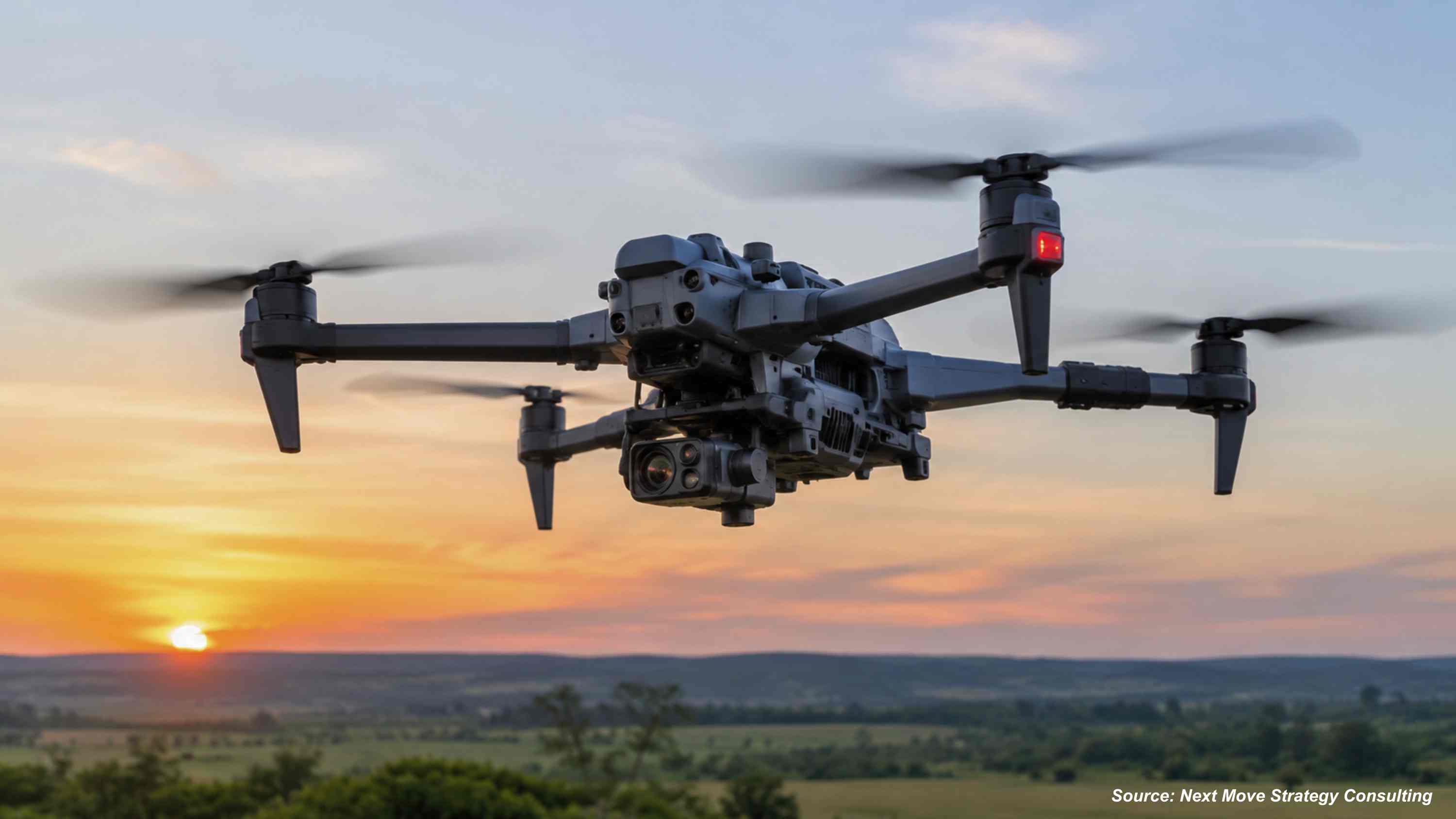
The FCC's October 29 order frees 50 MHz of licensed spectrum for drone links, yet routine flights beyond visual line of sight still hinge on an FAA rule held in White House review since July 10
On October 29, 2026, the Federal Communications Commission voted to open 50 megahertz of the 800 MHz Cellular band to drone operations, removing an airborne-use prohibition that the agency adopted in 1991 to protect ground networks from handsets used on aircraft. In its news release FCC Opens More Cellular Spectrum for Drones, the Commission stated that the order unlocks the spectrum for unmanned aircraft command, control, communication and payload operations, and that modern wireless networks use advanced technologies that keep drones from interfering with them. The decision matters most to fleets flown by a human operator in real time, because every remotely piloted mission depends on a live link carrying video, telemetry and control inputs.
According to Next Move Strategy Consulting's Remotely Operated Drone Market report, the global remotely operated drone market was valued at USD 6.8 billion in 2025 and is projected to reach USD 25.0 billion by 2035, growing at a CAGR of 13.8% from 2026 to 2035. NextMSC primary research and analysis puts the 2026 market at USD 7.8 billion and attributes the largest single contribution to that growth, 2.1 percentage points of CAGR, to infrastructure and asset inspection demand, followed by beyond visual line of sight rule-making at 1.9 percentage points between 2027 and 2035.
For More Information: Download FREE Sample on Remotely Operated Drone Market Report
Why Link Capacity Matters to Piloted Fleets
NextMSC primary research and analysis identifies direct flight control and real-time viewing as the features that sustain user engagement in this market, with live telemetry, smart cameras and encrypted datalinks determining how safely a mission can run. All of those functions travel over radio links, which gives access to licensed, nationwide, low-band spectrum direct operational weight. The Commission adopted rules to license cellular service in the 800 MHz band in 1981; until this order its airborne-use restriction stood between drone operators and 50 megahertz of it, and the Commission said the change also gives the band parity with other flexible-use spectrum.
Reporting by Broadband Breakfast on October 29, 2026 confirms that under the order wireless providers can offer drone services in the band, which turns the ruling into a commercial channel for carriers as well as a regulatory change for operators.
“Virtually all drones need access to spectrum”
- Brendan Carr, Chairman, Federal Communications Commission, Broadband Breakfast, October 29, 2026.
Ashleigh de la Torre, Amazon's vice president of public policy, said in a statement reported by Broadband Breakfast that demand for drone delivery is growing and that additional airwaves would be beneficial.
The Rule That Sets Range: Part 108 at the White House
Spectrum alone does not change where a pilot may fly. The Federal Aviation Administration and the Transportation Security Administration proposed their beyond visual line of sight framework, Normalizing Unmanned Aircraft Systems Beyond Visual Line of Sight Operations, in the Federal Register on August 7, 2025 (90 FR 38212). The Office of Information and Regulatory Affairs now lists the final rule, RIN 2120-AL82, as received on July 10, 2026 with a status of pending review. In the interim, NextMSC primary research and analysis notes, expanded FAA Part 107 waiver approvals are supporting fleet growth.
The Federal Aviation Administration announced on October 5, 2026 that it had awarded USD 12 million to 19 drone research and testing projects connected with its designated test sites. FAA Administrator Bryan Bedford framed the Broad Agency Announcement program as an additional direct line to industry and test-site partners, aimed at the technologies that safe integration of drones depends on. NextMSC primary research and analysis assigns beyond visual line of sight rule-making an estimated 1.9 percentage-point effect on the market's growth rate from 2027 to 2035, the second-largest driver in its dependency table, with the benefit concentrated in long-corridor pipeline, rail and power-line inspection that visual-only operation makes uneconomical.
Demand Base: What FAA Registration Data Shows
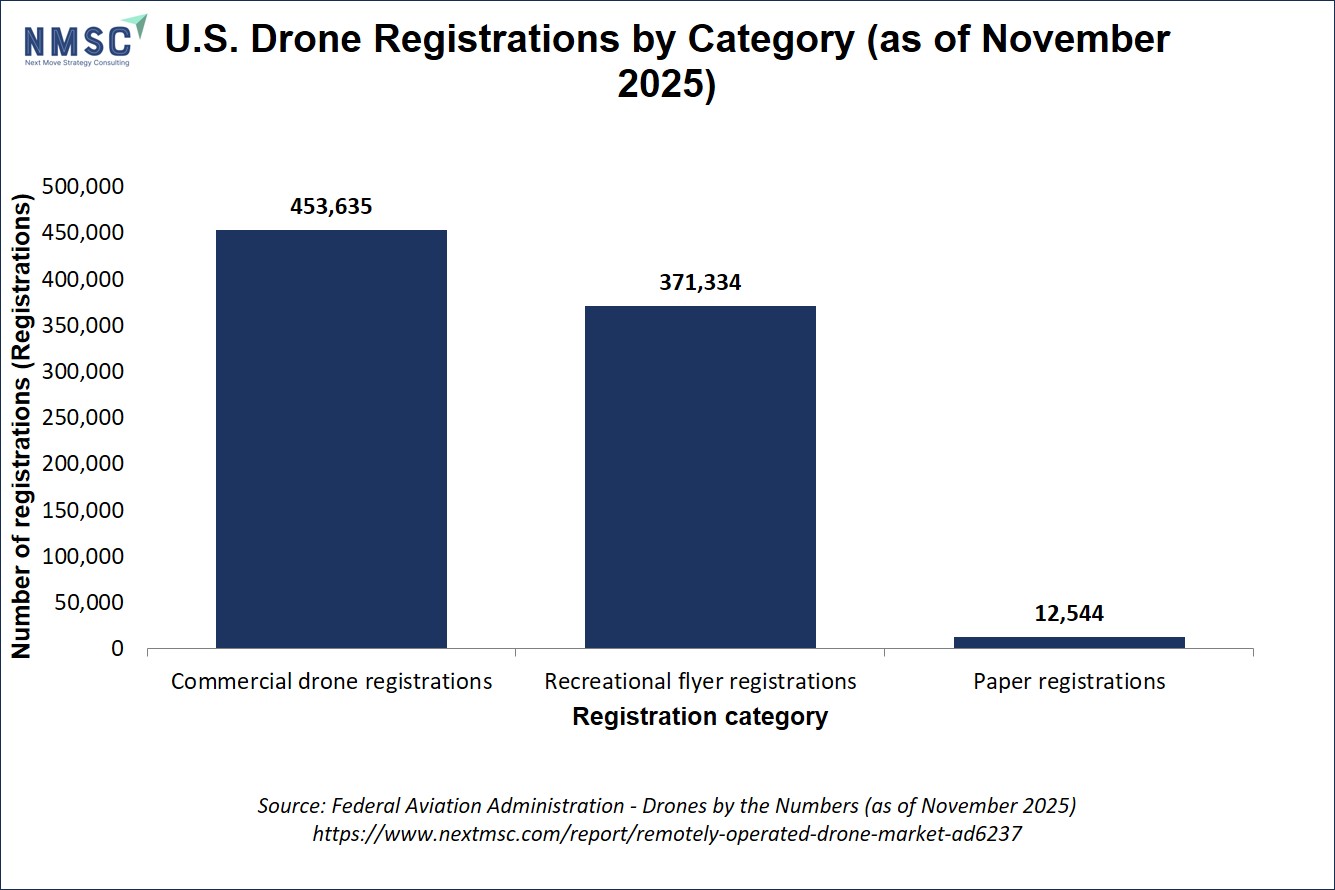
The Federal Aviation Administration's Drones by the Numbers page, dated as of November 2025, lists 837,513 registered drones in the United States: 453,635 commercial drone registrations, 371,334 recreational flyer registrations and 12,544 paper registrations. The same page counts 481,760 certificated remote pilots and 1,226,168 TRUST certificates issued, a base of trained operators and registered aircraft that predates the new spectrum access.
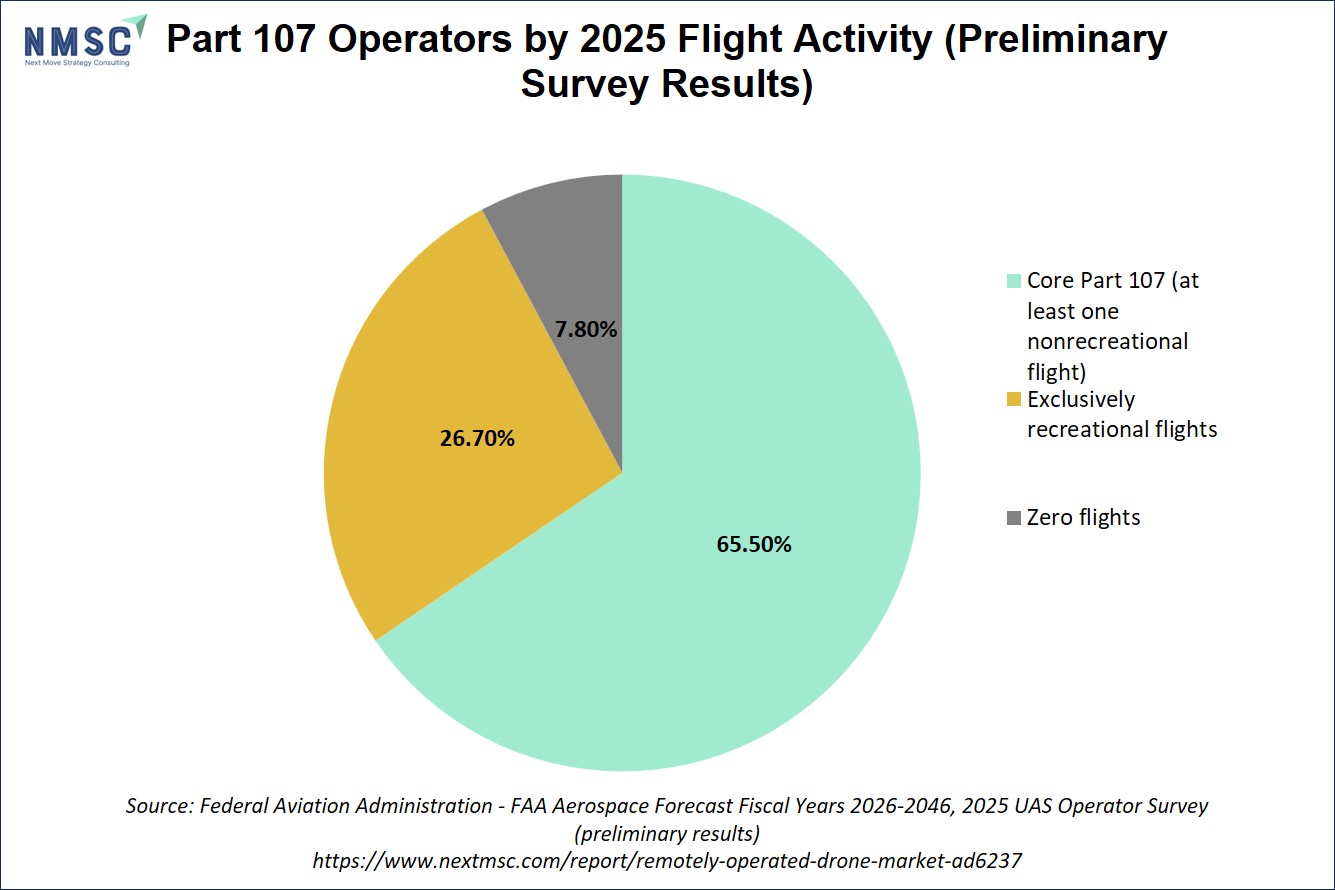
Registration counts show who is registered, not who flies commercial missions, and the Federal Aviation Administration's Aerospace Forecast Fiscal Years 2026-2046 adds that second layer. In the preliminary results of its 2025 UAS Operator Survey, 65.5% of Part 107 operators, which the agency labels core Part 107, reported at least one nonrecreational flight in 2025, while 26.7% reported exclusively recreational flights and 7.8% reported no flights. For vendors of piloted systems, roughly two-thirds of certificated operators in that survey were therefore flying missions that qualify as commercial or public-use work.
Key Industry Developments: Domestic Capacity, Defense Integration and Sourcing Rules
Skydio, the U.S. drone manufacturer, announced in April 2026 a USD 3.5 billion investment in the United States over five years, covering domestic manufacturing, research and development, and supply chain development. The company said the commitment is expected to create more than 2,000 Skydio jobs and direct more than USD 1 billion to domestic suppliers. In the same announcement Skydio stated that it has shipped more than 60,000 aircraft to more than 3,800 customers, including more than 1,200 public safety agencies, and that its Drone as First Responder service lets drones arrive on scene first 71% of the time.
In Europe, Parrot announced on May 13, 2026 that its ANAFI UKR micro-UAV was selected for integration into armored platforms under a major European armored vehicle program, with 250 units delivered to date, a further 175 scheduled to ship in the second quarter of 2026 and a 10-year framework allowing additional procurements.
On the supply side, the Federal Communications Commission on December 22, 2025 added foreign-produced unmanned aircraft systems and UAS critical components to its Covered List following a national security determination. The step bars new models from receiving equipment authorization while leaving previously authorized models in place. NextMSC primary research and analysis assigns supply chain dependence on foreign components an estimated reduction of 1.1 percentage points in North American growth from 2026 to 2029.
Six Dated Developments Shaping Piloted Drone Operations
|
Date |
Body |
Action |
Scale |
|
October 29, 2026 |
Federal Communications Commission |
Order opening the 800 MHz Cellular band to drone operations |
50 megahertz of licensed spectrum |
|
October 5, 2026 |
Federal Aviation Administration |
Awards for drone research and testing projects |
USD 12 million; 19 projects |
|
July 10, 2026 |
Office of Information and Regulatory Affairs |
Final beyond visual line of sight rule (RIN 2120-AL82) received for review |
Status: pending review |
|
May 13, 2026 |
Parrot |
ANAFI UKR selected for armored vehicle program |
250 delivered; 175 due in Q2 2026; 10-year framework |
|
April 2026 |
Skydio |
Domestic manufacturing and supply chain commitment |
USD 3.5 billion over five years |
|
December 22, 2025 |
Federal Communications Commission |
Foreign-produced UAS and critical components added to Covered List |
New models barred from equipment authorization |
Segment Dynamics: Multirotor Holds Scale, Hybrid VTOL Leads Growth
NextMSC primary research and analysis shows multirotor drones accounting for approximately 42.1% of 2025 revenue, rising from USD 2.86 billion in 2025 to USD 9.32 billion by 2035, supported by vertical take-off flexibility for inspection, surveillance and mapping in confined sites. Hybrid VTOL drones record the fastest platform growth at a 17.5% CAGR from 2025 to 2035, as long-range corridor mapping and beyond visual line of sight-enabled inspection programs favor aircraft that combine fixed-wing endurance with vertical launch convenience.
Remotely Operated Drone Market by Platform Type
|
Platform type |
2025 (USD billion) |
2035 (USD billion) |
CAGR |
|
Fixed-wing drones |
1.50 |
5.09 |
13.0% |
|
Multirotor drones |
2.86 |
9.32 |
12.5% |
|
Hybrid VTOL drones |
1.22 |
6.11 |
17.5% |
|
Underwater remotely operated vehicles |
1.22 |
4.48 |
13.9% |
By application, surveillance and security led in 2025 at USD 2.11 billion, driven by border security, event monitoring and critical infrastructure protection mandates, while agriculture and precision farming is the fastest-growing application at a 16.1% CAGR from 2025 to 2035 as subsidy programs in India, China and Brazil lower the adoption barrier. By end user, defense and government was the largest segment in 2025 at USD 2.45 billion, and commercial and enterprise is expanding fastest at a 15.2% CAGR, projected to become the largest end-user segment by 2035 as energy, construction and logistics companies move from pilot programs to standing operational fleets.
Regional Outlook: North America Leads, Asia-Pacific Accelerates
North America held approximately 34.6% of global revenue in 2025, equal to USD 2.35 billion, with the United States contributing approximately USD 1.83 billion. NextMSC primary research and analysis describes the region as comparatively mature, with growth increasingly driven by fleet expansion among existing operators and a supplier base being reshaped by manufacturing reshoring after recent national-security procurement restrictions. Asia-Pacific is the fastest-growing region at a 16.7% CAGR, propelled by agricultural modernization programs and infrastructure inspection needs across China, India and Southeast Asia, while Europe grows at 13.1% under the harmonized drone regulation framework of the European Union Aviation Safety Agency.
Remotely Operated Drone Market by Region
|
Region |
2025 (USD billion) |
2035 (USD billion) |
CAGR |
|
North America |
2.35 |
7.15 |
11.8% |
|
Europe |
1.63 |
5.59 |
13.1% |
|
Asia-Pacific |
1.94 |
9.10 |
16.7% |
|
Middle East and Africa |
0.51 |
1.89 |
14.0% |
|
Latin America |
0.37 |
1.27 |
13.1% |
Growth Drivers and Restraints
NextMSC primary research and analysis quantifies each factor's effect on the market's growth rate. Six drivers add between 1.2 and 2.1 percentage points each, while three restraints subtract between 0.7 and 1.1 points, with the heaviest drag on North America where foreign-component dependence meets the new sourcing rules.
Drivers and Restraints, Impact on CAGR
|
Factor |
Type |
Impact on CAGR |
Geography |
Timeline |
|
Infrastructure and asset inspection demand |
Driver |
+2.1% |
Global |
2026-2035 |
|
Beyond visual line of sight rule-making |
Driver |
+1.9% |
Global |
2027-2035 |
|
Drone as First Responder public safety programs |
Driver |
+1.8% |
North America, Europe |
2026-2032 |
|
Precision agriculture adoption in emerging economies |
Driver |
+1.6% |
Asia-Pacific, Latin America |
2026-2035 |
|
Defense and border-security procurement growth |
Driver |
+1.4% |
Middle East and Africa, Asia-Pacific |
2026-2033 |
|
Advances in battery density and AI navigation |
Driver |
+1.2% |
Global |
2026-2035 |
|
Supply chain dependence on foreign components |
Restraint |
-1.1% |
North America |
2026-2029 |
|
Airspace congestion and no-fly zone restrictions |
Restraint |
-0.9% |
Europe, North America |
2026-2030 |
|
Data privacy and cybersecurity concerns |
Restraint |
-0.7% |
Global |
2026-2032 |
NMSC Strategic Perspective: Link Capacity Is Arriving Before Route Authority
NextMSC primary research and analysis treats link capacity and route authority as two separate constraints on piloted fleets. The Federal Communications Commission order eases the first; the second remains with the Federal Aviation Administration, where the final rule is pending review. In NextMSC's driver table, beyond visual line of sight rule-making carries an estimated 1.9 percentage points of CAGR from 2027 to 2035, behind only infrastructure and asset inspection demand at 2.1 points. Operators planning long-corridor pipeline, rail and power-line programs therefore face a sequencing decision: bandwidth contracts can be negotiated now, but the range those links are meant to serve depends on the timing of the final rule.
Procurement rules are the second force. NextMSC primary research and analysis finds that domestic manufacturing credentials have gained weight in government tenders following national-security sourcing restrictions, a pattern consistent with Skydio's USD 3.5 billion commitment and the Covered List action of December 22, 2025. Vendors that co-locate component suppliers are using domestic manufacturing transparency as a procurement-eligibility strategy in security-sensitive government tenders, while vendors dependent on foreign components face the 1.1-point North American drag identified above through 2029.
Third, revenue models are shifting from airframes to services. NextMSC primary research and analysis recommends that manufacturers prioritize domestic supply chain transparency and software-driven recurring revenue, and identifies drone-as-a-service subscriptions, beyond visual line of sight-enabled inspection routes and underwater remotely operated vehicle inspection in offshore energy as its three whitespace opportunities. Carrier access to 800 MHz adds a new connectivity option beneath those subscription offers without altering their regulatory timing.
Competitive Landscape: Two Archetypes, One Procurement Filter
NextMSC primary research and analysis describes the market as moderately fragmented: the top ten players account for a significant share of defense and government revenue, while commercial and enterprise demand is more distributed. Two archetypes dominate, namely diversified aerospace and defense groups serving government procurement, and specialized commercial manufacturers focused on public safety and enterprise inspection. NextMSC finds the second archetype gaining relative share as Drone as First Responder and inspection-as-a-service programs scale faster than traditional defense procurement cycles.
Companies profiled in NextMSC's report include SZ DJI Technology Co., Ltd., AeroVironment, Inc., Skydio, Inc., Parrot SA and The Boeing Company (Insitu), among 20 profiled participants. Skydio's April 2026 manufacturing commitment and Parrot's May 2026 armored vehicle selection, both cited above, show two distinct competitive routes: domestic capacity expansion for public safety and utility buyers, and embedded reconnaissance integration for defense customers.
Bottom Line
The Federal Communications Commission's October 29, 2026 order removes a 35-year-old barrier to drone use of 50 megahertz of licensed spectrum, widening the communications options for fleets that depend on live pilot control. It does not change where those fleets may fly: the Federal Aviation Administration's final beyond visual line of sight rule has been listed as pending review at the Office of Information and Regulatory Affairs since July 10, 2026, and NextMSC primary research and analysis ties 1.9 percentage points of annual growth to its arrival. Against a market valued at USD 6.8 billion in 2025 and projected to reach USD 25.0 billion by 2035, the near-term signals favor operators and vendors that pair hardware with software and services, build domestic supply chains as procurement rules tighten, and prepare long-corridor inspection programs for launch when route authority arrives. The principal risks are further delay in the FAA rule, airspace restrictions and foreign-component dependence in North America.
About Next Move Strategy Consulting
Next Move Strategy Consulting is a premier market research and management consulting firm that has been committed to provide strategically analysed well documented latest research reports to its clients. The research industry is flooded with many firms to choose from, what makes NMSC different from the rest is its top-quality research and the obsession of turning data into knowledge by dissecting every bit of it and providing fact-based research recommendation that is supported by information collected from over 500 million websites, paid databases, industry journals and one on one consultations with industry experts across a diverse range of industry sectors. The high-quality customized research reports with actionable insights and excellent end-to-end customer service help our clients to take critical business decisions that enables them to move beyond time and have competitive edge in the industry.
We have been servicing over 1000 customers globally that includes 90% of the Fortune 500 companies over a decade. Our analysts are constantly tracking various high growth markets and identifying hidden opportunities in each sector or the industry. We provide one of the industry’s best quality syndicate as well as custom research reports across 10 different industry verticals. We are committed to deliver high quality research solutions in accordance to your business needs. Our industry standard delivery solutions that ranges from the pre consultation to after-sales services, provide an excellent client experience and ensure right strategic decision making for businesses.
For more information, please contact:
Next Move Strategy Consulting
5th Floor 867 Boylston St, STE 500,
Boston, MA 02116, U.S.
E-Mail: [email protected]
Direct: +1-217-650-7991
Website: www.nextmsc.com
About the Author
 Priyanshu Das
— Priyanshu Das is SEO Executive at Next Move Strategy Consulting, where he has led on-page and off-page SEO, keyword research, and SEO audits for the firm's B2B market research publications for 2 years. His audit process combines technical crawl analysis, backlink profile review, and competitor keyword gap mapping — using tools including Screaming Frog and Google Search Console — to prioritize fixes by organic search-visibility impact, informed by his own prior in-house and agency SEO experience.
About the Reviewer
 Sanyukta Deb
— Sanyukta Deb is Digital Marketing Team Lead at Next Move Strategy Consulting, where she has led content strategy and technical SEO for the firm's B2B market research publications for over 2 years. Her editorial process translates NextMSC's primary and secondary research — spanning technology, industrial, and consumer sectors — into commercial narratives, backed by search-intent, keyword, and competitive analysis. She brings 5 years of overall experience in digital marketing and content strategy.
















Add Comment