Remotely Operated Drone Market Global Industry Analysis and Forecast (2026–2035)

The global Remotely Operated Drone Market size was valued at USD 6.8 billion in 2025 and is estimated at USD 7.8 billion in 2026, forecast to reach USD 25.0 billion by 2035, expanding at a 13.8% CAGR between 2026 and 2035. North America leads with approximately 34.6% share, while Multirotor Drones dominate all other platform types with approximately 42.1% share.

Download Free Sample PDF
Base Year (2025)
$6.80 Billion
Forecast (2035)
$25.00 Billion
CAGR (2026-2035)
13.8%
Top Region
North America

What Is the Remotely Operated Drone Market Size?

The global remotely operated drone market size was valued at USD 6.8 Billion in 2025 and is estimated at USD 7.8 Billion in 2026, before reaching USD 25.0 Billion by 2035, growing at a CAGR of 13.8% during the 2026–2035 forecast period. North America leads with an approximate 34.6% revenue share, while multirotor drones dominate the platform type segment with an approximate 42.1% share in 2025.

Remotely Operated Drone Market Global Industry Analysis and Forecast (2026–2035) Revenue Forecast

Values in USD Billion

2025 $6.80 Billion
2025
2026 $7.80 Billion
2026
2027 $8.88 Billion
2027
2028 $10.10 Billion
2028
2029 $11.50 Billion
2029
2030 $13.08 Billion
2030
2031 $14.89 Billion
2031
2032 $16.94 Billion
2032
2033 $19.28 Billion
2033
2034 $21.94 Billion
2034
2035 $25.00 Billion
2035

Key Takeaways

Market Size in 2025: USD 6.8 Billion

Market Size in 2026: USD 7.8 Billion

Revenue Forecast in 2035: USD 25.0 Billion

CAGR (2026–2035): 13.8%

Dominant Segment (By Platform Type): Multirotor Drones USD 2.86 Billion in 2025 to USD 9.32 Billion in 2035

Fastest-Growing Segment (By Platform Type): Hybrid VTOL Drones CAGR of 17.5% (2025–2035)

Dominant Segment (By Application): Surveillance and Security USD 2.11 Billion in 2025 to USD 6.86 Billion in 2035

Fastest-Growing Segment (By Application): Agriculture and Precision Farming CAGR of 16.1% (2025–2035)

Dominant Segment (By End User): Defense and Government USD 2.45 Billion in 2025 to USD 7.55 Billion in 2035

Fastest-Growing Segment (By End User): Commercial and Enterprise CAGR of 15.2% (2025–2035)

Dominant Region: North America approximately 34.6% revenue share in 2025

Fastest-Growing Region: Asia-Pacific CAGR of 16.7% (2025–2035)

Dominant Country: United States approximately USD 1.83 Billion in 2025

Fastest-Growing Country Market: Australia, with an approximate 16.8% CAGR (2025–2035) based on the reported 2025 and 2035 market values

What Does the Remotely Operated Drone Market Encompass?

The remotely operated drone market encompasses the design, manufacture, and deployment of uncrewed aerial and underwater platforms that are actively piloted by a human operator via a ground control station or handheld controller, as distinct from fully autonomous systems. We observed that the market spans hardware, mission software, and operational services across defense, public safety, agriculture, energy, construction, and media end uses, with revenue recognized at the platform and service point of sale.
The regulatory environment continues to shape adoption, as national aviation authorities progressively formalize beyond visual line of sight approval pathways and remote identification requirements, while several governments have restricted procurement of foreign-manufactured platforms on national security grounds. During our market evaluation, we noticed that rising integration of edge-AI object detection, longer-endurance battery chemistries, and mesh-network communication links is improving mission reliability, encouraging enterprises to transition from pilot programs to fleet-scale deployment of remotely operated drones.

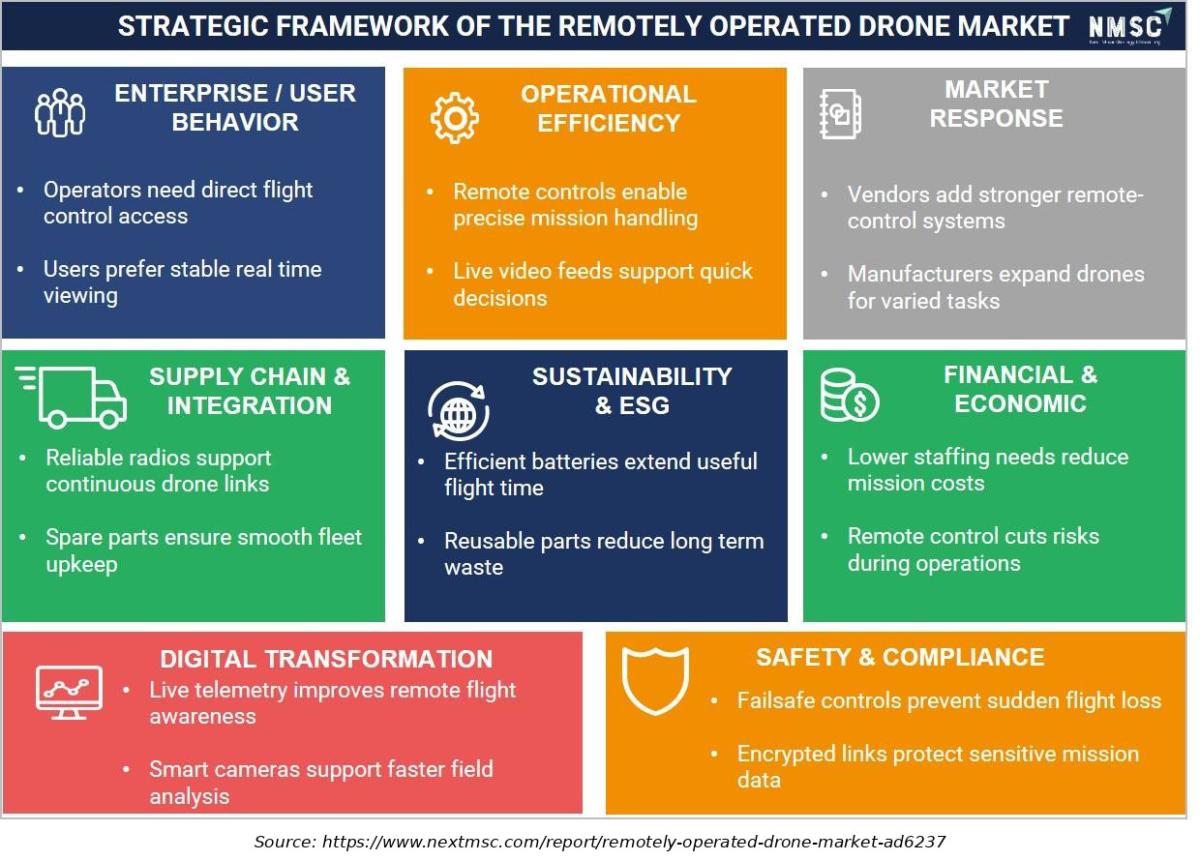
Strategic Framework of the Remotely Operated Drone Market

Strategic Framework of the Remotely Operated Drone Market
Based on research conducted by NMSC, we found that direct flight control and real-time viewing drive user engagement in the Remotely Operated Drone Market. Furthermore, live telemetry and smart cameras improve situational awareness, while efficient batteries extend flight durations. Concurrently, reduced staffing requirements reduce overall mission costs, whereas reliable radios, spare part supplies, failsafe controls, and encrypted datalinks ensure resilient and safer operations across the global Remotely Operated Drone Industry.

Market Drivers & Dynamics

Interactive Dataset
Infrastructure and asset inspection demand driver +2.1% Global 2026–2035
Drone as First Responder public safety programs driver +1.8% North America, Europe 2026–2032
Precision agriculture adoption in emerging economies driver +1.6% Asia-Pacific, Latin America 2026–2035
Beyond visual line of sight rule-making driver +1.9% Global 2027–2035
Defense and border-security procurement growth driver +1.4% Middle East & Africa, Asia-Pacific 2026–2033
Advances in battery density and AI navigation driver +1.2% Global 2026–2035
Airspace congestion and no-fly zone restrictions restraint −0.9% Europe, North America 2026–2030
Supply chain dependence on foreign components restraint −1.1% North America 2026–2029
Data privacy and cybersecurity concerns restraint −0.7% Global 2026–2032
Source: Next Move Strategy Consulting

Growth Drivers

What Is the Primary Growth Driver?

Infrastructure and asset inspection demand is the primary growth driver, as utilities, energy operators, and transportation agencies replace manual inspection with remotely piloted platforms. Our assessment indicates that regulatory bodies including the United States Federal Aviation Administration have expanded commercial Part 107 waiver approvals, supporting sustained fleet expansion. The report attributes an estimated 2.1 percentage-point growth impact to this driver, reinforcing inspection as a leading application through 2035.

How Is Public Safety Adoption Driving Market Growth?

Public safety adoption is accelerating market growth as police and fire agencies formalize Drone as First Responder programs under Federal Aviation Administration beyond visual line of sight waivers. We found that these programs reduce emergency response time and generate recurring software subscription revenue for platform vendors. Skydio has disclosed deployment across more than 1,200 public safety agencies, a scale that illustrates how government adoption is compounding demand for remotely operated aerial platforms nationwide.

Growth Inhibitors

What Is Restraining the Remotely Operated Drone Market?

Supply chain dependence on foreign-sourced components is restraining market growth, particularly following the United States Federal Communications Commission's December 2025 addition of certain foreign-manufactured drones to its Covered List on national security grounds. Our analysis shows that this restriction disrupts existing sourcing arrangements and raises near-term platform costs while domestic supply chains are rebuilt, moderating fleet expansion for cost-sensitive commercial buyers in the near term.

What Are the Growth Opportunities?

Where Does Drone-as-a-Service Create Whitespace?

Subscription-based drone-as-a-service models create whitespace for utilities and construction firms that prefer operating expenditure over capital equipment ownership. Service operators offering piloting, data processing, and analytics stand to capture recurring revenue as enterprise customers scale programs without in-house fleet management.

How Can Beyond Visual Line of Sight Waivers Unlock New Routes?

Expanding beyond visual line of sight waiver approvals unlock long-corridor pipeline, rail, and power-line inspection routes previously uneconomical under visual-only operation. Inspection service providers and sensor payload manufacturers are positioned to benefit as regulatory clarity extends operational range per flight.

What Opportunity Exists in Underwater Remotely Operated Vehicles?

Offshore energy and port-infrastructure operators present an underexploited opportunity for underwater remotely operated vehicles performing hull, pipeline, and subsea cable inspection. Manufacturers offering integrated sonar and high-definition camera payloads stand to benefit as offshore wind capacity additions expand inspection demand.

Segmentation Analysis

2025 (USD Billion)
2035 (USD Billion)
Fixed-Wing Drones 2025: $1.50 Billion | 2035: $5.09 Billion
Fixed-Wing D
Multirotor Drones 2025: $2.86 Billion | 2035: $9.32 Billion
Multirotor D
Hybrid VTOL Drones 2025: $1.22 Billion | 2035: $6.11 Billion
Hybrid VTOL
Underwater Remotely Operated Vehicles 2025: $1.22 Billion | 2035: $4.48 Billion
Underwater R
Fixed-Wing Drones $1.50 Billion $5.09 Billion 13.0%
Multirotor Drones $2.86 Billion $9.32 Billion 12.5%
Hybrid VTOL Drones $1.22 Billion $6.11 Billion 17.5%
Underwater Remotely Operated Vehicles $1.22 Billion $4.48 Billion 13.9%

Which Platform Type Dominates the Market?

Multirotor drones dominate the platform type segment, accounting for approximately 42.1% of 2025 revenue, supported by their vertical take-off flexibility and suitability for inspection, surveillance, and mapping in confined sites. We observed that hybrid VTOL drones are the fastest-growing platform type at a 17.5% CAGR from 2025 to 2035, based on the reported 2025 and 2035 segment values, as long-range corridor mapping and Beyond Visual Line of Sight-enabled inspection programs favor platforms combining fixed-wing endurance with vertical launch convenience.

2025 (USD Billion)
2035 (USD Billion)
Surveillance
Inspection a
Mapping and
Agriculture
Search and R
Segment Item 2025 (USD Billion) 2035 (USD Billion) CAGR
Surveillance and Security $10.0 USD Billion $40.0 USD Billion 15.0%
Inspection and Monitoring $17.1 USD Billion $51.1 USD Billion 21.0%
Mapping and Surveying $24.2 USD Billion $62.2 USD Billion 11.0%
Agriculture and Precision Farming $31.3 USD Billion $73.3 USD Billion 21.0%
Search and Rescue $38.4 USD Billion $84.4 USD Billion 14.0%

Segment-wise data is locked

Unlock complete segment-wise numbers for By Application.

Unlock Full Data

Which Application Leads Market Demand?

Surveillance and Security leads the application segment with a 2025 revenue base of USD 2.11 Billion, driven by border security, event monitoring, and critical infrastructure protection mandates. Our findings suggest that the Agriculture and Precision Farming segment is the fastest-growing application at a 16.1% CAGR from 2025 to 2035, based on the reported segment values, as government-backed subsidy programs in India, China, and Brazil lower the adoption barrier for smallholder and commercial farming operators deploying remotely piloted crop-monitoring platforms.

2025 (USD Billion)
2035 (USD Billion)
Defense and
Commercial a
Energy and U
Construction
Agriculture
Segment Item 2025 (USD Billion) 2035 (USD Billion) CAGR
Defense and Government $10.0 USD Billion $40.0 USD Billion 25.0%
Commercial and Enterprise $17.1 USD Billion $51.1 USD Billion 23.0%
Energy and Utilities $24.2 USD Billion $62.2 USD Billion 9.0%
Construction and Infrastructure $31.3 USD Billion $73.3 USD Billion 23.0%
Agriculture $38.4 USD Billion $84.4 USD Billion 24.0%

Segment-wise data is locked

Unlock complete segment-wise numbers for By End User.

Unlock Full Data

Which End User Segment Is Expanding Fastest?

Defense and Government remains the dominant end-user segment in 2025 at USD 2.45 Billion, reflecting sustained border-security and military reconnaissance procurement. During our market evaluation, we noticed that Commercial and Enterprise adoption is expanding fastest at a 15.2% CAGR from 2025 to 2035, based on the reported segment values, and is projected to become the largest end-user segment by 2035, as energy, construction, and logistics companies scale remotely piloted fleets beyond initial pilot deployments into standing operational programs.

2025 (USD Billion)
2035 (USD Billion)
Hardware
Airframe
Propulsion S
Camera and S
Communicatio
Segment Item 2025 (USD Billion) 2035 (USD Billion) CAGR
Hardware $10.0 USD Billion $40.0 USD Billion 27.0%
Airframe $17.1 USD Billion $51.1 USD Billion 17.0%
Propulsion System $24.2 USD Billion $62.2 USD Billion 15.0%
Camera and Sensors $31.3 USD Billion $73.3 USD Billion 17.0%
Communication System $38.4 USD Billion $84.4 USD Billion 26.0%

Segment-wise data is locked

Unlock complete segment-wise numbers for By Component.

Unlock Full Data
2025 (USD Billion)
2035 (USD Billion)
Visual Line
Beyond Visua
Segment Item 2025 (USD Billion) 2035 (USD Billion) CAGR
Visual Line of Sight $10.0 USD Billion $40.0 USD Billion 15.0%
Beyond Visual Line of Sight $17.1 USD Billion $51.1 USD Billion 9.0%

Segment-wise data is locked

Unlock complete segment-wise numbers for By Range.

Unlock Full Data

Growth Opportunities

Three forward-looking opportunities stand out as whitespace for platform manufacturers, software vendors, and service operators through 2035.

Where Does Drone-as-a-Service Create Whitespace?

Subscription-based drone-as-a-service models create whitespace for utilities and construction firms that prefer operating expenditure over capital equipment ownership. Service operators offering piloting, data processing, and analytics stand to capture recurring revenue as enterprise customers scale programs without in-house fleet management.

How Can Beyond Visual Line of Sight Waivers Unlock New Routes?

Expanding beyond visual line of sight waiver approvals unlock long-corridor pipeline, rail, and power-line inspection routes previously uneconomical under visual-only operation. Inspection service providers and sensor payload manufacturers are positioned to benefit as regulatory clarity extends operational range per flight.

What Opportunity Exists in Underwater Remotely Operated Vehicles?

Offshore energy and port-infrastructure operators present an underexploited opportunity for underwater remotely operated vehicles performing hull, pipeline, and subsea cable inspection. Manufacturers offering integrated sonar and high-definition camera payloads stand to benefit as offshore wind capacity additions expand inspection demand.

Regional Outlook

2025 (USD Billion)
2035 (USD Billion)
North Americ
Europe
Asia-Pacific
Middle East
Latin Americ
Region 2025 (USD Billion) 2035 (USD Billion) CAGR (%)
North America $10.0 USD Billion $40.0 USD Billion 9.0%
Europe $17.1 USD Billion $51.1 USD Billion 27.0%
Asia-Pacific $24.2 USD Billion $62.2 USD Billion 25.0%
Middle East & Africa $31.3 USD Billion $73.3 USD Billion 23.0%
Latin America $38.4 USD Billion $84.4 USD Billion 12.0%

Regional data is locked

Unlock complete regional numbers for this market.

Unlock Full Data

SWOT Analysis

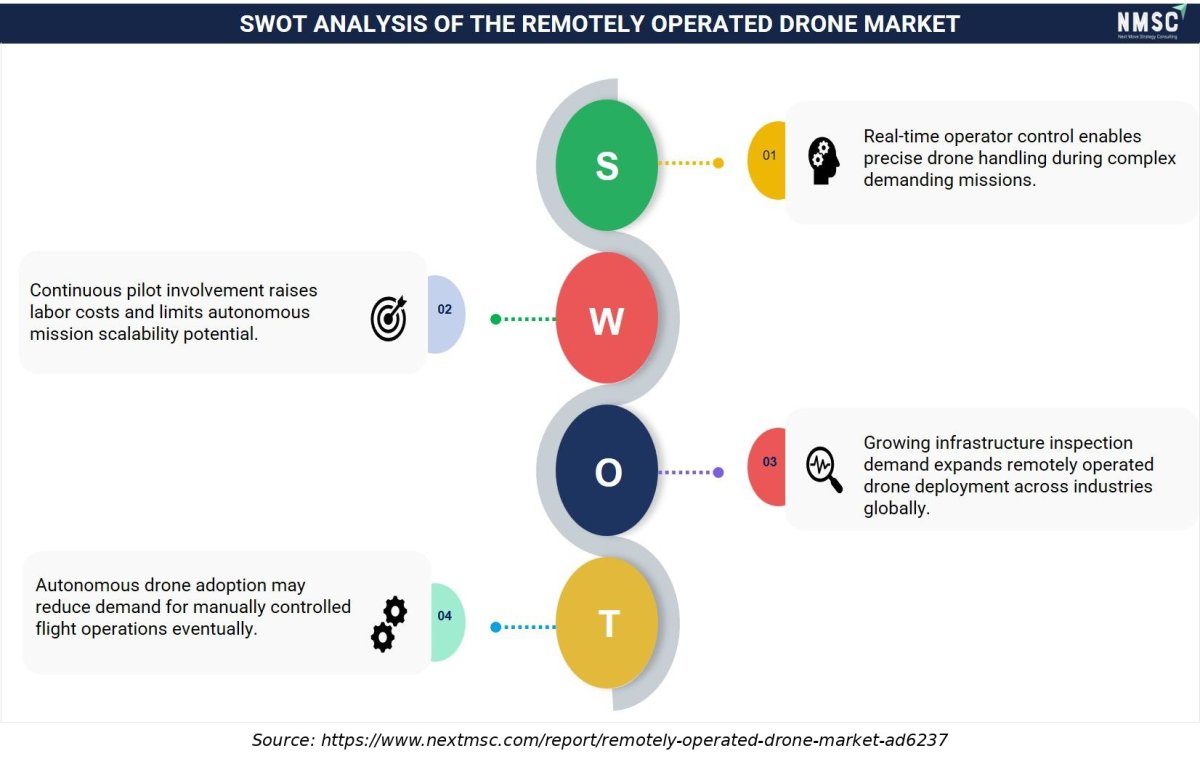
This SWOT view highlights structural strengths, strategic gaps, expansion headroom, and external risks shaping outcomes in the Remotely Operated Drone Market Global Industry Analysis and Forecast (2026–2035).
Strengths

precise real-time handling during complex missions represents a core strength of the Remotely Operated Drone Market.

Weaknesses

high labor costs from continuous pilot involvement create operational weaknesses.

Opportunities

surging global demand for industrial infrastructure inspection provides substantial growth opportunities

Threats

the accelerating adoption of autonomous alternative platforms poses a notable competitive threat across the broader Remotely Operated Drone Industry.

Competitive Landscape

Our analysis shows that the remotely operated drone market remains moderately fragmented, with platform manufacturers competing on payload performance, flight endurance, and increasingly on data-software integration rather than hardware specifications alone.

Dimension Description
Dimension Assessment
Market Structure Moderately fragmented, with the top ten players accounting for a significant share of Defense and Government revenue while Commercial and Enterprise demand remains more distributed
Innovation Focus AI-assisted flight control, longer-endurance battery systems, and cloud-based fleet and data-management software
M&A Activity Selective acquisitions of sensor, software, and regional service providers to expand end-to-end platform offerings

How Do Companies Compete in This Market?

Companies compete primarily on flight endurance, payload versatility, and increasingly on the depth of accompanying fleet-management and data-analytics software. We observed that vendors serving defense and public safety customers additionally compete on domestic manufacturing credentials, a factor that has gained procurement weight following recent national-security sourcing restrictions in several markets.

Which Competitive Archetypes Dominate the Market?

Two archetypes dominate the remotely operated drone market: diversified aerospace and defense conglomerates serving government procurement, and specialized commercial platform manufacturers focused on public safety and enterprise inspection. Our assessment indicates that the specialized commercial archetype is gaining relative share as Drone as First Responder and inspection-as-a-service programs scale faster than traditional defense procurement cycles.

What Innovation and Differentiation Strategies Are Emerging?

Manufacturers are differentiating through integrated AI-assisted obstacle avoidance, thermal and multispectral payload options, and subscription software that extends the hardware relationship into recurring revenue. We found that companies investing in domestic supply chain co-location are also using manufacturing transparency as a differentiation and procurement-eligibility strategy in security-sensitive government tenders.

Key Market Players

Based on research conducted by NMSC, the following companies represent the leading participants in the global remotely operated drone market, ranked by verified scale of market-specific operations.

SZ DJI Technology Co., Ltd. AeroVironment, Inc. Skydio, Inc. Parrot SA The Boeing Company (Insitu) Textron Inc. Elbit Systems Ltd. Israel Aerospace Industries Ltd. Teledyne Technologies Incorporated Lockheed Martin Corporation Autel Robotics Co., Ltd. Yuneec International Co., Ltd. AgEagle Aerial Systems Inc. Draganfly Inc. Wingtra AG Quantum Systems GmbH XAG Co., Ltd. Terra Drone Corporation ideaForge Technology Limited Percepto Robotics Ltd.

Latest Developments

Our analysis shows that recent strategic activity in the remotely operated drone market has centered on domestic manufacturing expansion and regulatory realignment amid heightened national-security scrutiny of foreign-made platforms.

Date Event
June 2026 Percepto launched a next-generation inspection intelligence platform for energy infrastructure, combining its drone-in-a-box systems with advanced AI capabilities to improve monitoring and operational decision-making. The launch strengthens remote, repeatable drone inspection workflows for utilities and industrial assets, expanding remote inspection workflows for utilities and industrial assets.
May 2026 Parrot announced that its ANAFI UKR tactical micro-UAV was selected for integration under a major European armored vehicle program, with several hundred systems scheduled for delivery in 2026 under a 10-year framework agreement. The integration expands embedded drone reconnaissance capabilities for frontline intelligence, surveillance, and force protection.
April 2026 Quantum Systems announced that the U.S. Army selected its Vector AI small UAS for Company-Level sUAS Directed Requirement 2 under a USD15.3 million contract. The selection accelerates fielding of advanced tactical aerial intelligence and supports the Army’s modernization of small unmanned aircraft for brigade-level reconnaissance and future requirements.
December 2025 Textron Systems received a contract to deliver three Aerosonde Mk. 4.7 VTOL UAS systems to Nigeria’s Tantita Security Services. The ITAR-free configuration and optional training and additional aircraft support international deployment, demonstrating demand for runway-independent remotely operated surveillance drones for protecting critical oil and gas infrastructure.
November 2025 Draganfly received a second purchase order from a Fortune 50 telecommunications company for multiple Commander 3XL drones integrated with USaS LEAP tether systems. The expanded NDAA-compliant fleet supports persistent aerial operations for emergency management and post-disaster telecommunications, highlighting demand for long-endurance remotely operated drones in critical infrastructure resilience.

Investment Opportunities

Where Is Capital Inflow Concentrated?

Capital inflow is concentrated in United States and European platform manufacturers expanding domestic production capacity. Skydio's disclosed USD 3.5 Billion manufacturing commitment and USD 110 Million Series F round, which raised its valuation to USD 4.4 Billion, illustrate continued investor confidence in domestically manufactured platforms amid tightening national-security procurement rules.

How Is Infrastructure Investment Shaping the Market?

Infrastructure investment is shaping the market as manufacturers co-locate component suppliers to rebuild domestic supply chains. Our findings suggest that programs such as Skydio's SkyForge supplier co-location initiative are expected to create thousands of new manufacturing roles, reflecting a broader capital shift toward vertically integrated regional production capacity.

What ESG Considerations Are Relevant to Investors?

Environmental, social, and governance considerations relevant to investors include battery lifecycle management, data-privacy governance for surveillance applications, and workforce development tied to new domestic manufacturing facilities. We observed that governance transparency around foreign-sourced components is increasingly factored into institutional investment and government-procurement decisions alike.

Key Benefits for Stakeholders

How Does This Report Benefit Industry Leaders?

Industry leaders benefit from this report's segmentation analysis, competitive benchmarking, and regional demand forecasts, which support platform roadmap prioritization and manufacturing capacity planning. Our analysis shows that the report's country-level sizing enables leaders to sequence market-entry investment toward the fastest-growing geographies identified in the Regional Outlook.

How Does This Report Benefit Investors and Financial Analysts?

Investors and financial analysts benefit from the report's consistent 2025–2035 revenue and CAGR forecasts, which support valuation modeling and capital-allocation decisions across platform manufacturers and service operators. The Competitive Landscape and Key Market Players sections provide a structured basis for comparative due diligence.

How Does This Report Benefit Technology Vendors and Product Teams?

Technology vendors and product teams benefit from the Segmentation Analysis and Key Emerging Trends sections, which identify the fastest-growing platform types and applications for roadmap alignment. Our findings suggest that product teams can use the Growth Opportunities section to prioritize software and payload investment toward the highest-growth use cases.

Key Market Segments Evaluated

By Platform Type

  • Fixed-Wing Drones
  • Multirotor Drones
  • Hybrid VTOL Drones
  • Underwater Remotely Operated Vehicles

By Application

  • Surveillance and Security
  • Inspection and Monitoring
  • Mapping and Surveying
  • Agriculture and Precision Farming
  • Search and Rescue
  • Media and Entertainment

By End User

  • Defense and Government
  • Commercial and Enterprise
  • Energy and Utilities
  • Construction and Infrastructure
  • Agriculture
  • Media and Entertainment
  • Others
  • Public Safety and Law Enforcement

By Component

  • Hardware
  • Airframe
  • Propulsion System
  • Camera and Sensors
  • Communication System
  • Software
  • Services
  • Piloting and Operations
  • Data Analytics and Processing
  • Maintenance and Support

By Range

  • Visual Line of Sight
  • Beyond Visual Line of Sight

By Region

  • North America 
    • U.S.
    • Canada
    • Mexico.
  • Europe 
    • UK
    • Germany
    • France
    • Italy
    • Spain
    • Sweden
    • Denmark
    • Finland
    • Netherlands
    • Rest of Europe.
  • Asia-Pacific 
    • China
    • India
    • Japan
    • South Korea
    • Taiwan
    • Indonesia
    • Vietnam
    • Australia
    • Philippines
    • Malaysia
    • Rest of APAC.
  • Middle East & Africa 
    • Saudi Arabia
    • UAE
    • Egypt
    • Israel
    • Turkey
    • Nigeria
    • South Africa
    • Rest of MEA.
  • Latin America 
    • Brazil
    • Argentina
    • Chile
    • Colombia
    • Rest of LATAM.

Conclusion & Recommendations

The long-term outlook for the remotely operated drone market remains strongly positive, with revenue projected to grow from USD 7.8 Billion in 2026 to USD 25.0 Billion by 2035 at a 13.8% CAGR. Our assessment indicates that continued regulatory development and enterprise fleet-scale adoption will support this trajectory through the forecast period.

What Strategic Positioning Do We Recommend?

We recommend that manufacturers prioritize domestic supply chain transparency and software-driven recurring revenue models to strengthen positioning with government and enterprise buyers. Vendors that pair hardware sales with data-analytics subscriptions are better positioned to capture the enterprise and public safety segments identified as the fastest-growing through 2035.

How Attractive Is the Market for New Investment?

The market presents an attractive investment profile, supported by a projected USD 17.2 Billion incremental revenue opportunity between 2026 and 2035. Our analysis shows that Asia-Pacific and the commercial and enterprise end-user segment offer the most favorable risk-adjusted growth profile for new capital deployment.

What Are the Key Market Shifts and Risks?

Key market shifts include accelerating beyond visual line of sight regulatory approval and reshoring of manufacturing amid national-security procurement restrictions. Principal risks include continued airspace congestion regulation and supply chain disruption tied to foreign-component sourcing restrictions, both of which could moderate near-term fleet expansion in affected markets.

What Are the Primary Growth Pathways Ahead?

Primary growth pathways include expansion of drone-as-a-service subscription models, scaling of underwater remotely operated vehicle inspection in offshore energy, and continued public safety adoption of Drone as First Responder programs. Our findings suggest that companies pursuing these three pathways simultaneously are positioned to benefit from these growth pathways.

FAQs

About the Author

Saista Faiyaz

Saista Faiyaz

Saista Faiyaz is Research Associate at Next Move Strategy Consulting, where she has covered consumer markets and healthcare technologies for 3 years. Her work includes primary interview review, secondary-source validation, market sizing, and structured analysis of company and industry data. She supports research by comparing evidence across sources, organizing findings into market narratives, and documenting assumptions used in analysis. Her scope includes cross-market benchmarking, and reports.

About the Reviewer

Supradip Baul

Supradip Baul

Supradip Baul is an accomplished business consultant and strategist with over a decade of rich experience in market intelligence, strategy, technology, and business transformation. His work has included rigorous qualitative and quantitative analysis across multiple industries, helping clients shape investment decisions and long-term roadmaps. Earlier in his career, he was associated with Gartner, where he contributed to industry-leading reports and market share analyses. He has worked with leading global companies and holds an MBA with a dual specialization in Marketing and Finance.

Download Free Sample

Pratyush Kumar Das

PRATYUSH KUMAR DAS

Assistant Manager

Polycab India Limited

We would like to express our appreciation for the data and insights provided by nextmsc. We are very pleased with the quality and depth of the information, which has proven to be highly valuable and beneficial for our business decision-making.

Mohit Agarwal

MOHIT AGARWAL

Chief Manager

DryChem India Pvt. Ltd.

Next Move Strategy Consulting is an amazing team of consultants. We required a market study report for our investors on top priority and the team went above and beyond our expectations to deliver the same with ample supporting data within a short time span enabling us to secure the investments and keep our project timeline maintained. Their professionalism, attention to detail, and timely delivery of actionable recommendations have left a lasting impression on our organization.

Kishu Kanda

KISHU KANDA

Strategy Analyst

Accenture

We purchased the AI Consumer Market Report from this company. Not only did they customize the report to meet our specific requirements, but they also showed great flexibility in accommodating our budget. The report we received fully met our expectations. Additionally, they provided prompt and thorough responses to both our pre-purchase and follow-up questions. We look forward to working with this company again in the future.

Ross J Mckenzie

ROSS J MCKENZIE

Business Insight Manager

Staysure Group

“Next MSC have been incredibly helpful in providing detailed & robust information on our market, alongside quantifying growth by different segments. The process to procure was simple and easy, with sample reports and regular contact to ensure we had what we needed. Succinct detail on their sources & methodologies is also greatly received, allowing transparency in this respect helps build trust in the detail you pay for. Joseph in particular was fantastic, and helped ensure efficient provision of the insight pack – thank you NMSC!”.

Henri Knyphausen

HENRI KNYPHAUSEN

Partner at Singulier [Ex-BCG]

Singulier

I recently engaged NEXTMSC.com for a commercial due diligence project within the intralogistics sector, and I am pleased to provide a reference based on my experience. In utilizing NEXTMSC.com's services, I found their report to offer valuable insights into market dynamics and key industry players. The initial report provided a solid foundation for our analysis. However, as we were investigating a smaller target in the market, and I had specific customization requests requiring additional research. These requests included detailed information on product portfolios of various players and sub-market sizes, both inclusive and exclusive of certain product categories. NEXTMSC.com demonstrated commendable responsiveness and agility in accommodating these customization requests. Within a timeframe of 1-2 weeks, they delivered a revised report that met our specific needs. Furthermore, they were receptive to my follow-up inquiries, ensuring clarity and understanding of the data provided. The final deliverable significantly contributed to our due diligence efforts. One of NEXTMSC.com's notable strengths lies in their qualitative research capabilities. However, for future engagements, I would recommend the inclusion of a quantified market model in Excel format. Such a model would offer the ability to conduct in-depth analyses and explore various market segments, including country-specific data and subcomponent breakdowns. Based on my positive experience, I would not hesitate to work with NEXTMSC.com again. Their responsiveness, willingness to accommodate customization requests, and commitment to delivering actionable insights make them a reliable partner for commercial research projects.

Custom Market Research Services

We will customize the research for you if the listed report does not fully match your requirements.

Get 30% Free Customization

Select License

This website uses cookies to ensure you get the best experience on our website. Learn more

✖