GICON's 365-Metre Tower Raises the Wind Industry's Height Bar | NextMSC
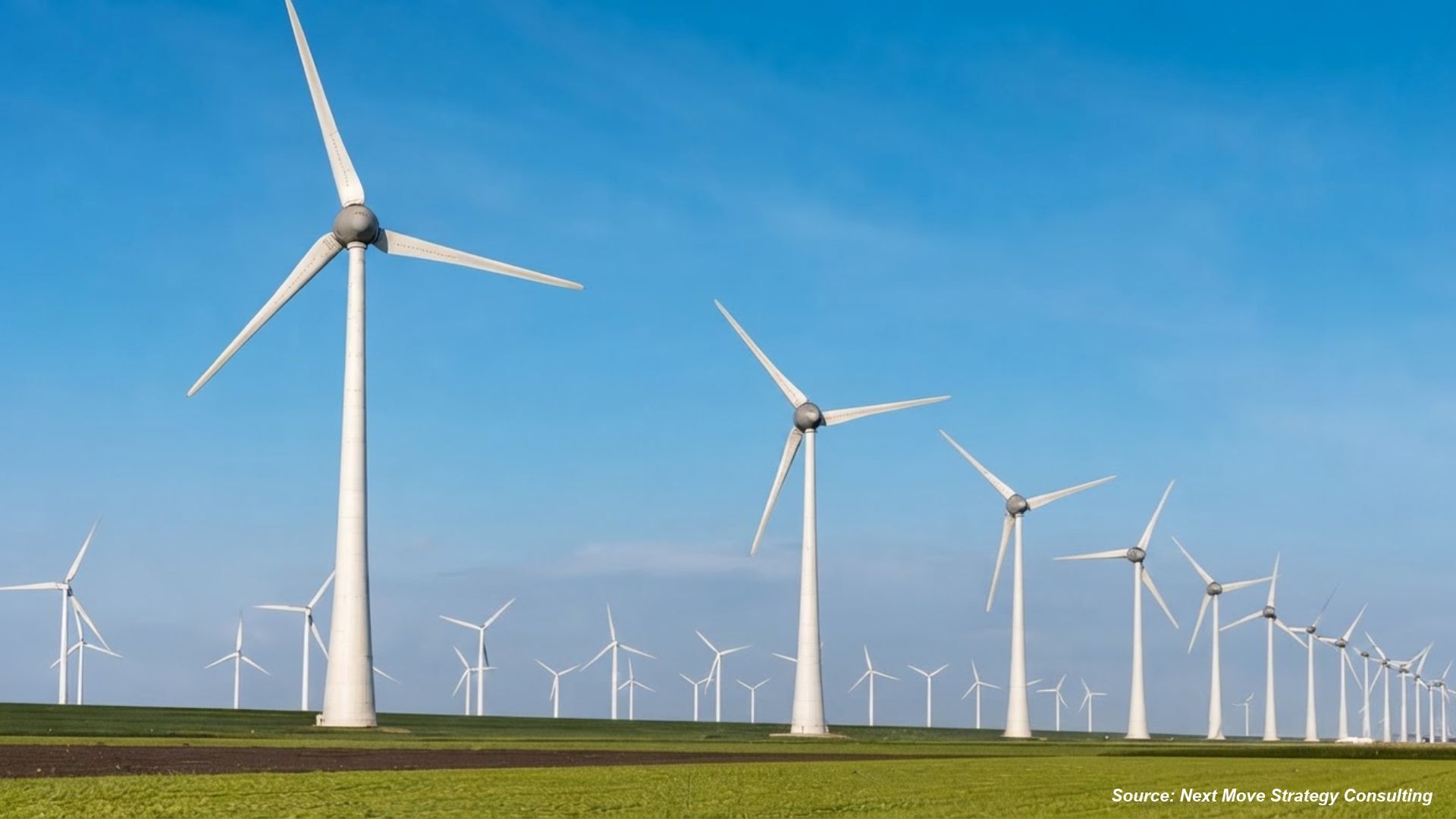
GICON's 365-Metre World Record Tower Signals a Structural Inflection Point for the Global Wind Turbine Tower Industry
Opening Event: The World's Tallest Wind Turbine Tower Is Now Standing in Germany
On September 29, 2026, German engineering company GICON completed the installation of the world's tallest wind turbine in Schipkau, Brandenburg — a 365-metre structure rising atop a 167-metre telescopic lattice tower, with a hub height of 300 metres. Commissioned by Germany's Federal Agency for Disruptive Innovation (SPRIND), the project deploys a hydraulic jacking mechanism to raise the inner tower through an outer lattice framework — a construction method necessitated by the absence of cranes capable of reaching 300 metres. GICON projects that the structure will generate approximately twice the annual energy output of a conventional turbine with the same rotor diameter installed at a standard hub height, and anticipates that future iterations of the platform will accommodate turbines of 8 MW and above, each capable of producing up to 33 gigawatt-hours per year.
"365 meters — this is an overwhelming moment for our entire team," said Prof. Dr. Jochen Großmann, Founder and CEO of GICON. "What was long a challenging idea and then an equally challenging construction project now stands as a globally unique facility in Schipkau."
This milestone is not an isolated engineering curiosity — it is a commercial signal. As turbine OEMs and project developers race to access stronger, more consistent wind resources at higher altitudes, the structural engineering requirements for wind turbine towers are being fundamentally redefined. According to Next Move Strategy Consulting's Wind Turbine Tower Market report, the global Wind Turbine Tower Market was valued at USD 32.30 billion in 2025 and is estimated at USD 34.92 billion in 2026, forecast to reach USD 70.79 billion by 2035, expanding at a CAGR of 8.1% between 2026 and 2035. The absolute dollar opportunity generated between 2026 and 2035 stands at USD 35.87 billion — a figure that positions taller, offshore-capable, and hybrid tower architectures as the most consequential area for capital allocation across the energy infrastructure supply chain.
For More Information: Download FREE Sample on Wind Turbine Tower Market Report
Record Wind Installations Compress Tower Manufacturing Lead Times Globally
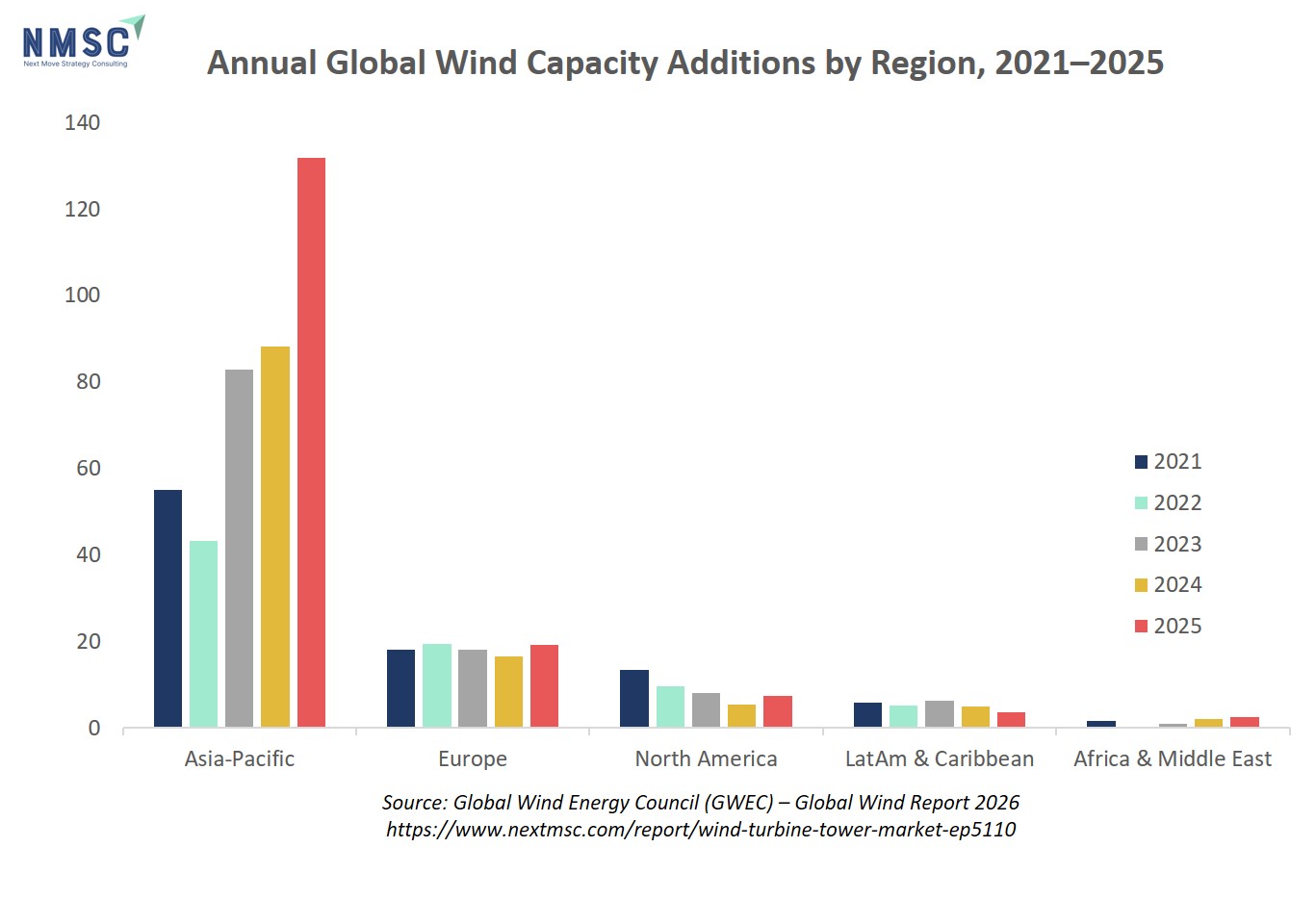
The structural demand underpinning this market is not speculative. According to the Global Wind Energy Council's (GWEC) Global Wind Report 2026, published on April 20, 2026, the global wind industry installed a record-breaking 165 GW of new wind capacity in 2025 — a 40% increase over the previous record year. Global cumulative wind capacity reached 1,299 GW by end-2025, with 28,395 wind turbines installed across 57 countries.
"The steep increase we have seen in global wind installations sets a new benchmark for an industry which is rapidly accelerating and responding to heightened demand for homegrown, affordable and resilient renewable energy," said Ben Backwell, CEO of GWEC, at the report's launch in Madrid. "At a time when skyrocketing oil and gas prices and supply shocks are once again causing disruption to economies around the world, the wind sector has demonstrated its ability to scale at speed."
China alone added 120.5 GW of new wind capacity in 2025, bringing its cumulative total to 640.5 GW. India nearly doubled its annual installations to a record 6.3 GW (up 86% year-on-year), while the United States commissioned 6.9 GW — a 71% year-on-year rebound. Europe's total installed wind capacity crossed the 300 GW threshold, with Germany adding 5.7 GW and the UK connecting over 1 GW of new offshore capacity. GWEC's Market Intelligence projects that 969 GW of new wind capacity will be commissioned between 2026 and 2030, averaging 194 GW annually — a pipeline that translates directly into sustained, multi-year procurement demand for tower sections, substructures, and lifecycle services.
CRH's $8.5 Billion Arcosa Acquisition Reshapes the North American Tower Supply Chain
The most consequential competitive event in the Wind Turbine Tower Market during 2026 occurred on June 22, when CRH plc (NYSE: CRH) announced an agreement to acquire Arcosa, Inc. (NYSE: ACA) in an all-cash transaction at USD 150 per share — a 25% premium to Arcosa's 60-day trading volume-weighted average price — valuing the company at a total enterprise value of approximately USD 8.5 billion.
"This strategic acquisition reinforces our position as the #1 infrastructure player in North America and advances our strategy to build an aggregates-led, connected portfolio," said Jim Mintern, CEO of CRH, in the company's official press release dated June 22, 2026. "As demand for U.S. energy and utility infrastructure solutions accelerates, this transaction places CRH at the forefront of an immense growth opportunity."
Arcosa's Engineered Structures business holds a top-three market position in critical infrastructure products, including wind turbine towers, supported by long-term megatrends in grid modernization and electrification. The transaction, expected to close in Q1 2027 subject to regulatory and stockholder approvals, is projected to generate USD 175 million in annual run-rate cost synergies by year three. For the Wind Turbine Tower Market, this consolidation event signals that infrastructure-platform acquirers now view wind tower manufacturing capacity as a strategic infrastructure asset — not merely a cyclical fabrication business — and are willing to pay premium multiples to secure it.
NMSC Market Segmentation: Where the Growth Is Concentrated
According to NextMSC primary research and analysis, growth across the Wind Turbine Tower Market is broad-based but structurally concentrated in three areas: offshore deployment formats, taller hub-height tower architectures, and lifecycle service channels.
Tubular Steel Tower retained the dominant position at USD 19.70 billion in 2025, underpinned by established fabrication infrastructure and proven structural performance across onshore markets. However, Hybrid Steel Concrete Tower is the fastest-growing sub-segment at a 12.0% CAGR through 2035 — a rate that reflects the specific engineering logic of taller hub heights: concrete lower sections eliminate the oversized-load transportation constraints that cap conventional steel shell diameters, allowing manufacturers to produce taller towers closer to project sites without exceeding road transport limits.
Offshore Floating is the fastest-growing deployment format at a 19.8% CAGR — the highest growth rate of any segment in the entire market — as pilot-scale floating wind farms in France, Japan, and South Korea transition toward commercial deployment. The More Than 8 MW turbine capacity class registers an 18.2% CAGR, reflecting the industry's structural shift toward larger offshore-rated turbines that require correspondingly taller, higher-tonnage tower sections. These two data points are not coincidental: they are mechanically linked — larger turbines require taller towers, and taller towers in deep-water settings require floating substructures.
Regional Outlook: Asia-Pacific Leads, Middle East & Africa Accelerates
According to NextMSC primary research and analysis, Asia-Pacific dominated the Wind Turbine Tower Market with approximately 46% revenue share (USD 14.86 billion) in 2025, driven by China's USD 9.21 billion market — the largest single-country position globally — and expanding manufacturing bases in India, Japan, and South Korea. China's market is projected to reach USD 19.71 billion by 2035 at a 7.9% CAGR, underpinned by provincial offshore wind targets and the world's largest domestic tower fabrication capacity.
The Middle East & Africa region is the fastest-growing market at a 14.0% CAGR, with Saudi Arabia registering the highest country-level growth rate at 15.8% CAGR — from USD 420 million in 2025 to USD 1.70 billion by 2035. This trajectory is directly linked to Vision 2030-linked renewable energy targets and large-scale onshore wind auction rounds. The GWEC's 2026 Global Wind Report corroborates this trajectory, noting that the 1,500 MW Dawadmi wind farm in Saudi Arabia set a new world record in 2025 for the lowest-cost wind project at USD 1.338/kWh, and that the Middle East is expected to add more than 18 GW of onshore wind capacity between 2026 and 2030.
India's Wind Turbine Tower Market, valued at USD 1.19 billion in 2025, is projected to reach USD 4.42 billion by 2035 at a 14.7% CAGR — the second-highest country-level growth rate globally — supported by national wind-solar hybrid procurement targets and state renewable purchase obligations that are pushing developers toward taller hub heights to access stronger inland wind resources.
Competitive Landscape: Consolidation, Offshore Expansion, and Portfolio Exits
According to NextMSC primary research and analysis, the Wind Turbine Tower Market features a moderately consolidated competitive landscape, with global tower specialists competing alongside regional Asian and European fabricators on scale, cost, and local-content compliance. The validated competitive set of 20 companies includes CS Wind Corporation, GRI Renewable Industries, Windar Renovables, Welcon A/S, Arcosa Inc., Titan Wind Operational Support, TSP Wind Power Group, Qingdao Wuxiao Group, Marmen Inc., and Broadwind Inc. (which exited wind tower manufacturing in 2026).
Three structural competitive events have reshaped the market in 2025–2026:
1. Windar Renovables' Offshore Plant Groundbreaking (May 2025): Windar Renovables celebrated the groundbreaking of a new XXL offshore wind tower manufacturing plant in Szczecin, Poland, designed to produce next-generation offshore wind turbine towers and expected to begin production in 2026 — directly strengthening the European offshore wind supply chain at a moment when developer request-for-proposal shortlists increasingly require certified offshore-rated fabrication capacity.
2. GRI Renewable Industries' Hybrid Tower Acquisition (March 2025): GRI Renewable Industries acquired a 45% stake in Windtechnic Engineering, expanding its capabilities into hybrid and concrete wind tower technologies to address rising demand for taller onshore turbine towers at low-wind-speed inland sites.
3. CRH's USD 8.5 Billion Acquisition of Arcosa (June 22, 2026): As detailed above, this transaction consolidates wind tower and engineered structures capability within a larger infrastructure platform, signalling that premium multiples are now available for manufacturers with certified domestic production and long-term framework agreement backlogs.
Key Growth Drivers and Restraints
According to NextMSC primary research and analysis, the primary growth driver of the Wind Turbine Tower Market is the convergence of global decarbonization policy mandates and offshore wind capacity expansion. The U.S. Inflation Reduction Act's Advanced Manufacturing Production Credit sustains demand for domestically fabricated towers in North America, while the European Commission's Renewable Energy Directive and China's provincial offshore wind targets are pushing developers to specify larger-diameter, higher-tonnage tower and substructure systems — compressing manufacturing lead times for offshore-rated tower sections across both regions.
The principal restraint is steel plate price volatility tied to iron ore and scrap feedstock costs. The U.S. Energy Information Administration tracks recurring industrial commodity price swings that compress manufacturer margins and delay capital investment in new fabrication capacity — a constraint that disproportionately affects smaller regional manufacturers with limited scale to hedge steel procurement against larger, vertically integrated tower groups.
Permitting delays and grid interconnection bottlenecks represent a secondary restraint, particularly in North America and Europe, where project timelines are extending beyond original developer schedules and deferring tower procurement decisions.
Innovation Frontier: Modular Wood, Telescopic Lattice, and Floating Substructures
The GICON milestone in Schipkau is one of three distinct innovation vectors reshaping tower design requirements. A second vector is modular, low-carbon tower materials. In March 2025, TÜV SÜD granted third-party design approval to Modvion's modular wooden wind turbine tower for large onshore wind turbines — a development that directly addresses the transportation bottleneck constraining conventional steel tower height scaling.
"Our modular wind turbine towers dramatically reduce CO₂ emissions by replacing steel and concrete with wood, while enabling highly efficient, taller installations without transport bottlenecks," said Otto Lundman, CEO of Modvion, following TÜV SÜD's design approval in March 2025.
A third vector is floating offshore substructure commercialization. According to NextMSC primary research and analysis, developers are advancing semi-submersible and spar-buoy platforms capable of supporting turbines exceeding 12 MW in water depths beyond 60 metres — a format that is expanding the addressable market for tower and substructure manufacturers beyond the fixed-bottom depth constraints that have historically capped offshore deployment geography.
NMSC Strategic Perspective: What This Market Shift Means for Stakeholders
NextMSC's analysis of the Wind Turbine Tower Market identifies three structural conclusions that should inform capital allocation and sourcing strategy through 2035:
First, the hub-height race is now a procurement criterion, not a product feature. GICON's 365-metre structure demonstrates that the engineering ceiling for onshore tower height has not yet been reached. As developers increasingly specify hub heights above 160 metres to access stronger inland wind resources — and as hybrid steel-concrete designs make those heights commercially viable without exceeding road transport limits — manufacturers that cannot demonstrate hybrid tower engineering capability risk exclusion from developer request-for-proposal shortlists. The 12.0% CAGR of the Hybrid Steel Concrete Tower sub-segment, against the market's overall 8.1% CAGR, quantifies the premium that this capability commands.
Second, the CRH-Arcosa transaction has reset the valuation benchmark for wind tower assets. At 11.5x 2026E Adjusted EBITDA (including synergies), the acquisition multiple signals that strategic acquirers are pricing in the long-term framework agreement backlog and domestic-content compliance value embedded in established tower manufacturers — not merely their current fabrication revenue. Investors evaluating wind tower manufacturers should treat local-content certification and long-term OEM framework agreements as primary valuation inputs, not secondary qualitative factors.
Third, the Offshore Floating segment's 19.8% CAGR represents the highest-conviction growth pathway in the market, but it carries the longest commercialization timeline. The transition from pilot-scale floating projects in France, Japan, and South Korea to commercial deployment will require sustained policy support, port infrastructure investment, and supply chain development that extends well beyond the near-term procurement cycle. Suppliers entering this segment should plan for a 2028–2032 revenue ramp, not a 2026–2027 one.
The Middle East & Africa region's 14.0% CAGR — anchored by Saudi Arabia's 15.8% country-level growth rate — represents the most accessible near-term geographic opportunity for manufacturers seeking above-market growth outside of Asia-Pacific, given the region's active auction pipeline and improving regulatory frameworks under Vision 2030-linked diversification programs.
Bottom Line
The Wind Turbine Tower Market is undergoing a structural transition that is simultaneously expanding its addressable geography, its engineering complexity, and its competitive concentration. GICON's 365-metre world record tower in Schipkau, completed on September 29, 2026, is the most visible evidence that the hub-height ceiling for onshore wind is being systematically raised — and that the tower architectures required to reach those heights are fundamentally different from the standardized tubular steel structures that built the industry's first generation. According to NextMSC primary research and analysis, the market will grow from USD 34.92 billion in 2026 to USD 70.79 billion by 2035 at an 8.1% CAGR, generating USD 35.87 billion in absolute dollar opportunity over the forecast period. The GWEC's record 165 GW of new wind capacity installed in 2025 confirms that the demand pipeline sustaining this growth is real and accelerating. CRH's USD 8.5 billion acquisition of Arcosa confirms that infrastructure-platform capital is now pricing wind tower manufacturing as a strategic infrastructure asset. Manufacturers that combine offshore-rated fabrication capability, hybrid tower engineering, and local-content compliance will capture the premium segments of this market; those that do not will face increasing margin pressure in the commoditizing onshore tubular steel segment.
About Next Move Strategy Consulting
Next Move Strategy Consulting is a premier market research and management consulting firm that has been committed to provide strategically analysed well documented latest research reports to its clients. The research industry is flooded with many firms to choose from, what makes NMSC different from the rest is its top-quality research and the obsession of turning data into knowledge by dissecting every bit of it and providing fact-based research recommendation that is supported by information collected from over 500 million websites, paid databases, industry journals and one on one consultations with industry experts across a diverse range of industry sectors. The high-quality customized research reports with actionable insights and excellent end-to-end customer service help our clients to take critical business decisions that enables them to move beyond time and have competitive edge in the industry.
We have been servicing over 1000 customers globally that includes 90% of the Fortune 500 companies over a decade. Our analysts are constantly tracking various high growth markets and identifying hidden opportunities in each sector or the industry. We provide one of the industry's best quality syndicate as well as custom research reports across 10 different industry verticals. We are committed to deliver high quality research solutions in accordance to your business needs. Our industry standard delivery solutions that ranges from the pre consultation to after-sales services, provide an excellent client experience and ensure right strategic decision making for businesses.
For more information, please contact:
Next Move Strategy Consulting
5th Floor 867 Boylston St, STE 500,
Boston, MA 02116, U.S.
E-Mail: [email protected]
Direct: +1-217-650-7991
Website: www.nextmsc.com
About the Author
 Sanyukta Deb
— Sanyukta Deb is Digital Marketing Team Lead at Next Move Strategy Consulting, where she has led content strategy and technical SEO for the firm's B2B market research publications for over 2 years. Her editorial process translates NextMSC's primary and secondary research — spanning technology, industrial, and consumer sectors — into commercial narratives, backed by search-intent, keyword, and competitive analysis. She brings 5 years of overall experience in digital marketing and content strategy.
Sanyukta Deb
— Sanyukta Deb is Digital Marketing Team Lead at Next Move Strategy Consulting, where she has led content strategy and technical SEO for the firm's B2B market research publications for over 2 years. Her editorial process translates NextMSC's primary and secondary research — spanning technology, industrial, and consumer sectors — into commercial narratives, backed by search-intent, keyword, and competitive analysis. She brings 5 years of overall experience in digital marketing and content strategy.
About the Reviewer
 Debashree Dey
— Debashree Dey is Assistant Manager at Next Move Strategy Consulting, where she supports cross-vertical market content and communications across diverse industries for 6 years. Her professional background includes senior content writing, communications, and published manuscript authorship, with experience developing audience-focused business narratives and maintaining clear, consistent messaging. Her role supports research-led content development and editorial quality across NextMSC publications.
Debashree Dey
— Debashree Dey is Assistant Manager at Next Move Strategy Consulting, where she supports cross-vertical market content and communications across diverse industries for 6 years. Her professional background includes senior content writing, communications, and published manuscript authorship, with experience developing audience-focused business narratives and maintaining clear, consistent messaging. Her role supports research-led content development and editorial quality across NextMSC publications.















Add Comment