Wind Turbine Tower Market Size, Share, Trends and Growth Analysis, By New Tower Supply (Tubular Steel Tower, Concrete Tower, Hybrid Steel Concrete Tower, Lattice Tower, and Other Tower), By Tower Services (Inspection, Repair, Retrofit, Surface Protection, Installation Support, and Other Services), By Deployment (Onshore, Offshore Fixed Bottom, and Other ), By Turbine Capacity Class, By Buyer Type, By Sales Channel, By End User, and Region — Global Industry Report and Forecast, 2026–2035
Industry: Energy & Power | Publishing Date: July 13, 2026 | Last Updated: September 30, 2026 | No of Pages: N/A | No. of Tables: N/A | No. of Figures: N/A | Format: PDF | Report Code: EP5110
What Is the Wind Turbine Tower Market Size?
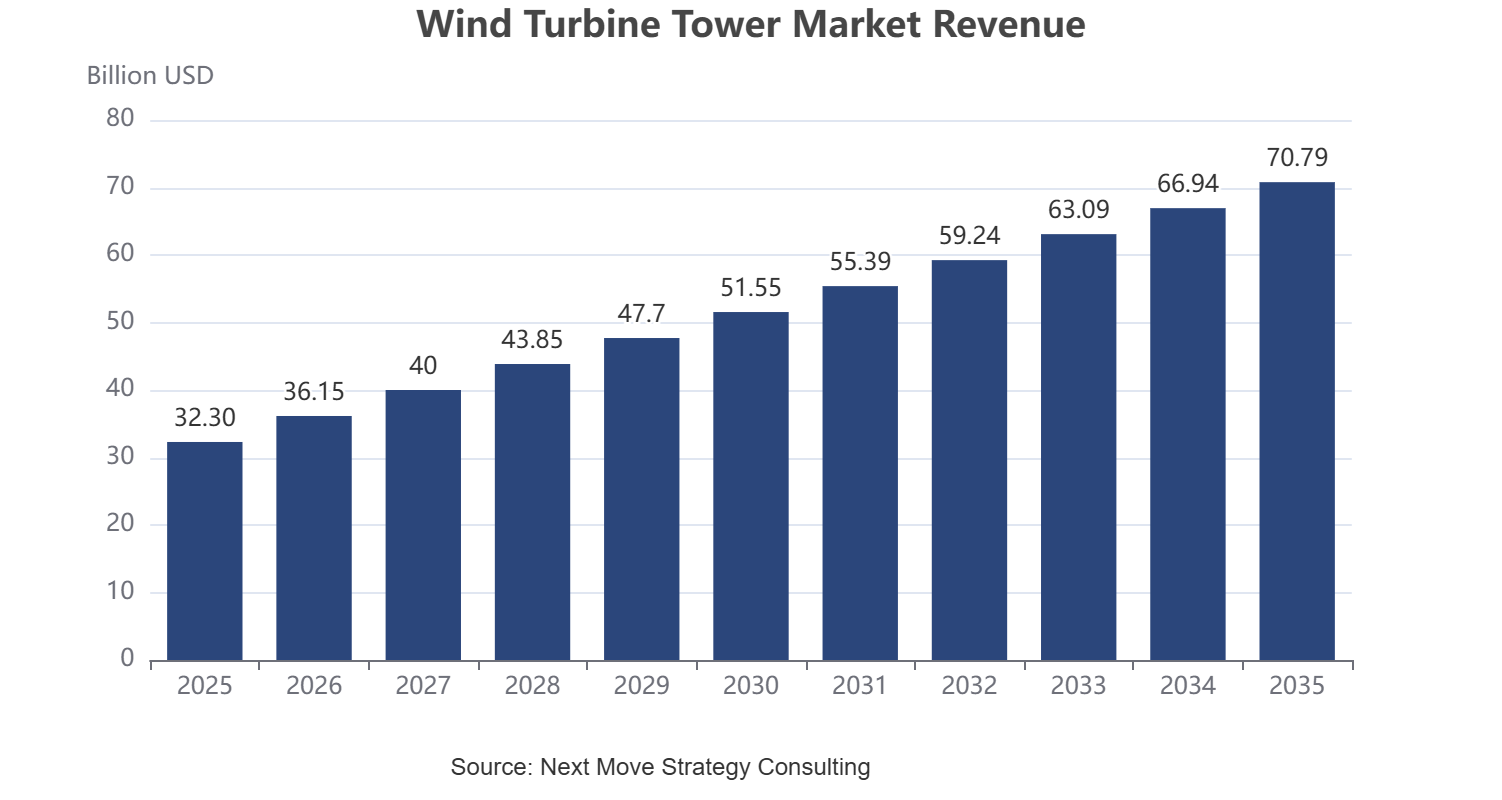
The global Wind Turbine Tower Market size was valued at USD 32.30 Billion in 2025 and is estimated at USD 34.92 Billion in 2026, forecast to reach USD 70.79 Billion by 2035, expanding at an 8.1% CAGR between 2026 and 2035. Asia-Pacific leads with approximately 46% share, while under new tower supply, Tubular Steel Tower dominates with approximately 61% share.
We observed that growth is broad-based across every segmentation axis, with offshore deployment and taller, higher-capacity towers driving the dominant structural shifts through 2035.
|
Key Takeaways |
|
By New Tower Supply: Tubular Steel Tower held the largest share of approximately 61% (USD 19.70 Billion) in 2025; Hybrid Steel Concrete Tower is the fastest-growing sub-segment at 12.0% CAGR from 2026–2035. |
|
By Tower Services: Inspection held the largest share of approximately 29% (USD 9.37 Billion) in 2025; Retrofit is the fastest-growing sub-segment at 11.7% CAGR from 2026–2035. |
|
By Deployment: Onshore held the largest share of approximately 75% (USD 24.23 Billion) in 2025; Offshore Floating is the fastest-growing sub-segment at 19.8% CAGR from 2026–2035. |
|
By Turbine Capacity Class: 3 To 5 MW held the largest share of approximately 40% (USD 12.92 Billion) in 2025; More Than 8 MW is the fastest-growing sub-segment at 18.2% CAGR from 2026–2035. |
|
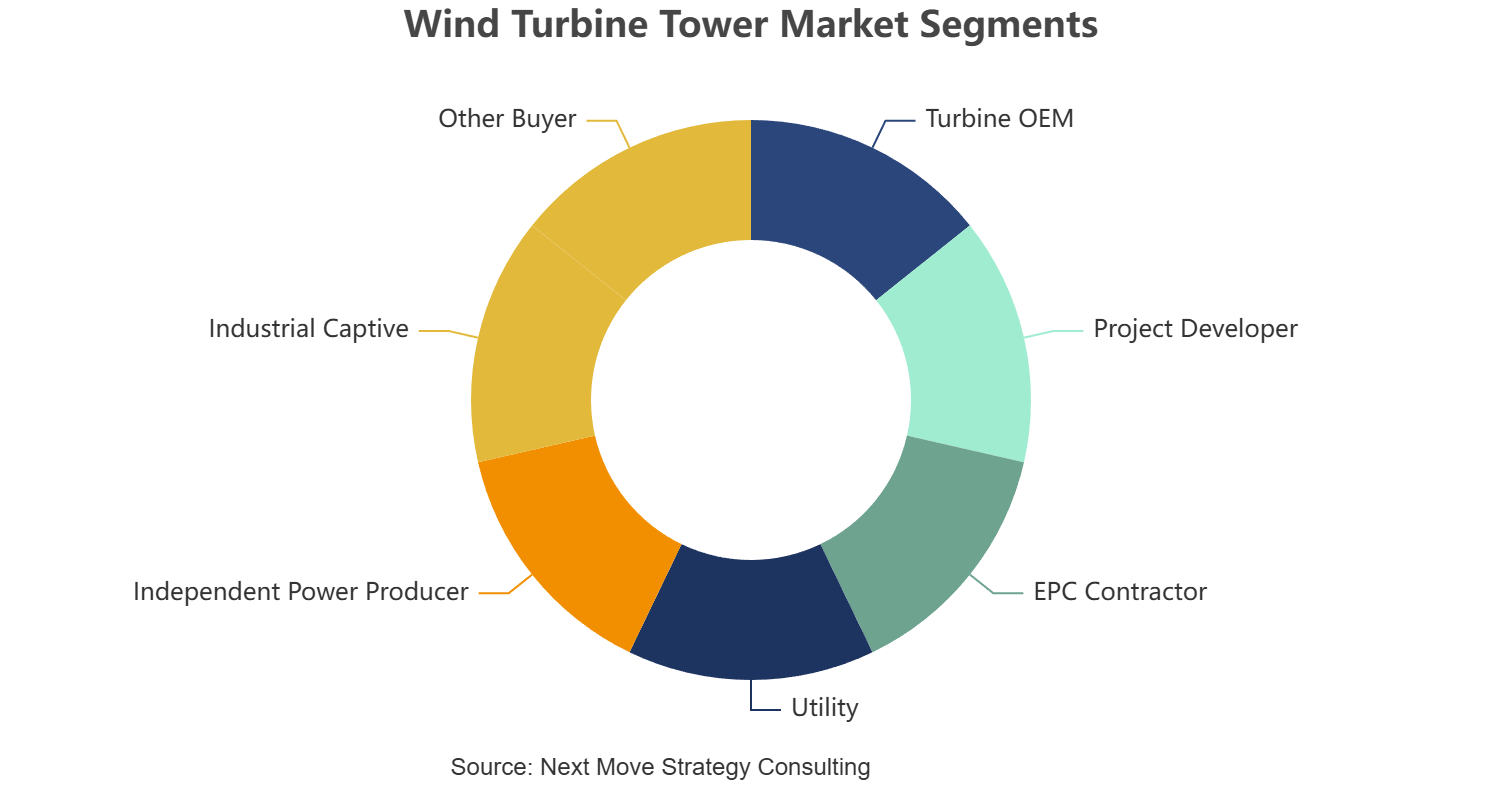
By Buyer Type: Project Developer held the largest share of approximately 31% (USD 10.01 Billion) in 2025; Independent Power Producer is the fastest-growing sub-segment at 12.7% CAGR from 2026–2035. |
|
By Sales Channel: Framework Agreement held the largest share of approximately 46% (USD 14.86 Billion) in 2025; Distributor or Agent is the fastest-growing sub-segment at 10.3% CAGR from 2026–2035. |
|
By End User: Utility Scale Wind Farm held the largest share of approximately 68% (USD 21.96 Billion) in 2025; Offshore Energy Project is the fastest-growing sub-segment at 18.6% CAGR from 2026–2035. |
|
Dominant Region: Asia-Pacific dominated with approximately 46% revenue share (USD 14.86 Billion) in 2025. |
|
Fastest-Growing Region: Middle East & Africa is expected to register the highest CAGR of 14.0% during 2026–2035. |
|
Dominant Country: China led with approximately USD 9.21 Billion in 2025. |
|
Fastest-Growing Country: Saudi Arabia is the fastest-growing country at approximately 15.8% CAGR from 2026–2035. |
Between 2026 and 2035, the Wind Turbine Tower Market is set to generate an absolute dollar opportunity of USD 35.87 Billion, positioning offshore-capable and taller-hub-height tower architectures as a compelling area for capital allocation.
According to our analysis, sustained investment in offshore fixed bottom and floating substructure capacity is reshaping procurement criteria for turbine OEMs and project developers, as local-content certification increasingly determines vendor shortlisting across North America, Europe, and Asia-Pacific markets.
What does the Wind Turbine Tower Market Encompass?
The market encompasses the structural support systems, ranging from tubular steel, concrete, hybrid steel-concrete, and lattice designs, that elevate wind turbine nacelles and rotors to optimal hub heights for energy capture. Our assessment indicates that the scope spans new tower supply and lifecycle services such as inspection, repair, retrofit, and surface protection, delivered to turbine OEMs, project developers, EPC contractors, and utilities across onshore and offshore deployment settings worldwide. The category has evolved from standardized tubular steel structures into a diversified portfolio of taller, hybrid, and floating-compatible designs, driven by rising hub heights, larger rotor diameters, and the expansion of offshore wind capacity.
Regulatory frameworks such as the U.S. Department of Energy's offshore wind permitting guidance and the European Union's Renewable Energy Directive shape structural certification and local-content requirements, while national grid codes increasingly influence tower foundation design standards. We observed that technology adoption is shifting toward hybrid steel-concrete and taller lattice-hybrid architectures that enable cost-effective scaling beyond 160 meters hub height. Next Move Strategy Consulting's analysis indicates that this structural shift, combined with offshore floating substructure commercialization, is redefining sourcing criteria across the Wind Turbine Tower Market.
|
Parameters |
Details |
|
Market Size in 2025 |
USD 32.30 Billion |
|
Market Size in 2026 |
USD 34.92 Billion |
|
Revenue Forecast in 2035 |
USD 70.79 Billion |
|
Growth Rate |
CAGR of 8.1% from 2026 to 2035 |
|
Analysis Period |
2025–2035 |
|
Base Year Considered |
2025 |
|
Forecast Period |
2026–2035 |
|
Market Size Estimation |
Revenue (USD Billion) |
|
Companies Profiled |
20 |
|
Countries Covered |
33 |
|
Market Share |
Available for Top 10 Companies |
Key Emerging Trends
Based on research conducted by Next Move Strategy Consulting, we found that four structural trends are reshaping product development, sourcing, and stakeholder engagement across the market.
How Is Floating Offshore Substructure Technology Transforming Deployment?
Floating offshore substructures are emerging as a commercially viable deployment format for deep-water wind sites previously inaccessible to fixed-bottom towers. We observed that developers are advancing semi-submersible and spar-buoy platforms capable of supporting turbines exceeding 12 MW in water depths beyond 60 meters. Project developers and EPC contractors are piloting these architectures off the coasts of France, Japan, and South Korea, positioning floating substructures as a premium, higher-margin category within the broader deployment segmentation structure.
Why Are Hybrid Steel-Concrete Towers Gaining Adoption for Taller Hub Heights?
Hybrid steel-concrete towers are gaining share as developers pursue hub heights beyond 160 meters to access stronger, more consistent wind resources at low-wind-speed inland sites. Our findings suggest that concrete lower sections reduce transportation constraints associated with oversized steel shells, allowing taller towers to be manufactured closer to project sites. Manufacturers such as GRI Renewable Industries and Welcon are expanding hybrid tower portfolios, reflecting rising demand for cost-effective height scaling across onshore wind projects.
How Is Repowering Reshaping Demand for Tower Retrofit and Life-Extension Services?
Repowering and life-extension programs are pushing operators to specify retrofit, inspection, and surface-protection services for aging onshore fleets approaching the end of their original design life. We observed that utilities and independent power producers increasingly favor structural upgrades over full replacement where foundation integrity permits, extending service life by 10 to 15 years. This trend is elevating demand for tower services among asset owners managing installed bases across North America and Europe.
What Role Does Localized Manufacturing Play in Wind Tower Supply Chains?
Localized manufacturing capacity is emerging as a strategic response to logistics constraints and domestic-content policy requirements across major wind markets. Our analysis shows that manufacturers are establishing production facilities closer to project sites to reduce oversized-load transportation costs and comply with local-content mandates. CS Wind's expansion of its Pueblo, Colorado facility exemplifies this direction, positioning the plant to serve growing U.S. demand while mitigating cross-border logistics and tariff exposure.
SUPPLY CHAIN STRUCTURE OF THE WIND TURBINE TOWER MARKET
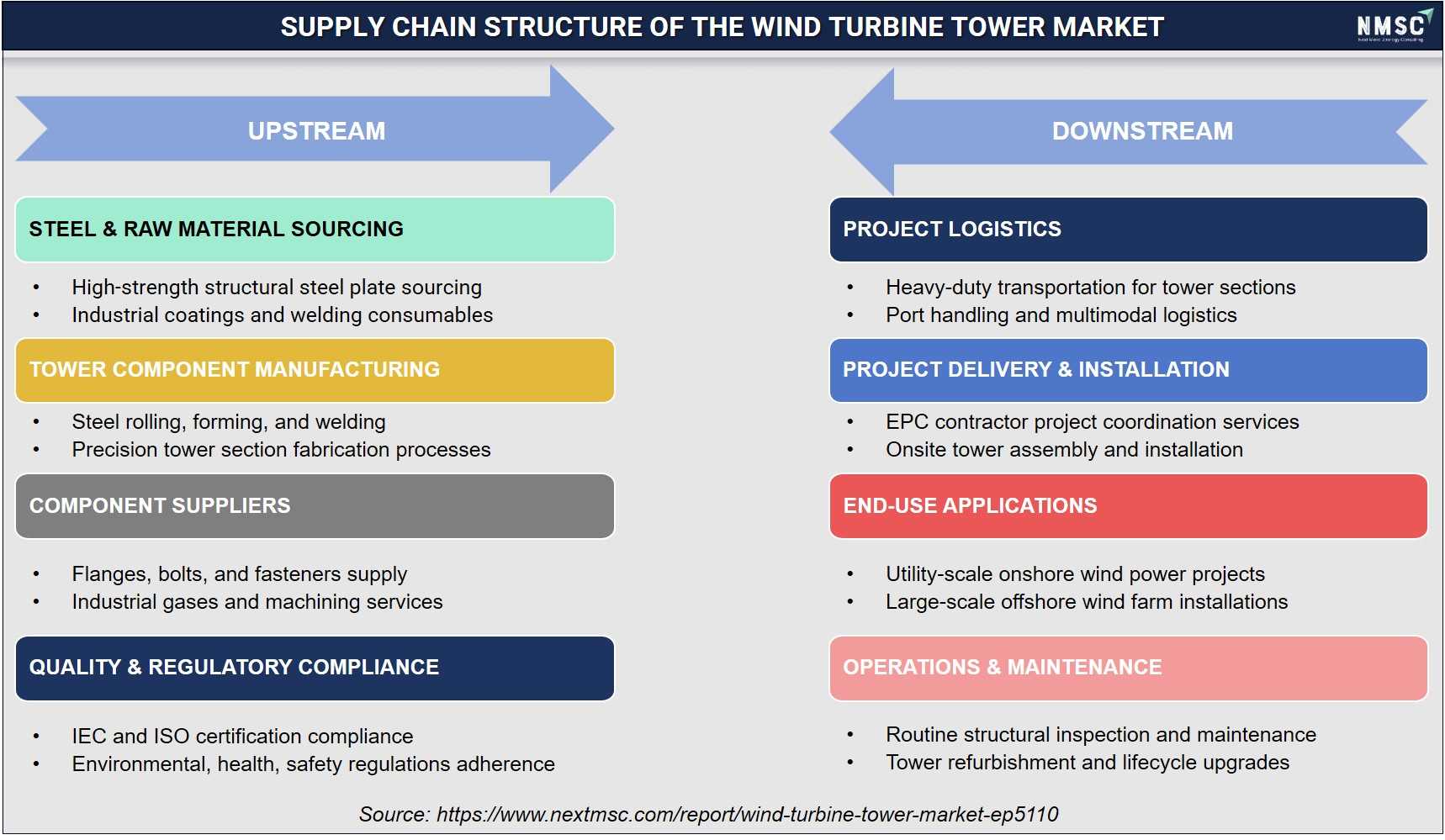
The wind turbine tower market supply chain begins with the procurement of high-strength structural steel, industrial coatings, and welding consumables required for manufacturing durable tower structures. These raw materials are processed through steel rolling, forming, welding, and precision fabrication to produce tower sections. Supporting component suppliers provide essential parts such as flanges, bolts, fasteners, industrial gases, and machining services, while strict compliance with IEC, ISO, and environmental, health, and safety regulations ensures product quality and reliability. Once manufactured, tower sections are transported through specialized heavy-duty logistics and port handling networks for delivery to project sites. EPC contractors then oversee tower assembly and installation for utility-scale onshore and offshore wind farms. Following commissioning, ongoing operations and maintenance including structural inspections, refurbishment, and lifecycle upgrades—help maximize turbine performance, operational efficiency, and asset longevity.
Growth Drivers and Restraints
Growth Catalyst and Risk Assessment Matrix
|
Factors |
Type |
(+/−) % Impact on CAGR |
Geographic Relevance |
Impact Timeline |
|
Global decarbonization targets and renewable portfolio standards |
Driver |
+2.3% |
Global |
2026-2035 |
|
Offshore wind capacity expansion across Asia-Pacific and Europe |
Driver |
+1.9% |
Asia-Pacific, Europe |
2026-2035 |
|
Repowering and life-extension of aging onshore wind fleets |
Driver |
+1.7% |
Europe, North America |
2026-2035 |
|
Rising hub heights and taller tower demand for low-wind-speed sites |
Driver |
+1.4% |
Global |
2026-2032 |
|
U.S. Advanced Manufacturing Production Credit under the Inflation Reduction Act |
Driver |
+1.2% |
North America |
2026-2032 |
|
Local-content and domestic manufacturing mandates |
Driver |
+1.0% |
Asia-Pacific, Latin America |
2026-2035 |
|
Steel price volatility and raw material cost pressure |
Restraint |
-1.5% |
Global |
2026-2035 |
|
Permitting delays and grid interconnection bottlenecks |
Restraint |
-1.1% |
North America, Europe |
2026-2032 |
|
Policy uncertainty around offshore wind subsidies and tariffs |
Restraint |
-0.9% |
North America |
2026-2030 |
What Is the Primary Growth Driver of the Wind Turbine Tower Market?
Global decarbonization targets and renewable portfolio standards are the primary driver of the market. The U.S. Energy Information Administration continues to track rising wind capacity additions as utilities pursue clean-energy procurement mandates, sustaining structural demand for new tower supply. We observed that this policy-driven momentum, reinforced by corporate renewable-energy procurement, continues to anchor baseline consumption of tubular steel and hybrid towers across developed and emerging economies alike.
How Is Offshore Wind Expansion Driving Wind Turbine Tower Industry Growth?
Offshore wind capacity expansion across Asia-Pacific and Europe is accelerating market growth toward fixed bottom and floating substructure formats. The European Commission's offshore renewable energy strategy and China's provincial offshore wind targets are pushing developers to specify larger-diameter, higher-tonnage tower and substructure systems. Our assessment indicates that this regulatory pressure, combined with turbine capacity scaling beyond 8 MW, is compressing manufacturing lead times for offshore-rated tower sections across Europe and Asia-Pacific.
What Is Restraining Wind Turbine Tower Market Expansion?
Volatility in steel plate pricing, tied to iron ore and scrap feedstock costs, restrains margin stability across the Wind Turbine Tower Market supply chain. The U.S. Energy Information Administration tracks recurring industrial commodity price swings that compress manufacturer margins and delay capital investment in new fabrication capacity. We found that smaller regional manufacturers face particular exposure, as limited scale reduces their ability to hedge steel procurement compared with larger, vertically integrated tower groups.
Segmentation Analysis
Segment Sizing: By New Tower Supply
|
Segment |
2025 (USD) |
2035 (USD) |
CAGR% (2026–2035) |
|
Tubular Steel Tower |
USD 19.70 Billion |
USD 38.93 Billion |
6.9% |
|
Concrete Tower |
USD 4.85 Billion |
USD 11.33 Billion |
9.0% |
|
Hybrid Steel Concrete Tower |
USD 3.55 Billion |
USD 10.62 Billion |
12.0% |
|
Lattice Tower |
USD 2.91 Billion |
USD 7.08 Billion |
9.4% |
|
Other Tower |
USD 1.29 Billion |
USD 2.83 Billion |
8.2% |
|
Total |
USD 32.30 Billion |
USD 70.79 Billion |
8.1% |
Which Tower Type Dominates the Wind Turbine Tower Market?
Tubular Steel Tower remained the dominant new tower supply category across the market, valued at USD 19.70 Billion in 2025 on established fabrication infrastructure and proven structural performance across onshore projects. Our findings suggest that Hybrid Steel Concrete Tower is the fastest-growing sub-segment, registering a 12.0% CAGR from 2026 to 2035, as developers increasingly specify hybrid designs to reach taller hub heights cost-effectively at low-wind-speed inland sites without exceeding oversized-load transportation limits.
Segment Sizing: By Deployment
|
Segment |
2025 (USD) |
2035 (USD) |
CAGR% (2026–2035) |
|
Onshore |
USD 24.23 Billion |
USD 43.89 Billion |
5.9% |
|
Offshore Fixed Bottom |
USD 6.46 Billion |
USD 18.41 Billion |
11.4% |
|
Offshore Floating |
USD 1.29 Billion |
USD 7.08 Billion |
19.8% |
|
Other Deployment |
USD 323 Million |
USD 1.42 Billion |
16.8% |
|
Total |
USD 32.30 Billion |
USD 70.79 Billion |
8.1% |
Which Deployment Setting Leads the Wind Turbine Tower Market?
Onshore deployment led the Wind Turbine Tower Market, valued at USD 24.23 Billion in 2025, supported by mature permitting frameworks and lower installation costs relative to offshore projects. Based on research conducted by Next Move Strategy Consulting, we found that Offshore Floating is the fastest-growing deployment format, expanding at a 19.8% CAGR from 2026 to 2035, as pilot-scale floating wind farms in France, Japan, and South Korea transition toward commercial deployment.
Segment Sizing: By Turbine Capacity Class
|
Segment |
2025 (USD) |
2035 (USD) |
CAGR% (2026–2035) |
|
Less Than 1 MW |
USD 969 Million |
USD 708 Million |
-4.3% |
|
1 To 3 MW |
USD 7.11 Billion |
USD 9.91 Billion |
2.9% |
|
3 To 5 MW |
USD 12.92 Billion |
USD 22.65 Billion |
5.5% |
|
5 To 8 MW |
USD 8.40 Billion |
USD 23.36 Billion |
11.1% |
|
More Than 8 MW |
USD 2.91 Billion |
USD 14.16 Billion |
18.2% |
|
Total |
USD 32.30 Billion |
USD 70.79 Billion |
8.1% |
Which Turbine Capacity Class Drives the Most Tower Demand?
The 3 To 5 MW capacity class generated the largest tower demand across the Wind Turbine Tower Market, valued at USD 12.92 Billion in 2025 on widespread deployment across established onshore markets. Our analysis shows that More Than 8 MW is the fastest-growing capacity class, registering an 18.2% CAGR from 2026 to 2035, reflecting the industry's structural shift toward larger offshore-rated turbines that require correspondingly taller, higher-tonnage tower sections.
Growth Opportunities
Our analysis shows that three forward-looking opportunities stand out for stakeholders positioning within the Wind Turbine Tower Market over the 2026-2035 forecast period.
How Are Floating Substructure Platforms Creating Opportunities for Offshore Developers?
Floating substructure platforms present a whitespace opportunity for offshore project developers and independent power producers seeking to unlock deep-water wind resources. Suppliers that commercialize scalable semi-submersible and spar-buoy designs stand to capture recurring component sales as developers advance floating projects across France, Japan, South Korea, and the U.S. West Coast, particularly among offshore energy projects seeking differentiated, deep-water deployment formats.
Why Are Retrofit and Life-Extension Services Emerging as a Growth Opportunity for Asset Owners?
Utilities and independent power producers managing aging onshore fleets represent an underpenetrated opportunity for retrofit, inspection, and surface-protection service providers. Manufacturers that develop validated structural upgrade packages for towers approaching end-of-design-life can secure long-term service contracts with utility and industrial captive end users, benefiting from recurring replacement-cycle revenue tied to repowering programs.
How Are Localized Manufacturing Hubs Unlocking Opportunities for Regional Suppliers?
Local-content mandates across Asia-Pacific and Latin America create an opportunity for regional tower fabricators and joint-venture partners offering domestically manufactured tower sections. Early movers that establish production capacity aligned with national content requirements can differentiate with project developers and EPC contractors pursuing compliant, logistics-efficient supply chains across their regional project portfolios.
PESTEL ANALYSIS OF THE WIND TURBINE TOWER INDUSTRY
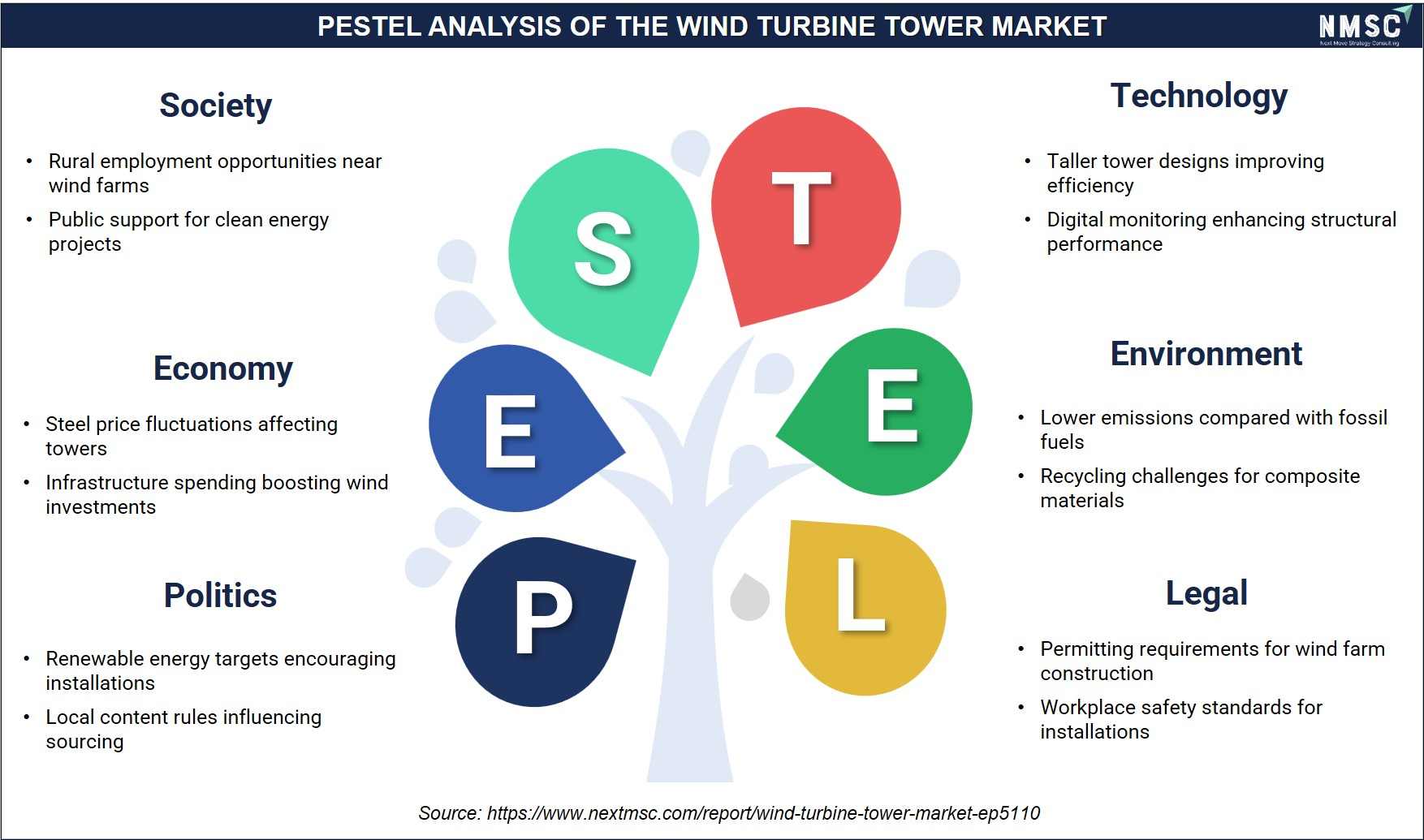
The PESTEL analysis of the Wind Turbine Tower Market evaluates the external factors influencing industry growth. Government renewable energy policies, investment trends, and increasing demand for clean energy drive market expansion. Technological advancements in taller and modular towers improve efficiency, while environmental sustainability goals accelerate adoption. Compliance with international standards, safety regulations, and permitting requirements also plays a critical role in supporting innovation, project development, and long-term market growth.
Regional Outlook
Geographic Performance Snapshot
|
Region |
2025 (USD) |
2035 (USD) |
CAGR% (2026–2035) |
Key Driver |
|
North America |
USD 5.81 Billion |
USD 9.91 Billion |
5.2% |
IRA-linked manufacturing credits and utility-scale wind procurement |
|
Europe |
USD 7.75 Billion |
USD 14.16 Billion |
6.0% |
EU offshore wind strategy and Renewable Energy Directive targets |
|
Asia-Pacific |
USD 14.86 Billion |
USD 33.98 Billion |
8.7% |
China's provincial offshore targets and expanding manufacturing base |
|
Middle East & Africa |
USD 1.62 Billion |
USD 5.66 Billion |
14.0% |
Vision 2030-linked diversification and utility-scale wind tenders |
|
Latin America |
USD 2.26 Billion |
USD 7.08 Billion |
12.5% |
Brazil's expanding onshore wind pipeline and grid auctions |
|
Total |
USD 32.30 Billion |
USD 70.79 Billion |
8.1% |
— |
North America Wind Turbine Tower Market Outlook
North America maintains an established manufacturing base supported by Advanced Manufacturing Production Credit incentives under the Inflation Reduction Act. We observed that domestic content requirements sustain demand for locally fabricated tubular steel towers, while developers increasingly specify taller hybrid designs to access stronger inland wind resources. Technology adoption remains advanced, with utilities and EPC contractors driving demand for repowering and retrofit services across the region's maturing onshore fleet.
Europe Wind Turbine Tower Market Outlook
Europe's market is shaped by an ambitious offshore wind buildout supported by the EU's Renewable Energy Directive and national offshore leasing programs. Our assessment indicates that Germany, the UK, and France anchor regional demand for offshore fixed bottom and floating substructure capacity, while regulatory pressure accelerates local-content sourcing. Technology adoption favors larger-diameter offshore-rated towers, and competitive intensity remains high among established European fabricators.
Asia-Pacific Wind Turbine Tower Market Outlook
Asia-Pacific leads the market with China's expanding manufacturing base and provincial offshore wind targets driving the largest regional demand pool. We found that India, Japan, and South Korea are scaling both onshore and offshore capacity additions, supported by national renewable energy targets. Technology adoption is advancing rapidly, with regional fabricators investing in larger-diameter production lines to serve export and domestic offshore demand.
Middle East & Africa Wind Turbine Tower Market Outlook
The Middle East & Africa region is emerging as the fastest-growing Wind Turbine Tower Market, driven by Vision 2030-linked diversification programs and expanding utility-scale wind tenders. Our findings suggest that Saudi Arabia and the UAE are advancing large-scale onshore wind auctions, while South Africa's renewable energy procurement program sustains steady demand. Regulatory influence is developing, and technology penetration is improving as regional developers partner with established international tower suppliers.
Latin America Wind Turbine Tower Market Outlook
Latin America's Wind Turbine Tower Market benefits from Brazil's expanding onshore wind pipeline and competitive grid auction mechanisms that continue to attract new project development. We observed that Argentina's renewable energy auctions and Chile's grid modernization efforts support steady regional demand for tubular steel and lattice towers. Technology adoption remains focused on proven onshore designs, and competitive intensity is moderate among regional and international suppliers serving the region.
United States Wind Turbine Tower Market
Based on our engagements, the U.S. market was valued at approximately USD 4.53 Billion in 2025, projected to reach USD 7.43 Billion by 2035 at a 4.7% CAGR. Demand structure is anchored by Advanced Manufacturing Production Credit incentives that favor domestically fabricated towers. Regulatory influence remains strong under Inflation Reduction Act provisions, technology penetration favors tubular steel and hybrid designs, and competitive intensity is elevated among localized manufacturers such as CS Wind and Arcosa.
Canada Wind Turbine Tower Market
Through our analysis, Canada's market reached approximately USD 870 Million in 2025 and is projected to reach USD 1.59 Billion by 2035, registering a 6.0% CAGR. Demand is underpinned by provincial renewable procurement targets and grid modernization investment across Ontario and Alberta. Regulatory influence stems from federal clean-electricity standards, technology penetration favors standard tubular steel towers, and competitive intensity remains moderate among regional fabricators serving cross-border supply chains.
United Kingdom Wind Turbine Tower Market
From our assessment, the UK market was valued near USD 1.55 Billion in 2025, projected to reach USD 2.83 Billion by 2035 at a 6.0% CAGR. Demand structure is shaped by an established offshore wind leasing program and government-backed Contracts for Difference auctions. Regulatory influence remains high, technology penetration is advanced toward offshore fixed bottom substructures, and competitive intensity is elevated among European tower fabricators serving North Sea projects.
Germany Wind Turbine Tower Market
According to evaluation, Germany's market reached roughly USD 1.94 Billion in 2025 and is expected to hit USD 3.40 Billion by 2035, growing at a 5.5% CAGR. Demand is driven by the EU Renewable Energy Directive and Germany's onshore repowering pipeline. Regulatory influence is developing under federal wind energy area targets, and technology penetration is advancing as domestic fabricators scale hybrid tower production.
France Wind Turbine Tower Market
Based on our engagements, France's market stood at about USD 1.09 Billion in 2025, forecast to reach USD 2.12 Billion by 2035 at a 6.8% CAGR. Demand structure reflects France's floating offshore wind pilot program and expanding onshore auction pipeline. Regulatory influence remains strong under national offshore leasing rounds, technology penetration is advancing toward floating substructures, and competitive intensity is rising among European and Asian fabricators.
China Wind Turbine Tower Market
Through our analysis, China's Wind Turbine Tower Market reached approximately USD 9.21 Billion in 2025 and is projected to reach USD 19.71 Billion by 2035, registering a 7.9% CAGR. Demand is underpinned by provincial offshore wind targets and the world's largest domestic manufacturing base. Regulatory influence stems from national renewable portfolio mandates, technology penetration favors large-diameter offshore towers, and competitive intensity remains high among domestic fabricators.
India Wind Turbine Tower Market
From our assessment, India's Wind Turbine Tower Market was valued near USD 1.19 Billion in 2025, projected to reach USD 4.42 Billion by 2035 at a 14.7% CAGR. Demand structure is supported by national wind-solar hybrid procurement targets and expanding auction capacity. Regulatory influence remains significant under state renewable purchase obligations, technology penetration is advancing toward taller hub heights, and competitive intensity is centered on domestic and regional fabricators.
Japan Wind Turbine Tower Market
According to evaluation, Japan's market reached roughly USD 1.04 Billion in 2025 and is expected to hit USD 1.70 Billion by 2035, growing at a 4.7% CAGR. Demand is driven by government-backed offshore wind auction rounds and floating pilot projects. Regulatory influence is developing under the Ports and Harbors Act offshore provisions, and technology penetration is advancing toward floating substructure designs.
South Korea Wind Turbine Tower Market
Based on our engagements, South Korea's market stood at about USD 669 Million in 2025, forecast to reach USD 1.36 Billion by 2035 at a 7.3% CAGR. Demand structure reflects national offshore wind roadmap targets and expanding floating pilot capacity off Ulsan. Regulatory influence remains strong under the Renewable Portfolio Standard, and technology penetration favors offshore fixed bottom and floating designs.
Australia Wind Turbine Tower Market
Through our analysis, Australia's market reached approximately USD 669 Million in 2025 and is projected to reach USD 1.53 Billion by 2035, registering an 8.7% CAGR. Demand is underpinned by state renewable energy zones and expanding offshore wind declared areas. Regulatory influence stems from national electricity market reforms, and competitive intensity remains moderate among regional and international fabricators.
UAE Wind Turbine Tower Market
From our assessment, the UAE market was valued near USD 275 Million in 2025, projected to reach USD 963 Million by 2035 at a 14.0% CAGR. Demand structure is supported by national energy diversification strategy targets and expanding utility-scale renewable tenders. Regulatory influence remains moderate, technology penetration is improving through imported tower designs, and competitive intensity is rising as developers expand project pipelines.
Saudi Arabia Wind Turbine Tower Market
According to evaluation, Saudi Arabia's market reached roughly USD 420 Million in 2025 and is expected to hit USD 1.70 Billion by 2035, growing at a 15.8% CAGR. Demand is driven by Vision 2030-linked renewable energy targets and large-scale onshore wind auction rounds. Regulatory influence is developing under Saudi Standards, Metrology and Quality Organization guidelines, and technology penetration is advancing as domestic fabricators scale production.
South Africa Wind Turbine Tower Market
Based on our engagements, South Africa's market stood at about USD 355 Million in 2025, forecast to reach USD 1.13 Billion by 2035 at a 12.8% CAGR. Demand structure reflects the Renewable Energy Independent Power Producer Procurement Programme's ongoing auction rounds. Regulatory influence remains moderate, technology penetration is gradually improving, and competitive intensity is limited given reliance on imported tower components.
Brazil Wind Turbine Tower Market
Through our analysis, Brazil's Wind Turbine Tower Market reached approximately USD 1.31 Billion in 2025 and is projected to reach USD 3.89 Billion by 2035, registering an 11.9% CAGR. Demand is underpinned by Brazil's large domestic onshore wind pipeline and competitive grid auction mechanisms. Regulatory influence stems from national energy planning targets, technology penetration favors standard tubular steel towers, and competitive intensity remains moderate among regional fabricators.
Argentina Wind Turbine Tower Market
From our assessment, Argentina's Wind Turbine Tower Market was valued near USD 339 Million in 2025, projected to reach USD 991 Million by 2035 at an 11.7% CAGR. Demand structure is supported by RenovAr renewable auction program legacy contracts and steady grid modernization investment. Regulatory influence remains limited amid macroeconomic volatility, technology penetration is modest, and competitive intensity is centered on a small number of regional fabricators.
Competitive Landscape
We observed that the Wind Turbine Tower Market features a moderately consolidated competitive landscape, with global tower specialists competing alongside regional Asian and European fabricators on scale, cost, and local-content compliance.
|
Key Takeaways |
|
Market Structure: Moderately consolidated; the top companies profiled in this report collectively account for a majority of global Wind Turbine Tower Market revenue, while numerous regional Asian and Latin American fabricators serve cost-sensitive onshore demand. |
|
Innovation Focus: Hybrid steel-concrete tower architectures, floating offshore substructure development, and taller hub-height engineering dominate current innovation pipelines across leading suppliers. |
|
M&A Activity: Selective consolidation and portfolio restructuring, exemplified by CRH's announced acquisition of Arcosa and Broadwind's strategic exit from wind tower manufacturing. |
How Do Companies Compete in the Wind Turbine Tower Industry?
Companies compete primarily on manufacturing scale, local-content compliance, and offshore-rated fabrication capability across the Wind Turbine Tower Market. Global players such as CS Wind Corporation and GRI Renewable Industries leverage multi-continent production footprints to serve turbine OEMs and developers under long-term framework agreements, while regional Chinese converters compete on cost efficiency and rapid delivery for standard onshore tower formats supplied to smaller project developers.
Which Competitive Archetypes Dominate the Wind Turbine Tower Market?
Two archetypes dominate the market: diversified global fabricators offering multi-continent production and offshore-rated engineering support, and specialized regional manufacturers focused on cost-competitive onshore tower supply. CS Wind Corporation and Arcosa, Inc. exemplify the diversified archetype through localized manufacturing footprints, while Qingdao Wuxiao Group and TSP Wind Power Group exemplify the regional cost-leadership archetype serving Asia-Pacific export demand.
How Are Companies Differentiating Through Innovation in Wind Turbine Towers?
Innovation and differentiation strategy increasingly center on hybrid tower engineering and offshore substructure capability. GRI Renewable Industries' Windtechnic hybrid tower platform and its Baltic Towers offshore joint venture in Poland both extend fabrication capability toward taller and offshore-rated designs. Our analysis shows that suppliers unable to demonstrate offshore-rated fabrication capacity risk exclusion from developer request-for-proposal shortlists in Europe and Asia-Pacific.
What M&A and Expansion Activity Is Shaping the Wind Turbine Tower Market?
Mergers, acquisitions, and portfolio restructuring continue to reshape competitive positioning within the market. CRH's announced $8.5 billion acquisition of Arcosa consolidates wind tower and engineered structures capability within a larger infrastructure platform, while Broadwind's divestiture of its Abilene facility illustrates how smaller diversified manufacturers are exiting wind towers to focus on higher-margin precision manufacturing markets.
Key Market Players
Our assessment indicates that the following 20 companies represent the validated competitive set actively shaping product innovation, capacity expansion, and offshore fabrication strategy within the global Wind Turbine Tower Market.
-
CS Wind Corporation
-
GRI Renewable Industries, S.L.
-
Windar Renovables, S.L.U.
-
Welcon A/S
-
Dajin Heavy Industry Co., Ltd.
-
Arcosa, Inc.
-
Titan Wind Operational Support ApS
-
TSP Wind Power Group Co., Ltd.
-
Qingdao Wuxiao Group Co., Ltd.
-
Qingdao Tianneng Heavy Industries Co., Ltd.
-
Marmen Inc.
-
Broadwind, Inc. (exited wind tower manufacturing in 2026; profiled for historical positioning)
-
KGW Schweriner Maschinen- und Anlagenbau GmbH
-
Dongkuk S&C Co., Ltd.
-
Jiangsu Haili Wind Power Equipment Technology Co., Ltd.
-
SPECO Co., Ltd.
-
Ventower Industries LLC
-
Shanghai Fengling Renewables Co., Ltd.
-
Sutong Shipping Group Co., Ltd.
-
Qingdao Qiangli Steel Structure Co., Ltd.
Latest Developments
We found that recent M&A and capacity developments within the Wind Turbine Tower Market are concentrated on portfolio consolidation and offshore fabrication expansion, reflecting the industry's structural shift toward larger, higher-value projects.
|
Date |
Event |
|
May 2025 |
Windar Renovables celebrated the groundbreaking of its new XXL offshore wind tower manufacturing plant in Szczecin, Poland. The factory will manufacture next-generation offshore wind turbine towers and is expected to begin production in 2026, strengthening the European offshore wind supply chain. |
|
March 2025 |
GRI Renewable Industries acquired a 45% stake in Windtechnic Engineering. The acquisition expands GRI's capabilities into hybrid and concrete wind tower technologies, enabling the company to address the growing demand for taller onshore wind turbine towers. |
Expert Insights

“Having this stamp of approval for one of the largest onshore turbines available is a great leap forward. Our modular wind turbine towers dramatically reduce CO₂ emissions by replacing steel and concrete with wood, while enabling highly efficient, taller installations without transport bottlenecks.”
— Otto Lundman, CEO, Modvion
Statement made following TÜV SÜD's third-party design approval of Modvion's modular wooden wind turbine tower for large onshore wind turbines (March 2025).
Market Interpretation
This statement highlights a key innovation shaping the Wind Turbine Tower Market the shift toward modular, low-carbon tower technologies. As wind turbines continue to increase in size, conventional steel towers face transportation and installation constraints. Modvion's engineered wood-based modular towers offer a sustainable alternative by reducing lifecycle CO₂ emissions while enabling greater hub heights and easier logistics. This advancement is expected to support the deployment of larger, more efficient onshore wind projects and drive innovation in next-generation tower manufacturing.
Investment Opportunities
What Capital Inflows Are Targeting the Wind Turbine Tower Industry?
Capital inflows into the Wind Turbine Tower Market are increasingly directed toward offshore-rated fabrication capacity and portfolio consolidation. Strategic acquirers continue to fund infrastructure-platform integration, as seen in CRH's announced USD 8.5 billion acquisition of Arcosa. We observed that investors favor suppliers demonstrating offshore fabrication scale and backlog visibility, viewing long-term framework agreements as a proxy for durable revenue retention with turbine OEMs and developers.
How Is Infrastructure Investment Supporting Wind Turbine Tower Manufacturing?
Infrastructure investment is expanding fabrication and offshore-substructure assembly capacity across Asia-Pacific and Europe, particularly in China and Poland, to serve rising domestic and export demand. Our findings suggest that regional fabricators are investing in larger-diameter rolling and welding lines to accommodate tower sections for turbines exceeding 8 MW, supporting the precision required for offshore fixed bottom and floating substructure formats.
What ESG Considerations Are Shaping Wind Turbine Tower Investment Decisions?
Environmental, social, and governance considerations are central to investment decisions across the Wind Turbine Tower Market, with low-carbon steel sourcing and community employment impact serving as key evaluation criteria. The U.S. Environmental Protection Agency's industrial emissions data continues to inform manufacturer sustainability disclosures. We found that investors increasingly favor manufacturers demonstrating localized job creation and low-carbon steel partnerships, treating these as governance indicators alongside safety compliance.
Key Benefits for Stakeholders
How Does This Report Benefit Enterprise and Industry Leaders?
Enterprise and industry leaders gain access to validated segmentation, competitive benchmarking, and regional demand forecasts that support sourcing and capacity-planning decisions across the Wind Turbine Tower Market. Our analysis shows that detailed deployment, turbine capacity class, and buyer type breakdowns help procurement teams align specifications with local-content and offshore-readiness requirements while identifying underserved regional segments for portfolio expansion.
How Does This Report Benefit Investors and Financial Analysts?
Investors and financial analysts benefit from consistent, single-point market size and CAGR estimates that support valuation and capital-allocation decisions across the Wind Turbine Tower Market supply chain. We observed that the report's regional and segment-level growth differentials help identify which fabricators are best positioned to capture above-market growth in offshore and taller hub-height tower categories through 2035.
How Does This Report Benefit Technology Vendors and Product Teams?
Technology vendors and product teams gain insight into emerging design requirements, including hybrid tower engineering, floating substructure platforms, and local-content-compliant manufacturing, that are reshaping the Wind Turbine Tower Market. Our findings suggest that this analysis helps R&D teams prioritize development roadmaps around offshore-rated fabrication and taller hub-height structural systems increasingly required by developer request-for-proposal processes.
Key Market Segments
By New Tower Supply
-
Tubular Steel Tower
-
Concrete Tower
-
Precast Segmental
-
Cast In Place
-
-
Hybrid Steel Concrete Tower
-
Steel Base Concrete Upper
-
Concrete Base Steel Upper
-
-
Lattice Tower
-
Other Tower
By Tower Services
-
Inspection
-
Repair
-
Retrofit
-
Surface Protection
-
Installation Support
-
Other Services
By Deployment
-
Onshore
-
Offshore Fixed Bottom
-
Offshore Floating
-
Other Deployment
By Turbine Capacity Class
-
Less Than 1 MW
-
1 To 3 MW
-
3 To 5 MW
-
5 To 8 MW
-
More Than 8 MW
By Buyer Type
-
Turbine OEM
-
Project Developer
-
EPC Contractor
-
Utility
-
Independent Power Producer
-
Industrial Captive
-
Other Buyer
By Sales Channel
-
Direct
-
Framework Agreement
-
Distributor or Agent
-
Captive Transfer
By End User
-
Utility Scale Wind Farm
-
Commercial and Industrial Wind Project
-
Community Wind Project
-
Government Wind Project
-
Offshore Energy Project
-
Other End User
By Region
-
North America: U.S., Canada, Mexico
-
Europe: UK, Germany, France, Italy, Spain, Sweden, Denmark, Finland, Netherlands, Rest of Europe
-
Asia-Pacific: China, India, Japan, South Korea, Taiwan, Indonesia, Vietnam, Australia, Philippines, Malaysia
-
Middle East & Africa: Saudi Arabia, UAE, Egypt, Israel, Turkey, Nigeria, South Africa, Rest of MEA
-
Latin America: Brazil, Argentina, Chile, Colombia, Rest of LATAM
Conclusion and Recommendations
What Is the Long-Term Outlook for the Wind Turbine Tower Market?
The long-term outlook for the Wind Turbine Tower Market remains positive, with global revenue projected to more than double from USD 32.30 billion in 2025 to USD 70.79 billion by 2035 at an 8.1% CAGR. We observed that sustained decarbonization policy, offshore wind expansion, and repowering-driven service demand will continue underpinning growth across onshore and offshore deployment through the forecast period.
What Strategic Positioning Should Wind Tower Suppliers Pursue?
Suppliers should prioritize offshore-rated fabrication capability while pursuing local-content compliance to secure long-term developer and turbine OEM contracts. Our assessment indicates that manufacturers investing early in hybrid tower engineering and floating substructure capability will be best positioned to capture premium pricing within the Wind Turbine Tower Market.
How Attractive Is the Wind Turbine Tower Market for New Investment?
The Wind Turbine Tower Market presents an attractive investment case, supported by a USD 35.87 billion absolute dollar opportunity between 2026 and 2035 and above-average growth in Middle East & Africa and offshore deployment categories. We found that investment attractiveness is highest for fabricators combining offshore-rated scale with local-content compliance, positioning them to serve both cost-sensitive onshore and premium offshore developer segments simultaneously.
What Market Shifts and Key Risks Should Stakeholders Monitor?
Stakeholders should monitor steel-price volatility, permitting and interconnection delays, and policy uncertainty around offshore subsidies as key risks to the Wind Turbine Tower Market. Our analysis shows that suppliers unable to adapt to local-content specifications risk losing contract awards to competitors with certified domestic manufacturing platforms, particularly within North America's increasingly incentive-linked procurement environment.
What Are the Key Growth Pathways for the Wind Turbine Tower Market?
Key growth pathways include expanding offshore fixed bottom and floating substructure portfolios, scaling hybrid tower manufacturing capacity, and deepening penetration into repowering and retrofit service channels. Next Move Strategy Consulting's analysis indicates that suppliers pursuing these pathways while maintaining cost competitiveness in standard onshore tower categories will be best positioned to capture the Wind Turbine Tower Market's projected growth through 2035.
About the Author
 Liza Phukan
— Liza Phukan is Research Associate at Next Move Strategy Consulting, where she has covered emerging industries and market research across sectors for 3.5 years. Her work includes analyzing industry developments, validating market data, and developing structured business content from research findings. She uses secondary research and data-validation practices to turn complex market information into clear decision-useful market analysis for business audiences and support report development and B2B.
Liza Phukan
— Liza Phukan is Research Associate at Next Move Strategy Consulting, where she has covered emerging industries and market research across sectors for 3.5 years. Her work includes analyzing industry developments, validating market data, and developing structured business content from research findings. She uses secondary research and data-validation practices to turn complex market information into clear decision-useful market analysis for business audiences and support report development and B2B.
About the Reviewer
 Supradip Baul
— Supradip Baul is an accomplished business consultant and strategist with over a decade of rich experience in market intelligence, strategy, technology, and business transformation. His work has included rigorous qualitative and quantitative analysis across multiple industries, helping clients shape investment decisions and long-term roadmaps. Earlier in his career, he was associated with Gartner, where he contributed to industry-leading reports and market share analyses. He has worked with leading global companies and holds an MBA with a dual specialization in Marketing and Finance.
Supradip Baul
— Supradip Baul is an accomplished business consultant and strategist with over a decade of rich experience in market intelligence, strategy, technology, and business transformation. His work has included rigorous qualitative and quantitative analysis across multiple industries, helping clients shape investment decisions and long-term roadmaps. Earlier in his career, he was associated with Gartner, where he contributed to industry-leading reports and market share analyses. He has worked with leading global companies and holds an MBA with a dual specialization in Marketing and Finance.
At Next Move Strategy Consulting, we understand that insightful market research is the cornerstone of successful business decisions. That's why we employ a robust and multifaceted approach, combining various methodologies to deliver the most accurate and actionable data for our clients.

Research Landscape
We navigate the world of research with two primary approaches:
Qualitative Approach
Our qualitative research methodologies involve immersive techniques such as in-depth interviews, focus groups, and observational studies. By engaging directly with individuals and stakeholders, we uncover valuable insights that quantitative data alone may overlook.

Quantitative Research
In tandem with qualitative methodologies, NMSC leverages the power of Quantitative Research to provide a robust foundation of numerical insights. Through systematic data collection and analysis, we quantify patterns, preferences, and market trends, offering a comprehensive view of the business landscape.
Our quantitative research approach employs diverse tools, including surveys, experiments, and statistical modelling. These methodologies enable us to gather data from a large and representative sample, ensuring the statistical significance of our findings. By employing structured questionnaires and standardized data collection methods, we guarantee the reliability and validity of the information we present to our clients.
Quantitative research is particularly effective in measuring the prevalence of trends, assessing market size, and gauging the impact of various factors on consumer behavior. The numerical precision attained through this approach equips our clients with actionable insights, facilitating data-driven decision-making and strategy formulation.


Our Specialized Toolbox for Industry-Specific Market Research
We deploy a specialized arsenal of techniques tailored to meet your unique requirements. Here's a glimpse into our comprehensive toolbox:

Information Procurement
The stage entails acquiring market data or relevant information through various sources and methodologies.


Market Research Approach
We utilize both top-down and bottom-up approaches in market research analysis to achieve a comprehensive understanding of the market dynamics, leveraging the broad perspective of industry trends and macroeconomic factors alongside detailed insights from specific segments and individual companies.

Porters Five Forces Analysis
We conduct Porter's Five Forces analysis to evaluate the competitive landscape of an industry, providing us with insights into factors that affect profitability and strategic positioning.

SWOT Analysis

Forecasting
We utilize a forecasting model to predict future consumption by considering parameters like population, economics, regulations, market competition, drivers, constraints, technology, and pricing. We also employ statistical techniques such as multilinear regression, exponential smoothing, moving average, ARIMA, and Monte Carlo simulations for accurate predictions. In econometric forecasting, we analyzed short-term and long-term event impacts, attributing values based on regulatory frameworks, economic factors, and market events.





 Speak to Our Analyst