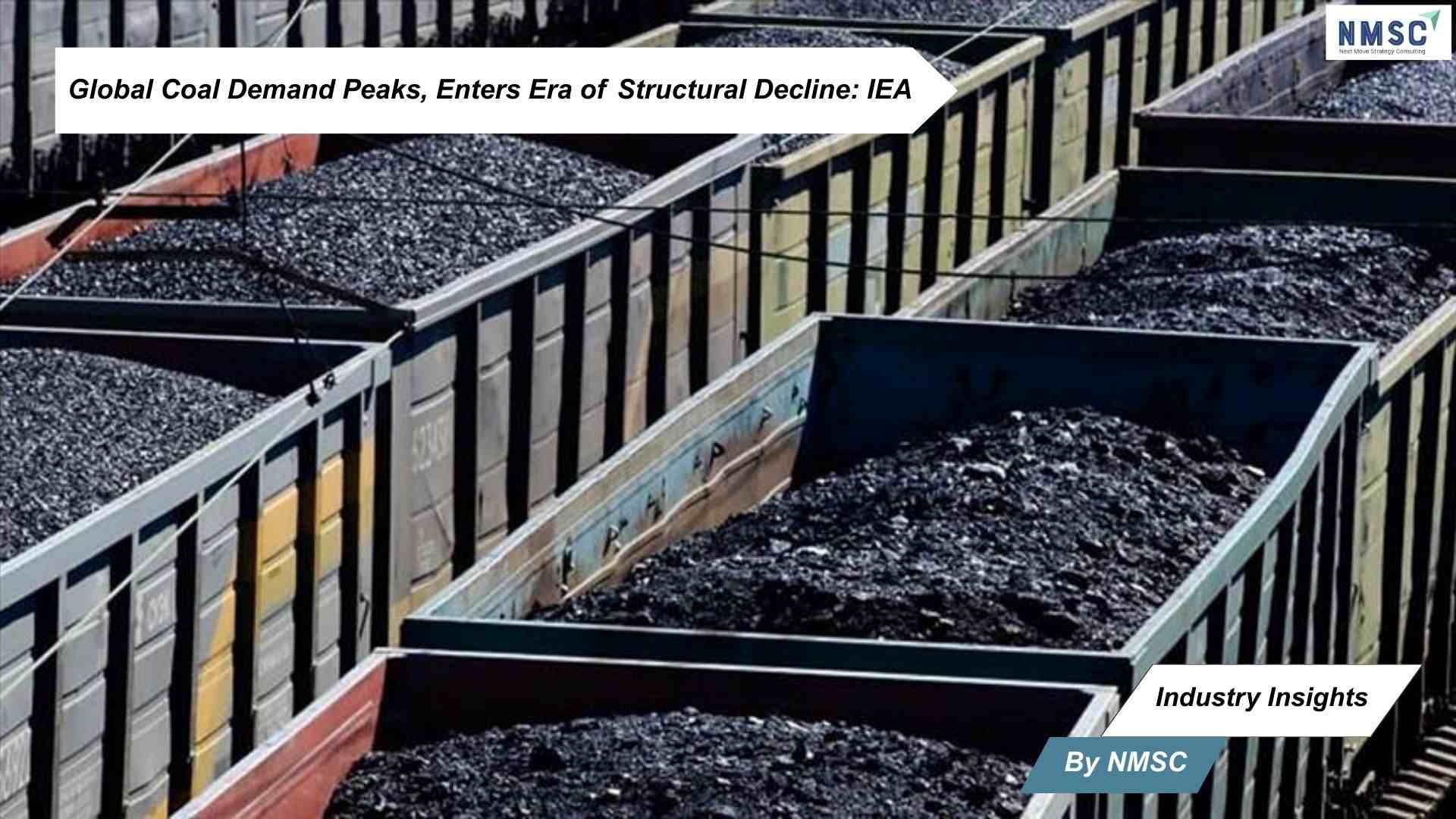
Global Coal Demand Peaks, Enters Era of Structural Decline: IEA
Industry Insights from Next Move Strategy Consulting
A new report from the International Energy Agency (IEA) signals a historic inflection point for the world's most polluting fossil fuel, forecasting that global coal demand has hit a ceiling and will begin a sustained decline starting in 2026. This pivotal shift, after years of record consumption, is primarily driven by an accelerated clean energy transition in China, which accounts for more than half of the world's coal use.
A Plateau After Record Highs
The IEA's Coal 2025 report projects a slight 0.5% year-on-year increase in global coal demand for 2025, reaching a record 8.85 billion tonnes. However, this new peak is expected to be short-lived. The agency states that global demand will then "plateau" and begin "falling slightly by the end of the decade," dropping about 3% below 2025 levels and returning to a level below that of 2023.
This marks a significant reversal from previous forecasts. Last year, the IEA projected a continued increase in demand through 2027. The latest outlook identifies powerful countervailing forces: a "faster-than-expected expansion of renewables in key Asian nations" and continued "structural declines" in major economies like Europe.
China's Pivotal Role in Reversing the Trend
The central driver of this new global trajectory is China. The IEA's data indicates that after remaining roughly unchanged between 2024 and 2025, China's coal demand is now set to drop to 4,879 million tonnes by 2027—a major downward revision of 126 million tonnes from last year's forecast. This decline is attributed to the "formidable renewables expansion" and "steady growth" of nuclear power within the country's power sector, which are set to "crowd out" coal from the electricity grid.
This projected drop in Chinese consumption is so substantial that it is forecast to more than cancel out the effects of coal-supportive policy measures implemented in the United States. While U.S. coal demand saw a short-term increase in 2025 and its decline is expected to be slower than previously anticipated, the IEA notes the 38-million-tonne upward revision for the U.S. is dwarfed by China's 126-million-tonne downward revision.
While the truck was supposed to convince Americans to climb into an electric vehicle, it didn’t convince enough of them. The Lightning didn’t reinvent the F-150; it looks and feels largely like the gas model, right down to the massive gear selector that cleverly into the center console. The major electric vehicle exceptions, like the yawning front trunk where the sparkplugs and cylinders used to be, were designed as value-adds.
Key Regional Trends and Future Uncertainties
The global transition is uneven, with distinct regional dynamics:
-
India: While remaining a "key driver of global coal demand," the country saw an unexpected dip in 2025 consumption linked to a strong monsoon that boosted hydropower. Its future coal growth forecasts have also been downgraded.
-
European Union: The bloc continues its "structural decline" in coal use, driven by renewables expansion and policy, despite a slower-than-expected pace in 2025 due to lower wind and hydropower output.
-
Uncertainties: The IEA cautions that several factors, including faster electricity demand growth or slower renewables integration in China, "could turn the slight drop into a small increase".
According to Next Move Strategy Consulting, this IEA report represents more than a market adjustment; it is a strategic signal for global energy and industrial policy. The projected decline in coal demand, led by China's energy transition, will accelerate capital reallocation toward renewable infrastructure and low- carbon dioxide technologies. For investors and corporations, this underscores a fundamental shift in risk assessment, where long-term investments in coal-exposed assets face heightened transition risk, while opportunities in grid modernization, renewable supply chains, and energy storage are amplified. The data confirms that policy momentum and technological advancement in clean power are now creating measurable structural change in the world's largest energy markets.
The New Energy Landscape Takes Shape
The IEA concludes that with "renewable capacity surging, nuclear expanding steadily, and a huge wave of liquefied natural gas coming to market, coal-fired power generation is forecast to decline from 2026 onward". While the path may not be linear, the direction is now clear. The era of ever-rising global coal demand has ended, giving way to a new phase defined by competition from cleaner alternatives and a redefined geopolitical energy landscape.
Source: Bloomberg
Prepared by: Next Move Strategy Consulting
About the Author
 Sanyukta Deb
— Sanyukta Deb is Digital Marketing Team Lead at Next Move Strategy Consulting, where she has led content strategy and technical SEO for the firm's B2B market research publications for over 2 years. Her editorial process translates NextMSC's primary and secondary research — spanning technology, industrial, and consumer sectors — into commercial narratives, backed by search-intent, keyword, and competitive analysis. She brings 5 years of overall experience in digital marketing and content strategy.
Sanyukta Deb
— Sanyukta Deb is Digital Marketing Team Lead at Next Move Strategy Consulting, where she has led content strategy and technical SEO for the firm's B2B market research publications for over 2 years. Her editorial process translates NextMSC's primary and secondary research — spanning technology, industrial, and consumer sectors — into commercial narratives, backed by search-intent, keyword, and competitive analysis. She brings 5 years of overall experience in digital marketing and content strategy.
About the Reviewer
 Debashree Dey
— Debashree Dey is Assistant Manager at Next Move Strategy Consulting, where she supports cross-vertical market content and communications across diverse industries for 6 years. Her professional background includes senior content writing, communications, and published manuscript authorship, with experience developing audience-focused business narratives and maintaining clear, consistent messaging. Her role supports research-led content development and editorial quality across NextMSC publications.
Debashree Dey
— Debashree Dey is Assistant Manager at Next Move Strategy Consulting, where she supports cross-vertical market content and communications across diverse industries for 6 years. Her professional background includes senior content writing, communications, and published manuscript authorship, with experience developing audience-focused business narratives and maintaining clear, consistent messaging. Her role supports research-led content development and editorial quality across NextMSC publications.


















Add Comment