Anti-Static Packaging Market By Product Form (Bags and Pouches, Films and Tubing, Trays and Clamshells, Boxes and Containers), By Material (Polyethylene, Polypropylene, PET, PVC, Paper and Paperboard, Polyurethane, Polyethylene Foam, ), By Packaging Configuration (Flexible, Semi-Rigid, Rigid), by Reusability (Single-Use, Returnable), and By End Use Industry (Electronics, Automotive, Aerospace and Defense, Industrial, Energy, Chemical) — Global Analysis 2025–2035
Industry: Construction & Manufacturing | Latest Edition: September 30, 2026 | No of Pages: N/A | No. of Tables: N/A | No. of Figures: N/A | Format: PDF | Report Code: CM4981
What Is the Anti-Static Packaging Market Size?
The Anti-Static Packaging Market is valued at USD 13.85 billion in 2025 and is projected to grow from USD 15.17 billion in 2026 to USD 34.35 billion by 2035, expanding at a CAGR of 9.51% from 2026 to 2035. This consistent growth trajectory is anchored by the rising integration of electrostatic discharge protection in electronics manufacturing, accelerating automotive electrification requiring specialized component packaging, increasing adoption of ESD-safe practices in semiconductor and integrated circuit fabrication, and tightening international standards governing electrostatic sensitive device handling across global supply chains.
|
Parameters |
Details |
|
Market Size in 2025 |
USD 13.85 Billion |
|
Market Size in 2026 |
USD 15.17 Billion |
|
Revenue Forecast in 2035 |
USD 34.35 Billion |
|
Growth Rate |
CAGR of 9.51% from 2026 to 2035 |
|
Analysis Period |
2025–2035 |
|
Base Year Considered |
2025 |
|
Forecast Period |
2026–2035 |
|
Market Size Estimation |
USD Billion |
|
Companies Profiled |
20 |
|
Countries Covered |
33 |
|
Market Share |
Top 10 |
Anti-Static Packaging Market Overview
What Is the Definition and Scope of the Anti-Static Packaging Market?
The Anti-Static Packaging Market encompasses packaging solutions engineered to prevent electrostatic discharge buildup and dissipation near electrostatic sensitive devices and assemblies. Products span antistatic bags, static shielding films, conductive trays, foam inserts, ESD corrugated boxes, tapes, and packaging accessories. The scope extends across all protection classes defined by IEC 61340 and ANSI/ESD S20.20, serving electronics, automotive, aerospace, defense, medical device, and telecommunications end-use industries globally.
How Has the Anti-Static Packaging Market Structurally Evolved Over Time?
From our research, we found that the Anti-Static Packaging Market has evolved from rudimentary polyethylene bags toward multilayer metallized laminates, conductive polymer-compounded trays, and smart packaging integrating humidity indicators and RFID sensors. Device miniaturization has amplified voltage sensitivity, driving tighter resistance tolerance specifications. Simultaneously, contract electronics manufacturing growth in Asia Pacific has commercialised niche ESD packaging formats previously at commodity scale, expanding market breadth while intensifying price competition on standardized product categories.
What Regulatory Standards and Frameworks Govern the Anti-Static Packaging Market?
NMSC's analysis indicates the Anti-Static Packaging Market is governed by ANSI/ESD S20.20, administered by the ESD Association, and IEC 61340, published by the International Electrotechnical Commission, defining material characterisation, resistance classification, labeling, and supply chain handling requirements. EU REACH and RoHS directives restrict hazardous substances in packaging materials, while the EU Packaging and Packaging Waste Regulation mandates recyclability criteria applicable to ESD film and laminate products entering European markets.
How Is Technology Adoption Advancing Within the Anti-Static Packaging Market?
Based on our market evaluation, technology adoption in the Anti-Static Packaging Market is advancing through multilayer laminate film development combining superior moisture and static shielding, bio-based recyclable antistatic polymer formulations aligned with OEM sustainability requirements, and digital integration through RFID-enabled bags and condition-monitoring sensors. Smart packaging adoption is accelerating particularly in aerospace, defense, and semiconductor logistics, where IEC 61340-5-1 ESD control program documentation requirements mandate full traceability for electrostatic-sensitive device shipments throughout supply chains.
|
Key Takeaways |
|
By Product Form, Bags and Pouches dominate the Anti-Static Packaging Market, generating USD 3.46 billion in 2025 and projected to reach USD 8.59 billion by 2035, at a CAGR of 9.53%. Packaging Accessories are the fastest-growing segment, expanding at a CAGR of 9.52% through 2035 as manufacturers increasingly adopt integrated ESD and moisture protection solutions. |
|
By Protection Class, Antistatic packaging leads the market with USD 5.54 billion in 2025 and is expected to reach USD 13.74 billion by 2035, growing at a CAGR of 9.51%. Multi-Protection solutions are the fastest-growing category, advancing at a CAGR of 9.56% due to demand for combined ESD, moisture, and corrosion protection. |
|
By Material, Polyethylene holds the largest share at USD 3.46 billion in 2025 and is forecast to reach USD 8.59 billion by 2035, registering a CAGR of 9.53%. Other Engineered Materials are the fastest-growing segment, with a CAGR of 9.65%, supported by sustainability and recyclability requirements. |
|
By Packaging Configuration, Flexible Packaging dominates the market with USD 6.37 billion in 2025 and is projected to reach USD 15.81 billion by 2035, growing at a CAGR of 9.51%. Semi-Rigid Packaging is the fastest-growing segment, driven by rising demand from EV battery electronics and advanced semiconductor packaging. |
|
By Reusability, Single-Use Packaging leads the market, accounting for USD 9.70 billion in 2025 and projected to reach USD 24.06 billion by 2035, at a CAGR of 9.52%. Returnable Packaging is the fastest-growing category, supported by circular economy initiatives and closed-loop semiconductor logistics. |
|
By End Use Industry, Electronics is the dominant segment with USD 5.54 billion in 2025 and is expected to reach USD 13.74 billion by 2035, growing at a CAGR of 9.51%. Automotive is the fastest-growing end-use industry, driven by increasing electrification and demand for ESD packaging in EV components. |
|
By Region, Asia Pacific leads the Anti-Static Packaging Market with USD 5.54 billion in 2025 and is projected to reach USD 13.74 billion by 2035, registering a CAGR of 9.51%, supported by its strong electronics manufacturing base. North America is the fastest-growing region, expanding at a CAGR of 9.53% through 2035, driven by semiconductor and EV battery investments. |
|
By Country, China is the largest market, supported by its leadership in electronics manufacturing and semiconductor assembly. India is the fastest-growing country market, driven by electronics production incentives and investments under the India Semiconductor Mission. |
Key Emerging Trends in the Anti-Static Packaging Market
How Is the Proliferation of Electric Vehicle Electronics Creating New ESD Packaging Requirements?
Through our market assessment, we observed that the rapid electrification of vehicle platforms is generating structurally new demand for ESD-compliant packaging engineered to address both electrostatic discharge risk and high-voltage operational environments. Battery management system controllers, power electronics modules, and electric motor drive inverters contain voltage-sensitive components that require protection throughout manufacturing logistics and after-market distribution. Major automotive OEMs including Toyota, Volkswagen Group, and General Motors are extending ANSI/ESD S20.20 compliance requirements to their Tier 1 and Tier 2 electronic component suppliers, expanding the addressable market for the Anti-Static Packaging Market significantly beyond conventional electronics manufacturing.
How Are Sustainable Material Innovations Reshaping ESD Packaging Product Development?
NMSC's analysis indicates that sustainability imperatives from major electronics brands are catalyzing a new wave of material innovation within the Anti-Static Packaging Market. Brand owners including Apple, Samsung, and Dell have published supplier packaging sustainability guidelines that restrict single-use plastics and require recyclable or compostable ESD packaging alternatives. In response, packaging companies are developing bio-based antistatic formulations using plant-derived polyol coatings and inherently dissipative polymers that eliminate the need for carbon black additives, enabling end-of-life recyclability. Cortec Corporation and Pregis LLC have introduced compostable and recyclable ESD film products aligned with these requirements.
How Is Semiconductor Reshoring Investment in the United States and Europe Expanding Domestic ESD Packaging Demand?
Our analysis shows that government-supported semiconductor manufacturing expansion programs in the United States and Europe are creating durable new demand centers for ESD packaging within the Anti-Static Packaging Market. The U.S. CHIPS and Science Act, enacted in 2022 and disbursing funds through 2025 and beyond, is supporting wafer fabrication facility construction by TSMC, Intel, and Samsung Electronics in Arizona, Ohio, and Texas. The European Chips Act targets doubling Europe's semiconductor production share by 2030. Each new fabrication facility represents a concentrated demand source for ESD bags, conductive trays, foam inserts, and cleanroom-compatible packaging accessories.
How Is Digitalization of ESD Supply Chain Compliance Creating Demand for Smart Packaging Integration?
Based on our market evaluation, we noticed that electronics manufacturers are integrating digital traceability and condition monitoring capabilities into ESD packaging programs to ensure compliance integrity throughout global supply chains. Humidity indicator cards, RFID-enabled ESD bags, and digital shock and tilt sensors are being deployed within anti-static packaging assemblies to provide real-time condition data for electrostatic sensitive device shipments. The demand for traceable packaging aligns with IEC 61340-5-1 documentation requirements for ESD-protected areas. Delphon Industries and Desco Industries have developed sensor-integrated anti-static packaging configurations serving aerospace, defense, and advanced semiconductor logistics applications.
What Are the Key Market Drivers, Breakthroughs, and Investment Opportunities That Will Shape the Anti-Static Packaging Industry in the Next Decade?
Growth Catalyst and Risk Assessment Matrix
|
Drivers / Trends / Restraints |
(+/-) % Impact on CAGR Forecast |
Geographic Relevance |
Impact Timeline |
|
Electronics manufacturing output growth driving ESD packaging demand |
+2.1% |
Asia Pacific, North America |
Immediate (2025–2027) |
|
EV platform electrification expanding automotive ESD packaging requirements |
+1.8% |
Global |
Near-term (2025–2029) |
|
CHIPS Act and European Chips Act semiconductor reshoring programs |
+1.5% |
North America, Europe |
Near-term (2025–2028) |
|
IEC 61340 and ANSI/ESD S20.20 standard adoption in emerging markets |
+1.2% |
Asia Pacific, MEA |
Medium-term (2026–2030) |
|
Sustainability mandates pushing sustainable ESD material development |
+0.9% |
Europe, North America |
Medium-term (2027–2032) |
|
Raw material price volatility for polyethylene and metallized laminates |
-1.1% |
Global |
Persistent (2025–2035) |
|
Counterfeit ESD packaging disrupting supply chain integrity |
-0.8% |
Asia Pacific, LATAM |
Persistent (2025–2035) |
|
Medical device ESD packaging compliance under IEC 60601 creating new vertical demand |
+0.7% |
North America, Europe, Asia Pacific |
Medium-term (2027–2033) |
What Are the Growth Drivers of the Anti-Static Packaging Market?
How Is Global Electronics Manufacturing Expansion Creating Structural Demand for Anti-Static Packaging?
From our research, we found that the continued expansion of global electronics manufacturing output is the most significant structural driver of Anti-Static Packaging Market demand. The Semiconductor Industry Association reports that global semiconductor sales in 2024 exceeded USD 627 billion, reflecting the scale of device production that requires ESD-compliant packaging throughout fabrication, testing, and distribution. The International Trade Administration notes that electronics manufacturing represents one of the largest industrial sectors globally by output value. Each printed circuit board, integrated circuit, and electronic assembly unit requires ESD-compliant bags, trays, or foam inserts during production and transit, creating sustained, proportional demand for anti-static packaging materials and systems.
How Are IEC 61340 and ANSI/ESD S20.20 Standards Driving Compliance-Led Procurement?
NMSC's analysis indicates that mandatory adoption of IEC 61340 and ANSI/ESD S20.20 within supplier qualification programs operated by major electronics OEMs is creating a compliance-driven demand cycle within the Anti-Static Packaging Market. The ESD Association documents that ANSI/ESD S20.20 certification is required by numerous Tier 1 contract electronics manufacturers as a prerequisite for supplier approval. This standard specifies packaging material resistance values, labelling requirements, and handling protocols that must be met throughout the supply chain. As electronics OEMs extend ESD program requirements to second- and third-tier suppliers in Asia Pacific and Latin America, the geographic footprint of compliant anti-static packaging demand continues to expand.
How Is the Electrification of Automotive Platforms Expanding the Anti-Static Packaging Addressable Market?
Our assessment indicates that the accelerating electrification of the global automotive industry is generating structurally new and growing demand for ESD-compliant packaging that did not exist in conventional internal combustion engine vehicle supply chains. The International Energy Agency reports that global electric vehicle sales reached 17 million units in 2024, with production requiring extensive use of battery management systems, power electronics, and vehicle electronic control units containing voltage-sensitive components. The U.S. Department of Energy's Vehicle Technologies Office has published guidance on ESD protection in EV battery manufacturing environments. Each EV contains significantly more electrostatic-sensitive electronic assemblies than a conventional vehicle, multiplying the per-vehicle packaging requirement within the Anti-Static Packaging Market.
What Are the Growth Inhibitors of the Anti-Static Packaging Market?
How Does Raw Material Price Volatility Constrain Anti-Static Packaging Margin Stability?
Through NMSC's assessment, we found that price volatility in key petrochemical-derived raw materials, including polyethylene, polypropylene, and PET resins, creates margin compression pressure for Anti-Static Packaging Market participants that operate in a cost-competitive commodity packaging environment. The American Chemistry Council tracks resin price indices that demonstrate significant quarter-to-quarter volatility correlated with crude oil price movements and supply disruptions. Metallized laminate costs are additionally influenced by aluminum commodity prices, which are subject to energy cost fluctuations in smelting operations. Manufacturers with limited ability to pass through raw material cost increases to contract-bound OEM customers face sustained profitability risk from input cost volatility.
How Does the Prevalence of Counterfeit ESD Packaging Undermine Market Integrity?
Based on our market evaluation, we noticed that the proliferation of counterfeit and substandard ESD packaging that misrepresents its electrical resistance characteristics constitutes a significant market integrity challenge within the Anti-Static Packaging Market. Non-compliant packaging materials labelled as antistatic or static shielding but lacking verified electrical performance can expose electrostatic sensitive devices to latent damage that manifests as field failures, creating reputational and warranty liability for electronics manufacturers who unknowingly procure fraudulent materials. The ESD Association has issued guidance on packaging material verification testing. This market risk creates procurement complexity and drives demand for third-party verification and certification services.
What Are the Growth Opportunities in the Anti-Static Packaging Market?
How Does the India Semiconductor Mission Present a High-Growth Market Entry Opportunity?
Our analysis shows that the India Semiconductor Mission, administered by the Ministry of Electronics and Information Technology (MeitY), is establishing India as a priority destination for semiconductor fabrication and assembly investment, creating a rapidly developing new demand center within the Anti-Static Packaging Market. MeitY has approved semiconductor and display fabrication facilities under the scheme, representing committed investment creating concentrated demand for ESD bags, wafer carriers, conductive trays, and cleanroom-compatible packaging accessories. India's expanding electronics manufacturing base under the PLI scheme, covering mobile devices, electronic components, and IT hardware, further amplifies the addressable market opportunity for Anti-Static Packaging Market participants establishing early local supply presence.
How Can Recyclable and Bio-Based ESD Packaging Capture Premium Market Positioning?
NMSC's analysis indicates that the convergence of corporate sustainability commitments from major electronics brands and regulatory pressure on single-use plastic packaging in Europe and Asia Pacific creates a significant product innovation opportunity within the Anti-Static Packaging Market. The European Union's Packaging and Packaging Waste Regulation, finalizing mandatory recycled content and recyclability requirements, is compelling electronics manufacturers to evaluate ESD packaging materials against end-of-life criteria. Companies that bring certified recyclable or compostable anti-static packaging to market with demonstrated electrical performance equivalent to conventional materials will command premium pricing and preferred supplier status from sustainability-committed OEM customers.
How Do Aerospace and Defense Program Expansions Create Specialized Anti-Static Packaging Opportunities?
Through our analysis, we observe that global aerospace and defense procurement expansion is generating demand for specialized military-specification and cleanroom-compatible ESD packaging within the Anti-Static Packaging Market that commands premium margins and long-term program supply relationships. The U.S. Department of Defense's MIL-PRF-81705 specification for moisture and static protective bags establishes performance requirements for defense electronics packaging that exceed commercial standards. Defense and aerospace programs involving avionics systems, satellite electronics, and missile guidance components require mil-spec ESD packaging with full material traceability documentation. These requirements differentiate specialist suppliers including Delphon Industries and Desco Industries from commodity packaging providers.
How Is the Anti-Static Packaging Market Segmented, and What Are the Key Insights from the Segmentation Analysis?
Which Product Form Generates the Largest Revenue in the Anti-Static Packaging Market?
|
Segments |
2025 (USD Billion) |
2035 (USD Billion) |
CAGR (%) |
|
Bags and Pouches |
3.46 |
8.59 |
9.53% |
|
Films and Tubing |
2.77 |
6.87 |
9.50% |
|
Trays and Clamshells |
2.08 |
5.15 |
9.51% |
|
Boxes and Containers |
1.94 |
4.80 |
9.50% |
|
Foam and Inserts |
1.39 |
3.44 |
9.50% |
|
Paper and Board Packaging |
0.83 |
2.06 |
9.50% |
|
Tapes and Labels |
0.55 |
1.37 |
9.52% |
|
Packaging Accessories |
0.55 |
1.37 |
9.52% |
|
Other Product Forms |
0.28 |
0.70 |
9.61% |
Bags and Pouches is the dominant product form within the Anti-Static Packaging Market, generating USD 3.46 billion in 2025 and projected to reach USD 8.59 billion by 2035 at a CAGR of 9.53%. This category encompasses pink antistatic bags, static shielding bags, conductive bags, moisture barrier bags, and bubble bags, with static shielding bags representing the highest-revenue sub-segment due to their ability to provide both ESD protection and Faraday shielding. Films and Tubing is the second-largest category at USD 2.77 billion in 2025, serving roll-to-roll packaging automation requirements across semiconductor and PCB manufacturing lines. Trays and Clamshells are the fastest-evolving product form, with conductive thermoformed trays gaining adoption in automated component handling within ESD-protected areas.
How Do Protection Class Specifications Determine Anti-Static Packaging Market Demand Patterns?
|
Segments |
2025 (USD Billion) |
2035 (USD Billion) |
CAGR (%) |
|
Antistatic |
5.54 |
13.74 |
9.51% |
|
Dissipative |
2.77 |
6.87 |
9.50% |
|
Conductive |
2.77 |
6.87 |
9.50% |
|
Static Shielding |
1.94 |
4.80 |
9.50% |
|
Multi Protection |
0.83 |
2.07 |
9.56% |
Antistatic is the dominant protection class within the Anti-Static Packaging Market at USD 5.54 billion in 2025, representing the baseline level of ESD protection applied across the widest range of packaging applications including shipping bags, foam inserts, and pallet liners. Dissipative and Conductive classes each account for USD 2.77 billion in 2025, with conductive packaging preferred in applications requiring defined low-resistance pathways for charge grounding and dissipative materials deployed in environments where controlled charge decay is required. Static Shielding packaging, the most technically demanding class, is specified for transporting assembled electronic devices outside ESD protected areas. Multi Protection is the fastest-growing class at a CAGR of 9.56%, driven by combined ESD and moisture barrier requirements in advanced electronics logistics.
Which Material Dominates the Anti-Static Packaging Market and What Is Driving Emerging Material Adoption?
|
Segments |
2025 (USD Billion) |
2035 (USD Billion) |
CAGR (%) |
|
Polyethylene |
3.46 |
8.59 |
9.53% |
|
Polypropylene |
1.94 |
4.80 |
9.50% |
|
PET |
1.66 |
4.12 |
9.53% |
|
PVC |
1.39 |
3.44 |
9.50% |
|
Paper and Paperboard |
1.39 |
3.44 |
9.50% |
|
Polyurethane |
1.11 |
2.75 |
9.48% |
|
Polyethylene Foam |
1.11 |
2.75 |
9.48% |
|
Metallized Laminates |
0.83 |
2.06 |
9.50% |
|
Aluminum Foil Laminates |
0.55 |
1.37 |
9.52% |
|
Other Engineered Materials |
0.41 |
1.03 |
9.65% |
Polyethylene is the leading material within the Anti-Static Packaging Market at USD 3.46 billion in 2025, valued for its versatility across antistatic, dissipative, and conductive formulations and its compatibility with both film extrusion and foam fabrication processes. Polypropylene and PET represent the second and third largest material categories, with PET gaining traction in static shielding film applications due to its superior dimensional stability and moisture barrier properties. Metallized Laminates and Aluminum Foil Laminates, while smaller by volume, deliver the highest-performance static shielding characteristics and are specified in military and aerospace packaging applications. Other Engineered Materials is the fastest-growing category at a CAGR of 9.65%, driven by bio-based antistatic formulation development and specialty composite substrates for cleanroom-compatible ESD packaging.
How Does Packaging Configuration Drive Anti-Static Packaging Market Revenue Distribution?
|
Segments |
2025 (USD Billion) |
2035 (USD Billion) |
CAGR (%) |
|
Flexible Packaging |
6.37 |
15.81 |
9.51% |
|
Semi-Rigid Packaging |
4.16 |
10.31 |
9.51% |
|
Rigid Packaging |
3.32 |
8.23 |
9.51% |
Flexible Packaging dominates the Anti-Static Packaging Market by configuration at USD 6.37 billion in 2025, encompassing bags, films, tubing, and rollstock that accommodate diverse component sizes and high-throughput packaging automation requirements. Semi-Rigid Packaging accounts for USD 4.16 billion in 2025, covering thermoformed trays, clamshells, and foam inserts that provide dimensional control for fragile PCB assemblies and high-value semiconductor devices. Rigid Packaging, at USD 3.32 billion in 2025, includes conductive corrugated boxes, conductive plastic totes, and component carriers used in returnable logistics applications for automotive electronics and large PCB assemblies. Our findings suggest that Semi-Rigid packaging is experiencing accelerating adoption in EV battery component logistics as manufacturers seek packaging that combines ESD protection with mechanical shock resistance.
How Is the Shift Toward Returnable Packaging Reshaping Anti-Static Packaging Market Supply Chains?
|
Segments |
2025 (USD Billion) |
2035 (USD Billion) |
CAGR (%) |
|
Single-Use Packaging |
9.70 |
24.06 |
9.52% |
|
Returnable Packaging |
4.15 |
10.29 |
9.50% |
Single-Use Packaging dominates the Anti-Static Packaging Market at USD 9.70 billion in 2025, driven by the high-volume, high-throughput nature of electronics component distribution where per-unit packaging costs must remain minimal, and cleanliness requirements preclude reuse. Returnable Packaging at USD 4.15 billion in 2025 is gaining strategic importance in automotive and large-scale electronics manufacturing supply chains where standardized reusable ESD totes, boxes, and trays reduce per-trip packaging cost and support closed-loop logistics programs. Our assessment indicates that automotive Tier 1 suppliers are the primary adopters of returnable anti-static packaging programs, motivated by both cost reduction and sustainability reporting requirements under extended producer responsibility frameworks.
Which Sales Channel Commands the Largest Share of Anti-Static Packaging Market Revenue?
|
Segments |
2025 (USD Billion) |
2035 (USD Billion) |
CAGR (%) |
|
Direct OEM Sales |
4.71 |
11.68 |
9.50% |
|
Distributor Sales |
3.32 |
8.23 |
9.51% |
|
Direct EMS Sales |
2.77 |
6.87 |
9.50% |
|
E-Commerce Sales |
1.66 |
4.12 |
9.53% |
|
Contract Packaging |
1.39 |
3.45 |
9.54% |
Direct OEM Sales is the largest channel within the Anti-Static Packaging Market at USD 4.71 billion in 2025, reflecting the direct procurement relationships that major semiconductor manufacturers, consumer electronics OEMs, and automotive electronics producers maintain with specialized ESD packaging suppliers. Distributor Sales at USD 3.32 billion in 2025 serves mid-market electronics manufacturers and contract assemblers that require flexible volume access across multiple packaging categories without maintaining direct supplier relationships. Direct EMS Sales at USD 2.77 billion represents the large contract electronics manufacturing sector. E-Commerce Sales is the fastest-growing channel at a CAGR of 9.53%, driven by expanding small-lot procurement by electronics repair services, independent PCB assemblers, and ESD program managers. Contract Packaging at USD 1.39 billion serves third-party packaging service providers incorporating ESD protection into customer-specific packaging solutions.
Which End Use Industry Generates the Highest Demand for Anti-Static Packaging Solutions?
|
Segments |
2025 (USD Billion) |
2035 (USD Billion) |
CAGR (%) |
|
Electronics |
5.54 |
13.74 |
9.51% |
|
Automotive |
2.77 |
6.87 |
9.50% |
|
Aerospace and Defense |
1.66 |
4.12 |
9.53% |
|
Medical Devices |
1.39 |
3.44 |
9.50% |
|
Telecommunications Equipment |
0.83 |
2.06 |
9.50% |
|
Industrial Equipment |
0.83 |
2.06 |
9.50% |
|
Energy and Power Electronics |
0.55 |
1.37 |
9.52% |
|
Chemical Industry |
0.14 |
0.34 |
9.30% |
|
Other Industries |
0.14 |
0.35 |
9.60% |
Electronics is the dominant end use industry within the Anti-Static Packaging Market at USD 5.54 billion in 2025, encompassing semiconductor manufacturing, integrated circuit packaging, PCB manufacturing, electronics assembly, and consumer electronics, all of which require ESD protective packaging throughout production, warehousing, and distribution. Automotive is the second-largest end use at USD 2.77 billion in 2025 and is growing as EV platform adoption increases per-vehicle electronic component content. Aerospace and Defense at USD 1.66 billion commands the highest per-unit packaging specifications and is growing at a CAGR of 9.53% as global defense electronics procurement expands. Medical Devices at USD 1.39 billion increasingly require ESD protection for implantable and diagnostic electronic assemblies with embedded sensor and microprocessor components. Energy and Power Electronics is a growing vertical as inverter and power conversion equipment for solar, wind, and grid storage applications adopts ESD packaging standards.
Supply Chain Structure of the Anti-Static Packaging Market
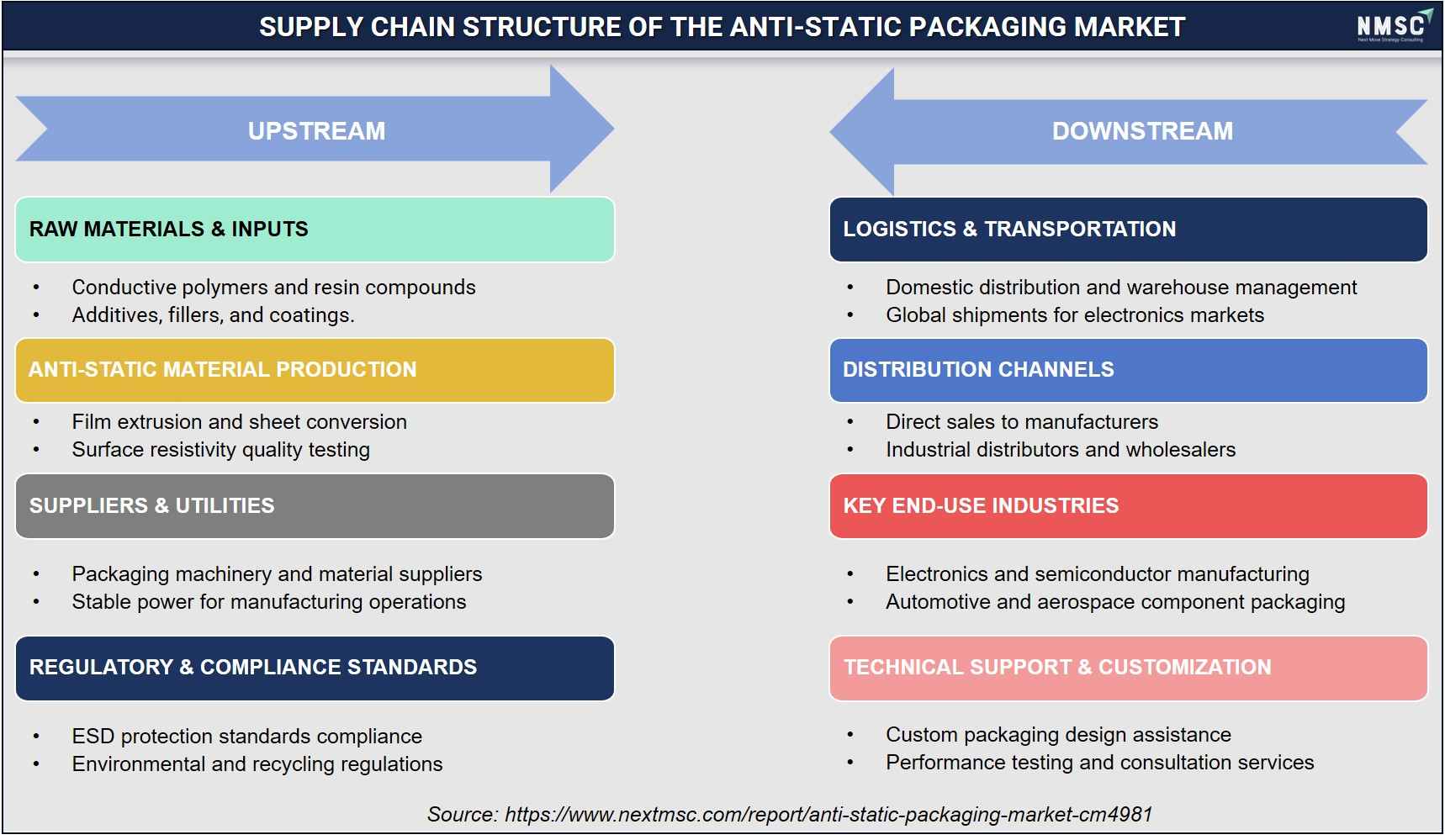
The above framework maps the supply chain of the Anti-Static Packaging Market across upstream sourcing, production, and downstream distribution. We observed that conductive polymers and resin compounds form the core raw material base, while film extrusion and resistivity testing define production, supported by packaging machinery suppliers. Compliance with ESD standards and environmental regulations governs upstream operations, whereas downstream activities include global logistics, direct sales, and industrial distributors serving electronics, automotive, and aerospace sectors, with custom design and performance testing reinforcing customer support.
Regional Outlook of the Anti-Static Packaging Market
Geographic Performance Snapshot
|
Region |
2025 (USD Billion) |
2035 (USD Billion) |
CAGR (%) |
|
Asia Pacific |
5.54 |
13.74 |
9.51% |
|
North America |
3.46 |
8.59 |
9.53% |
|
Europe |
2.77 |
6.87 |
9.50% |
|
Middle East & Africa |
1.11 |
2.75 |
9.48% |
|
Latin America |
0.97 |
2.40 |
9.46% |
Asia Pacific Anti-Static Packaging Market
Asia Pacific leads the Anti-Static Packaging Market with USD 5.54 billion in 2025, projected to reach USD 13.74 billion by 2035 at a CAGR of 9.51%. The region hosts the world's largest concentration of electronics manufacturing activity, encompassing consumer electronics assembly in China and Vietnam, semiconductor fabrication and packaging in Taiwan and South Korea, and PCB production across multiple Southeast Asian countries. NMSC's analysis indicates that expanding government investment in semiconductor manufacturing capability in India, Japan, and Malaysia is diversifying regional ESD packaging demand beyond the established manufacturing hubs and creating new sub-regional growth vectors within the Asia Pacific Anti-Static Packaging Market.
China Anti-Static Packaging Market
Based on our engagements with industry stakeholders in China, the country holds the largest single-country share within the Asia Pacific Anti-Static Packaging Market, driven by its position as the world's dominant producer of consumer electronics, printed circuit boards, and semiconductor assembly and testing services. Regulatory guidance from the Ministry of Industry and Information Technology on electronics quality standards reinforces ESD control requirements throughout Chinese electronics manufacturing supply chains. Technology penetration is high among major EMS providers including Foxconn, Pegatron, and BYD Electronics, which operate large-scale ESD-certified manufacturing environments. Competitive intensity is elevated, with both multinational and domestic packaging suppliers competing aggressively for volume contracts.
India Anti-Static Packaging Market
Through our analysis, India is the fastest-growing country within the Asia Pacific Anti-Static Packaging Market, driven by the Ministry of Electronics and Information Technology's Production-Linked Incentive scheme and the India Semiconductor Mission under MeitY. Government-approved semiconductor fabrication projects from Tata Electronics, CG Power, and Kaynes Semicon are creating concentrated new demand for ESD-compliant wafer carriers, trays, and bags. Technology penetration is advancing as Indian electronics manufacturers align with global OEM ESD program requirements. Competitive intensity is increasing as international ESD packaging suppliers establish local distribution and manufacturing partnerships to serve the growing demand base.
Japan Anti-Static Packaging Market
From our assessment, Japan is a mature and technically demanding market within the Asia Pacific Anti-Static Packaging Market, characterized by rigorous ESD packaging standards maintained by electronics giants including Sony, Panasonic, Murata Manufacturing, and Renesas Electronics. Japan Industrial Standards (JIS) complement IEC 61340 in specifying ESD packaging material performance requirements. Competitive intensity is high, with domestic suppliers including Achilles Corporation and Toyobo Co., Ltd. holding established market positions. Technology adoption is advanced, with automated ESD packaging systems integrated into high-speed electronics assembly lines. Strategic outlook favors premium-specification packaging aligned with Japan's focus on high-reliability and automotive-grade electronics.
South Korea Anti-Static Packaging Market
According to evaluation of the South Korean electronics manufacturing landscape, the Anti-Static Packaging Market in South Korea is driven by the world-leading semiconductor manufacturing operations of Samsung Electronics and SK Hynix, along with LG Electronics display and consumer electronics production. The Korean Agency for Technology and Standards enforces packaging quality regulations aligned with international ESD standards. Technology penetration is among the highest globally, with automated conductive tray and static shielding bag systems integrated into advanced semiconductor clean room packaging lines. Strategic outlook is positive, with expanding memory and logic semiconductor production supporting sustained demand growth through 2035.
Taiwan Anti-Static Packaging Market
Based on our market evaluation, Taiwan occupies a strategically critical position within the Asia Pacific Anti-Static Packaging Market due to the global significance of TSMC's wafer fabrication capacity and a dense ecosystem of integrated circuit packaging and testing companies. Taiwan's Bureau of Standards, Metrology and Inspection enforces quality standards relevant to ESD packaging. Technology penetration is high, with advanced wafer carrier systems, ultra-clean anti-static films, and precision conductive foam inserts required for leading-edge semiconductor handling. Strategic outlook is shaped by geopolitical diversification pressures, with TSMC's facility construction in Arizona, Japan, and Germany creating aligned international demand for its established ESD packaging supply chain partners.
Indonesia Anti-Static Packaging Market
Through our analysis, Indonesia is an emerging growth market within the Asia Pacific Anti-Static Packaging Market, supported by increasing electronics manufacturing investment by regional contract manufacturers and the government's Making Indonesia 4.0 industrial policy. The Ministry of Industry regulates electronic product quality standards with implications for packaging compliance. Technology penetration is developing, with ESD packaging adoption concentrated among electronics assembly plants serving export markets. Strategic outlook is positive as Indonesia's low-cost manufacturing position and large domestic consumer electronics market attract increasing foreign direct investment in electronics production requiring ESD-compliant supply chain packaging.
Vietnam Anti-Static Packaging Market
From our assessment, Vietnam has emerged as a rapidly growing Anti-Static Packaging Market within Southeast Asia, driven by the country's expanding role as an electronics manufacturing hub hosting major Samsung Electronics, Intel, and LG facilities. The Ministry of Science and Technology oversees product quality regulations. Technology penetration is advancing rapidly as Samsung's large-scale smartphone and chip packaging operations in Bac Ninh and Thai Nguyen provinces require extensive ESD packaging programs aligned with global Samsung supplier standards. Strategic outlook is favorable as Vietnam continues to attract electronics manufacturing investment diversifying from China.
Australia Anti-Static Packaging Market
According to evaluation, Australia's Anti-Static Packaging Market is relatively smaller within Asia Pacific but represents a stable and quality-focused demand environment driven by defense electronics procurement, telecommunications equipment, and medical device manufacturing. Standards Australia administers IEC-aligned ESD standards applicable to electronic product packaging. Technology penetration is moderate, with demand concentrated among defense contractors and medical device manufacturers. Strategic outlook is supported by the Australian government's AUKUS defense cooperation program, which drives procurement of high-reliability military electronics requiring mil-spec ESD packaging solutions.
Philippines Anti-Static Packaging Market
Based on our engagements, the Philippines Anti-Static Packaging Market benefits from the country's established semiconductor assembly and testing industry, which hosts operations from Texas Instruments, Analog Devices, and Integrated Micro-Electronics. The Department of Science and Technology provides technical standards oversight. Technology penetration is high within the semiconductor sector, with ESD-compliant packaging required throughout chip packaging lines. Strategic outlook is positive as the government's Philippine Development Plan prioritizes electronics manufacturing investment as a key growth sector.
Malaysia Anti-Static Packaging Market
Through our analysis, Malaysia is a well-established Anti-Static Packaging Market within Asia Pacific, supported by a mature semiconductor and electronics manufacturing ecosystem including Intel, Infineon Technologies, and STMicroelectronics operations. The Department of Standards Malaysia provides technical standards relevant to ESD packaging. Technology penetration is high among semiconductor manufacturers, with advanced wafer carriers, conductive trays, and static shielding bags deployed across precision packaging environments. Strategic outlook is supported by Malaysia's National Semiconductor Strategy, which targets doubling semiconductor revenue contribution by 2030.
North America Anti-Static Packaging Market
North America is the second-largest region in the Anti-Static Packaging Market at USD 3.46 billion in 2025, projected to reach USD 8.59 billion by 2035 at the highest regional CAGR of 9.53%. The region benefits from substantial new semiconductor fabrication investment catalyzed by the U.S. CHIPS and Science Act, expanding EV battery manufacturing in the U.S. and Canada, and a large established electronics assembly base. Our findings suggest that military and defense electronics procurement under DoD contracts creates sustained demand for mil-spec ESD packaging specifications within the North America Anti-Static Packaging Market, providing a premium revenue floor above commercial market pricing.
U.S. Anti-Static Packaging Market
Based on our engagements with North American industry stakeholders, the United States is the largest country market in the Anti-Static Packaging Market within the region, driven by the highest per-capita electronics manufacturing investment globally and the presence of world-leading semiconductor companies including Intel, Micron Technology, GlobalFoundries, and TSMC Arizona. The ESD Association, headquartered in the U.S., administers ANSI/ESD S20.20 standards that underpin domestic procurement requirements. The CHIPS and Science Act is funding USD 52 billion in semiconductor manufacturing and research, generating concentrated demand for ESD packaging in new fabrication facilities. Defense electronics procurement under MIL-PRF-81705 sustains demand for premium mil-spec packaging.
Canada Anti-Static Packaging Market
Through our analysis, Canada's Anti-Static Packaging Market is developing steadily, supported by the federal government's strategic investment in semiconductor supply chain development and clean energy electronics manufacturing. Canada's National Research Council and Standards Council of Canada administer ESD-relevant technical standards. Technology penetration is moderate, with demand concentrated in Ontario's electronics manufacturing cluster and British Columbia's clean technology sector. Strategic outlook is positive as electric vehicle battery manufacturing investment from Volkswagen, Stellantis, and Honda in Ontario creates new automotive electronics packaging demand aligned with IEC 61340 requirements.
Mexico Anti-Static Packaging Market
From our assessment, Mexico represents a growing Anti-Static Packaging Market driven by the country's expanding contract electronics manufacturing base servicing North American OEMs and the nearshoring trend that is redirecting manufacturing investment from Asia to Mexico under North American supply chain reshoring programs. The Secretaría de Economía supports electronics manufacturing through trade facilitation under the USMCA agreement. Technology penetration is advancing as Tier 1 automotive electronics suppliers and contract manufacturers in Monterrey, Guadalajara, and Juárez implement ANSI/ESD S20.20-aligned ESD packaging programs to meet North American customer requirements.
Europe Anti-Static Packaging Market
Europe accounts for USD 2.77 billion in the Anti-Static Packaging Market in 2025, growing to USD 6.87 billion by 2035 at a CAGR of 9.50%. The region is characterized by stringent regulatory standards, including the EU's REACH and RoHS directives that influence permitted materials in ESD packaging, and a strong industrial base in automotive electronics, defense electronics, and telecommunications equipment manufacturing. NMSC's analysis indicates that the European Chips Act, targeting EUR 43 billion in semiconductor investment, is catalyzing new demand for semiconductor-grade ESD packaging in Germany, the Netherlands, France, and Ireland.
UK Anti-Static Packaging Market
Based on our engagements, the United Kingdom's Anti-Static Packaging Market is supported by defense electronics procurement from the Ministry of Defence, a developed medical device manufacturing sector, and a growing aerospace electronics industry. The British Standards Institution administers BS EN 61340 standards equivalent to IEC 61340. Technology penetration is high among defense contractors and aerospace manufacturers. Strategic outlook is shaped by the UK Semiconductor Strategy, which has committed investment in domestic chip design and compound semiconductor manufacturing, creating aligned ESD packaging demand growth.
Germany Anti-Static Packaging Market
Through our analysis, Germany is the largest country market within the Europe Anti-Static Packaging Market, driven by its position as Europe's leading automotive electronics manufacturing nation and the presence of major semiconductor and electronics companies including Infineon Technologies, OSRAM, Siemens, and Robert Bosch. DIN EN 61340 standards provide the regulatory framework. Technology penetration is high, with advanced returnable conductive packaging systems widely deployed in automotive supply chains through standardized VDA-compliant material flow containers. Strategic outlook is supported by the Intel Magdeburg semiconductor fab investment and TSMC Dresden facility, both expected to create significant additional ESD packaging demand through 2030.
France Anti-Static Packaging Market
From our assessment, France's Anti-Static Packaging Market benefits from a strong aerospace and defense electronics sector anchored by Airbus, Thales, Safran, and Leonardo operations that require military and aerospace-specification ESD packaging. The Bureau de Normalisation de la Mécanique implements IEC 61340-aligned standards. Technology penetration is high in aerospace applications, with cleanroom-compatible and mil-spec anti-static packaging widely deployed. Strategic outlook is positive as STMicroelectronics' Crolles expansion and France's France 2030 investment plan support domestic semiconductor manufacturing growth.
Italy Anti-Static Packaging Market
According to evaluation, Italy's Anti-Static Packaging Market is driven by industrial electronics manufacturing, automotive electronics supply chains serving Stellantis and Ferrari, and a growing medical device sector. UNI EN 61340 standards apply. Technology penetration is moderate, with adoption led by multinational subsidiaries and export-oriented electronics manufacturers. Strategic outlook is supported by the PNRR (National Recovery and Resilience Plan) which channels investment into advanced manufacturing and digital technologies, creating indirect stimulus for ESD packaging demand in upgraded electronics production environments.
Spain Anti-Static Packaging Market
Based on our market evaluation, Spain's Anti-Static Packaging Market is in a growth phase supported by automotive electronics manufacturing for SEAT and Volkswagen Group and expanding renewable energy electronics production. AENOR administers the relevant ESD packaging standards under UNE EN 61340. Technology adoption is advancing as Spanish electronics manufacturers implement ANSI/ESD S20.20-aligned programs to qualify as suppliers to multinational automotive and telecommunications OEMs. Strategic outlook is positive as the Spanish government's PERTE Chip semiconductor program allocates EUR 12.25 billion to build domestic semiconductor capabilities.
Sweden Anti-Static Packaging Market
Through our analysis, Sweden's Anti-Static Packaging Market benefits from a sophisticated telecommunications and defense electronics manufacturing base anchored by Ericsson, Saab Group, and Volvo Cars' electronics operations. Swedish Standards Institute administers IEC-aligned ESD standards. Technology penetration is high, with advanced ESD packaging systems deployed across Ericsson's 5G radio access network manufacturing. Strategic outlook is positive as Sweden's electrification of its automotive and transportation sectors expands electronic component content requiring ESD-compliant packaging throughout supply chains.
Denmark Anti-Static Packaging Market
From our assessment, Denmark's Anti-Static Packaging Market is characterized by demand from wind energy electronics manufacturing, medical devices, and industrial automation equipment sectors. Dansk Standard administers relevant IEC standards. Technology penetration is above average, driven by the technical sophistication of Danish industrial electronics manufacturers. Strategic outlook is supported by Denmark's clean energy technology export growth, with wind turbine power electronics requiring ESD-compliant packaging standards across global supply chains.
Finland Anti-Static Packaging Market
According to evaluation, Finland's Anti-Static Packaging Market is primarily driven by telecommunications electronics manufacturing, industrial automation, and medical technology sectors. The Finnish Standards Association SFS administers IEC 61340-equivalent standards. Technology penetration is high among Nokia's telecommunications equipment supply chain. Strategic outlook is stable, with market growth supported by Finnish government investment in digital infrastructure and the country's growing role in European defense electronics supply chains.
Netherlands Anti-Static Packaging Market
Based on our engagements, the Netherlands holds a strategically important position within the European Anti-Static Packaging Market due to ASML's position as the world's sole manufacturer of extreme ultraviolet lithography machines used in advanced semiconductor fabrication. ASML's operations and its extensive supply chain of precision optics and electronics suppliers create specialized demand for ultra-clean, anti-static packaging that prevents contamination of photolithography equipment components. NEN administers Dutch ESD standards. Technology penetration is advanced, with semiconductor equipment packaging requirements exceeding standard IEC 61340 specifications.
Middle East & Africa Anti-Static Packaging Market
The Middle East and Africa region accounts for USD 1.11 billion in the Anti-Static Packaging Market in 2025, growing to USD 2.75 billion by 2035 at a CAGR of 9.48%. Market development is concentrated in Israel, the UAE, Saudi Arabia, Turkey, and South Africa, which collectively represent the primary demand centers for ESD packaging driven by defense electronics, telecommunications, and industrial automation manufacturing. Our analysis shows that Vision 2030 initiatives in Saudi Arabia and UAE are investing in electronics manufacturing capabilities that will require ESD-compliant packaging supply chains aligned with international standards.
Saudi Arabia Anti-Static Packaging Market
Based on our engagements, Saudi Arabia's Anti-Static Packaging Market is developing as part of the Vision 2030 diversification program that is attracting electronics and technology manufacturing investment. The Saudi Standards, Metrology and Quality Organization (SASO) administers quality standards relevant to ESD packaging imports. Technology penetration is early-stage, with demand currently concentrated in defense systems integration and telecommunications equipment installation. Strategic outlook is positive as NEOM smart city construction and Saudi Aramco's digital oilfield technology investments create new demand centers for industrial electronics packaging.
UAE Anti-Static Packaging Market
Through our analysis, the UAE's Anti-Static Packaging Market benefits from the country's position as a regional hub for electronics distribution, defense systems integration, and technology services. The Emirates Authority for Standardization and Metrology (ESMA) administers relevant technical standards. Technology penetration is moderate, with demand concentrated in defense electronics procurement by the UAE Armed Forces and telecommunications infrastructure deployment. Strategic outlook is positive as Abu Dhabi's industrial diversification strategy and Dubai Industrial City attract electronics manufacturing investment requiring ESD packaging supply.
Egypt Anti-Static Packaging Market
From our assessment, Egypt's Anti-Static Packaging Market is at an early development stage, driven by the country's expanding electronics assembly sector concentrated in free economic zones and the government's Smart Egypt digital transformation program. The Egyptian Organization for Standardization and Quality provides the regulatory framework. Technology penetration is limited, with adoption primarily among export-oriented electronics manufacturers serving European and GCC clie
Egypt Anti-Static Packaging Market
From our assessment, Egypt's Anti-Static Packaging Market is at an early development stage, driven by the country's expanding electronics assembly sector concentrated in free economic zones and the government's Smart Egypt digital transformation program. The Egyptian Organization for Standardization and Quality provides the regulatory framework. Technology penetration is limited, with adoption primarily among export-oriented electronics manufacturers serving European and GCC clients with ESD compliance requirements. Strategic outlook is positive as foreign direct investment in Egyptian electronics manufacturing grows.
Israel Anti-Static Packaging Market
According to evaluation, Israel has a disproportionately sophisticated Anti-Static Packaging Market relative to its size, reflecting the country's advanced semiconductor and defense electronics industries. Companies including Intel Israel (the global center for Intel's advanced chip design), Tower Semiconductor, and Elbit Systems create concentrated demand for high-specification ESD packaging. The Standards Institution of Israel (SII) administers relevant IEC-aligned standards. Technology penetration is among the highest in the MEA region, with Israeli semiconductor facilities requiring precision ESD-controlled packaging aligned with global fab-grade specifications.
Turkey Anti-Static Packaging Market
Based on our market evaluation, Turkey's Anti-Static Packaging Market is growing, driven by the country's expanding electronics manufacturing base serving both domestic demand and regional export markets. The Turkish Standards Institution (TSE) administers EN 61340-aligned standards. Technology adoption is advancing as Turkish electronics manufacturers supplying automotive OEMs implement ANSI/ESD S20.20-aligned packaging programs. Strategic outlook is positive as Turkey's electronics exports to Europe and the Middle East increase, requiring ESD packaging compliance as a supplier qualification requirement.
Nigeria Anti-Static Packaging Market
Through our analysis, Nigeria's Anti-Static Packaging Market is at an early stage of development, with demand primarily generated by telecommunications equipment installation and electronics repair services. The Standards Organisation of Nigeria (SON) provides the regulatory framework. Technology penetration is limited, with ESD packaging adoption concentrated among multinational telecommunications companies and electronics retailers. Strategic outlook is positive over the medium term as Nigerian digital infrastructure investment grows and local electronics assembly capacity develops.
South Africa Anti-Static Packaging Market
From our assessment, South Africa represents the most developed Anti-Static Packaging Market in Sub-Saharan Africa, driven by telecommunications equipment manufacturing, defense electronics, and automotive electronics supply chains serving the country's vehicle assembly industry. The South African Bureau of Standards (SABS) administers ESD-relevant standards. Technology penetration is higher than elsewhere in Sub-Saharan Africa, with adoption concentrated among BMW, Mercedes-Benz, and Toyota South Africa's electronics supply chains requiring ESD-compliant component packaging.
Latin America Anti-Static Packaging Market
Latin America accounts for USD 0.97 billion in the Anti-Static Packaging Market in 2025, growing to USD 2.40 billion by 2035 at a CAGR of 9.46%. Brazil and Mexico are the dominant country markets, together representing the majority of regional electronics manufacturing and automotive electronics production. Our analysis shows that nearshoring of electronics manufacturing from Asia to Mexico under USMCA trade framework benefits is accelerating Anti-Static Packaging Market demand within the region, particularly in automotive electronics supply chains.
Brazil Anti-Static Packaging Market
Based on our engagements, Brazil is the largest Anti-Static Packaging Market in Latin America, driven by the country's electronics manufacturing sector under the Lei de Informática incentive program, automotive electronics production for Brazilian OEM operations, and telecommunications infrastructure investment. ABNT (Associação Brasileira de Normas Técnicas) administers NBR IEC 61340-aligned standards. Technology penetration is moderate, with adoption concentrated among Zona Franca de Manaus electronics manufacturers and multinational automotive electronics suppliers. Strategic outlook is positive as Brazil's automotive electrification investment grows.
Argentina Anti-Static Packaging Market
Through our analysis, Argentina's Anti-Static Packaging Market is developing despite macroeconomic challenges, driven by electronics manufacturing in the Tierra del Fuego special economic zone and automotive parts manufacturing for the domestic market. IRAM (Instituto Argentino de Normalización y Certificación) administers relevant technical standards. Technology penetration is moderate, with ESD packaging adoption driven by multinational electronics subsidiaries requiring global packaging standards compliance. Strategic outlook is cautiously positive, contingent on macroeconomic stabilization and continued electronics sector investment.
Chile Anti-Static Packaging Market
From our assessment, Chile's Anti-Static Packaging Market is relatively small but stable, driven by mining electronics, telecommunications equipment, and industrial automation sectors. The Instituto Nacional de Normalización (INN) administers relevant IEC-aligned standards. Technology penetration is moderate, with ESD packaging use concentrated among industrial equipment manufacturers and telecommunications providers. Strategic outlook is supported by Chile's lithium production ambitions, which are driving investment in battery technology manufacturing that will require ESD-compliant component packaging solutions.
Colombia Anti-Static Packaging Market
According to evaluation, Colombia's Anti-Static Packaging Market is in a growth phase supported by expanding electronics retail distribution, industrial equipment manufacturing, and telecommunications infrastructure investment. ICONTEC (Instituto Colombiano de Normas Técnicas y Certificación) administers relevant technical standards. Technology adoption is advancing, led by multinational electronics distributors requiring ESD-compliant packaging for imported component distribution. Strategic outlook is positive as Colombia's digital economy investment program drives electronics deployment across government and commercial sectors.
Competitive Landscape of the Anti-Static Packaging Market
Competitive Dynamics and M&A Landscape
|
Key Takeaways |
Details |
|
Market Structure |
Moderately consolidated with a small number of global packaging conglomerates (Sealed Air, Amcor, Smurfit WestRock, Pregis) competing alongside numerous specialized ESD packaging manufacturers (Desco Industries, Nefab, Delphon, Conductive Containers) and regional players across Asia Pacific. |
|
Innovation Focus |
Sustainable ESD packaging using recyclable and bio-based materials, multilayer static shielding films with enhanced moisture barrier properties, smart packaging integration with humidity indicators and RFID tracking, and mil-spec ESD packaging for defense and aerospace applications. |
|
M&A Activity |
Consolidation is ongoing as large packaging conglomerates acquire ESD specialty capabilities. Sealed Air, Pregis, and ProAmpac have each pursued strategic acquisitions to expand specialty protective packaging portfolios. UFP Technologies has grown through targeted acquisitions of foam fabrication and specialty packaging companies aligned with ESD and cleanroom market requirements. |
How Do Companies Compete in the Anti-Static Packaging Market?
The competitive landscape of the Anti-Static Packaging Market is bifurcated between large-scale packaging conglomerates that include ESD packaging within broad protective packaging portfolios and specialized manufacturers that focus exclusively on ESD protection solutions. Sealed Air Corporation, Amcor plc, and Smurfit WestRock plc compete on portfolio breadth, global manufacturing footprint, and supply chain integration capabilities with major electronics OEM customers. NMSC's analysis indicates that competitive differentiation for specialty ESD packaging vendors such as Desco Industries, Nefab AB, and Delphon Industries is built on material science expertise, ESD standard compliance depth, and the ability to provide custom engineered solutions for specific ESD program requirements.
Which Kind of Companies Dominate the Anti-Static Packaging Market?
The Anti-Static Packaging Market is dominated by a combination of global packaging conglomerates, dedicated ESD specialty manufacturers, and vertically integrated material compounders. Packaging conglomerates including Sealed Air Corporation and Amcor plc maintain broad product portfolios encompassing ESD bags, films, and foam inserts alongside conventional protective packaging, competing on scale and global customer relationships. Dedicated ESD specialists including Desco Industries, Nefab AB, Delphon Industries, and Conductive Containers compete on technical depth, product range coverage across ESD protection classes, and value-added services including ESD program auditing. Material specialists including Nan Ya Plastics Corporation and Toyobo Co., Ltd. compete on material compounding innovation and supply scale for antistatic and conductive polymer formulations.
Material Science and Compliance Expertise Drive Market Success in the Anti-Static Packaging Market
Our assessment indicates that material science expertise and demonstrated compliance capability have emerged as the primary bases for competitive success in the Anti-Static Packaging Market for premium and specialty applications. Vendors that maintain ISO 17025-accredited ESD packaging testing laboratories, hold ANSI/ESD S20.20 compliance certifications, and can provide full material traceability documentation for defense and aerospace programs command premium pricing and long-term preferred supplier status. Companies investing in proprietary antistatic polymer compounding, multilayer laminate development, and sustainable ESD material innovation are best positioned to capture above-market growth from compliance-driven and sustainability-motivated procurement programs.
Market Players to opt for Merger and Acquisition Strategies to Expand Their Presence in the Anti-Static Packaging Market
Through NMSC's assessment, we found that M&A activity within the Anti-Static Packaging Market is expected to accelerate through 2028 as packaging conglomerates seek to deepen ESD specialty capabilities and geographic coverage. Acquisition targets of strategic interest include specialty ESD foam fabricators with aerospace and defense certifications, Asia Pacific ESD packaging manufacturers with established semiconductor customer relationships, and sustainable ESD material innovators with bio-based antistatic formulation intellectual property. Private equity investment in mid-tier specialty packaging companies is also anticipated, driven by the Anti-Static Packaging Market's steady growth profile, high customer switching costs, and recurring revenue from long-term OEM supply agreements.
Who Are the Key Market Players in the Anti-Static Packaging Market?
-
Nefab AB
-
Desco Industries, Inc.
-
Sealed Air Corporation
-
Pregis LLC
-
Smurfit Westrock plc
-
Amcor plc
-
ProAmpac LLC
-
Advantek, Inc.
-
Dou Yee Enterprises (S) Pte Ltd
-
Conductive Containers, Inc.
-
GWP Group Limited
-
UFP Technologies, Inc.
-
Cortec Corporation
-
Teknis Limited
-
Botron Company Inc.
-
Delphon Industries, LLC
-
Achilles Corporation
-
Toyobo Co., Ltd.
-
Nan Ya Plastics Corporation
-
Tegatai Packaging India Pvt. Ltd.
What Are the Latest Developments in the Anti-Static Packaging Industry?
|
Date |
Event |
|
2025 |
Nefab AB introduced FiberFlute, a recyclable heavy-duty packaging solution available with ESD protection for electronics and battery applications. |
|
December 2025 |
Cortec Corporation expanded adoption of its EcoSonic VpCI-125 HP films, which combine corrosion protection with permanent anti-static properties. |
SWOT Analysis of the Anti-Static Packaging Market
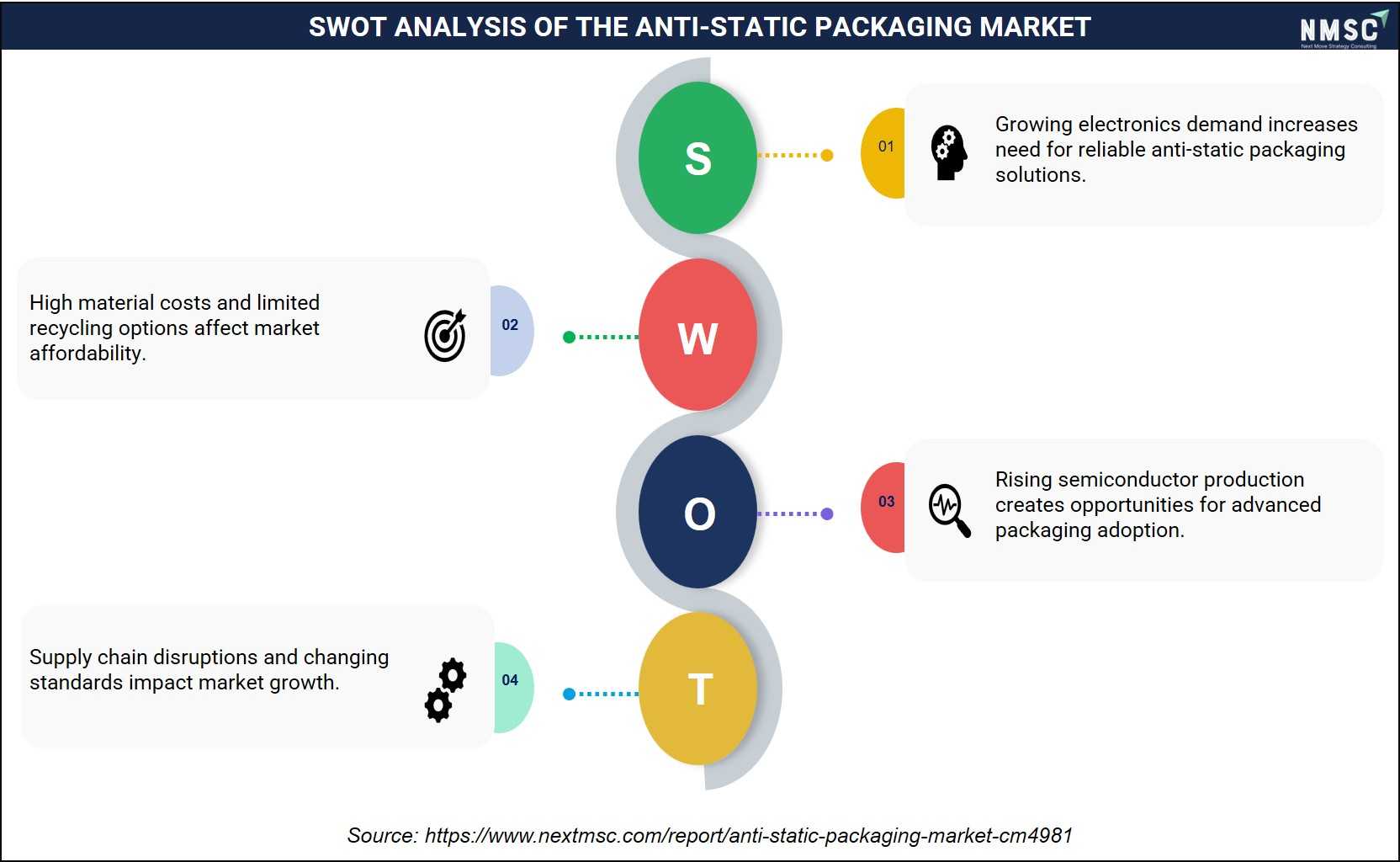
The above SWOT framework identifies key strategic factors shaping the Anti-Static Packaging Market across strengths, weaknesses, opportunities, and threats. We observed that growing electronics demand increasing the need for reliable anti-static packaging solutions serves as a core strength, while high material costs and limited recycling options emerge as key weaknesses affecting affordability. Further, rising semiconductor production creates opportunities for advanced packaging adoption, presents significant growth potential, yet supply chain disruptions and changing standards continue to threaten market stability and long-term growth.
What Are the Investment Opportunities in the Anti-Static Packaging Market?
Capital Inflows
The Anti-Static Packaging Market is attracting capital through CHIPS Act disbursements in the United States and European Chips Act investments, creating greenfield ESD packaging demand at new semiconductor fabrication facilities. TSMC, Intel, and Samsung Electronics wafer fab construction in Arizona, Ohio, Texas, and Saxony generates multi-year ESD packaging supply contracts. Our assessment indicates that vendors with cleanroom-compatible ESD product certification and proximity to new fab sites are the primary beneficiaries of this capital-driven demand wave.
Infrastructure Investments
Infrastructure investment in the Anti-Static Packaging Market is concentrated in automated thermoforming capacity for conductive and dissipative trays, antistatic film extrusion lines, and foam fabrication facilities in Asia Pacific and North America. Electronics manufacturers establishing dual-source ESD packaging procurement create investment opportunities for regional manufacturing expansion. Through our analysis, we observed that investment in automated conductive tray production for semiconductor logistics represents the highest-return capital deployment opportunity within the Anti-Static Packaging Market.
ESG Mandates
ESG criteria are reshaping investment within the Anti-Static Packaging Market as electronics OEM sustainability commitments and EU Packaging Waste Regulation recyclability requirements create compliance-driven demand for bio-based and recyclable ESD materials. Companies securing Environmental Product Declarations for recyclable anti-static packaging achieve preferred supplier status from sustainability-committed OEMs. NMSC's analysis indicates that investment in bio-based antistatic polymer formulations is a strategically attractive ESG-aligned innovation pathway commanding premium pricing and superior customer retention.
Digital Transformation
Digital transformation is creating Anti-Static Packaging Market investment opportunities through RFID-enabled ESD bags, IoT-connected condition monitoring sensors, and digital ESD compliance management platforms. Our findings suggest these innovations align with MIL-PRF-81705 documentation requirements and IEC 61340-5-1 audit trail standards. Aerospace, defense, and advanced semiconductor logistics customers are primary adopters, paying premium prices for traceable anti-static packaging that delivers real-time shipment condition visibility throughout global ESD-sensitive device supply chains.
Key Benefits for Stakeholders
Electronics Manufacturers
Based on our research, electronics manufacturers benefit by identifying optimal ESD packaging specifications by protection class and product form across semiconductor, PCB, and consumer electronics applications. The report benchmarks sourcing strategies across Direct OEM, Distributor, and E-Commerce channels, supports supplier qualification decisions for new facilities established under CHIPS Act and European Chips Act programs, and delivers regional demand data to guide ESD packaging procurement planning across 33 covered countries.
Packaging Manufacturers
NMSC's analysis provides packaging manufacturers with granular growth projections across eight segmentation dimensions, identifying Packaging Accessories and Other Engineered Materials as the fastest-growing subsegments through 2035. Capacity investment planning, new product development prioritization across sustainable ESD materials, and competitive positioning assessment against global conglomerates and specialty players are all supported by the report's market share analysis, detailed competitive landscape, and M&A activity assessment within the Anti-Static Packaging Market.
Automotive OEMs and Tier 1 Suppliers
Automotive OEMs and Tier 1 suppliers gain quantified visibility into ESD packaging demand within EV battery electronics supply chains, returnable packaging opportunity sizing, and ANSI/ESD S20.20-compliant supplier landscape intelligence. Our findings identify the fastest-growing automotive sub-segments including battery components and vehicle electronics, support closed-loop returnable container program design, and provide benchmarking data for ESD packaging cost optimization across global automotive electronics manufacturing and aftermarket distribution operations.
Investors
Investors receive validated total addressable market analysis across eight segmentation dimensions and 33 countries, M&A target landscape intelligence spanning specialty ESD foam, film, and tray manufacturer categories, and granular regional growth data. Our assessment provides specific investment thesis support through identification of North America as the fastest-growing region and India as the fastest-growing country, enabling PE and strategic acquirers to prioritize capital allocation within the Anti-Static Packaging Market.
Aerospace and Defense Contractors
Through our analysis, aerospace and defense contractors benefit from detailed coverage of MIL-PRF-81705-compliant packaging requirements, mil-spec ESD supplier landscape assessment covering Delphon Industries and Desco Industries, and program-level demand forecasting for defense electronics packaging. The report supports specification development for avionics, satellite electronics, and electronic warfare system packaging, identifies ITAR-compliant domestic supply options, and provides benchmark data for ESD packaging lifecycle cost analysis across defense procurement programs.
ESD Consultants and Regulators
ESD consultants and program managers benefit from market structure data supporting ESD packaging policy design, competitive supplier benchmarking across product forms and protection classes, and compliance upgrade planning aligned with ANSI/ESD S20.20. Regulators and standards bodies gain industry structure analysis supporting IEC 61340 revision inputs, identification of market segments with the highest compliance gaps, and data informing emerging economy ESD standard adoption guidance within the global Anti-Static Packaging Market.
Key Market Segments
By Product Form
-
Bags and Pouches
-
Pink Antistatic Bags
-
Static Shielding Bags
-
Conductive Bags
-
Moisture Barrier Bags
-
Bubble Bags and Pouches
-
-
Films and Tubing
-
Antistatic Films
-
Static Shielding Films
-
Conductive Films
-
Tubing
-
Rollstock
-
-
Trays and Clamshells
-
Thermoformed Trays
-
Conductive Trays
-
Dissipative Trays
-
Clamshells
-
-
Boxes and Containers
-
Conductive Corrugated Boxes
-
Conductive Plastic Boxes
-
Totes
-
Bins
-
Reusable Containers
-
Component Carriers
-
-
Foam and Inserts
-
Polyethylene Foam
-
Polyurethane Foam
-
Conductive Foam
-
Dissipative Foam
-
Custom Inserts
-
-
Paper and Board Packaging
-
Antistatic Paper
-
Conductive Paperboard
-
Paper Bags
-
Paper Wraps
-
-
Tapes and Labels
-
ESD Tapes
-
ESD Labels
-
Warning Labels
-
-
Packaging Accessories
-
Desiccants
-
Humidity Indicator Cards
-
Cushioning Accessories
-
Packaging Kits
-
-
Other Product Forms
By Protection Class
-
Antistatic
-
Dissipative
-
Conductive
-
Static Shielding
-
Multi Protection
-
ESD and Moisture Protection
-
ESD and Corrosion Protection
-
ESD and Cleanroom Protection
-
By Material
-
Polyethylene
-
Polypropylene
-
PET
-
PVC
-
Paper and Paperboard
-
Polyurethane
-
Polyethylene Foam
-
Metallized Laminates
-
Aluminum Foil Laminates
-
Other Engineered Materials
By Packaging Configuration
-
Flexible Packaging
-
Semi-Rigid Packaging
-
Rigid Packaging
By Reusability
-
Single-Use Packaging
-
Returnable Packaging
By Sales Channel
-
Direct OEM Sales
-
Direct EMS Sales
-
Distributor Sales
-
E-Commerce Sales
-
Contract Packaging
By End Use Industry
-
Electronics
-
Semiconductor Manufacturing
-
Integrated Circuit Packaging
-
PCB Manufacturing
-
Electronics Assembly
-
Consumer Electronics
-
-
Automotive
-
Electronic Components
-
Battery Components
-
Vehicle Electronics
-
-
Aerospace and Defense
-
Medical Devices
-
Telecommunications Equipment
-
Industrial Equipment
-
Energy and Power Electronics
-
Chemical Industry
-
Other Industries
By Region
-
North America: U.S., Canada, and Mexico.
-
Europe: UK, Germany, France, Italy, Spain, Sweden, Denmark, Finland, the Netherlands, and the rest of Europe.
-
Asia Pacific: China, India, Japan, South Korea, Taiwan, Indonesia, Vietnam, Australia, Philippines, Malaysia and the rest of APAC.
-
Middle East & Africa (MEA): Saudi Arabia, UAE, Egypt, Israel, Turkey, Nigeria, South Africa, and the rest of MEA.
-
Latin America: Brazil, Argentina, Chile, Colombia, and the rest of LATAM.
Conclusion and Recommendations
Long-Term Outlook
The Anti-Static Packaging Market is on a sustained growth trajectory, expanding from USD 13.85 billion in 2025 to USD 34.35 billion by 2035 at a CAGR of 9.51%. Our analysis shows structural demand from global electronics manufacturing expansion, automotive electrification, and semiconductor reshoring creates a non-discretionary demand floor. CHIPS Act investments and EV adoption simultaneously deliver high-growth demand increments, ensuring broad-based market expansion across all product forms, protection classes, and geographic regions through the forecast period.
Investment Destination
The Anti-Static Packaging Market presents a compelling investment profile with stable demand growth from non-discretionary compliance requirements, high customer switching costs from ESD program integration, and recurring OEM supply agreement revenue. Our findings suggest specialty ESD foam and tray manufacturers serving semiconductor and defense customers, sustainable ESD material innovators with bio-based antistatic IP, and Asia Pacific ESD packaging specialists near new fabrication facilities in India and Malaysia represent the strongest investment opportunities through 2035.
Market Shifts and Key Risks
Key market shifts include ESD requirement extension into automotive EV, medical device, and energy electronics supply chains as significant incremental demand contributors. Key risks within the Anti-Static Packaging Market are polyethylene and metallized laminate raw material cost volatility, counterfeit non-compliant ESD packaging compressing margins for certified vendors, and the technical complexity of meeting evolving ESD specifications for advanced semiconductor packaging formats including heterogeneous integration and chiplet-based designs requiring more precise material characterization.
Principal Growth Pathways
Principal growth pathways include geographic expansion into India, Vietnam, and Malaysia as advanced electronics manufacturing capabilities develop; sustainable recyclable ESD packaging development aligned with EU Packaging Waste Regulation requirements; vertical market penetration into EV battery module electronics and medical device packaging as compliance programs mature; and service model development combining ESD program auditing with packaging system design consultation to differentiate from commodity competitors and build higher-value enterprise relationships within the Anti-Static Packaging Market.
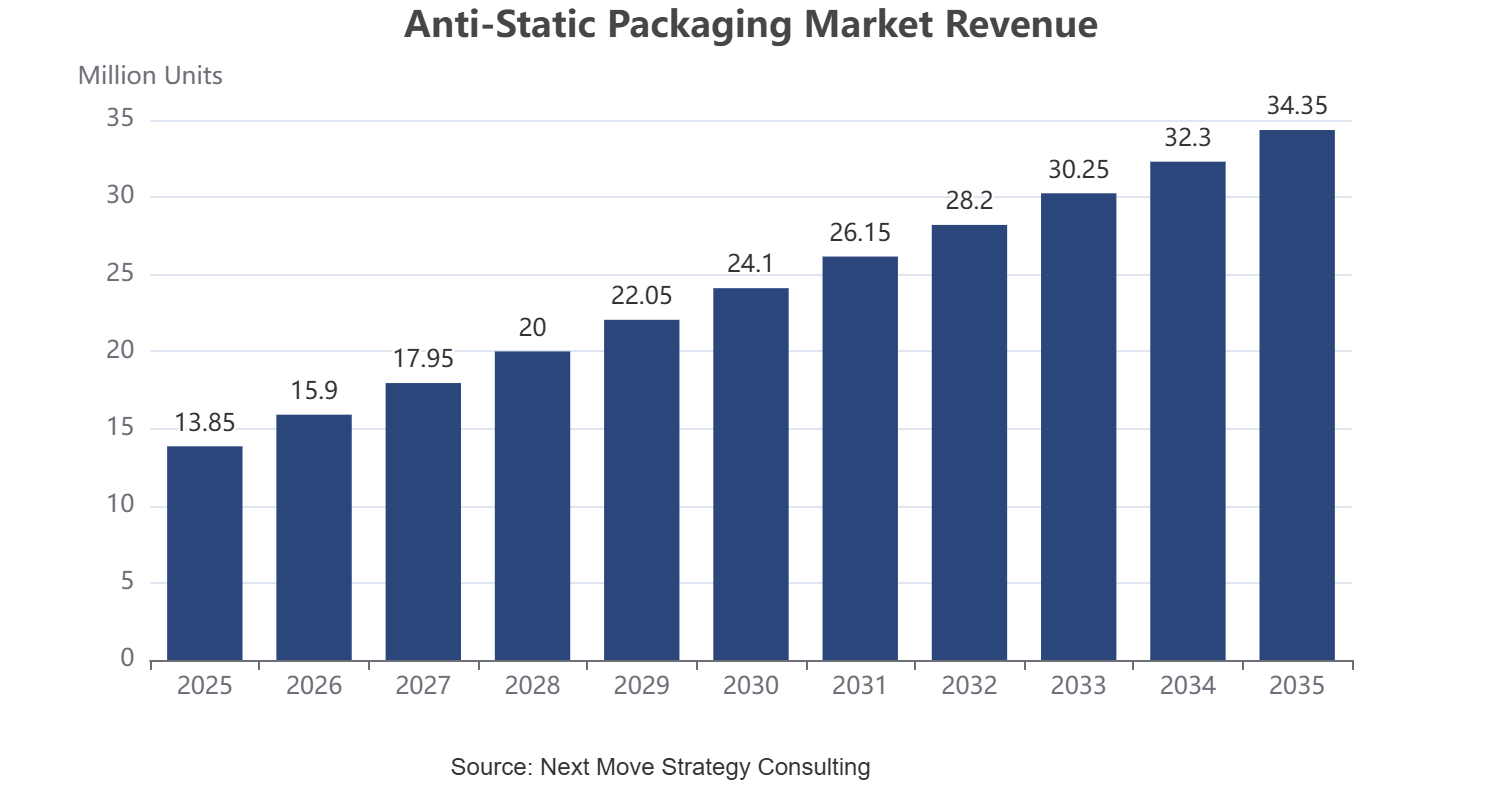
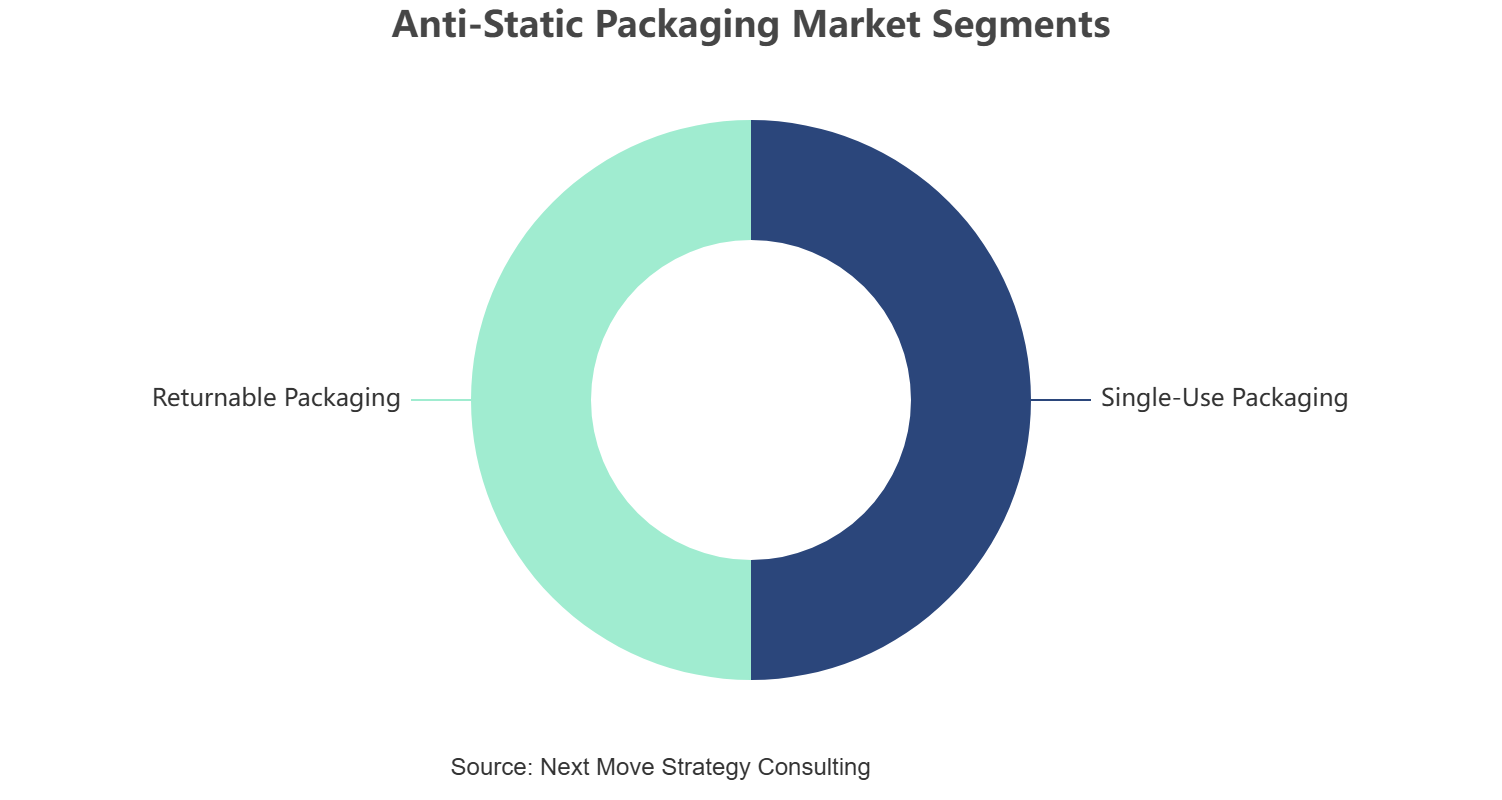
About the Author
 Mayurima Roy
— Mayurima Roy is Research Analyst at Next Move Strategy Consulting, where she has spent 4 years working across the firm's full industry coverage rather than a single fixed vertical. Her work centers on structured research, ongoing trend tracking, competitive assessment, and insight-led content development, translating complex market data into clear, decision-ready narratives that support informed client decision-making across diverse global industries, market sectors, and world regions every day.
Mayurima Roy
— Mayurima Roy is Research Analyst at Next Move Strategy Consulting, where she has spent 4 years working across the firm's full industry coverage rather than a single fixed vertical. Her work centers on structured research, ongoing trend tracking, competitive assessment, and insight-led content development, translating complex market data into clear, decision-ready narratives that support informed client decision-making across diverse global industries, market sectors, and world regions every day.
About the Reviewer
 Supradip Baul
— Supradip Baul is an accomplished business consultant and strategist with over a decade of rich experience in market intelligence, strategy, technology, and business transformation. His work has included rigorous qualitative and quantitative analysis across multiple industries, helping clients shape investment decisions and long-term roadmaps. Earlier in his career, he was associated with Gartner, where he contributed to industry-leading reports and market share analyses. He has worked with leading global companies and holds an MBA with a dual specialization in Marketing and Finance.
Supradip Baul
— Supradip Baul is an accomplished business consultant and strategist with over a decade of rich experience in market intelligence, strategy, technology, and business transformation. His work has included rigorous qualitative and quantitative analysis across multiple industries, helping clients shape investment decisions and long-term roadmaps. Earlier in his career, he was associated with Gartner, where he contributed to industry-leading reports and market share analyses. He has worked with leading global companies and holds an MBA with a dual specialization in Marketing and Finance.
At Next Move Strategy Consulting, we understand that insightful market research is the cornerstone of successful business decisions. That's why we employ a robust and multifaceted approach, combining various methodologies to deliver the most accurate and actionable data for our clients.

Research Landscape
We navigate the world of research with two primary approaches:
Qualitative Approach
Our qualitative research methodologies involve immersive techniques such as in-depth interviews, focus groups, and observational studies. By engaging directly with individuals and stakeholders, we uncover valuable insights that quantitative data alone may overlook.

Quantitative Research
In tandem with qualitative methodologies, NMSC leverages the power of Quantitative Research to provide a robust foundation of numerical insights. Through systematic data collection and analysis, we quantify patterns, preferences, and market trends, offering a comprehensive view of the business landscape.
Our quantitative research approach employs diverse tools, including surveys, experiments, and statistical modelling. These methodologies enable us to gather data from a large and representative sample, ensuring the statistical significance of our findings. By employing structured questionnaires and standardized data collection methods, we guarantee the reliability and validity of the information we present to our clients.
Quantitative research is particularly effective in measuring the prevalence of trends, assessing market size, and gauging the impact of various factors on consumer behavior. The numerical precision attained through this approach equips our clients with actionable insights, facilitating data-driven decision-making and strategy formulation.


Our Specialized Toolbox for Industry-Specific Market Research
We deploy a specialized arsenal of techniques tailored to meet your unique requirements. Here's a glimpse into our comprehensive toolbox:

Information Procurement
The stage entails acquiring market data or relevant information through various sources and methodologies.


Market Research Approach
We utilize both top-down and bottom-up approaches in market research analysis to achieve a comprehensive understanding of the market dynamics, leveraging the broad perspective of industry trends and macroeconomic factors alongside detailed insights from specific segments and individual companies.

Porters Five Forces Analysis
We conduct Porter's Five Forces analysis to evaluate the competitive landscape of an industry, providing us with insights into factors that affect profitability and strategic positioning.

SWOT Analysis

Forecasting
We utilize a forecasting model to predict future consumption by considering parameters like population, economics, regulations, market competition, drivers, constraints, technology, and pricing. We also employ statistical techniques such as multilinear regression, exponential smoothing, moving average, ARIMA, and Monte Carlo simulations for accurate predictions. In econometric forecasting, we analyzed short-term and long-term event impacts, attributing values based on regulatory frameworks, economic factors, and market events.





 Speak to Our Analyst