Global Food Waste Crisis Puts Post-Harvest Treatment in Focus

UN's Zero Waste Day Spotlights $1 Trillion Food Loss Problem, Reinforcing Case for Post-Harvest Preservation Technologies
Nairobi and New York marked the 2026 International Day of Zero Waste on March 30 with a stark warning from the United Nations: more than one billion tonnes of food are wasted globally each year, even as hundreds of millions face hunger. The observance, jointly facilitated by the UN Environment Programme (UNEP) and UN-Habitat, revealed that 19 percent of all food available to consumers is wasted at the retail, food service and household stages, while a further 13 percent is lost post-harvest and before it ever reaches retail shelves.
UN Secretary-General António Guterres called on governments, retailers, and consumers to take coordinated action, while UNEP Executive Director Inger Andersen noted that food loss and waste costs the global economy approximately US$1 trillion annually and generates 8 to 10 percent of global greenhouse gas emissions — nearly five times the emissions produced by the aviation sector. As part of the observance, UNEP and UN Tourism launched the "Recipe of Change" initiative, mobilizing 14 hospitality companies representing US$56.5 billion in annual revenue and 600 million guests annually, including Accor, Hilton, Meliá, and TUI Group, to measure and reduce food waste across supply chains.
The observance followed closely on the heels of a separate development: in May 2026, the Food and Agriculture Organization (FAO) confirmed that its Food Loss and Waste Database — the most visited page on its technical platform — now contains roughly 30,000 individual data points, though significant gaps remain in coverage of livestock, sugar crops, cocoa, coffee, and root and tuber losses. FAO statisticians noted that highly perishable fruits and vegetables can experience losses of 30 to 40 percent between farm and market in some developing regions.
Together, these developments have placed renewed institutional attention on technologies and practices designed to reduce losses at the farm-to-retail interface. This is precisely the domain addressed by the global Post-Harvest Treatment Market, which encompasses coatings, cleaners, sanitizers, fungicides, sprout inhibitors, and ethylene blockers used to preserve crop quality after harvest.
For More Information – Download FREE Sample on Post-Harvest Treatment Market Report
Market Trajectory and Strategic Drivers
According to Next Move Strategy Consulting (NMSC), the global post-harvest treatment market is projected to reach USD 2.92 billion by 2030, expanding at a compound annual growth rate (CAGR) of 6.9 percent between 2024 and 2030. The report attributes this growth to tightening food safety regulations, rising global trade in perishable goods, and growing government investment in agricultural infrastructure, particularly across Asia-Pacific.
NMSC's analysis identifies Asia-Pacific as the dominant regional market, underpinned by rising crop production in China, India, and Japan. Citing OECD projections, the report notes that global crop production is forecast to increase by 18 percent, with China contributing approximately 30 percent of that growth and India around 17 percent — a dynamic that intensifies the need for effective post-harvest preservation infrastructure to prevent losses at scale.
North America, meanwhile, is experiencing steady expansion driven by stricter regulatory enforcement, including the U.S. Food and Drug Administration's Food Safety Modernization Act (FSMA), which has reshaped crop preservation practices across the supply chain since its implementation.
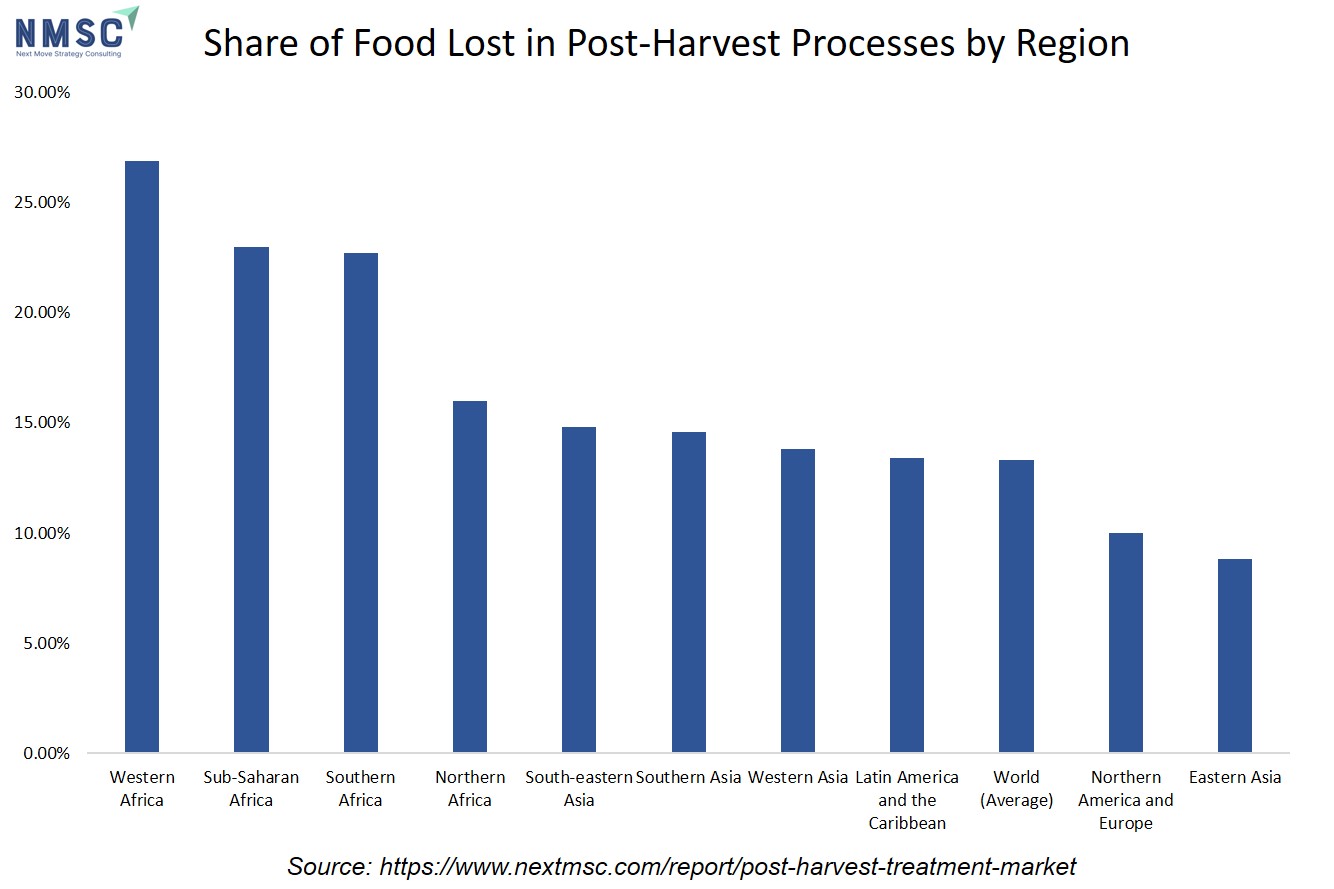
The regional disparity illustrated above underscores why post-harvest treatment adoption varies significantly by geography. Sub-Saharan Africa's post-harvest loss rate of 23 percent — more than double the 10 percent recorded across Northern America and Europe — reflects gaps in cold chain infrastructure, storage capacity, and access to preservation chemistries, all factors that NMSC's regional analysis identifies as constraints on market penetration in lower-income regions.
Regulatory and Corporate Momentum
Food safety regulation continues to be a primary structural driver of the market. UPL Ltd. partnered with the governments of Zambia, Sierra Leone, Liberia, and The Gambia, alongside the Commonwealth Secretariat, to launch a food security program focused on strengthening production, storage, and supply chain resilience. Corporate consolidation and technology integration are also reshaping the competitive landscape: MustGrow Biologics Corp. expanded its partnership with Janssen PMP, a division of Johnson & Johnson, to address postharvest preservation of potatoes and bananas globally, while AgroFresh Solutions partnered with sensor technology firm Strella to deliver real-time perishability data on stored apples and pears, enabling data-driven inventory management.
Key players active in the space include UPL Limited, MustGrow Biologics Corporation, JBT Corporation, Hazel Technologies, Inc., Xeda International, AgroFresh Solutions, Inc., Syngenta Group, Valent Biosciences Corporation, Citrosol International, and Futureco Bioscience LLC, according to NMSC's competitive landscape assessment.
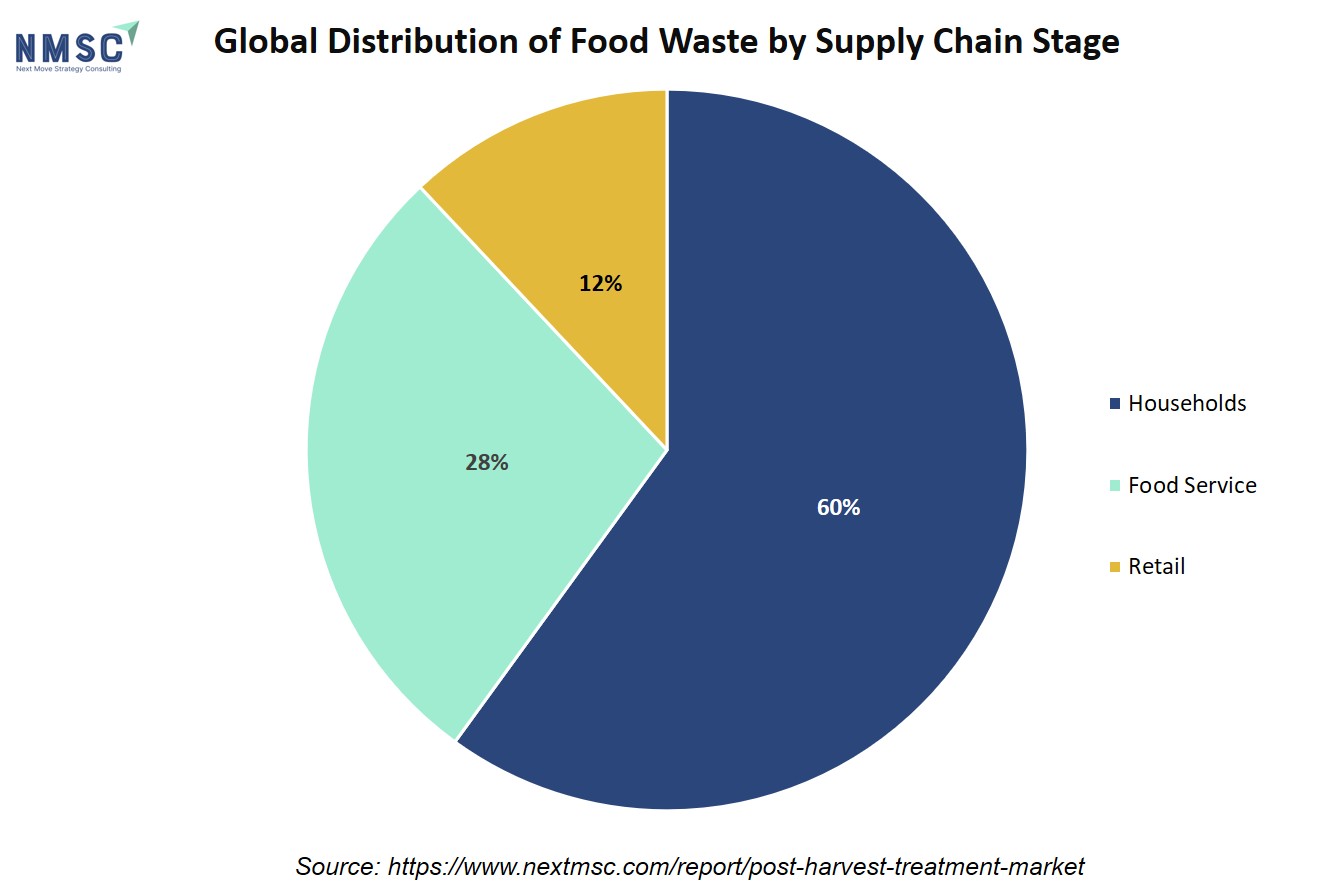
While the pie chart above addresses waste occurring after retail, it reinforces the complementary role of post-harvest treatment technologies, which primarily target the pre-retail loss segment — the stage where preservation chemistries and coatings have the greatest documented impact on shelf life and spoilage reduction.
National Progress and Policy Benchmarks
A small number of countries have demonstrated that structural investment in food loss and waste reduction yields measurable results, offering a policy benchmark relevant to post-harvest treatment adoption strategies.
National Food Waste Reduction Achievements
|
Country |
Reduction Achieved |
Baseline Year |
Measurement Year |
Key Mechanism |
|
Japan |
53% reduction in total food loss and waste |
2000 |
2022 |
National food recycling policy framework |
|
United Kingdom |
22% reduction in food waste |
2007 |
2025 |
Public-private collaboration (WRAP), consumer behavior initiatives |
Global Food Loss and Waste Key Indicators
|
Indicator |
Value |
Reference Period |
|
Food lost post-harvest, pre-retail (global average) |
13.2% – 13.3% |
2023–2024 |
|
Food wasted at retail, food service, and household levels |
19% |
2024 |
|
Estimated annual global economic cost of food loss and waste |
US$1 trillion |
2026 |
|
Share of global greenhouse gas emissions attributable to food loss and waste |
8–10% |
2026 |
|
Share of global methane emissions attributable to food waste |
Up to 14% |
2026 |
Outlook
NMSC's forecast anticipates continued growth for post-harvest treatment adoption through 2030, supported by rising global crop trade volumes, expanding cold chain infrastructure investment, and regulatory tightening across major consuming regions. The report also identifies organic and sustainable agricultural product lines as an emerging opportunity segment, incentivizing development of non-chemical and naturally derived preservation technologies tailored to organic farming practices.
However, the report cautions that inadequate rural infrastructure — including insufficient roads, electricity, and storage facilities — continues to constrain market accessibility in regions where post-harvest losses are highest, a pattern consistent with the FAO-sourced regional loss data presented above.
The global post-harvest treatment market is positioned for steady expansion through 2030, driven by mounting regulatory pressure, food security imperatives, and corporate commitments to reduce supply chain losses. The March 2026 UN International Day of Zero Waste observance and FAO's expanding food loss database confirm that post-harvest losses remain a persistent, costly, and unevenly distributed global challenge, with Sub-Saharan Africa and Western Africa recording loss rates more than double those of Northern America and Europe. This regional disparity represents both a risk — reflecting infrastructure and adoption gaps in lower-income markets — and an opportunity for preservation technology providers to expand into underserved geographies. Corporate partnerships involving sensor technology, biologics, and multinational agrochemical firms signal accelerating innovation within the sector. Investors and industry stakeholders should monitor regulatory developments such as the FSMA in North America and emerging sustainability mandates in Europe and Asia-Pacific, as these will continue to shape demand for coatings, sanitizers, and ethylene-blocking technologies across fruit and vegetable supply chains globally.
About Next Move Strategy Consulting
Next Move Strategy Consulting is a premier market research and management consulting firm that has been committed to provide strategically analysed well documented latest research reports to its clients. The research industry is flooded with many firms to choose from, what makes NMSC different from the rest is its top-quality research and the obsession of turning data into knowledge by dissecting every bit of it and providing fact-based research recommendation that is supported by information collected from over 500 million websites, paid databases, industry journals and one on one consultations with industry experts across a diverse range of industry sectors. The high-quality customized research reports with actionable insights and excellent end-to-end customer service help our clients to take critical business decisions that enables them to move beyond time and have competitive edge in the industry.
We have been servicing over 1000 customers globally that includes 90% of the Fortune 500 companies over a decade. Our analysts are constantly tracking various high growth markets and identifying hidden opportunities in each sector or the industry. We provide one of the industry's best quality syndicate as well as custom research reports across 10 different industry verticals. We are committed to deliver high quality research solutions in accordance to your business needs. Our industry standard delivery solutions that ranges from the pre consultation to after-sales services, provide an excellent client experience and ensure right strategic decision making for businesses.
For more information, please contact:
Next Move Strategy Consulting
5th Floor 867
Boylston St, STE 500,
Boston, MA 02116, U.S.
E-Mail: [email protected]
Direct: +1-217-650-7991
Website: www.nextmsc.com
About the Author
 Sanyukta Deb
— Sanyukta Deb is Digital Marketing Team Lead at Next Move Strategy Consulting, where she has led content strategy and technical SEO for the firm's B2B market research publications for over 2 years. Her editorial process translates NextMSC's primary and secondary research — spanning technology, industrial, and consumer sectors — into commercial narratives, backed by search-intent, keyword, and competitive analysis. She brings 5 years of overall experience in digital marketing and content strategy.
Sanyukta Deb
— Sanyukta Deb is Digital Marketing Team Lead at Next Move Strategy Consulting, where she has led content strategy and technical SEO for the firm's B2B market research publications for over 2 years. Her editorial process translates NextMSC's primary and secondary research — spanning technology, industrial, and consumer sectors — into commercial narratives, backed by search-intent, keyword, and competitive analysis. She brings 5 years of overall experience in digital marketing and content strategy.
About the Reviewer
 Debashree Dey
— Debashree Dey is Assistant Manager at Next Move Strategy Consulting, where she supports cross-vertical market content and communications across diverse industries for 6 years. Her professional background includes senior content writing, communications, and published manuscript authorship, with experience developing audience-focused business narratives and maintaining clear, consistent messaging. Her role supports research-led content development and editorial quality across NextMSC publications.
Debashree Dey
— Debashree Dey is Assistant Manager at Next Move Strategy Consulting, where she supports cross-vertical market content and communications across diverse industries for 6 years. Her professional background includes senior content writing, communications, and published manuscript authorship, with experience developing audience-focused business narratives and maintaining clear, consistent messaging. Her role supports research-led content development and editorial quality across NextMSC publications.


















Add Comment