Google's 1 GW Voltus Deal Moves Virtual Power Plants into Hyperscale Supply

Google's Tenfold Voltus Expansion and a 16 GW Sunrun, Tesla and Renew Home Framework Show Data Center Demand Pulling Home Batteries and Thermostats Into Grid Capacity Markets
On October 22, 2026, Google and Voltus announced an expanded agreement to build a 1-gigawatt virtual power plant across the PJM Interconnection, the grid region that serves 67 million people in 13 states and the District of Columbia. Google describes the arrangement as a tenfold expansion of a 100-megawatt agreement the companies signed in June 2026, while Utility Dive reports that 1,070 MW is being added to the initial 100 MW. Under the structure, Google funds the plant and Voltus aggregates batteries, smart thermostats, on-site generation and flexible industrial loads from homes and businesses, offers the combined capacity into PJM's market when the grid is strained, and pays participants through bill savings and direct payments. Voltus spokesperson Sarah Spitz told Utility Dive that the company expects to ramp the plant to full capacity over three to four years and to operate it under a contract with Google through 2040, a tenor that moves distributed capacity out of utility pilot programs and into long-dated corporate procurement.
According to Next Move Strategy Consulting's Virtual Power Plant Market report, the global virtual power plant market was valued at USD 8.53 billion in 2025 and is projected to reach USD 51.47 billion by 2035, growing at a CAGR of 16.7% from 2026 to 2035. NextMSC primary research and analysis places the market at USD 12.82 billion in 2026, with North America holding roughly 37% of revenue and demand response accounting for about 44% of the technology mix. The Google and Voltus agreement tests the assumption behind that trajectory: whether hyperscale buyers will pay for aggregated flexibility at fleet scale instead of relying only on utility enrolment programs.
For More Information: Download FREE Sample on Virtual Power Plant Market Report
The Financial Logic: PJM's Capacity Shortfall Created the Buyer
The economics start with PJM's capacity market. In its 2025 Annual State of the Market Report for PJM, released on March 12, 2026, Monitoring Analytics, the grid's independent market monitor, reported that the cost of capacity within each megawatt-hour of wholesale power rose from $3.61 in 2024 to $13.09 in 2025, an increase of 262.3%, while the total cost of wholesale power rose 48.9% to $82.67 per MWh. The monitor identified data center load growth as the primary reason for the tight supply and high prices, and reported that the amount by which PJM fell short of its reliability objective grew from 208.7 MW in the 2026/2027 capacity auction to 6,516.6 MW in the 2027/2028 auction. A buyer facing that shortfall has a direct incentive to fund capacity that can be contracted and enrolled faster than new generation can be built.
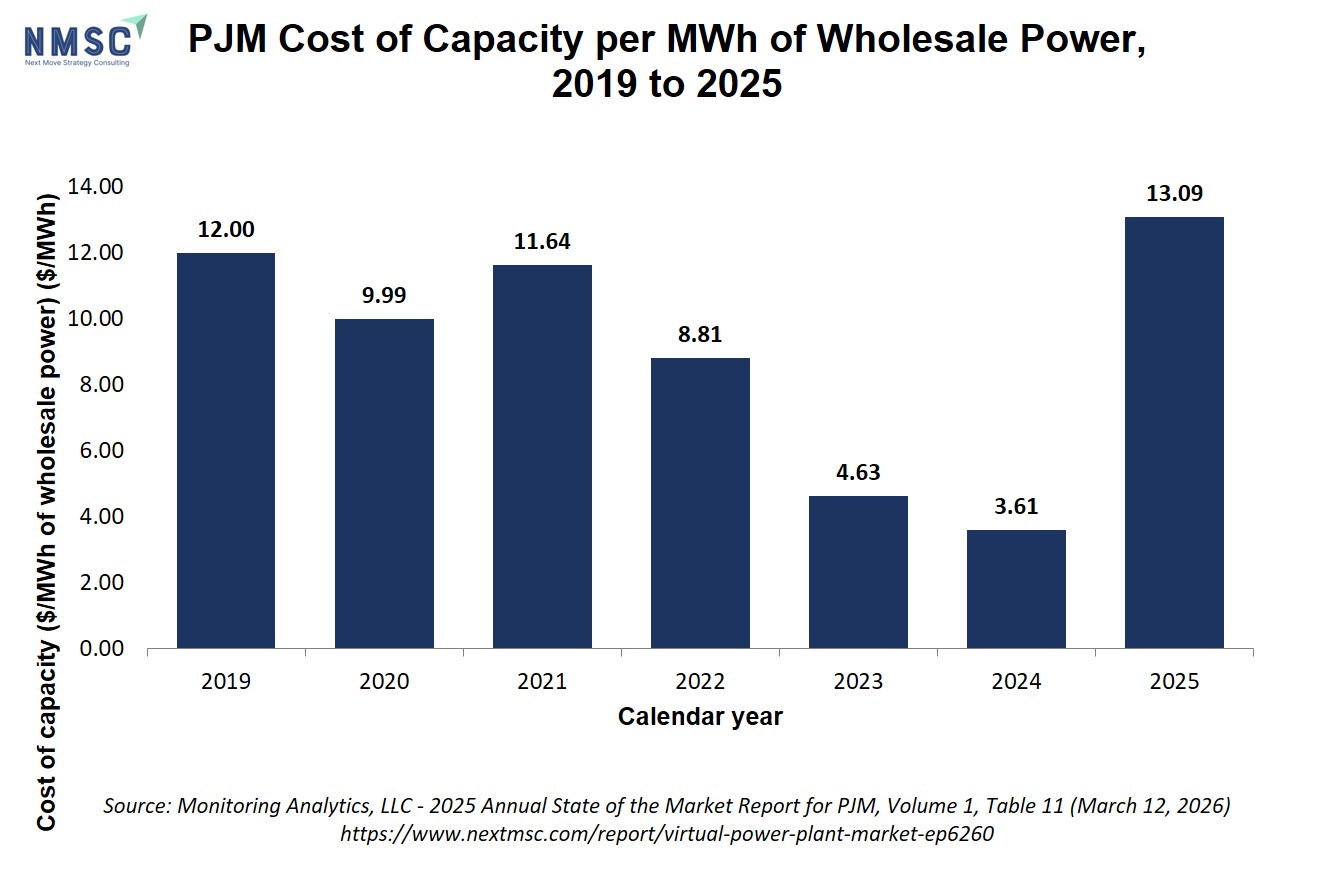
The cost of capacity in each MWh of PJM wholesale power fell to $3.61 in 2024 and then rose to $13.09 in 2025, the highest level in the 2019 to 2025 series shown, according to Monitoring Analytics.
PJM Total Cost of Wholesale Power by Component, 2024 and 2025 ($/MWh)
|
Component |
2024 ($/MWh) |
2025 ($/MWh) |
Change |
|
Energy |
$32.59 |
$49.28 |
+51.2% |
|
Capacity |
$3.61 |
$13.09 |
+262.3% |
|
Transmission |
$17.73 |
$18.53 |
+4.5% |
|
Ancillary services |
$0.92 |
$1.10 |
+20.0% |
|
Administration |
$0.68 |
$0.67 |
-0.6% |
|
Total cost of wholesale power |
$55.52 |
$82.67 |
+48.9% |
Demand response is already monetizing that scarcity. Utility Dive reported, citing the same market monitor's March report, that demand response revenue in PJM rose 240% from 2024 to 2025 to $523.5 million, driven mainly by higher capacity prices, and that emergency demand response accounted for 88% of the total. The concentration matters for virtual power plant design, because most of today's PJM demand response revenue is earned by loads that curtail in emergencies. Monitoring Analytics has also pressed for rules that would require large data centers to bring their own new generation, and its 2025 report argues that the current definition of demand response lets inferior products substitute for physical capacity, an issue it lists among the features that still threaten competitive outcomes in the capacity market.
Key Industry Developments: From a 100 MW Pilot to Gigawatt-Scale Contracts
The October announcement followed a run of financings and framework agreements. The Next Web reported that Voltus raised a $225 million Series D round on October 8, 2026, and Utility Dive reported that the company has about 8.5 GW of distributed assets under contract across North America and aims to reach 20 GW by the end of the decade. On June 24, 2026, Sunrun, Renew Home and Tesla announced a framework to deliver more than 16 GW of flexible capacity to hyperscalers and utilities. Sunrun's press release states that the resource draws dispatchable capacity from hundreds of thousands of home battery systems operated by Sunrun and Tesla, together with flexible peak capacity from more than 8 million smart thermostats and devices managed by Renew Home, and that more than 300 MW is available for immediate deployment in Virginia.
“actively bring our own capacity to the grids that serve us”
— Ellen Zuckerman, Head of Energy Market Development, North & South America, Google, Google press release, as reported by Utility Dive, October 22, 2026.
Independent coverage has also separated announced scale from firm supply. Electrek noted that the 16 GW headline is a theoretical aggregate of rated battery capacity and thermostat load-shift potential rather than 16 GW of firm, around-the-clock generation, and that the open question is whether the three companies can convert the announcement into signed offtake contracts. The Google and Voltus agreement answers part of that question for one buyer in one market, with a named counterparty and a contract term.
Selected Virtual Power Plant Agreements and Financings Announced in 2026
|
Date |
Parties |
Announced Scale |
Structure |
|
June 2026 |
Google and Voltus (PJM) |
100 MW |
Initial Google-funded agreement to aggregate customer resources into a virtual power plant |
|
June 24, 2026 |
Sunrun, Renew Home and Tesla |
More than 16 GW (16.8 GW in the companies' capacity infographic) |
Framework to aggregate home batteries and more than 8 million thermostats and devices for hyperscalers and utilities; more than 300 MW available in Virginia |
|
October 8, 2026 |
Voltus |
$225 million |
Series D funding round; about 8.5 GW under contract and a target of 20 GW by the end of the decade |
|
October 22, 2026 |
Google and Voltus (PJM) |
1 GW (1,070 MW added to the initial 100 MW, per Utility Dive) |
Expanded agreement; full ramp over three to four years under a Google contract through 2040 |
Segment Dynamics: Demand Response Leads, Mixed Portfolios Grow Faster
NextMSC primary research and analysis shows demand response as the largest technology segment, rising from USD 3.80 billion in 2025 to USD 20.40 billion by 2035, which equals about 44% of 2026 revenue (USD 5.60 billion). Mixed asset portfolios that combine batteries, thermostats, electric vehicle chargers and solar are the fastest-growing technology segment at an 18.0% CAGR from 2026 to 2035, rising from USD 2.95 billion in 2025 to USD 19.30 billion by 2035, ahead of distributed generation at 17.0%. By offering, NextMSC primary research and analysis identifies services as the fastest-growing category at an 18.8% CAGR, and by end user it identifies residential as the fastest-growing category at 18.3%. The structures announced by Google with Voltus and by Sunrun, Renew Home and Tesla both pair thermostats with batteries or other assets, the portfolio design that corresponds to the mixed asset category. The residential supply of batteries is growing: the Lawrence Berkeley National Laboratory reports in its U.S. Distributed Solar and Storage 2026 Data Update that batteries were paired with 37% of new residential solar installations in 2025, up from 25% in 2024.
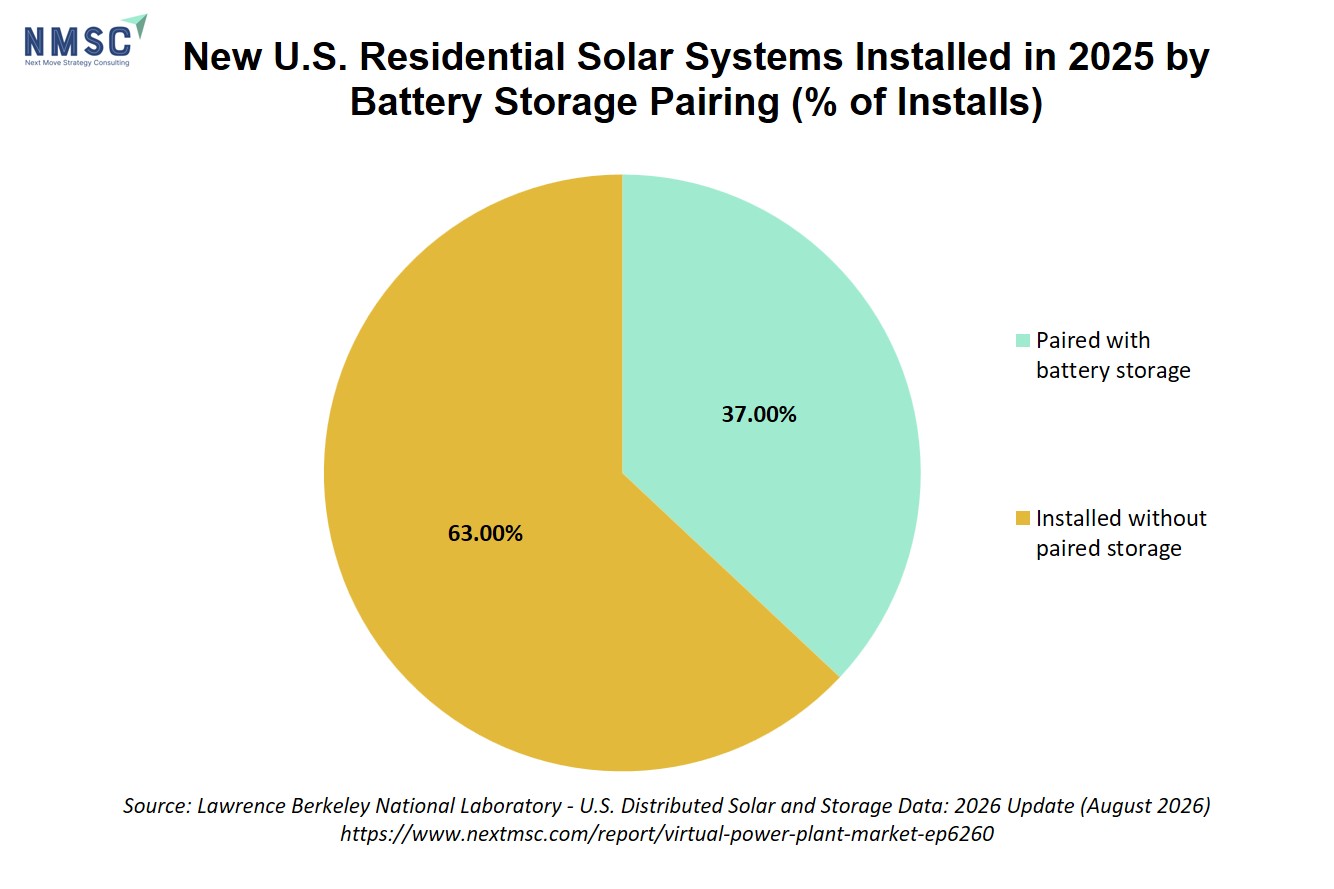
Berkeley Lab reports that the residential storage attachment rate rose from 25% of installs in 2024 to 37% in 2025. The 63% share is the remainder of the 100% total after the reported 37%. The attachment rate excludes batteries added later to existing solar systems and standalone battery installations.
Regional Outlook: North America Leads, Asia-Pacific Grows Fastest
NextMSC primary research and analysis places North America at roughly 37% of global revenue, or USD 4.75 billion in 2026, with the United States at an estimated USD 4.15 billion. Asia-Pacific is the fastest-growing region at a 19.6% CAGR from 2026 to 2035, reaching USD 16.57 billion by 2035. At the country level, Saudi Arabia is the fastest-growing market at a 23.7% CAGR from a small base of USD 0.08 billion in 2025, and India is projected to rise from USD 0.20 billion in 2025 to USD 2.15 billion by 2035, a 22.3% CAGR. The PJM contracts concentrate near-term activity in the United States, which is consistent with North America's lead in the NextMSC regional split.
Growth Drivers and Restraints
-
Driver, capacity scarcity: Monitoring Analytics reports that PJM's capacity cost per MWh rose 262.3% in 2025 and that the capacity shortfall against the reliability objective widened to 6,516.6 MW in the 2027/2028 auction.
-
Driver, national scale targets: The U.S. Department of Energy's Pathways to Commercial Liftoff report estimates that deploying 80 to 160 GW of virtual power plants by 2030 could cover 10% to 20% of peak demand and save on the order of $10 billion a year in grid costs.
-
Driver, buyer balance sheets: Google funds the PJM plant directly, and Voltus raised $225 million in October 2026 while setting a 20 GW under-contract target tied to its Bring Your Own Capacity initiative, according to The Next Web and Utility Dive.
-
Restraint, firmness of capacity: Electrek's assessment that the 16 GW headline is a theoretical aggregate shows that announced capacity and contracted, dispatchable capacity are different measures.
-
Restraint, rule uncertainty: Utility Dive reported that the Federal Energy Regulatory Commission largely rejected PJM's plan to curtail large loads without new supply earlier in October 2026, and Monitoring Analytics continues to challenge how demand response counts as capacity.
-
Restraint, platform fragility: Energy-Storage.news reported, citing Handelsblatt, that sonnen GmbH, a German home battery and virtual power plant company that Shell sold in August 2026, filed for insolvency on October 22, 2026, while its U.S. business continues as Sonnen Intelligence GmbH.
U.S. Department of Energy Benchmarks for Virtual Power Plant Scale
|
Metric |
DOE Benchmark |
|
Virtual power plant capacity operating at the time of the report (2023) |
30 to 60 GW |
|
Deployment scenario for 2030 |
80 to 160 GW, about triple the scale at the time of the report |
|
Share of peak demand virtual power plants could address at that scale |
10% to 20% |
|
Annual grid cost savings at that scale |
On the order of $10 billion |
|
New resources the U.S. needs by 2030 |
Enough to serve approximately 200 GW of peak demand |
NMSC Strategic Perspective: Contracts, Not Enrolments, Now Set the Pace
NextMSC primary research and analysis reads the October 22 announcement as a change in who funds distributed capacity. Utility programs and wholesale market payments have been the established revenue routes for aggregators, and PJM's demand response revenue, 88% of which came from emergency programs, shows how concentrated those routes are. A Google-funded plant under contract through 2040 gives a platform provider a named counterparty with a long-dated obligation, which is the kind of revenue that supports project and platform financing. NextMSC's forecast of USD 12.82 billion in 2026 and USD 51.47 billion by 2035 depends on that conversion, because frameworks of 16 GW or 1 GW become revenue only when devices are enrolled, metered and dispatched on demand.
Three variables decide whether the trajectory holds. The first is verified dispatch: buyers that pay for capacity need performance evidence, which favours software and platform providers and service firms, and NextMSC identifies services as the fastest-growing offering at an 18.8% CAGR. The second is portfolio mix: batteries paired with flexible loads deliver firmer output than single-device programs, consistent with the 18.0% CAGR NextMSC attributes to mixed asset portfolios. The third is rule stability: the market monitor's criticism of how demand response counts as capacity, together with the Federal Energy Regulatory Commission's rejection of PJM's large-load plan, shows that PJM's capacity rules are still moving. NextMSC therefore expects revenue to concentrate in providers with contracted, metered fleets, while providers that depend on announced but unenrolled capacity carry execution risk.
Competitive Landscape
Competition now runs along three lines. Voltus competes on aggregated commercial, industrial and residential flexibility and has tied its 20 GW target to its Bring Your Own Capacity initiative. Sunrun, Tesla and Renew Home compete on ownership of enrolled residential devices, and their June framework targets the same hyperscale buyers. Utility Dive also listed other recent announcements, including a 150-MW, $500 million virtual power plant from Budderfly and Schneider Electric and a Pacific Gas & Electric offering developed with Rewiring America, Google, Carrier Global, Tesla, Sunrun, Renew Home and other partners. The sector's fragility is visible in sonnen's October insolvency filing, which came two months after Shell completed the sale of the business.
Bottom Line
Google's October 22, 2026 agreement with Voltus turns the virtual power plant from a utility program into a financed capacity contract: 1 GW by Google's description, funded by a hyperscaler, ramped over three to four years and contracted through 2040. PJM's capacity cost rising from $3.61 to $13.09 per MWh in 2025 explains the buyer's urgency, and the Sunrun, Tesla and Renew Home framework shows the same demand reaching residential fleets. NextMSC primary research and analysis projects the market from USD 8.53 billion in 2025 to USD 51.47 billion by 2035 at a 16.7% CAGR, with North America at roughly 37% of revenue and Asia-Pacific growing fastest at 19.6%. That forecast depends on three conditions that external evidence leaves open: converting announced capacity into metered, dispatchable fleets, stable PJM rules for demand response and large loads, and aggregator balance sheets durable enough to honour multi-year commitments. Providers with verified dispatch records and contracted fleets are best placed to capture the spending that moves from utility programs to hyperscaler-funded capacity.
About Next Move Strategy Consulting
Next Move Strategy Consulting is a premier market research and management consulting firm that has been committed to provide strategically analysed well documented latest research reports to its clients. The research industry is flooded with many firms to choose from, what makes NMSC different from the rest is its top-quality research and the obsession of turning data into knowledge by dissecting every bit of it and providing fact-based research recommendation that is supported by information collected from over 500 million websites, paid databases, industry journals and one on one consultations with industry experts across a diverse range of industry sectors. The high-quality customized research reports with actionable insights and excellent end-to-end customer service help our clients to take critical business decisions that enables them to move beyond time and have competitive edge in the industry.
We have been servicing over 1000 customers globally that includes 90% of the Fortune 500 companies over a decade. Our analysts are constantly tracking various high growth markets and identifying hidden opportunities in each sector or the industry. We provide one of the industry’s best quality syndicate as well as custom research reports across 10 different industry verticals. We are committed to deliver high quality research solutions in accordance to your business needs. Our industry standard delivery solutions that ranges from the pre consultation to after-sales services, provide an excellent client experience and ensure right strategic decision making for businesses.
For more information, please contact:
Next Move Strategy Consulting
5th Floor 867 Boylston St, STE 500,
Boston, MA 02116, U.S.
E-Mail: [email protected]
Direct: +1-217-650-7991
Website: www.nextmsc.com
About the Author
 Priyanshu Das
— Priyanshu Das is SEO Executive at Next Move Strategy Consulting, where he has led on-page and off-page SEO, keyword research, and SEO audits for the firm's B2B market research publications for 2 years. His audit process combines technical crawl analysis, backlink profile review, and competitor keyword gap mapping — using tools including Screaming Frog and Google Search Console — to prioritize fixes by organic search-visibility impact, informed by his own prior in-house and agency SEO experience.
About the Reviewer
 Sanyukta Deb
— Sanyukta Deb is Digital Marketing Team Lead at Next Move Strategy Consulting, where she has led content strategy and technical SEO for the firm's B2B market research publications for over 2 years. Her editorial process translates NextMSC's primary and secondary research — spanning technology, industrial, and consumer sectors — into commercial narratives, backed by search-intent, keyword, and competitive analysis. She brings 5 years of overall experience in digital marketing and content strategy.

















Add Comment