How Big Is the Advanced Quantum Sensing Market After GPS-Free Test Flights?
A 4-Hour-23-Minute GPS-Free Pacific Flight, a Coral Sea Gravity Trial and a USD 40 Million NASA Program Show Quantum Sensors Moving Into Defense and Space Service
On September 4, 2026, the U.S. Defense Innovation Unit (DIU) announced that a quantum magnetic navigation system built by Honeywell Aerospace had guided a test aircraft for 4 hours and 23 minutes over the Pacific Ocean without GPS, flying from Seattle's Puget Sound to southern Alaska and back. In its release, titled GPS-Free Test Flight Success Marks Critical Advance for Aviation, National Security, the Defense Innovation Unit said the MagNav system improved position accuracy by 89% compared with traditional backup navigation methods. DefenseScoop reported on September 8, 2026 that the aircraft was an Embraer 170 and that DIU and Honeywell plan a further flight test on a U.S. military aircraft later in 2026.
The flight lands as quantum sensing moves from research budgets to procurement lists. According to Next Move Strategy Consulting's Advanced Quantum Sensing Market report, the global advanced quantum sensing market was valued at USD 0.47 billion in 2025 and is projected to reach USD 7.25 billion by 2035, growing at a CAGR of 31.5% between 2026 and 2035. NextMSC primary research and analysis puts the 2026 market at USD 0.62 billion, which implies an absolute dollar opportunity of USD 6.63 billion across the forecast period.
For More Information: Download FREE Sample on Advanced Quantum Sensing Market Report
How Big Is the Advanced Quantum Sensing Market?
The market is small and growing from a narrow base. NextMSC primary research and analysis sizes it at USD 0.47 billion in 2025 and USD 0.62 billion in 2026, then projects USD 7.25 billion in 2035, a roughly fifteen-fold increase over ten years. Atomic clocks were the largest sensor type in 2025 at USD 0.10 billion, about 22% of revenue, and North America held about 44% of regional revenue at USD 0.21 billion. The scale matters because a single government program or defense contract is now large enough to move market-level totals, a point developed in the NMSC Strategic Perspective below.
The Financial Logic: Why GPS Jamming Has Become a Procurement Problem
Satellite navigation has become a measurable operating risk. Windward data, reported by SAFETY4SEA on June 24, 2026, recorded approximately 978,000 GPS jamming events worldwide in the first quarter of 2026, with 98% concentrated in the Middle East Gulf and more than 1,100 vessels affected. SAFETY4SEA described the quarter as the largest single-quarter concentration of maritime jamming events Windward has recorded. When a receiver loses its satellite fix, operators fall back on inertial systems whose position error grows with time. Quantum sensors address that failure at its source: the Defense Innovation Unit describes the magnetic signature of the planet's crust as an unjammable navigation map.
Gravity-based positioning produced its first open-water evidence on August 27, 2026, when Q-CTRL reported that its Ironstone Opal quantum gravimeter navigated a vessel in the Coral Sea, off Australia's east coast, without GPS. GPS World reported on August 28, 2026 that the trial covered 83 kilometers aboard a 29-meter surface vessel and held bounded positioning accuracy of 1 nautical mile, more than 10 times better than a navigation-grade inertial backup. Q-CTRL's release said the unit sat in a passenger cabin and ran autonomously, without temperature control, gyroscopic stabilization or frequent recalibration, a configuration the company presented as evidence of readiness for real-world conditions.
NextMSC primary research and analysis ranks rising defense demand for GPS-denied navigation as the largest single driver in its growth model for this market, with a +6.5% impact on CAGR, ahead of government quantum technology funding programs at +5.0%.
Key Industry Developments: Four Dated Milestones Between August and October 2026
On August 27, 2026, Infleqtion announced a USD 20 million follow-on contract from NASA for the Quantum Gravity Gradiometer Pathfinder, a mission led by NASA's Jet Propulsion Laboratory to fly the first space-based quantum gravity sensor. Infleqtion's release said the award lifts NASA's total investment in the program to USD 40 million. In this phase Infleqtion will build an initial sensor head and electronics engineering development unit and test it at the Einstein Elevator drop-tower microgravity facility in Hannover, Germany. Work is scheduled through 2027, and the mission is expected to launch aboard a low-Earth-orbit spacecraft in 2030.
“We are no longer testing the quantum technology itself”
- Dana Anderson, Chief Science Officer, Infleqtion, Infleqtion press release, NASA Awards Infleqtion $20M Contract for Quantum Gravity Sensor, August 27, 2026.
NextMSC primary research and analysis reads that statement as a change in the commercial test: the question for buyers is no longer whether cold atoms can measure gravity, but whether the instrument performs in the environment it will be sold into. Hardware miniaturization and RF sensing moved in parallel. On October 6, 2026, Infleqtion, Honeywell Aerospace and the University of California, Santa Barbara announced a prototype that reduces the footprint needed for laser stabilization, which Infleqtion said paves the way for compact, fieldable quantum systems and chip-scale manufacturing. On October 13, 2026, Infleqtion UK announced an Innovate UK-funded project to develop a deployable quantum radio frequency direction finding system, taking atom-based RF sensing from laboratory research to operational environments.
Four Dated Milestones at a Glance
|
Date |
Organisation |
Milestone |
Named Source |
|
August 27, 2026 |
Q-CTRL |
GPS-free quantum gravimetric navigation trial in the Coral Sea; bounded accuracy of 1 nautical mile over 83 kilometers |
Q-CTRL; GPS World |
|
August 27, 2026 |
Infleqtion and NASA |
USD 20 million follow-on contract for the Quantum Gravity Gradiometer Pathfinder; NASA total investment USD 40 million |
Infleqtion |
|
September 4, 2026 |
Defense Innovation Unit and Honeywell Aerospace |
4 hours 23 minutes of GPS-free flight over the Pacific; 89% position accuracy improvement over backup navigation |
Defense Innovation Unit; DefenseScoop |
|
October 13, 2026 |
Infleqtion UK |
Innovate UK-funded project to develop a deployable quantum RF direction finding system |
Infleqtion |
Commercial Proof: Infleqtion's First-Quarter Revenue and the Cost of Scaling
Revenue data from the first publicly traded neutral-atom quantum computing company shows demand arriving ahead of profit. In its results release of May 14, 2026, Infleqtion reported first-quarter 2026 revenue of USD 9.5 million across computing, sensing and software, up 14% from USD 8.3 million a year earlier, all of it organic and all of it from quantum products. The company named its Quantum Spectrum atom-based RF sensing platform the second-largest contributor to sensing revenue and said multiple new customer programs address demand for trusted signals in contested environments. Infleqtion raised its 2026 revenue outlook to at least USD 40 million, while reporting a GAAP loss from operations of USD 33.6 million for the quarter.
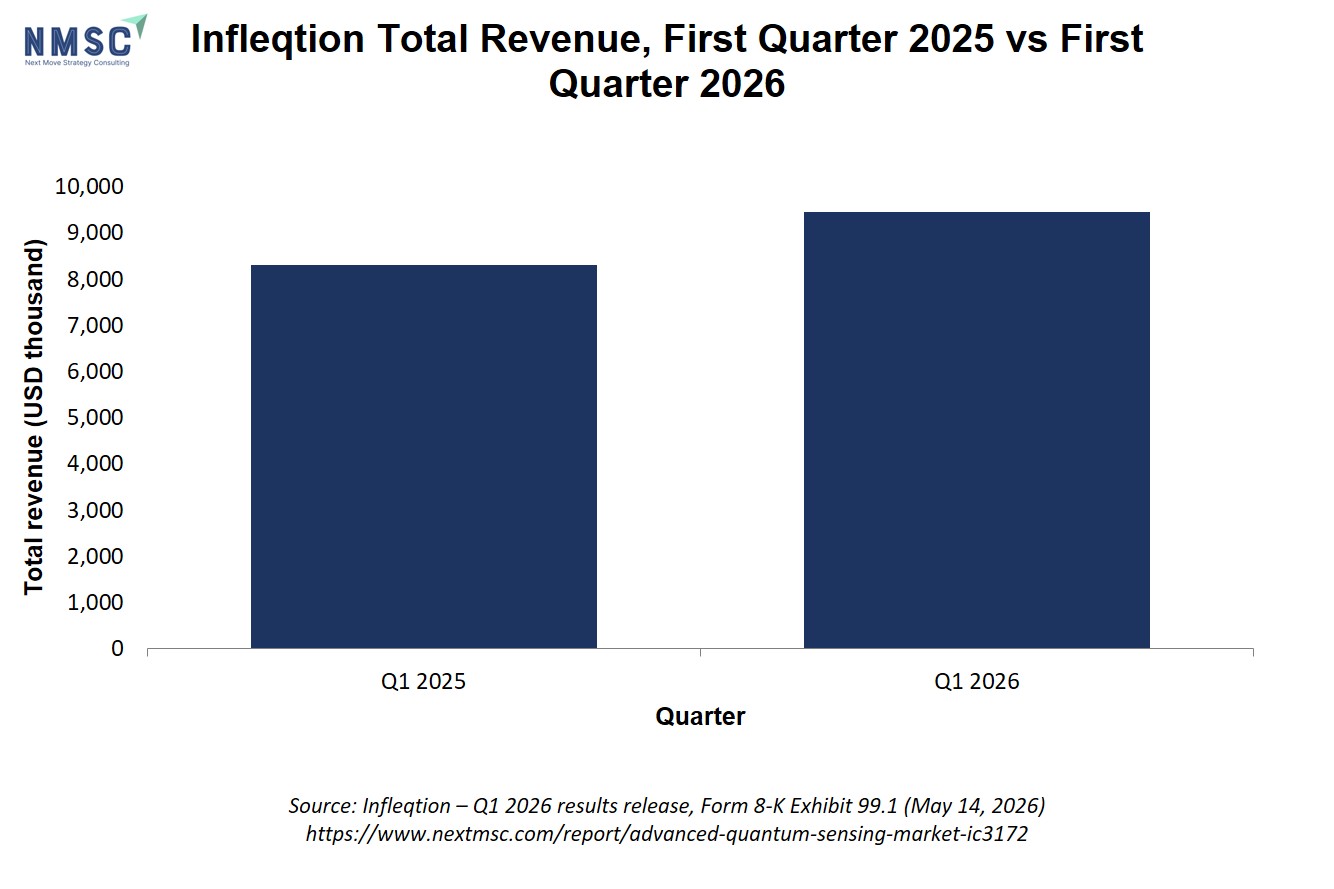
The gap between USD 9.5 million of revenue and a USD 33.6 million operating loss illustrates the restraint that NextMSC primary research and analysis quantifies: high per-unit hardware and cryogenic infrastructure costs carry a −3.5% impact on CAGR through 2032, and limited manufacturing scale and skilled workforce availability a further −2.5% through 2030. The loss also includes items unrelated to sensor manufacturing. Infleqtion's non-GAAP operating loss, which excludes stock-based compensation, acquisition and integration costs and go-public transaction expenses of USD 11.5 million, was USD 13.2 million, so the GAAP figure should not be read as a measure of sensor unit economics.
Segment Dynamics: Atomic Clocks Lead Today, Magnetic Sensors Grow Fastest
According to NextMSC primary research and analysis, atomic clocks were the largest sensor type in 2025 at USD 0.10 billion, supported by commercial maturity in timing, navigation and telecommunications synchronization. Magnetic sensors, which span SQUID, optically pumped magnetometer, NV center and TMR devices, are the fastest-growing type at a 35.7% CAGR from 2026 to 2035, rising from USD 0.08 billion in 2025 to USD 1.74 billion in 2035. The DIU flight test, which relied on the Earth's magnetic field, is field evidence in the sensor segment where NextMSC projects the fastest expansion.
By application, defense and security was the largest category in 2025 at USD 0.14 billion, while medical and healthcare is the fastest-growing at a 42.9% CAGR, expanding from USD 0.04 billion to USD 1.23 billion as magnetic sensing platforms scale for diagnostic imaging and neurological monitoring. By technology platform, solid-state defects led in 2025 at USD 0.10 billion on established NV-center diamond manufacturing and room-temperature operation, and neutral atoms are the fastest-growing platform at a 38.5% CAGR, moving from USD 0.05 billion to USD 1.16 billion. Infleqtion's portfolio of quantum optical clocks, RF receivers and inertial sensors sits on that neutral-atom platform.
Regional Outlook: North America Leads, Asia-Pacific Grows Fastest
NextMSC primary research and analysis shows North America leading with about 44% of 2025 revenue, or USD 0.21 billion, anchored by defense procurement and NASA space qualification programs; the United States alone accounted for about USD 0.16 billion. The NASA award and the DIU flight test are both U.S. programs, which is consistent with that concentration. Europe was valued at USD 0.13 billion in 2025 and is projected to reach USD 1.74 billion by 2035 at a 29.2% CAGR, shaped by national quantum technology strategies and defense modernization; the Innovate UK-funded project announced by Infleqtion UK on October 13, 2026 follows that national-strategy pathway.
Asia-Pacific is the fastest-growing region at a 38.5% CAGR, from USD 0.09 billion in 2025 to USD 2.32 billion in 2035, on expanding national quantum research investment. At country level, NextMSC identifies India as the fastest-growing market at a 45.0% CAGR, from about USD 0.02 billion to USD 0.56 billion, and China at a 41.5% CAGR, from about USD 0.04 billion to USD 1.05 billion.
Growth Drivers and Restraints
NextMSC primary research and analysis assigns six positive and three negative factors a measured impact on the 2026–2035 CAGR. Defense demand for GPS-denied navigation (+6.5%), government funding programs (+5.0%), healthcare diagnostic imaging (+4.0%) and space and satellite qualification programs (+3.5%) carry the largest positive weights. On the negative side, hardware and cryogenic infrastructure costs (−3.5%), limited manufacturing scale and workforce availability (−2.5%) and export control restrictions on sensitive quantum technologies (−1.5%) set the limits.
Advanced Quantum Sensing Market — Growth Catalyst and Risk Assessment Matrix
|
Factor |
Type |
Impact on CAGR |
Geography |
Timeline |
|
Rising defense demand for GPS-denied navigation |
Driver |
+6.5% |
North America, Europe |
2026–2035 |
|
Government quantum technology funding programs |
Driver |
+5.0% |
Global |
2026–2032 |
|
Expanding healthcare diagnostic imaging applications |
Driver |
+4.0% |
North America, Asia-Pacific |
2026–2035 |
|
Space and satellite quantum sensor qualification programs |
Driver |
+3.5% |
North America, Europe |
2026–2035 |
|
Miniaturization and room-temperature sensor packaging |
Driver |
+2.5% |
Global |
2026–2035 |
|
Rising oil and gas exploration gravimetric adoption |
Driver |
+1.5% |
North America, Middle East & Africa |
2026–2032 |
|
High per-unit hardware and cryogenic infrastructure costs |
Restraint |
−3.5% |
Global |
2026–2032 |
|
Limited manufacturing scale and skilled workforce availability |
Restraint |
−2.5% |
Global |
2026–2030 |
|
Export control restrictions on sensitive quantum technologies |
Restraint |
−1.5% |
North America, Europe, Asia-Pacific |
2026–2035 |
NMSC Strategic Perspective: Field Qualification Has Become the Entry Ticket
NextMSC primary research and analysis reads the August-to-October 2026 milestones as one pattern. Each was measured against an operational yardstick rather than a laboratory benchmark: position error against a backup navigation system in the DIU flight, nautical-mile accuracy over 83 kilometers in the Coral Sea, and drop-tower microgravity performance for the NASA instrument. NextMSC's analysis shows sensor developers moving from laboratory-grade demonstrations to deployable, field-hardened systems, a shift that favors vendors with defense and space qualification credentials over research-stage entrants. Developers that cannot show field validation risk exclusion from defense and space procurement shortlists.
Public money is setting the pace. The NASA gravity pathfinder carries USD 40 million in cumulative NASA investment, DIU's MagNav program drew applications from 72 companies before Honeywell Aerospace was selected for prototype development, and Innovate UK is funding the British RF direction finding project. NextMSC assigns government quantum technology funding a +5.0% impact on CAGR through 2032. Against a 2025 market of USD 0.47 billion, one multi-year program of USD 40 million is material, although the comparison sets multi-year contract value against annual market revenue and should be read as an indicator of concentration, not as a market share.
For investors and suppliers, NextMSC's analysis points to three pockets where growth outpaces the 31.5% market rate: magnetic sensors at 35.7%, neutral-atom platforms at 38.5% and medical and healthcare applications at 42.9%, with Asia-Pacific at 38.5% as the fastest region. The absolute dollar opportunity is USD 6.63 billion between 2026 and 2035. The risks sit on the cost and policy side: export control restrictions on sensitive quantum technologies carry a −1.5% impact on CAGR across North America, Europe and Asia-Pacific through 2035, and hardware cost remains the largest restraint at −3.5%.
Competitive Landscape
NextMSC primary research and analysis describes a highly fragmented, early-stage market in which specialist developers and diversified aerospace groups compete on sensor precision, field-deployment readiness and defense qualification. Honeywell Aerospace is the prototype developer in DIU's MagNav program and is collaborating with Infleqtion on miniaturized laser stabilization. Infleqtion's portfolio spans quantum optical clocks, atom-based RF sensing and inertial sensing, and its May 14, 2026 release announced a timing solution with Safran Electronics & Defense that integrates its Tiqker quantum optical clock with Safran's White Rabbit and SecureSync systems for GNSS-challenged environments.
Q-CTRL competes through a software-led approach. Its August 27, 2026 release described AI-powered software that stabilizes quantum sensors without special countermeasures, and stated that the company holds contracts with DARPA, the U.S. Defense Innovation Unit, the Australian Department of Defence and the UK Royal Navy. Those contract details are Q-CTRL's own statements and are not independently confirmed in this article.
Bottom Line
The advanced quantum sensing market is small but moving from laboratory proof to field qualification. NextMSC primary research and analysis values it at USD 0.47 billion in 2025 and projects USD 7.25 billion by 2035, a 31.5% CAGR. Between August 27 and October 13, 2026, a Defense Innovation Unit flight test, a Coral Sea gravimetric trial, a USD 20 million NASA follow-on award and two Infleqtion hardware and RF announcements showed buyers testing sensors against operating conditions. Defense navigation demand, government funding and healthcare imaging carry the largest positive effects in NextMSC's model, while hardware cost, manufacturing scale and export controls remain the main limits. Magnetic sensors, neutral-atom platforms and Asia-Pacific are growing fastest, and North America remains the largest region. Suppliers that secure qualification credentials and public program positions are best placed to capture the USD 6.63 billion opportunity projected between 2026 and 2035.
About Next Move Strategy Consulting
Next Move Strategy Consulting is a premier market research and management consulting firm that has been committed to provide strategically analysed well documented latest research reports to its clients. The research industry is flooded with many firms to choose from, what makes NMSC different from the rest is its top-quality research and the obsession of turning data into knowledge by dissecting every bit of it and providing fact-based research recommendation that is supported by information collected from over 500 million websites, paid databases, industry journals and one on one consultations with industry experts across a diverse range of industry sectors. The high-quality customized research reports with actionable insights and excellent end-to-end customer service help our clients to take critical business decisions that enables them to move beyond time and have competitive edge in the industry.
We have been servicing over 1000 customers globally that includes 90% of the Fortune 500 companies over a decade. Our analysts are constantly tracking various high growth markets and identifying hidden opportunities in each sector or the industry. We provide one of the industry’s best quality syndicate as well as custom research reports across 10 different industry verticals. We are committed to deliver high quality research solutions in accordance to your business needs. Our industry standard delivery solutions that ranges from the pre consultation to after-sales services, provide an excellent client experience and ensure right strategic decision making for businesses.
For more information, please contact:
Next Move Strategy Consulting
5th Floor 867 Boylston St, STE 500,
Boston, MA 02116, U.S.
E-Mail: [email protected]
Direct: +1-217-650-7991
Website: www.nextmsc.com
About the Author
 Sanyukta Deb
— Sanyukta Deb is Digital Marketing Team Lead at Next Move Strategy Consulting, where she has led content strategy and technical SEO for the firm's B2B market research publications for over 2 years. Her editorial process translates NextMSC's primary and secondary research — spanning technology, industrial, and consumer sectors — into commercial narratives, backed by search-intent, keyword, and competitive analysis. She brings 5 years of overall experience in digital marketing and content strategy.
About the Reviewer
 Debashree Dey
— Debashree Dey is Assistant Manager at Next Move Strategy Consulting, where she supports cross-vertical market content and communications across diverse industries for 6 years. Her professional background includes senior content writing, communications, and published manuscript authorship, with experience developing audience-focused business narratives and maintaining clear, consistent messaging. Her role supports research-led content development and editorial quality across NextMSC publications.
















Add Comment