Advanced Quantum Sensing Market Size, Share, Trends and Growth Analysis, By Sensor Type (Atomic Clocks, Magnetic Sensors, Gravimeters & Accelerometers, Gyroscopes, Imaging & Photon Detectors, RF & Electric Field Sensors, Interferometers, Chemical & Molecular Sensors, PAR Sensors, and Other Quantum Sensors), By Technology Platform, By Application, By Industry Vertical, and Region – Global Industry Report and Forecast, 2026–2035
Industry: Semiconductor & Electronics | Publishing Date: July 28, 2026 | Last Updated: July 31, 2026 | No of Pages: N/A | No. of Tables: N/A | No. of Figures: N/A | Format: PDF | Report Code: SE3172
What Is the Advanced Quantum Sensing Market Size?
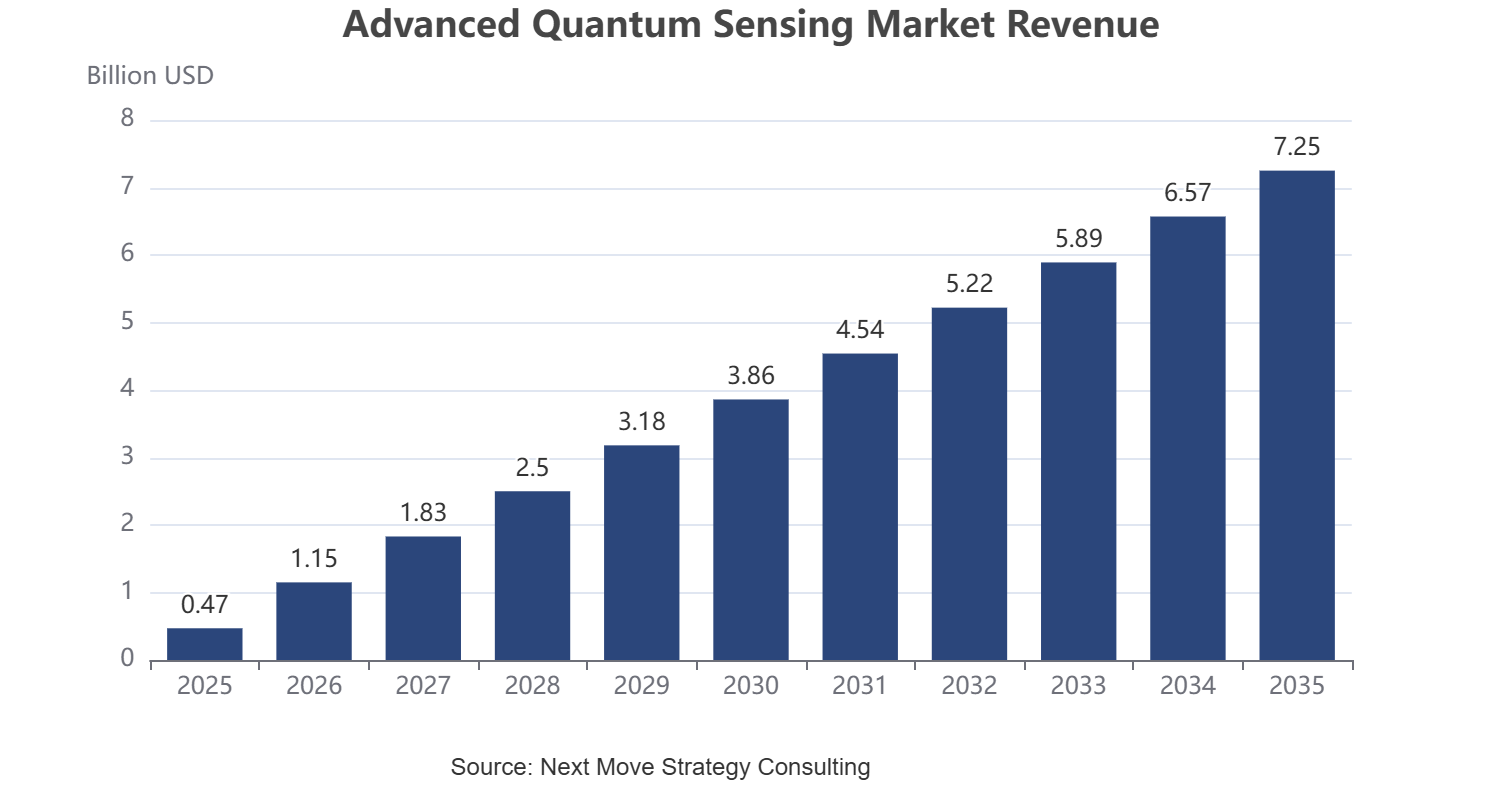
The global advanced quantum sensing market size was valued at USD 0.47 billion in 2025 and is estimated at USD 0.62 billion in 2026, forecast to reach USD 7.25 billion by 2035, expanding at a 31.5% CAGR between 2026 and 2035. North America leads with approximately 44% share, while atomic clocks dominate all other sensor types with approximately 22% share.
We observed that growth is broad-based across every segmentation axis, with magnetic sensors and healthcare-linked applications driving the dominant structural shifts through 2035.
|
Key Takeaways |
|
By Sensor Type: Atomic Clocks held the largest share of approximately 22% (USD 0.10 billion) in 2025; Magnetic Sensors is the fastest-growing sub-segment at 35.7% CAGR from 2026–2035. |
|
By Technology Platform: Solid-State Defects held the largest share of approximately 22% (USD 0.10 billion) in 2025; Neutral Atoms is the fastest-growing sub-segment at 38.5% CAGR from 2026–2035. |
|
By Application: Defense and Security held the largest share of approximately 30% (USD 0.14 billion) in 2025; Medical and Healthcare is the fastest-growing sub-segment at 42.9% CAGR from 2026–2035. |
|
By Industry Vertical: Aerospace and Defense held the largest share of approximately 32% (USD 0.15 billion) in 2025; Healthcare and Life Sciences is the fastest-growing sub-segment at 43.0% CAGR from 2026–2035. |
|
Dominant Region: North America dominated with approximately 44% revenue share (USD 0.21 billion) in 2025. |
|
Fastest-Growing Region: Asia-Pacific is expected to register the highest CAGR of 38.5% during 2026–2035. |
|
Dominant Country: U.S. led with approximately USD 0.16 billion in 2025. |
|
Fastest-Growing Country: India is the fastest-growing country at approximately 45.0% CAGR from 2026–2035. |
Market Opportunity: The advanced quantum sensing market is expected to create an absolute dollar opportunity of USD 6.63 billion between 2026 and 2035, presenting significant investment potential across defense, healthcare, and navigation sensing platforms.
According to Next Move Strategy Consulting analysis, sensor developers are increasingly transitioning from laboratory-grade demonstrations to deployable, field-hardened systems, a shift that favors vendors with proven defense and space qualification credentials over research-stage entrants as commercialization accelerates through 2035.
What Does the Advanced Quantum Sensing Market Encompass?
The advanced quantum sensing market encompasses devices that exploit quantum mechanical phenomena, including superposition, entanglement, and quantum coherence, to measure magnetic fields, time, gravity, rotation, and electromagnetic radiation with precision exceeding classical sensors. Our assessment indicates that the scope spans atomic clocks, magnetic sensors, gravimeters, gyroscopes, imaging and photon detectors, and related devices built on neutral atom, solid-state defect, superconducting, photonic, and trapped-ion platforms. The category has evolved from national laboratory demonstrations into field-deployable commercial products, driven by defense modernization and GPS-denied navigation requirements.
Regulatory frameworks such as U.S. export control classifications under the Department of Commerce and national security review processes shape how quantum sensing technologies are commercialized and exported internationally. We observed that technology adoption is shifting toward room-temperature, ruggedized sensor packages suitable for field and space deployment. Next Move Strategy Consulting's analysis indicates that this structural shift, combined with expanding defense and healthcare procurement budgets, is redefining commercialization priorities across the advanced quantum sensing market.
|
Parameters |
Details |
|
Market Size in 2025 |
USD 470 Million |
|
Market Size in 2026 |
USD 620 Million |
|
Revenue Forecast in 2035 |
USD 7250 Million |
|
Growth Rate |
CAGR of 31.5% from 2026 to 2035 |
|
Analysis Period |
2025–2035 |
|
Base Year Considered |
2025 |
|
Forecast Period |
2026–2035 |
|
Market Size Estimation |
USD Million |
|
Companies Profiled |
15 |
|
Countries Covered |
33 |
|
Market Share |
Available for Top 10 Companies |
Key Emerging Trends
Based on research conducted by Next Move Strategy Consulting, we found that four structural trends are reshaping technology commercialization, adoption, and stakeholder engagement across the advanced quantum sensing industry.
How Is Precision Timing Moving from Lab to Field Deployment?
Quantum-enabled precision timing systems are transitioning from laboratory demonstrations into ruggedized products deployed across defense and telecommunications networks. We observed that Infleqtion's April 2026 delivery of its first quantum-enabled precision timing solution, developed with Safran Electronics & Defense and integrating its Tiqker optical atomic clock, illustrates this shift toward field-validated commercial timing products. Defense and telecommunications customers are adopting these systems to secure resilient timing independent of GPS signals.
Why Is Atom-Based RF Sensing Gaining Defense Traction?
Atom-based radio frequency sensing platforms are gaining specification priority among defense customers seeking trusted signal detection in contested electromagnetic environments. Our findings suggest that Infleqtion's Quantum Spectrum platform became its second-largest sensing revenue contributor in the first quarter of 2026, supported by multiple new customer programs. Developers are prioritizing atom-based RF architectures that deliver superior sensitivity without cryogenic cooling requirements.
How Are Space Agencies Adopting Quantum Gravimetric Sensing?
Space agencies are increasingly commissioning quantum sensors for orbital gravitational field measurement and navigation applications. We found that Infleqtion's role as a collaborator on NASA's Quantum Gravity Gradiometer Pathfinder mission, announced in February 2026, secured more than USD 20 million in contracted funding for a quantum sensor scheduled for orbital deployment. This trend is elevating demand for space-qualified quantum sensing hardware among aerospace and satellite integrators.
What Role Does Public Investment Play in Commercialization?
Government funding programs are accelerating the transition of quantum sensing technologies from research institutions into commercial products. Our analysis shows that Infleqtion's engagement with DARPA's HARQ program and expanded ARPA-E funding illustrates how public investment underwrites early commercial deployment risk. This trend is broadening the pool of vendors able to reach field-deployable maturity ahead of private capital availability.
Ecosystem Analysis of the Advanced Quantum Sensing Market
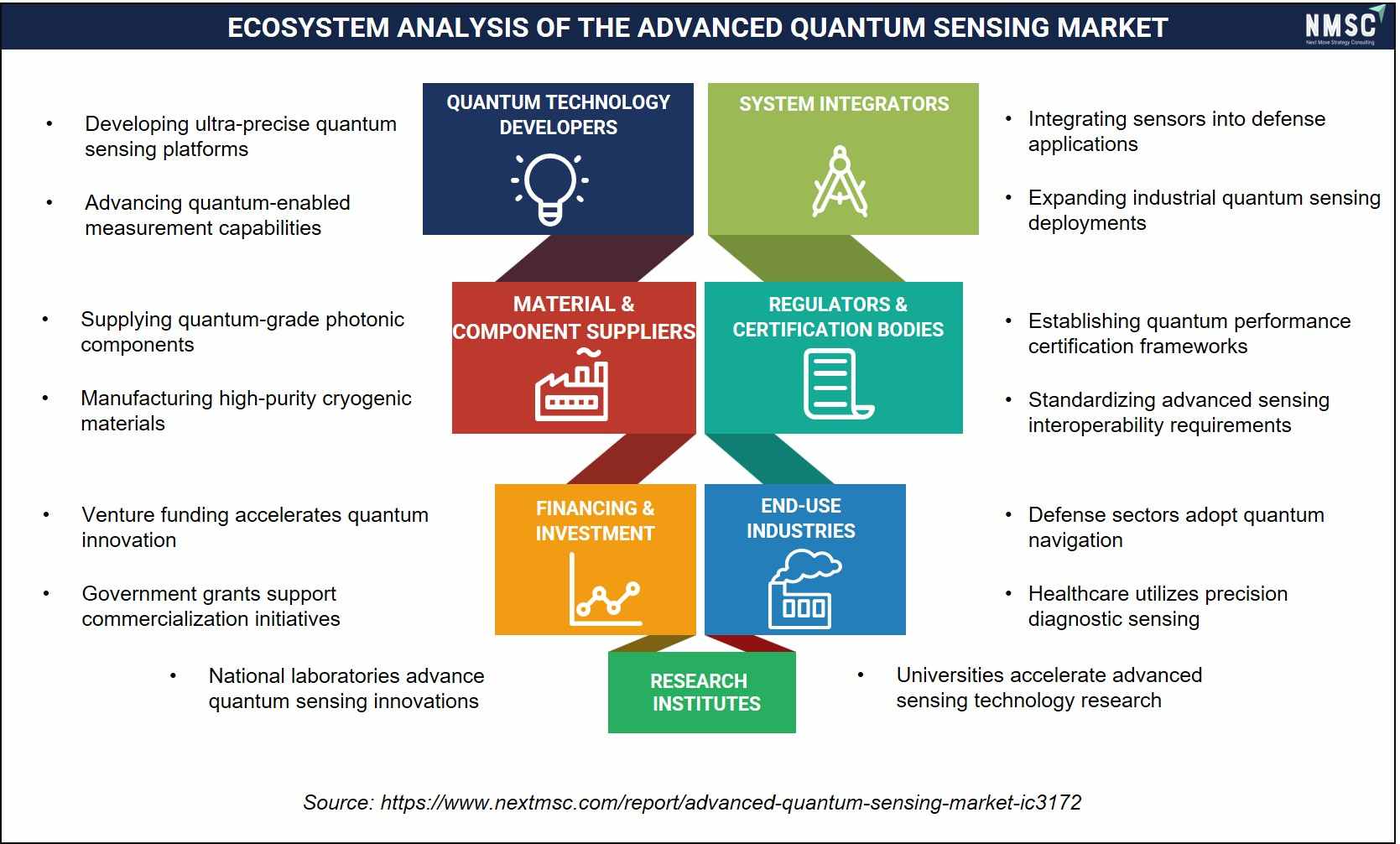
The advanced quantum sensing market ecosystem is built on collaboration among quantum technology developers, material and component suppliers, system integrators, regulatory and certification bodies, research institutes, funding organizations, and end-use industries. Continuous innovation, strategic investments, technology commercialization, and regulatory support accelerate product development and adoption across defense, healthcare, industrial manufacturing, aerospace, telecommunications, and scientific research applications.
Growth Drivers and Restraints
Growth Catalyst and Risk Assessment Matrix
|
Factors |
Type |
(+/−) % Impact on CAGR |
Geographic Relevance |
Impact Timeline |
|
Rising defense demand for GPS-denied navigation |
Driver |
+6.5% |
North America, Europe |
2026–2035 |
|
Government quantum technology funding programs |
Driver |
+5.0% |
Global |
2026–2032 |
|
Expanding healthcare diagnostic imaging applications |
Driver |
+4.0% |
North America, Asia-Pacific |
2026–2035 |
|
Space and satellite quantum sensor qualification programs |
Driver |
+3.5% |
North America, Europe |
2026–2035 |
|
Miniaturization and room-temperature sensor packaging |
Driver |
+2.5% |
Global |
2026–2035 |
|
Rising oil and gas exploration gravimetric adoption |
Driver |
+1.5% |
North America, Middle East & Africa |
2026–2032 |
|
High per-unit hardware and cryogenic infrastructure costs |
Restraint |
−3.5% |
Global |
2026–2032 |
|
Limited manufacturing scale and skilled workforce availability |
Restraint |
−2.5% |
Global |
2026–2030 |
|
Export control restrictions on sensitive quantum technologies |
Restraint |
−1.5% |
North America, Europe, Asia-Pacific |
2026–2035 |
What Is the Primary Growth Driver of the Advanced Quantum Sensing Market?
Rising defense demand for GPS-denied navigation is the primary driver of the market. U.S. Department of Defense and DARPA program disclosures indicate sustained funding for resilient positioning, navigation, and timing technologies that do not rely on satellite signals. We observed that this demand, reinforced by contested electromagnetic environment requirements, continues to anchor baseline investment in atomic clock and inertial quantum sensing across developed defense economies.
How Is Government Funding Driving Market Growth?
Sustained government quantum technology funding is accelerating market growth by underwriting early commercialization risk for field-deployable sensor systems. NASA's Quantum Gravity Gradiometer Pathfinder mission and DARPA's HARQ program illustrate this public investment pattern, with Infleqtion alone securing more than USD 20 million in contracted NASA funding as of early 2026. Our assessment indicates that this funding pipeline is compressing commercialization timelines for space and defense-qualified quantum sensors.
What Is Restraining Advanced Quantum Sensing Market Expansion?
High per-unit hardware costs and cryogenic infrastructure requirements restrain adoption among cost-sensitive commercial and industrial customers. Company financial disclosures show that leading quantum sensing developers continue to operate at a net loss while scaling manufacturing capacity, reflecting the market's early commercialization stage. We found that limited specialized manufacturing scale and a constrained skilled workforce continue to lengthen production timelines industry-wide.
Segmentation Analysis
Segment Sizing: By Sensor Type
|
Segment |
2025 (USD) |
2035 (USD) |
CAGR% (2026–2035) |
|
Atomic Clocks |
USD 0.10 Billion |
USD 1.16 Billion |
26.9% |
|
Magnetic Sensors |
USD 0.08 Billion |
USD 1.74 Billion |
35.7% |
|
Gravimeters and Accelerometers |
USD 0.06 Billion |
USD 0.80 Billion |
30.2% |
|
Gyroscopes |
USD 0.05 Billion |
USD 0.65 Billion |
29.9% |
|
Imaging and Photon Detectors |
USD 0.07 Billion |
USD 1.16 Billion |
33.4% |
|
RF and Electric Field Sensors |
USD 0.04 Billion |
USD 0.65 Billion |
33.2% |
|
Interferometers |
USD 0.03 Billion |
USD 0.44 Billion |
29.2% |
|
Chemical and Molecular Sensors |
USD 0.02 Billion |
USD 0.36 Billion |
34.7% |
|
PAR Sensors |
USD 0.01 Billion |
USD 0.15 Billion |
31.4% |
|
Other Quantum Sensors |
USD 0.01 Billion |
USD 0.14 Billion |
25.6% |
|
Total |
USD 0.47 Billion |
USD 7.25 Billion |
31.5% |
Which Sensor Type Segment Dominates the Advanced Quantum Sensing Market?
Atomic Clocks led the market with USD 0.10 billion in 2025, supported by their commercial maturity in timing, navigation, and telecommunications synchronization applications. We observed that Magnetic Sensors, encompassing SQUID, optically pumped magnetometer, NV center, and TMR technologies, is the fastest-growing sensor type, expanding at a 35.7% CAGR from 2026 to 2035, as healthcare imaging and defense detection applications scale field deployment.
Segment Sizing: By Application
|
Segment |
2025 (USD) |
2035 (USD) |
CAGR% (2026–2035) |
|
Defense and Security |
USD 0.14 Billion |
USD 1.74 Billion |
28.2% |
|
Navigation and Positioning |
USD 0.08 Billion |
USD 1.16 Billion |
29.7% |
|
Scientific Research |
USD 0.08 Billion |
USD 0.87 Billion |
27.3% |
|
Industrial and Energy |
USD 0.05 Billion |
USD 0.80 Billion |
32.8% |
|
Medical and Healthcare |
USD 0.04 Billion |
USD 1.23 Billion |
42.9% |
|
Environmental and Geological Monitoring |
USD 0.03 Billion |
USD 0.58 Billion |
33.4% |
|
Quantum Computing Readout |
USD 0.02 Billion |
USD 0.44 Billion |
34.1% |
|
Telecommunications |
USD 0.02 Billion |
USD 0.29 Billion |
31.4% |
|
Agriculture |
USD 0.01 Billion |
USD 0.14 Billion |
31.4% |
|
Total |
USD 0.47 Billion |
USD 7.25 Billion |
31.5% |
Which Application Segment Leads Market Demand?
Defense and Security remained the leading application within the market, valued at USD 0.14 billion in 2025 on sustained government procurement for navigation, detection, and signal-sensing systems. Our findings suggest that Medical and Healthcare is the fastest-growing application, registering a 42.9% CAGR from 2026 to 2035, as magnetic sensing platforms scale for diagnostic imaging and neurological monitoring applications requiring non-invasive precision.
Segment Sizing: By Technology Platform
|
Segment |
2025 (USD) |
2035 (USD) |
CAGR% (2026–2035) |
|
Solid-State Defects |
USD 0.10 Billion |
USD 1.31 Billion |
28.5% |
|
Superconducting Circuits |
USD 0.08 Billion |
USD 1.02 Billion |
29.5% |
|
Photonic Platforms |
USD 0.08 Billion |
USD 1.23 Billion |
30.6% |
|
Trapped Ions |
USD 0.05 Billion |
USD 0.65 Billion |
29.9% |
|
Cold Atom Platforms |
USD 0.06 Billion |
USD 0.94 Billion |
32.6% |
|
Neutral Atoms |
USD 0.05 Billion |
USD 1.16 Billion |
38.5% |
|
Rydberg Atoms |
USD 0.03 Billion |
USD 0.58 Billion |
35.7% |
|
Nuclear Magnetic Resonance (NMR) |
USD 0.02 Billion |
USD 0.36 Billion |
28.8% |
|
Total |
USD 0.47 Billion |
USD 7.25 Billion |
31.5% |
Which Technology Platform Is Most Widely Adopted?
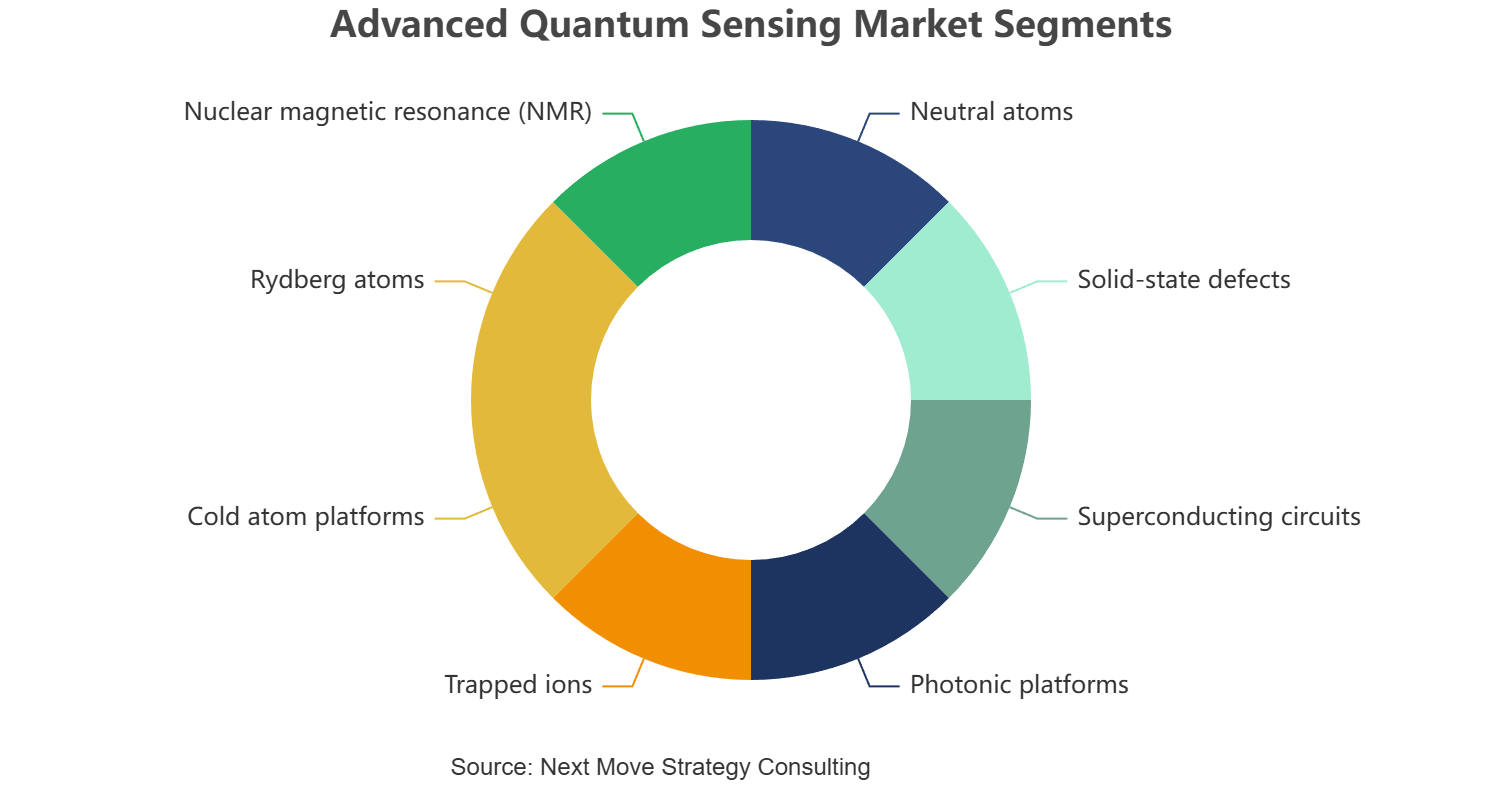
Solid-State Defects remained the dominant technology platform across the market, reaching USD 0.10 billion in 2025 due to established NV-center diamond manufacturing and room-temperature operability. Based on research conducted by Next Move Strategy Consulting, we found that Neutral Atoms represent the fastest-growing platform at a 38.5% CAGR from 2026 to 2035, reflecting expanding commercial deployment of neutral-atom clocks, gravimeters, and RF sensors across defense and space programs.
Growth Opportunities
Our analysis shows that three forward-looking opportunities stand out for stakeholders positioning within the advanced quantum sensing market over the 2026–2035 forecast period.
How Can Magnetic Sensing Unlock Value in Medical Diagnostics?
Magnetic sensing platforms present a whitespace opportunity for medical device manufacturers seeking non-invasive diagnostic imaging capable of detecting neurological and cardiac signals. Suppliers that scale optically pumped magnetometer manufacturing stand to capture recurring clinical procurement revenue as hospitals and research institutions adopt quantum-enabled diagnostic imaging.
Where Does GPS-Denied Navigation Create New Defense Demand?
Defense and aerospace integrators seeking resilient navigation outside satellite coverage represent an underpenetrated opportunity for quantum inertial and gravimetric sensor developers. Manufacturers that secure space and defense qualification credentials can capture recurring platform-integration contracts tied to next-generation navigation system procurement.
How Can Neutral Atom Platforms Benefit Telecommunications Timing?
Telecommunications operators seeking resilient network synchronization independent of GPS signals create an opportunity for neutral-atom clock developers offering field-deployable timing solutions. Early movers that secure telecommunications infrastructure partnerships can differentiate ahead of legacy timing-system incumbents as 5G and 6G network resilience requirements intensify.
Strategic Framework of the Advanced Quantum Sensing Market
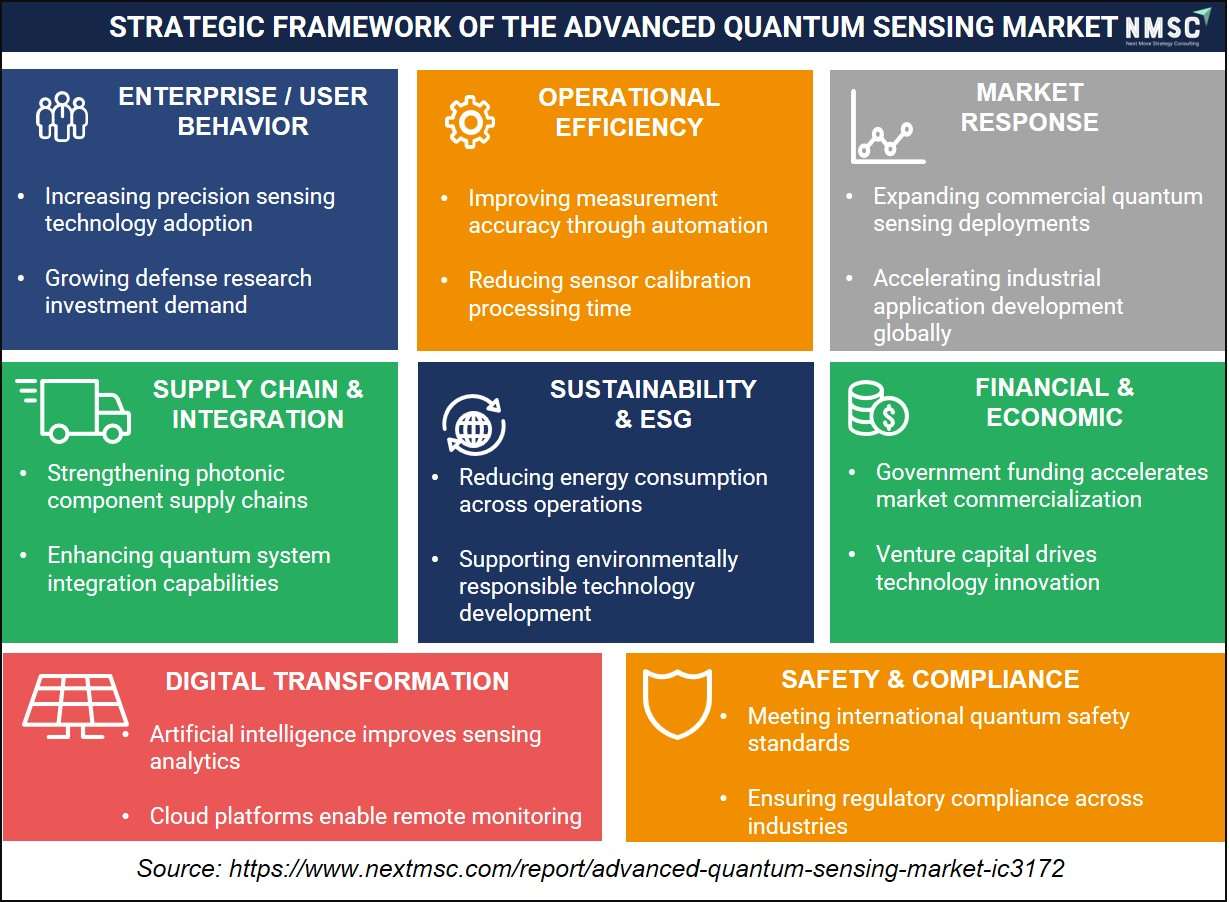
The strategic framework of the advanced quantum sensing market is driven by increasing adoption of precision sensing technologies, automation, AI-enabled analytics, and expanding commercial deployments. Government funding, venture capital investments, and stronger photonic supply chains are accelerating innovation and commercialization. Emphasis on sustainability, regulatory compliance, and digital transformation further supports reliable deployment across defense, healthcare, industrial, telecommunications, and scientific research applications.
Regional Outlook
|
Region |
2025 (USD) |
2035 (USD) |
CAGR% (2026–2035) |
Key Driver |
|
North America |
USD 0.21 Billion |
USD 2.61 Billion |
28.5% |
Defense procurement and NASA space qualification programs |
|
Europe |
USD 0.13 Billion |
USD 1.74 Billion |
29.2% |
National quantum technology strategies and defense modernization |
|
Asia-Pacific |
USD 0.09 Billion |
USD 2.32 Billion |
38.5% |
Expanding national quantum research investment |
|
Middle East & Africa |
USD 0.02 Billion |
USD 0.29 Billion |
31.4% |
Growing defense and energy sector modernization |
|
Latin America |
USD 0.02 Billion |
USD 0.29 Billion |
31.4% |
Expanding research institution investment |
|
Total |
USD 0.47 Billion |
USD 7.25 Billion |
31.5% |
— |
North America Advanced Quantum Sensing Market Outlook
North America leads the advanced quantum sensing market with an established base of defense procurement and NASA-sponsored space qualification programs across the U.S. and Canada. We observed that Department of Commerce export control classifications and DARPA funding programs sustain demand for both magnetic and RF sensing platforms, while developers increasingly pursue field deployment over laboratory demonstration. Technology adoption remains advanced, with neutral-atom and solid-state defect platforms driving innovation among the region's leading manufacturers.
Europe Advanced Quantum Sensing Market Outlook
Europe's advanced quantum sensing market reflects an emerging but strategically prioritized landscape shaped by national quantum technology strategies and European Union research funding programs. Our findings suggest that UK, German, and French institutions are accelerating adoption of photonic and superconducting sensing platforms to satisfy defense modernization and scientific research demand. Technology adoption favors interferometer and gravimeter systems, supported by regional manufacturers investing in field-qualified hardware.
Asia-Pacific Advanced Quantum Sensing Market Outlook
Asia-Pacific is the fastest-growing advanced quantum sensing market region, propelled by expanding national quantum research investment in China and India and rising defense modernization budgets. We found that regulatory frameworks remain less harmonized than in Europe, giving developers flexibility to scale cold atom and trapped-ion platforms rapidly. Technology adoption is accelerating as regional manufacturers, including several China-based research institutions, expand capacity to serve domestic defense and telecommunications demand.
Middle East & Africa Advanced Quantum Sensing Market Outlook
The advanced quantum sensing market in Middle East & Africa is expanding as Gulf Cooperation Council economies diversify into defense and energy sector modernization. Our analysis shows that Saudi Arabia and the UAE are attracting sensor investment tied to oil and gas gravimetric exploration and national security programs. Regulatory influence remains moderate, while technology adoption is gradually shifting toward imported gravimeter and magnetic sensing systems.
Latin America Advanced Quantum Sensing Market Outlook
Latin America's advanced quantum sensing market is supported by expanding research institution investment in Brazil and Argentina. We observed that regulatory frameworks are less stringent than in North America or Europe, though national research agencies are introducing dedicated quantum technology funding programs. Technology adoption remains centered on scientific research applications, with competitive intensity increasing as regional institutions partner with global sensor developers.
U.S. Advanced Quantum Sensing Market
Based on our estimates, the U.S. market was valued at approximately USD 0.16 billion in 2025 and is projected to reach USD 1.85 billion by 2035, growing at a 27.3% CAGR. Demand is anchored by mature defense procurement and NASA space qualification programs. Technology penetration favors neutral-atom and solid-state defect platforms, and competitive intensity remains high among established developers serving national security customers.
Canada Advanced Quantum Sensing Market
The market in Canada reached roughly USD 0.03 billion in 2025 and is forecast to hit USD 0.36 billion by 2035 at a 27.8% CAGR. Demand structure mirrors U.S. defense and research adoption patterns, while national quantum strategy funding shapes institutional procurement. Technology penetration is rising as national research institutions expand quantum sensing programs, with competitive intensity moderate given reliance on cross-border supply from U.S.-based developers.
UK Advanced Quantum Sensing Market
As per our estimate, the UK market stood at about USD 0.03 billion in 2025, advancing toward USD 0.32 billion by 2035 at a 28.7% CAGR. Demand is driven by the UK National Quantum Computing Centre's established research and defense partnership base. Regulatory influence is significant, technology penetration favors solid-state and superconducting platforms, and competitive intensity remains steady among domestic and European sensor developers.
Germany Advanced Quantum Sensing Market
According to our analysis, Germany's market was valued near USD 0.04 billion in 2025 and is set to reach USD 0.43 billion by 2035, expanding at a 28.1% CAGR. Demand structure benefits from Germany's strong domestic industrial and automotive research base. Germany's national quantum technology framework drives regulatory influence, while technology penetration favors solid-state defect and photonic platforms among leading manufacturers.
France Advanced Quantum Sensing Market
Based on our estimates, France's market reached approximately USD 0.02 billion in 2025, projected to climb to USD 0.28 billion by 2035 at a 28.6% CAGR. Demand is supported by France's prominent defense and aerospace research base, which shapes gyroscope and interferometer adoption. Regulatory influence from French national quantum strategy is notable, and competitive intensity remains high given the concentration of specialized manufacturers headquartered domestically.
China Advanced Quantum Sensing Market
The market in China stood at roughly USD 0.04 billion in 2025 and is forecast to reach USD 1.05 billion by 2035, registering a 41.5% CAGR. Demand is fueled by expanding domestic quantum research investment alongside a growing base of regional research institutions. Regulatory influence is increasing gradually, technology penetration is accelerating through cold atom deployments, and competitive intensity remains elevated among numerous China-based developers.
India Advanced Quantum Sensing Market
As per our estimate, India's market was valued at about USD 0.02 billion in 2025, projected to reach USD 0.56 billion by 2035 at a 45.0% CAGR, the fastest among covered countries. Demand structure reflects rising national quantum mission funding and expanding defense modernization budgets. Regulatory influence is developing, technology penetration favors magnetic and RF sensing formulations, and competitive intensity is increasing as domestic and global developers scale capacity.
Japan Advanced Quantum Sensing Market
According to our analysis, Japan's market reached close to USD 0.02 billion in 2025 and is expected to hit USD 0.32 billion by 2035, growing at a 33.5% CAGR. Demand is supported by Japan's precision-engineering manufacturing heritage, led by domestic suppliers serving research and industrial customers. Regulatory influence is well established, technology penetration is advanced, and competitive intensity remains high among long-standing domestic developers.
South Korea Advanced Quantum Sensing Market
Based on our estimates, South Korea's market stood at approximately USD 0.01 billion in 2025, forecast to reach USD 0.23 billion by 2035 at a 34.6% CAGR. Demand structure benefits from the country's globally influential semiconductor and electronics manufacturing base. Technology penetration is high, with domestic manufacturers supplying advanced sensor packaging, and competitive intensity remains pronounced amid rapid technology innovation cycles.
Australia Advanced Quantum Sensing Market
The market in Australia reached about USD 0.01 billion in 2025 and is projected to reach USD 0.15 billion by 2035, expanding at a 32.6% CAGR. Demand is supported by a well-established defense and mining exploration sector and growing preference for gravimeter sensing formats. Regulatory influence stems from Australia's national quantum strategy, while technology penetration favors cold atom platforms amid moderate competitive intensity.
UAE Advanced Quantum Sensing Market
As per our estimate, the UAE market was valued near USD 0.01 billion in 2025, projected to reach USD 0.09 billion by 2035 at a 33.7% CAGR. Demand structure is shaped by the UAE's role as a regional defense and energy technology hub. Regulatory influence remains moderate, technology penetration is improving through imported gravimeter and magnetic sensing systems, and competitive intensity is rising as distributors expand portfolios to serve Gulf markets.
Saudi Arabia Advanced Quantum Sensing Market
According to our analysis, Saudi Arabia's market reached roughly USD 0.01 billion in 2025 and is expected to hit USD 0.10 billion by 2035, growing at a 32.6% CAGR. Demand is driven by Vision 2030-linked energy sector modernization and expanding oil and gas exploration gravimetric adoption. Regulatory influence is developing under national technology guidelines, and technology penetration is advancing as importers scale distribution of gravimeter systems.
South Africa Advanced Quantum Sensing Market
Based on our estimates, South Africa's market stood at about USD 0.00 billion in 2025, forecast to reach USD 0.05 billion by 2035 at a 31.0% CAGR. Demand structure reflects a developing research base contending with limited domestic manufacturing capacity. Regulatory influence remains moderate, technology penetration is gradually improving, and competitive intensity is limited given reliance on imported sensing components from Europe and North America.
Brazil Advanced Quantum Sensing Market
The market in Brazil reached approximately USD 0.01 billion in 2025 and is projected to reach USD 0.15 billion by 2035, registering a 31.0% CAGR. Demand is underpinned by Brazil's expanding research institution network and growing energy-sector exploration interest. Regulatory influence stems from national science funding policy, technology penetration favors gravimeter formats, and competitive intensity remains moderate among regional research partnerships.
Argentina Advanced Quantum Sensing Market
As per our estimate, Argentina's market was valued near USD 0.00 billion in 2025, projected to reach USD 0.07 billion by 2035 at a 32.2% CAGR. Demand structure is supported by steady research institution investment despite macroeconomic volatility. Regulatory influence remains limited, technology penetration is modest, and competitive intensity is centered on a small number of regional research partnerships serving domestic institutions.
Competitive Landscape
We observed that the advanced quantum sensing market features a highly fragmented, early-stage competitive landscape, with specialized technology developers competing alongside diversified industrial groups on platform maturity and defense qualification credentials.
|
Dimension |
Details |
|
Market Structure |
Highly fragmented; numerous specialized quantum sensor developers compete for early commercial contracts, while diversified industrial groups such as Honeywell International Inc. and Robert Bosch GmbH bring manufacturing scale to select sensor categories. |
|
Innovation Focus |
Field-deployable, room-temperature sensor packaging and defense and space qualification programs dominate current innovation pipelines across leading developers. |
|
M&A Activity |
Selective public-market entry and strategic partnership activity, exemplified by Infleqtion's 2026 business combination with Churchill Capital Corp X and its precision timing partnership with Safran Electronics & Defense. |
How Do Companies Compete in the Advanced Quantum Sensing Market?
Companies compete primarily on sensor precision, field-deployment readiness, and defense qualification credentials across the industry. Platform specialists such as Infleqtion Inc. leverage neutral-atom architecture spanning both computing and sensing to serve national security customers, while diversified groups such as Honeywell International Inc. compete on manufacturing scale and integration expertise across broader aerospace and industrial portfolios.
Which Competitive Archetypes Dominate the Advanced Quantum Sensing Market?
Two archetypes dominate the market: neutral-atom and solid-state defect platform specialists offering purpose-built sensing hardware, and diversified industrial groups integrating quantum sensing into broader aerospace and defense product lines. Infleqtion Inc. exemplifies the specialist archetype through its dedicated neutral-atom sensing and timing portfolio, while Robert Bosch GmbH exemplifies the diversified archetype through its Bosch Quantum Sensing division.
How Are Companies Differentiating Through Innovation in Quantum Sensing?
Innovation and differentiation strategy increasingly center on transitioning laboratory-grade sensors into ruggedized, field-validated products. Infleqtion's Tiqker optical atomic clock integration with Safran's timing systems and its Quantum Spectrum RF sensing platform both illustrate this shift toward deployable commercial hardware. Our analysis shows that developers unable to demonstrate field validation risk exclusion from defense and space procurement shortlists.
What M&A and Expansion Activity Is Shaping the Advanced Quantum Sensing Market?
Public-market entry and strategic partnership activity continue to shape competitive positioning within the industry. Infleqtion's proposed business combination with Churchill Capital Corp X, declared effective by the SEC in January 2026, illustrates how developers are accessing public capital markets to fund manufacturing scale-up, while its partnership with Safran Electronics & Defense illustrates cross-industry collaboration to accelerate commercialization.
Key Market Players
Our assessment indicates that the following 15 companies are actively shaping product innovation, capacity expansion, and commercialization strategy within the global advanced quantum sensing market.
-
Infleqtion Inc. (formerly ColdQuanta)
-
Exail (includes iXblue / Muquans product family)
-
AOSense Inc.
-
M Squared Lasers Ltd. (M²)
-
Nomad Atomics Pty Ltd
-
Single Quantum B.V.
-
Photon Spot Inc.
-
Munich Quantum Instruments GmbH (MQI)
-
Pixel Photonics GmbH
-
Quantum Opus LLC
-
Qnami AG
-
Quantum Diamond Technologies Inc. (QDTI)
-
Robert Bosch GmbH (Bosch Quantum Sensing)
Latest Developments
We found that recent product launches and funding milestones within the advanced quantum sensing market are concentrated on field deployment and space qualification, reflecting the industry's transition toward commercial-scale readiness.
|
Date |
Event |
|
June 2025 |
Infleqtion raised USD 100 million in Series C funding to accelerate the commercialization of its atom-based quantum sensing, precision timing, and quantum computing platforms. The investment will support the deployment of field-ready quantum sensing systems for defence, aerospace, and critical infrastructure applications. |
|
April 2025 |
Bosch and Element Six formed a joint venture, Bosch Quantum Sensing GmbH, to industrialize and commercialize diamond-based quantum sensors for applications including medical technology, navigation, mobility, and industrial sensing. |
Investment Opportunities
What Capital Inflows Are Targeting the Advanced Quantum Sensing Market?
Capital inflows into the advanced quantum sensing market are increasingly directed toward public-market listings and defense-linked commercialization programs. Infleqtion's proposed business combination, expected to deliver over USD 540 million in gross proceeds, illustrates this trend toward accessing public capital to fund manufacturing scale-up. We observed that investors favor developers demonstrating validated government contract pipelines as a proxy for long-term revenue visibility.
How Is Infrastructure Investment Supporting Advanced Quantum Sensing Deployment?
Infrastructure investment is expanding manufacturing capacity for field-deployable sensor packaging across North America, Europe, and Asia-Pacific to serve rising defense and healthcare demand. Our findings suggest that developers are investing in ruggedized, room-temperature sensor architectures to compress deployment timelines for customers facing GPS-denied navigation and diagnostic imaging requirements, supporting the precision needed for defense and space-qualified applications alike.
What ESG Considerations Are Shaping Advanced Quantum Sensing Investment Decisions?
Environmental, social, and governance considerations remain secondary to technical and national-security criteria within the industry, though energy-efficient sensor architectures are increasingly noted in investor disclosures. We found that investors increasingly favor developers with transparent government contract disclosures and export-control compliance records, treating regulatory governance as a key indicator alongside technical performance and manufacturing readiness.
Key Benefits for Stakeholders
How Does This Report Benefit Enterprise and Industry Leaders?
Enterprise and industry leaders gain access to validated segmentation, competitive benchmarking, and regional demand forecasts that support technology-selection and procurement decisions across the advanced quantum sensing industry. Our analysis shows that detailed sensor type, technology platform, and application breakdowns help program and procurement teams align specifications with defense, healthcare, and navigation requirements while identifying underserved categories for portfolio expansion.
How Does This Report Benefit Investors and Financial Analysts?
Investors and financial analysts benefit from consistent, single-point market size and CAGR estimates that support valuation and capital-allocation decisions across the advanced quantum sensing supply chain. We observed that the report's regional and segment-level growth differentials help identify which developers are best positioned to capture above-market growth in magnetic sensing and healthcare categories through 2035.
How Does This Report Benefit Technology Vendors and Product Teams?
Technology vendors and product teams gain insight into emerging design requirements, including field-deployable packaging, defense qualification standards, and neutral-atom platform scaling, that are reshaping the industry. Our findings suggest that this analysis helps R&D teams prioritize development roadmaps around precision timing and RF sensing capabilities increasingly required by defense and telecommunications procurement processes.
Key Market Segments
By Sensor Type
-
Atomic clocks
-
Magnetic sensors
-
SQUID
-
Optically pumped magnetometer (OPM)
-
NV center magnetometer
-
TMR sensors (quantum enabled / spintronic)
-
-
Gravimeters and accelerometers
-
Gyroscopes
-
Imaging and photon detectors
-
SNSPD
-
SPAD
-
Quantum imaging systems
-
-
RF and electric field sensors
-
Interferometers
-
Chemical and molecular sensors
-
PAR sensors
-
Other quantum sensors
By Technology Platform
-
Neutral atoms
-
Solid-state defects
-
Superconducting circuits
-
Photonic platforms
-
Trapped ions
-
Cold atom platforms
-
Rydberg atoms
-
Nuclear magnetic resonance (NMR)
By Application
-
Navigation and positioning
-
Medical and healthcare
-
Defense and security
-
Environmental and geological monitoring
-
Industrial and energy
-
Scientific research
-
Agriculture
-
Quantum computing readout
-
Telecommunications
By Industry Vertical
-
Aerospace and defense
-
Healthcare and life sciences
-
Oil and gas
-
Automotive and transportation
-
Telecommunications
-
Agriculture
-
Research and academia
-
Industrial manufacturing
-
Environmental monitoring
-
Space and satellite
By Region
-
North America: U.S., Canada, Mexico
-
Europe: UK, Germany, France, Italy, Spain, Sweden, Denmark, Finland, Netherlands, Rest of Europe
-
Asia-Pacific: China, India, Japan, South Korea, Taiwan, Indonesia, Vietnam, Philippines, Malaysia, Rest of APAC
-
Middle East & Africa: Saudi Arabia, UAE, Egypt, Israel, Turkey, Nigeria, South Africa, Rest of MEA
-
Latin America: Brazil, Argentina, Chile, Colombia, Rest of LATAM
Conclusion and Recommendations
What Is the Long-Term Outlook for the Advanced Quantum Sensing Market?
The long-term outlook for the market remains highly favorable, with global revenue projected to expand from USD 0.47 billion in 2025 to USD 7.25 billion by 2035 at a 31.5% CAGR. We observed that sustained defense procurement, space qualification programs, and expanding healthcare diagnostic applications will continue underpinning demand across sensor types through the forecast period.
What Strategic Positioning Should Advanced Quantum Sensing Suppliers Pursue?
Suppliers should prioritize field-deployable, ruggedized sensor packaging while pursuing defense and space qualification credentials to secure long-term government contracts. Our assessment indicates that developers investing early in neutral-atom and magnetic sensing platforms, alongside public capital access, will be best positioned to capture premium pricing within the advanced quantum sensing market.
How Attractive Is the Advanced Quantum Sensing Market for New Investment?
The advanced quantum sensing industry presents a highly attractive investment case, supported by a USD 6.63 billion absolute dollar opportunity between 2026 and 2035 and above-average growth in Asia-Pacific and healthcare categories. We found that investment attractiveness is highest for developers combining validated government contract pipelines with scaled manufacturing capacity across defense and commercial channels.
What Market Shifts and Key Risks Should Stakeholders Monitor?
Stakeholders should monitor high per-unit hardware costs, limited manufacturing scale, and export control restrictions as key risks to the advanced quantum sensing market. Our analysis shows that developers unable to adapt to field-deployment specifications risk losing contracts to competitors with proven qualification track records, particularly within North America's increasingly defense-driven procurement environment.
What Are the Key Growth Pathways for the Advanced Quantum Sensing Market?
Key growth pathways include expanding magnetic sensing healthcare applications, scaling neutral-atom precision timing capacity, and deepening penetration into Asia-Pacific defense and research channels. Next Move Strategy Consulting's analysis indicates that suppliers pursuing these pathways while maintaining cost competitiveness in core atomic clock categories will be best positioned to capture the advanced quantum sensing market's projected growth through 2035.
About the Author
 Liza Phukan
— Liza Phukan is Research Associate at Next Move Strategy Consulting, where she has covered emerging industries and market research across sectors for 3.5 years. Her work includes analyzing industry developments, validating market data, and developing structured business content from research findings. She uses secondary research and data-validation practices to turn complex market information into clear decision-useful market analysis for business audiences and support report development and B2B.
Liza Phukan
— Liza Phukan is Research Associate at Next Move Strategy Consulting, where she has covered emerging industries and market research across sectors for 3.5 years. Her work includes analyzing industry developments, validating market data, and developing structured business content from research findings. She uses secondary research and data-validation practices to turn complex market information into clear decision-useful market analysis for business audiences and support report development and B2B.
About the Reviewer
 Supradip Baul
— Supradip Baul is an accomplished business consultant and strategist with over a decade of rich experience in market intelligence, strategy, technology, and business transformation. His work has included rigorous qualitative and quantitative analysis across multiple industries, helping clients shape investment decisions and long-term roadmaps. Earlier in his career, he was associated with Gartner, where he contributed to industry-leading reports and market share analyses. He has worked with leading global companies and holds an MBA with a dual specialization in Marketing and Finance.
Supradip Baul
— Supradip Baul is an accomplished business consultant and strategist with over a decade of rich experience in market intelligence, strategy, technology, and business transformation. His work has included rigorous qualitative and quantitative analysis across multiple industries, helping clients shape investment decisions and long-term roadmaps. Earlier in his career, he was associated with Gartner, where he contributed to industry-leading reports and market share analyses. He has worked with leading global companies and holds an MBA with a dual specialization in Marketing and Finance.
At Next Move Strategy Consulting, we understand that insightful market research is the cornerstone of successful business decisions. That's why we employ a robust and multifaceted approach, combining various methodologies to deliver the most accurate and actionable data for our clients.

Research Landscape
We navigate the world of research with two primary approaches:
Qualitative Approach
Our qualitative research methodologies involve immersive techniques such as in-depth interviews, focus groups, and observational studies. By engaging directly with individuals and stakeholders, we uncover valuable insights that quantitative data alone may overlook.

Quantitative Research
In tandem with qualitative methodologies, NMSC leverages the power of Quantitative Research to provide a robust foundation of numerical insights. Through systematic data collection and analysis, we quantify patterns, preferences, and market trends, offering a comprehensive view of the business landscape.
Our quantitative research approach employs diverse tools, including surveys, experiments, and statistical modelling. These methodologies enable us to gather data from a large and representative sample, ensuring the statistical significance of our findings. By employing structured questionnaires and standardized data collection methods, we guarantee the reliability and validity of the information we present to our clients.
Quantitative research is particularly effective in measuring the prevalence of trends, assessing market size, and gauging the impact of various factors on consumer behavior. The numerical precision attained through this approach equips our clients with actionable insights, facilitating data-driven decision-making and strategy formulation.


Our Specialized Toolbox for Industry-Specific Market Research
We deploy a specialized arsenal of techniques tailored to meet your unique requirements. Here's a glimpse into our comprehensive toolbox:

Information Procurement
The stage entails acquiring market data or relevant information through various sources and methodologies.


Market Research Approach
We utilize both top-down and bottom-up approaches in market research analysis to achieve a comprehensive understanding of the market dynamics, leveraging the broad perspective of industry trends and macroeconomic factors alongside detailed insights from specific segments and individual companies.

Porters Five Forces Analysis
We conduct Porter's Five Forces analysis to evaluate the competitive landscape of an industry, providing us with insights into factors that affect profitability and strategic positioning.

SWOT Analysis

Forecasting
We utilize a forecasting model to predict future consumption by considering parameters like population, economics, regulations, market competition, drivers, constraints, technology, and pricing. We also employ statistical techniques such as multilinear regression, exponential smoothing, moving average, ARIMA, and Monte Carlo simulations for accurate predictions. In econometric forecasting, we analyzed short-term and long-term event impacts, attributing values based on regulatory frameworks, economic factors, and market events.





 Speak to Our Analyst