India’s Bullet Train Initiative Accelerates the High-Speed Rail Market
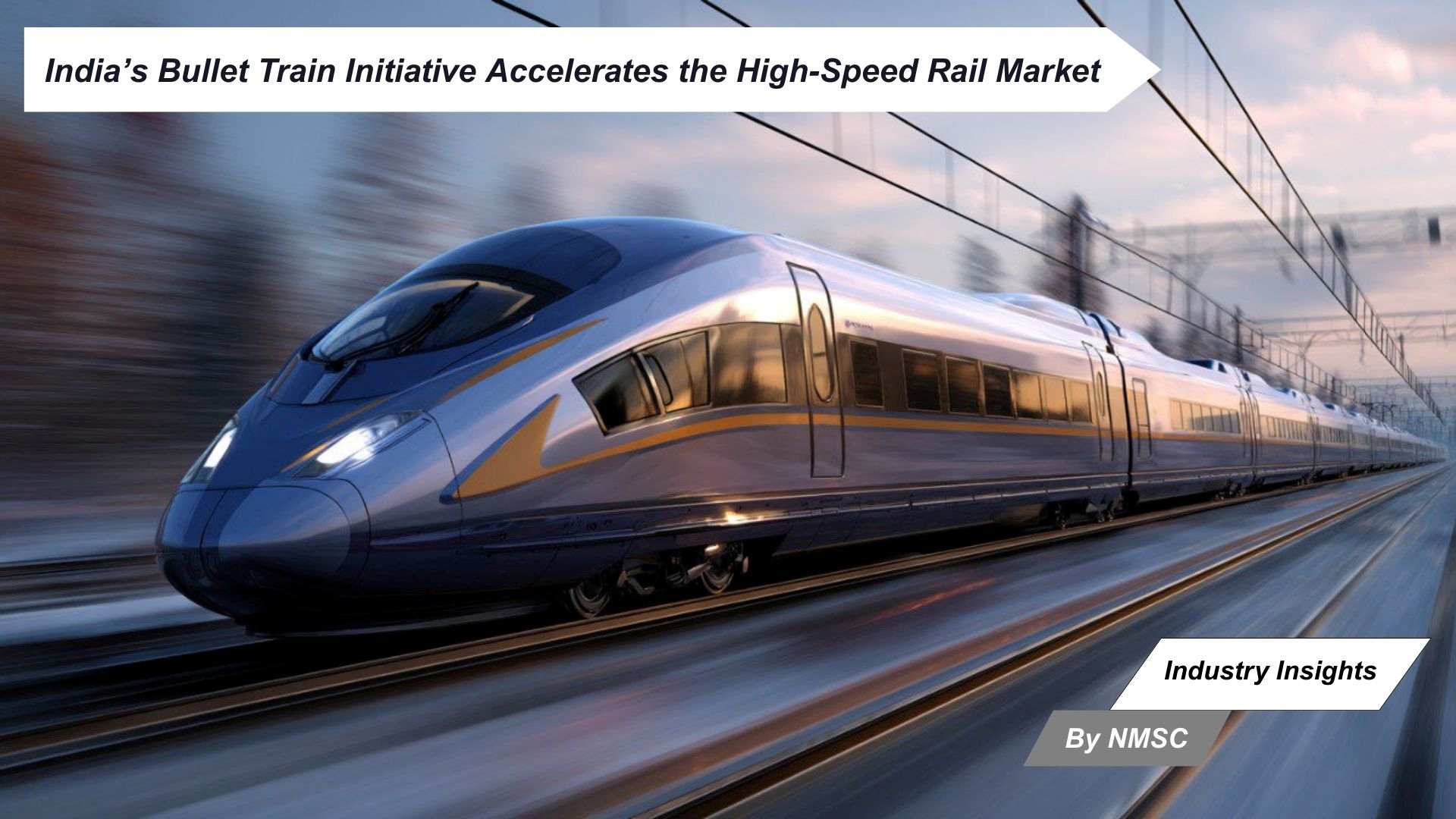
Industry Insights from Next Move Strategy Consulting
As nations continue to modernize transportation infrastructure, India’s progress toward launching its first high-speed rail service represents a significant milestone in the global bullet train market. The upcoming introduction of a bullet train on the Mumbai–Ahmedabad corridor highlights the country’s commitment to advanced rail technology, improved connectivity, and faster intercity travel.
The project forms part of India’s broader strategy to modernize railway infrastructure while strengthening domestic manufacturing capabilities. With services expected to begin in 2027, the initiative signals the emergence of high-speed rail as a transformative component of the country’s transport ecosystem.
A Landmark Step Toward High-Speed Rail Connectivity
India’s first bullet train will operate along the 508-kilometre Mumbai–Ahmedabad High-Speed Rail Corridor, connecting two of the country’s major economic centers. The system is designed for trains capable of running at speeds of up to 320 km/h, significantly reducing travel time between the cities.
Once the corridor becomes fully operational, the journey between Mumbai and Ahmedabad is expected to take approximately two hours, a substantial reduction compared with conventional rail travel that currently takes several hours.
The rollout will take place in phases. The first operational segment is expected to run between Surat and Bilimora, forming the initial stage of the high-speed corridor’s deployment. Additional sections will gradually expand connectivity across the route.
Made-in-India Bullet Train Vision
A key highlight of the project is the focus on domestic manufacturing. India plans to introduce a Made-in-India bullet train on the Ahmedabad–Mumbai corridor, reinforcing the country’s ambitions to develop indigenous high-speed rail capabilities while strengthening its manufacturing ecosystem.
The initiative aligns with national efforts to enhance local production, technology development, and infrastructure innovation. By building and deploying high-speed rail solutions domestically, India aims to reduce reliance on imports and establish a foundation for future expansion of bullet train networks.
Infrastructure Development and Project Progress
Construction progress on the high-speed rail corridor continues across several segments. Major engineering works include viaduct construction, tunneling, and station development across the route.
The corridor will feature 12 stations connecting key locations across Maharashtra and Gujarat, including Bandra-Kurla Complex, Thane, Virar, Boisar, Vapi, Surat, Bharuch, Vadodara, Anand, Ahmedabad, and Sabarmati.
The project is designed to support frequent train services, with high-speed trains expected to operate at regular intervals once the network becomes fully operational.
Strategic Importance for the Transportation Sector
Beyond improving passenger mobility, the Mumbai–Ahmedabad high-speed rail corridor is expected to stimulate economic activity along the route. Faster connectivity between major urban and industrial hubs can encourage regional development, support business travel, and enhance tourism potential.
The introduction of bullet train technology also marks a technological leap for India’s railway infrastructure, integrating advanced safety systems, modern engineering practices, and high-speed rail standards used globally.
According to Next Move Strategy Consulting
According to Next Move Strategy Consulting, the launch of India’s first bullet train service is likely to accelerate growth in the global Bullet Train Market by demonstrating the rising demand for high-speed rail infrastructure in emerging economies. The project may encourage further investments in advanced rail technologies, domestic manufacturing capabilities, and large-scale transportation modernization initiatives across the Asia-Pacific region.
As governments increasingly prioritize sustainable and efficient transport systems, high-speed rail corridors such as the Mumbai–Ahmedabad route are expected to play a critical role in shaping the future of intercity mobility.
Source: Times of India
Prepared by: Next Move Strategy Consulting
About the Author
 Sanyukta Deb is Digital Marketing Team Lead at Next Move Strategy Consulting, where she has led content strategy and technical SEO for the firm's B2B market research publications for over 2 years. Her editorial process translates NextMSC's primary and secondary research — spanning technology, industrial, and consumer sectors — into commercial narratives, backed by search-intent, keyword, and competitive analysis. She brings 5 years of overall experience in digital marketing and content strategy.
About the Reviewer
 Debashree Dey is Assistant Manager at Next Move Strategy Consulting, where she supports cross-vertical market content and communications across diverse industries for 6 years. Her professional background includes senior content writing, communications, and published manuscript authorship, with experience developing audience-focused business narratives and maintaining clear, consistent messaging. Her role supports research-led content development and editorial quality across NextMSC publications.
















Add Comment