Indonesia’s B50 Diesel Mandate Tests Automotive Fuel Additive Formulations
Jakarta’s Move to a 50% Palm-Based Diesel Blend, Innospec’s Steady Fuel Specialties Quarter and the January 2027 TOP TIER+ Transition Target Are Redrawing Additive Priorities
On July 9, 2026, President Prabowo Subianto presided over the formal launch of Indonesia’s mandatory B50 biodiesel programme at the KM 57 Rest Area in Karawang, West Java, according to the Cabinet Secretariat of the Republic of Indonesia. The mandate took effect on July 1, 2026, and lifts the palm oil-based share of the country’s diesel from 40% to 50%. Reuters reported on the day of the launch that Energy Minister Bahlil Lahadalia expects crude palm oil use to rise to between 16.3 million and 17 million metric tons from 15.2 million tons, which makes B50 one of the largest mandatory biodiesel blending schemes in operation.
According to Next Move Strategy Consulting’s Automotive Fuel Additives Market report, the global automotive fuel additives market was valued at USD 7.80 billion in 2025 and is projected to reach USD 13.10 billion by 2035, growing at a CAGR of 5.3% from 2025 to 2035. NextMSC primary research and analysis identifies cold flow improvers as the fastest-growing product category at a 7.3% CAGR over that period, and attributes that pace to biodiesel blend mandates that raise demand for additives preventing fuel gelling in low-temperature conditions.
For More Information: Download FREE Sample on Automotive Fuel Additives Market Report
The Policy Arithmetic: What B50 Changes in Indonesia’s Diesel Pool
The Cabinet Secretariat states that the government aims to cut diesel imports by up to 18 million kilolitres in 2026, equivalent to roughly 310,000 barrels per day, and projects foreign exchange savings of IDR 170 trillion under B50 against IDR 133.3 trillion under B40. The same statement estimates that the programme will absorb around 2.1 million workers and reduce carbon dioxide emissions by up to 44.46 million tons. Energy Minister Bahlil Lahadalia described the launch as a historic milestone for national energy independence, resilience and sovereignty.
For fuel chemistry, the relevant detail is readiness testing. The Ministry of Energy and Mineral Resources reported tests on motor vehicles, heavy mining equipment, agricultural machinery, trains, marine vessels and power plants, with results showing that B50 meets government technical specifications and the standards required by vehicle manufacturers, according to the Cabinet Secretariat. NextMSC primary research and analysis links biodiesel blending to demand for stability, lubricity and low-temperature additives, which makes performance across that range of engines the relevant test for formulators.
Supply arrangements remain unsettled. Reuters reported that Indonesia allocated 15.64 million kilolitres of biodiesel under its B40 programme this year, that an energy ministry official put B50 fatty acid methyl ester (FAME) requirements at 16.7 million to 18 million kilolitres, and that the ministry had yet to issue additional quotas. Businesses were given until the end of September to use remaining B40 stocks. Bio Energy Times reported on July 28, 2026 that Pertamina Patra Niaga had begun nationwide distribution and aimed to complete the rollout at all fuel stations by October 1.
Indonesia Biodiesel Mandate: B40 Baseline versus B50, July 2026
|
Parameter |
B40 baseline |
B50 mandate |
|
Palm oil-based biodiesel share of diesel |
40% |
50% |
|
Foreign exchange savings (IDR trillion) |
133.3 |
170 |
|
Crude palm oil use (million metric tons) |
15.2 |
16.3 to 17.0 |
|
Biodiesel volume (million kilolitres) |
15.64 allocated for 2026 under B40 |
16.7 to 18.0 FAME required |
Reuters also reported that President Prabowo said he had pushed for a B100 mandate but was advised by ministers that a 50% blend was sufficient to eliminate imports, and that Bahlil said the government would begin research into a 60% mix. The direction of travel is therefore upward, which matters to formulators because each step in blend ratio changes the fuel properties that additive packages must correct.
Key Industry Developments: Earnings, Standards and Product Launches
On November 3, 2026, Innospec Inc. reported third-quarter results in a Form 8-K showing Fuel Specialties revenues of USD 180.7 million, up 5% from USD 172.0 million a year earlier, on 3% higher volumes and 2% higher price and product mix. Operating income in the business rose 1% to USD 35.6 million from USD 35.3 million, and gross margin eased by 0.5 percentage points to 35.1%. For the nine months ended September 30, 2026, Fuel Specialties revenues were USD 548.0 million against USD 507.4 million in the same period of 2025.
“Fuel Specialties had another strong quarter delivering revenue growth and steady operating income”
- Patrick S. Williams, President and Chief Executive Officer, Innospec Inc., Innospec third-quarter 2026 results release (Form 8-K, Exhibit 99.1), November 3, 2026.
Innospec Fuel Specialties Segment: Third Quarter 2026 versus Third Quarter 2025
|
Metric |
Q3 2026 |
Q3 2025 |
|
Net sales (USD million) |
180.7 |
172.0 |
|
Gross profit (USD million) |
63.4 |
61.2 |
|
Gross margin |
35.1% |
35.6% |
|
Operating income (USD million) |
35.6 |
35.3 |
|
Nine-month net sales (USD million) |
548.0 |
507.4 |
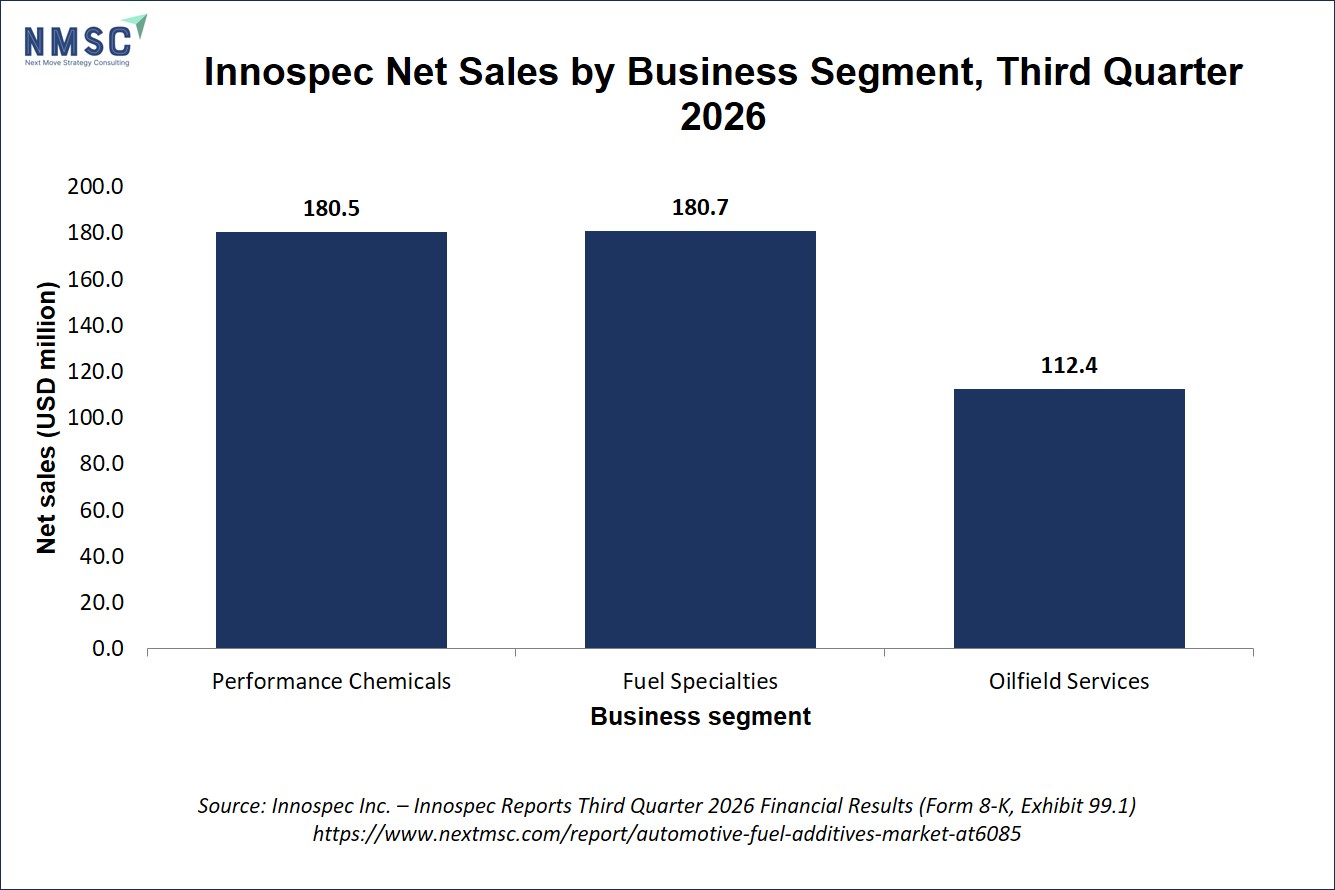
Innospec reported third-quarter 2026 net sales of USD 180.7 million in Fuel Specialties, USD 180.5 million in Performance Chemicals and USD 112.4 million in Oilfield Services, which together make up total revenues of USD 473.6 million.
In gasoline, the compliance timeline centres on the transition to the revised TOP TIER+ detergent gasoline standard. TOP TIER+ is an automaker-sponsored voluntary fuel-performance programme, rather than a federal EPA mandate. According to TOP TIER's programme guidance, most, if not all, approved gasoline brands are expected to have transitioned to TOP TIER+ by January 2027. BASF similarly identified January 2027 as the mandatory implementation deadline in its September 17, 2025 announcement. However, the revised standard, released in January 2025, provides a two-year transition window, with some industry coverage identifying February 2027 as the final transition cutoff. The January 2027 date should therefore be understood as the programme's stated transition target rather than a universal legal deadline. Fuel retailers and brands participating in TOP TIER must continue meeting the programme's applicable performance and certification requirements to retain their approved status. BASF said its Keropur AP 225-20 formulation had passed the required tests, with deliveries scheduled to begin in the first half of 2026.
Compliance Checkpoints Shaping Additive Formulation
|
Instrument |
Fuel |
What it requires |
Date |
|
TOP TIER+ gasoline programme |
Gasoline |
Automaker-sponsored voluntary performance standard introducing GDI injector deposit-control and stochastic pre-ignition protection testing. Participating approved brands are expected to transition from the existing TOP TIER standard to TOP TIER+. |
January 2027 transition target; some industry coverage cites February 2027 as the end of the transition window. |
|
40 CFR Part 1090, Section 1090.260 |
Gasoline |
Lowest additive concentration of the detergent determined by the manufacturer using specified deposit-control test methods |
Current as of June 2026 |
|
TOP TIER Diesel Fuel Performance Standard, Base Level, Revision D |
Diesel |
Detergent additive performance demonstrated against the standard’s test procedure |
April 2026 |
Segment Dynamics: Deposit Control Leads, Cold Flow Grows Fastest
According to NextMSC primary research and analysis, deposit control additives, which include detergents and dispersants that keep fuel injectors and intake valves clean, held the largest product share at approximately 34%, valued at USD 2.65 billion in 2025. Cold flow improvers are the fastest-growing product category at a 7.3% CAGR from 2025 to 2035, and TIER improvers are expected to expand at a 5.9% CAGR as biodiesel’s reduced natural lubricity increases the need for lubricity treatment in diesel systems.
By fuel type, NextMSC primary research and analysis shows gasoline as the largest category at approximately 46% of the 2025 market, or USD 3.59 billion, while biofuels are the fastest-growing at a 9.2% CAGR as ethanol and biodiesel blending mandates require dedicated stability and lubricity additive treatment. Passenger vehicles represent approximately 52% of 2025 value at USD 4.06 billion, and commercial vehicles are the fastest-growing vehicle category at a 6.5% CAGR as fleet operators adopt additive programmes to reduce maintenance costs.
Regional Outlook
NextMSC primary research and analysis shows Asia-Pacific as the leading region with approximately 40% of 2025 revenue, or USD 3.12 billion, supported by expanding vehicle parc growth in China and India and rising ethanol and biodiesel blending mandates. Indonesia’s B50 launch sits within that regional demand picture. Middle East & Africa is the fastest-growing region at a 6.8% CAGR from 2025 to 2035, driven by commercial vehicle fleet growth and refinery capacity expansion.
At the national level, NextMSC estimates the United States as the largest single market at approximately USD 1.37 billion in 2025, anchored by EPA detergency requirements and an established aftermarket retail network, and India as the fastest-growing country at approximately 8.3% CAGR through 2035 on rapid vehicle parc expansion and rising ethanol blending targets.
Growth Drivers and Restraints
Evidence Matrix: Drivers and Restraints Documented in 2025 and 2026
|
Factor |
Type |
Documented evidence |
Geography |
|
Biodiesel blend mandates |
Driver |
Indonesia raised its mandate from 40% to 50% on July 1, 2026 and plans research into a 60% blend |
Indonesia |
|
GDI-driven detergent standards |
Driver |
TOP TIER+ introduces injector deposit-control and stochastic pre-ignition testing for GDI engines. The automaker-sponsored voluntary programme expects most approved gasoline brands to transition by January 2027, with some industry coverage identifying February 2027 as the final transition cutoff. |
United States |
|
Regulatory detergent floor |
Driver |
40 CFR Part 1090 sets deposit-control standards, with the lowest additive concentration set by the detergent manufacturer |
United States |
|
Margin pressure and input costs |
Restraint |
Innospec Fuel Specialties gross margin eased 0.5 points to 35.1% while operating income rose 1% on 5% revenue growth; at group level the company cited elevated raw material costs among reasons sequential results were lower than expected |
Global |
|
Biodiesel allocation uncertainty |
Restraint |
The energy ministry had yet to issue additional B50 quotas, and industry participants awaited revised allocations as of July 9, 2026 |
Indonesia |
NMSC Strategic Perspective: Additive Value Is Moving Toward Blend-Specific Packages
NextMSC primary research and analysis reads the 2026 evidence as a shift in where additive value is created. Indonesia’s step from B40 to B50, with 16.7 million to 18 million kilolitres of FAME needed, turns a blend ratio into a formulation variable, and the reported research into a 60% mix suggests the ratio will not stay fixed. Suppliers whose cold flow, lubricity and stability chemistries are proven only at lower blend levels carry qualification risk as ratios rise, which is consistent with NextMSC’s finding that biofuels are the fastest-growing fuel segment at a 9.2% CAGR.
In gasoline, the TOP TIER+ transition expected by January 2027 for most approved brands moves the competitive test from marketing claims to certified results. Because TOP TIER+ is an automaker-sponsored voluntary programme rather than a federal EPA mandate, this date represents a programme transition milestone for participating fuel brands and retailers, not a statutory deadline for every gasoline supplier. Some industry coverage places the final transition cutoff in February 2027. BASF and Afton Chemical have both introduced additive series designed for the revised standard, giving participating refiners and terminal operators time to complete formulation qualification and transition planning.
Innospec’s results show the commercial reality. Fuel Specialties volumes rose 3% and price and product mix added 2%, yet operating income grew only 1% as gross margin slipped 0.5 points, so growth in this category is currently being earned through volume and mix rather than margin expansion. For investors, NextMSC primary research and analysis puts the absolute opportunity at USD 4.95 billion between 2026 and 2035, with Asia-Pacific and Middle East & Africa offering the most favourable conditions through expanding vehicle parc, blend mandates and refinery capacity investment.
Competitive Landscape
NextMSC primary research and analysis describes the market as moderately consolidated, with diversified specialty chemical majors such as BASF SE and Chevron Corporation competing alongside dedicated formulators such as Innospec Inc., NewMarket Corporation, The Lubrizol Corporation and Infineum International Limited. Competition centres on formulation breadth, regulatory compliance capability and OEM qualification credentials.
Three traceable events frame the current competitive picture. BASF announced Keropur AP 225-20 for TOP TIER+ on September 17, 2025. Afton Chemical introduced HiTEC 65522 GPA for direct-injection engines in August 2025. Innospec reported higher Fuel Specialties volumes and revenue on November 3, 2026. Two of these are product launches built to a named standard and the third is a volume-led earnings result, and NextMSC primary research and analysis identifies OEM qualification credentials as a core basis of competition.
Bottom Line
Indonesia’s B50 mandate, effective July 1, 2026 and formally launched on July 9, shows that blend policy now moves faster than the chemistry that supports it, with research into a 60% mix already announced. At the same time, TOP TIER programme guidance expects most, if not all, approved gasoline brands to have transitioned to TOP TIER+ by January 2027, although some industry coverage identifies February 2027 as the final transition cutoff. TOP TIER+ is an automaker-sponsored voluntary programme, not a federal EPA mandate; its requirements apply to participating brands and retailers seeking to retain TOP TIER approval. Innospec’s third-quarter Fuel Specialties results, with 5% revenue growth but only 1% operating income growth, indicate that volume and mix are carrying the category while margins hold steady. NextMSC primary research and analysis projects the global automotive fuel additives market to expand from USD 7.80 billion in 2025 to USD 13.10 billion by 2035 at a 5.3% CAGR, with cold flow improvers and biofuel-compatible chemistries growing fastest. The practical priority for formulators is qualification at higher blend ratios and under revised detergent standards.
About Next Move Strategy Consulting
Next Move Strategy Consulting is a premier market research and management consulting firm that has been committed to provide strategically analysed well documented latest research reports to its clients. The research industry is flooded with many firms to choose from, what makes NMSC different from the rest is its top-quality research and the obsession of turning data into knowledge by dissecting every bit of it and providing fact-based research recommendation that is supported by information collected from over 500 million websites, paid databases, industry journals and one on one consultations with industry experts across a diverse range of industry sectors. The high-quality customized research reports with actionable insights and excellent end-to-end customer service help our clients to take critical business decisions that enables them to move beyond time and have competitive edge in the industry.
We have been servicing over 1000 customers globally that includes 90% of the Fortune 500 companies over a decade. Our analysts are constantly tracking various high growth markets and identifying hidden opportunities in each sector or the industry. We provide one of the industry’s best quality syndicate as well as custom research reports across 10 different industry verticals. We are committed to deliver high quality research solutions in accordance to your business needs. Our industry standard delivery solutions that ranges from the pre consultation to after-sales services, provide an excellent client experience and ensure right strategic decision making for businesses.
For more information, please contact:
Next Move Strategy Consulting
5th Floor 867 Boylston St, STE 500,
Boston, MA 02116, U.S.
E-Mail: [email protected]
Direct: +1-217-650-7991
Website: www.nextmsc.com
About the Author
 Sanyukta Deb
— Sanyukta Deb is Digital Marketing Team Lead at Next Move Strategy Consulting, where she has led content strategy and technical SEO for the firm's B2B market research publications for over 2 years. Her editorial process translates NextMSC's primary and secondary research — spanning technology, industrial, and consumer sectors — into commercial narratives, backed by search-intent, keyword, and competitive analysis. She brings 5 years of overall experience in digital marketing and content strategy.
About the Reviewer
 Debashree Dey
— Debashree Dey is Assistant Manager at Next Move Strategy Consulting, where she supports cross-vertical market content and communications across diverse industries for 6 years. Her professional background includes senior content writing, communications, and published manuscript authorship, with experience developing audience-focused business narratives and maintaining clear, consistent messaging. Her role supports research-led content development and editorial quality across NextMSC publications.
















Add Comment