Industrial Automation: Google DeepMind AI Brain Launch
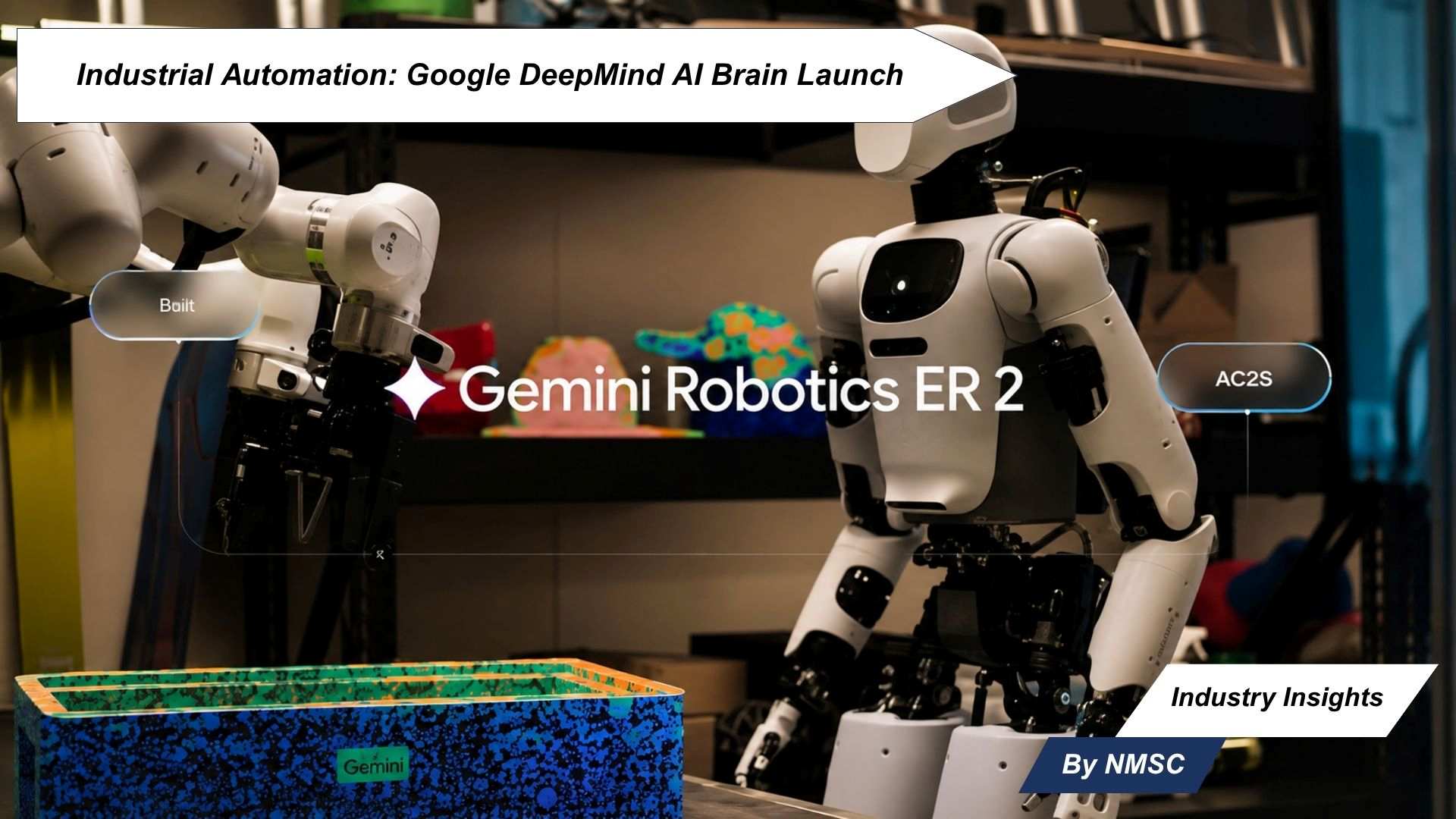
Google DeepMind Launches AI 'Brain' to Coordinate Fleets of Industrial Robots
LONDON, United Kingdom — July 31, 2026 — Google DeepMind has unveiled Gemini Robotics ER 2, an advanced artificial intelligence model engineered to function as a high-level controller for industrial robots, marking a significant development for the industrial automation sector. The model is designed to enable robots to understand spoken instructions, interpret live video, plan multi-step workflows, and coordinate multiple machines simultaneously — with minimal human intervention. According to Next Move Strategy Consulting, the global industrial automation market, is projected to reach USD 363.31 billion by 2030, growing at a CAGR of 9.60%.
Unlike conventional industrial robots programmed for fixed, repetitive sequences, Gemini Robotics ER 2 is designed to sit above a robot's existing control systems, acting as an orchestration layer that interfaces with lower-level vision-language-action (VLA) models. Google described the system as a "step change" in powering robots with video understanding, task orchestration, and multi-robot collaboration.
The model enables different types of robots to communicate using a shared understanding of a task, allowing them to divide work autonomously. In one demonstration, Boston Dynamics' Spot robot responded to a spoken request by navigating through a building, locating an object, and returning it to the user — with Gemini Robotics ER 2 orchestrating the robot's navigation and manipulator APIs throughout.
A key advancement embedded in the model is its self-monitoring capability. By processing continuous video feeds, the system can track task progress, adapt when errors occur, retry failed steps, and verify task completion before proceeding to the next stage. Google also noted improvements in safety performance, with the model capable of halting a humanoid robot when a person enters its working area and resuming operations once the space is clear.
Key Highlights:
-
Multi-Robot Coordination: Gemini Robotics ER 2 enables heterogeneous robot fleets to share task understanding and divide work autonomously, reducing the need for individual machine programming.
-
Adaptive Task Execution: The model monitors its own progress via continuous video feeds, adjusting actions in real time and verifying task completion before advancing to subsequent steps.
-
External Tool Integration: The system can access Google Search and user-defined functions, allowing robots to retrieve contextual information dynamically during operations.
-
Developer Availability: Gemini Robotics ER 2 is now accessible through the Gemini API and Google AI Studio, with private preview access available via the Gemini Enterprise Agent Platform.
Analyst Insight:
According to analysts at Next Move Strategy Consulting, the launch of Gemini Robotics ER 2 reflects a broader industry shift away from machine-specific programming toward foundation AI models capable of reasoning across diverse hardware platforms. NMSC analysts note that as manufacturers increasingly operate mixed-robot environments — combining collaborative robots, autonomous mobile robots, and humanoids — demand for unified orchestration intelligence is expected to accelerate adoption of AI-driven automation frameworks. This development aligns with the market's projected trajectory toward USD 363.31 billion by 2030, as AI integration becomes a primary growth catalyst across discrete and process industries.
Industry Outlook:
The introduction of a general-purpose AI orchestration model for industrial robots signals a structural shift in how automation systems are deployed and managed. For manufacturers operating dynamic production environments — where line configurations change frequently or multiple robot types must collaborate — the ability to deploy and reconfigure robotic systems through natural language instructions could substantially reduce integration timelines and operational costs.
The launch also intensifies competition among technology firms developing foundation models for physical AI, with implications for sectors ranging from automotive and electronics manufacturing to logistics and pharmaceuticals. As AI-native control architectures become more prevalent, industrial automation vendors and system integrators will face growing pressure to align their platforms with open, model-agnostic orchestration standards.
Source: Automation News
For More Information – Download FREE Sample on Industrial Automation Market Report
Prepared By: Sanyukta Deb
About the Author
 Sanyukta Deb
— Sanyukta Deb is Digital Marketing Team Lead at Next Move Strategy Consulting, where she has led content strategy and technical SEO for the firm's B2B market research publications for over 2 years. Her editorial process translates NextMSC's primary and secondary research — spanning technology, industrial, and consumer sectors — into commercial narratives, backed by search-intent, keyword, and competitive analysis. She brings 5 years of overall experience in digital marketing and content strategy.
Sanyukta Deb
— Sanyukta Deb is Digital Marketing Team Lead at Next Move Strategy Consulting, where she has led content strategy and technical SEO for the firm's B2B market research publications for over 2 years. Her editorial process translates NextMSC's primary and secondary research — spanning technology, industrial, and consumer sectors — into commercial narratives, backed by search-intent, keyword, and competitive analysis. She brings 5 years of overall experience in digital marketing and content strategy.
About the Reviewer
 Debashree Dey
— Debashree Dey is Assistant Manager at Next Move Strategy Consulting, where she supports cross-vertical market content and communications across diverse industries for 6 years. Her professional background includes senior content writing, communications, and published manuscript authorship, with experience developing audience-focused business narratives and maintaining clear, consistent messaging. Her role supports research-led content development and editorial quality across NextMSC publications.
Debashree Dey
— Debashree Dey is Assistant Manager at Next Move Strategy Consulting, where she supports cross-vertical market content and communications across diverse industries for 6 years. Her professional background includes senior content writing, communications, and published manuscript authorship, with experience developing audience-focused business narratives and maintaining clear, consistent messaging. Her role supports research-led content development and editorial quality across NextMSC publications.















Add Comment