Amazon's €10B Robotics Bet Reshapes Automation
Amazon's European Robotics Surge and Gartner's "Human-Optional" Warehouse Forecast Signal a Structural Shift in Global Industrial Automation
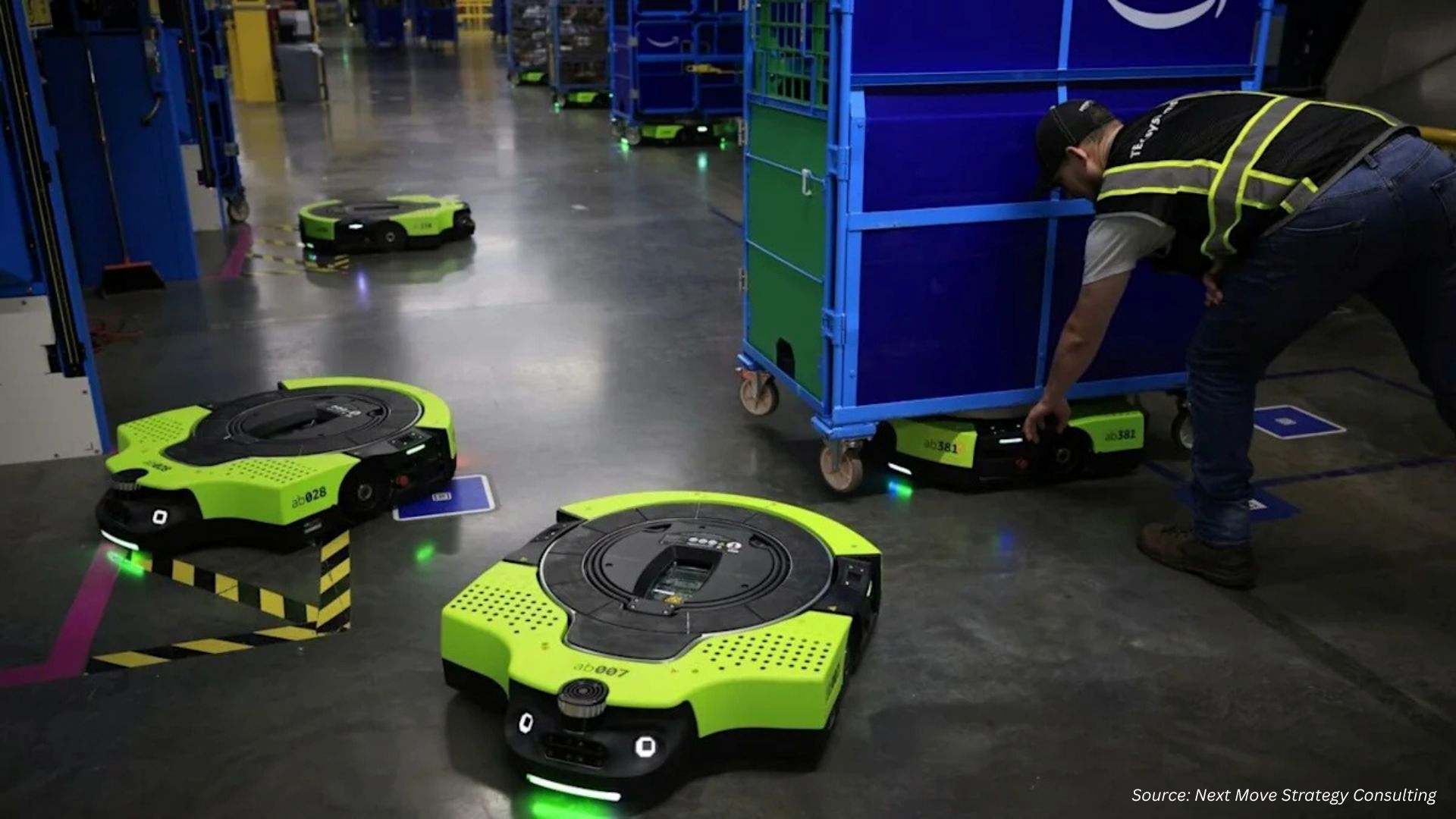
Amazon unveiled a next-generation version of its autonomous Proteus robot on June 4, 2026, at its "Delivering the Future" event in London, alongside a commitment of more than €10 billion to expand and modernize fulfillment centers across Europe over the coming years. The upgraded Proteus can now operate throughout fulfillment sites rather than being confined to dock areas, taking direction from employees through conversational, AI-driven prompts instead of technical programming interfaces. The announcement builds on Amazon's broader 2025 capital expenditure plan of approximately $100 billion, a substantial portion of which the company has allocated to robotics and artificial intelligence across its logistics network.
The scale of this investment carries global significance beyond a single retailer's operations. Just weeks earlier, on April 13, 2026, Gartner forecast that by 2030, half of all new warehouses built in developed markets will be designed as "robot-centric" facilities in which human labor is required only for exception handling rather than daily operations. Gartner attributed this shift to persistent labor cost pressure and a shrinking pool of workers willing to perform manual warehouse tasks, forcing chief supply chain officers to accelerate adoption of intralogistics smart robotics and multiagent orchestration platforms.
These developments are unfolding against a backdrop of accelerating global robot deployment. According to the International Federation of Robotics (IFR), U.S. industrial robot installations rose 11% year-over-year to reach 38,000 units in 2025, with the food industry recording 30% growth as manufacturers diversify automation beyond the traditional automotive sector. China, meanwhile, continues to dominate the global market, having installed 295,000 industrial robots in 2024 alone—a global market share of 54%—supported by a national robotics strategy that has now been formally embedded into the country's 15th Five-Year Plan (2026–2030).
The global Factory and Warehouse Automation Market sits at the center of this transformation, encompassing articulated robots, autonomous mobile robots (AMRs), automated guided vehicles (AGVs), warehouse management systems, and related hardware, software, and services deployed across industrial and logistics environments. According to Next Move Strategy Consulting, the market's growth trajectory through 2030 is being propelled by three converging forces: persistent labor shortages across manufacturing and distribution, the operational imperative to improve fulfillment speed and accuracy amid rising e-commerce volumes, and the long-term cost optimization benefits enabled by Industry 4.0 technologies including IoT-enabled devices and advanced data analytics.
For More Information – Download FREE Sample on Factory and Warehouse Automation Market Report
Robotics-as-a-Service (RaaS) is emerging as a pivotal enabler of broader adoption, according to the NMSC report, allowing companies to deploy automation through subscription-based models that eliminate the large upfront capital outlay traditionally associated with industrial robotics. This shift is expected to lower entry barriers for small and mid-sized manufacturers and logistics operators that have historically been priced out of large-scale automation investment.
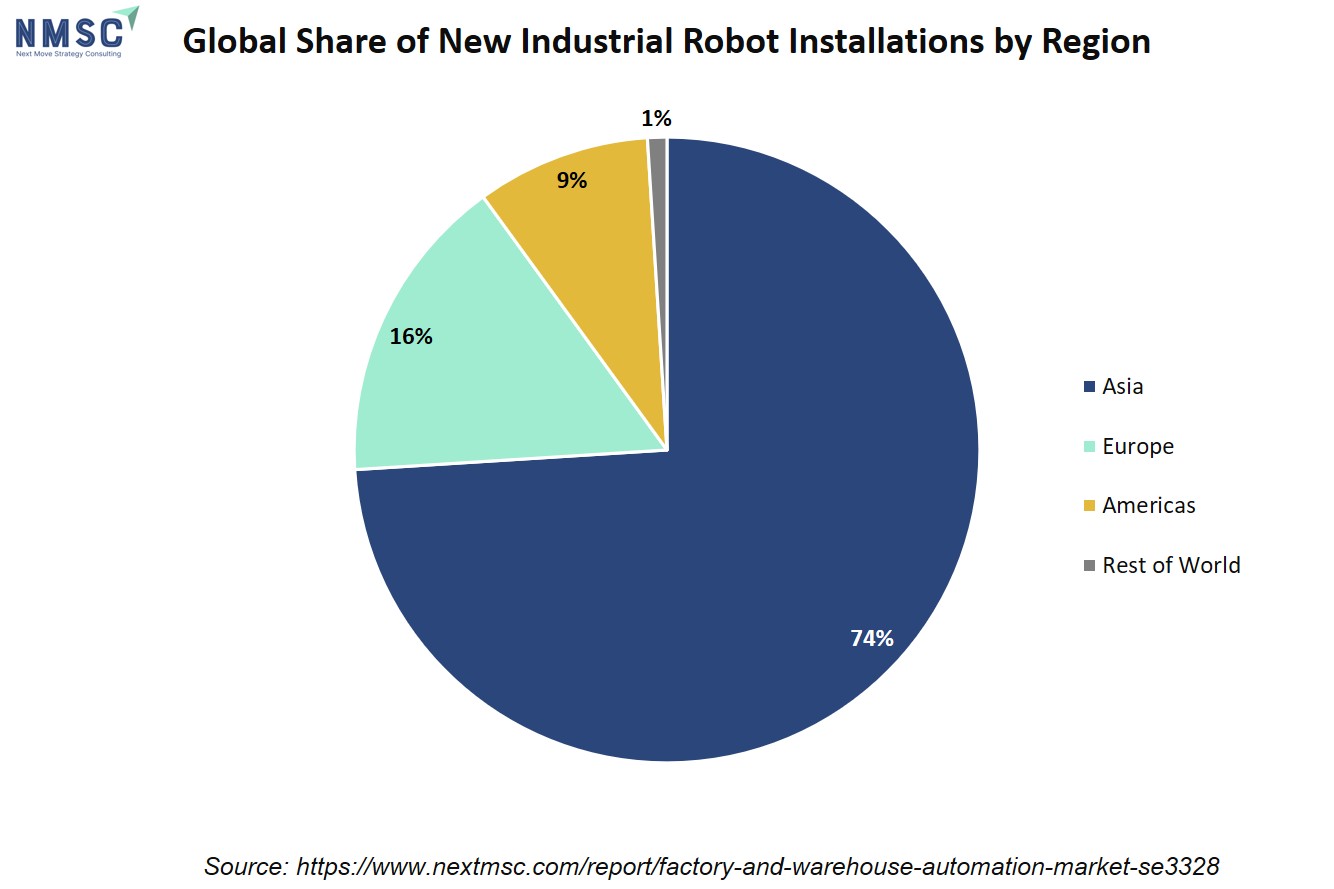
Regional concentration of new robot deployment remains heavily skewed toward Asia, which continues to anchor global manufacturing automation capacity.
On the corporate front, competitive intensity within the automation supply chain continues to rise. Per NMSC's analysis, Dematic and Daifuku continue to invest in modular automated storage and retrieval systems (AS/RS) and conveyor technology, while Symbotic's 2025 collaboration with Walmart has strengthened micro-fulfillment capabilities across the retailer's distribution network. ABB's 2024 acquisition of Sevensense has bolstered its AI-driven robotics portfolio, and KION's 2025 partnership with NVIDIA is advancing autonomous systems development. Honeywell Intelligrated continues to integrate IoT-enabled real-time analytics into its warehouse execution offerings, while Swisslog is prioritizing AMR deployment to support same-day and next-day delivery models increasingly demanded by retail and e-commerce customers.
Amazon's own trajectory illustrates the operational payoff of sustained robotics investment. The company's Shreveport, Louisiana facility, which opened with ten times more robotic equipment than earlier-generation warehouses, has achieved a 25% reduction in the cost of fulfilling orders, and Morgan Stanley analysts estimate that expanded robotics-enabled warehousing could generate approximately $10 billion in annual savings for the company by 2030. Since acquiring Kiva Systems for $775 million in 2012, Amazon has expanded its robotics division to deploy more than 750,000 mobile devices alongside tens of thousands of robotic arms and autonomous systems across its global fulfillment network.
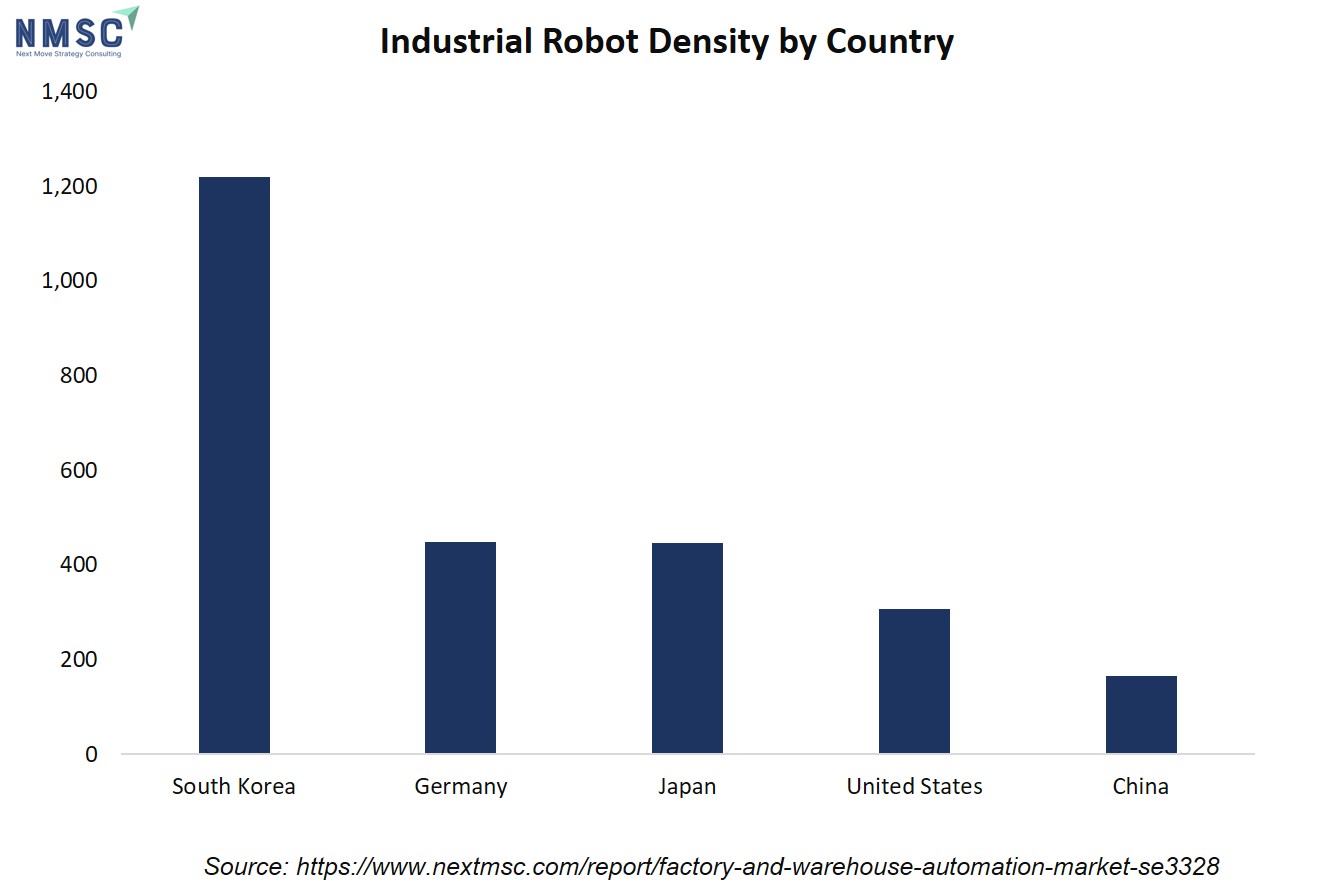
Industrial Robot Density by Selected Country
|
Country |
Robot Density (Units per 10,000 Employees) |
|
South Korea |
1,220 |
|
Germany |
449 |
|
Japan |
446 |
|
United States |
307 |
|
China |
166 |
Industrial Robot Installations by End-User Sector
|
End-User Sector |
U.S. Robot Installations, 2025 (Units) |
|
Automotive |
13,500 |
|
Food |
~3,000 |
|
Metal & Machinery |
~3,000 |
|
Electrical-Electronics |
~3,000 |
|
Total U.S. Installations |
38,000 |
Policy momentum is reinforcing this industrial shift. On July 13, 2026, four leading global robotics and automation associations—the International Federation of Robotics, the Association for Advancing Automation (A3), VDMA Robotics + Automation, and Spain's AER Automation—signed the Barcelona Declaration on Robotics and Automation 2026, formalizing a long-term commitment to advocate for national robotics strategies, improved investment conditions, and international standardization across governments worldwide. Separately, A3 has presented a formal "Vision for a National Robotics Strategy" to U.S. lawmakers, proposing a Federal Robotics Office and market-driven tax incentives to accelerate domestic automation adoption.
Regionally, North America continues to hold the largest revenue share of the factory and warehouse automation market, driven by e-commerce-led demand and near-shoring trends that have spurred new factory construction, according to NMSC. Europe's outlook remains positive over the long term despite integration challenges posed by legacy IT infrastructure, while Asia-Pacific—led by China, Japan, South Korea, and India—is emerging as the fastest-growing region, supported by government initiatives such as India's "Make in India" program and warehouse consolidation following the country's GST implementation.
Bottom Line
The global factory and warehouse automation sector is entering a structurally different growth phase, driven not by incremental efficiency gains but by a fundamental redesign of industrial facilities around robotic labor. Amazon's €10 billion European commitment and Gartner's projection of human-optional warehouses by 2030 indicate that automation is shifting from a cost-saving overlay to a foundational design principle for new industrial and logistics infrastructure. Persistent labor shortages, rising robot density across advanced manufacturing economies, and the maturation of Robotics-as-a-Service models are collectively lowering adoption barriers for mid-sized enterprises previously excluded from large-scale automation. Risks remain concentrated in integration complexity with legacy systems, high upfront deployment costs, and cybersecurity exposure as robotic fleets become increasingly networked. For investors and industry leaders, the strategic implication is clear: competitive positioning in this market will increasingly depend on scalable, software-defined robotics platforms and long-term vendor partnerships rather than single-purpose automation investments, as regional strategies in Asia, North America, and Europe continue to diverge in pace and policy support.
About Next Move Strategy Consulting
Next Move Strategy Consulting is a premier market research and management consulting firm that has been committed to provide strategically analysed well documented latest research reports to its clients. The research industry is flooded with many firms to choose from, what makes NMSC different from the rest is its top-quality research and the obsession of turning data into knowledge by dissecting every bit of it and providing fact-based research recommendation that is supported by information collected from over 500 million websites, paid databases, industry journals and one on one consultations with industry experts across a diverse range of industry sectors. The high-quality customized research reports with actionable insights and excellent end-to-end customer service help our clients to take critical business decisions that enables them to move beyond time and have competitive edge in the industry.
We have been servicing over 1000 customers globally that includes 90% of the Fortune 500 companies over a decade. Our analysts are constantly tracking various high growth markets and identifying hidden opportunities in each sector or the industry. We provide one of the industry's best quality syndicate as well as custom research reports across 10 different industry verticals. We are committed to deliver high quality research solutions in accordance to your business needs. Our industry standard delivery solutions that ranges from the pre consultation to after-sales services, provide an excellent client experience and ensure right strategic decision making for businesses.
For more information, please contact:
Next Move Strategy Consulting
5th Floor 867
Boylston St, STE 500,
Boston, MA 02116, U.S.
E-Mail: [email protected]
Direct: +1-217-650-7991
Website: www.nextmsc.com
About the Author
 Sanyukta Deb
— Sanyukta Deb is Digital Marketing Team Lead at Next Move Strategy Consulting, where she has led content strategy and technical SEO for the firm's B2B market research publications for over 2 years. Her editorial process translates NextMSC's primary and secondary research — spanning technology, industrial, and consumer sectors — into commercial narratives, backed by search-intent, keyword, and competitive analysis. She brings 5 years of overall experience in digital marketing and content strategy.
Sanyukta Deb
— Sanyukta Deb is Digital Marketing Team Lead at Next Move Strategy Consulting, where she has led content strategy and technical SEO for the firm's B2B market research publications for over 2 years. Her editorial process translates NextMSC's primary and secondary research — spanning technology, industrial, and consumer sectors — into commercial narratives, backed by search-intent, keyword, and competitive analysis. She brings 5 years of overall experience in digital marketing and content strategy.
About the Reviewer
 Debashree Dey
— Debashree Dey is Assistant Manager at Next Move Strategy Consulting, where she supports cross-vertical market content and communications across diverse industries for 6 years. Her professional background includes senior content writing, communications, and published manuscript authorship, with experience developing audience-focused business narratives and maintaining clear, consistent messaging. Her role supports research-led content development and editorial quality across NextMSC publications.
Debashree Dey
— Debashree Dey is Assistant Manager at Next Move Strategy Consulting, where she supports cross-vertical market content and communications across diverse industries for 6 years. Her professional background includes senior content writing, communications, and published manuscript authorship, with experience developing audience-focused business narratives and maintaining clear, consistent messaging. Her role supports research-led content development and editorial quality across NextMSC publications.















Add Comment