Is China’s CR450 the Breakthrough That Could Redefine the Future of High-Speed Rail?
Lede
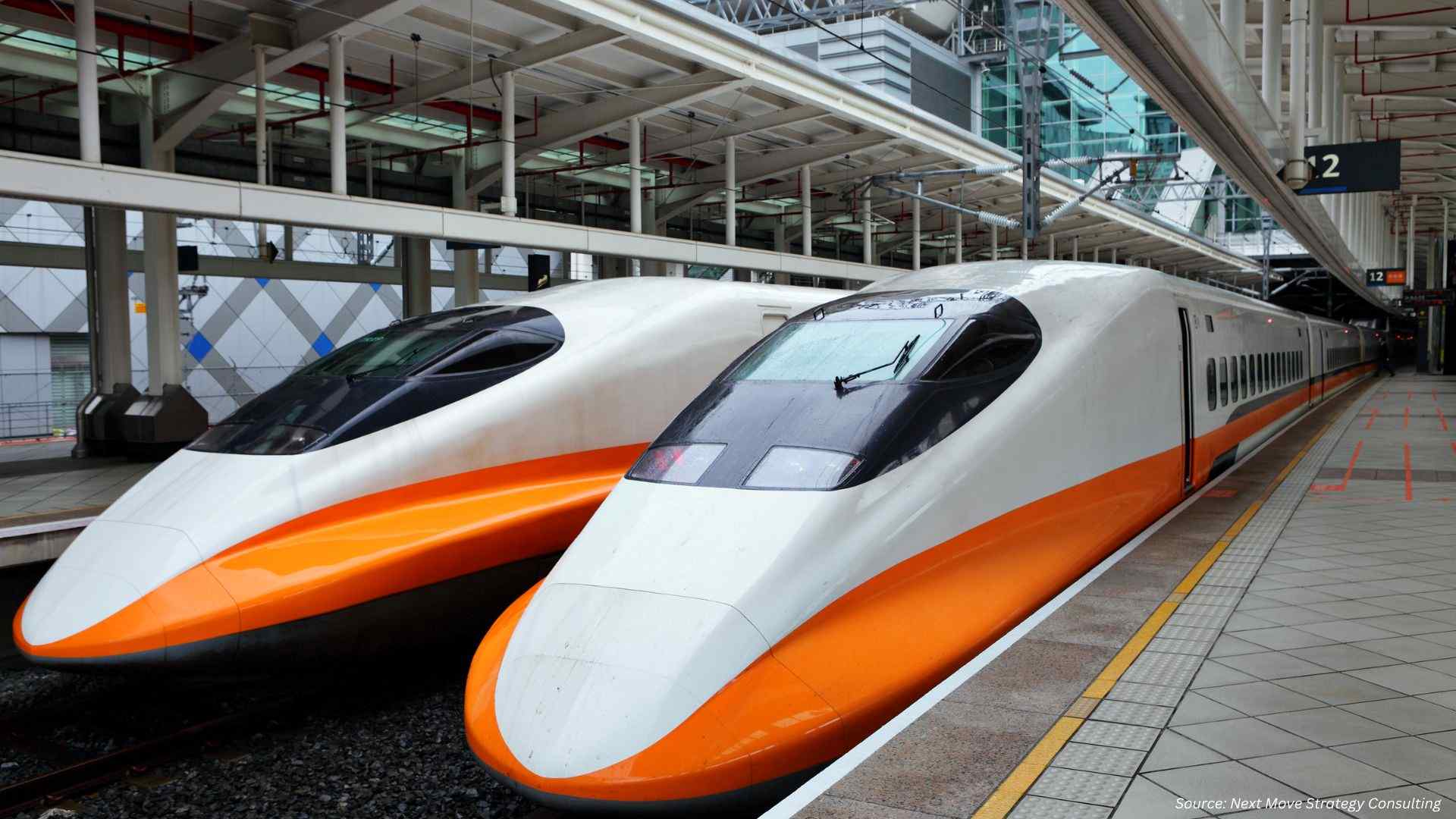
China’s latest high-speed rail innovation, the CR450 bullet train, has drawn global attention after reaching 453 km/h during test runs, marking a major milestone in next-generation rail development. As the next generation of high-speed trains moves closer to commercial deployment, the development signals not only a technological milestone but also a broader shift in how nations approach ultra-fast, energy-efficient rail travel.
China’s CR450 Sets a New Benchmark in High-Speed Rail
China has taken another step forward in high-speed transportation with the successful trial of the CR450 bullet train on the Shanghai–Chengdu high-speed rail corridor. During testing, the train achieved a peak speed of 453 km/h, positioning it among the fastest rail systems ever developed.
Designed with a target operational speed of 400 km/h, the CR450 represents a substantial advancement over earlier models such as the CR400 Fuxing series, which currently operates commercially at around 350 km/h. The trial results indicate that the new train could significantly reduce travel times across long-distance routes once it enters commercial service.
Engineers behind the project have also demonstrated the train’s impressive acceleration capability. The CR450 can accelerate from 0 to 350 km/h in just 4 minutes and 40 seconds, reflecting improvements in propulsion, braking systems, and structural engineering.
Another remarkable moment during the testing phase occurred when two CR450 units passed each other at a combined speed approaching 900 km/h, showcasing the precision and safety standards of modern high-speed rail technology.
Engineering Innovations Behind the CR450
Beyond raw speed, the CR450 introduces a range of engineering upgrades designed to enhance efficiency and operational performance.
One of the most visible design improvements is its longer aerodynamic nose, which extends the train’s profile and helps reduce drag during high-speed travel. Engineers also lowered the roofline and incorporated structural optimizations that significantly improve airflow around the train body.
The CR450 is also around 50–55 tonnes lighter than its predecessor, enabling faster acceleration and lower energy consumption. According to engineers involved in the project, the train’s aerodynamic refinements reduce air resistance by approximately 22 percent, improving overall energy efficiency.
These innovations highlight a broader trend in high-speed rail development: combining speed, sustainability, and passenger comfort rather than focusing on velocity alone.
Next-Generation Bullet Trains Push High-Speed Rail Limits
It highlights the performance comparison between two generations of high-speed bullet trains, emphasizing the technological leap in rail speed capabilities. It shows that the CR450 bullet train reached a record test speed of 453 km/h, demonstrating a significant advancement in high-speed rail engineering. In comparison, the earlier CR400 series operates commercially at around 350 km/h, which has been the standard operational speed for many modern high-speed rail systems. The graphic visually represents the speed gap of approximately 90–100 km/h between the existing commercial operating benchmark and the new test record, illustrating how next-generation rail technologies are pushing the boundaries of train performance. Developments such as the CR450, which achieved this milestone during trials on China’s high-speed rail network, highlight the country’s continued focus on improving aerodynamics, propulsion efficiency, and overall rail system performance.

Passenger Experience and Sustainability Goals
China’s upcoming bullet train is also designed with passenger comfort and environmental performance in mind.
The lightweight structure and improved aerodynamics contribute to a smoother and quieter ride, particularly at extreme speeds. Faster acceleration also reduces overall journey times, making high-speed rail more competitive with short-haul flights.
From an environmental perspective, the CR450 aligns with China’s long-term strategy to expand low-carbon transportation alternatives. High-speed rail systems typically produce significantly fewer emissions per passenger kilometer compared with air travel, and improvements in energy efficiency could further reduce the sector’s carbon footprint.
Once deployed commercially, the CR450 is expected to operate across China’s extensive high-speed rail network, strengthening connectivity between major economic hubs and densely populated regions.
Key Technical Highlights of the CR450
|
Feature |
Details |
|
Maximum Test Speed |
453 km/h |
|
Planned Operational Speed |
400 km/h |
|
Acceleration |
0–350 km/h in 4 minutes |
|
Aerodynamic Improvement |
22% reduction in air resistance |
|
Weight Reduction |
Around 50–55 tonnes lighter |
|
Reliability Testing |
600,000 km fault-free trial target |
|
Expected Commercial Debut |
Around 2026 |
Global Implications for High-Speed Rail Development
The CR450’s performance signals a new phase in the evolution of high-speed rail. Over the past two decades, China has built the world’s largest high-speed rail network, connecting major cities with rapid transit corridors that have reshaped domestic travel patterns.
With the CR450, the focus appears to be shifting from network expansion toward technological leadership and next-generation train systems.
Such developments could influence infrastructure planning in other regions as well. Countries investing in high-speed rail including projects across Asia, Europe, and parts of the Middle East are increasingly prioritizing faster trains, improved energy efficiency, and advanced safety systems.
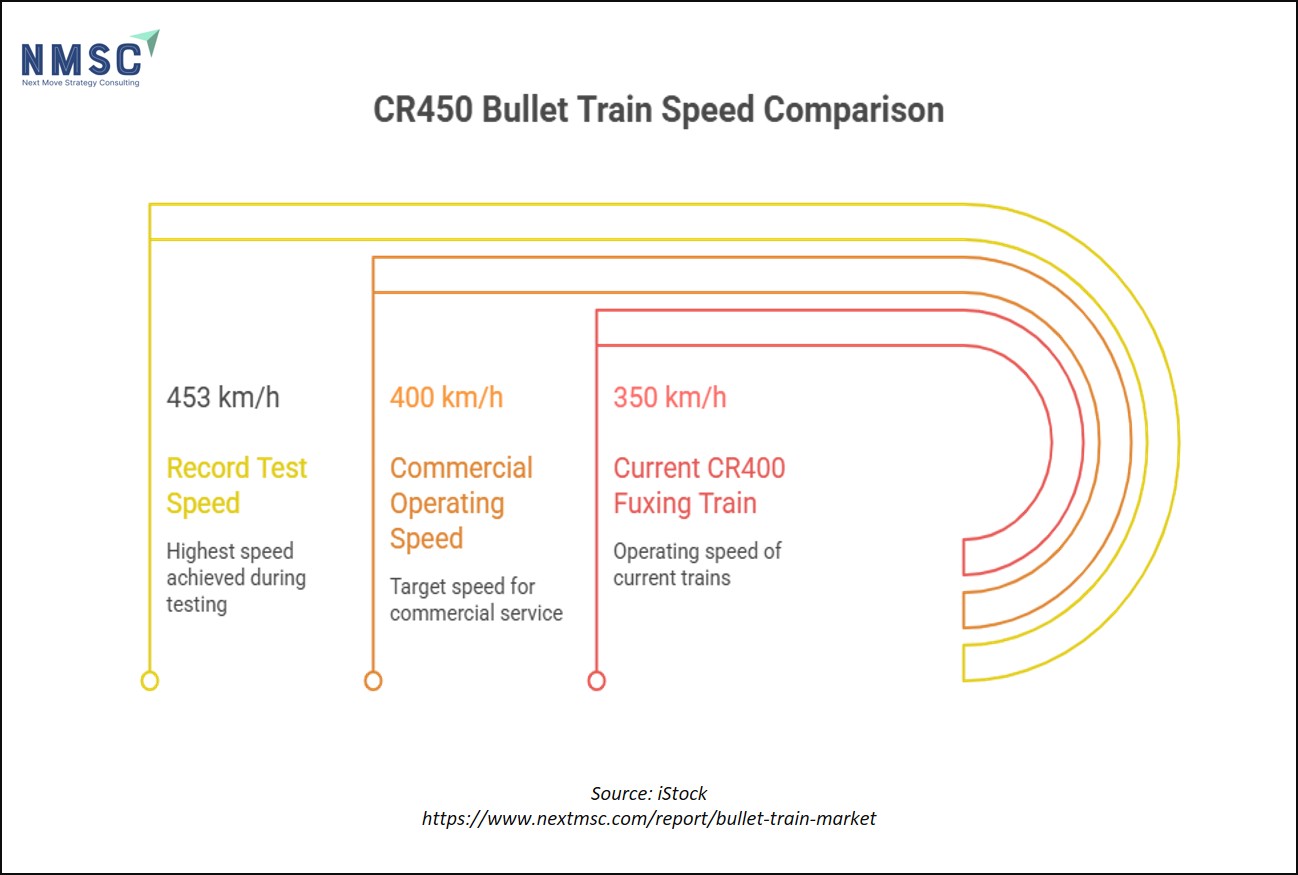
Comparison of Record and Operational Speeds in China’s Bullet Train Evolution
A comparative overview of speed benchmarks within China’s high-speed rail technology, highlighting the progress from the currently operating CR400 Fuxing bullet train to the next-generation CR450 model. It shows that the CR400 series currently operates at an average commercial speed of around 350 km/h, which has been the standard for many modern high-speed rail networks. The upcoming CR450 train is designed to operate commercially at 400 km/h, representing a significant improvement in travel efficiency and intercity connectivity. During testing phases, the CR450 achieved a record trial speed of 453 km/h, demonstrating the advancements in aerodynamics, propulsion systems, and lightweight engineering integrated into the new train design. This progression highlights China’s continuous efforts to enhance high-speed rail performance while maintaining safety and reliability before commercial deployment.
Long-Term Industry Impact and NMSC Perspective
The evolution from metro and conventional rail systems to high-speed bullet trains reflects a broader transformation in the Bullet Train Market, driven by rising demand for faster, sustainable, and high-capacity transportation solutions. NMSC analysis suggests that technological breakthroughs like the CR450 are expected to accelerate investment in next-generation rail infrastructure worldwide, as governments increasingly view high-speed rail as a competitive and environmentally friendly alternative to short-haul air travel. As countries continue to expand intercity connectivity and reduce travel times between economic hubs, innovations in high-speed rail design, efficiency, and passenger experience are likely to play a critical role in shaping the future trajectory of the global bullet train industry.
According to insights from Next Move Strategy Consulting, innovations like the CR450 highlight a broader transformation in the high-speed rail ecosystem.
1. Acceleration of Ultra-High-Speed Rail Programs
The success of the CR450 could encourage other countries to explore train systems operating beyond the traditional 300–350 km/h range. As technologies mature, ultra-high-speed rail could become a viable alternative for intercity routes traditionally dominated by aviation.
2. Increased Focus on Energy Efficiency
Aerodynamic design improvements and lightweight materials will likely become central to next-generation rail development. Energy-efficient trains not only reduce operational costs but also support global decarbonization goals.
3. Expansion of Rail as a Competitive Mode of Transport
Faster rail travel could strengthen competition with short-haul flights, particularly on routes under 1,000 kilometers where high-speed trains can deliver comparable door-to-door travel times.
4. Export Opportunities and Global Collaboration
China’s progress in advanced rail engineering may also expand opportunities for technology exports and international partnerships as countries invest in modernizing rail infrastructure.
From an industry perspective, NMSC analysts note that the convergence of speed innovation, sustainability, and passenger experience is expected to shape the next wave of rail modernization globally.
5. Outlook for the Future of High-Speed Transportation
As the CR450 moves closer to commercial operation, it reflects a broader global ambition to push the limits of rail transportation. The train’s combination of record-setting speed, improved efficiency, and passenger-focused design signals how high-speed rail systems are evolving to meet growing demand for faster and more sustainable mobility.
If the upcoming commercial rollout meets expectations, the CR450 could set a new standard for future rail technologies potentially influencing infrastructure investments and transportation strategies worldwide.
About Next Move Strategy Consulting:
Next Move Strategy Consulting is a premier market research and management consulting firm that has been committed to providing strategically analysed well documented latest research reports to its clients. The research industry is flooded with many firms to choose from, what makes NMSC different from the rest is its top-quality research and the obsession of turning data into knowledge by dissecting every bit of it and providing fact-based research recommendation that is supported by information collected from over 500 million websites, paid databases, industry journals and one on one consultations with industry experts across a diverse range of industry sectors. The high-quality customized research reports with actionable insights and excellent end-to-end customer service help our clients to take critical business decisions that enables them to move beyond time and have competitive edge in the industry.
We have been servicing over 1000 customers globally that includes 90% of the Fortune 500 companies over a decade. Our analysts are constantly tracking various high growth markets and identifying hidden opportunities in each sector or the industry. We provide one of the industry’s best quality syndicate as well as custom research reports across 10 different industry verticals. We are committed to deliver high quality research solutions in accordance to your business needs. Our industry standard delivery solutions that ranges from the pre consultation to after-sales services, provide an excellent client experience and ensure right strategic decision making for businesses.
For more information, please contact:
Next Move Strategy Consulting
5th Floor 867
Boylston St, STE 500
Boston, MA 02116, U.S.
E-Mail: [email protected]
Direct: +1 857 758 5017
Website: www.nextmsc.com
About the Author
 Sanyukta Deb
— Sanyukta Deb is Digital Marketing Team Lead at Next Move Strategy Consulting, where she has led content strategy and technical SEO for the firm's B2B market research publications for over 2 years. Her editorial process translates NextMSC's primary and secondary research — spanning technology, industrial, and consumer sectors — into commercial narratives, backed by search-intent, keyword, and competitive analysis. She brings 5 years of overall experience in digital marketing and content strategy.
Sanyukta Deb
— Sanyukta Deb is Digital Marketing Team Lead at Next Move Strategy Consulting, where she has led content strategy and technical SEO for the firm's B2B market research publications for over 2 years. Her editorial process translates NextMSC's primary and secondary research — spanning technology, industrial, and consumer sectors — into commercial narratives, backed by search-intent, keyword, and competitive analysis. She brings 5 years of overall experience in digital marketing and content strategy.
About the Reviewer
 Debashree Dey
— Debashree Dey is Assistant Manager at Next Move Strategy Consulting, where she supports cross-vertical market content and communications across diverse industries for 6 years. Her professional background includes senior content writing, communications, and published manuscript authorship, with experience developing audience-focused business narratives and maintaining clear, consistent messaging. Her role supports research-led content development and editorial quality across NextMSC publications.
Debashree Dey
— Debashree Dey is Assistant Manager at Next Move Strategy Consulting, where she supports cross-vertical market content and communications across diverse industries for 6 years. Her professional background includes senior content writing, communications, and published manuscript authorship, with experience developing audience-focused business narratives and maintaining clear, consistent messaging. Her role supports research-led content development and editorial quality across NextMSC publications.
















Add Comment