Is Electric Aviation Shifting from Air Taxi Hype to Real-World Deployment?

Lede
The Air Taxi Market is entering a decisive transition phase as recent developments in Asia and the United States suggest that electric aviation is moving beyond conceptual showcases into operational testing and strategic deployment. Announcements from Vertical Aerospace at the Singapore Airshow, alongside Amazon’s growing investment in BETA Technologies, indicate that the next chapter in advanced air mobility may be defined less by futuristic imagery and more by certification, cargo economics, and healthcare missions. Together, these moves illustrate a broader structural recalibration within the Air Taxi Market where scalability, regulatory maturity, and real-world use cases are increasingly taking precedence over speculative timelines.
Vertical Aerospace Advances Practical AAM in Japan and Singapore
Vertical Aerospace outlined two Asia-focused initiatives designed to transition electric vertical take-off and landing (eVTOL) aircraft from demonstrations to structured operations.
In Japan, Vertical is progressing route development in partnership with Marubeni Corporation, focusing initially on the Kansai region. Proposed corridors, including potential services across Osaka Bay, aim to reduce travel times by up to 80% compared with ground transport. Demonstration flights are targeted for 2026, with commercial ambitions linked to tourism, airport shuttles, premium travel, and time-sensitive logistics. Meanwhile, in Singapore, Vertical secured a proof-of-concept grant under the Dimension X Cohort 7 Challenge led by Hatch, the innovation arm of the Home Team Science & Technology Agency. The programme will test emergency medical services (EMS) missions using electric and hybrid-electric aircraft for remote island communities. Flight trials are expected in the second half of 2026.
These initiatives align with Singapore’s national Advanced Air Mobility roadmap, supported by the Economic Development Board and the Civil Aviation Authority of Singapore. The emphasis is clear: operational credibility before mass deployment.
Vertical’s Valo platform is designed for speeds up to 240 km/h and ranges up to 160 km in its fully electric configuration, with hybrid-electric variants under development to extend mission flexibility.
Redefining 500-Mile Travel – The Emerging Air Taxi Corridor Model
The California map illustrates a 500-mile corridor between SF and SD normally a long drive contrasted with a 13-minute air-based alternative. The airplane and airport visuals suggest how electric aircraft can bypass ground congestion and drastically reduce transit times.
The image reflects a central theme shaping the Air Taxi Market: regional corridor optimization. Rather than focusing only on futuristic urban concepts, companies are increasingly targeting structured routes that connect key economic hubs. Similar strategies are visible in Asia, where route planning in Japan and healthcare-focused flight trials in Singapore demonstrate how air taxis may first scale through defined corridors and mission-specific use cases.

Amazon Signals a Cargo-First Electric Aviation Strategy
While passenger-focused eVTOL aircraft dominate headlines, Amazon’s 5.3% stake in BETA Technologies underscores a more pragmatic approach to electric aviation.
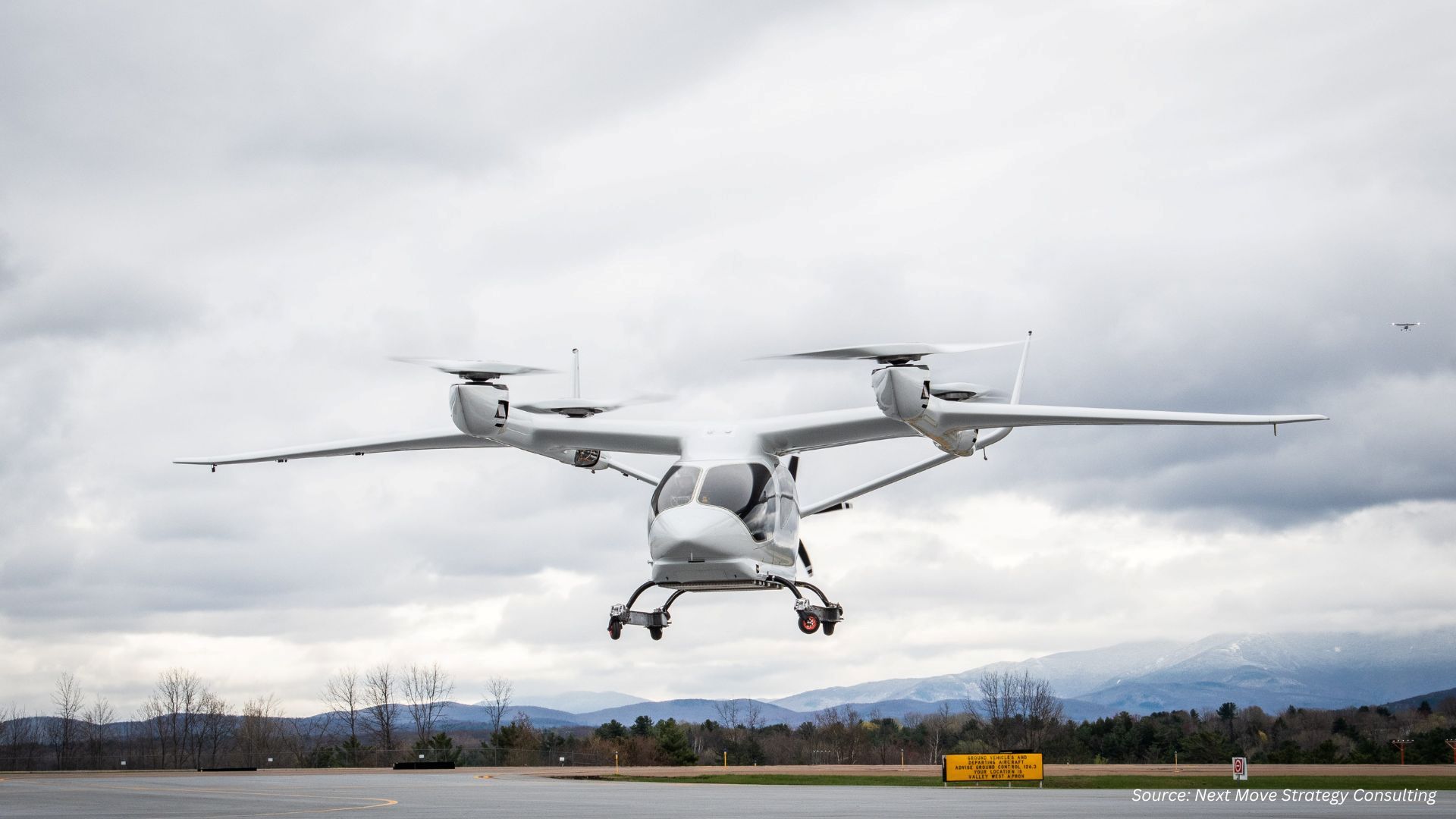
Rather than prioritising vertical-lift urban air taxis, BETA has focused on conventional take-off and landing (CTOL) electric aircraft, which integrate more seamlessly into existing airport infrastructure. For Amazon’s logistics network, this approach reduces dependency on new vertiport construction and complex urban airspace frameworks.
BETA’s ALIA aircraft has been conducting cargo operations in Norway between Stavanger and Bergen, in collaboration with Bristow Norway and airport operator Avinor. The six-month operational campaign included winter-condition testing, multi-airport rotations, and mobile charging deployment demonstrating that electric aircraft can function in demanding real-world conditions.
Norway’s Civil Aviation Authority has established a regulatory sandbox framework, enabling controlled integration of electric aircraft into live airspace while refining safety methodologies. This approach mirrors the broader industry pivot toward freight-led validation before passenger scaling. For Amazon, the investment appears less speculative and more infrastructural: electrifying segments of its regional cargo network without reimagining the entire aviation ecosystem.
Long-Term Impact on the Air Taxi Market
These parallel developments suggest the Air Taxi Market may evolve along two complementary tracks:
First, Asia is positioning itself as a testbed for early passenger and healthcare use cases. Japan’s route planning and Singapore’s EMS trials demonstrate that governments willing to pair innovation funding with regulatory clarity could accelerate structured deployment.
Second, cargo-led electrification may outpace urban passenger services. CTOL aircraft, requiring minimal infrastructure disruption, could achieve commercial viability sooner building operational confidence that ultimately benefits passenger-focused platforms.
This dual-path model reduces systemic risk. Freight operations generate revenue, operational data, and regulatory familiarity. Passenger services follow once certification, safety validation, and public acceptance mature.
Structural Shift Over Spectacle
From a Next Move Strategy Consulting perspective, the Air Taxi Market is entering a validation phase where infrastructure compatibility and mission-specific deployment will determine near-term winners.
Rather than a binary competition between eVTOL and CTOL models, the sector is likely to segment by use case:
Healthcare and time-critical mobility in island or congested regions may favour eVTOL platforms supported by strong regulatory ecosystems.
Regional cargo and short-haul logistics may prioritise CTOL electric aircraft due to easier airspace integration and faster certification pathways.
NMSC anticipates that between 2026 and 2030, freight-first deployments will play a stabilising role in electric aviation economics. Passenger air taxis will expand gradually in markets demonstrating regulatory leadership and public-private coordination, such as Japan and Singapore.
The broader impact extends beyond aircraft manufacturing. Infrastructure planning, charging networks, hybrid propulsion systems, pilot training frameworks, and digital air traffic management solutions are expected to see accelerated demand as deployment moves from concept to corridor-level execution.
Conclusion
The Air Taxi Market is no longer defined solely by futuristic renderings or ambitious timelines. Vertical Aerospace’s Asia expansion and Amazon’s strategic alignment with BETA Technologies reflect a maturing ecosystem one increasingly focused on operational proof, regulatory integration, and scalable economics. If electric aviation succeeds, it may not do so through a dramatic urban breakthrough, but through disciplined cargo trials, emergency service missions, and regionally anchored route networks that quietly build the foundations of a new aviation era.
About Next Move Strategy Consulting:
Next Move Strategy Consulting is a premier market research and management consulting firm that has been committed to providing strategically analysed well documented latest research reports to its clients. The research industry is flooded with many firms to choose from, what makes NMSC different from the rest is its top-quality research and the obsession of turning data into knowledge by dissecting every bit of it and providing fact-based research recommendation that is supported by information collected from over 500 million websites, paid databases, industry journals and one on one consultations with industry experts across a diverse range of industry sectors. The high-quality customized research reports with actionable insights and excellent end-to-end customer service help our clients to take critical business decisions that enables them to move beyond time and have competitive edge in the industry.
We have been servicing over 1000 customers globally that includes 90% of the Fortune 500 companies over a decade. Our analysts are constantly tracking various high growth markets and identifying hidden opportunities in each sector or the industry. We provide one of the industry’s best quality syndicate as well as custom research reports across 10 different industry verticals. We are committed to deliver high quality research solutions in accordance to your business needs. Our industry standard delivery solutions that ranges from the pre consultation to after-sales services, provide an excellent client experience and ensure right strategic decision making for businesses.
For more information, please contact:
Next Move Strategy Consulting
5th Floor 867
Boylston St, STE 500
Boston, MA 02116, U.S.
E-Mail: [email protected]
Direct: +1 857 758 5017
Website: www.nextmsc.com
About the Author
 Sanyukta Deb
— Sanyukta Deb is Digital Marketing Team Lead at Next Move Strategy Consulting, where she has led content strategy and technical SEO for the firm's B2B market research publications for over 2 years. Her editorial process translates NextMSC's primary and secondary research — spanning technology, industrial, and consumer sectors — into commercial narratives, backed by search-intent, keyword, and competitive analysis. She brings 5 years of overall experience in digital marketing and content strategy.
Sanyukta Deb
— Sanyukta Deb is Digital Marketing Team Lead at Next Move Strategy Consulting, where she has led content strategy and technical SEO for the firm's B2B market research publications for over 2 years. Her editorial process translates NextMSC's primary and secondary research — spanning technology, industrial, and consumer sectors — into commercial narratives, backed by search-intent, keyword, and competitive analysis. She brings 5 years of overall experience in digital marketing and content strategy.
About the Reviewer
 Debashree Dey
— Debashree Dey is Assistant Manager at Next Move Strategy Consulting, where she supports cross-vertical market content and communications across diverse industries for 6 years. Her professional background includes senior content writing, communications, and published manuscript authorship, with experience developing audience-focused business narratives and maintaining clear, consistent messaging. Her role supports research-led content development and editorial quality across NextMSC publications.
Debashree Dey
— Debashree Dey is Assistant Manager at Next Move Strategy Consulting, where she supports cross-vertical market content and communications across diverse industries for 6 years. Her professional background includes senior content writing, communications, and published manuscript authorship, with experience developing audience-focused business narratives and maintaining clear, consistent messaging. Her role supports research-led content development and editorial quality across NextMSC publications.

















Add Comment