Is the Global Network Attached Storage Market a Good Industry to Invest In?
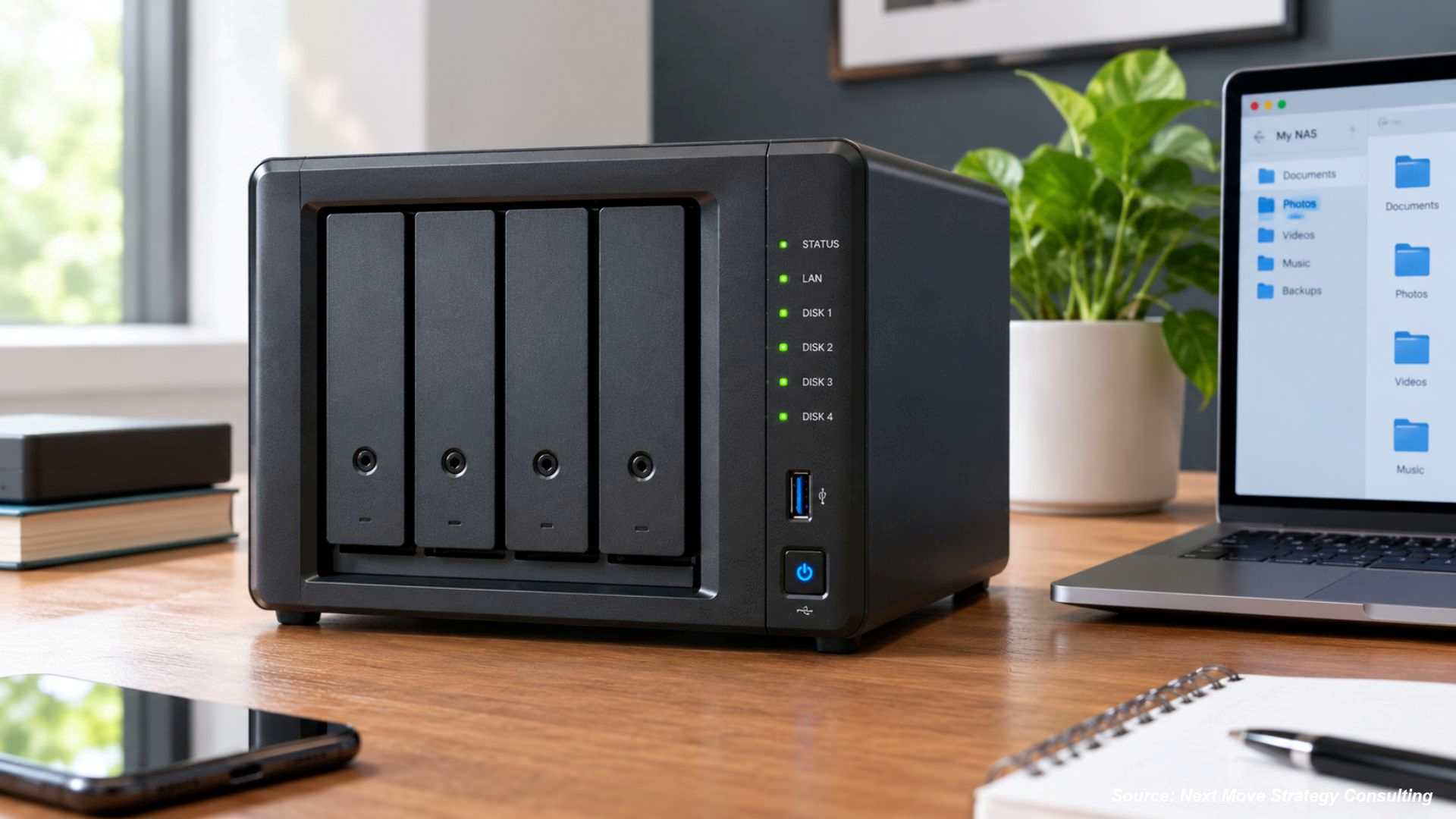
Seagate’s Data Center Customers Now Account for 80% of Revenue as Drive Pricing Firms, While Synology and NetApp Push On-Premises AI Storage as the Counterweight
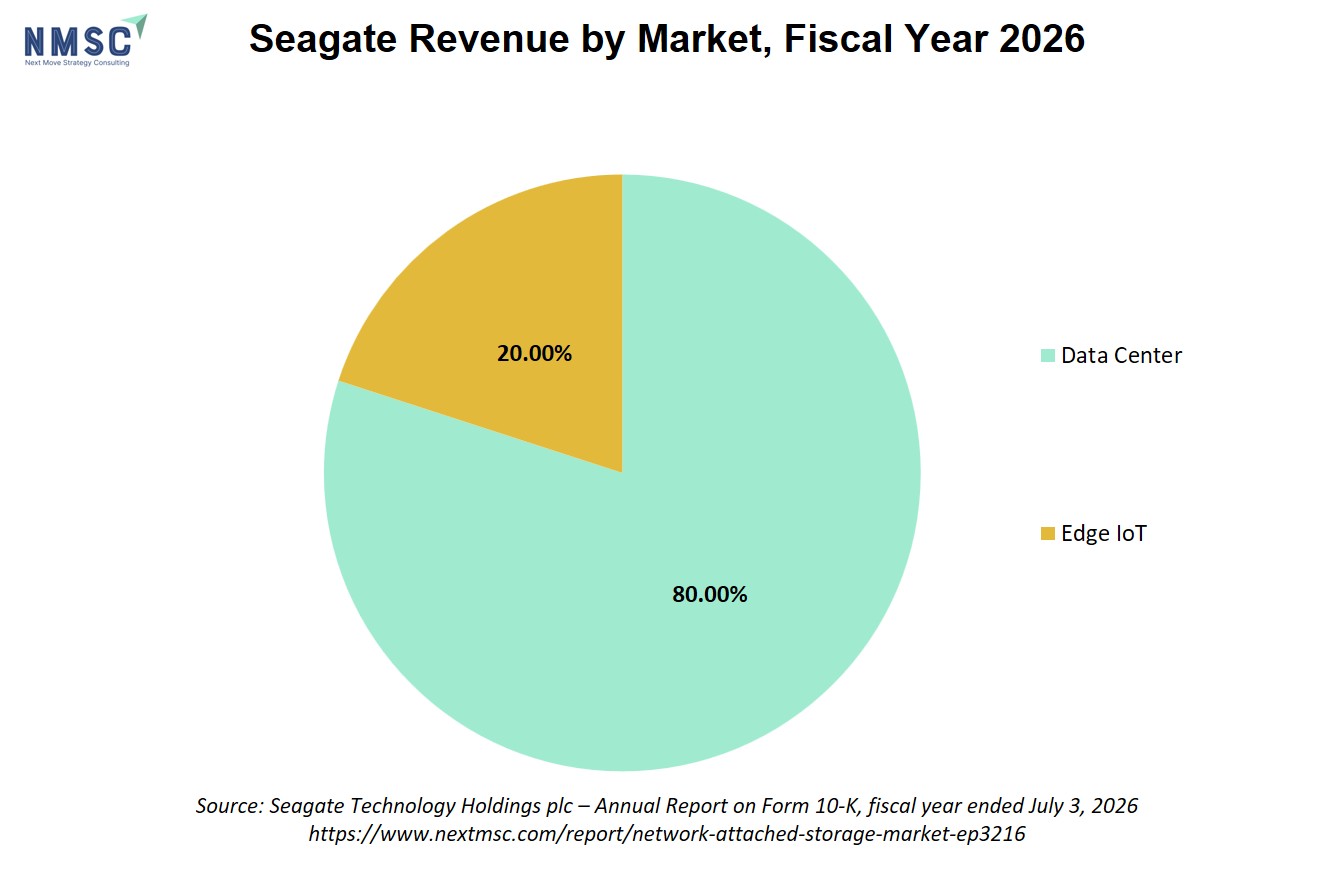
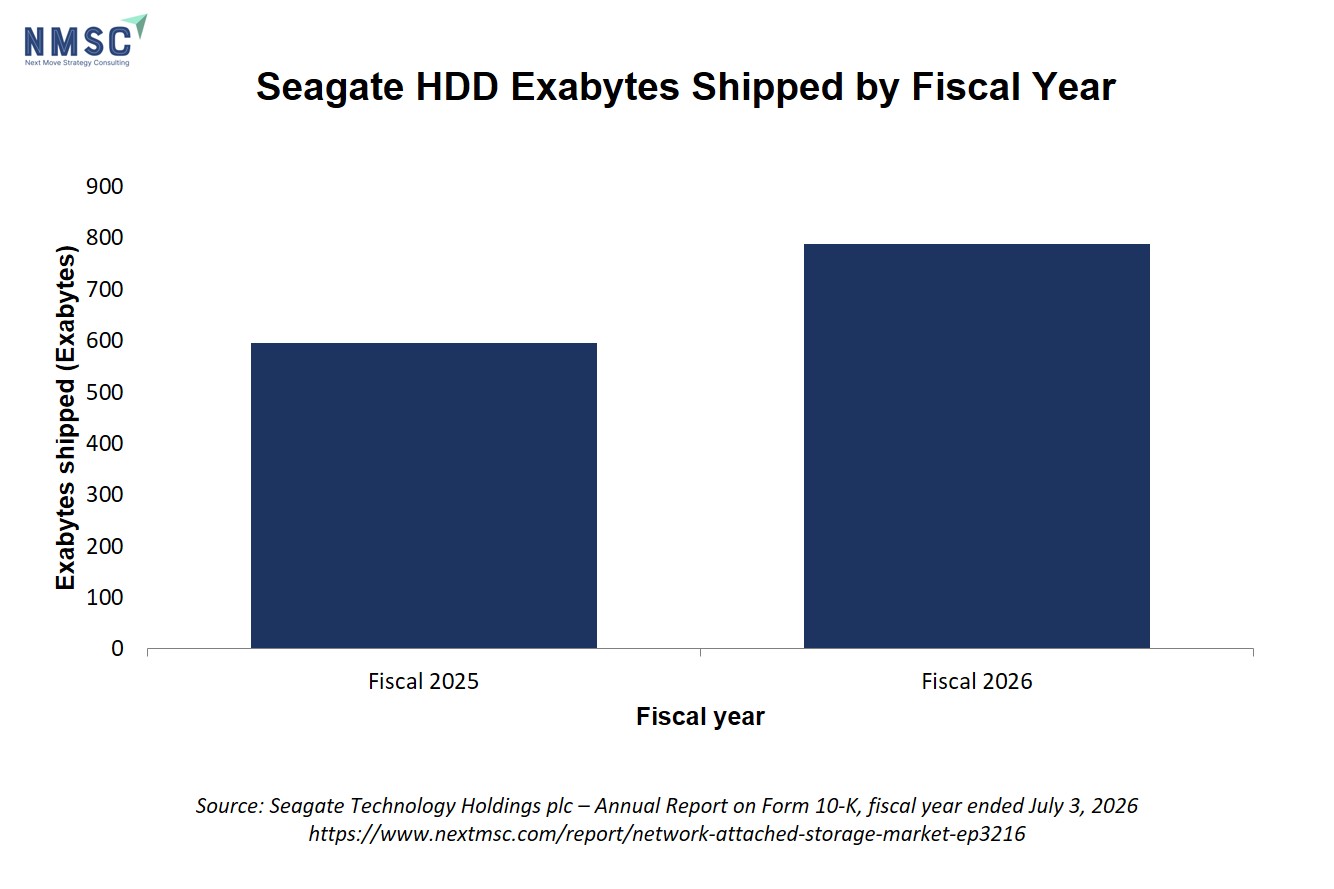
In late July 2026, Seagate Technology Holdings reported results for its fiscal year ended July 3, 2026, and the filing reads like a map of where storage capital is heading. Annual revenue rose 34% to USD 12.2 billion, fourth-quarter GAAP gross margin reached 52.3% against 37.4% a year earlier, and total hard disk drive shipments climbed to 789 exabytes from 595. Seagate’s annual report on Form 10-K attributes the revenue increase primarily to higher nearline exabyte shipments and favorable pricing actions. It also shows the Data Center market at 80% of revenue, up from 75%, while Edge IoT, the unit whose products serve network attached storage and other video and image applications, slipped to 20% from 25%. For investors asking whether network attached storage is a good industry to enter, the filing frames the question precisely: demand for storage is expanding, but the drives inside every NAS enclosure are produced by suppliers whose growth and margins now come overwhelmingly from hyperscale and enterprise data center customers.
According to Next Move Strategy Consulting’s Network Attached Storage Market report, the global network attached storage market was valued at USD 34.89 billion in 2024 and is projected to reach USD 83.65 billion by 2030, growing at a CAGR of 20% from 2025 to 2030. NextMSC primary research and analysis identifies three demand forces behind that trajectory: the growth of unstructured data from high-resolution video, imaging and sensor logs; the need for centralized storage with secure remote access for distributed workforces; and the spread of IoT devices and surveillance systems that generate continuous data streams.
For More Information: Download FREE Sample on Network Attached Storage Market Report
Growth Is Visible; Returns Are the Question
A forecast CAGR of 20% describes demand, not profitability. Three tests separate a good industry to invest in from a merely large one: whether demand is durable, whether suppliers’ costs are stable, and whether vendors own the customer relationship through software rather than competing on hardware alone. The earnings reports from Seagate, Western Digital and NetApp between July and September 2026, together with Synology’s mid-2026 product announcements, offer evidence on each test.
The Financial Logic: Hyperscale Demand Is Rewriting Drive Economics
Seagate’s Form 10-K for the fiscal year ended July 3, 2026 quantifies the shift. Revenue from Data Center customers rose to 80% of the total from 75%, while Edge IoT fell to 20% from 25%, and the retail channel, which sells branded storage to casual users, gamers and creative professionals, declined to 6% of revenue from 8%. Nearline exabytes, the high-capacity drives sold into data centers, rose to 695 from 497, whereas non-nearline exabytes eased to 94 from 98. In the same filing, Seagate states that solid-state storage continues to displace lower-capacity hard drives in Edge IoT and client applications.
Western Digital’s results on August 5, 2026 point in the same direction. Fourth-quarter revenue rose 44% year over year to USD 3.747 billion, GAAP gross margin expanded to 54.1% from 41.0%, and fiscal 2026 revenue reached USD 12.919 billion, up 36%. Irving Tan, chief executive of Western Digital, said in the release that the company enters fiscal 2027 with continued confidence in the durability of demand. Dave Mosley, Seagate’s chair and chief executive officer, said in the company’s July 2026 results release that he sees “durable long-term demand for mass capacity storage.”
NextMSC primary research and analysis draws a cautious reading from these filings. The two drive suppliers cited above each reported a year-over-year gross margin expansion of 13 to 15 percentage points (Seagate from 37.4% to 52.3% in the fourth quarter, Western Digital from 41.0% to 54.1%), a result consistent with the favorable pricing actions Seagate cites in its annual report. NAS buyers who purchase drives alongside enclosures face that pricing directly, and vendors that bundle drives carry it in their own margins.
Key Industry Developments: Three Dated Moves Since June
On June 4, 2026, Synology used COMPUTEX 2026 to present the next generation of its DiskStation Manager operating system, with support for GPU-equipped NAS and AI appliances that run inference on premises, alongside ActiveProtect Manager 2.0, the DP5200 data protection appliance and the ChatPlus and Meet collaboration tools. On June 16, 2026, Synology released DSM 7.4, adding the DSM Agent for AI-guided system management, scheduled for the third quarter of 2026, and AI Search, ChatPlus and Meet, scheduled for the fourth quarter. The release also notes that Synology hard drives are required for the new post-processing deduplication and compression feature, an example of software functionality tied to branded hardware.
“…putting it to work where data lives.”
- Bie-i Chu, Executive Vice President, Synology NAS Group, Synology, DiskStation Manager 7.4 release, June 16, 2026.
On September 2, 2026, NetApp reported first-quarter fiscal 2027 results for the quarter ended July 31, 2026: record net revenue of USD 2.03 billion, up 30% year over year; record all-flash array revenue of USD 1.3 billion, up 47%; public cloud revenue of USD 206 million, up 28%; and billings of USD 2.06 billion, up 36%. NetApp significantly raised its full-year fiscal 2027 revenue and earnings guidance, and chief executive George Kurian described the result as the company’s strongest first quarter to date. These headline figures cover NetApp’s broader data infrastructure platform and do not isolate NAS revenue, so they indicate enterprise spending on file and hybrid storage rather than a NAS-only growth rate.
Reported Results From Storage Suppliers, July to September 2026
|
Company |
Reporting date |
Period |
Headline figures |
|
Seagate |
Late July 2026 |
Fiscal year ended July 3, 2026 |
Revenue USD 12,195 million (up 34%); fourth-quarter GAAP gross margin 52.3% versus 37.4%; 789 exabytes shipped versus 595 |
|
Western Digital |
August 5, 2026 |
Fiscal fourth quarter 2026 |
Revenue USD 3,747 million (up 44%); GAAP gross margin 54.1% versus 41.0%; fiscal 2026 revenue USD 12,919 million (up 36%) |
|
NetApp |
September 2, 2026 |
Fiscal first quarter 2027 (ended July 31, 2026) |
Net revenue USD 2.03 billion (up 30%); all-flash USD 1.3 billion (up 47%); billings USD 2.06 billion (up 36%) |
Seagate Fiscal 2026 Versus Fiscal 2025: The Mix Behind the Drive Supply
|
Metric |
Fiscal 2026 |
Fiscal 2025 |
|
Revenue (USD million) |
12,195 |
9,097 |
|
Data Center share of revenue |
80% |
75% |
|
Edge IoT share of revenue |
20% |
25% |
|
Retail channel share of revenue |
6% |
8% |
|
Nearline HDD exabytes shipped |
695 |
497 |
|
Non-nearline HDD exabytes shipped |
94 |
98 |
|
Total HDD exabytes shipped |
789 |
595 |
Segment Dynamics: Where the Software Moat Forms
The NMSC report segments the market by type (consumer, enterprise and midmarket NAS), storage solution (scale-up and scale-out), storage capacity (below 1TB, 1TB to 5TB and above 5TB), connectivity, design (from 1 to 8 bays up to more than 20 bays), deployment (on-premises, cloud and hybrid) and industry vertical, including BFSI, IT and telecom, healthcare, retail, and media and entertainment. Segment-level values are available in the full report. NextMSC primary research and analysis notes that as hybrid work models persist, organizations need on-premises storage that combines security with ease of access, which places the deployment segment closest to this year’s evidence. Seagate’s Edge IoT lineup spans 1TB to 32TB drives for applications that include NAS, a range that overlaps the two upper capacity bands in the NMSC segmentation, while Synology’s on-premises AI features target exactly the organizations that prefer to keep inference and collaboration data in-house.
Regional Outlook
NextMSC primary research and analysis finds that North America continues to lead the market, supported by IT infrastructure, digital transformation programs and demand from media, healthcare and government users in the United States. Europe is expanding quickly as data privacy rules such as GDPR push companies in Germany, the United Kingdom and France toward secure, centrally managed storage. Asia-Pacific is witnessing explosive growth, with China, India and Japan adding NAS capacity for IoT data, surveillance and smart city programs, and the rest of the world, spanning Latin America, the Middle East and Africa, is an emerging market. For context on supply, Seagate’s Form 10-K reports that 50% of its fiscal 2026 revenue was billed from the Americas, 40% from Asia Pacific and 10% from Europe, the Middle East and Africa.
Growth Drivers and Restraints
The matrix below separates NextMSC primary research and analysis from facts reported by named external sources, so that each entry can be traced to its origin.
NMSC Strategic Perspective: A Conditional Yes for Investors Who Own the Software Layer
NextMSC primary research and analysis supports a conditional answer to the question posed in the headline. Demand is the strongest part of the case: the 20% CAGR in NMSC’s forecast rests on data-creation forces that remain intact, and the 2026 earnings cycle shows storage customers spending heavily. The case narrows when attention turns to how returns are distributed.
Three observations follow from the evidence in this article. First, input economics currently favor drive suppliers over enclosure makers: Seagate and Western Digital each reported a margin expansion of 13 to 15 percentage points, and Seagate attributes part of its growth to pricing actions. In NextMSC’s assessment, vendors that bundle drives bear that pricing in their margins, which favors companies able to monetize software. Second, Synology’s June 2026 announcements show where that monetization is being pursued: AI-guided management, on-premises collaboration tools and storage efficiency features tied to its own drives. Third, cloud competition and upfront cost remain genuine restraints, particularly for small and medium businesses, which is why the hybrid deployment segment in the NMSC report warrants close tracking.
For investors, the practical screening questions are whether a company controls a software platform that customers renew, how exposed its bill of materials is to drive pricing, and how much of its revenue depends on small-business buyers sensitive to upfront cost. This article is market analysis and not investment advice.
Competitive Landscape
The NMSC report profiles 15 companies, among them Dell Technologies, IBM, Synology, NetApp, Huawei, QNAP, ASUSTOR, Microsoft, Buffalo, UGREEN, Western Digital, Hitachi Vantara, Netgear, Seagate and Hewlett Packard Enterprise, and provides market share data for 10 of them. The 2026 events documented here fall into two groups. Platform vendors are moving up the stack: Synology with DSM 7.4 and its COMPUTEX 2026 lineup in June, and NetApp with the record quarter it reported on September 2, 2026. Component suppliers are capturing value at the hardware layer: Seagate, with fiscal 2026 revenue of USD 12.2 billion, and Western Digital, with fiscal 2026 revenue of USD 12.9 billion. NextMSC primary research and analysis indicates that the market’s expansion hinges on the ability of vendors to balance innovation with affordability, serving large enterprises and small and medium businesses alike.
Bottom Line
Network attached storage looks conditionally attractive: demand is strong, but returns depend on where capital sits in the value chain. NextMSC primary research and analysis values the global market at USD 34.89 billion in 2024 and projects USD 83.65 billion by 2030, and the 2026 earnings cycle supports the demand case. Seagate reported 34% annual revenue growth and 789 exabytes shipped, Western Digital grew fourth-quarter revenue 44%, and NetApp raised full-year guidance after record first-quarter revenue. The same filings show where the economics currently sit. Seagate now earns 80% of its revenue from data center customers, and both drive makers widened gross margins by 13 to 15 percentage points. Synology’s decision to embed AI-guided management and on-premises collaboration tools in its operating system suggests that durable returns will accrue to vendors that own the software layer rather than the enclosure. Investors should weigh drive cost exposure, cloud competition and small-business price sensitivity before committing capital. This analysis is market commentary and not investment advice.
About Next Move Strategy Consulting
Next Move Strategy Consulting is a premier market research and management consulting firm that has been committed to provide strategically analysed well documented latest research reports to its clients. The research industry is flooded with many firms to choose from, what makes NMSC different from the rest is its top-quality research and the obsession of turning data into knowledge by dissecting every bit of it and providing fact-based research recommendation that is supported by information collected from over 500 million websites, paid databases, industry journals and one on one consultations with industry experts across a diverse range of industry sectors. The high-quality customized research reports with actionable insights and excellent end-to-end customer service help our clients to take critical business decisions that enables them to move beyond time and have competitive edge in the industry.
We have been servicing over 1000 customers globally that includes 90% of the Fortune 500 companies over a decade. Our analysts are constantly tracking various high growth markets and identifying hidden opportunities in each sector or the industry. We provide one of the industry’s best quality syndicate as well as custom research reports across 10 different industry verticals. We are committed to deliver high quality research solutions in accordance to your business needs. Our industry standard delivery solutions that ranges from the pre consultation to after-sales services, provide an excellent client experience and ensure right strategic decision making for businesses.
For more information, please contact:
Next Move Strategy Consulting
5th Floor 867 Boylston St, STE 500,
Boston, MA 02116, U.S.
E-Mail: [email protected]
Direct: +1-217-650-7991
Website: www.nextmsc.com
About the Author
 Sanyukta Deb
— Sanyukta Deb is Digital Marketing Team Lead at Next Move Strategy Consulting, where she has led content strategy and technical SEO for the firm's B2B market research publications for over 2 years. Her editorial process translates NextMSC's primary and secondary research — spanning technology, industrial, and consumer sectors — into commercial narratives, backed by search-intent, keyword, and competitive analysis. She brings 5 years of overall experience in digital marketing and content strategy.
About the Reviewer
 Debashree Dey
— Debashree Dey is Assistant Manager at Next Move Strategy Consulting, where she supports cross-vertical market content and communications across diverse industries for 6 years. Her professional background includes senior content writing, communications, and published manuscript authorship, with experience developing audience-focused business narratives and maintaining clear, consistent messaging. Her role supports research-led content development and editorial quality across NextMSC publications.













Add Comment