Which Region Dominates the U.S. Warehouse Robotics Market? The South Leads
Walmart’s USD 1.3 Billion Georgia Build and Amazon’s North Carolina Launch Pull Warehouse Automation Capital South, While the Midwest Adds Scale and the West Shows Fewer New Commitments
On August 27, 2026, the Georgia Department of Economic Development announced that Walmart will build a 1.5-million-square-foot, highly automated fulfillment center in Carnesville, Georgia, a USD 1.3 billion investment that the state says will create 1,000 jobs, with construction scheduled to begin in late 2026. Five weeks later, on October 5, 2026, WilmingtonBiz reported that Amazon had formally launched what it described as North Carolina’s largest and most advanced robotics fulfillment center, a site that began ramping up in August. Two of the country’s largest retailers have committed capital to robotics-led buildings within weeks of each other, and both sit in the South, which sharpens a question the warehouse automation industry has avoided answering with data: which U.S. region is actually leading?
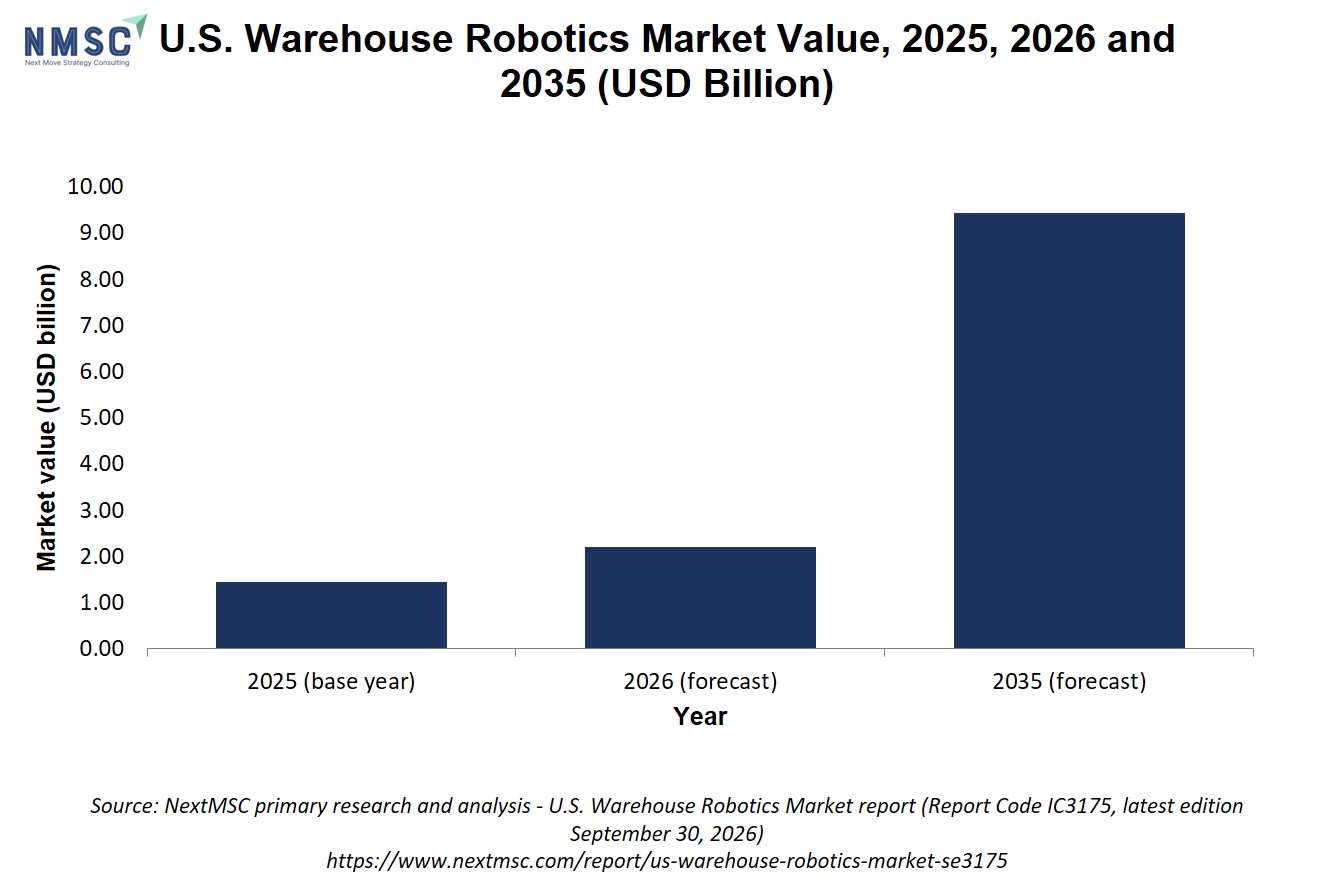
According to Next Move Strategy Consulting’s U.S. Warehouse Robotics Market report, the U.S. warehouse robotics market was valued at USD 1.45 billion in 2025 and is projected to reach USD 9.44 billion by 2035, growing at a CAGR of 17.59% from 2026 to 2035. NextMSC primary research and analysis places 2026 market size at USD 2.20 billion and unit volume rising from 94 thousand units in 2025 to 668 thousand units by 2035, a CAGR of 18.50% over the 2026 to 2035 period. The report analyzes the United States as one national market and does not publish a sub-national revenue split, so this article tests regional leadership against named, dated external disclosures rather than against any NMSC regional share.
For More Information: Download FREE Sample on U.S. Warehouse Robotics Market Report
On NMSC’s published figures, 2035 revenue is 6.5 times the 2025 base (NextMSC calculation from the report’s USD 1.45 billion and USD 9.44 billion values), a trajectory in which the location of each new facility matters more than the national total, because large automated buildings are procured once and operated for a decade or longer.
The Short Answer: The South Leads on Committed Capital, Not on Measured Revenue
On the disclosures reviewed for this article, the South holds the strongest claim to leadership in new robotics-led capacity, measured by the size and automation intensity of facilities announced or opened in 2026. The Midwest follows with a recently opened goods-to-person site, the West shows fewer new commitments in the sources reviewed, and the Northeast’s disclosed activity does not state its automation scope. That is a ranking of capital being committed, not of robots installed or revenue booked: no federal agency or NMSC publication currently breaks warehouse robot installations out by region, and a reader should treat any claim of precise regional shares in this market with caution.
The Backdrop: Labor Economics Meet Capital Budgets
The International Federation of Robotics reported in its World Robotics 2026 press release of September 24, 2026 that the United States installed 38,400 industrial robots in 2025, a 12% year-on-year increase that put the country ahead of Japan’s 36,200 installations and into second place worldwide behind China. The figure covers industrial robots across all sectors, led by automotive at 13,500 installations, so it frames national momentum rather than warehouse deployment specifically.
Warehouse labor data point in the same direction without proving causation. The U.S. Bureau of Labor Statistics’ Industries at a Glance page for Warehousing and Storage, extracted on October 20, 2026, shows seasonally adjusted employment slipping from 1,845.8 thousand in June 2026 to a preliminary 1,831.8 thousand in September 2026, a decline of 14,000 jobs or 0.8% (NextMSC calculation from BLS figures). BLS does not attribute that movement to automation. Supply Chain Dive reported in 2026 on a 2025 study by MHI, Peerless Research Group and The Robotics Group finding that 48% of participating organizations were using robots in their plants or warehouses in 2025, up from 23% three years earlier.
The spending side is explicit at the largest buyer. Walmart’s supply chain capital outlays are scheduled to crest within the same window as the Georgia build, and its chief executive told investors as much on the company’s fourth-quarter call.
“probably peak this year and next year”
- John Furner, President and Chief Executive Officer, Walmart, Walmart fourth-quarter earnings call, as reported by Supply Chain Dive in “Walmart: Supply chain spending set to ‘peak’ next 2 years, CEO says”, February 2026.
Key Industry Developments: Where the Capital Is Landing
The Georgia project is the largest single disclosure. Walmart’s Carnesville center, about 85 miles northeast of Atlanta, is a USD 1.3 billion commitment that Supply Chain Dive reported on after the August 27, 2026 state announcement, and it belongs to a network that Walmart has built around same-day and next-day shipping. In North Carolina, WilmingtonBiz reported on October 5, 2026 that Amazon’s Wilmington center is one of its next-generation sites; Amazon’s news release, as quoted by WilmingtonBiz, credits the design with up to 25% faster fulfillment processing than earlier facility designs and 30% more skilled technical roles in reliability, maintenance and engineering.
Texas adds a third Southern data point at smaller scale. Supply Chain Dive reported on July 13, 2026 that a Texas Department of Licensing and Regulation filing dated July 6 shows Amazon planning a 248,687-square-foot sorting warehouse in Georgetown, Texas, a USD 48 million project due for completion by July 2027, in which robotic systems bring items to employees for order preparation. Outside the South, Shein’s 737,000-square-foot automated distribution warehouse in Lebanon, Indiana, announced in a September 10, 2026 press release and reported by Supply Chain Dive on September 14, 2026, uses a goods-to-person fulfillment system and sits beside the retailer’s existing Whitestown operations, giving Central Indiana more than 2.5 million square feet of Shein space.
Disclosed 2026 Warehouse Automation Commitments by U.S. Region
|
Region |
Site |
Scale and automation detail |
Date |
|
South |
Walmart, Carnesville, Georgia |
USD 1.3 billion; 1.5 million sq ft highly automated fulfillment center; 1,000 jobs; construction from late 2026 |
Aug. 27, 2026 |
|
South |
Amazon, Wilmington, North Carolina |
Robotics fulfillment center opened in August; up to 25% faster processing per Amazon |
Oct. 5, 2026 |
|
South |
Amazon, Georgetown, Texas |
USD 48 million; 248,687 sq ft sorting warehouse with robotic systems; completion due July 2027 |
July 6, 2026 (filing) |
|
Midwest |
Shein, Lebanon, Indiana |
737,000 sq ft automated warehouse; goods-to-person system; operations from September 2026 |
Sept. 10, 2026 |
|
West |
Walmart, California |
Fifth next-generation fulfillment center, slated to open in California in 2026 |
Aug. 2026 report |
|
Northeast |
Amazon, Long Island, New York |
Operations site in preparation; automation scope not stated in the report |
July 28, 2026 |
The table is a record of what was disclosed, and the regional spread is uneven for a reason the sources do not resolve: companies announce greenfield builds with press releases, while retrofits inside existing buildings often pass without one. Walmart’s plan to retrofit 23 of its 42 regional distribution centers with automation, noted by Supply Chain Dive in its August 2026 coverage of the Georgia project, is exactly that kind of quieter activity, and its locations are not itemized here.
Competitive Dynamics: Integrators Consolidate as Sites Multiply
The vendor side is reorganizing around the same build cycle. Robotics 24/7 reported on October 12, 2026 that Toyota Automated Logistics now combines Bastian Solutions, Vanderlande’s warehousing business and viastore under one umbrella, and Symbotic announced in October 2026 that it is acquiring Germany’s cellumation to add modular sortation technology. Bastian Solutions and Symbotic are both profiled among the 15 key players in the NMSC report, which also records Symbotic’s January 2025 acquisition of Walmart’s Advanced Systems & Robotics business and the related agreement to expand warehouse automation across Walmart’s network.
Growth Drivers and Restraints
U.S. Warehouse Robotics Market — Growth Catalyst & Risk Assessment Matrix
|
Driver or restraint |
Type |
Impact on CAGR |
Impact timeline |
|
E-commerce and omnichannel expansion driving demand for automated fulfillment |
Driver |
+2.2% |
Short to medium term (1–5 years) |
|
Labor shortages and rising warehouse labor costs accelerating AMR, AGV and robotic picking adoption |
Driver |
+1.9% |
Short to medium term (1–5 years) |
|
AI-powered warehouse management and robotics software platforms |
Driver |
+1.6% |
Medium to long term (3–8 years) |
|
Next-generation fulfillment centers, collaborative robotics and autonomous operations |
Driver |
+1.2% |
Long term (4–10 years) |
|
High deployment costs and integration complexity limiting small and mid-sized enterprises |
Restraint |
–1.3% |
Short to medium term (1–5 years) |
NMSC Strategic Perspective: Build Cycles, Not Installed Base, Will Decide Regional Leadership
NextMSC primary research and analysis reads the 2026 disclosures as evidence that leadership in this market is being decided at the moment of site selection. A greenfield building in Georgia or North Carolina can be designed around robotics from the slab upward, whereas a retrofit inside an older distribution center must route autonomous equipment around existing racking, conveyors and legacy control systems. The NMSC report assigns a −1.3% impact on the CAGR forecast to deployment cost and integration complexity, and that restraint weighs most heavily on retrofits and on smaller operators, which helps explain why the largest disclosed commitments cluster in new buildings in the South.
The same lens explains what the South’s lead does not mean. It does not mean the region holds the most installed robots, a measure no public source supplies, and it does not mean the Midwest or West is falling behind in operational automation. NextMSC’s reading is that the South currently leads on the pipeline of capacity that will be commissioned over the next several years, while regions with older distribution networks are more likely to modernize through the phased retrofit programs that Walmart has described and that rarely carry a headline figure.
Three developments would change this view: a federal or industry body publishing installation counts by state, Walmart or Amazon disclosing retrofit locations, or a cluster of large automated builds being announced in the Midwest or West. For system integrators and robot vendors, the practical implication is to staff commissioning, maintenance and software support where the 2026 to 2027 openings are concentrated, since NMSC’s forecast of volume growing from 94 thousand to 668 thousand units depends on those sites performing as designed.
Bottom Line
The title question has a defensible answer with a clear limit: the South leads on committed capital in the U.S. warehouse robotics market. Walmart’s USD 1.3 billion automated fulfillment center in Carnesville, Georgia, Amazon’s robotics fulfillment center in Wilmington, North Carolina, and Amazon’s USD 48 million robotic sorting warehouse in Georgetown, Texas, together outweigh the Midwest’s Shein site in Lebanon, Indiana, and the thinner record in the West and Northeast. No public dataset measures installed warehouse robots by region, so this is a ranking of announced and opened capacity rather than of revenue. According to NextMSC primary research and analysis, the U.S. market will grow from USD 1.45 billion in 2025 to USD 9.44 billion by 2035 at a 17.59% CAGR, with deployment cost and integration complexity the main brake. Vendors should follow the 2026 to 2027 commissioning pipeline, while investors should watch whether retrofit programs in older hubs close the gap.
About Next Move Strategy Consulting
Next Move Strategy Consulting is a premier market research and management consulting firm that has been committed to provide strategically analysed well documented latest research reports to its clients. The research industry is flooded with many firms to choose from, what makes NMSC different from the rest is its top-quality research and the obsession of turning data into knowledge by dissecting every bit of it and providing fact-based research recommendation that is supported by information collected from over 500 million websites, paid databases, industry journals and one on one consultations with industry experts across a diverse range of industry sectors. The high-quality customized research reports with actionable insights and excellent end-to-end customer service help our clients to take critical business decisions that enables them to move beyond time and have competitive edge in the industry.
We have been servicing over 1000 customers globally that includes 90% of the Fortune 500 companies over a decade. Our analysts are constantly tracking various high growth markets and identifying hidden opportunities in each sector or the industry. We provide one of the industry’s best quality syndicate as well as custom research reports across 10 different industry verticals. We are committed to deliver high quality research solutions in accordance to your business needs. Our industry standard delivery solutions that ranges from the pre consultation to after-sales services, provide an excellent client experience and ensure right strategic decision making for businesses.
For more information, please contact:
Next Move Strategy Consulting
5th Floor 867 Boylston St, STE 500,
Boston, MA 02116, U.S.
E-Mail: [email protected]
Direct: +1-217-650-7991
Website: www.nextmsc.com
About the Author
 Sanyukta Deb
— Sanyukta Deb is Digital Marketing Team Lead at Next Move Strategy Consulting, where she has led content strategy and technical SEO for the firm's B2B market research publications for over 2 years. Her editorial process translates NextMSC's primary and secondary research — spanning technology, industrial, and consumer sectors — into commercial narratives, backed by search-intent, keyword, and competitive analysis. She brings 5 years of overall experience in digital marketing and content strategy.
About the Reviewer
 Debashree Dey
— Debashree Dey is Assistant Manager at Next Move Strategy Consulting, where she supports cross-vertical market content and communications across diverse industries for 6 years. Her professional background includes senior content writing, communications, and published manuscript authorship, with experience developing audience-focused business narratives and maintaining clear, consistent messaging. Her role supports research-led content development and editorial quality across NextMSC publications.














Add Comment