Commercial Elevator Market Global Industry Analysis and Forecast (2026–2035)

The global Commercial Elevator Market size was valued at USD 64.80 billion in 2025 and is estimated at USD 70.60 billion in 2026, forecast to reach USD 141.13 billion by 2035, expanding at an 8.0% CAGR between 2026 and 2035. Asia-Pacific leads with approximately 42% share, while Traction Elevator dominates all other technologies with approximately 58% share.

Download Free Sample PDF
Base Year (2025)
$64.80 Billion
Forecast (2035)
$141.13 Billion
CAGR (2026-2035)
8.0%
Top Region
Asia-Pacific

What Is the Commercial Elevator Market Size?
The global commercial elevator market size was valued at USD 64.80 billion in 2025 and is estimated at USD 70.60 billion in 2026, forecast to reach USD 141.13 billion by 2035, expanding at an 8.0% CAGR between 2026 and 2035. Asia-Pacific leads with approximately 42% share, while Traction Elevator dominates all other technologies with approximately 58% share.

We observed that growth is broad-based across every segmentation axis, with machine room-less elevators and modernization services driving the dominant structural shifts through 2035.

Commercial Elevator Market Global Industry Analysis and Forecast (2026–2035) Revenue Forecast
Values in USD Billion

2025 $64.80 Billion
2025
2026 $70.60 Billion
2026
2027 $76.25 Billion
2027
2028 $82.35 Billion
2028
2029 $88.94 Billion
2029
2030 $96.05 Billion
2030
2031 $103.73 Billion
2031
2032 $112.03 Billion
2032
2033 $121.00 Billion
2033
2034 $130.68 Billion
2034
2035 $141.13 Billion
2035

Key Takeaways

By Technology: Traction Elevator held the largest share of approximately 58% (USD 37.58 billion) in 2025; Machine Room-Less Elevator is the fastest-growing sub-segment at 11.7% CAGR from 2026–2035.

By Speed: Medium Speed held the largest share of approximately 48% (USD 31.10 billion) in 2025; High Speed is the fastest-growing sub-segment at 11.8% CAGR from 2026–2035.

By Capacity: 1001–2000 kg held the largest share of approximately 52% (USD 33.70 billion) in 2025; Above 2000 kg is the fastest-growing sub-segment at 10.5% CAGR from 2026–2035.

By Door Type: Center Opening Door held the largest share of approximately 54% (USD 35.00 billion) in 2025; Telescopic Door is the fastest-growing sub-segment at 10.8% CAGR from 2026–2035.

By Service Type: New Installation held the largest share of approximately 46% (USD 29.81 billion) in 2025; Modernization is the fastest-growing sub-segment at 12.6% CAGR from 2026–2035.

By Application: Office Buildings held the largest share of approximately 28% (USD 18.14 billion) in 2025; Mixed-Use Commercial Complexes is the fastest-growing sub-segment at 12.3% CAGR from 2026–2035.

Dominant Region: Asia-Pacific dominated with approximately 42% revenue share (USD 27.22 billion) in 2025.

Fastest-Growing Region: Middle East & Africa is expected to register the highest CAGR of 10.2% during 2026–2035.

Dominant Country: China led with approximately USD 13.07 billion in 2025.

Fastest-Growing Country: UAE is the fastest-growing country at approximately 11.2% CAGR from 2026–2035.

Market Opportunity: The commercial elevator market is expected to create an absolute dollar opportunity of USD 70.53 billion between 2026 and 2035, presenting significant investment potential across machine room-less elevator production and modernization service infrastructure.

According to NMSC analysis, leading manufacturers are increasingly pursuing large-scale consolidation to accelerate the shift toward recurring service and modernization revenue, a shift that favors diversified suppliers with global installed-base density over regional manufacturers as aging elevator infrastructure across mature markets drives sustained refurbishment demand through 2035.

What Does the Commercial Elevator Market Encompass?
The commercial elevator market encompasses vertical transportation systems designed, manufactured, installed, and serviced for office buildings, retail centers, hotels, healthcare facilities, and mixed-use commercial developments. Our assessment indicates that the scope spans traction, hydraulic, and machine room-less technologies delivered through new installation, maintenance and repair, and modernization service models. The category has evolved from purely mechanical transport systems into digitally connected, IoT-enabled infrastructure, driven by urbanization, high-rise construction, and rising demand for predictive maintenance capability across aging installed bases.
Regulatory frameworks governing elevator safety codes and accessibility standards shape product certification and installation requirements across covered geographies. We observed that technology adoption is shifting from standalone mechanical systems toward connected platforms offering destination dispatch, remote monitoring, and predictive maintenance capability. NMSC's analysis indicates that this structural shift, combined with unprecedented industry consolidation, is redefining competitive dynamics and service delivery models across the commercial elevator market.

Market Drivers & Dynamics

Interactive Dataset
Rising high-rise commercial construction in Asia-Pacific driver +2.4% Asia-Pacific, Global 2026–2035
Expanding modernization demand across aging installed base driver +2.1% North America, Europe 2026–2035
Growing adoption of IoT-enabled predictive maintenance platforms driver +1.6% Global 2026–2032
Rising smart city and mixed-use development investment driver +1.5% Middle East & Africa, Asia-Pacific 2026–2035
Expanding hospitality and healthcare infrastructure development driver +1.2% Global 2026–2032
Increasing accessibility regulation compliance requirements driver +1.0% North America, Europe 2026–2035
High capital cost of new elevator installation and modernization restraint −1.1% Latin America, MEA 2026–2032
Industry consolidation creating regulatory and integration uncertainty restraint −0.8% Europe, Global 2026–2028
Volatility in steel and raw material input costs restraint −0.6% Global 2026–2030
Source: Next Move Strategy Consulting

Growth Drivers

What Is the Primary Growth Driver of the Commercial Elevator Market?

Rising high-rise commercial construction in Asia-Pacific is the primary driver of the market. China's National Bureau of Statistics continues to report sustained commercial real estate development activity across major metropolitan centers, sustaining demand for new elevator installations. We observed that this behavioral shift, reinforced by expanding smart city initiatives, continues to anchor baseline consumption of traction and machine room-less elevator systems across developed and emerging Asia-Pacific markets alike.

How Is Modernization Demand Driving Commercial Elevator Market Growth?
Expanding modernization demand across aging installed infrastructure is accelerating market growth toward retrofit and upgrade service revenue. Otis Worldwide Corporation reported modernization and refurbishment orders rising 26% with backlog up 30% at constant currency, reflecting building owners' preference for extending existing elevator assets rather than full replacement. Our assessment indicates that this expansion, combined with tightening accessibility and safety regulations, is compressing modernization adoption timelines across North America and Europe.

Growth Inhibitors

What Is Restraining Commercial Elevator Market Expansion?
High capital cost of new elevator installation and modernization restrains adoption among cost-sensitive commercial property owners in emerging markets. The U.S. Bureau of Labor Statistics continues to document elevated construction materials and skilled labor costs that contribute to elevator installation expenses. We found that smaller regional developers face particular exposure, as limited capital access constrains their ability to prioritize elevator modernization over other building capital expenditure priorities.

Segmentation Analysis

2025 (USD Billion)
2035 (USD Billion)
Traction Elevator 2025: $37.58 Billion | 2035: $70.56 Billion
Traction Ele
Machine Room-Less Elevator 2025: $18.14 Billion | 2035: $53.63 Billion
Machine Room
Hydraulic Elevator 2025: $9.08 Billion | 2035: $16.94 Billion
Hydraulic El
Traction Elevator $37.58 Billion $70.56 Billion 6.2%
Machine Room-Less Elevator $18.14 Billion $53.63 Billion 11.7%
Hydraulic Elevator $9.08 Billion $16.94 Billion 6.2%

Which Technology Segment Dominates the Commercial Elevator Market?

Traction Elevator led the market with USD 37.58 billion in 2025, supported by its established role in mid-rise and high-rise commercial buildings requiring efficient, energy-conscious vertical transportation, distinct from the freight elevator category serving industrial cargo movement. We observed that Machine Room-Less Elevator is the fastest-growing technology, expanding at an 11.7% CAGR from 2026 to 2035, as developers prioritize space-efficient designs that eliminate dedicated machine rooms.

2025 (USD Billion)
2035 (USD Billion)
Low Speed
Medium Speed
High Speed
Segment Item 2025 (USD Billion) 2035 (USD Billion) CAGR
Low Speed $10.0 USD Billion $40.0 USD Billion 14.0%
Medium Speed $17.1 USD Billion $51.1 USD Billion 24.0%
High Speed $24.2 USD Billion $62.2 USD Billion 22.0%

Segment-wise data is locked

Unlock complete segment-wise numbers for By Speed.

Unlock Full Data
2025 (USD Billion)
2035 (USD Billion)
Up to 1000 k
1001–2000 kg
Above 2000 k
Segment Item 2025 (USD Billion) 2035 (USD Billion) CAGR
Up to 1000 kg $10.0 USD Billion $40.0 USD Billion 24.0%
1001–2000 kg $17.1 USD Billion $51.1 USD Billion 22.0%
Above 2000 kg $24.2 USD Billion $62.2 USD Billion 20.0%

Segment-wise data is locked

Unlock complete segment-wise numbers for By Capacity.

Unlock Full Data
2025 (USD Billion)
2035 (USD Billion)
Center Openi
Side Opening
Telescopic D
Segment Item 2025 (USD Billion) 2035 (USD Billion) CAGR
Center Opening Door $10.0 USD Billion $40.0 USD Billion 23.0%
Side Opening Door $17.1 USD Billion $51.1 USD Billion 9.0%
Telescopic Door $24.2 USD Billion $62.2 USD Billion 19.0%

Segment-wise data is locked

Unlock complete segment-wise numbers for By Door Type.

Unlock Full Data
2025 (USD Billion)
2035 (USD Billion)
New Installa
Maintenance
Modernizatio
Segment Item 2025 (USD Billion) 2035 (USD Billion) CAGR
New Installation $10.0 USD Billion $40.0 USD Billion 25.0%
Maintenance and Repair $17.1 USD Billion $51.1 USD Billion 11.0%
Modernization $24.2 USD Billion $62.2 USD Billion 25.0%

Segment-wise data is locked

Unlock complete segment-wise numbers for By Service Type.

Unlock Full Data

Which Service Type Leads Commercial Elevator Market Revenue?
New Installation remained the leading service type, valued at USD 29.81 billion in 2025, on the strength of sustained high-rise commercial construction activity across Asia-Pacific and the Middle East. Based on research conducted by NMSC, we found that Modernization is the fastest-growing service type at a 12.6% CAGR from 2026 to 2035, reflecting building owners' increasing preference for upgrading aging installed infrastructure over full system replacement.

2025 (USD Billion)
2035 (USD Billion)
Office Build
Hotels and H
Retail and S
Healthcare F
Airports and
Segment Item 2025 (USD Billion) 2035 (USD Billion) CAGR
Office Buildings $10.0 USD Billion $40.0 USD Billion 27.0%
Hotels and Hospitality $17.1 USD Billion $51.1 USD Billion 9.0%
Retail and Shopping Malls $24.2 USD Billion $62.2 USD Billion 19.0%
Healthcare Facilities $31.3 USD Billion $73.3 USD Billion 17.0%
Airports and Transportation Hubs $38.4 USD Billion $84.4 USD Billion 18.0%

Segment-wise data is locked

Unlock complete segment-wise numbers for By Application.

Unlock Full Data

Which Application Leads Commercial Elevator Market Demand?

Office Buildings remained the leading application, valued at USD 18.14 billion in 2025, on the strength of sustained demand for passenger elevator systems in premium and Class A commercial office developments. Our findings suggest that Mixed-Use Commercial Complexes is the fastest-growing application, registering a 12.3% CAGR from 2026 to 2035, as developers increasingly combine retail, hospitality, and office functions within integrated vertical developments.

2025 (USD Billion)
2035 (USD Billion)
North Americ
Canada
Mexico.
Europe: UK
Germany
Segment Item 2025 (USD Billion) 2035 (USD Billion) CAGR
North America: U.S. $10.0 USD Billion $40.0 USD Billion 21.0%
Canada $17.1 USD Billion $51.1 USD Billion 23.0%
Mexico. $24.2 USD Billion $62.2 USD Billion 25.0%
Europe: UK $31.3 USD Billion $73.3 USD Billion 15.0%
Germany $38.4 USD Billion $84.4 USD Billion 16.0%

Segment-wise data is locked

Unlock complete segment-wise numbers for By Region.

Unlock Full Data

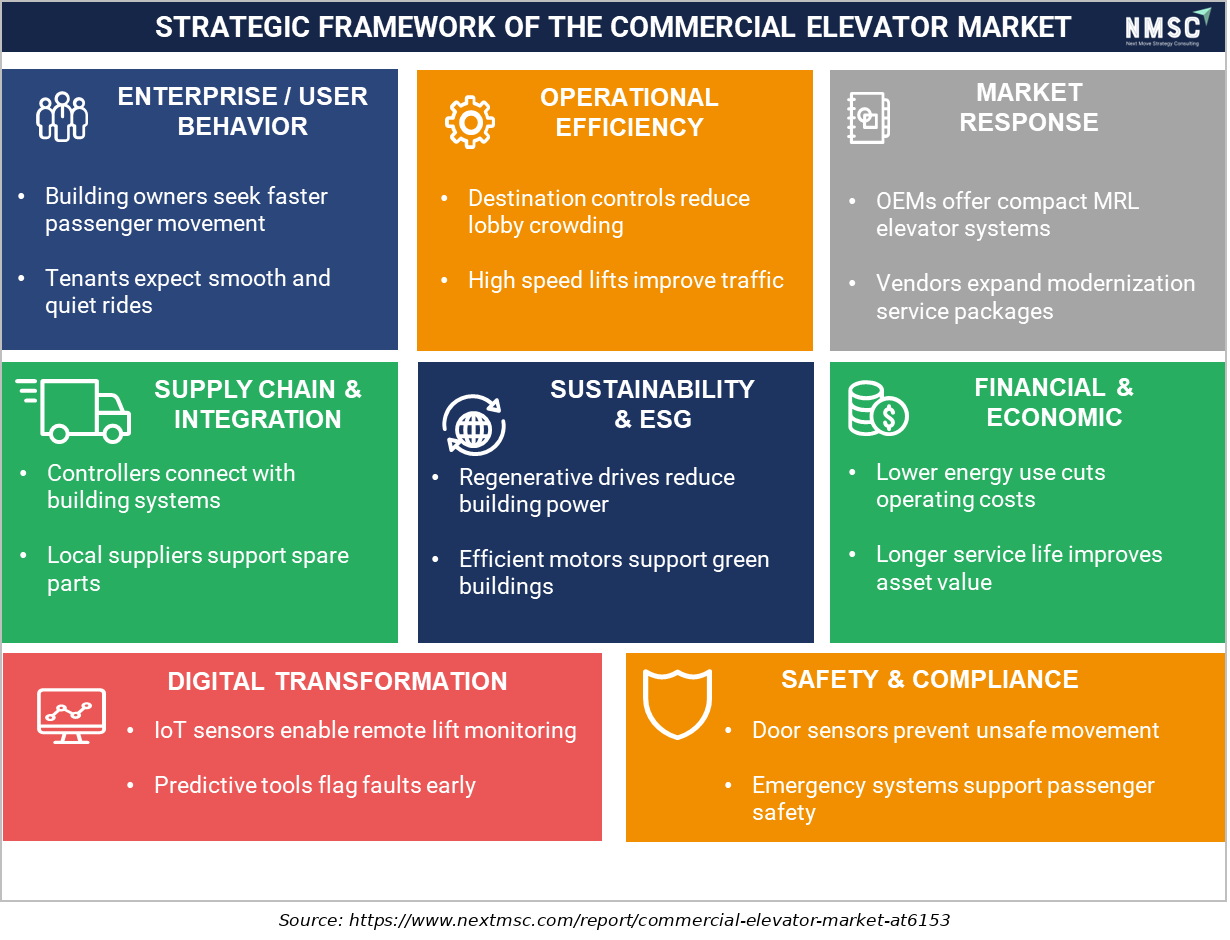
Strategic Framework of the Commercial Elevator Market

Strategic Framework of the Commercial Elevator Market

The commercial elevator market is shaped by demand for faster passenger movement, operational efficiency, sustainability, digital monitoring, and enhanced safety. Building owners prioritize high-speed and reliable systems, while manufacturers increasingly offer machine-room-less solutions, connected controls, predictive maintenance, and modernization services. Energy-efficient drives, remote monitoring, and advanced safety technologies further support cost optimization and long-term asset performance.

Growth Opportunities

Our analysis shows that three forward-looking opportunities stand out for stakeholders positioning within the commercial elevator market over the 2026–2035 forecast period.

How Can IoT-Enabled Service Contracts Unlock Recurring Revenue?

IoT-connected predictive maintenance platforms present a whitespace opportunity for manufacturers seeking to convert installed base into recurring, high-margin service revenue. Vendors that scale cloud-connected monitoring across their fleet stand to capture long-term service contracts as building owners prioritize downtime reduction, particularly among office building and healthcare facility end users seeking predictable operational costs.

Where Does Mixed-Use Development Create Elevator Whitespace?

Mixed-use commercial complexes represent an underpenetrated opportunity for manufacturers offering flexible, multi-zone elevator systems serving combined retail, office, and hospitality functions. Vendors that develop destination dispatch solutions optimized for high-traffic, mixed-tenant buildings can secure long-term contracts, benefiting from expanding integrated urban development investment across Asia-Pacific and the Middle East.

How Can Modernization Partnerships Unlock Aging Infrastructure Revenue?

Aging commercial building stock in mature markets creates a substantial opportunity for manufacturers offering retrofit-compatible modernization packages. Early movers that secure long-term modernization framework agreements with building owners and facility managers can differentiate with office building and hotel customers pursuing safety and efficiency upgrades without full system replacement.

Regional Outlook

2025 (USD Billion)
2035 (USD Billion)
Asia-Pacific
North Americ
Europe
Middle East
Latin Americ
Region 2025 (USD Billion) 2035 (USD Billion) CAGR (%)
Asia-Pacific $10.0 USD Billion $40.0 USD Billion 9.0%
North America $17.1 USD Billion $51.1 USD Billion 27.0%
Europe $24.2 USD Billion $62.2 USD Billion 25.0%
Middle East & Africa $31.3 USD Billion $73.3 USD Billion 23.0%
Latin America $38.4 USD Billion $84.4 USD Billion 12.0%

Regional data is locked

Unlock complete regional numbers for this market.

Unlock Full Data

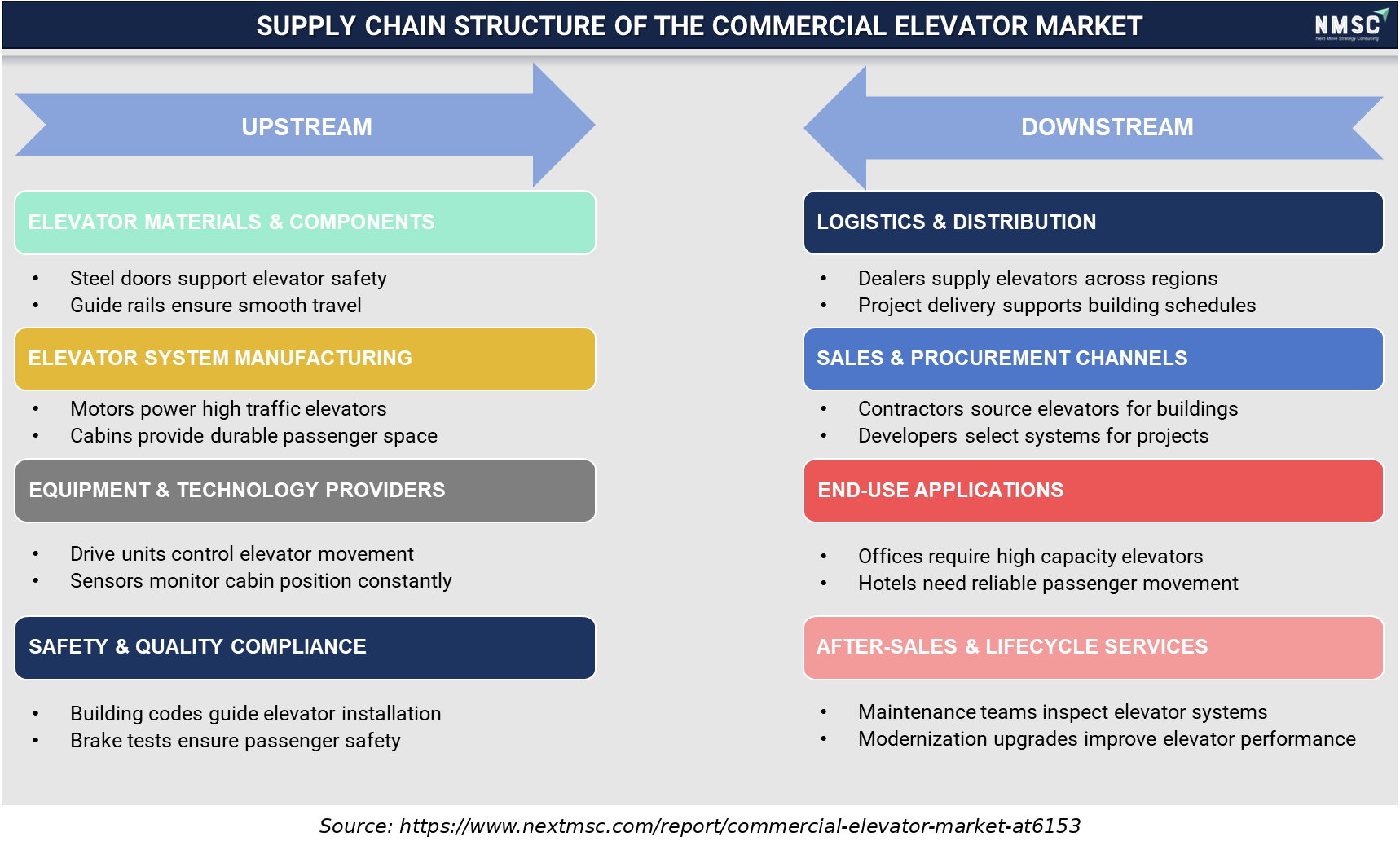
Supply Chain Structure of the Commercial Elevator Market

Supply Chain Structure of the Commercial Elevator Market

The commercial elevator supply chain covers component suppliers, elevator system manufacturers, technology providers, distributors, contractors, and service organizations. Upstream participants supply doors, guide rails, motors, cabins, drives, and sensors, while downstream channels handle distribution, installation, project procurement, and end-use deployment. Maintenance and modernization providers support lifecycle performance, safety compliance, and continued elevator efficiency.

Competitive Landscape

We observed that the commercial elevator market features a highly consolidated competitive landscape, with global manufacturers competing alongside regional specialists on installed-base density, service network reach, and connected technology capability across the industry.

Dimension Description
Market Structure Highly consolidated; the top companies profiled in this report collectively account for a majority of global commercial elevator revenue, with the pending KONE-TK Elevator combination set to further concentrate the industry's upper tier.
Innovation Focus IoT-enabled predictive maintenance, machine room-less design, and AI-powered destination dispatch dominate current innovation pipelines across leading manufacturers.
M&A Activity Industry-defining consolidation, exemplified by KONE Corporation's April 2026 agreement to acquire TK Elevator in a EUR 29.4 billion transaction creating the world's largest elevator and escalator company.

How Do Companies Compete in the Commercial Elevator Market?

Companies compete primarily on installed-base service density, connected technology capability, and modernization expertise across the industry. Global manufacturers such as Otis Worldwide Corporation and KONE Corporation leverage extensive service networks to serve premium commercial customers, while regional specialists such as Canny Elevator Co., Ltd. and Johnson Lifts Private Limited compete on price competitiveness and localized manufacturing presence in their home markets.

Which Competitive Archetypes Dominate the Commercial Elevator Market?

Two archetypes dominate the market: global manufacturers offering integrated new installation, maintenance, and modernization services at scale, and regional specialists focused on cost-competitive manufacturing for domestic and neighboring markets. Schindler Holding Ltd. and Mitsubishi Electric Corporation exemplify the global archetype through multi-country service networks, while SJEC Corporation and Yungtay Engineering Co., Ltd. exemplify the regional archetype serving Asia-Pacific price-sensitive demand.

How Are Companies Differentiating Through Innovation in Commercial Elevators?

Innovation and differentiation strategy increasingly center on connected service platforms and AI-powered building integration. Otis Worldwide Corporation's Otis ONE IoT platform and KONE Corporation's extended Amazon Web Services collaboration both extend digital capability into predictive maintenance and smart building integration. Our analysis shows that manufacturers unable to demonstrate credible connected service infrastructure risk exclusion from premium commercial property procurement.

What M&A and Expansion Activity Is Shaping the Commercial Elevator Market?

Unprecedented consolidation and regional capacity expansion continue to reshape the industry. KONE Corporation's agreement to acquire TK Elevator represents the largest transaction in the sector's history, while TK Elevator's joint venture with Alat to build manufacturing capacity in Saudi Arabia and a separate EQT tender offer for Fujitec Co., Ltd. both signal accelerating capital reallocation toward underserved growth markets and digital service capability.

Key Market Players

Our assessment indicates that the following 20 companies are actively shaping product innovation, service expansion, and consolidation strategy within the global commercial elevator market.

KONE Corporation Schindler Holding Ltd. TK Elevator GmbH Mitsubishi Electric Corporation Hitachi, Ltd. Fujitec Co., Ltd. Hyundai Elevator Co., Ltd. Toshiba Corporation Canny Elevator Co., Ltd. SJEC Corporation Yungtay Engineering Co., Ltd. Orona, S. Coop. Wittur Group Johnson Lifts Private Limited GiantKONE Elevator Co., Ltd. Kleemann Hellas SA IFE Elevators Co., Ltd. Shenyang Yuanda Intelligent Industry Group Co., Ltd. Escon Elevators Pvt. Ltd.

Latest Developments

We found that recent developments within the commercial elevator market are concentrated on industry-defining consolidation and expanding digital service capability, reflecting the sector's most significant structural transition in decades.

Date Event
July 2026 KONE won an order to supply 23 KONE MonoSpace® 700 DX lifts for 75 London Wall, a major office redevelopment project in the City of London, UK. The redevelopment involves comprehensive refurbishment and expansion of the existing building, including four additional storeys. The project will use KONE Office Flow, E-Link monitoring and KONE 24/7 Connect services to support efficient people flow for approximately 4,000 daily users.

Investment Opportunities

What Capital Inflows Are Targeting the Commercial Elevator Market?

Capital inflows into the commercial elevator market are increasingly directed toward industry consolidation and regional manufacturing capacity expansion. KONE Corporation's agreement to acquire TK Elevator for an enterprise value of EUR 29.4 billion represents the largest capital commitment in the sector's history, alongside a separate EQT tender offer valued at approximately USD 2.7 billion for Fujitec Co., Ltd. We observed that investors favor manufacturers demonstrating credible service revenue growth and installed-base density.

How Is Infrastructure Investment Supporting Commercial Elevator Delivery?

Infrastructure investment is expanding regional manufacturing and service capacity to support commercial elevator delivery at scale. Our findings suggest that TK Elevator's USD 185.3 million joint venture with Alat is building dedicated manufacturing capacity in Saudi Arabia to serve accelerating Saudi Arabia real estate development. Manufacturers are prioritizing regional production facilities and service technician networks as the binding constraint on installation and modernization capacity.

What ESG Considerations Are Shaping Commercial Elevator Investment Decisions?

Environmental, social, and governance considerations are central to investment decisions across the industry, with energy efficiency and climate disclosure as key environmental criteria. KONE Corporation's inclusion on CDP's annual 'A List' for the 13th consecutive year reflects systematic integration of climate performance into corporate strategy. We found that investors increasingly scrutinize manufacturers' energy-efficient product portfolios and modernization impact on building sustainability ratings as governance indicators.

Key Benefits for Stakeholders

How Does This Report Benefit Enterprise and Industry Leaders?

Enterprise and industry leaders gain access to validated segmentation, competitive benchmarking, and regional demand forecasts that support product design and service network planning decisions across the commercial elevator industry. Our analysis shows that detailed technology, service type, and application breakdowns help procurement teams align specifications with modernization and safety requirements while identifying underserved categories for portfolio expansion.

How Does This Report Benefit Investors and Financial Analysts?

Investors and financial analysts benefit from consistent, single-point market size and CAGR estimates that support valuation and capital-allocation decisions across the commercial elevator market supply chain amid unprecedented industry consolidation. We observed that the report's regional and segment-level growth differentials help identify which manufacturers are best positioned to capture above-market growth in modernization and machine room-less categories through 2035.

How Does This Report Benefit Technology Vendors and Product Teams?

Technology vendors and product teams gain insight into emerging design requirements, including IoT-enabled predictive maintenance, machine room-less architecture, and AI-powered destination dispatch, that are reshaping the industry. Our findings suggest that this analysis helps research and development teams prioritize roadmaps around connected service infrastructure increasingly required by commercial property owner and facility manager procurement processes.

Key Market Segments Evaluated

By Technology

  • Traction Elevator 
    • Geared Traction Elevator
    • Gearless Traction Elevator
  • Machine Room-Less Elevator
  • Hydraulic Elevator

By Speed

  • Low Speed
  • Medium Speed
  • High Speed

By Capacity

  • Up to 1000 kg
  • 1001–2000 kg
  • Above 2000 kg

By Door Type

  • Center Opening Door
  • Side Opening Door
  • Telescopic Door

By Service Type

  • New Installation
  • Maintenance and Repair
  • Modernization

By Application

  • Office Buildings
  • Hotels and Hospitality
  • Retail and Shopping Malls
  • Healthcare Facilities
  • Airports and Transportation Hubs
  • Educational Institutions
  • Mixed-Use Commercial Complexes

By Region

  • North America 
    • U.S.
    • Canada
    • Mexico.
  • Europe 
    • UK
    • Germany
    • France
    • Italy
    • Spain
    • Sweden
    • Denmark
    • Finland
    • Netherlands
    • Rest of Europe.
  • Asia-Pacific 
    • China
    • India
    • Japan
    • South Korea
    • Taiwan
    • Indonesia
    • Vietnam
    • Australia
    • Philippines
    • Malaysia
    • Rest of APAC.
  • Middle East & Africa 
    • Saudi Arabia
    • UAE
    • Egypt
    • Israel
    • Turkey
    • Nigeria
    • South Africa
    • Rest of MEA.
  • Latin America 
    • Brazil
    • Argentina
    • Chile
    • Colombia
    • Rest of LATAM.

Conclusion & Recommendations

The long-term outlook for the commercial elevator market remains robust, supported by sustained Asia-Pacific high-rise construction, accelerating modernization demand, and unprecedented industry consolidation reshaping service capability. NMSC's analysis indicates that the market's expansion from USD 64.80 billion in 2025 to USD 141.13 billion by 2035 reflects structural, durable demand rather than short-term cyclical growth, positioning the industry for sustained expansion through the forecast period.

What Strategic Positioning Should Manufacturers Pursue?

Manufacturers should prioritize connected service infrastructure and modernization capability to differentiate amid intensifying post-consolidation competition. Our assessment indicates that suppliers combining scaled installed-base density with proven IoT and predictive maintenance platforms will be best positioned to capture premium commercial contracts within the commercial elevator market's increasingly concentrated competitive landscape.

How Attractive Is the Commercial Elevator Market for New Investment?

The commercial elevator industry presents an attractive investment case, supported by a USD 70.53 billion absolute dollar opportunity between 2026 and 2035 and above-average growth in Middle East & Africa and modernization categories. We found that investment attractiveness is highest for manufacturers combining global service networks with scaled connected technology platforms, positioning them to capture both new installation and recurring service revenue simultaneously.

What Market Shifts and Key Risks Should Stakeholders Monitor?

Stakeholders should monitor regulatory scrutiny of the pending KONE-TK Elevator combination, high capital costs for new installation and modernization, and raw material price volatility as key risks to the commercial elevator market. Our analysis shows that manufacturers unable to match post-consolidation scale economics risk losing competitive positioning to the combined entity, particularly within Europe's increasingly concentrated service market.

What Are the Key Growth Pathways for the Commercial Elevator Market?

Key growth pathways include expanding IoT-enabled service contracts, scaling machine room-less product portfolios, and deepening penetration into mixed-use commercial development. NMSC's analysis indicates that manufacturers pursuing these pathways while maintaining service network density will be best positioned to capture the commercial elevator market's projected growth through 2035.

FAQs

About the Author

Mihul Sharma

Mihul Sharma

Mihul Sharma is Research Associate at Next Move Strategy Consulting, where he has covered technology, industrial, and healthcare markets for 3 years. His work applies structured business research, market analysis, and secondary-source review to assess market trends, competitive developments, and growth opportunities. He supports report development by fully synthesizing industry data, company information, and market signals into concise findings for strategy and investment-focused research teams.

About the Reviewer

Supradip Baul

Supradip Baul

Supradip Baul is an accomplished business consultant and strategist with over a decade of rich experience in market intelligence, strategy, technology, and business transformation. His work has included rigorous qualitative and quantitative analysis across multiple industries, helping clients shape investment decisions and long-term roadmaps. Earlier in his career, he was associated with Gartner, where he contributed to industry-leading reports and market share analyses. He has worked with leading global companies and holds an MBA with a dual specialization in Marketing and Finance.

Download Free Sample

Gustaf Hummel Burstrom

GUSTAF HUMMEL BURSTROM

Founder

Revline Tools AB

Joseph and the team at Next Move Strategy Consulting have been excellent to work with, in supplying us with relevant market data and forecasts for our specific category. We had some special requirements and they were able to do a custom package to suit our needs. We would definitely recommend them to any other company needing market data and forecasts

Henri Knyphausen

HENRI KNYPHAUSEN

Partner at Singulier [Ex-BCG]

Singulier

I recently engaged NEXTMSC.com for a commercial due diligence project within the intralogistics sector, and I am pleased to provide a reference based on my experience. In utilizing NEXTMSC.com's services, I found their report to offer valuable insights into market dynamics and key industry players. The initial report provided a solid foundation for our analysis. However, as we were investigating a smaller target in the market, and I had specific customization requests requiring additional research. These requests included detailed information on product portfolios of various players and sub-market sizes, both inclusive and exclusive of certain product categories. NEXTMSC.com demonstrated commendable responsiveness and agility in accommodating these customization requests. Within a timeframe of 1-2 weeks, they delivered a revised report that met our specific needs. Furthermore, they were receptive to my follow-up inquiries, ensuring clarity and understanding of the data provided. The final deliverable significantly contributed to our due diligence efforts. One of NEXTMSC.com's notable strengths lies in their qualitative research capabilities. However, for future engagements, I would recommend the inclusion of a quantified market model in Excel format. Such a model would offer the ability to conduct in-depth analyses and explore various market segments, including country-specific data and subcomponent breakdowns. Based on my positive experience, I would not hesitate to work with NEXTMSC.com again. Their responsiveness, willingness to accommodate customization requests, and commitment to delivering actionable insights make them a reliable partner for commercial research projects.

Pratyush Kumar Das

PRATYUSH KUMAR DAS

Assistant Manager

Polycab India Limited

We would like to express our appreciation for the data and insights provided by nextmsc. We are very pleased with the quality and depth of the information, which has proven to be highly valuable and beneficial for our business decision-making.

Robert Sean Trevino

ROBERT SEAN TREVINO

Sr. Director, Head of Strategic Insights & Analytics

Foundation Medicine

I realized that it was a reliable source of information. These days, there are many people who are looking for authentic data, and this is one of the only sources that can offer them with what they need;

Mohit Agarwal

MOHIT AGARWAL

Chief Manager

DryChem India Pvt. Ltd.

Next Move Strategy Consulting is an amazing team of consultants. We required a market study report for our investors on top priority and the team went above and beyond our expectations to deliver the same with ample supporting data within a short time span enabling us to secure the investments and keep our project timeline maintained. Their professionalism, attention to detail, and timely delivery of actionable recommendations have left a lasting impression on our organization.

Custom Market Research Services

We will customize the research for you if the listed report does not fully match your requirements.

Get 30% Free Customization

Select License

This website uses cookies to ensure you get the best experience on our website. Learn more

✖