Landscaping and Gardening Service Market Enters New Growth Phase

Federal Land Policy Overhaul and Rising Residential Outsourcing Demand Reshape the Global Landscaping and Gardening Service Market Outlook Through 2035
In a regulatory development with direct implications for land management and outdoor service industries across the United States, the Bureau of Land Management (BLM) published a final rule on May 12, 2026, fully rescinding the Conservation and Landscape Health Rule originally promulgated in May 2024. Effective June 11, 2026, the rule — published in the Federal Register as Document 2026-09386 — eliminates provisions that had established conservation as a discrete land use category, removes restoration and mitigation leasing mechanisms, and restores the regulatory framework governing Areas of Critical Environmental Concern to its pre-2024 form. The BLM manages approximately 245 million acres of public lands, representing roughly one-tenth of the total land area of the United States.
The policy reversal recalibrates the regulatory environment for grounds maintenance, vegetation management, and landscape services operating on or adjacent to federal public lands — a development that carries operational and commercial implications for the broader global Landscaping and Gardening Service Market, which according to Next Move Strategy Consulting was valued at USD 146.80 billion in 2025 and is projected to reach USD 283.50 billion by 2035, expanding at a compound annual growth rate of 6.85% over the forecast period.
For More Information: Download FREE Sample on Landscaping and Gardening Service Market Report
Federal Land Policy Shift: Implications for the Grounds Maintenance Sector
The BLM's rescission of the Conservation and Landscape Health Rule represents a significant deregulatory action under Executive Orders 14154 (Unleashing American Energy) and 14192 (Unleashing Prosperity Through Deregulation). By eliminating the 2024 Rule's restoration and mitigation leasing provisions — which had allowed third parties to obtain leases for conservation activities on public lands — the final rule removes a mechanism that critics argued could have restricted productive land uses including grazing, mineral development, and recreation.
For professional landscaping and grounds maintenance contractors operating under federal land use authorizations, the rescission reduces procedural complexity in planning and permitting processes. The BLM received 138,161 public comment submissions during the rulemaking process, reflecting the breadth of stakeholder interest across ranching, recreation, environmental consulting, and restoration service sectors — all of which intersect with the professional landscaping industry's commercial base.
The regulatory shift arrives at a moment of structural expansion in the landscaping and gardening service sector. According to the National Association of Landscape Professionals (NALP), citing IBISWorld data, the US landscaping services industry reached a market size of USD 188.8 billion in 2025, employing more than 1.4 million people across 692,777 landscaping service businesses — a 4.8% increase in business count from 2024. Between 2020 and 2025, the US market grew at an average annual rate of 6.5%.
Workforce Dynamics: BLS Employment Projections Signal Sustained Demand
The US Bureau of Labor Statistics (BLS) Occupational Outlook Handbook projects that overall employment of grounds maintenance workers will grow 4% from 2024 to 2034 — a rate described as "about as fast as the average for all occupations." Total employment in the sector stood at 1,296,400 in 2024, with approximately 171,600 job openings projected annually over the decade, driven by both new demand and the need to replace workers who exit the labor force.
The BLS identifies expanding residential outsourcing and growing institutional investment in urban green spaces as the primary demand drivers underpinning this employment trajectory. As communities invest in creating more green spaces in urban areas, the demand for grounds maintenance workers to plant and maintain these landscapes is projected to increase — a dynamic that directly reinforces the commercial growth thesis for professional landscaping service providers.
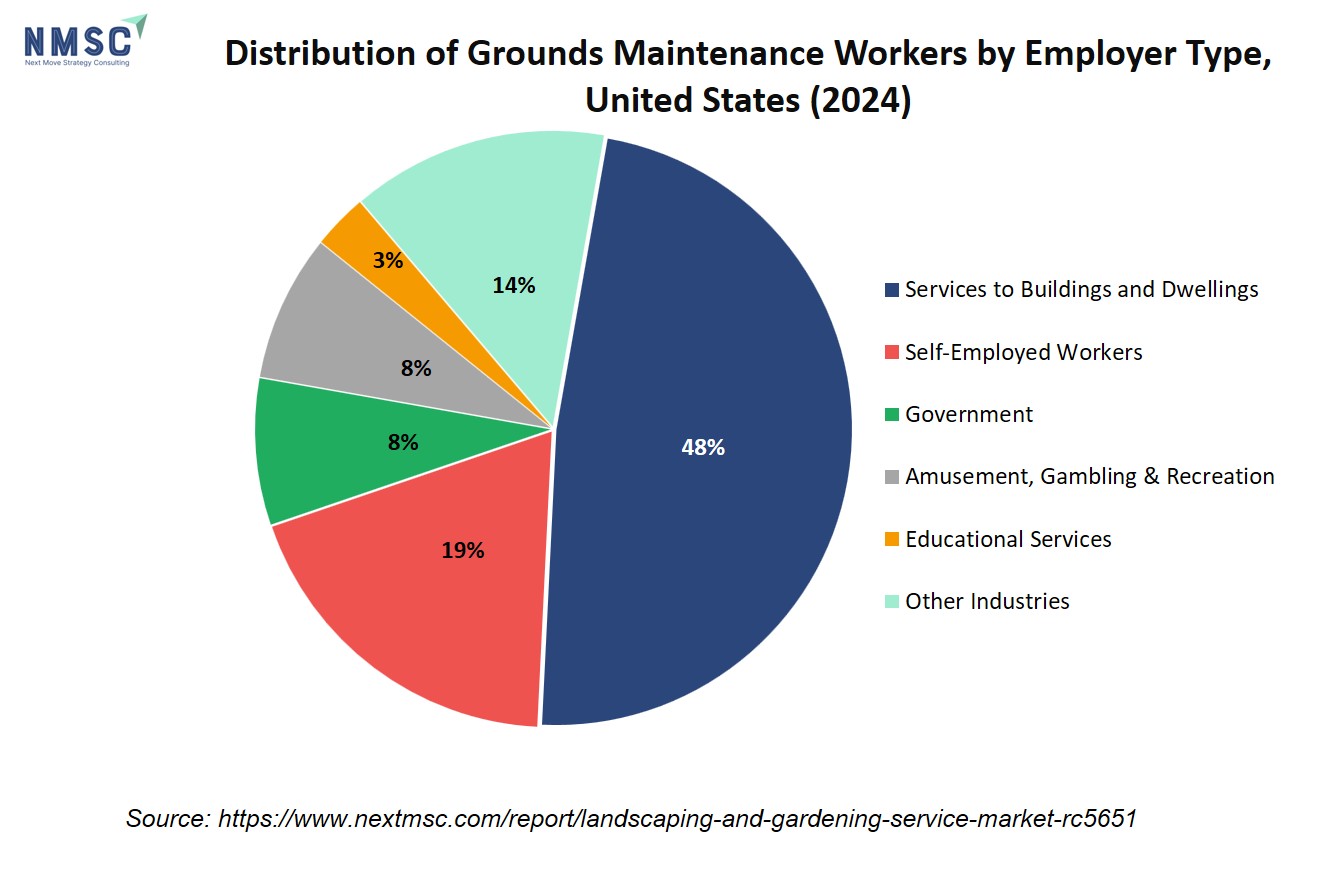
US Grounds Maintenance Workers — BLS Employment Projections by Occupation (2024–2034)
|
Occupation |
SOC Code |
Employment 2024 |
Projected Employment 2034 |
Numeric Change |
% Change |
|
Grounds Maintenance Workers (Total) |
37-3000 |
1,296,400 |
1,342,300 |
+45,900 |
+4% |
|
Landscaping & Groundskeeping Workers |
37-3011 |
1,192,500 |
1,235,000 |
+42,400 |
+4% |
|
Tree Trimmers and Pruners |
37-3013 |
60,100 |
62,100 |
+2,000 |
+3% |
|
Pesticide Handlers, Sprayers & Applicators |
37-3012 |
29,600 |
30,700 |
+1,100 |
+4% |
|
Grounds Maintenance Workers, All Other |
37-3019 |
14,100 |
14,500 |
+300 |
+2% |
Notes: Projected annual average openings across all grounds maintenance occupations: approximately 171,600. Many openings result from replacement needs as workers transfer to other occupations or retire.
Wage Stratification Reflects Skill Premium Across Service Specialisations
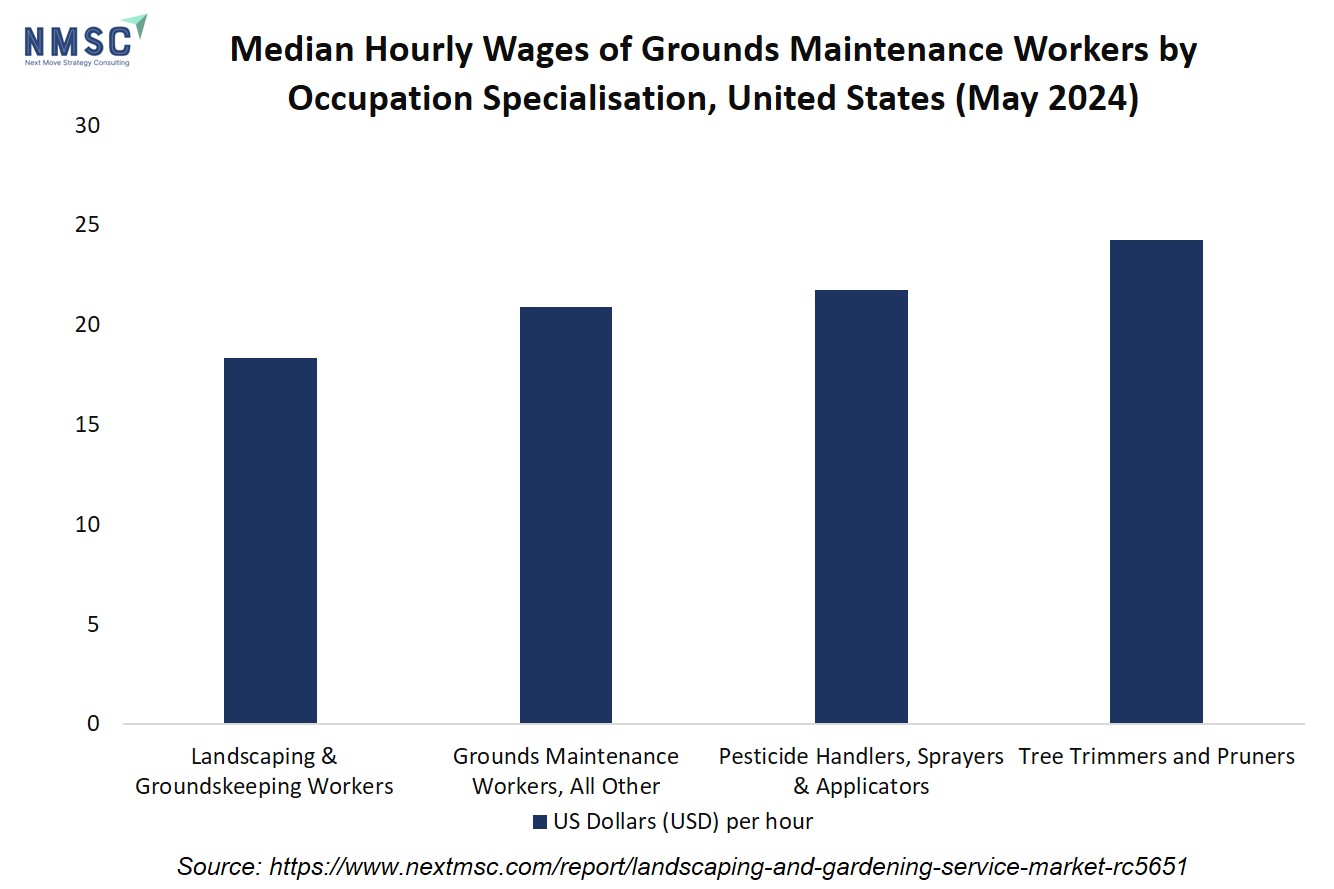
The BLS data reveals a meaningful wage stratification across grounds maintenance specialisations, with tree trimmers and pruners commanding the highest median hourly wage at USD 24.25 in May 2024 — 32% above the median for landscaping and groundskeeping workers at USD 18.31. This wage differential reflects the technical skill, safety certification, and equipment proficiency required for arboricultural work relative to general lawn maintenance.
The wage gap between maintenance and construction workers within the landscaping sector has been identified as a structural labour market challenge. According to Aspire's 2026 Commercial Landscape Industry Report, surveying more than 1,000 commercial landscaping professionals across the United States, 54% of respondents cited recruiting and retaining staff as a major business risk, with 70% of participants indicating they would increase wages — 44% by 4% or more — in response to competitive labour market pressures.
Commercial Sector Resilience and Technology Adoption
Despite macroeconomic headwinds, the commercial landscaping segment is demonstrating notable resilience. According to Aspire's 2026 Commercial Landscape Industry Report, 42% of commercial landscape companies expect the market to improve in 2026, and a further 38% anticipate conditions will remain stable relative to 2025. Commercial maintenance accounts for 83% of contractors' revenue, underscoring the structural importance of recurring-service contracts to the sector's financial architecture.
Technology adoption is accelerating as a competitive differentiator. The survey found that 62% of commercial landscape companies are currently using seven or more software systems, with 28% deploying ten or more. The most widely adopted platforms include accounting software (72%), invoicing tools (67%), estimating and proposal systems (65%), and GPS tracking (58%). Among companies seeking to change solutions, the primary motivations are workflow automation (58%), operational efficiency improvement (51%), and scalability (36%).
According to Next Move Strategy Consulting's analysis, route-optimisation and mobile workforce-management platforms are replacing manual scheduling to reduce fuel costs and improve crew utilisation across recurring-service contracts. National operators are adopting these platforms to standardise service quality, while independent contractors face rising pressure to digitise dispatch operations to remain competitive. The On-Demand Services segment is projected to expand at 7.92% CAGR from 2026 to 2035, as digital marketplace platforms broaden access to ad hoc project-based bookings.
Market Segmentation: Irrigation Services and Institutional Demand Lead Growth
Within the service type segmentation, Irrigation System Services is the fastest-growing sub-segment, projected to expand at 9.03% CAGR from 2026 to 2035, driven by expanding municipal water-restriction ordinances across drought-prone regions and growing demand for smart controller retrofits. Lawn Care and Maintenance retains the largest revenue share at approximately 34% (USD 49.91 billion in 2025), anchored by high-frequency recurring visits and broad residential and commercial penetration.
By end-user segment, the Institutional and Government category is the fastest-growing at 7.80% CAGR from 2026 to 2035, as municipal green-infrastructure contracts expand and government-backed urban beautification programs drive bulk procurement. The Residential segment remains the largest at approximately 52% of total market revenue (USD 76.34 billion in 2025), reflecting broad suburban homeownership and rising outsourcing of routine lawn care.
The NALP's January 2026 Economic Forecast Report characterises 2026 as a year of mild to moderate growth for the landscape industry, noting significant deviation between individual markets. The construction market is experiencing a soft patch in both single-unit housing and nonresidential construction, while consumer spending continues to accelerate on both a dollar and volume basis.
US Grounds Maintenance Workers — Median Hourly Wages by Industry Sector (May 2024)
|
Industry Sector |
Median Hourly Wage (USD) |
|
Educational Services (State, Local & Private) |
$20.42 |
|
Government (excl. State/Local Education & Hospitals) |
$18.81 |
|
Services to Buildings and Dwellings |
$18.77 |
|
Amusement, Gambling & Recreation Industries |
$17.06 |
|
Overall Median — All Grounds Maintenance Workers |
$18.50 |
Notes: Data excludes self-employed workers, as OEWS does not collect wages for self-employed individuals. The overall median for all US occupations in May 2024 was $23.80 per hour.
Regional Outlook: Asia-Pacific Leads Growth, North America Anchors Revenue
North America dominates the global landscaping and gardening service market with approximately 42% revenue share (USD 61.66 billion in 2025), supported by a mature recurring-service culture, high per-household outsourcing rates, and active roll-up consolidation of independent contractors into national service platforms. The United States alone accounted for approximately USD 43.16 billion in 2025, with the market projected to reach USD 77.11 billion by 2035 at a 5.93% CAGR.
Asia-Pacific is the fastest-growing region, projected to expand at 8.85% CAGR from 2026 to 2035, driven by rising urban green-infrastructure investment, expanding commercial property development, and government-backed ecological greening initiatives in China and India. Vietnam is identified as the fastest-growing individual country market at approximately 11.08% CAGR. Europe's growth at 5.72% CAGR reflects steady institutional demand supported by EU environmental directives and strong municipal sustainability and biodiversity policy frameworks.
The Middle East and Africa region is benefiting from national greening and tourism-infrastructure initiatives, particularly in Gulf Cooperation Council economies. Saudi Arabia's Vision 2030 urban development programs are driving government-backed landscaping tenders, while the UAE's hospitality-sector grounds maintenance investment continues to expand.
Competitive Landscape: Consolidation and M&A Activity Intensify
The global landscaping and gardening service market remains highly fragmented, with the top 10 companies accounting for a meaningful but non-dominant share of global revenue. Private-equity-backed roll-up consolidation is reshaping the competitive base as national platforms acquire regional contractors to build multi-market service density.
In March 2026, BrightView Holdings, Inc. expanded its Sports Turf and Golf maintenance portfolios by securing major project contracts and renewals across premier venues, including new golf course maintenance agreements for Country Club of Miami and Lake Arrowhead Country Club, alongside high-profile playing field installations for collegiate and professional sports complexes.
In February 2026, BrightView expanded its long-standing golf course management partnership with The Villages in Florida, increasing its managed portfolio from 20% to over 50% of the community's 400 golf holes — taking over operations and turf management for upwards of 20 nine-hole golf courses.
Also in February 2026, Davey Resource Group, a subsidiary of The Davey Tree Expert Company, acquired Cal Engineering Solutions, Inc. and its sister companies, expanding engineering, utility infrastructure, and vegetation management capabilities across North America. This followed Davey's September 2025 acquisition of LandStudies through its Wetland Studies and Solutions subsidiary, adding ecological restoration, watershed planning, and stormwater management capabilities.
According to Next Move Strategy Consulting's analysis, National and Enterprise Service Companies represent the fastest-growing provider type at 8.56% CAGR from 2026 to 2035, as roll-up consolidation expands multi-market service platforms. Independent Local Contractors, while retaining the largest current share at approximately 46% (USD 67.53 billion in 2025), face increasing competitive pressure from scaled enterprise operators with centralised procurement and standardised crew training.
Sustainability and Water Efficiency: Emerging Differentiators
Demand for native-plant landscaping, reduced-chemical lawn care, and water-efficient irrigation servicing is emerging as a structural differentiator among environmentally conscious residential and institutional clients. Municipal sustainability programs are incentivising low-water landscape conversions, while state water agencies are increasingly mandating smart controller retrofits — a shift that is elevating demand for irrigation-certified contractors as a differentiated, higher-margin category.
The NALP's 2025 Gardening Insights Survey, conducted by Axiom, found that 44.4% of respondents spent more money on gardening in 2024 compared to 2023, with Generation Z (65.4%) and Generation Y (47%) reporting the greatest increase in time spent gardening. This generational shift in consumer engagement with outdoor spaces is reinforcing the long-term demand base for professional landscaping services.
Bottom Line
The global landscaping and gardening service market is entering a structurally reinforced growth phase, underpinned by converging forces: the BLM's June 2026 deregulatory action reshaping federal land management policy, sustained residential outsourcing demand, accelerating commercial sector technology adoption, and expanding institutional green-infrastructure procurement. The BLS projects 45,900 net new grounds maintenance jobs in the United States alone through 2034, with 171,600 annual openings reflecting both new demand and replacement needs — a labour market dynamic that simultaneously validates the sector's growth trajectory and highlights its most significant operational constraint. For investors, the near-term opportunity is concentrated in roll-up consolidation platforms, irrigation-servicing infrastructure, and digital scheduling technology providers. Key risks include persistent skilled labour shortages — cited by 54% of commercial contractors as a primary business risk — seasonal demand volatility, and rising input cost pressure on service margins. Strategically, operators combining strong regional service density with centralised technology infrastructure and sustainability-certified service portfolios are best positioned to capture disproportionate share of the USD 127.30 billion absolute dollar opportunity projected between 2026 and 2035.
About Next Move Strategy Consulting
Next Move Strategy Consulting is a premier market research and management consulting firm that has been committed to provide strategically analysed well documented latest research reports to its clients. The research industry is flooded with many firms to choose from, what makes NMSC different from the rest is its top-quality research and the obsession of turning data into knowledge by dissecting every bit of it and providing fact-based research recommendation that is supported by information collected from over 500 million websites, paid databases, industry journals and one on one consultations with industry experts across a diverse range of industry sectors. The high-quality customized research reports with actionable insights and excellent end-to-end customer service help our clients to take critical business decisions that enables them to move beyond time and have competitive edge in the industry.
We have been servicing over 1000 customers globally that includes 90% of the Fortune 500 companies over a decade. Our analysts are constantly tracking various high growth markets and identifying hidden opportunities in each sector or the industry. We provide one of the industry's best quality syndicate as well as custom research reports across 10 different industry verticals. We are committed to deliver high quality research solutions in accordance to your business needs. Our industry standard delivery solutions that ranges from the pre consultation to after-sales services, provide an excellent client experience and ensure right strategic decision making for businesses.
For more information, please contact:
Next Move Strategy Consulting
5th Floor 867
Boylston St, STE 500,
Boston, MA 02116, U.S.
E-Mail: [email protected]
Direct: +1-217-650-7991
Website: www.nextmsc.com
About the Author
 Sanyukta Deb
— Sanyukta Deb is Digital Marketing Team Lead at Next Move Strategy Consulting, where she has led content strategy and technical SEO for the firm's B2B market research publications for over 2 years. Her editorial process translates NextMSC's primary and secondary research — spanning technology, industrial, and consumer sectors — into commercial narratives, backed by search-intent, keyword, and competitive analysis. She brings 5 years of overall experience in digital marketing and content strategy.
Sanyukta Deb
— Sanyukta Deb is Digital Marketing Team Lead at Next Move Strategy Consulting, where she has led content strategy and technical SEO for the firm's B2B market research publications for over 2 years. Her editorial process translates NextMSC's primary and secondary research — spanning technology, industrial, and consumer sectors — into commercial narratives, backed by search-intent, keyword, and competitive analysis. She brings 5 years of overall experience in digital marketing and content strategy.
About the Reviewer
 Debashree Dey
— Debashree Dey is Assistant Manager at Next Move Strategy Consulting, where she supports cross-vertical market content and communications across diverse industries for 6 years. Her professional background includes senior content writing, communications, and published manuscript authorship, with experience developing audience-focused business narratives and maintaining clear, consistent messaging. Her role supports research-led content development and editorial quality across NextMSC publications.
Debashree Dey
— Debashree Dey is Assistant Manager at Next Move Strategy Consulting, where she supports cross-vertical market content and communications across diverse industries for 6 years. Her professional background includes senior content writing, communications, and published manuscript authorship, with experience developing audience-focused business narratives and maintaining clear, consistent messaging. Her role supports research-led content development and editorial quality across NextMSC publications.


















Add Comment