Laser-Tuned 3D Imaging and DIY LED Innovations Accelerate Volumetric Display Adoption
Volumetric Display Market Size to Hit USD 1.97 Billion by 2030 as Laser-Tuned 3D Imaging and DIY LED Innovations Accelerate Adoption
Breakthroughs in laser-controlled rare-earth glass imaging and compact homemade LED-based volumetric systems are accelerating momentum across the global volumetric display industry, as enterprises race to commercialize immersive three-dimensional visualization technologies. The latest market projections indicate the Volumetric Display Market is expected to grow from USD 321.2 million in 2023 to USD 1.97 billion by 2030, registering a CAGR of 29.6% from 2024 to 2030.
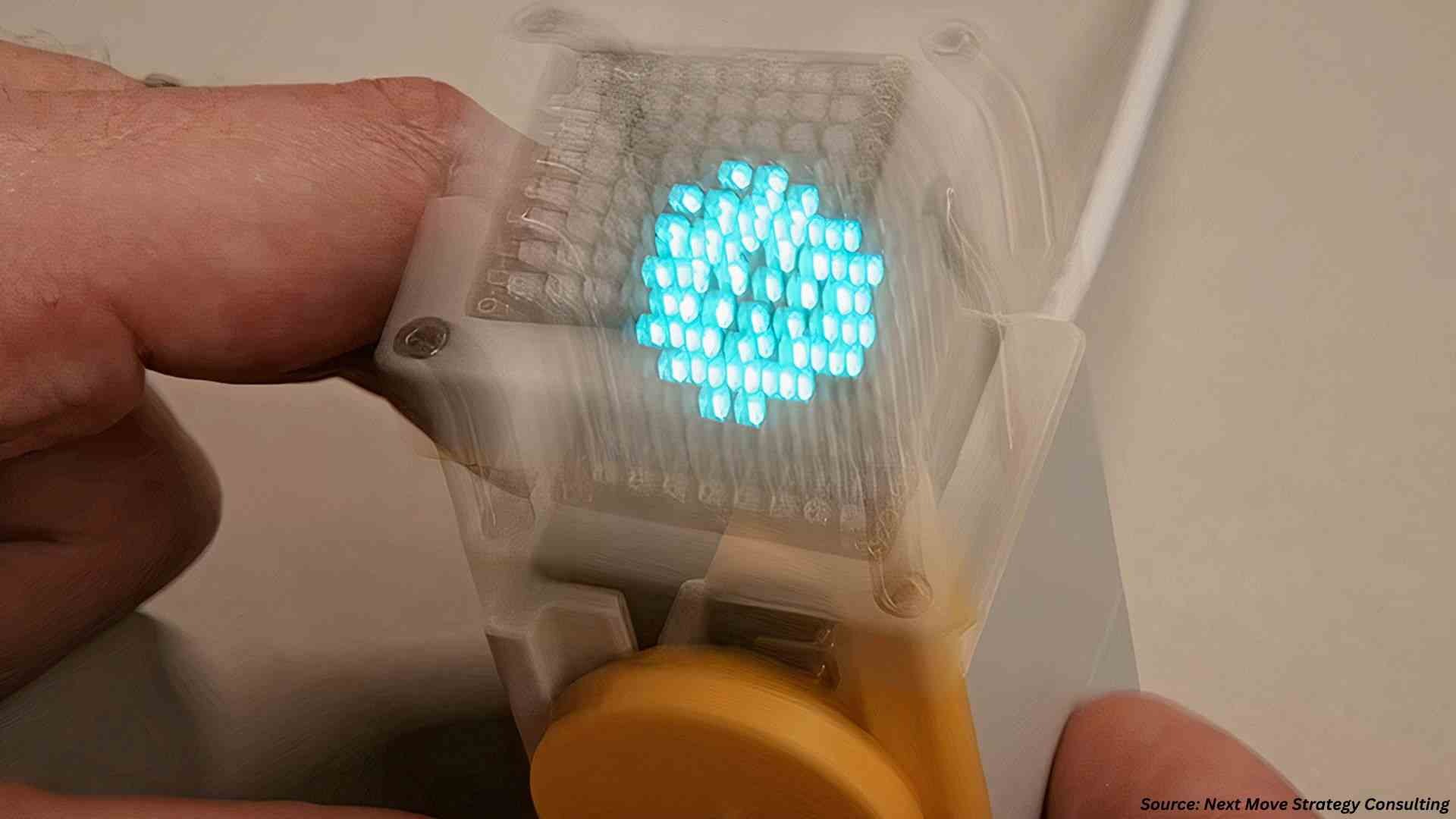
The surge follows two high-profile developments that drew industry attention during 2025–2026. In November 2025, developer Matthew Lim demonstrated a homemade mini volumetric display powered by an ESP32 microcontroller and synchronized LED motion system, showcasing low-cost spatial imaging capabilities using persistence-of-vision mechanics. Separately, researchers publishing in Light: Science & Applications reported a significant advancement in rare-earth doped tellurite glass capable of dynamically generating RGB volumetric images through laser excitation modulation.

According to the latest NMSC proprietary dataset, enterprise demand for headset-free 3D visualization systems increased sharply over the last six months, particularly across healthcare imaging, aerospace simulation, automotive engineering, and defense visualization sectors.
Sikha Haritwal, Senior Research Analyst at Next Move Strategy Consulting, notes that volumetric displays are transitioning from experimental visualization tools into scalable commercial infrastructure supported by advances in photonics, LED miniaturization, and AI-assisted rendering.
“The industry is witnessing a convergence of low-cost hardware experimentation and high-end material science innovation, creating a faster commercialization pathway for volumetric visualization systems,” Haritwal said.
Homemade LED Volumetric Display Highlights Shift Toward Affordable Innovation
Matthew Lim’s compact volumetric display prototype gained industry attention after demonstrating how hobbyist-grade electronics could simulate floating three-dimensional objects within a pocket-sized structure. The device used an ESP32 board, an 8×8 LED matrix, encoder-guided motor synchronization, and persistence-of-vision effects to create volumetric illusions inside a 20mm movement range.
Unlike traditional volumetric systems dependent on complex rotating fans or holographic chambers, the homemade prototype used a bouncing rack-and-pinion mechanism driven by an N20 motor cycling at 16 frames per second. The synchronized LED flashes created layered depth perception capable of displaying cubes, fluid simulations, rotating spheres, and wireframe animations.

Industry analysts say the prototype reflects a broader trend toward low-cost prototyping and decentralized innovation in the volumetric display ecosystem.
According to NMSC researchers, reduced component costs and open-source development communities are lowering barriers for experimentation in spatial display technologies, potentially accelerating innovation cycles across consumer electronics and educational visualization platforms.
Rare-Earth Doped Glass Advances Commercial 3D Visualization
In a parallel development, researchers Yiyuan Zhu and Renren Deng reported a breakthrough in full-colour volumetric imaging using rare-earth doped monolithic tellurite glass. The study demonstrated how laser excitation modulation could dynamically control RGB colour emissions inside transparent glass structures.
The system integrated Ho3+, Tm3+, Yb3+, and Nd3+ ions to generate red, green, and blue volumetric emissions using varying excitation wavelengths and pulse strategies. Researchers successfully demonstrated moving, rotating, and expanding 3D visualizations embedded directly inside the glass volume.
The development represents a major advancement for upconversion-based volumetric displays, which are increasingly viewed as a promising pathway toward transparent 3D visualization systems without the need for wearable headsets or projection surfaces.
NMSC analysts identified increasing research investment in photonic display materials following the publication, particularly among advanced optics manufacturers and defense visualization laboratories.
Market Dynamics: What Changed in the Last Six Months
The volumetric display sector has undergone rapid shifts since late 2025, including:
Increased funding into spatial visualization startups
Rising healthcare demand for surgical 3D imaging systems
Expansion of AI-assisted rendering engines
Growing military investment in immersive command interfaces
Declining costs of LED matrices and microcontroller-based display systems
Stronger focus on transparent volumetric visualization platforms
Analysts note that volumetric displays are increasingly competing with augmented reality systems in enterprise collaboration and industrial simulation environments.
Regional Growth Outlook
|
Region |
Primary Growth Driver |
|
North America |
Defense simulation and healthcare imaging |
|
Asia-Pacific |
Consumer electronics manufacturing |
|
Europe |
Industrial engineering applications |
|
Middle East & Africa |
Smart infrastructure visualization |
Healthcare continues to dominate demand due to increasing adoption of advanced visualization systems for diagnostics, surgical planning, and collaborative imaging workflows.
Competitive Landscape Intensifies
Technology developers are increasingly focused on:
-
Transparent display architectures
-
Rare-earth photonic materials
-
Low-latency volumetric rendering
-
AI-enhanced spatial visualization
-
Energy-efficient LED synchronization systems
-
Multi-angle collaborative viewing technologies

Industry observers say Asia-Pacific is emerging as a major manufacturing hub for volumetric display hardware due to semiconductor infrastructure growth and lower production costs.
What CEOs and Investors Should Do Next
-
Increase investments in photonic and laser-based volumetric technologies
-
Explore partnerships with healthcare and aerospace visualization providers
-
Monitor open-source hardware ecosystems driving rapid prototyping
-
Expand R&D into transparent display materials and rare-earth optics
-
Evaluate AI-powered rendering platforms for industrial deployment opportunities
Analysts believe the next two years will be critical in determining whether volumetric displays evolve into mainstream enterprise visualization infrastructure or remain limited to specialized industrial applications.
About Next Move Strategy Consulting:
Next Move Strategy Consulting is a premier market research and management consulting firm that has been committed to provide strategically analysed well documented latest research reports to its clients. The research industry is flooded with many firms to choose from, what makes NMSC different from the rest is its top-quality research and the obsession of turning data into knowledge by dissecting every bit of it and providing fact-based research recommendation that is supported by information collected from over 500 million websites, paid databases, industry journals and one on one consultations with industry experts across a diverse range of industry sectors. The high-quality customized research reports with actionable insights and excellent end-to-end customer service help our clients to take critical business decisions that enables them to move beyond time and have competitive edge in the industry.
We have been servicing over 1000 customers globally that includes 90% of the Fortune 500 companies over a decade. Our analysts are constantly tracking various high growth markets and identifying hidden opportunities in each sector or the industry. We provide one of the industry’s best quality syndicate as well as custom research reports across 10 different industry verticals. We are committed to deliver high quality research solutions in accordance to your business needs. Our industry standard delivery solutions that ranges from the pre consultation to after-sales services, provide an excellent client experience and ensure right strategic decision making for businesses.
For more information, please contact:
Next Move Strategy Consulting
5th Floor 867
Boylston St, STE 500,
Boston, MA 02116, U.S.
E-Mail: [email protected]
Direct: +1-217-650-7991
Website: www.nextmsc.com
About the Author
 Sanyukta Deb
— Sanyukta Deb is Digital Marketing Team Lead at Next Move Strategy Consulting, where she has led content strategy and technical SEO for the firm's B2B market research publications for over 2 years. Her editorial process translates NextMSC's primary and secondary research — spanning technology, industrial, and consumer sectors — into commercial narratives, backed by search-intent, keyword, and competitive analysis. She brings 5 years of overall experience in digital marketing and content strategy.
Sanyukta Deb
— Sanyukta Deb is Digital Marketing Team Lead at Next Move Strategy Consulting, where she has led content strategy and technical SEO for the firm's B2B market research publications for over 2 years. Her editorial process translates NextMSC's primary and secondary research — spanning technology, industrial, and consumer sectors — into commercial narratives, backed by search-intent, keyword, and competitive analysis. She brings 5 years of overall experience in digital marketing and content strategy.
About the Reviewer
 Debashree Dey
— Debashree Dey is Assistant Manager at Next Move Strategy Consulting, where she supports cross-vertical market content and communications across diverse industries for 6 years. Her professional background includes senior content writing, communications, and published manuscript authorship, with experience developing audience-focused business narratives and maintaining clear, consistent messaging. Her role supports research-led content development and editorial quality across NextMSC publications.
Debashree Dey
— Debashree Dey is Assistant Manager at Next Move Strategy Consulting, where she supports cross-vertical market content and communications across diverse industries for 6 years. Her professional background includes senior content writing, communications, and published manuscript authorship, with experience developing audience-focused business narratives and maintaining clear, consistent messaging. Her role supports research-led content development and editorial quality across NextMSC publications.















Add Comment