Legal WIM Enforcement Expands as Overloaded Trucks Drive Costly Road Damage

WIM Enforcement Crosses Legal Threshold in Seven Jurisdictions as Global Road Damage Costs Reach USD 150 Billion Annually
In a development that marks a structural inflection point for the global weigh-in-motion (WIM) industry, at least seven jurisdictions — including New York City, Brazil, Austria, the Czech Republic, Switzerland, South Africa, and multiple European Union member states — achieved or materially advanced type-approved, legally binding high-speed WIM enforcement between 2023 and mid-2026, according to a June 2026 feature published by Traffic Technology Today. The shift — from WIM as a passive traffic-data instrument to WIM as the sole legal basis for issuing a penalty notice at highway speed — is redefining the commercial addressable market for sensor manufacturers, software integrators, and certification bodies simultaneously.
According to Next Move Strategy Consulting's Weigh-in-Motion System Market report, the global weigh-in-motion system market is projected to reach USD 2.31 billion by 2030, growing at a CAGR of 10.6% from 2025 to 2030. NextMSC's proprietary research and analysis attributes this trajectory to the convergence of three independently measurable forces: escalating road-safety mandates backed by WHO mortality data, accelerating public infrastructure investment under programmes such as the U.S. Infrastructure Investment and Jobs Act (IIJA), and the maturation of high-speed WIM sensor accuracy to within 2–3% of gross vehicle weight — a threshold sufficient for direct legal enforcement in a growing number of regulatory frameworks.
For More Information: Download FREE Sample on Weigh-in-Motion System Market Report
The Infrastructure Cost Imperative: Why Enforcement Economics Have Changed
The commercial case for WIM deployment has historically rested on traffic-data collection and pre-screening at weigh stations. That calculus has been fundamentally altered by a body of evidence quantifying the fiscal cost of overloading that governments can no longer absorb.
In October 2025, the Union of Concerned Scientists (UCS) published what it described as the most comprehensive current quantification of road damage attributable to heavy trucks in the United States. "Despite accounting for just 11% of the more than 3 trillion miles of travel on US roads annually, we estimate heavy-duty trucks are responsible for at least 91% of the wear and tear on those roads," wrote Dave Cooke, senior vehicles analyst at UCS. UCS estimated that the trucking industry is responsible for roughly USD 150 billion per year in U.S. highway costs while contributing approximately USD 60 billion in road-user charges — a structural subsidy of USD 87.6 billion annually transferred from overloading operators to the public purse.
The physics underlying this cost asymmetry is the fourth-power law, established by the American Association of State Highway Officials (AASHO) Road Test in the late 1950s: pavement damage increases with the fourth power of axle load. A truck operating at twice the legal axle weight does not cause twice the road damage — it causes 16 times as much. A vehicle just 10% over its permitted gross vehicle weight increases pavement wear by 46%. The ACEA Strategic Advisory Group noted in its SAG 23 report that overloading can compress the service life of a road designed to last 20 years to just seven years — a finding that reframes WIM enforcement not as a regulatory cost but as a capital-preservation investment.
"If you have to treat a road in five years instead of eight, or in eight years instead of 12, there's a real cost impact," said Judith Corley-Lay, chief pavement management engineer at the North Carolina Department of Transportation, in the June 2026 Traffic Technology Today feature. "Every legislative session, some industry goes to the legislature and asks for an exemption. Every one of those exemptions means the trucks on the road are heavier."
The problem is not confined to advanced economies. Indonesia's coordinating minister for infrastructure, Agus Harimurti Yudhoyono, has stated that road maintenance costs from overloaded trucks reach Rp 43.45 trillion annually — approximately USD 2.7 billion — and that over-dimension, over-load (ODOL) vehicles "cause massive damage to basic infrastructure, such as roads and bridges, and increase carbon emissions," underpinning Indonesia's zero-ODOL national policy and new investment in WIM enforcement at toll operator Jasa Marga's seven new WIM sites.
Enforcement Outcomes: Measured Reductions, Not Theoretical Projections
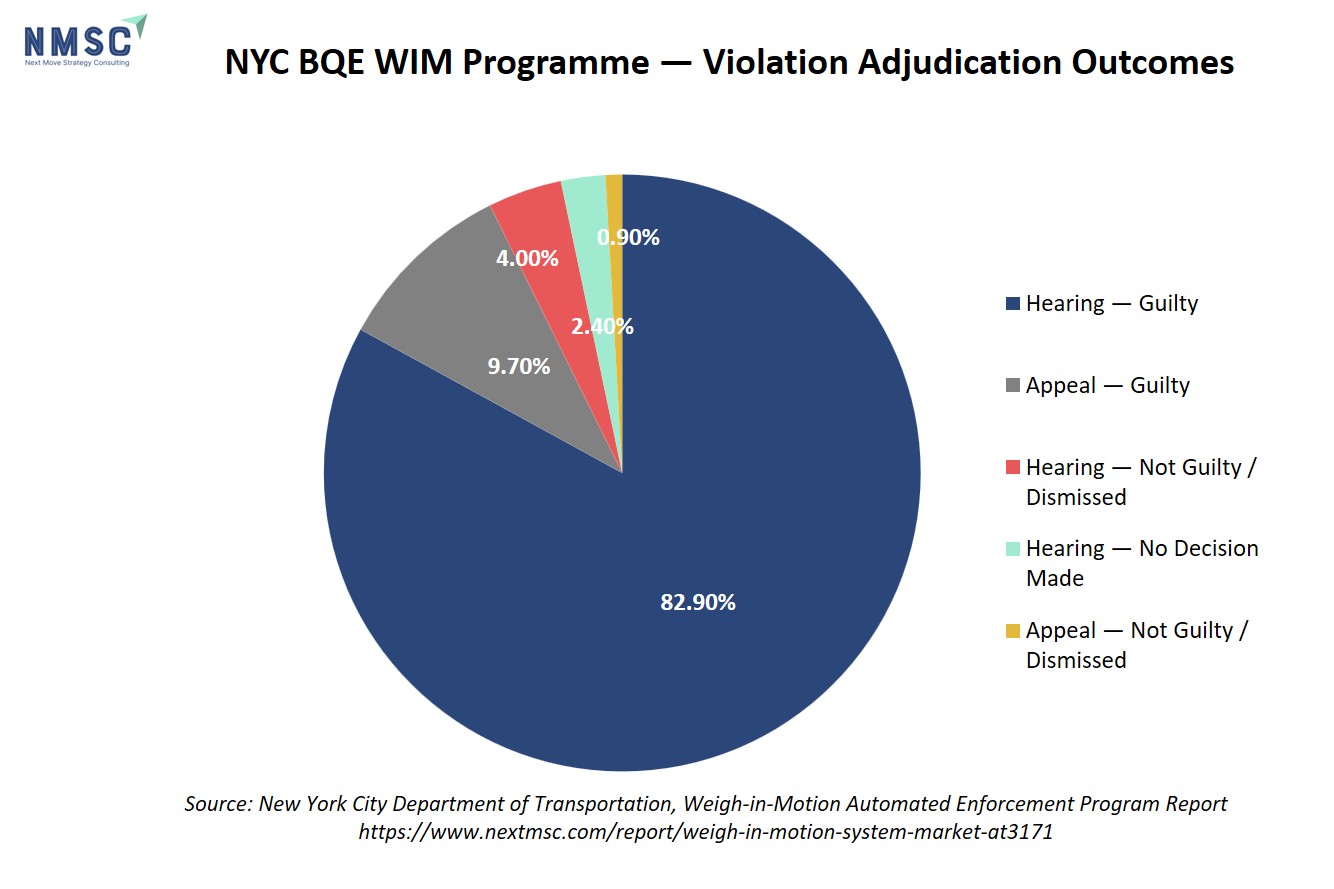
The most consequential data point for WIM market expansion in 2026 is not a forecast — it is a documented enforcement outcome. New York City's Department of Transportation launched automated WIM direct enforcement on the Brooklyn-Queens Expressway (BQE) in November 2023, in partnership with Kistler Group, using sensors embedded in the roadway surface. Within 12 months, overweight vehicles on the monitored section dropped 60%, from a monthly average of 7,920 vehicles to approximately 2,769.
"I hope our partnerships with legislative leaders and the governor to bring WIM to New York City, and the results it has yielded, can serve as a national model for other cities and states," said Ydanis Rodriguez, Commissioner of the New York City Department of Transportation, in the Traffic Technology Today June 2026 feature.
The NYC outcome is consistent with evidence from other jurisdictions. In the Netherlands, a company-profiling enforcement model — using WIM data to identify persistently offending operators and visiting them with enforcement records rather than relying solely on roadside interceptions — achieved over 90% behavioural change among targeted firms. Research published via the International Society for Weigh in Motion (ISWIM) found that on Polish roads where systematic WIM enforcement was introduced, the overloading rate fell from 23% to 5%. A peer-reviewed study published in Sustainability (MDPI, January 2025) by researchers at the Korea Advanced Institute of Science and Technology found that annual road damage costs were reduced by approximately USD 700,000 when WIM enforcement was conducted on the most damaged road sections in Montana.
Regulatory Architecture: NIST Certification Guidance and the EU Directive Revision
The principal bottleneck to WIM's transition from screening tool to enforcement instrument has been legal metrology — the absence of nationally recognised certification standards that allow a WIM reading to withstand judicial challenge. Two regulatory developments in 2025–2026 are directly addressing this gap.
The U.S. National Institute of Standards and Technology (NIST) Office of Weights and Measures (OWM) published NIST Special Publication 2200-05, Certification Approaches for Weigh-In-Motion Systems in Law Enforcement Applications, providing the first national guidance framework for all stakeholders involved in applying WIM systems for direct enforcement of road weight limits. The publication addresses certification frequency, test-speed parameters, automatic calibration protocols, and violation-threshold methodology — the precise technical questions that have historically prevented WIM readings from forming the sole legal basis of a penalty notice in U.S. jurisdictions.
Simultaneously, the European Union's revision of its Weights and Dimensions Directive entered formal discussions, with the EU already permitting a weight increase of one tonne for alternatively fuelled lorries — a provision that expands the commercial vehicle weight envelope and correspondingly increases the enforcement burden on WIM infrastructure across member states, according to NextMSC primary research and analysis.
In South Africa, the South African National Roads Agency (SANRAL) entered into a formal agreement with Provincial Law Enforcement on January 30, 2026, to monitor overloaded trucks through weighbridges, extending its WIM enforcement programme across additional freight corridors. SANRAL's WIMe project is conducting enforcement trials, with ISWIM planning a technical workshop visit to evaluate the programme's methodology.
In Kenya, the Kenya National Highways Authority (KeNHA) deployed high-speed WIM at key Northern Corridor weighbridge stations using systems supplied by Czech firm Camea, reporting a significant reduction in axle-load violations and planning an additional 10 virtual weighbridges. "Even partial damage to the road network translates to colossal losses," said Jared Makori, deputy director in charge of axle load control at KeNHA, in the June 2026 Traffic Technology Today feature. "That means higher maintenance budgets, delayed development elsewhere, and in extreme cases, total reconstruction."
U.S. Infrastructure Investment and the IIJA Multiplier
The U.S. Infrastructure Investment and Jobs Act (IIJA), which provides the basis for Federal Highway Administration (FHWA) programmes through September 30, 2026, commits USD 350 billion to highway programmes over five years. On October 1, 2026, FHWA announced FY26 INFRA Track 1 Awards, continuing the programme's competitive grant disbursements to transportation projects with significant regional impact. The scale of new road and bridge construction funded under IIJA directly expands the addressable market for WIM systems: newly constructed infrastructure requires embedded weight-monitoring sensors from commissioning, rather than retrofitting — a procurement dynamic that shortens the WIM sales cycle and increases average contract value.
The Federal Motor Carrier Safety Administration (FMCSA) maintains regulations governing the safety and oversight of commercial motor vehicles, with its mission explicitly focused on reducing crashes and fatalities involving large trucks and buses — a mandate that aligns directly with WIM deployment as a primary enforcement mechanism. According to the World Health Organization, approximately 1.16 million people die each year as a result of road traffic crashes, with road traffic injuries remaining the leading cause of death among children and young adults aged 5–29 years. This mortality burden provides the public-health justification for WIM investment that is increasingly cited in legislative appropriations processes.
Competitive Landscape: Kapsch Restructuring and the Market Consolidation Signal
The competitive dynamics of the WIM market in 2026 are being shaped not only by technology deployment but by corporate financial restructuring. On July 26, 2026, Kapsch TrafficCom AG — one of the market's leading intelligent transportation systems providers — announced that it had reached agreement with its major financial creditors on key terms of a restructuring, with a final restructuring agreement expected to be concluded in September 2026. The company had previously signed an agreement on the sale of a majority stake in its German subsidiary.
The Kapsch restructuring is a significant signal for market structure: it indicates that the transition from legacy tolling and screening contracts to direct-enforcement WIM programmes — which require higher sensor accuracy, metrological certification, and cloud-based data management — is creating financial stress for vendors whose product portfolios and cost structures were calibrated to the previous generation of WIM applications. Competitors with stronger positions in certified high-speed enforcement systems, such as Kistler Group and Q-Free ASA, are positioned to absorb market share as procurement agencies prioritise enforcement-grade specifications.
The EU's Horizon Europe-funded SETO project (Grant Agreement No. 101103695), which ran from June 2023 to June 2026, presented advances in direct enforcement of overloaded trucks at the Club Imagerie 2025 workshop and JTR2025 in Nantes, highlighting three detection approaches under evaluation: inductive loops, camera-AI based detection using convolutional neural networks, and combined methods integrating bending plates and piezoelectric sensors. The SETO consortium met in Ypres and Ghent in July 2025 to drive the final phase of the project, with findings expected to inform EU-wide enforcement standards.
In the autonomous vehicle segment, PrePass and Kodiak linked driverless trucks to roadside checks in September 2026, and PrePass expanded its Bypass app to Oregon weigh stations in the same month — developments that extend WIM's relevance into the emerging autonomous freight corridor.
Bridge Structural Health Monitoring: The Emerging WIM Revenue Layer
Beyond pavement enforcement, WIM technology is expanding into bridge structural health monitoring — a segment that adds a recurring software and analytics revenue stream to what has historically been a hardware-dominated market. Kistler Group launched a cloud-based platform in 2025 that unifies WIM and structural health monitoring data streams, enabling simultaneous monitoring of vehicle weight, vibration, crack propagation, and weather effects on bridge structures.
"A bridge has a major carbon footprint, both concrete and steel are carbon-intensive materials," said Professor Eugene O'Brien of University College Dublin, in the June 2026 Traffic Technology Today feature. "By extending the working life of a bridge, we are getting more transport service for that carbon footprint." This framing — WIM as a carbon-efficiency instrument, not merely a compliance tool — is opening new procurement pathways in jurisdictions with net-zero infrastructure commitments.
The self-powered WIM system segment represents a further opportunity horizon. Systems integrating self-sensing pavements, autonomous data acquisition, and embedded triggering mechanisms eliminate the need for external power infrastructure — reducing both installation cost and the operational barriers that have historically limited WIM deployment to high-traffic arterials. According to NextMSC primary research and analysis, this technological progression is expected to extend WIM's addressable market to secondary road networks and emerging-economy freight corridors where grid connectivity is unreliable.
NMSC Strategic Perspective: The Enforcement Threshold as a Market Catalyst
-
NextMSC primary research and analysis identifies the legal-enforcement threshold as the single most consequential structural shift in the WIM market since the technology's commercial introduction. Prior to 2023, WIM systems generated revenue primarily through hardware sales for traffic-data collection and pre-screening — a market characterised by long procurement cycles, low software content, and limited recurring revenue. The transition to direct enforcement fundamentally alters the commercial model in three ways.
-
First, certification requirements create a defensible moat. Only WIM systems that meet metrological standards — such as those outlined in NIST SP 2200-05 in the U.S. or equivalent national frameworks in the EU — can be deployed for direct enforcement. This raises the technical and regulatory barrier to entry, concentrating market share among vendors with certified product portfolios and reducing price competition from lower-specification alternatives.
-
Second, enforcement mandates convert discretionary procurement into statutory expenditure. When a jurisdiction legislates that overweight vehicles must be detected and penalised at highway speed, WIM deployment ceases to be a budget-dependent infrastructure upgrade and becomes a legal obligation. This shifts WIM from the capital expenditure discretionary category — vulnerable to budget cycles — into the operational expenditure compliance category, which is structurally more resilient.
-
Third, the convergence of WIM with AI, ANPR, cloud analytics, and structural health monitoring creates a platform revenue model. Vendors that can offer a unified data platform — integrating weight data, vehicle identification, bridge health metrics, and enforcement workflow management — command significantly higher contract values and longer customer relationships than those selling standalone sensors. The Kistler cloud platform launch in 2025 and Q-Free's SaaS model across its Kinetic Mobility platform (launched April 2023) are early indicators of this transition.
NextMSC's proprietary analysis projects that the enforcement-grade WIM segment will grow at a materially faster rate than the overall market CAGR of 10.6%, as the seven jurisdictions that have already achieved type-approved direct enforcement serve as reference deployments for the next wave of adopters across Asia-Pacific, Latin America, and Sub-Saharan Africa. The Kapsch TrafficCom restructuring, viewed through this lens, is not a signal of market weakness — it is a signal of market transition, in which vendors calibrated to the previous generation of WIM applications face structural pressure to adapt or consolidate.
Bottom Line
The global weigh-in-motion system market is undergoing a transition that is simultaneously technical, regulatory, and commercial. The shift from passive data collection to legally binding, type-approved enforcement at highway speed — documented across seven jurisdictions by mid-2026 — has converted WIM from an infrastructure monitoring tool into a statutory compliance instrument, with direct consequences for procurement volumes, contract structures, and vendor competitive positioning. The NYC BQE programme's 60% reduction in overweight vehicles within 12 months, Indonesia's USD 2.7 billion annual overloading damage bill, and the NIST SP 2200-05 certification framework collectively demonstrate that the enforcement economics are no longer theoretical. According to NextMSC primary research and analysis, the global WIM market is projected to grow from USD 1.14 billion in 2024 to USD 2.31 billion by 2030 at a CAGR of 10.6%, with the fastest growth concentrated in Asia-Pacific — where road network expansion, electric truck proliferation, and zero-ODOL policies are creating simultaneous demand for new WIM deployments — and in North America, where IIJA-funded highway construction and NIST certification guidance are removing the two principal barriers to direct enforcement adoption. The Kapsch TrafficCom restructuring signals that market consolidation around enforcement-grade, platform-capable vendors is already underway.
About Next Move Strategy Consulting
Next Move Strategy Consulting is a premier market research and management consulting firm that has been committed to provide strategically analysed well documented latest research reports to its clients. The research industry is flooded with many firms to choose from, what makes NMSC different from the rest is its top-quality research and the obsession of turning data into knowledge by dissecting every bit of it and providing fact-based research recommendation that is supported by information collected from over 500 million websites, paid databases, industry journals and one on one consultations with industry experts across a diverse range of industry sectors. The high-quality customized research reports with actionable insights and excellent end-to-end customer service help our clients to take critical business decisions that enables them to move beyond time and have competitive edge in the industry.
We have been servicing over 1000 customers globally that includes 90% of the Fortune 500 companies over a decade. Our analysts are constantly tracking various high growth markets and identifying hidden opportunities in each sector or the industry. We provide one of the industry's best quality syndicate as well as custom research reports across 10 different industry verticals. We are committed to deliver high quality research solutions in accordance to your business needs. Our industry standard delivery solutions that ranges from the pre consultation to after-sales services, provide an excellent client experience and ensure right strategic decision making for businesses.
For more information, please contact:
Next Move Strategy Consulting
5th Floor 867 Boylston St, STE 500,
Boston, MA 02116, U.S.
E-Mail: [email protected]
Direct: +1-217-650-7991
Website: www.nextmsc.com
About the Author
 Sanyukta Deb
— Sanyukta Deb is Digital Marketing Team Lead at Next Move Strategy Consulting, where she has led content strategy and technical SEO for the firm's B2B market research publications for over 2 years. Her editorial process translates NextMSC's primary and secondary research — spanning technology, industrial, and consumer sectors — into commercial narratives, backed by search-intent, keyword, and competitive analysis. She brings 5 years of overall experience in digital marketing and content strategy.
Sanyukta Deb
— Sanyukta Deb is Digital Marketing Team Lead at Next Move Strategy Consulting, where she has led content strategy and technical SEO for the firm's B2B market research publications for over 2 years. Her editorial process translates NextMSC's primary and secondary research — spanning technology, industrial, and consumer sectors — into commercial narratives, backed by search-intent, keyword, and competitive analysis. She brings 5 years of overall experience in digital marketing and content strategy.
About the Reviewer
 Debashree Dey
— Debashree Dey is Assistant Manager at Next Move Strategy Consulting, where she supports cross-vertical market content and communications across diverse industries for 6 years. Her professional background includes senior content writing, communications, and published manuscript authorship, with experience developing audience-focused business narratives and maintaining clear, consistent messaging. Her role supports research-led content development and editorial quality across NextMSC publications.
Debashree Dey
— Debashree Dey is Assistant Manager at Next Move Strategy Consulting, where she supports cross-vertical market content and communications across diverse industries for 6 years. Her professional background includes senior content writing, communications, and published manuscript authorship, with experience developing audience-focused business narratives and maintaining clear, consistent messaging. Her role supports research-led content development and editorial quality across NextMSC publications.


















Add Comment