Market Transformation in Electric Injection Molding Machines: What Has Changed and What Comes Next
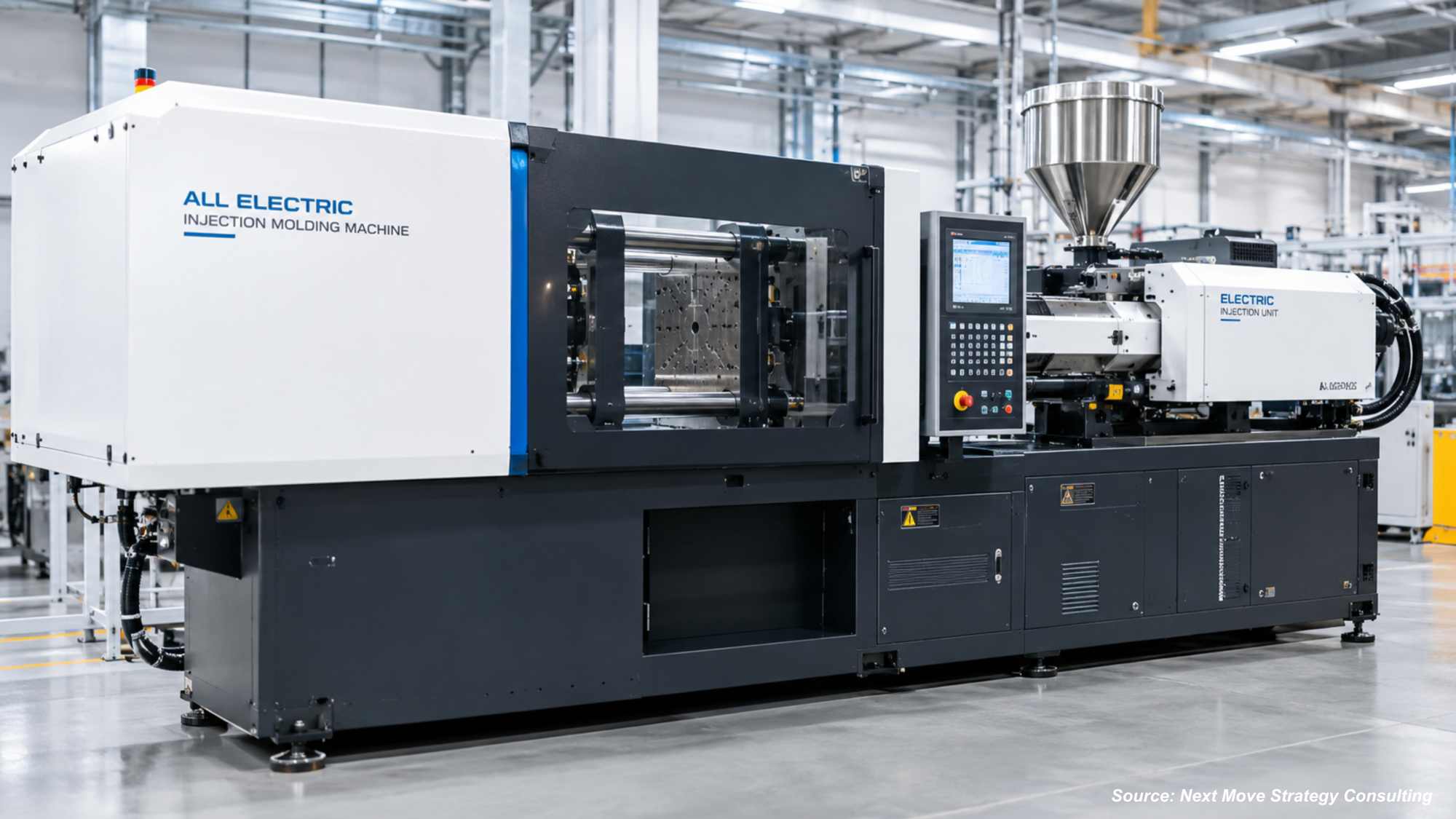
Sumitomo (SHI) Demag's 48-Cavity Closure Cell, Wittmann's EcoPrimus and Arburg's Stork IMM Deal Show All-Electric Drives Reaching Beyond Precision Niches
On 12 October 2026, the 30th Fakuma opened in Friedrichshafen, Germany, with 1,547 exhibitors across 12 halls, according to PlasticsToday's report Fakuma Marks 30th Edition With New Honor for Arburg, published on October 12, 2026. The five-day fair, which runs through October 16, drew fewer exhibitors than the 1,639 recorded at the 2024 edition, a figure given in organiser P. E. Schall's 2025 preview Great Interest for 30th Fakuma in Fall 2026. Even so, all-electric machines anchor the live exhibits announced by Sumitomo (SHI) Demag, the Wittmann Group, SHIBAURA MACHINE LWB, FANUC and Arburg: 48-cavity beverage closures, insulin-pen caps, 96-cavity medical closures and automated production cells, all run on machines that replace hydraulic drives with servo-electric ones.
According to Next Move Strategy Consulting's Electric Injection Molding Machine Market report, the global market is assessed from a 2024 base year across a 2025–2030 forecast period, covering 28 countries and 15 profiled companies, and is segmented by machine type, clamping force, material, pressure type, end user and region. NextMSC primary research and analysis identifies three forces behind adoption: the energy savings of servo-driven machines, which draw power only during specific movements while hydraulic systems consume power continuously while running; the demand for lightweight, high-precision parts in automotive and electric-vehicle production; and the expansion of plastics processing in packaging, automotive and electronics. The report names higher upfront investment as the principal restraint and IoT integration as the main opening for smarter, more efficient operations.
For More Information: Download FREE Sample on Electric Injection Molding Machine Market Report
The Financial Logic: Power Prices, Order Books and the Case for Electric Drives
The commercial backdrop is less buoyant than the exhibition floor suggests. The VDMA Plastics and Rubber Machinery Association reported in its June 10, 2026 press release Global footprint secures future role that price-adjusted order intake fell 5% in the first quarter of 2026 and turnover fell 3%, and it forecasts stable turnover for the full year with slight growth from 2027. The association cited robust demand from packaging and medical technology despite U.S. tariffs and named Asia and America as the main sources of momentum. That demand profile matches the applications on show at Fakuma: beverage closures, insulin-pen caps, medical valves and microfluidic parts.
Electricity cost is the second pillar of the electric case. Eurostat's May 8, 2026 release Non-household electricity prices in 2nd half of 2025: -3.5% put the EU average at €18.37 per 100 kWh for businesses consuming between 500 and 2,000 MWh a year, down from €19.03 in the first half of 2025. Germany, Fakuma's host country, was the third most expensive at €22.64, behind Ireland at €25.52 and Cyprus at €24.29, while Finland recorded €7.48 and Sweden €9.70. A NextMSC calculation from the Eurostat figures shows a German business paying 23.2% more than the EU average and about three times the Finnish rate. Because servo-electric drives draw power only when a movement is required, the higher the tariff, the more each kilowatt-hour saved is worth to the machine owner, which is the mechanism NextMSC primary research and analysis identifies behind electric adoption.
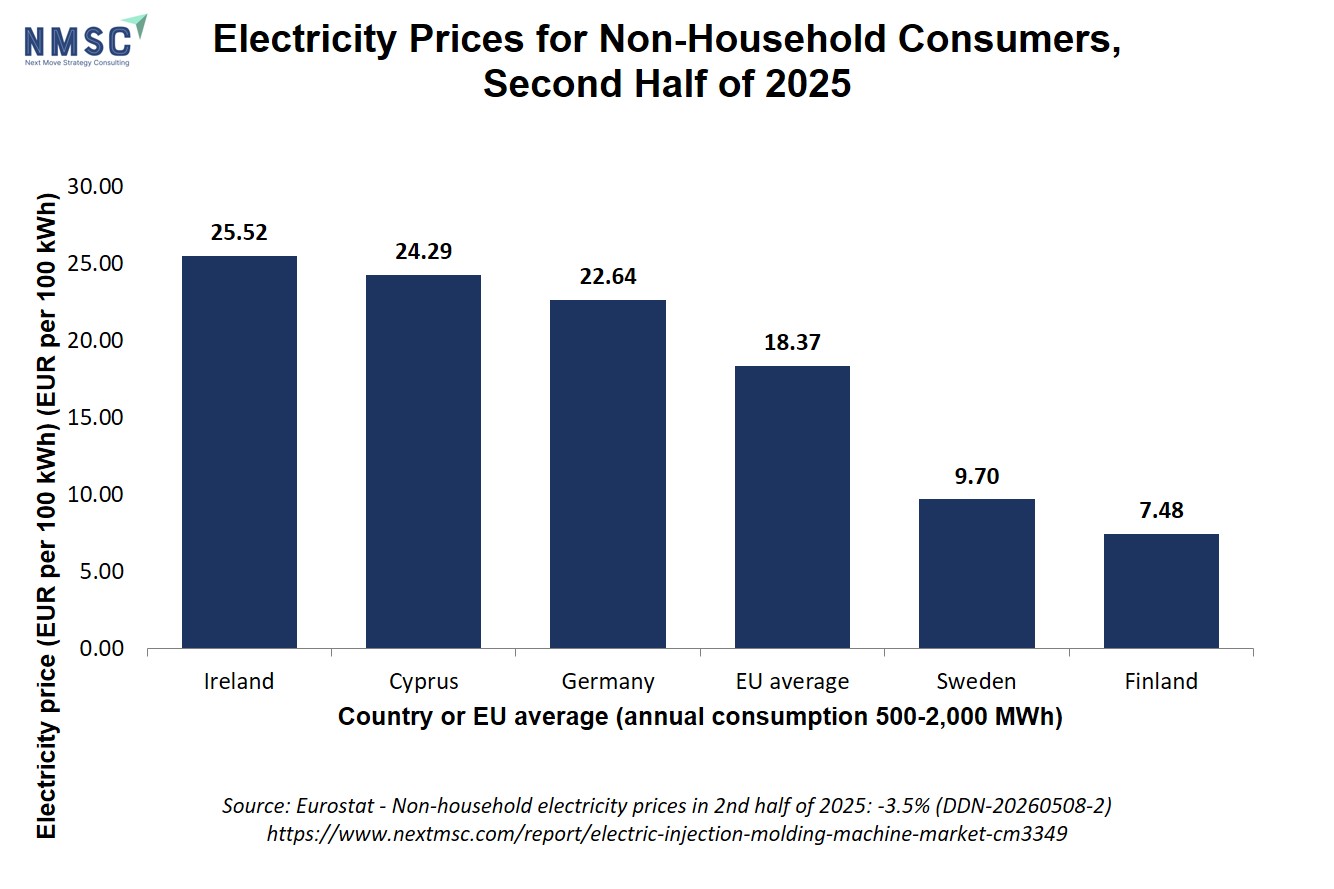
Eurostat's figures cover business consumers with annual electricity use between 500 and 2,000 MWh. Ireland, Cyprus and Germany recorded the highest prices in the second half of 2025, and Finland and Sweden the lowest.
Key Industry Developments: What Exhibitors Brought to Friedrichshafen
Sumitomo (SHI) Demag, in its August 4, 2026 Fakuma press release, said it will run beverage closures on an IntElect S 280 for the first time, using a 48-cavity mold from HTW, as a showcase of its electric drive technology in a classic high-output packaging application. On an IntElect S 75 it will mold a transparent polycarbonate card box with variothermal mold temperature control. At partner booths, an IntElect S 130 will produce polypropylene closures in a 96-cavity mold for medical use, and an IntElect 130 LSR will mold a liquid silicone rubber medical valve.
“Successful projects therefore depend on close collaboration between specialized technology partners”
- Anatol Sattel, CEO, Sumitomo (SHI) Demag, Fakuma 2026 press release, August 4, 2026.
The Wittmann Group's July 2026 Fakuma press release presents the all-electric EcoPrimus as a machine with 1,000 kN of clamping force, an injection speed of 200 mm/s and the B8X control system, developed for compact single-component molding in large quantities with a limited range of options; at the fair it will mold insulin-pen protective caps in an eight-cavity mold. SHIBAURA MACHINE LWB, in an August 4, 2026 announcement, will run a 100-ton EC100SXIII all-electric machine with automated linear part removal, making a polypropylene business-card box. FANUC's August 2026 announcement lists two fully electric ROBOSHOT cells, paired with robotics, machine vision and IIoT connectivity, and ENGEL's Fakuma 2026 exhibit page includes the tie-bar-less victory electric 220, the e-win 1800 and the e-motion 380 T, which it presents as its benchmark for packaging applications.
Arburg, according to its Fakuma press information published by Interempresas on September 7, 2026, is showing its newly developed electric Allrounder Trend series for standard applications: an Allrounder 1000 e Trend with 1,000 kN of clamping force and a maximum injection speed of 500 mm/s in an automated automotive-component cell, and an Allrounder 1800 e Trend working a 64-cavity mold from ACH Solution.
All-Electric Exhibits Announced for Fakuma 2026
|
Exhibitor |
Machine |
Application shown |
Stated specification |
|
Sumitomo (SHI) Demag |
IntElect S 280 |
Beverage closures |
48-cavity mold from HTW |
|
Sumitomo (SHI) Demag |
IntElect S 130 (partner booth) |
Polypropylene closures for medical use |
96-cavity mold |
|
Wittmann Group |
EcoPrimus |
Insulin-pen protective caps |
1,000 kN clamping force; 200 mm/s injection speed; eight-cavity mold |
|
SHIBAURA MACHINE LWB |
EC100SXIII |
Polypropylene business-card box |
100 metric tons clamping force; automated linear part removal |
|
Arburg |
Allrounder 1000 e Trend |
Automated automotive-component cell |
1,000 kN clamping force; 500 mm/s maximum injection speed |
|
Arburg |
Allrounder 1800 e Trend |
Multi-cavity production cell |
64-cavity mold from ACH Solution |
|
FANUC |
ROBOSHOT (two cells) |
Injection molding with robotics, vision and IIoT connectivity |
Two fully electric cells |
Segment Dynamics: Clamping Force, Materials and End Users
NextMSC primary research and analysis segments the market by machine type (vertical, horizontal and other electric machines), clamping force (below 200 tons, 200–500 tons and above 500 tons), material (plastic, metal, rubber, ceramic and others), pressure type (low pressure below 100 MPa and high pressure above 100 MPa) and end user (automotive, packaging, electronics, healthcare, consumer goods, toy making, building and construction, home appliances and others).
The Fakuma exhibits map onto this structure. The 100-ton EC100SXIII from SHIBAURA MACHINE LWB and the 1,000 kN EcoPrimus and Allrounder 1000 e Trend, which equals 102 metric tons of force, all fall inside the report's below-200-ton clamping-force band on either a metric or short-ton convention. The application mix spans packaging closures, healthcare components and automotive parts, and the materials range from polypropylene and polycarbonate to liquid silicone rubber. NextMSC primary research and analysis highlights automotive and plastics processing as the sectors where precision, sustainability and reduced energy consumption matter most, and the exhibitor line-ups show machine builders positioning for those buyers.
NextMSC Segmentation Scope Against Fakuma 2026 Exhibits
|
Segment dimension |
Categories in the NextMSC report |
Fakuma 2026 example |
|
Clamping force |
Below 200 tons; 200–500 tons; above 500 tons |
SHIBAURA MACHINE LWB EC100SXIII (100 metric tons); Wittmann Group EcoPrimus (1,000 kN) |
|
Material |
Plastic; metal; rubber; ceramic; others |
Polypropylene and polycarbonate (Sumitomo (SHI) Demag); liquid silicone rubber (IntElect 130 LSR) |
|
End user |
Automotive; packaging; electronics; healthcare; consumer goods; toy making; building and construction; home appliances; others |
Beverage closures (IntElect S 280); medical closures and valves (Sumitomo (SHI) Demag); automotive cell (Arburg Allrounder 1000 e Trend) |
Regional Outlook: Policy Support in Europe, Asia-Pacific and North America
In Europe, NextMSC's regional analysis ties adoption to the EU Green Deal's carbon-neutrality targets, the Ecodesign Directive's energy-efficiency standards, Horizon Europe research funding and Germany's Industry 4.0 grant programmes. The German power prices recorded by Eurostat add a cost incentive to that regulatory pull.
For Asia-Pacific, NextMSC primary research and analysis points to China's Made in China 2025 initiative, Japan's Society 5.0 vision, South Korea's Smart Factory program and India's Make in India initiative as industrial-policy anchors for electric machinery. The VDMA Plastics and Rubber Machinery Association expects Asia, alongside America, to supply momentum for machine builders into 2027, with China remaining one of the centres of global plastics consumption.
In North America, NextMSC's analysis cites the U.S. Department of Energy's Advanced Manufacturing Office funding, the National Institute of Standards and Technology's Manufacturing Extension Partnership, Canada's Strategic Innovation Fund and U.S. Inflation Reduction Act tax credits as the main supports, while the VDMA Plastics and Rubber Machinery Association lists U.S. tariffs among the adversities facing machine builders.
Growth Drivers and Restraints
Electric Injection Molding Machine Market: Drivers and Restraints Matrix
|
Factor |
Type |
Mechanism |
Evidence |
|
Energy-efficiency demand |
Driver |
Servo motors draw power only for specific movements, while hydraulic systems draw power continuously while running |
NextMSC primary research and analysis; Eurostat: German business electricity at €22.64 per 100 kWh, second half of 2025 |
|
Automotive and electric-vehicle parts |
Driver |
Lightweight, precision-engineered components suit electric machines |
NextMSC primary research and analysis; Arburg automotive-component cell at Fakuma |
|
Packaging and healthcare output |
Driver |
High-cavity closures and caps need repeatable, fast cycles |
Sumitomo (SHI) Demag 48- and 96-cavity molds; Wittmann Group eight-cavity insulin-pen caps; VDMA cites robust packaging and medical technology demand |
|
IoT and digital integration |
Opportunity |
Real-time monitoring, predictive maintenance and process optimization |
NextMSC primary research and analysis; FANUC IIoT connectivity and ENGEL connectivity messaging at Fakuma |
|
Higher upfront investment |
Restraint |
Capital outlay exceeds that of hydraulic machines, deterring smaller processors |
NextMSC primary research and analysis; Wittmann Group EcoPrimus and Arburg Trend aimed at standard applications |
|
Large-tonnage limits |
Restraint |
The report notes limits in extremely large-tonnage applications |
NextMSC primary research and analysis |
|
Soft machinery orders and tariffs |
Restraint |
Lower order intake reduces near-term machine shipments |
VDMA: first-quarter 2026 order intake down 5% and turnover down 3%; U.S. tariffs cited |
NMSC Strategic Perspective: From Precision Niche to Volume Workhorse
NextMSC primary research and analysis reads the Fakuma line-ups as a change in what electric machines are being asked to do. Medical and optical precision work is a familiar showcase for electric drives, and it is still here in the 96-cavity medical closures and microfluidic exhibits. What stands out this year is the volume end: Sumitomo (SHI) Demag is running 48-cavity beverage closures on an IntElect S for the first time, the Wittmann Group is positioning the EcoPrimus on cost efficiency in standard applications, and Arburg has built an electric series for standard applications. Together these point to builders widening the electric range in both directions, toward higher output and toward simpler, lower-cost configurations.
The commercial logic follows from the restraint the report identifies. Higher upfront cost is the main barrier for smaller processors, and the Wittmann Group addresses it by limiting the option list rather than performance. Eurostat's price spread shows where the payback case is strongest: in markets such as Germany, where business electricity cost more than 23% above the EU average in the second half of 2025, each kilowatt-hour a servo-electric drive avoids is worth more.
Consolidation is the second signal. ARBURG signed a purchase agreement on July 29, 2026, to acquire Stork IMM, the Dutch manufacturer of high-speed injection molding machines for thin-wall packaging. By Fakuma 2026, Stork IMM confirmed that it had become part of the ARBURG family. Separately, Stork launched its first all-electric injection molding machine line in March 2025, before showcasing its next-generation All-Electric 6600-3550 with 2K technology at K 2025 in Düsseldorf, Germany, in October 2025. During the exhibition, the machine demonstrated the production of a two-cavity, 5-liter polypropylene pail with a handle and in-mold labeling in a cycle time of just 5.9 seconds. These developments highlight the expansion of all-electric injection molding technology into high-output, thin-wall packaging applications.
For machine builders, NextMSC's analysis points to digital features as the next differentiator: the report identifies IoT-enabled real-time monitoring and predictive maintenance as a growth opportunity, and FANUC and ENGEL both built their Fakuma messaging around connectivity and artificial intelligence. For processors, the payback case is strongest where power is dearest. For investors, the VDMA Plastics and Rubber Machinery Association's outlook of stable 2026 turnover and slight growth from 2027 argues for patience on volumes while product mix shifts toward electric.
Competitive Landscape
The report profiles 15 companies and publishes market shares for 10 of them. Its key-player list includes Shibaura Machine, ENGEL, ARBURG, Fanuc, Sumitomo Heavy Industries, Nissei Plastic Industrial, Haitian International and KraussMaffei, among others. Each recent move among them traces to a named announcement: Arburg's July 29, 2026 signing for Stork IMM; Sumitomo (SHI) Demag's August 4, 2026 pairing of IntElect machines with technotrans cooling, Enesty water management and other partners; the Wittmann Group's first full showing of its primus range; and FANUC's connected ROBOSHOT cells.
NextMSC primary research and analysis reads the partner-heavy approach, in which chillers, molds and robots are shown as one system on the Sumitomo (SHI) Demag booth, as evidence that competition is shifting from the machine specification alone to the complete production cell.
Bottom Line
Fakuma's 30th edition, opened on October 12, 2026 with 1,547 exhibitors, shows all-electric injection molding machines moving from a precision specialty toward volume production. Sumitomo (SHI) Demag's 48-cavity beverage-closure cell, the Wittmann Group's 1,000 kN EcoPrimus, SHIBAURA MACHINE LWB's 100-ton EC100SXIII and Arburg's electric Allrounder Trend series all target packaging, healthcare and automotive output. The economics rest on power cost: Eurostat recorded €22.64 per 100 kWh for German business users in the second half of 2025 against an EU average of €18.37, while the VDMA Plastics and Rubber Machinery Association reports softer orders in early 2026 and expects only slight growth from 2027. NextMSC primary research and analysis identifies energy efficiency, automotive demand and plastics-industry expansion as the forces behind adoption, higher upfront investment as the main restraint, and IoT integration as the main opening. Arburg's purchase of Stork IMM signals that scale and service reach are becoming part of the contest.
About Next Move Strategy Consulting
Next Move Strategy Consulting is a premier market research and management consulting firm that has been committed to provide strategically analysed well documented latest research reports to its clients. The research industry is flooded with many firms to choose from, what makes NMSC different from the rest is its top-quality research and the obsession of turning data into knowledge by dissecting every bit of it and providing fact-based research recommendation that is supported by information collected from over 500 million websites, paid databases, industry journals and one on one consultations with industry experts across a diverse range of industry sectors. The high-quality customized research reports with actionable insights and excellent end-to-end customer service help our clients to take critical business decisions that enables them to move beyond time and have competitive edge in the industry.
We have been servicing over 1000 customers globally that includes 90% of the Fortune 500 companies over a decade. Our analysts are constantly tracking various high growth markets and identifying hidden opportunities in each sector or the industry. We provide one of the industry’s best quality syndicate as well as custom research reports across 10 different industry verticals. We are committed to deliver high quality research solutions in accordance to your business needs. Our industry standard delivery solutions that ranges from the pre consultation to after-sales services, provide an excellent client experience and ensure right strategic decision making for businesses.
For more information, please contact:
Next Move Strategy Consulting
5th Floor 867 Boylston St, STE 500,
Boston, MA 02116, U.S.
E-Mail: [email protected]
Direct: +1-217-650-7991
Website: www.nextmsc.com
About the Author
 Sanyukta Deb
— Sanyukta Deb is Digital Marketing Team Lead at Next Move Strategy Consulting, where she has led content strategy and technical SEO for the firm's B2B market research publications for over 2 years. Her editorial process translates NextMSC's primary and secondary research — spanning technology, industrial, and consumer sectors — into commercial narratives, backed by search-intent, keyword, and competitive analysis. She brings 5 years of overall experience in digital marketing and content strategy.
About the Reviewer
 Debashree Dey
— Debashree Dey is Assistant Manager at Next Move Strategy Consulting, where she supports cross-vertical market content and communications across diverse industries for 6 years. Her professional background includes senior content writing, communications, and published manuscript authorship, with experience developing audience-focused business narratives and maintaining clear, consistent messaging. Her role supports research-led content development and editorial quality across NextMSC publications.












Add Comment