Maruti EV Strategy & Nissan Reboot Mark Turning Point for Auto Industry
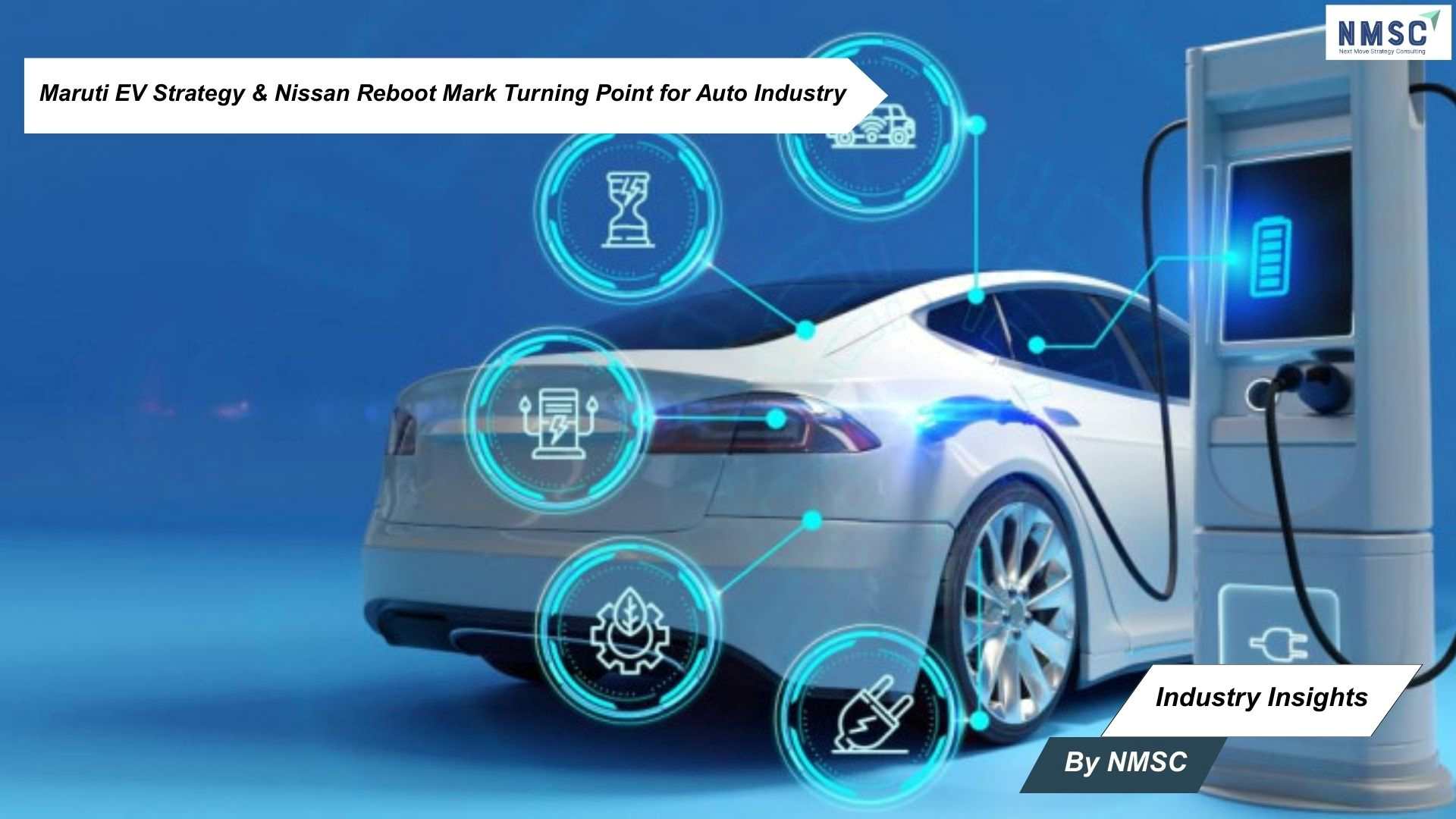
Industry Insights from Next Move Strategy Consulting
As the Indian automotive sector navigates the complex transition toward electrification, strategic moves from key players are defining the market's near-term trajectory. Maruti Suzuki's candid assessment of electric vehicle adoption hurdles, coupled with Nissan's planned comeback and robust export performance, highlights an industry balancing ambitious future goals with present-day market realities. These developments underscore a critical phase where addressing consumer confidence and expanding product portfolios are as crucial as infrastructure development.
A Candid Assessment of EV Adoption Barriers
Maruti Suzuki, while preparing to launch its first battery electric vehicle, the eVitara, has openly identified three major constraints slowing widespread EV adoption in India: discrepancies between promised and real-world driving range, uneven charging infrastructure, and uncertainty around resale values. According to Partho Banerjee, the company's Senior Executive Officer for Marketing and Sales, early consumer experiences have negatively impacted confidence, particularly regarding range reliability for travel planning.
To directly counter these barriers, Maruti Suzuki announced it will introduce an assured buyback program for the eVitara. The company also plans to offer Battery as a Service (BaaS) and subscription models, aiming to mitigate the higher initial acquisition cost and resale value concerns that deter consumers.
Strategic Market Movements Beyond Electrification
Parallel to the EV narrative, other strategic shifts are reshaping the market. Nissan Motor India is embarking on a significant comeback plan, aiming to expand its lineup from a single model to three products by the end of 2026. This strategy leverages Renault-Nissan Alliance platforms for cost efficiency, with the first model—a sub-compact MPV named Gravite based on the Renault Triber—scheduled for unveiling in January 2026.
Simultaneously, the regulatory environment is tightening. The Supreme Court modified an earlier order, reinstating the authority to take action against 10-year-old diesel and 15-year-old petrol vehicles that do not meet BS-IV emission standards in the Delhi-NCR region. This move reinforces the role of regulation in driving vehicle replacement cycles.
Contrasting with domestic challenges, the export sector demonstrated remarkable strength. Passenger vehicle exports for April-November reached 599,276 units, a 20% year-on-year increase, putting the industry within sight of another annual record despite looming uncertainty from a proposed tariff hike in Mexico.
Infrastructure and Investment Fuel the Ecosystem
Beyond vehicle manufacturers, significant developments are occurring in the supporting EV ecosystem:
-
Charging Infrastructure: A strategic partnership between Esyasoft e-Mobility and Park+ plans to deploy 10,000 EV chargers across India over three years, representing a ₹100 crore investment.
-
Funding and Innovation: Electric motorcycle startup Oben Electric raised ₹85 crore in a Pre-Series B round for retail expansion and new products. Furthermore, HIVE and KPIT Technologies established a Center of Excellence focused on light electric vehicles and micromobility solutions.
-
Policy Impact: The PM E-DRIVE scheme delivered 1.13 million electric vehicles in its first year with reduced per-vehicle subsidies, suggesting growing market resilience.
Next Move Strategy Consulting – Analysis View
The current industry dynamics present a classic strategic inflection point. Maruti Suzuki's approach—publicly acknowledging adoption barriers while launching innovative financial products like buyback schemes and BaaS—indicates a shift from mere product selling to building holistic consumer confidence. This is likely to set a new benchmark for market entry, forcing competitors to offer similar financial security to attract buyers.
Nissan's asset-light, alliance-based reboot model highlights a strategic path for brands with diminished market share to re-enter competitively. This approach prioritizes rapid portfolio expansion and cost efficiency over unique product development, potentially encouraging other dormant global brands to reconsider the Indian market.
The strong export performance, amidst domestic EV hesitancy, underscores India's strengthening position in the global automotive supply chain. However, dependencies on specific markets like Mexico introduce volatility. For long-term stability, the industry must diversify its export destinations and continue enhancing the cost and quality proposition of made-in-India vehicles.
The concurrent push in charging infrastructure and clean energy, as seen with Tata's solar plants in Uttar Pradesh and the planned EV truck corridor in Kerala, signals that the foundational ecosystem is being built in parallel to vehicle development. This multi-pronged movement—combining vehicle strategy, financial innovation, ecosystem investment, and regulatory pressure—creates a more sustainable foundation for growth than demand-side subsidies alone.
Navigating a Multifaceted Automotive Landscape
The Indian automotive market is advancing on multiple fronts simultaneously. While the journey to mass EV adoption faces pragmatic hurdles related to cost, infrastructure, and trust, strategic responses are emerging. From assured buybacks to large-scale charger deployments, the industry is building the necessary financial and physical framework.
As legacy automakers like Maruti Suzuki and Nissan recalibrate their strategies, and new players secure investments for growth, the market is evolving into a more complex and competitive landscape. The coming years will be defined by how effectively these parallel strands of product innovation, ecosystem development, and strategic repositioning converge to drive sustainable mobility.
Source: Auto Car Professional
Prepared by: Next Move Strategy Consulting
About the Author
 Sanyukta Deb
— Sanyukta Deb is Digital Marketing Team Lead at Next Move Strategy Consulting, where she has led content strategy and technical SEO for the firm's B2B market research publications for over 2 years. Her editorial process translates NextMSC's primary and secondary research — spanning technology, industrial, and consumer sectors — into commercial narratives, backed by search-intent, keyword, and competitive analysis. She brings 5 years of overall experience in digital marketing and content strategy.
Sanyukta Deb
— Sanyukta Deb is Digital Marketing Team Lead at Next Move Strategy Consulting, where she has led content strategy and technical SEO for the firm's B2B market research publications for over 2 years. Her editorial process translates NextMSC's primary and secondary research — spanning technology, industrial, and consumer sectors — into commercial narratives, backed by search-intent, keyword, and competitive analysis. She brings 5 years of overall experience in digital marketing and content strategy.
About the Reviewer
 Debashree Dey
— Debashree Dey is Assistant Manager at Next Move Strategy Consulting, where she supports cross-vertical market content and communications across diverse industries for 6 years. Her professional background includes senior content writing, communications, and published manuscript authorship, with experience developing audience-focused business narratives and maintaining clear, consistent messaging. Her role supports research-led content development and editorial quality across NextMSC publications.
Debashree Dey
— Debashree Dey is Assistant Manager at Next Move Strategy Consulting, where she supports cross-vertical market content and communications across diverse industries for 6 years. Her professional background includes senior content writing, communications, and published manuscript authorship, with experience developing audience-focused business narratives and maintaining clear, consistent messaging. Her role supports research-led content development and editorial quality across NextMSC publications.















Add Comment