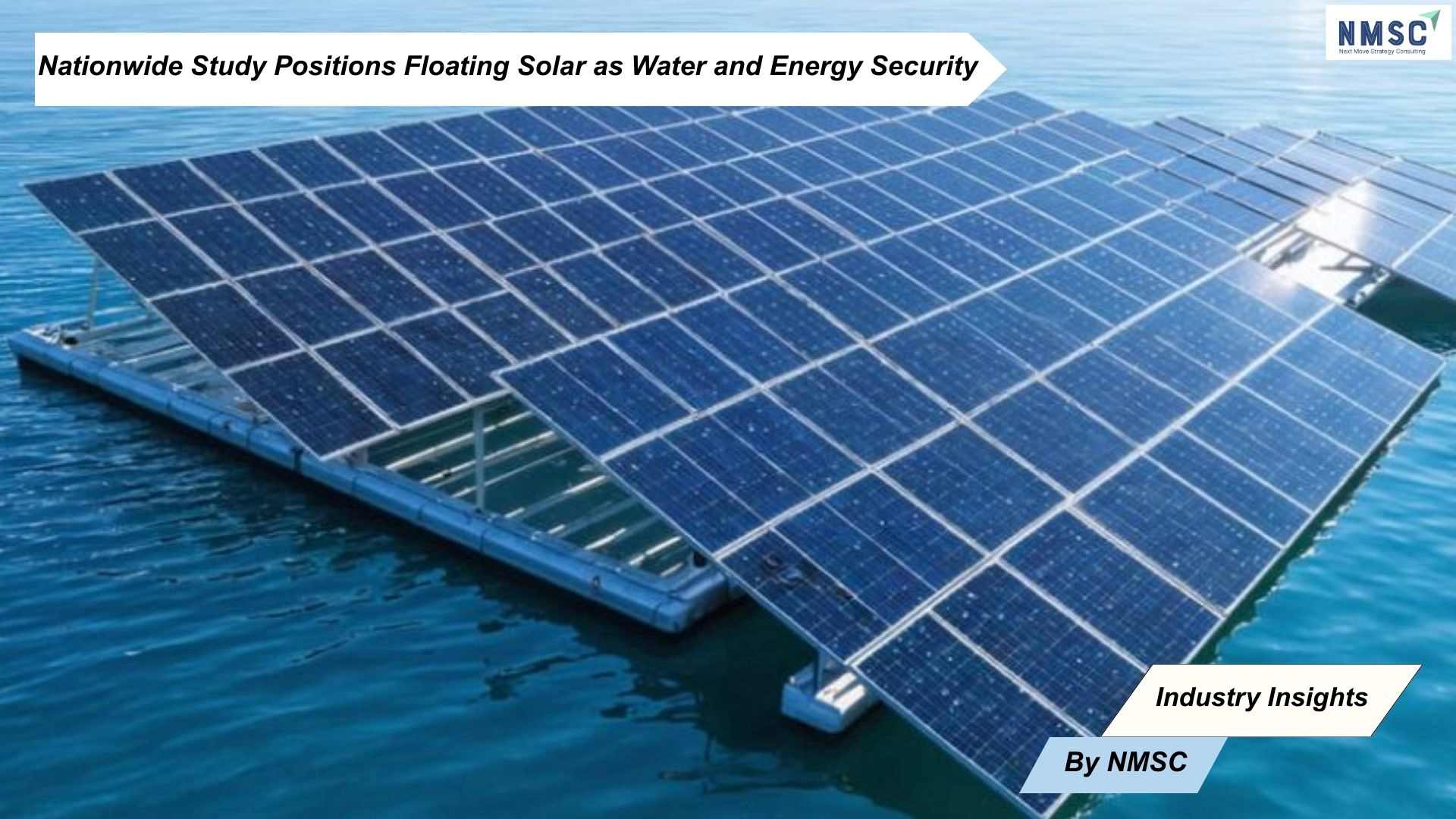
Nationwide Study Positions Floating Solar as Water and Energy Security
Industry Insights from Next Move Strategy Consulting
Confronting the critical nexus of water scarcity and escalating energy demand requires integrated solutions. A comprehensive new feasibility study demonstrates that deploying floating solar photovoltaic (FSPV) systems across Iran's dam reservoirs presents a transformative, dual-benefit strategy, offering a replicable model for arid regions globally.
A Dual-Strategy to Resolve Interlinked Crises
In arid and semi-arid climates, traditional resource management often treats water and energy systems separately, leading to compounded vulnerabilities. The FSPV model directly integrates these domains by generating renewable electricity while simultaneously conserving water through evaporation reduction. This approach is acutely relevant for Iran, where reservoir evaporation claims billions of cubic meters of water annually, and energy demand peaks during dry seasons.
The research provides a national blueprint, assessing technical potential across 117 major reservoirs. By utilizing existing water infrastructure, FSPV systems circumvent land-use conflicts and exploit the natural cooling effect of water, which can enhance photovoltaic efficiency by 5–15%. This creates a synergistic cycle: producing clean power while directly preserving the water needed for consumption, agriculture, and even conventional power generation.
Quantifying the National-Scale Potential
The study's geospatial and economic analysis quantifies a significant opportunity. The findings indicate that covering only 0.5% of total reservoir surface area could yield approximately 36,000 MW of annual electricity generation—equivalent to an estimated 40% of the country's current total power capacity.
The co-benefits are substantial. This scale of deployment could prevent the loss of 4.2 million cubic meters of water each year. Economically, the analysis projects a competitive levelized cost of electricity (LCOE) between USD 0.048 and 0.065 per kWh, with an estimated average capital expenditure of USD 700,000 per MW. Each megawatt generated is calculated to offset substantial emissions compared to fossil-fuel generation: up to 6,725 tons of CO₂, 14 tons of SO₂, and 25 tons of NOₓ.
A Framework for Sustainable Infrastructure Investment
The methodology—combining ArcGIS-based spatial analysis, high-resolution Solargis solar data, and localized evaporation modeling—establishes a replicable framework for national planning. It positions FSPV not merely as a power source, but as core infrastructure for enhancing water-energy resilience.
The technology's scalability and compatibility with existing hydropower infrastructure offer a pragmatic path to diversify energy portfolios and strengthen resource security without extensive new land allocation, making it a strategic asset for sustainable development.
Next Move Strategy Consulting’s View
This rigorous national assessment moves FSPV from a conceptual pilot to a bankable, strategic infrastructure class. For policymakers and investors in water-stressed regions, the study provides the data-driven validation needed to prioritize investments. It demonstrates that FSPV delivers a compelling convergence of financial returns (through competitive LCOE), environmental mandates (via emission offsets and water conservation), and energy security. We anticipate this model will accelerate strategic investment in floating solar, not as an alternative energy project, but as a fundamental component of national resource security and climate adaptation strategies worldwide.
Redefining Reservoir Infrastructure for a Resource-Constrained Era
The integration of floating solar photovoltaics into dam reservoirs represents a paradigm shift in infrastructure thinking. It demonstrates how innovatively coupling two critical systems can unlock compounded benefits, turning passive reservoir surfaces into active, dual-purpose assets.
As climate change intensifies resource pressures, this model provides a proven, scalable pathway. It redefines sustainable development, offering a tangible strategy to secure water and energy—the two foundational pillars of modern society—simultaneously.
Source: Nature.com
Prepared by: Next Move Strategy Consulting
About the Author
 Sanyukta Deb
— Sanyukta Deb is Digital Marketing Team Lead at Next Move Strategy Consulting, where she has led content strategy and technical SEO for the firm's B2B market research publications for over 2 years. Her editorial process translates NextMSC's primary and secondary research — spanning technology, industrial, and consumer sectors — into commercial narratives, backed by search-intent, keyword, and competitive analysis. She brings 5 years of overall experience in digital marketing and content strategy.
Sanyukta Deb
— Sanyukta Deb is Digital Marketing Team Lead at Next Move Strategy Consulting, where she has led content strategy and technical SEO for the firm's B2B market research publications for over 2 years. Her editorial process translates NextMSC's primary and secondary research — spanning technology, industrial, and consumer sectors — into commercial narratives, backed by search-intent, keyword, and competitive analysis. She brings 5 years of overall experience in digital marketing and content strategy.
About the Reviewer
 Debashree Dey
— Debashree Dey is Assistant Manager at Next Move Strategy Consulting, where she supports cross-vertical market content and communications across diverse industries for 6 years. Her professional background includes senior content writing, communications, and published manuscript authorship, with experience developing audience-focused business narratives and maintaining clear, consistent messaging. Her role supports research-led content development and editorial quality across NextMSC publications.
Debashree Dey
— Debashree Dey is Assistant Manager at Next Move Strategy Consulting, where she supports cross-vertical market content and communications across diverse industries for 6 years. Her professional background includes senior content writing, communications, and published manuscript authorship, with experience developing audience-focused business narratives and maintaining clear, consistent messaging. Her role supports research-led content development and editorial quality across NextMSC publications.
















Add Comment