NVIDIA and Faraday Future Accelerate Physical AI Expansion
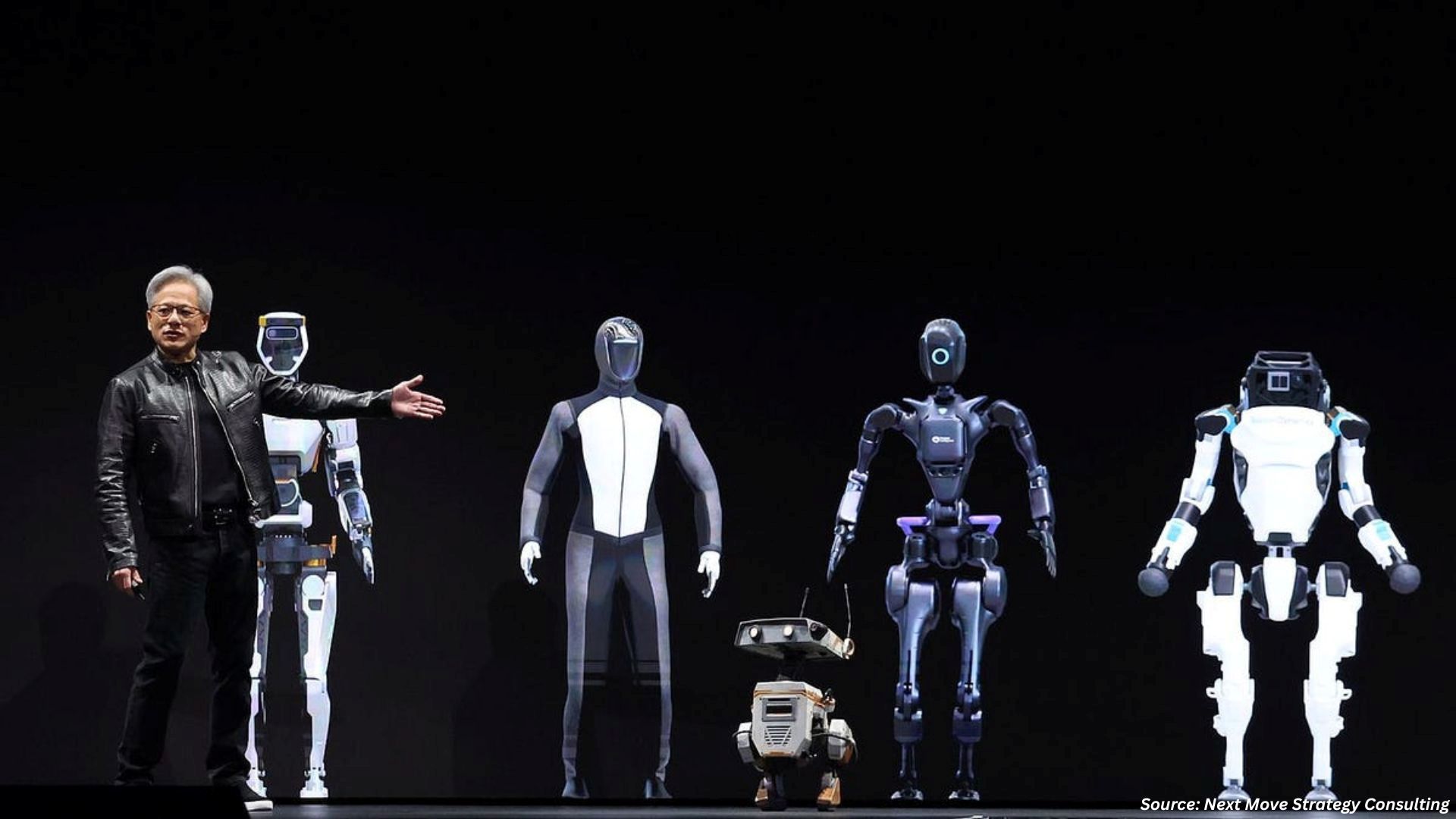
Physical AI Market Size to Hit USD 119.08 Billion by 2035 as NVIDIA and Faraday Future Accelerate Embodied AI Push
The global Physical AI Market entered a new growth phase this week after NVIDIA CEO Jensen Huang publicly outlined a strategic vision centered on “digital twins” and robotics-driven Physical AI, while Faraday Future announced a major corporate restructuring to reposition itself as a “Physical AI ecosystem company.”
The developments have intensified industry-wide focus on embodied AI systems that can interact with the real world through robotics, autonomous vehicles, industrial automation platforms, and intelligent infrastructure. According to the latest analysis from Next Move Strategy Consulting (NMSC), the global Physical AI market size was valued at USD 5.84 billion in 2025 and is projected to reach USD 119.08 billion by 2035, expanding at a CAGR of 32.5% between 2026 and 2035.
NVIDIA Pushes “Digital Twin” Infrastructure for Physical AI
During a keynote discussion at the recent Adobe Summit, Jensen Huang emphasized that the next major phase of AI innovation depends on machines understanding the physical world through highly accurate digital representations, often referred to as “digital twins.”
Huang stated that industries including manufacturing, logistics, transportation, and life sciences cannot be transformed through AI unless computers can accurately model real-world environments and objects. He highlighted the importance of precise 3D digital replicas that allow generative AI systems to interact with physical assets and environments before real-world deployment.

“The vast majority of the world is physical,” Huang noted during the discussion, emphasizing that AI must evolve beyond text and image generation into systems capable of operating autonomously within real-world environments.
The company’s strategy reflects a broader industry transition toward embodied AI systems powered by robotics simulation, AI accelerators, real-time sensor fusion, and edge computing infrastructure.
According to the latest NMSC proprietary dataset, enterprise spending on Physical AI infrastructure accelerated sharply during the first quarter of 2026 as industrial organizations expanded investments in robotics training environments, warehouse automation, and autonomous systems.
Faraday Future Expands Beyond EVs into Physical AI Ecosystems
Separately, Faraday Future announced a significant leadership restructuring that includes appointing founder YT Jia as sole global CEO while accelerating its transformation into a Physical AI-focused enterprise.
The company stated that it plans to evolve into a U.S.-based Physical AI ecosystem company built around “EAI Robotics + EAI EV,” integrating humanoid robotics, bionic robots, autonomous mobility systems, and AI-powered platforms into a unified operational model.
Faraday Future also disclosed that its robotics division shipped 68 embodied AI robots with positive gross margins as of April 2026 and aims to exceed 1,000 cumulative shipments during 2026.
Industry analysts view the announcement as part of a larger shift where automotive manufacturers are increasingly repositioning themselves as AI software, robotics, and autonomous systems companies rather than traditional automakers.
“Physical AI is rapidly becoming the convergence point between robotics, AI infrastructure, autonomous mobility, and industrial automation,” said Mayurima Roy, Research Analyst at Next Move Strategy Consulting. “The sector is transitioning from conceptual experimentation into commercial deployment, particularly across manufacturing, logistics, and intelligent mobility ecosystems.”
Market Momentum Accelerates Across Robotics and Autonomous Systems
The Physical AI sector has experienced accelerated momentum during the last six months as enterprises increased investments in autonomous systems capable of interacting with physical environments.
Several factors are contributing to the rapid market expansion:
-
Rising deployment of AI-enabled industrial robots
-
Expansion of warehouse automation infrastructure
-
Increased adoption of edge AI processors
-
Growth in humanoid robotics development
-
Advancements in simulation-driven robotics training
-
Stronger enterprise demand for autonomous logistics systems
-
Expansion of AI-powered manufacturing operations
NMSC researchers identified substantial increases in pilot programs involving humanoid robots, robotic inspection systems, autonomous industrial equipment, and intelligent mobility platforms throughout early 2026.
Regional Physical AI Market Outlook
|
Region |
Growth Trend |
Primary Growth Driver |
|
North America |
High |
Robotics infrastructure and AI compute investments |
|
Europe |
Moderate to High |
Smart manufacturing initiatives |
|
Asia-Pacific |
Fastest Growing |
Semiconductor expansion and industrial robotics |
|
Middle East |
Emerging |
Smart city and defense AI programs |
|
Latin America |
Gradual Growth |
Logistics and automation modernization |
Investment Activity Shifts Toward Embodied AI
Analysts note that investor sentiment surrounding Physical AI strengthened significantly following advances in robotics foundation models, multimodal AI systems, and simulation-driven autonomous training.
The market is increasingly benefiting from breakthroughs in:
-
AI inference chips
-
Real-time environmental perception
-
Robotics operating systems
-
Sensor fusion architectures
-
Autonomous navigation systems
-
Simulation and digital twin platforms
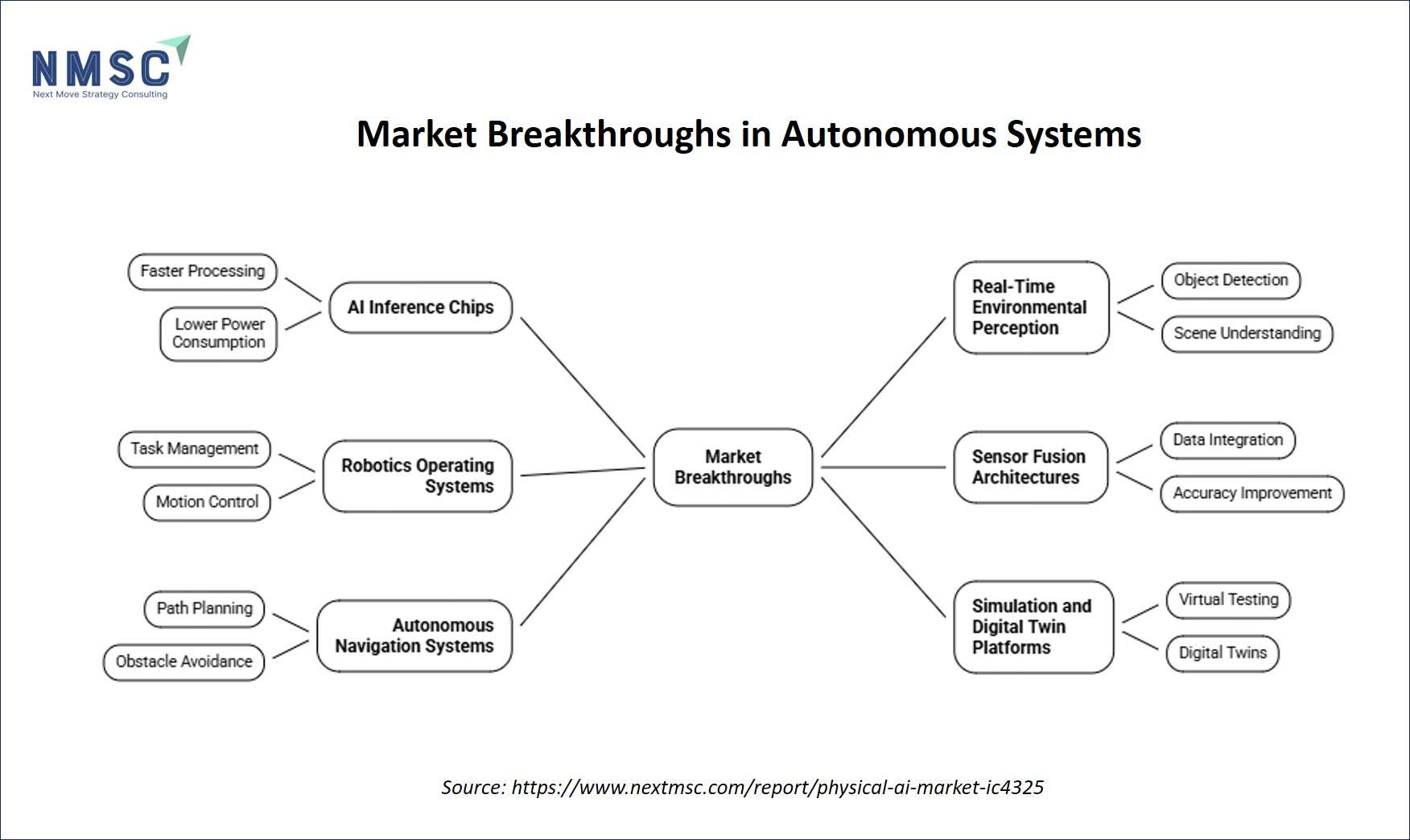
According to NMSC analysts, companies capable of controlling foundational AI infrastructure and robotics software ecosystems are expected to capture substantial long-term strategic value as commercialization accelerates.
What CEOs and Investors Should Do Next
-
Expand investments in robotics simulation and digital twin technologies
-
Strengthen partnerships across edge AI and semiconductor ecosystems
-
Prioritize autonomous systems deployment in logistics and manufacturing
-
Evaluate long-term workforce transformation tied to industrial automation
-
Monitor evolving regulatory frameworks around robotics and autonomous AI systems

Outlook
The Physical AI industry is entering a defining commercialization stage as AI systems increasingly move from digital environments into real-world operational deployment.
Recent developments from NVIDIA and Faraday Future underscore how rapidly competitive dynamics are evolving around embodied AI ecosystems, robotics infrastructure, and autonomous systems.
With industrial automation, humanoid robotics, AI mobility platforms, and digital twin technologies converging into a unified ecosystem, analysts expect Physical AI to emerge as one of the most strategically important technology sectors of the next decade.
About Next Move Strategy Consulting:
Next Move Strategy Consulting is a premier market research and management consulting firm that has been committed to provide strategically analysed well documented latest research reports to its clients. The research industry is flooded with many firms to choose from, what makes NMSC different from the rest is its top-quality research and the obsession of turning data into knowledge by dissecting every bit of it and providing fact-based research recommendation that is supported by information collected from over 500 million websites, paid databases, industry journals and one on one consultations with industry experts across a diverse range of industry sectors. The high-quality customized research reports with actionable insights and excellent end-to-end customer service help our clients to take critical business decisions that enables them to move beyond time and have competitive edge in the industry.
We have been servicing over 1000 customers globally that includes 90% of the Fortune 500 companies over a decade. Our analysts are constantly tracking various high growth markets and identifying hidden opportunities in each sector or the industry. We provide one of the industry’s best quality syndicate as well as custom research reports across 10 different industry verticals. We are committed to deliver high quality research solutions in accordance to your business needs. Our industry standard delivery solutions that ranges from the pre consultation to after-sales services, provide an excellent client experience and ensure right strategic decision making for businesses.
For more information, please contact:
Next Move Strategy Consulting
5th Floor 867
Boylston St, STE 500,
Boston, MA 02116, U.S.
E-Mail: [email protected]
Direct: +1-217-650-7991
Website: www.nextmsc.com
About the Author
 Sanyukta Deb
— Sanyukta Deb is Digital Marketing Team Lead at Next Move Strategy Consulting, where she has led content strategy and technical SEO for the firm's B2B market research publications for over 2 years. Her editorial process translates NextMSC's primary and secondary research — spanning technology, industrial, and consumer sectors — into commercial narratives, backed by search-intent, keyword, and competitive analysis. She brings 5 years of overall experience in digital marketing and content strategy.
Sanyukta Deb
— Sanyukta Deb is Digital Marketing Team Lead at Next Move Strategy Consulting, where she has led content strategy and technical SEO for the firm's B2B market research publications for over 2 years. Her editorial process translates NextMSC's primary and secondary research — spanning technology, industrial, and consumer sectors — into commercial narratives, backed by search-intent, keyword, and competitive analysis. She brings 5 years of overall experience in digital marketing and content strategy.
About the Reviewer
 Debashree Dey
— Debashree Dey is Assistant Manager at Next Move Strategy Consulting, where she supports cross-vertical market content and communications across diverse industries for 6 years. Her professional background includes senior content writing, communications, and published manuscript authorship, with experience developing audience-focused business narratives and maintaining clear, consistent messaging. Her role supports research-led content development and editorial quality across NextMSC publications.
Debashree Dey
— Debashree Dey is Assistant Manager at Next Move Strategy Consulting, where she supports cross-vertical market content and communications across diverse industries for 6 years. Her professional background includes senior content writing, communications, and published manuscript authorship, with experience developing audience-focused business narratives and maintaining clear, consistent messaging. Her role supports research-led content development and editorial quality across NextMSC publications.















Add Comment