Oil Supply Shocks Reshape Energy Infrastructure Priorities
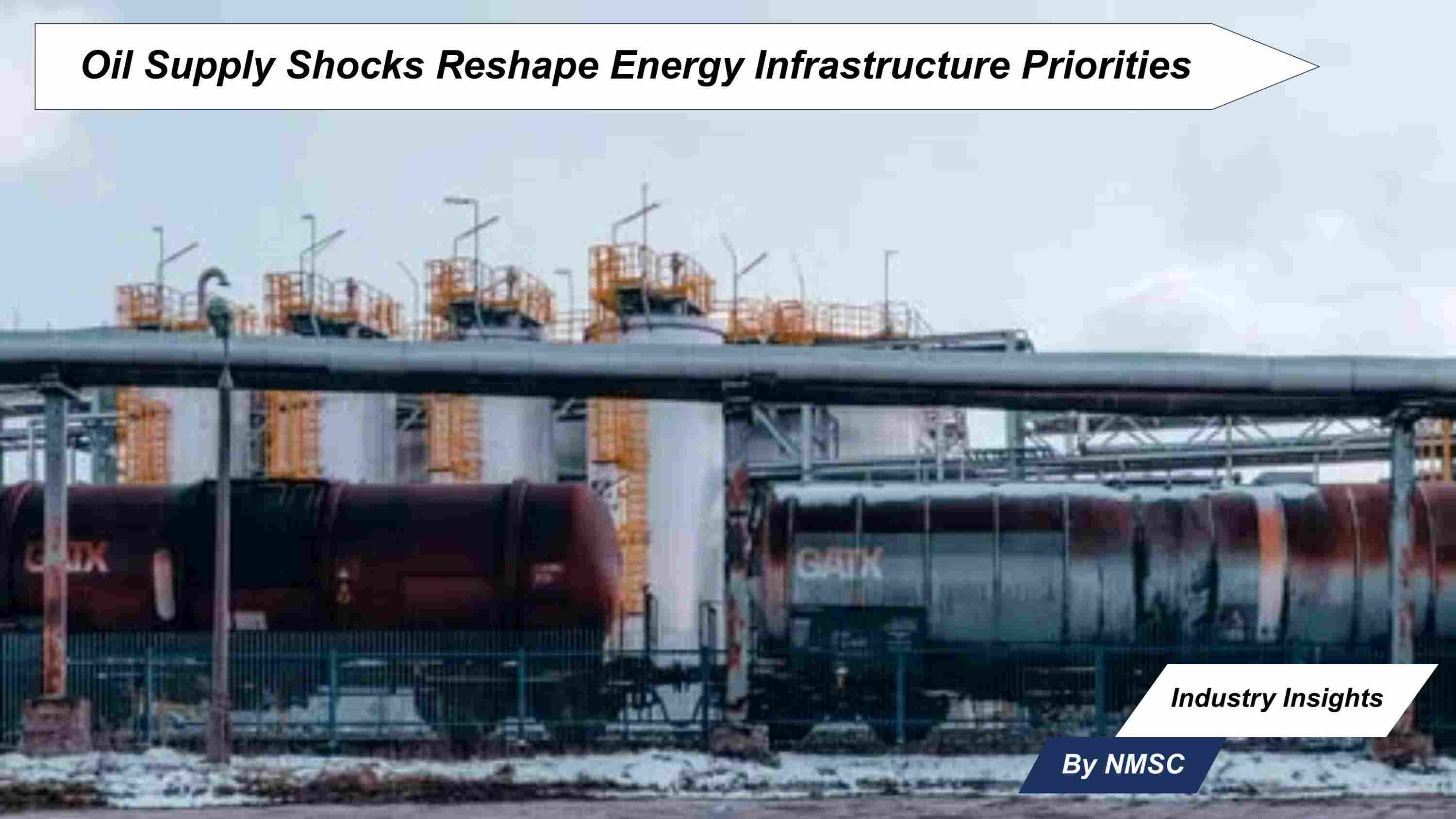
Oil Prices Hit Two-Week High as Saudi Attacks and Hormuz Tanker Strikes Escalate Supply Risks
LONDON, United Kingdom — October 12, 2026 — Oil prices surged to near two-week highs on Monday as escalating Houthi attacks on Saudi Arabia's Riyadh international airport and renewed tanker strikes in the Strait of Hormuz intensified global supply concerns, placing fresh pressure on the Oil & Gas EPC Market and the broader energy infrastructure investment landscape.
Brent crude futures rose $1.24, or 1.2%, to $106.19 per barrel by 1124 GMT their highest level since September 29 while US West Texas Intermediate crude climbed $1.11, or 1.2%, to $92.96 per barrel. The gains came even as US President Donald Trump announced that Russia would immediately supply more than 300,000 metric tons (2.25 million barrels) of diesel to US and global markets, alongside a Russia-Ukraine energy ceasefire.
The Iran-aligned Houthis claimed responsibility for a Saturday strike on Riyadh's King Khalid International Airport that killed 13 people and wounded more than 300, with further attacks reported on Sunday. Simultaneously, a tanker was struck by a drone near Oman's Sohar port, while a second vessel sustained damage transiting the Strait of Hormuz, according to the United Kingdom Maritime Trade Operations.
"The sense of some kind of normality of exports from the Strait of Hormuz was shattered last week. Fresh attacks by the Houthis on Saudi Arabia added to this and helped to lift prices," said SEB commodities analyst Bjarne Schieldrop, adding that "hard choices over what to defend will increasingly have to be made: oil infrastructure, military installations, royal palaces, civilian airports or other."
Goldman Sachs raised its Brent price forecast for December 2026 to $90 per barrel from $85, estimating a geopolitical risk premium of just over $20 per barrel, while forecasting WTI to average $81 in December 2026 and $73 in 2027. Meanwhile, Russia partially lifted its ban on diesel exports, releasing approximately 500,000 metric tons roughly 3.7 million barrels onto the international market, equivalent to around 13% of a single day of global demand, according to PVM analyst Tamas Varga.
In the Gulf of Mexico, energy majors Shell, Chevron, and BP were working to redeploy personnel and restore production at offshore platforms following Hurricane Isaias, which made landfall early on Saturday, compounding the week's supply disruption narrative. The International Energy Agency's Executive Director Fatih Birol called on all member countries to assess whether additional diesel releases are necessary and urged nations that have not yet fully delivered pledged volumes to accelerate releases, prioritising diesel supply.
Key Highlights:
-
Brent crude rose 1.2% to $106.19 per barrel on October 12, 2026 its highest level since September 29 driven by Houthi attacks on Saudi Arabia and Strait of Hormuz tanker strikes.
-
Goldman Sachs raised its December 2026 Brent forecast to $90 per barrel, citing a geopolitical risk premium exceeding $20 per barrel embedded in current prices.
-
Russia's diesel release of approximately 500,000 metric tons (~3.7 million barrels) represents roughly 13% of one day of global demand analysts note the immediate market impact remains limited given Russia's reduced refining capacity.
-
Shell, Chevron, and BP are restoring Gulf of Mexico production following Hurricane Isaias, adding a secondary supply recovery dynamic to an already volatile global energy market.
Analyst Insight:
According to analysts at Next Move Strategy Consulting, the convergence of Middle East supply disruptions, Strait of Hormuz tanker attacks, and Gulf of Mexico hurricane-related shutdowns represents a multi-vector stress event for global oil supply chains one that directly accelerates capital commitment toward energy infrastructure resilience. NMSC analysts note that the Oil & Gas EPC Market, valued at USD 2,179.65 Billion in 2026 and projected to reach USD 2,939.28 Billion by 2035 at a CAGR of 3.38%, is structurally positioned to absorb elevated EPC award activity as national oil companies and governments prioritize supply security through upstream field expansion, LNG terminal construction, and midstream infrastructure hardening. The Middle East & Africa region, which holds approximately 38% of global Oil & Gas EPC revenue share, faces the most immediate infrastructure investment pressure, with Saudi Arabia's market alone valued at approximately USD 238.86 Billion in 2025 underscoring the scale of assets now operating under heightened geopolitical risk.
Industry Outlook:
The escalation of Houthi attacks on Saudi energy infrastructure and the sustained targeting of tanker traffic through the Strait of Hormuz a corridor that historically carried approximately 20% of global oil and fuel shipments signals a structural shift in how energy infrastructure risk is priced and planned. For the Oil & Gas EPC sector, this environment reinforces the investment case for upstream field diversification, alternative export route development, and accelerated brownfield revamp programs in geographically stable markets. National oil companies across the GCC are expected to maintain or increase capital expenditure commitments to upstream and downstream EPC programs, even as geopolitical volatility introduces execution complexity. The IEA's call for coordinated emergency reserve releases further highlights the degree to which physical supply infrastructure pipelines, terminals, refineries, and export facilities has become a front-line strategic asset in the current conflict environment. Contractors with established GCC relationships, modular fabrication capability, and digital project delivery platforms are best positioned to capture the elevated EPC award volumes expected through the remainder of 2026 and into 2027.
Source: Reuters
For More Information: Download FREE Sample on Oil & Gas EPC Market Report
Prepared By: Sanyukta Deb
About the Author
 Sanyukta Deb
— Sanyukta Deb is Digital Marketing Team Lead at Next Move Strategy Consulting, where she has led content strategy and technical SEO for the firm's B2B market research publications for over 2 years. Her editorial process translates NextMSC's primary and secondary research — spanning technology, industrial, and consumer sectors — into commercial narratives, backed by search-intent, keyword, and competitive analysis. She brings 5 years of overall experience in digital marketing and content strategy.
Sanyukta Deb
— Sanyukta Deb is Digital Marketing Team Lead at Next Move Strategy Consulting, where she has led content strategy and technical SEO for the firm's B2B market research publications for over 2 years. Her editorial process translates NextMSC's primary and secondary research — spanning technology, industrial, and consumer sectors — into commercial narratives, backed by search-intent, keyword, and competitive analysis. She brings 5 years of overall experience in digital marketing and content strategy.
About the Reviewer
 Debashree Dey
— Debashree Dey is Assistant Manager at Next Move Strategy Consulting, where she supports cross-vertical market content and communications across diverse industries for 6 years. Her professional background includes senior content writing, communications, and published manuscript authorship, with experience developing audience-focused business narratives and maintaining clear, consistent messaging. Her role supports research-led content development and editorial quality across NextMSC publications.
Debashree Dey
— Debashree Dey is Assistant Manager at Next Move Strategy Consulting, where she supports cross-vertical market content and communications across diverse industries for 6 years. Her professional background includes senior content writing, communications, and published manuscript authorship, with experience developing audience-focused business narratives and maintaining clear, consistent messaging. Her role supports research-led content development and editorial quality across NextMSC publications.
















Add Comment