Oxford and KAUST Blood Sensor Challenges Imaging-Led Parkinson’s Diagnosis

A 66-Participant Blood Sensor Study, FDA Backing for Seed Amplification in Trials and Amprion’s Digital Pairing Point to Biology-Led Parkinson’s Diagnosis
In October 2026, bioengineers at King Abdullah University of Science and Technology (KAUST) and neuroscientists at the University of Oxford reported in Science Advances an experimental blood test that reads three forms of alpha-synuclein (total, aggregated and phosphorylated at serine 129) inside tiny vesicles shed by nerve cells, completing all three measurements in about 40 minutes. In a 66-person study, the University of Oxford’s NIHR Biomedical Research Centre said on 12 October 2026 that the combined readout separated people with Parkinson’s disease or isolated REM sleep behaviour disorder from healthy volunteers in nearly 90% of cases, and detected disease-linked signals in people at the earliest, prodromal stage. KAUST’s release of 6 October 2026 explained why blood testing has resisted this problem: more than 95% of circulating alpha-synuclein originates in red blood cells, which swamps the signal from brain-derived protein, and the researchers caution that the platform is not yet a standalone clinical test.
According to Next Move Strategy Consulting's Parkinson’s Disease Diagnostics Market report, the global Parkinson’s disease diagnostics market was valued at USD 4.53 billion in 2025 and is projected to reach USD 11.00 billion by 2035, growing at a CAGR of 9.28% from 2026 to 2035. NextMSC primary research and analysis attributes the trajectory to rising prevalence as populations age, regulatory validation of alpha-synuclein biomarkers and growing demand from biopharma sponsors for tests that enrich clinical-trial cohorts, and estimates the market at USD 4.95 billion in 2026.
For More Information: Download FREE Sample on Parkinson’s Disease Diagnostics Market Report
The Financial Logic: Parkinson’s Costs Accrue Before a Diagnosis Exists
The Michael J. Fox Foundation for Parkinson’s Research reported on 26 March 2026 that Parkinson’s disease and atypical parkinsonism cost the United States USD 82.2 billion in 2024 across roughly 1.2 million adults, of which USD 23.8 billion was excess direct medical spending and USD 58.4 billion was indirect and non-medical cost. The same study found that average medical costs in the 12 months before formal diagnosis ran about USD 10,000 per person above those of matched people without the disease. Health systems are therefore already paying for the condition before a diagnostic code exists, which is the gap that biomarker developers are targeting.
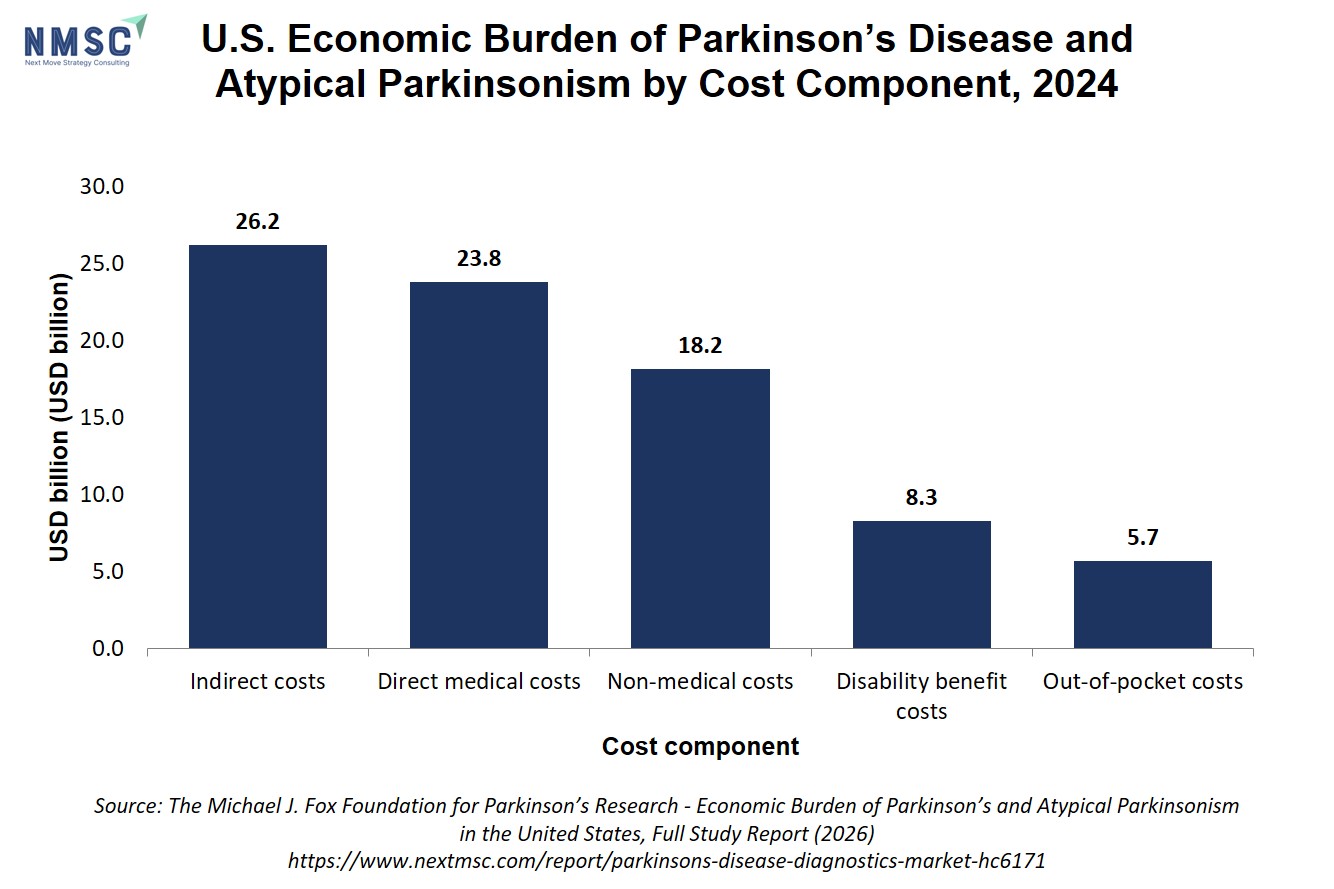
Indirect costs, mainly lost earnings and productivity among patients and unpaid care partners, formed the largest component at USD 26.2 billion, ahead of direct medical costs at USD 23.8 billion, according to the Michael J. Fox Foundation report.
Within the USD 23.8 billion of excess direct medical spending, the Foundation’s report assigned 42% to non-acute institutional care and 26% to hospital inpatient care, with prescription medication at 6%. The distribution shows spending concentrated in institutional and inpatient settings rather than in medication.
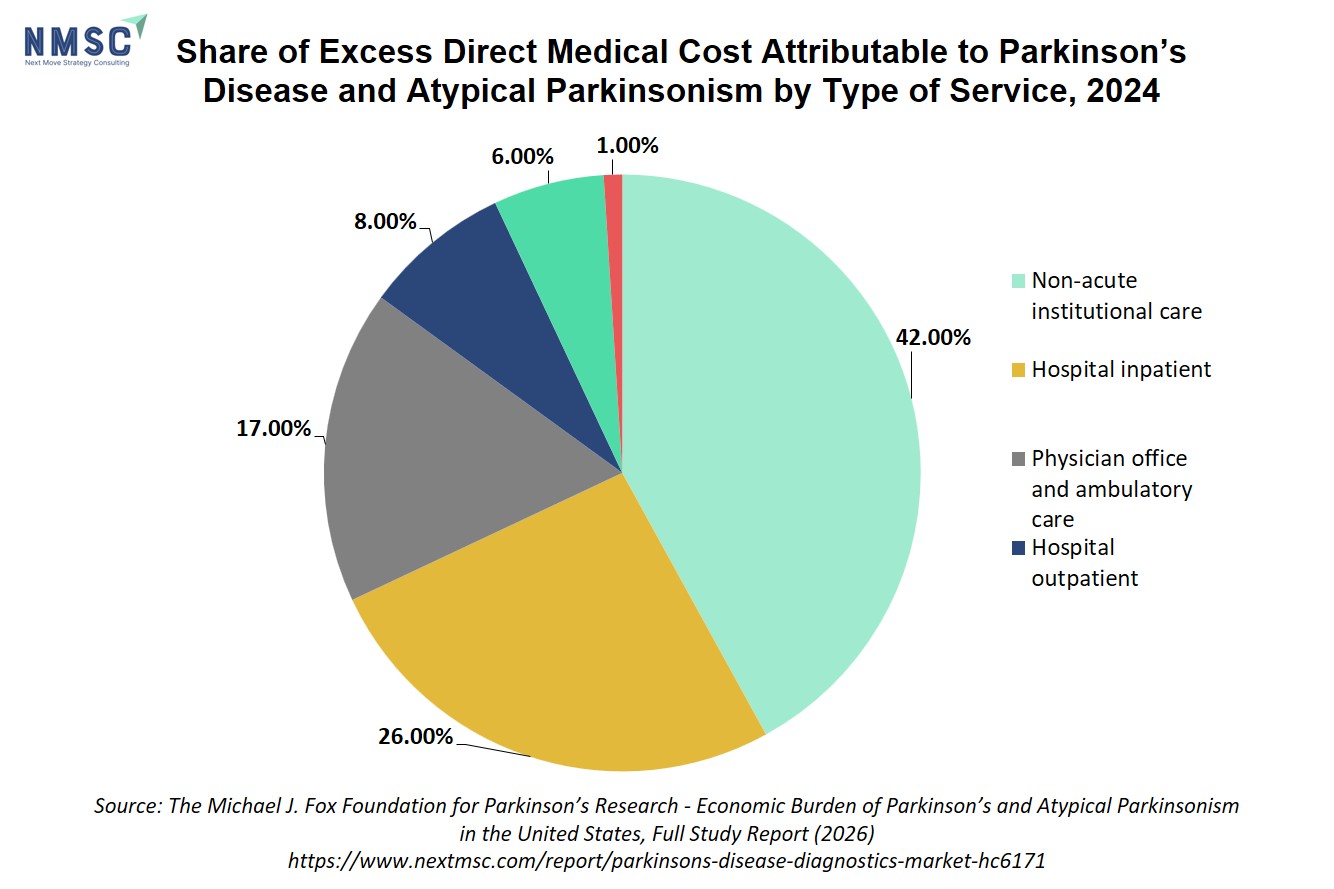
Physician office and ambulatory care accounted for 17% and hospital outpatient care for 8%, while durable medical equipment represented 1% of excess direct medical cost in 2024.
Medical Costs in the 12 Months Before Formal Diagnosis, United States (USD per person)
|
Insurance group |
Cost before diagnosis |
Comparison group without Parkinson’s |
Cost ratio |
|
Private insurance, under 65 |
$16,147 |
$12,482 |
1.3 |
|
Medicare, under 65 |
$39,363 |
$24,392 |
1.6 |
|
Medicaid, under 65 |
$20,910 |
$3,702 |
5.6 |
|
Medicare, 65 and older |
$30,832 |
$20,326 |
1.5 |
Demand for that testing is demographically anchored. The Parkinson’s Foundation reports that more than 1.1 million people in the United States live with Parkinson’s disease, that nearly 90,000 are diagnosed each year and that more than 10 million people are affected worldwide. The Michael J. Fox Foundation study shows how steeply prevalence climbs with age, from 0.04% of adults aged 18 to 49 to 2.05% of those aged 75 and older, so ageing populations enlarge the pool of people who need confirmation, differential diagnosis and staging.
Parkinson’s Disease and Atypical Parkinsonism Prevalence by Age Group, United States, 2024
|
Age group (years) |
Estimated people affected |
Prevalence rate |
|
18–49 |
56,816 |
0.04% |
|
50–64 |
240,838 |
0.39% |
|
65–74 |
376,698 |
1.07% |
|
75 and older |
539,611 |
2.05% |
|
All adults |
1,213,963 |
0.46% |
Key Industry Developments: Biology-Led Diagnosis Moves From Papers to Pathways
The Oxford–KAUST sensor sits within a run of 2026 developments. On 25 August 2026, the Critical Path Institute announced publication in the Journal of Parkinson’s Disease of the evidence and regulatory pathway behind the U.S. Food and Drug Administration’s Letter of Support for the alpha-synuclein seed amplification assay as a susceptibility and risk biomarker in clinical trials. The evidence traces to the Michael J. Fox Foundation’s flagship PPMI observational study, which first reported assay results in April 2023.
Commercial activity is following the biology. Amprion, which offers its SAAmplify-αSYN seed amplification test as a laboratory-developed assay, announced on 1 October 2026 a collaboration with Prema Cognition that places the 10-to-15-minute PREMAZ digital memory test, developed with the University of Cambridge Memory Lab, in front of confirmatory biomarker testing. The company disclosed that the assay received FDA Breakthrough Device designation in 2019 and has been commercially available in the United States since 2021. Earlier in 2026, Amprion announced a partnership with Macquarie University to establish clinical alpha-synuclein seed amplification testing in Australia (31 March) and a collaboration with Modality.AI to pair molecular biomarkers with AI-enabled digital assessments (9 July).
“a promising approach for detecting disease-associated forms of alpha-synuclein in blood”
- George Tofaris, Professor of Neurology and Translational Neuroscience, Nuffield Department of Clinical Neurosciences, University of Oxford, NIHR Biomedical Research Centre: Oxford news release, 12 October 2026.
Selected 2026 Developments in Parkinson’s Diagnostics
|
Date |
Organisation |
Development |
|
31 March 2026 |
Amprion and Macquarie University |
Partnership to establish clinical alpha-synuclein seed amplification testing in Australia |
|
9 July 2026 |
Amprion and Modality.AI |
Collaboration pairing molecular biomarkers with AI-enabled digital assessments, with Parkinson’s disease among the early areas of focus |
|
25 August 2026 |
Critical Path Institute |
Publication of the regulatory pathway behind the FDA Letter of Support for the alpha-synuclein seed amplification assay in clinical trials |
|
25 August 2026 |
Critical Path Institute |
Publication of the regulatory pathway behind the FDA Letter of Support for the alpha-synuclein seed amplification assay in clinical trials |
|
1 October 2026 |
Amprion and Prema Cognition |
Collaboration linking the PREMAZ digital memory test to confirmatory SAAmplify-αSYN testing |
|
October 2026 |
KAUST and University of Oxford |
Science Advances report of a blood-based electronic sensor measuring three alpha-synuclein forms in neuronal vesicles |
Segment Dynamics: Imaging Holds the Revenue, Assays Hold the Momentum
NextMSC primary research and analysis shows that neuroimaging led the market with USD 2.36 billion of 2025 revenue, about 52.1% of the total, because dopamine transporter SPECT remains the established confirmatory standard. The University of Oxford’s NIHR Biomedical Research Centre notes in its 12 October 2026 release that brain imaging is costly and unsuitable for large-scale screening, the limitation blood-based tests are built to remove. NextMSC projects biomarker assays, at USD 1.02 billion in 2025, to reach USD 3.70 billion by 2035 at a CAGR of 13.86%, lifting their share of revenue from 22.5% to 33.6% as seed amplification testing moves from specialist laboratories into routine neurology pathways.
Digital and wearable diagnostics are projected to expand from USD 0.62 billion to USD 1.90 billion at an 11.73% CAGR, while genetic testing is projected to rise from USD 0.53 billion to USD 1.00 billion at 6.44%, according to NextMSC primary research and analysis. By end user, hospitals and neurology clinics led with USD 1.85 billion in 2025, and research institutes and biopharma companies are the fastest-growing group at a 10.92% CAGR, a trajectory consistent with the trial-enrichment role the Critical Path Institute describes for the seed amplification assay.
Regional Outlook: North America Anchors Revenue, Asia-Pacific Sets the Pace
According to NextMSC primary research and analysis, North America led with about 38.0% of 2025 revenue, at USD 1.72 billion, and is projected to reach USD 3.75 billion by 2035, with the United States alone at approximately USD 1.52 billion in 2025. The Parkinson’s Foundation’s count of more than 1.1 million Americans living with the disease and nearly 90,000 new diagnoses a year provides the patient base behind that demand. Asia-Pacific is the fastest-growing region at an 11.59% CAGR, rising from USD 1.10 billion in 2025 to USD 3.30 billion by 2035, with India the fastest-growing country at 15.19% from a small base. Europe is projected to grow from USD 1.22 billion to USD 2.70 billion over the same period.
Institutional activity outside the United States points the same way. Amprion’s Macquarie University partnership brings seed amplification testing to Australia, and the blood sensor reported in October 2026 was developed jointly by a Saudi Arabian and a British university.
Growth Drivers and Restraints
-
Driver, population ageing: the Michael J. Fox Foundation study puts prevalence at 0.04% among adults aged 18 to 49 and 2.05% among those aged 75 and older, so older populations enlarge the tested population.
-
Driver, regulatory validation: the FDA Letter of Support for the alpha-synuclein seed amplification assay, documented by the Critical Path Institute on 25 August 2026, gives trial sponsors a recognised biomarker for cohort selection.
-
Driver, less invasive sampling: the University of Oxford’s NIHR Biomedical Research Centre reports that its October 2026 blood-sensor study separated patients from healthy volunteers in nearly 90% of cases from a blood sample.
-
Restraint, validation depth: the sensor was tested in 66 people, and KAUST states that it is not yet a standalone clinical blood test.
-
Restraint, access and reimbursement: NextMSC primary research and analysis identifies limited reimbursement for biomarker tests, a shortage of movement disorder specialists and assay standardisation gaps across laboratories as the main brakes on adoption.
NMSC Strategic Perspective: Diagnosis Is Moving From Symptoms to Biology
NextMSC primary research and analysis reads the October 2026 sensor result, the Letter of Support documentation and Amprion’s digital pairing as one pattern: diagnosis, which remains largely clinical today, is being redefined around pathology that can be measured. Revenue concentration in imaging is gradually giving way to molecular and digital testing, and value is migrating toward vendors that bundle an assay with interpretive software and clinician education rather than selling a single test.
For vendors, NextMSC’s analysis favours securing payer coverage early and pursuing laboratory partnerships in Asia-Pacific, while imaging leaders defend installed bases through quantification software and specialist firms license methods to regional laboratories instead of building capacity themselves. The decisive variable is evidence: NextMSC primary research and analysis indicates that a failed multicentre validation of blood-based tests would delay the forecast mix shift, whereas early payer coverage would pull biomarker adoption ahead of the base case.
For investors, the report’s USD 6.05 billion absolute revenue opportunity between 2026 and 2035 is weighted toward biomarker assays and Asia-Pacific, the two fastest-growing areas, while reimbursement timing remains the risk that determines how quickly regulatory milestones convert into revenue.
Competitive Landscape
NextMSC primary research and analysis describes the market as moderately concentrated, with imaging and diagnostics groups holding most revenue while specialist assay and digital firms grow fastest. The 16 companies profiled in the report include GE HealthCare Technologies, Siemens Healthineers, Koninklijke Philips, Roche, Abbott, Amprion, Quanterix and Rune Labs. NextMSC finds that licensing and laboratory partnerships prevail over large acquisitions, a pattern consistent with Amprion’s three 2026 announcements with Macquarie University, Modality.AI and Prema Cognition, each disclosed through Business Wire.
Companies compete on clinical evidence, installed base, laboratory access and payer coverage, according to NextMSC primary research and analysis. Consolidation becomes more likely once a regulator clears a blood-based synuclein test, at which point diagnostics majors may seek assay developers’ intellectual property and laboratory capacity.
Bottom Line
Parkinson’s diagnosis is being rebuilt around measurable biology, and October 2026 supplied the clearest evidence yet. The KAUST and University of Oxford blood sensor, which read three alpha-synuclein forms in about 40 minutes and separated patients from healthy volunteers in nearly 90% of cases in a 66-person study, remains experimental, but it arrives alongside FDA support for seed amplification in clinical trials and Amprion’s pairing of molecular testing with digital screening. The Michael J. Fox Foundation’s USD 82.2 billion cost figure for 2024, and its finding that medical costs run about USD 10,000 higher per person before diagnosis, give payers a financial reason to care. According to NextMSC primary research and analysis, the global Parkinson’s disease diagnostics market will grow from USD 4.53 billion in 2025 to USD 11.00 billion by 2035 at a 9.28% CAGR, with biomarker assays and Asia-Pacific leading growth. Validation depth and reimbursement timing will determine how fast that mix shift arrives.
About Next Move Strategy Consulting
Next Move Strategy Consulting is a premier market research and management consulting firm that has been committed to provide strategically analysed well documented latest research reports to its clients. The research industry is flooded with many firms to choose from, what makes NMSC different from the rest is its top-quality research and the obsession of turning data into knowledge by dissecting every bit of it and providing fact-based research recommendation that is supported by information collected from over 500 million websites, paid databases, industry journals and one on one consultations with industry experts across a diverse range of industry sectors. The high-quality customized research reports with actionable insights and excellent end-to-end customer service help our clients to take critical business decisions that enables them to move beyond time and have competitive edge in the industry.
We have been servicing over 1000 customers globally that includes 90% of the Fortune 500 companies over a decade. Our analysts are constantly tracking various high growth markets and identifying hidden opportunities in each sector or the industry. We provide one of the industry’s best quality syndicate as well as custom research reports across 10 different industry verticals. We are committed to deliver high quality research solutions in accordance to your business needs. Our industry standard delivery solutions that ranges from the pre consultation to after-sales services, provide an excellent client experience and ensure right strategic decision making for businesses.
For more information, please contact:
Next Move Strategy Consulting
5th Floor 867 Boylston St, STE 500,
Boston, MA 02116, U.S.
E-Mail: [email protected]
Direct: +1-217-650-7991
Website: www.nextmsc.com
About the Author
 Sanyukta Deb
— Sanyukta Deb is Digital Marketing Team Lead at Next Move Strategy Consulting, where she has led content strategy and technical SEO for the firm's B2B market research publications for over 2 years. Her editorial process translates NextMSC's primary and secondary research — spanning technology, industrial, and consumer sectors — into commercial narratives, backed by search-intent, keyword, and competitive analysis. She brings 5 years of overall experience in digital marketing and content strategy.
About the Reviewer
 Debashree Dey
— Debashree Dey is Assistant Manager at Next Move Strategy Consulting, where she supports cross-vertical market content and communications across diverse industries for 6 years. Her professional background includes senior content writing, communications, and published manuscript authorship, with experience developing audience-focused business narratives and maintaining clear, consistent messaging. Her role supports research-led content development and editorial quality across NextMSC publications.















Add Comment