Parkinson’s Disease Diagnostics Market Global Industry Analysis and Forecast (2026–2035)

The global Parkinson’s Disease Diagnostics Market is estimated at USD 4.95 Billion in 2026 and is projected to reach **USD 11.00 Billion by 2035, growing at a CAGR of 9.28% from 2026 to 2035 Growth is driven by rising disease prevalence, demand for early diagnosis, and advances in biomarker testing, neuroimaging, and wearable diagnostics.

Download Free Sample PDF
Base Year (2025)
$4.53 Billion
Forecast (2035)
$11.00 Billion
CAGR (2026-2035)
9.3%
Top Region
North America

What Is the Parkinson’s Disease Diagnostics Market Size?

The global Market was valued at USD 4.53 Billion in 2025, is estimated at USD 4.95 Billion in 2026, and is projected to reach USD 11.00 Billion by 2035, growing at a CAGR of 9.28% from 2026–2035. North America led with approximately 38.0% share in 2025, while neuroimaging dominated with approximately 52.1% share.

We observed that revenue concentration in imaging is gradually giving way to molecular and digital testing, which shapes the following key takeaways.

Parkinson’s Disease Diagnostics Market Global Industry Analysis and Forecast (2026–2035) Revenue Forecast

Values in USD Billion

2025 $4.53 Billion
2025
2026 $4.95 Billion
2026
2027 $5.41 Billion
2027
2028 $5.91 Billion
2028
2029 $6.46 Billion
2029
2030 $7.06 Billion
2030
2031 $7.71 Billion
2031
2032 $8.43 Billion
2032
2033 $9.21 Billion
2033
2034 $10.07 Billion
2034
2035 $11.00 Billion
2035

Key Takeaways

Diagnostic modality, dominant: Neuroimaging (USD 2.36 Billion in 2025; USD 4.40 Billion in 2035)

Diagnostic modality, fastest growing: Biomarker assays (CAGR of 13.86% from 2026–2035)

End user, dominant: Hospitals and neurology clinics (USD 1.85 Billion in 2025; USD 4.20 Billion in 2035)

End user, fastest growing: Research institutes and biopharma companies (CAGR of 10.92% from 2026–2035)

Dominant Region: North America (USD 1.72 Billion in 2025; USD 3.75 Billion in 2035)

Fastest-Growing Region: Asia-Pacific (CAGR of 11.59% from 2026–2035)

Dominant Country: U.S. (USD 1.52 Billion in 2025; USD 3.30 Billion in 2035)

Fastest-Growing Country: India (CAGR of 15.19% from 2026–2035)

Market opportunity: the Parkinson’s disease diagnostics market adds an absolute revenue opportunity of USD 6.05 Billion between 2026 and 2035, signalling a durable entry window for capital directed at biomarker and digital platforms.

According to NMSC analysis, biomarker assays, although only 22.5% of 2025 revenue, will lift their share to 33.6% by 2035 as seed amplification testing moves from specialist laboratories into routine neurology pathways.

What does the Parkinson’s Disease Diagnostics Market Encompass?

The market covers imaging systems, laboratory assays, genetic tests, and digital tools that identify Parkinson’s disease, separate it from atypical parkinsonism, and track progression. It spans dopamine transporter SPECT, MRI, PET, cerebrospinal fluid and blood assays, gene panels, and wearable sensors sold to hospitals, laboratories, imaging centers, and research organizations. Our findings suggest that diagnosis remains largely clinical, so objective biomarkers address a substantial unmet need across roughly 1.1 million diagnosed Americans.
Diagnosis historically rested on neurologist examination, with dopamine transporter imaging as the main confirmatory tool. Regulation is shifting toward biology-based definitions, and the U.S. FDA issued a Letter of Support endorsing cerebrospinal fluid alpha-synuclein seed amplification for trial enrichment. Laboratory developed tests operate under CLIA oversight, while imaging agents need marketing authorization. Technology adoption is moving from specialist centers toward routine laboratory and wearable workflows, which widens the addressable patient pool.

Market Drivers & Dynamics

Interactive Dataset
Rising Parkinson’s prevalence with population aging driver +1.9% Global 2026–2035
Regulatory validation of alpha-synuclein biomarkers driver +1.6% North America, Europe 2026–2032
Biopharma demand for trial enrichment diagnostics driver +1.2% North America, Europe, Asia-Pacific 2026–2033
Adoption of wearable and digital motor monitoring driver +0.9% North America, Europe 2026–2035
Neurology capacity expansion in Asia-Pacific driver +0.8% Asia-Pacific 2027–2035
Limited reimbursement for biomarker tests restraint −1.1% Global 2026–2030
Shortage of movement disorder specialists restraint −0.8% Latin America, Middle East & Africa 2026–2035
High cost of radiotracers and imaging logistics restraint −0.7% Global 2026–2031
Lack of assay standardization across laboratories restraint −0.6% Global 2026–2029
Source: Next Move Strategy Consulting

Growth Drivers

What is the primary growth driver of the Parkinson’s Disease Diagnostics Market?

Population aging is the primary growth driver, because age is the main risk factor for Parkinson’s disease. The Parkinson’s Foundation reports more than 1.1 million people living with the disease in the United States, nearly 90,000 new diagnoses each year, and more than 10 million patients worldwide. Our assessment indicates that this expanding diagnosed base raises test volumes, since every new case requires confirmation, differential diagnosis, and staging within the market.

How is biomarker validation driving Parkinson’s Disease Diagnostics Market growth?

Regulatory recognition converts research assays into clinical and trial infrastructure. The U.S. FDA issued a Letter of Support endorsing cerebrospinal fluid alpha-synuclein seed amplification as a susceptibility and risk biomarker for clinical trials, and the Parkinson’s Progression Markers Initiative supplied key evidence. Based on research conducted by NMSC, we found that this endorsement raises sponsor demand for screening tests and supports growth of laboratory volumes through 2035.

Growth Inhibitors

What is restraining the growth of the Parkinson’s disease diagnostics market?

Reimbursement and access gaps are the primary restraint. Many biomarker assays remain laboratory developed tests without uniform payer coverage, and movement disorder specialists are scarce outside major centers. We estimate that limited coverage and specialist shortages together reduce the 2026–2035 CAGR by roughly 1.9 percentage points (industry-derived estimate, no publicly verifiable dataset available). Radiotracer costs add further friction for the wider imaging segment.

What Are the Growth Opportunities?

Can blood based screening unlock prodromal detection in the Parkinson’s Disease Diagnostics Market?

Blood based synuclein tests could screen people with REM sleep behaviour disorder or hyposmia before motor symptoms appear. Central diagnostic laboratories benefit most, because a scalable venous draw removes the lumbar puncture barrier and supports high volume batch testing. Success depends on multicentre validation and payer coverage, yet the mechanism opens a screening pathway far larger than today’s symptomatic confirmation market.

Will companion diagnostics for disease modifying trials create new revenue in the Parkinson’s Disease Diagnostics Market?

Sponsors of alpha-synuclein therapies need biomarker positive participants, which turns seed amplification and imaging into enrolment gatekeepers. Research institutes and biopharma companies benefit through recurring assay contracts, and laboratories with trial grade quality systems gain preferred vendor status. If a therapy reaches approval, a paired companion diagnostic could convert research volumes into routine clinical testing.

Can remote monitoring extend the Parkinson’s Disease Diagnostics Market into emerging regions?

Wearable sensors and smartphone assessments allow general physicians to capture objective motor data where movement disorder specialists are scarce. Digital and wearable diagnostics benefit most, particularly in Latin America, Southeast Asia, and the Middle East. Telehealth reimbursement and low device cost are the enabling mechanisms, and hospitals can use the resulting data to triage referrals to specialized specialist centers.

Segmentation Analysis

2025 (USD Billion)
2035 (USD Billion)
Neuroimaging 2025: $2.36 Billion | 2035: $4.40 Billion
Neuroimaging
Biomarker assays 2025: $1.02 Billion | 2035: $3.70 Billion
Biomarker as
Genetic testing 2025: $0.53 Billion | 2035: $1.00 Billion
Genetic test
Digital and wearable diagnostics 2025: $0.62 Billion | 2035: $1.90 Billion
Digital and
Neuroimaging $2.36 Billion $4.40 Billion 6.34%
Biomarker assays $1.02 Billion $3.70 Billion 13.86%
Genetic testing $0.53 Billion $1.00 Billion 6.44%
Digital and wearable diagnostics $0.62 Billion $1.90 Billion 11.73%

Which diagnostic modality leads the Parkinson’s Disease Diagnostics Market?

Diagnostic modality separates neuroimaging, biomarker assays, genetic testing, and digital tools by the evidence each generates. Neuroimaging led with USD 2.36 Billion in 2025 because dopamine transporter SPECT is the established confirmatory standard. Our analysis shows that biomarker assays grow fastest at 13.86% through 2035, as seed amplification testing gains regulatory endorsement, while digital tools follow at 11.73% on remote monitoring demand.

2025 (USD Billion)
2035 (USD Billion)
Hospitals an
Diagnostic l
Diagnostic i
Research ins
Segment Item 2025 (USD Billion) 2035 (USD Billion) CAGR
Hospitals and neurology clinics $10.0 USD Billion $40.0 USD Billion 26.0%
Diagnostic laboratories $17.1 USD Billion $51.1 USD Billion 16.0%
Diagnostic imaging centers $24.2 USD Billion $62.2 USD Billion 18.0%
Research institutes and biopharma companies $31.3 USD Billion $73.3 USD Billion 8.0%

Segment-wise data is locked

Unlock complete segment-wise numbers for By End User.

Unlock Full Data

Which end user dominates the Parkinson’s Disease Diagnostics Market?

End user reflects where the test is ordered and delivered. Hospitals and neurology clinics led with USD 1.85 Billion in 2025, as neurologists anchor the diagnostic pathway. Our findings suggest that research institutes and biopharma companies grow fastest at 10.92% through 2035, driven by trial enrichment testing, while diagnostic laboratories reach 10.51% as centralized seed amplification testing scales.

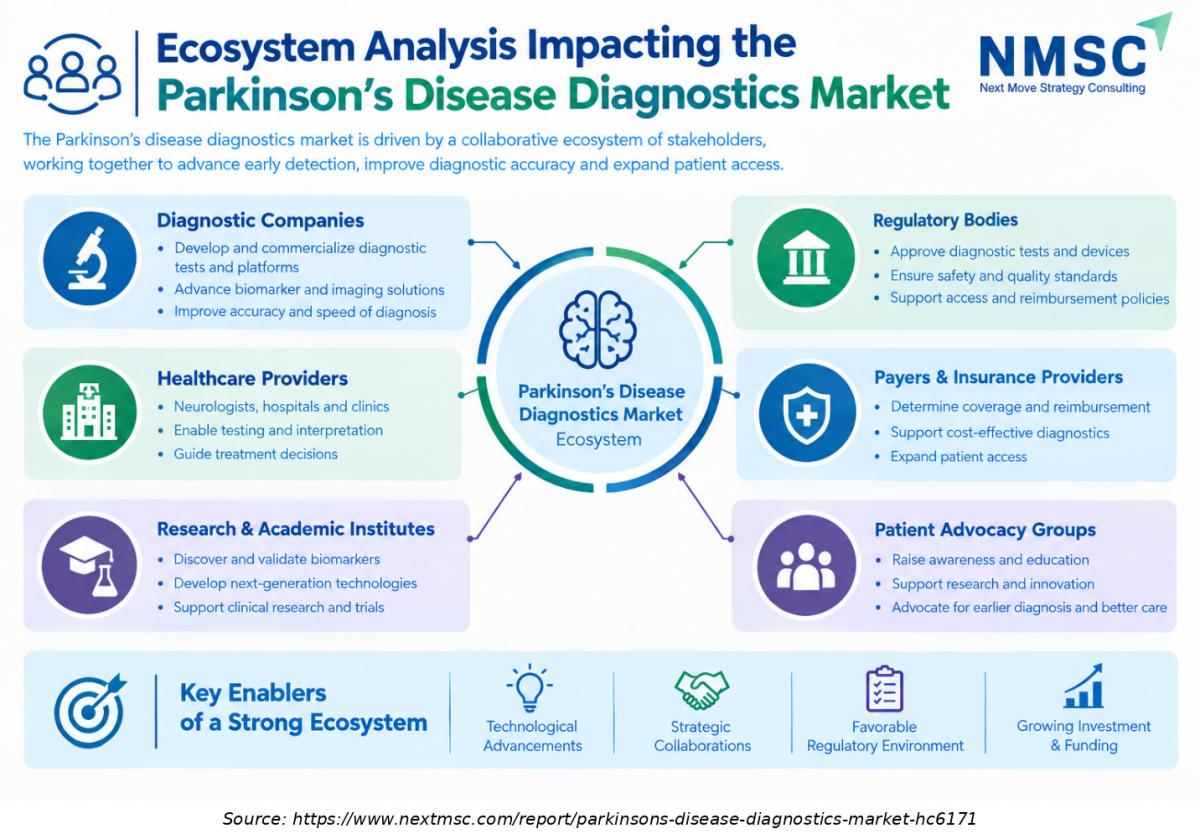
Ecosystem Analysis Impacting the Parkinson’s Disease Diagnostics Market

The Ecosystem Analysis infographic for the Parkinson’s Disease Diagnostics Market highlights the key stakeholders involved in the diagnostic landscape, including diagnostic technology providers, biomarker developers, hospitals, laboratories, neurologists, research institutions, regulatory bodies, and patients. It illustrates their interconnected roles across diagnostic development, testing, clinical research, and patient care.

Growth Opportunities

We found that three whitespace opportunities offer the clearest route to revenue beyond the base forecast.

Can blood based screening unlock prodromal detection in the Parkinson’s Disease Diagnostics Market?

Blood based synuclein tests could screen people with REM sleep behaviour disorder or hyposmia before motor symptoms appear. Central diagnostic laboratories benefit most, because a scalable venous draw removes the lumbar puncture barrier and supports high volume batch testing. Success depends on multicentre validation and payer coverage, yet the mechanism opens a screening pathway far larger than today’s symptomatic confirmation market.

Will companion diagnostics for disease modifying trials create new revenue in the Parkinson’s Disease Diagnostics Market?

Sponsors of alpha-synuclein therapies need biomarker positive participants, which turns seed amplification and imaging into enrolment gatekeepers. Research institutes and biopharma companies benefit through recurring assay contracts, and laboratories with trial grade quality systems gain preferred vendor status. If a therapy reaches approval, a paired companion diagnostic could convert research volumes into routine clinical testing.

Can remote monitoring extend the Parkinson’s Disease Diagnostics Market into emerging regions?

Wearable sensors and smartphone assessments allow general physicians to capture objective motor data where movement disorder specialists are scarce. Digital and wearable diagnostics benefit most, particularly in Latin America, Southeast Asia, and the Middle East. Telehealth reimbursement and low device cost are the enabling mechanisms, and hospitals can use the resulting data to triage referrals to scarce specialist centers.

Regional Outlook

2025 (USD Billion)
2035 (USD Billion)
North Americ
Europe
Asia-Pacific
Middle East
Latin Americ
Region 2025 (USD Billion) 2035 (USD Billion) CAGR (%)
North America $10.0 USD Billion $40.0 USD Billion 9.0%
Europe $17.1 USD Billion $51.1 USD Billion 27.0%
Asia-Pacific $24.2 USD Billion $62.2 USD Billion 25.0%
Middle East & Africa $31.3 USD Billion $73.3 USD Billion 23.0%
Latin America $38.4 USD Billion $84.4 USD Billion 12.0%

Regional data is locked

Unlock complete regional numbers for this market.

Unlock Full Data

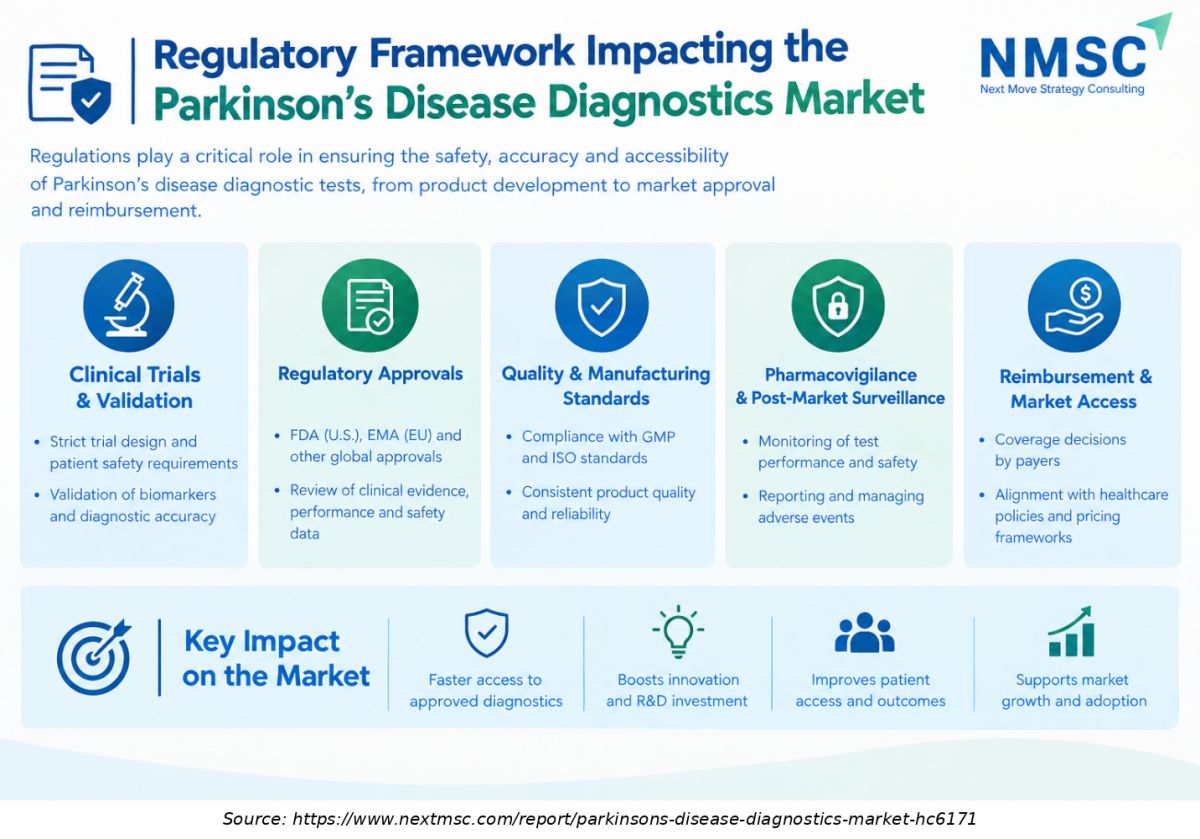
Regulatory Framework Impacting the Parkinson’s Disease Diagnostics Market

The Regulatory Framework infographic for the Parkinson’s Disease Diagnostics Market highlights key regulatory areas including diagnostic approval, clinical validation, patient safety, biomarker testing, medical-device standards, data privacy, and post-market surveillance. It illustrates how regulatory requirements shape the development, validation, and adoption of Parkinson’s disease diagnostic technologies.

Competitive Landscape

Our assessment indicates that the industry is moderately concentrated, with imaging majors and laboratory networks sharing revenue with specialist assay developers.

Dimension Description
Parameter Key Takeaway
Market Structure Moderately concentrated; imaging and diagnostics conglomerates hold most revenue while specialist assay and digital firms grow fastest
Innovation Focus Seed amplification assays, blood-based biomarkers, automated image quantification, and wearable motor sensing
M&A Activity Selective; licensing and laboratory partnerships prevail over large acquisitions

How do companies compete in the Parkinson’s Disease Diagnostics Market?

Companies compete on clinical evidence, installed base, laboratory access, and payer coverage rather than price alone. Imaging vendors bundle scanners, tracers, and quantification software, while laboratory networks compete on turnaround time and test menus. We observed that geographic expansion follows regulatory clearance, with vendors entering Asia-Pacific through local distributors and tiered pricing, and specialist firms licensing methods to partner laboratories abroad.

Which company archetypes dominate the Parkinson’s Disease Diagnostics Market?

Three archetypes dominate: imaging platform leaders, diversified diagnostics groups, and specialist biomarker developers. Imaging leaders such as GE HealthCare and Siemens Healthineers win through installed scanner bases and tracer linkage. Diversified groups such as Roche and LabCorp win through laboratory scale and channel reach. Specialists such as Amprion win through proprietary assay differentiation, and this evidence-based edge explains dominance in the market.

What defines innovation and differentiation strategy in the Parkinson’s Disease Diagnostics Market?

Differentiation centers on earlier and less invasive detection. Companies invest in blood and skin based synuclein assays, quantitative imaging software, and multimodal digital biomarkers, and they publish validation data to win payer confidence. Our findings suggest that vendors combining an assay with interpretive software and clinician education gain the strongest pull, while pricing strategies range from premium laboratory tests to subscription based digital platforms.

How active is M&A in the Parkinson’s Disease Diagnostics Market?

Acquisition activity remains selective, because assay standardization and reimbursement are unresolved. We found that larger groups prefer licensing, research collaborations, and laboratory partnerships to outright purchases, preserving optionality while evidence matures. Consolidation is more likely once regulators clear a blood based synuclein test, at which point diagnostics majors may acquire assay developers to secure intellectual property and laboratory capacity in the market.

Key Market Players

NMSC’s analysis indicates that the following 16 verified companies define the competitive set, listed in ranked order.

GE HealthCare Technologies Inc. Siemens Healthineers AG Koninklijke Philips N.V. Roche Holding AG Abbott Laboratories Thermo Fisher Scientific Inc. Danaher Corporation Labcorp Holdings Inc. Quest Diagnostics Incorporated Canon Inc. FUJIFILM Holdings Corporation Amprion Inc. Quanterix Corporation Revvity, Inc. Bio-Rad Laboratories, Inc. Rune Labs, Inc.

Latest Developments

We noticed that the most verifiable 2025–2026 developments are peer reviewed and regulatory milestones supporting biomarker adoption.

Date Event
May 2025 Rune Labs and the Parkinson’s Foundation launched a clinical program combining StrivePD wearable data with PD Generation genetic testing
March 2025 Mayo Clinic Laboratories and Amprion announced a collaboration expanding access to Amprion’s Simplify-αSYN test across the United States
April 2025 Quanterix introduced a dried-blood-spot extraction kit for Simoa assays at AD/PD 2025, enabling sensitive measurement of low-concentration neurobiomarkers from dried blood samples

Expert Insights

Ariana Farrand, PhD

Ariana Farrand, PhD

Senior Scientific Portfolio Manager | The Michael J. Fox Foundation

"“Biomarkers may have many different applications. For example, in clinical trials for Parkinson’s, they can be used to identify someone who has the disease, subgroups of patients that may be more likely to respond to a particular type of treatment or to measure how someone responds to treatment. They may also be used to identify people with Parkinson’s early in their disease progression, with the goal of one day slowing or halting the disease before symptoms even start.”"

Analyst Interpretation

The statement highlights the expanding role of biomarkers across the Parkinson’s diagnostic pathway. Beyond confirming disease presence, biomarker technologies are being developed for earlier identification, patient stratification, and disease monitoring. This is supporting a shift from symptom-based diagnosis toward biologically informed diagnostics and is increasing research activity around blood, cerebrospinal fluid, skin, genetic, and other biomarker platforms.

Market Interpretation

The statement highlights the expanding role of biomarkers across the Parkinson’s diagnostic pathway. Beyond confirming disease presence, biomarker technologies are being developed for earlier identification, patient stratification, and disease monitoring. This is supporting a shift from symptom-based diagnosis toward biologically informed diagnostics and is increasing research activity around blood, cerebrospinal fluid, skin, genetic, and other biomarker platforms.

Investment Opportunities

Where are capital inflows concentrating in the Parkinson’s Disease Diagnostics Market?

Capital flows toward assay developers, digital monitoring platforms, and radiotracer capacity, where evidence milestones create clear valuation steps. Biopharma sponsors indirectly fund diagnostics through trial enrichment contracts, which supports specialist laboratories. We estimate that research and biopharma customers account for 12.1% of 2025 revenue (industry-derived estimate, no publicly verifiable dataset available), a base that should broaden as clinical adoption follows.

Which infrastructure investments matter most for the Parkinson’s Disease Diagnostics Market?

Infrastructure priorities include CLIA and ISO accredited laboratories for seed amplification, cold chain logistics for cerebrospinal fluid specimens, and SPECT and PET capacity for community hospitals. Radio pharmacy networks determine tracer availability, so regions with sparse supply lag regardless of demand. During our market evaluation, we noticed that laboratories investing in automation and standardized protocols achieve the throughput needed to serve multinational trials.

How do ESG considerations affect investment in the Parkinson’s Disease Diagnostics Market?

Social considerations dominate: earlier diagnosis improves patient outcomes and reduces the US healthcare burden, which the Parkinson’s Foundation estimates at USD 82.2 billion for 2024. Governance matters because laboratory developed tests need transparent validation and data privacy for digital platforms. Environmental factors include radioisotope handling and waste. Investors increasingly screen for equitable access, since underserved regions remain underpenetrated and represent a long-term expansion opportunity.

Key Benefits for Stakeholders

How does this Parkinson’s Disease Diagnostics Market report benefit enterprise and industry leaders?

Industry leaders gain a segment level view of where revenue sits and where it will move. The report sizes each diagnostic modality, end user, and region for 2025 and 2035, helping executives allocate portfolio investment between imaging, assays, and digital tools. Competitive analysis of this market clarifies partnership targets, geographic entry priorities, and pricing positions against rivals.

How does this Parkinson’s Disease Diagnostics Market report benefit investors and financial analysts?

Investors receive a triangulated forecast anchored on USD 4.53 Billion in 2025 and USD 11.00 Billion in 2035, with a 9.28% CAGR for 2026–2035. The catalyst and risk matrix quantifies how each driver and restraint shifts growth, supporting scenario modelling. Country level projections identify where capital deployment can earn the highest incremental returns.

How does this Parkinson’s Disease Diagnostics Market report benefit technology vendors and product teams?

Vendors and product teams obtain evidence on which technologies gain clinical traction and which barriers slow them. Segment growth rates guide research priorities across seed amplification, blood-based assays, and wearable sensing. Regional and end user analysis shows where regulatory readiness and reimbursement align, helping product managers sequence launches and tailor go to market strategies.

Key Market Segments Evaluated

By Diagnostic modality

  • Neuroimaging 
    • Dopamine transporter SPECT
    • Magnetic resonance imaging
    • Positron emission tomography
  • Biomarker assays 
    • Cerebrospinal fluid assays
    • Blood based assays
    • Skin biopsy assays
  • Genetic testing 
    • Single gene testing
    • Multigene panel testing
  • Digital and wearable diagnostics 
    • Wearable motion sensors
    • Smartphone based assessments

By End user

  • Hospitals and neurology clinics
  • Diagnostic laboratories
  • Diagnostic imaging centers
  • Research institutes and biopharma companies

By Region

  • North America 
    • U.S.
    • Canada
    • Mexico.
  • Europe 
    • UK
    • Germany
    • France
    • Italy
    • Spain
    • Sweden
    • Denmark
    • Finland
    • Netherlands
    • Rest of Europe.
  • Asia-Pacific 
    • China
    • India
    • Japan
    • South Korea
    • Taiwan
    • Indonesia
    • Vietnam
    • Australia
    • Philippines
    • Malaysia
    • Rest of APAC.
  • Middle East & Africa 
    • Saudi Arabia
    • UAE
    • Egypt
    • Israel
    • Turkey
    • Nigeria
    • South Africa
    • Rest of MEA.
  • Latin America 
    • Brazil
    • Argentina
    • Chile
    • Colombia
    • Rest of LATAM.

Conclusion & Recommendations

Our analysis shows that the Parkinson’s disease diagnostics market will expand from USD 4.53 Billion in 2025 to USD 11.00 Billion in 2035, a 9.28% CAGR from 2026–2035. Demographic aging and biomarker validation provide durable demand, while the mix shifts from imaging toward assays and digital tools, broadening the base of tests per patient.

Strategic Positioning Recommendations

Vendors should pair assays with interpretive software and clinician education, secure payer coverage early, and pursue laboratory partnerships in Asia-Pacific. Imaging leaders should defend installed bases through quantification software, while specialist firms should license methods to regional laboratories. Focus on evidence generation, since validated performance data is the strongest lever for pricing power in this market.

Investment Attractiveness

Attractiveness is highest in biomarker assays, at 13.86% CAGR, and in Asia-Pacific, at 11.59%. The market adds USD 6.05 Billion between 2026 and 2035. Risk is moderated by strong epidemiology, but investors should weigh reimbursement timing, since payer decisions determine how quickly regulatory milestones convert into revenue. Timing of coverage decisions remains the decisive variable for returns.

Market Shifts and Key Risks

Key shifts include fewer invasive specimens, pathology-based disease definitions, and remote monitoring. Risks include slow reimbursement, assay standardization gaps, radiotracer supply constraints, and specialist shortages. Our assessment indicates that a failed multicentre validation of blood-based tests would delay the forecast mix shift, whereas early payer coverage would accelerate biomarker adoption beyond our base case.

Growth Pathways

Growth pathways include blood based prodromal screening, companion diagnostics for disease modifying therapies, and wearable enabled monitoring in emerging regions. Each pathway targets a distinct segment, from laboratories to biopharma sponsors and hospitals. Companies that align evidence, coverage, and distribution can convert these pathways into recurring revenue as the Parkinson’s disease diagnostics market matures through 2035.

FAQs

About the Author

Mayurima Roy

Mayurima Roy

Mayurima Roy is Research Analyst at Next Move Strategy Consulting, where she has spent 4 years working across the firm's full industry coverage rather than a single fixed vertical. Her work centers on structured research, ongoing trend tracking, competitive assessment, and insight-led content development, translating complex market data into clear, decision-ready narratives that support informed client decision-making across diverse global industries, market sectors, and world regions every day.

About the Reviewer

Supradip Baul

Supradip Baul

Supradip Baul is an accomplished business consultant and strategist with over a decade of rich experience in market intelligence, strategy, technology, and business transformation. His work has included rigorous qualitative and quantitative analysis across multiple industries, helping clients shape investment decisions and long-term roadmaps. Earlier in his career, he was associated with Gartner, where he contributed to industry-leading reports and market share analyses. He has worked with leading global companies and holds an MBA with a dual specialization in Marketing and Finance.

Download Free Sample

Mohit Agarwal

MOHIT AGARWAL

Chief Manager

DryChem India Pvt. Ltd.

Next Move Strategy Consulting is an amazing team of consultants. We required a market study report for our investors on top priority and the team went above and beyond our expectations to deliver the same with ample supporting data within a short time span enabling us to secure the investments and keep our project timeline maintained. Their professionalism, attention to detail, and timely delivery of actionable recommendations have left a lasting impression on our organization.

Melanie Samko

MELANIE SAMKO

Director of Marketing

TOSOH BIOSCIENCE, INC.

The information provided by NMSC is incredibly valuable, thank you so much for such a excellent work. I really appreciate it. I will make sure to reference all of it, in my summary document.

Robert Sean Trevino

ROBERT SEAN TREVINO

Sr. Director, Head of Strategic Insights & Analytics

Foundation Medicine

I realized that it was a reliable source of information. These days, there are many people who are looking for authentic data, and this is one of the only sources that can offer them with what they need;

Henri Knyphausen

HENRI KNYPHAUSEN

Partner at Singulier [Ex-BCG]

Singulier

I recently engaged NEXTMSC.com for a commercial due diligence project within the intralogistics sector, and I am pleased to provide a reference based on my experience. In utilizing NEXTMSC.com's services, I found their report to offer valuable insights into market dynamics and key industry players. The initial report provided a solid foundation for our analysis. However, as we were investigating a smaller target in the market, and I had specific customization requests requiring additional research. These requests included detailed information on product portfolios of various players and sub-market sizes, both inclusive and exclusive of certain product categories. NEXTMSC.com demonstrated commendable responsiveness and agility in accommodating these customization requests. Within a timeframe of 1-2 weeks, they delivered a revised report that met our specific needs. Furthermore, they were receptive to my follow-up inquiries, ensuring clarity and understanding of the data provided. The final deliverable significantly contributed to our due diligence efforts. One of NEXTMSC.com's notable strengths lies in their qualitative research capabilities. However, for future engagements, I would recommend the inclusion of a quantified market model in Excel format. Such a model would offer the ability to conduct in-depth analyses and explore various market segments, including country-specific data and subcomponent breakdowns. Based on my positive experience, I would not hesitate to work with NEXTMSC.com again. Their responsiveness, willingness to accommodate customization requests, and commitment to delivering actionable insights make them a reliable partner for commercial research projects.

Gustaf Hummel Burstrom

GUSTAF HUMMEL BURSTROM

Founder

Revline Tools AB

Joseph and the team at Next Move Strategy Consulting have been excellent to work with, in supplying us with relevant market data and forecasts for our specific category. We had some special requirements and they were able to do a custom package to suit our needs. We would definitely recommend them to any other company needing market data and forecasts

Custom Market Research Services

We will customize the research for you if the listed report does not fully match your requirements.

Get 30% Free Customization

Select License

This website uses cookies to ensure you get the best experience on our website. Learn more

✖