Pentagon's 25,000-System CENTCOM Delivery Moves Counter-Drone to Mass Scale
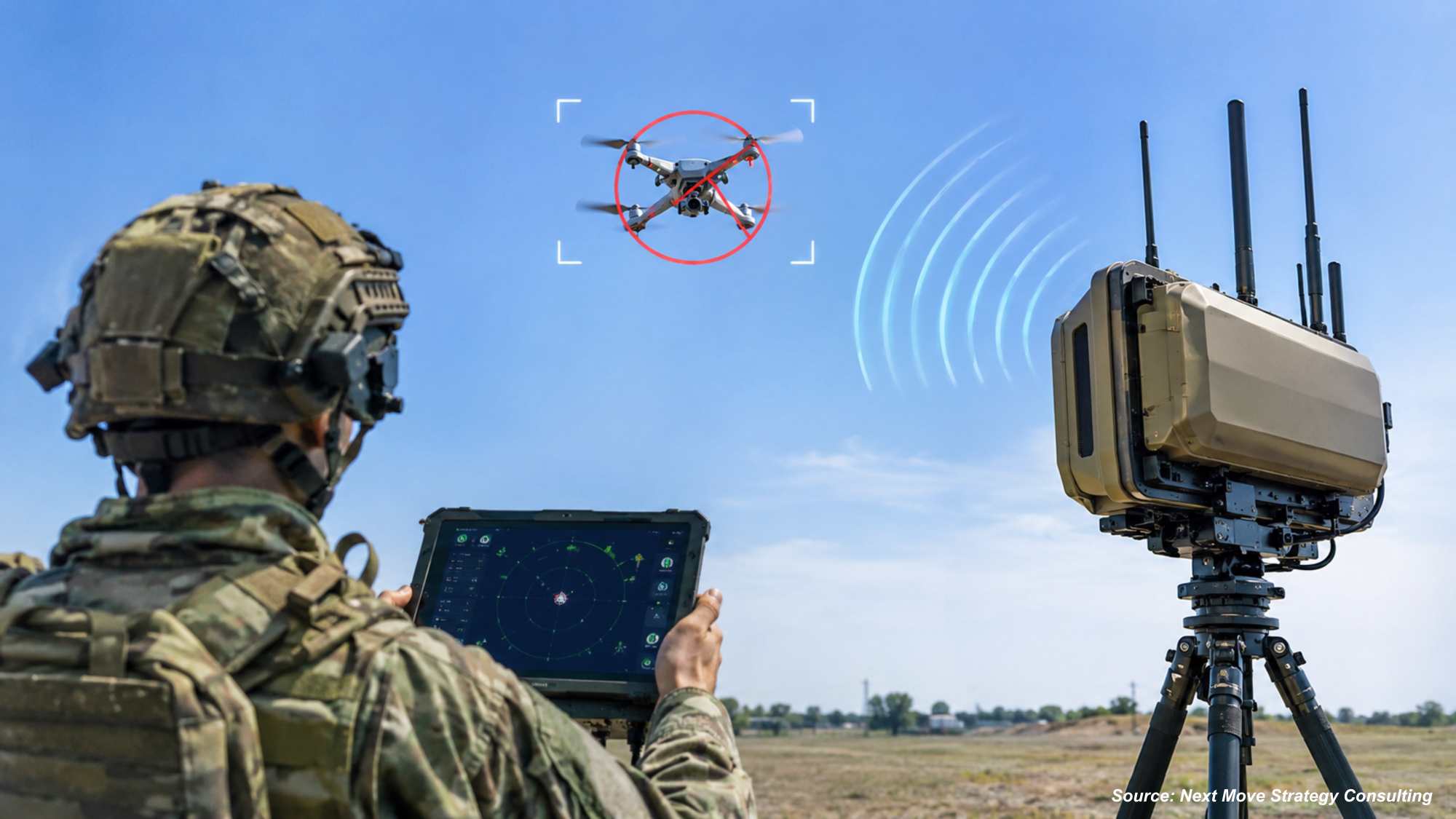
Pentagon's Delivery of 24,000 Counter-Drone Units to CENTCOM, a USD 4.15 Billion Domestic Shield Contract Wave and 700 World Cup Drone Seizures Show Counter-UAS Becoming Standing Infrastructure
On 4 November 2026, the U.S. Department of War announced that more than 25,000 unmanned and counter-drone systems had been delivered to U.S. Central Command (CENTCOM) this year, a “massive surge” backed by an investment of roughly USD 782 million, according to The Epoch Times' report of the announcement published the same day. More than 24,000 of the systems were counter-unmanned aircraft systems that the Department said can form a multi-layered defensive shield for U.S. forces through Joint Interagency Task Force 401 (JIATF-401), alongside more than 1,300 one-way attack drones and more than 100 unmanned surface and underwater vessels. The delivery, managed by the Direct Reporting Portfolio Manager for Unmanned Systems, quantifies how far counter-drone fielding has moved beyond prototype quantities inside a single theatre of operations.
According to Next Move Strategy Consulting's Counter-Drone Technologies Market report, the global counter-drone technologies market was valued at USD 5.40 billion in 2025 and is projected to reach USD 48.00 billion by 2035, growing at a CAGR of 22.7% from 2026 to 2035. NextMSC primary research and analysis places the 2026 market at USD 7.60 billion and attributes the trajectory to funded multiyear programs, combat experience in Ukraine and the Middle East, and homeland protection mandates, with North America holding approximately 42% share in 2026.
For More Information: Download FREE Sample on Counter-Drone Technologies Market Report
The Financial Logic: Ceilings, Grants and Fielding Quantities
The contract architecture behind those quantities became visible on 29 September 2026, when the U.S. Army published that JIATF-401 had awarded the latest in a series of contracts supporting Domestic Shield, the Department of War effort to improve counter-drone protection for risk-prioritized facilities and assets inside the United States. The announcement listed ten multiple-award indefinite-delivery/indefinite-quantity (IDIQ) contracts with base ceilings between USD 150 million and USD 500 million each, which sum to USD 4,150 million. Seven awardees received USD 500 million (Allen Control Systems, Digital Force Technologies, DroneShield, Napatree Technology, RADA Technologies, SRC and L3Harris WESCAM), Echodyne and PVP Advanced EO Systems received USD 250 million each, and SmartShooter received USD 150 million. The Army describes the accompanying C-UAS Marketplace as a streamlined route to identify, evaluate and transition commercial capabilities, so the multiple-award structure lets the task force draw on ten suppliers under established ceilings instead of opening a separate procurement for each requirement.
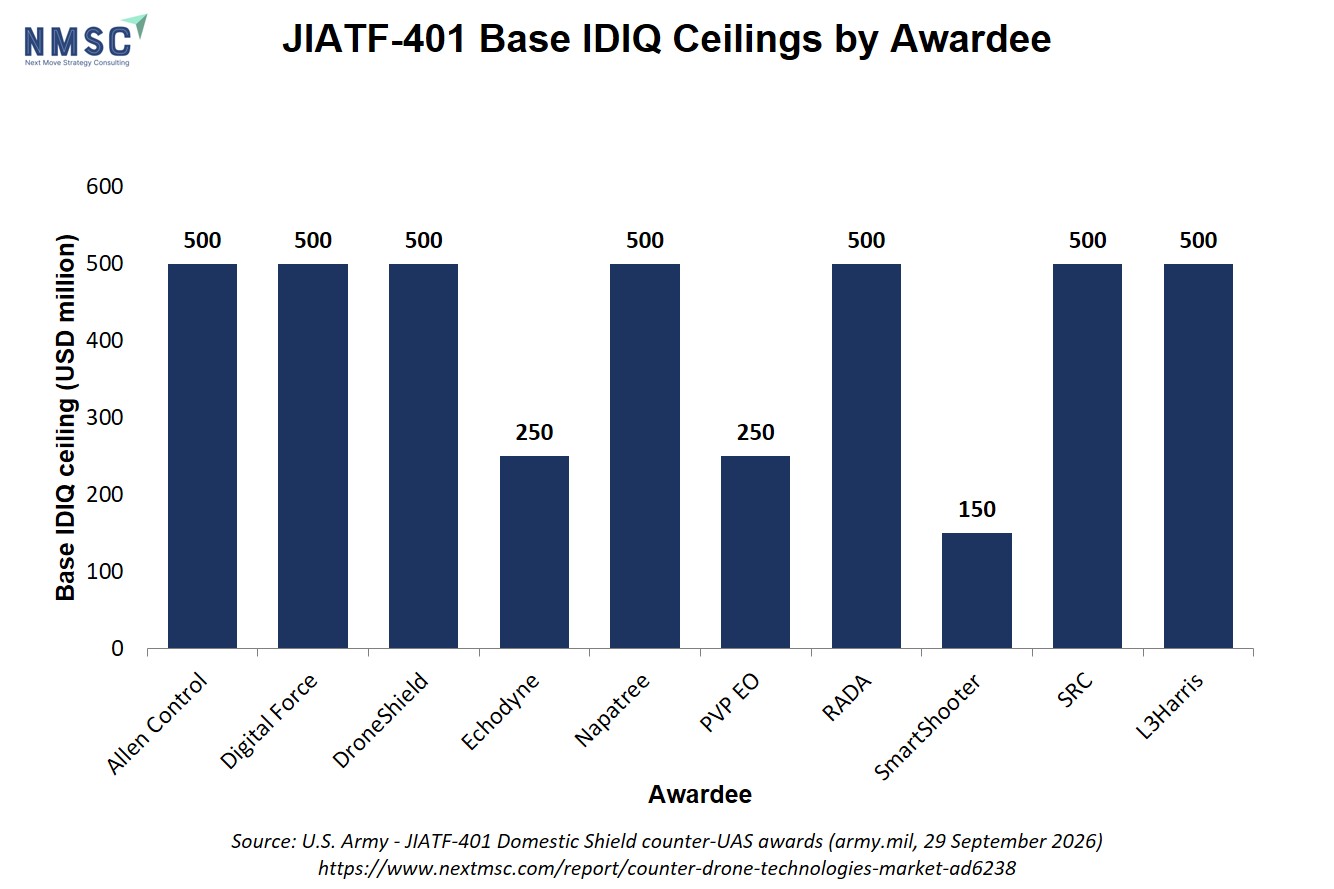
The ten base ceilings shown above are the exact values published by the U.S. Army for the Domestic Shield, C-UAS Marketplace and related counter-drone requirements. Chart labels are shortened for legibility: PVP EO is PVP Advanced EO Systems, Inc., and L3Harris is L3Harris WESCAM.
“JIATF-401 is continuously working with the military services to provide the counter-UAS capabilities needed to protect warfighters and installations.”
- Matt Ross, Brigadier General and Director, Joint Interagency Task Force 401, U.S. Army, JIATF-401 advances Domestic Shield with counter-UAS contract awards, 29 September 2026.
The technology covered by the awards spans smart optical scopes that help individual soldiers engage drones with standard rifles, automated robotic weapon stations, compact radar systems and long-range tracking cameras, according to the Army. Earlier awards in the series show the same pattern at smaller scale: JIATF-401 awarded a USD 13.8 million contract in June 2026 to deliver detection and mitigation capability to Joint Task Force-Southern Border, with options for sustainment, and a USD 500 million IDIQ to AeroVironment in July 2026 under the Domestic Shield program, as published by the Defense Visual Information Distribution Service.
Selected 2026 JIATF-401 Counter-UAS Contract Announcements
|
Announcement |
Date |
Contract detail |
|
Detection and mitigation capability for Joint Task Force-Southern Border |
June 2026 |
USD 13.8 million contract with options for additional sustainment support |
|
AeroVironment, Domestic Shield program |
July 2026 |
IDIQ contract with a USD 500 million ceiling |
|
Ten-award batch supporting Domestic Shield, the C-UAS Marketplace and other counter-drone requirements |
29 September 2026 |
Base ceilings of USD 150 million to USD 500 million per awardee; USD 4,150 million across the ten listed awards |
Funding for state and local agencies now runs on a separate line. According to the Federal Aviation Administration's 22 July 2026 release for the U.S. Department of Transportation, a counter-drone grant in the One Big Beautiful Bill Act of 2025 provided USD 500 million for state, local, tribal and territorial procurement, and the first USD 250 million was awarded to host cities and states for FIFA World Cup 2026. The release adds that Congress passed the Safer Skies Act in December 2025, extending counter-drone mitigation authority to state, local, tribal and territorial law enforcement agencies that meet training requirements. The grant and the statute address two separate gaps for local buyers: money to buy equipment and legal authority to act against a drone once it is detected.
Key Industry Developments: Fielding, Event Security and Export Orders
Owen West, CEO of Project Agincourt and Direct Reporting Portfolio Manager for Unmanned Systems, framed the CENTCOM delivery as an opening step rather than an endpoint. The Pentagon said it will keep delivering systems to the region and expand fielding pipelines for the technology to Pacific Command, European Command and the broader force, The Epoch Times reported. On the same day the Department announced a contract of more than USD 6.9 million to CHAOS 1, Inc. for Vanquish Prime radar systems to strengthen counter-drone protection in the CENTCOM region, and last month it signed a framework agreement with BAE Systems under which it would buy up to 25,000 interceptor kits each year for up to seven years.
“The thousands of systems operating across CENTCOM this year are just the beginning.”
- Owen West, CEO of Project Agincourt and Direct Reporting Portfolio Manager for Unmanned Systems, U.S. Department of War, The Epoch Times, Over 25,000 Drones, Counter-Drone Systems Delivered to CENTCOM, Pentagon Says, 4 November 2026.
Systems Delivered to U.S. Central Command in 2026, as Announced on 4 November 2026
|
Category |
Delivered to CENTCOM |
|
Unmanned and counter-drone systems, total |
More than 25,000 |
|
Counter-unmanned aircraft systems |
More than 24,000 |
|
One-way attack unmanned aerial vehicles |
More than 1,300 |
|
Unmanned surface vessels and unmanned underwater vessels |
More than 100 |
|
Investment described by the Department of War |
Roughly USD 782 million |
Event security supplied a second, civilian proof point. The FAA's 22 July 2026 release states that the FBI and the Department of Homeland Security seized more than 700 drones operating in restricted airspace across all 11 U.S. host cities during FIFA World Cup 2026, and that the FAA established no-drone zones through nearly 250 temporary flight restrictions covering match venues, fan festivals, team hotels and training sites. Each unauthorized drone was treated as a potential threat, and the department said the operation will inform protection of future gatherings including the 2028 Olympic Games.
U.S. Counter-Drone Operation at FIFA World Cup 2026
|
Indicator |
Reported figure |
|
Unauthorized drones seized across U.S. host cities |
More than 700 |
|
U.S. host cities covered by the operation |
11 |
|
Temporary flight restrictions established by the FAA |
Nearly 250 |
|
Counter-drone grant under the One Big Beautiful Bill Act of 2025 |
USD 500 million in total; first USD 250 million awarded to host cities and states |
|
Mitigation authority extended to state and local law enforcement |
Safer Skies Act, December 2025 |
Export demand is visible in Europe's air-defense order book. On 2 July 2026, Rheinmetall AG reported a first-time international order for four Skynex gun-based very short-range air defense systems, booked in the second quarter of 2026 and valued in the region of several hundred million euros. The contract includes trucks, ammunition and a full integrated logistic support package, with a 39-month execution timeline and the first battery due 21 months after signature, and Rheinmetall Italia acts as prime contractor. Separately, Reuters reported on 18 June 2026 that drone incursions at European airports, including suspected drone alerts at Munich and Copenhagen, are lifting demand for radars, jammers and defensive craft, and that Avinor, which operates 43 airports across Norway, has already installed a drone detection system to limit disruption and delays.
Segment Dynamics: Electronic Defeat Leads, Software and Directed Energy Gain
According to NextMSC primary research and analysis, RF detection and electronic defeat is the largest technology segment, expanding from USD 1.78 billion in 2025 to USD 12.40 billion by 2035, while directed energy is the fastest-growing technology at a 32.0% CAGR from 2026 to 2035. By offering, hardware accounts for approximately 67% of revenue in 2026, rising from USD 3.67 billion in 2025 to USD 29.28 billion by 2035, whereas software is the fastest-growing offering at a 25.2% CAGR as buyers pay for classification, sensor fusion and command tools that raise the value of installed sensors.
External evidence supports the directed energy thesis. DefenseScoop reported on 8 May 2026 that JIATF-401 launched a pilot program to field directed energy systems for drone defense, including high-energy lasers and microwave systems, at five military installations over six months, because those systems minimize risk to surrounding personnel and infrastructure. The same task force approved an autonomous long-range counter-drone system for use across the military after border testing, DefenseScoop reported on 9 June 2026, and the report noted that the border is regarded by senior officers as a testbed for such technology.
The software shift is measurable in company filings. DroneShield Limited's annual report for the year ended 31 December 2025 shows subscription revenue of AUD 11.6 million, up 312% from FY2024, equal to 4.9% of total revenue of AUD 216.5 million, with more than 3,000 AI-enabled devices carrying active subscriptions and a stated goal of 30% or more of revenue from software within five years. The same report shows how the hardware mix is spreading across product families, which indicates that no single detector or jammer line carries the company's sales.
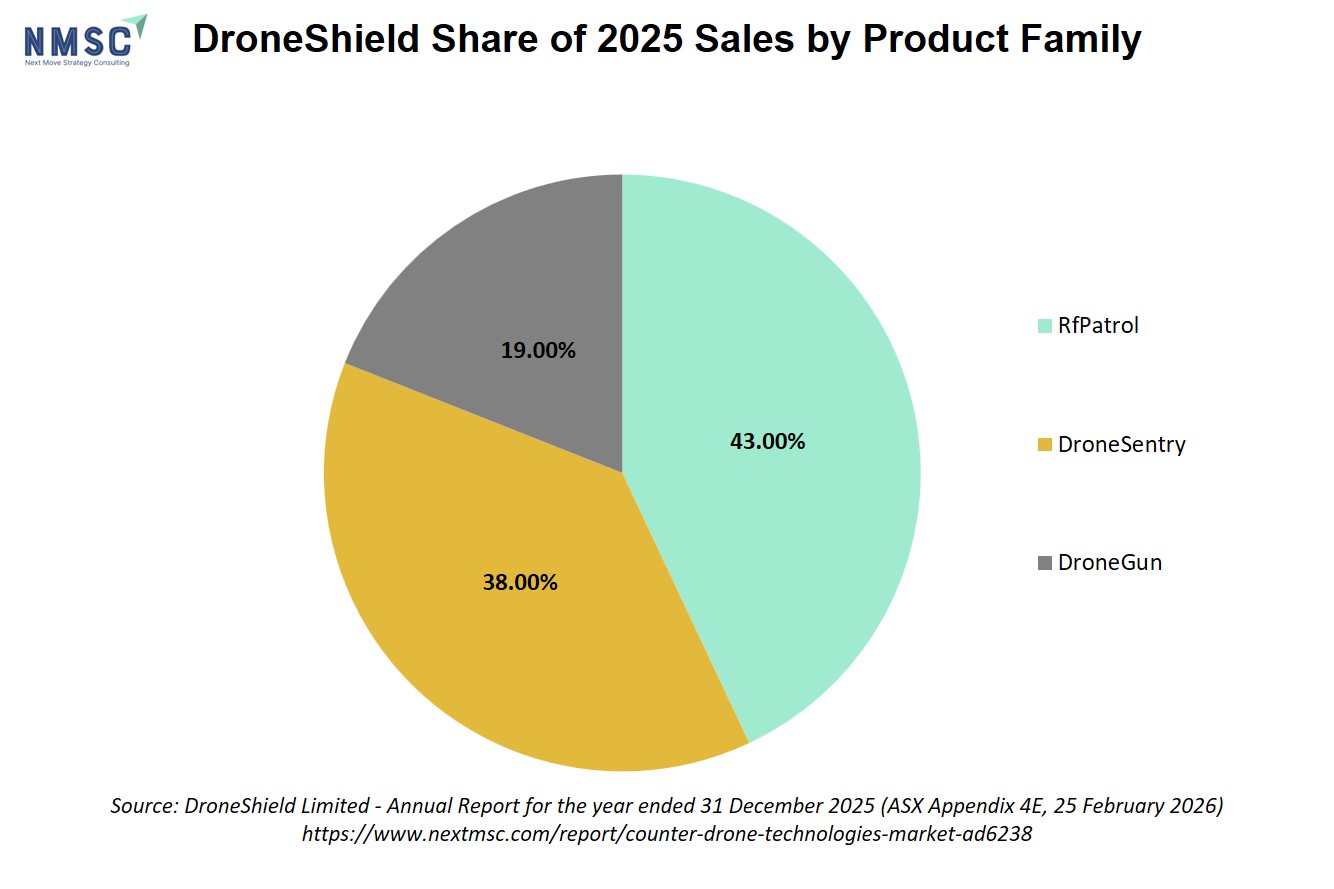
DroneShield's annual report describes RfPatrol as its body-worn detector line, DroneSentry as its multi-sensor on-the-move and fixed-site detection and defeat system, and DroneGun as its handheld jammer.
Regional Outlook
NextMSC primary research and analysis shows North America rising from USD 2.38 billion in 2025 to USD 19.20 billion by 2035 at a 23.2% CAGR, anchored by the U.S., which grows from USD 2.10 billion to USD 17.10 billion at a 22.0% CAGR as Army enterprise contracts, the Homeland Security contract vehicle and event security spending compound. Asia-Pacific is the fastest-growing region at a 25.3% CAGR, expanding from USD 0.92 billion to USD 10.08 billion by 2035, with India the fastest-growing major country at a 26.0% CAGR from USD 0.14 billion in 2025 to USD 1.60 billion by 2035.
DroneShield's FY2025 annual report documents the geographic diversification behind those regional rates: the share of revenue from the United States fell to 14% in 2025 from 69% in 2024, and Europe became the largest segment at 40%. The company states that its sales are concentrated in the United States, Western Europe, Asia-Pacific excluding China, and South America, and that the vast majority of its sales are not directly related to Ukraine, which indicates that demand is broadening across buyer geographies.
Growth Drivers and Restraints
Three drivers are documented by named sources. First, funding is converting into volume: the Pentagon's USD 782 million investment produced more than 24,000 counter-drone units in one theatre, and the Army's ten Domestic Shield awards carry USD 4,150 million in base ceilings. Second, incident pressure is pushing civil buyers: Reuters reported on 18 June 2026 that drone strikes and incursions at airports and oil facilities have prompted sharp demand growth from governments, airports and infrastructure operators. Third, mass events create a repeatable buyer: the 700-plus seizures in 11 U.S. host cities during the FIFA World Cup 2026 demonstrate a use case that recurs with the 2028 Olympic Games.
Restraints are equally specific. Reuters noted that regulatory challenges and safety questions still limit roll-out outside the military sphere. DefenseScoop reported on 9 June 2026 that two high-profile incidents earlier in the year temporarily shut Texas airspace after the departments miscoordinated the deployment of counter-drone systems at the border, showing that mitigation near civil aviation carries operational risk. On the supply side, DroneShield's annual report lists reliance on a limited number of key manufacturing partners and export-control approvals as material business risks that can delay delivery.
NMSC Strategic Perspective: Counter-Drone Becomes a Production Problem
NextMSC primary research and analysis indicates that the cost exchange gap between inexpensive attack drones and costly missiles is steering buyers toward layered architectures in which electronic defeat and directed energy absorb most low-end engagements. The 4 November delivery is consistent with that reading: more than 24,000 of the 25,000-plus systems sent to CENTCOM were counter-unmanned aircraft systems, and the Pentagon's October framework agreement with BAE Systems for up to 25,000 interceptor kits a year points to the same preference for low-cost effectors bought by the thousand rather than a small number of high-value interceptors.
NextMSC primary research and analysis also finds that commercial advantage is shifting to suppliers whose sensors and effectors plug into shared command and control. The Army's description of the C-UAS Marketplace stresses strict open-architecture standards that break proprietary vendor lock, and the Domestic Shield batch spread USD 4,150 million of ceilings across ten suppliers instead of concentrating it in one prime. For the absolute opportunity of approximately USD 40.40 billion that NextMSC estimates between 2026 and 2035, the practical implication is that interface compliance has become a condition of order flow rather than a point of differentiation.
For investors and vendors, NextMSC research points to recurring revenue as the least developed layer. Software is the fastest-growing offering at a 25.2% CAGR, yet DroneShield, the only listed pure-play counter-drone company in this record, reported software subscriptions at 4.9% of FY2025 revenue against a five-year goal of 30%. NextMSC's recommendation is to pair low-cost interceptors with software-defined command and control, price for cost per engagement, and enter Asia-Pacific and the Gulf through local partners. The main uncertainty in NextMSC's outlook is the pace at which civil mitigation authority expands beyond military users.
Competitive Landscape
NextMSC's ranked profile of fourteen companies leads with RTX Corporation, Anduril Industries, Rafael Advanced Defense Systems, Elbit Systems and L3Harris Technologies, followed by Rheinmetall, BAE Systems, Axon Enterprise, DroneShield, Bharat Electronics, CACI International, Epirus, Fortem Technologies and D-Fend Solutions. Primes compete on production scale and existing army relationships, while specialists compete on focused products and update speed. The traceable 2026 events fit that split: L3Harris WESCAM and DroneShield each received USD 500 million base IDIQ awards from JIATF-401 on 29 September 2026, and Rheinmetall booked its first international Skynex order in the second quarter.
DroneShield's filing also shows how fast a specialist can scale. Revenue rose 276% to AUD 216.5 million in FY2025, and the company plans to lift production capacity from roughly AUD 500 million to AUD 2.4 billion a year by the end of 2026 through facilities in Australia, the United States and Europe. NextMSC primary research and analysis expects deal activity to concentrate on detection, command software and effectors, where integration across vendors is the main bottleneck.
Bottom Line
The Pentagon's 4 November announcement turns counter-drone from a program category into a volume business: more than 24,000 counter-unmanned aircraft systems reached CENTCOM this year, the Army's ten Domestic Shield awards carry USD 4,150 million in base ceilings, and U.S. agencies seized more than 700 drones during FIFA World Cup 2026. According to NextMSC primary research and analysis, the global counter-drone technologies market will grow from USD 5.40 billion in 2025 to USD 48.00 billion by 2035 at a 22.7% CAGR, with North America leading and Asia-Pacific the fastest-growing region at 25.3%. Software at 25.2% and directed energy at 32.0% are the fastest-growing segments, but software subscriptions remain small against hardware in company filings, and civil mitigation authority is still narrower than military authority. Vendors that combine low-cost effectors, open interfaces and recurring software revenue, and that secure production capacity and export approvals early, are best placed to capture the funded demand that governments and event organizers are now placing.
About Next Move Strategy Consulting
Next Move Strategy Consulting is a premier market research and management consulting firm that has been committed to provide strategically analysed well documented latest research reports to its clients. The research industry is flooded with many firms to choose from, what makes NMSC different from the rest is its top-quality research and the obsession of turning data into knowledge by dissecting every bit of it and providing fact-based research recommendation that is supported by information collected from over 500 million websites, paid databases, industry journals and one on one consultations with industry experts across a diverse range of industry sectors. The high-quality customized research reports with actionable insights and excellent end-to-end customer service help our clients to take critical business decisions that enables them to move beyond time and have competitive edge in the industry.
We have been servicing over 1000 customers globally that includes 90% of the Fortune 500 companies over a decade. Our analysts are constantly tracking various high growth markets and identifying hidden opportunities in each sector or the industry. We provide one of the industry’s best quality syndicate as well as custom research reports across 10 different industry verticals. We are committed to deliver high quality research solutions in accordance to your business needs. Our industry standard delivery solutions that ranges from the pre consultation to after-sales services, provide an excellent client experience and ensure right strategic decision making for businesses.
For more information, please contact:
Next Move Strategy Consulting
5th Floor 867 Boylston St, STE 500,
Boston, MA 02116, U.S.
E-Mail: [email protected]
Direct: +1-217-650-7991
Website: www.nextmsc.com
About the Author
 Sanyukta Deb
— Sanyukta Deb is Digital Marketing Team Lead at Next Move Strategy Consulting, where she has led content strategy and technical SEO for the firm's B2B market research publications for over 2 years. Her editorial process translates NextMSC's primary and secondary research — spanning technology, industrial, and consumer sectors — into commercial narratives, backed by search-intent, keyword, and competitive analysis. She brings 5 years of overall experience in digital marketing and content strategy.
About the Reviewer
 Debashree Dey
— Debashree Dey is Assistant Manager at Next Move Strategy Consulting, where she supports cross-vertical market content and communications across diverse industries for 6 years. Her professional background includes senior content writing, communications, and published manuscript authorship, with experience developing audience-focused business narratives and maintaining clear, consistent messaging. Her role supports research-led content development and editorial quality across NextMSC publications.













Add Comment