PFAS Ruling Hardens Industrial Spill Liability as EPA Delays Response Plans

A unanimous D.C. Circuit panel upheld polluter-pays cleanup for PFOA and PFOS, yet EPA's October 13 delay of facility response plans to June 2030 splits the case for absorbent demand
On August 18, 2026, a three-judge panel of the U.S. Court of Appeals for the D.C. Circuit denied every petition filed by seven industry groups, including the U.S. Chamber of Commerce, to overturn the Environmental Protection Agency's 2024 designation of PFOA and PFOS as hazardous substances under the federal Superfund law. In Chamber of Commerce of the United States of America v. EPA (No. 24-1193), the court held that the designation places cleanup costs on polluters rather than taxpayers, and its opinion confirms that a party responsible for a release of more than one pound of either compound must report it to national authorities. The decision removes the central legal challenge to a liability regime in which a PFOA or PFOS release above that threshold is reportable and its cleanup cost can be recovered from the responsible party.
According to Next Move Strategy Consulting's Industrial Absorbent Market report, the global industrial absorbent market was valued at USD 4.81 billion in 2024 and is projected to reach USD 6.11 billion by 2030, growing at a CAGR of 5.0% from 2025 to 2030. NextMSC primary research and analysis puts the 2025 value at USD 5.01 billion and attributes demand to stricter spill and waste regulation, advances in absorption capacity, speed and durability, and rising interest in biodegradable and plant-based products, while the higher cost of eco-friendly absorbents remains a constraint for small and medium-sized enterprises.
For More Information: Download FREE Sample on Industrial Absorbent Market Report
What the Court Record Establishes
The opinion supplies planning numbers that industrial buyers can use to size exposure. According to the court's summary of the agency's record, EPA identified 133 sites outside the National Priorities List with the highest likelihood of PFOA and PFOS contamination, assumed it would pursue enforcement at about half of them, and calculated costs for 67 such sites over four years, a pace of sixteen to seventeen sites a year. For sites already on the National Priorities List, EPA's Regulatory Impact Analysis put the increase in cleanup costs attributable to the designation between USD 10.3 million and USD 51.7 million. The court also noted that PFOA and PFOS join more than 800 hazardous substances under the Superfund statute, and it stressed that cleanup actions remain discretionary, contingent and site specific, with statutory defenses and de minimis protections for small contributors.
Planning Figures Cited in the D.C. Circuit Opinion
|
Parameter |
Figure |
Context in the opinion |
|
Release reporting threshold |
More than 1 pound of PFOA or PFOS |
Responsible parties must report to national authorities |
|
Non-listed sites with highest contamination likelihood |
133 sites |
EPA figure drawn from remedial site investigation data |
|
Non-listed sites assumed to face enforcement |
67 sites over four years |
About half of the 133 sites; 16 to 17 sites a year because of resource constraints |
|
New sites investigated for the National Priorities List |
10.9 a year |
EPA figure used in its cost analysis |
|
Increase in cleanup cost at listed sites |
USD 10.3 million to USD 51.7 million |
Range in EPA's Regulatory Impact Analysis |
|
Hazardous substances under the Superfund statute |
More than 800 |
PFOA and PFOS added to an existing list |
The Counterweight: EPA Delays Facility Response Plans by Three Years
Eight weeks after the ruling, on October 13, 2026, the U.S. Environmental Protection Agency (EPA) published a final rule in the Federal Register that moves the compliance date for Clean Water Act hazardous substance facility response plans from June 1, 2027 to June 1, 2030. In the rule, signed by Administrator Lee Zeldin, the agency said it has not identified models that account for the physical and chemical properties of each of the 296 Clean Water Act hazardous substances, and that facilities may be unable to meet the existing deadline. EPA calculated annualized cost savings from the delay of USD 25.97 million at a 7% discount rate and USD 17.95 million at 3%, in 2024 dollars, and recorded that of 30 public comments, 18 supported the proposal and 11 opposed it.
Beveridge & Diamond PC noted in an October 20, 2026 alert that the rule does not rescind the program or change its core applicability criteria. Facilities that store at least 1,000 times the reportable quantity of a hazardous substance and sit within 0.5 miles of navigable water or a conveyance to it must still determine whether a plan is required, so planning work continues even though the filing date has moved.
Spill Liability and Response Planning Milestones
|
Date |
Milestone |
Authority |
|
March 28, 2024 |
EPA issues final rule requiring Clean Water Act hazardous substance facility response plans; first compliance date set at June 1, 2027 |
U.S. Environmental Protection Agency |
|
May 8, 2024 |
EPA publishes final rule designating PFOA and PFOS as Superfund hazardous substances |
U.S. Environmental Protection Agency |
|
February 18, 2026 |
EPA seeks comment on reconsidering the 2024 plan provisions; comments accepted through May 19, 2026 |
U.S. Environmental Protection Agency |
|
March 5, 2026 |
EPA proposes a three-year delay of the plan compliance date |
U.S. Environmental Protection Agency |
|
August 18, 2026 |
D.C. Circuit denies all petitions against the PFOA and PFOS designation |
U.S. Court of Appeals for the D.C. Circuit |
|
October 13, 2026 |
EPA publishes the final delay rule |
U.S. Environmental Protection Agency |
|
June 1, 2030 |
New plan deadline for facilities in operation on November 30, 2029 that meet the criteria |
U.S. Environmental Protection Agency |
Key Industry Developments
On October 8, 2026, Oil-Dri Corporation of America reported fiscal 2026 net sales of USD 493.8 million, a company record, with net income of USD 57.0 million. Its Business to Business group, which covers fluids purification, agricultural carriers and animal health products, generated USD 180.2 million, down 1%, while Retail and Wholesale sales rose 4% to USD 313.6 million. Domestic industrial and sports product sales rose 7% to USD 12.1 million in the fourth quarter, which the company attributed primarily to pricing actions that offset higher costs, including transportation expenses. Gross margin declined to 27.8% from 29.5% as per-ton domestic cost of goods sold rose 4%.
“strongest full-year sales and net income in history”
— Daniel S. Jaffee, President and Chief Executive Officer, Oil-Dri Corporation of America, Fourth quarter and fiscal year 2026 results release (Form 8-K, Exhibit 99.1), October 8, 2026.
Oil-Dri Corporation of America, Fiscal Year Ended July 31, 2026
|
Metric |
Fiscal 2026 |
Fiscal 2025 |
Change |
|
Consolidated net sales |
USD 493.8 million |
USD 485.6 million |
2% |
|
Business to Business net sales |
USD 180.2 million |
USD 182.6 million |
(1)% |
|
Retail and Wholesale net sales |
USD 313.6 million |
USD 303.0 million |
4% |
|
Net income |
USD 57.0 million |
USD 54.0 million |
6% |
|
Gross profit margin |
27.8% |
29.5% |
Lower |
On November 15, 2026, FOX13 Memphis reported that the Mississippi Department of Environmental Quality said 5,000 to 6,000 gallons of propylene glycol escaped from a tank at xAI's data center site in Southaven, Mississippi, and flowed into a drainage ditch. According to the report, xAI said a contractor improperly configured a hose connected to a mobile tank. The company deployed vacuum trucks and built earthen barriers, and state officials said the release posed no immediate threat to public health or safety. The report does not describe any use of sorbent products.
“a wake-up call to everyone in our entire region”
- Keshaun Pearson, Executive Director, Memphis Community Against Pollution, FOX13 Memphis, November 15, 2026.
Spill Statistics Show Where Sorbents Matter and Where They Do Not
ITOPF, the not-for-profit organisation that records accidental oil spills from tankers, reported in January 2026 that six tanker spills of seven tonnes or more occurred in 2025, releasing approximately 4,000 tonnes of oil, and that more than 99.99% of oil moved by sea reaches its destination safely. Annual volumes swing with single incidents: 15,000 tonnes in 2022, 2,000 tonnes in 2023, 10,000 tonnes in 2024 and 4,000 tonnes in 2025.
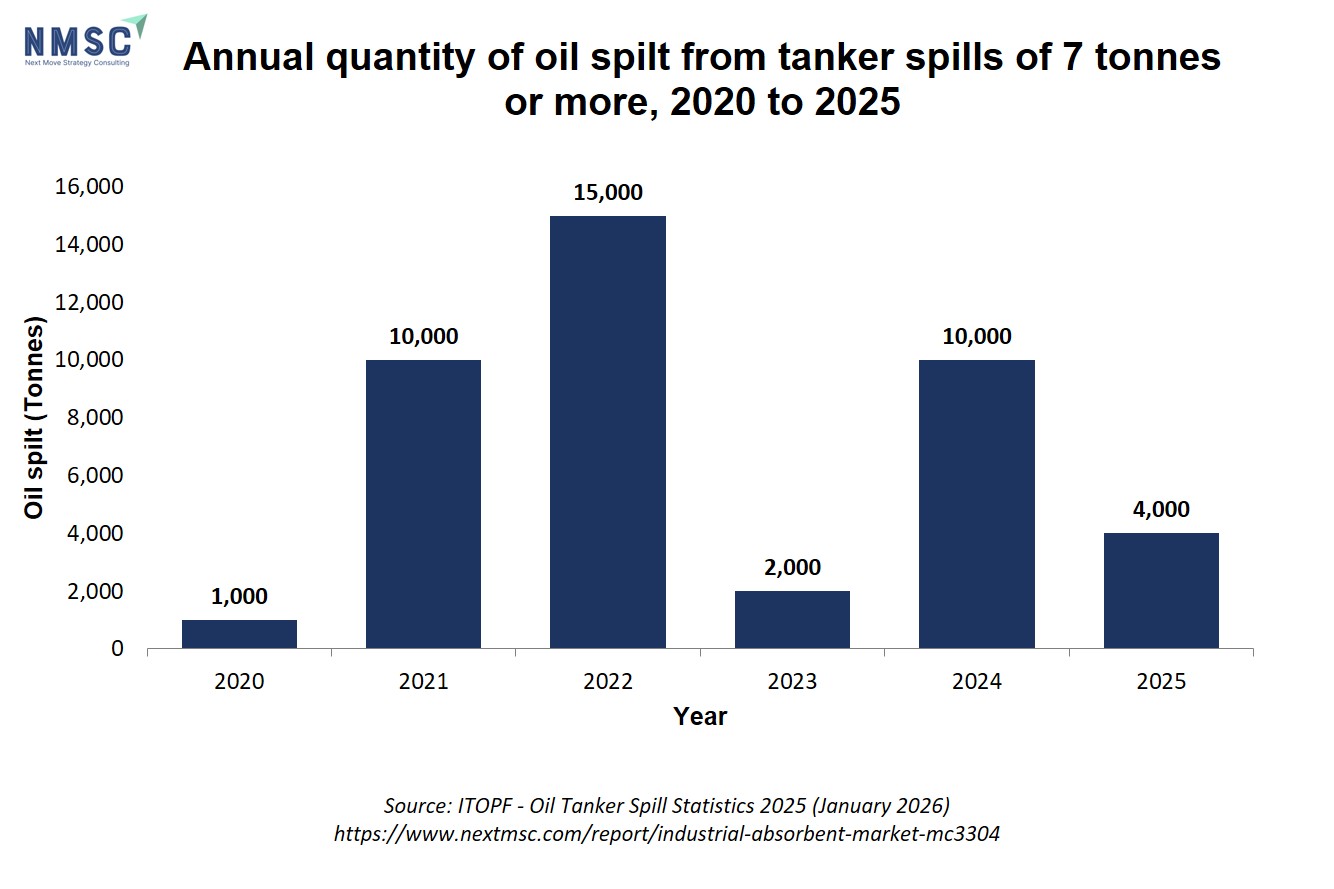
ITOPF records annual tanker spill volumes in tonnes, rounded to the nearest thousand. The 2018 spill of 116,000 tonnes remains the largest annual quantity in 24 years, which shows how a single incident can dominate a year's total.
The distribution of large spills shows why sorbent demand sits mostly outside tanker disasters. ITOPF's records for 1970 to 2025 show that 50% of 480 large spills, those above 700 tonnes, occurred while vessels were underway in open water, 17% while underway in inland or restricted waters and 9% during loading or discharging. Of the 1,407 medium spills of 7 to 700 tonnes, 29% occurred during loading and discharging, although ITOPF records the operation as unknown for 55% of them. ITOPF also publishes Technical Information Paper 8 on the use of sorbent materials in oil spill response.
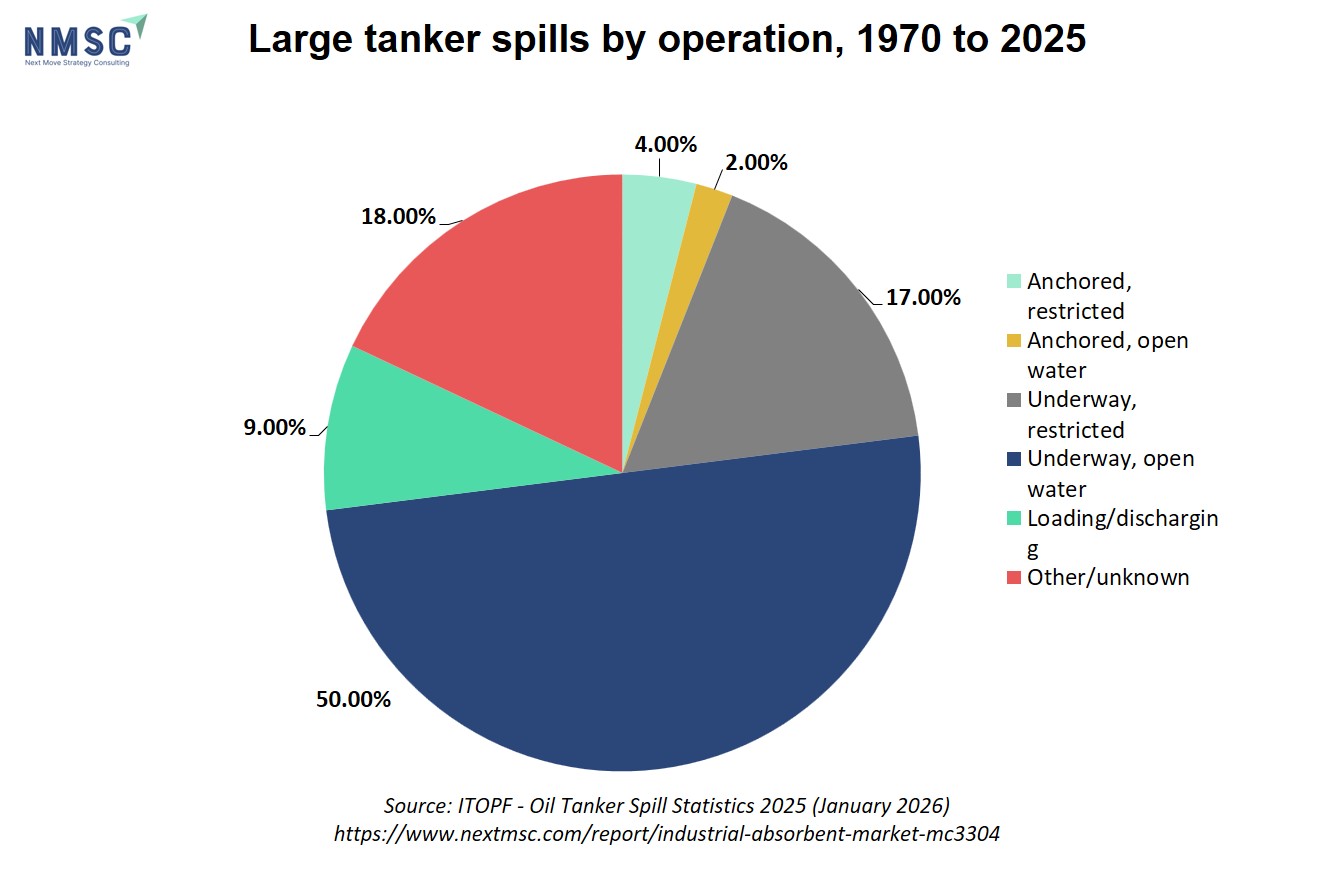
The shares cover 480 large tanker spills, those above 700 tonnes, recorded by ITOPF between 1970 and 2025. Restricted means inland or restricted waters, including ports and harbours, and the source reports whole percentages that total 100%.
Segment and Regional Outlook
NextMSC primary research and analysis segments the industry by material, product, absorption target, application, end use industry and region. Material classes run from natural organic and inorganic media through synthetic materials, superabsorbent polymers and hydrogels, and composite and engineered media to reclaimed and recycled materials. Product formats range from pads, rolls and sheets to booms, socks and dikes, spill kits and specialty products. NextMSC primary research and analysis identifies North America as the largest regional industry, supported by its regulatory framework and spill management demand in oil and gas, chemicals and manufacturing. Europe is another key region, with waste management and spill control rules tied to circular economy goals, while Asia-Pacific growth is linked to industrial build-out in China, India and Japan and the Middle East anchors oil and gas demand in the Rest of the World.
Growth Drivers and Restraints
-
Liability driver: the D.C. Circuit's August 18, 2026 ruling leaves in force a one-pound release-reporting threshold and Superfund cost recovery for PFOA and PFOS.
-
Planning driver: the facility response plan program remains in force for facilities at or above 1,000 times a hazardous substance's reportable quantity near navigable water, according to Beveridge & Diamond PC.
-
Timing restraint: EPA's October 13, 2026 final rule moves the plan deadline to June 1, 2030 and puts annualized savings for regulated facilities at USD 25.97 million at a 7% discount rate.
-
Cost restraint: Oil-Dri Corporation of America reported a 4% rise in per-ton domestic cost of goods sold in fiscal 2026, driven by higher manufacturing and freight costs.
-
Product mix driver: FyterTech Nonwovens' 2026 catalogue highlights recycled absorbent fill made from post-industrial waste, showing manufacturers positioning for sustainability-led purchasing.
NMSC Strategic Perspective: Mandated Demand With a Later Start Date
NextMSC primary research and analysis reads the August ruling and the October delay as two clocks running at different speeds. The ruling operates on releases that happen today: a PFOA or PFOS release above one pound is reportable, and the court's opinion confirms cleanup costs can be pursued from the responsible party. That gives facilities handling PFAS-bearing fluids a financial reason to contain early, which points demand toward containment and clean-up formats such as pads, socks, booms, spill kits and granules at those sites. The count in EPA's own record, 133 high-likelihood non-listed sites and 67 assumed enforcement sites over four years, indicates the pull is concentrated at specific facilities, not spread evenly across industry.
The second clock is slower. EPA's new June 1, 2030 plan deadline falls in the final year of NextMSC's 2025 to 2030 forecast window, which places plan-driven equipment stocking at the back end of the period and is consistent with a 5.0% CAGR rather than an acceleration. Supplier results point the same way: Oil-Dri's 7% fourth-quarter rise in domestic industrial and sports product sales came primarily from pricing actions, so NextMSC primary research and analysis treats price realization, not unit growth, as the nearer-term contributor. ITOPF's finding that half of large tanker spills occur underway in open water, and the vacuum-truck response reported at Southaven, indicate that absorbents serve the residual and small-volume end of the spill spectrum, where demand tracks facility activity and compliance routines. The variable to watch is EPA's reconsideration of the 2024 plan rule, which the agency says may bring further corrections, clarifications or revisions and could move spending dates more than the court ruling did.
Competitive Landscape
NextMSC's report profiles 20 companies, including 3M Company, Kimberly-Clark Corp., Oil-Dri Corp. of America, New Pig Corporation and Brady Corporation. Among them, Oil-Dri Corporation of America disclosed in its October 8, 2026 filing that cost pressure from manufacturing and freight narrowed gross margin by 1.7 percentage points, while a cash balance of USD 73.7 million, a company record, gives it room to keep investing. FyterTech Nonwovens, also profiled by NextMSC, positions its 2026 catalogue around UK-manufactured meltblown absorbents, spill kits, socks and booms, and recycled absorbent fill. Oil-Dri's disclosure centres on cost control and FyterTech's on recycled content, and neither describes PFAS-specific products.
Bottom Line
The August 18, 2026 D.C. Circuit decision removes the central legal challenge to a PFOA and PFOS liability regime built on a one-pound release-reporting threshold and cost recovery from polluters, while EPA's October 13, 2026 rule pushes the Clean Water Act hazardous substance facility response plan deadline to June 1, 2030. Demand for industrial absorbents therefore rests on two clocks: liability that applies to releases now, and planning requirements that start later. Oil-Dri's fiscal 2026 results show suppliers absorbing higher per-ton costs, with industrial and sports sales rising 7% in the fourth quarter on pricing actions. According to NextMSC primary research and analysis, the industry is projected to grow from USD 5.01 billion in 2025 to USD 6.11 billion by 2030 at a CAGR of 5.0%. Buyers and suppliers should watch EPA's reconsideration of the 2024 plan rule, which could move spending dates more than the court ruling did.
About Next Move Strategy Consulting
Next Move Strategy Consulting is a premier market research and management consulting firm that has been committed to provide strategically analysed well documented latest research reports to its clients. The research industry is flooded with many firms to choose from, what makes NMSC different from the rest is its top-quality research and the obsession of turning data into knowledge by dissecting every bit of it and providing fact-based research recommendation that is supported by information collected from over 500 million websites, paid databases, industry journals and one on one consultations with industry experts across a diverse range of industry sectors. The high-quality customized research reports with actionable insights and excellent end-to-end customer service help our clients to take critical business decisions that enables them to move beyond time and have competitive edge in the industry.
We have been servicing over 1000 customers globally that includes 90% of the Fortune 500 companies over a decade. Our analysts are constantly tracking various high growth markets and identifying hidden opportunities in each sector or the industry. We provide one of the industry’s best quality syndicate as well as custom research reports across 10 different industry verticals. We are committed to deliver high quality research solutions in accordance to your business needs. Our industry standard delivery solutions that ranges from the pre consultation to after-sales services, provide an excellent client experience and ensure right strategic decision making for businesses.
For more information, please contact:
Next Move Strategy Consulting
5th Floor 867 Boylston St, STE 500,
Boston, MA 02116, U.S.
E-Mail: [email protected]
Direct: +1-217-650-7991
Website: www.nextmsc.com
About the Author
 Priyanshu Das
— Priyanshu Das is SEO Executive at Next Move Strategy Consulting, where he has led on-page and off-page SEO, keyword research, and SEO audits for the firm's B2B market research publications for 2 years. His audit process combines technical crawl analysis, backlink profile review, and competitor keyword gap mapping — using tools including Screaming Frog and Google Search Console — to prioritize fixes by organic search-visibility impact, informed by his own prior in-house and agency SEO experience.
About the Reviewer
 Sanyukta Deb
— Sanyukta Deb is Digital Marketing Team Lead at Next Move Strategy Consulting, where she has led content strategy and technical SEO for the firm's B2B market research publications for over 2 years. Her editorial process translates NextMSC's primary and secondary research — spanning technology, industrial, and consumer sectors — into commercial narratives, backed by search-intent, keyword, and competitive analysis. She brings 5 years of overall experience in digital marketing and content strategy.

















Add Comment