Senior’s Second Volkswagen Pact Anchors Europe’s Battery Separator Supply
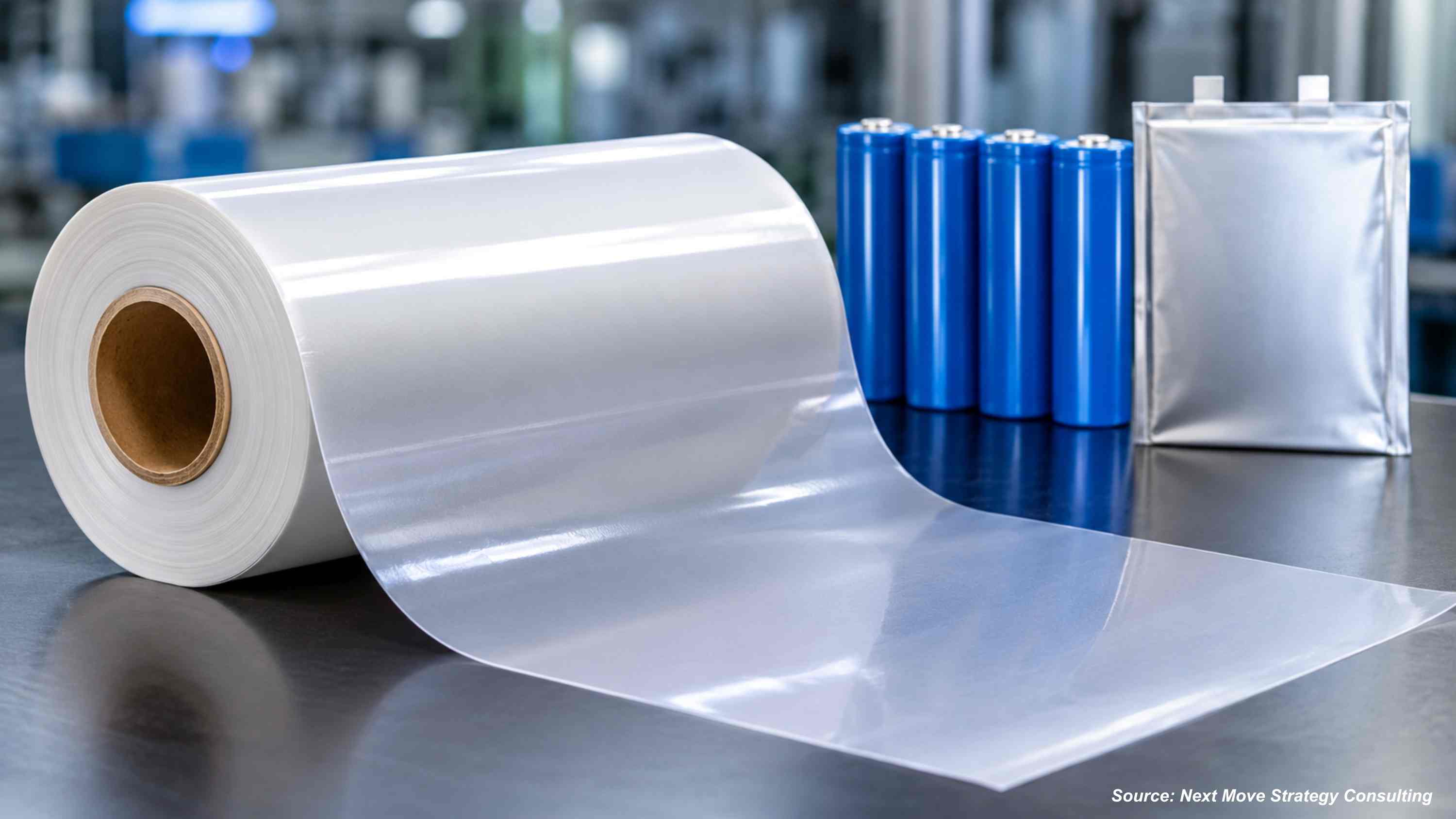
A 1.558 Billion-Square-Metre Nomination From a Volkswagen Battery Unit, a New Coating Line in North Carolina and a USD 497 Million Guangzhou Base Show Separator Capacity Being Committed Close to Where Cells Are Built
On 5 November 2026, Shenzhen Senior Technology Material Co., Ltd. announced that its wholly owned Swedish subsidiary, Senior Material (Europe) AB, had signed a second nomination agreement with a battery subsidiary of the Volkswagen Group. The agreement covers wet-process coated lithium-ion battery separator, with forecast supply of about 1.558 billion square metres from 2027 to 2034. It follows a first nomination signed in November 2024 for an estimated 2.09 billion square metres over 2025 to 2032, which Yicai Global reported on 12 November 2024 as an agreement with Volkswagen’s battery unit PowerCo. Senior did not disclose a contract value, and the volumes are forecasts that depend on the customer’s battery production plans and on subsequent purchase orders.
According to Next Move Strategy Consulting’s Lithium-Ion Battery Separator Market report, the global lithium-ion battery separator market was valued at USD 6.89 billion in 2025 and is projected to reach USD 26.55 billion by 2035, growing at a CAGR of 14.5% from 2026 to 2035. NextMSC primary research and analysis places the 2026 value at USD 7.85 billion, the first year of a forecast period in which supply agreements of the kind Senior announced are being signed years ahead of delivery.
For More Information: Download FREE Sample on Lithium-Ion Battery Separator Market Report
The Financial Logic: Cell Capacity Is Growing Fastest Where Separator Supply Is Thinnest
The International Energy Agency’s Global EV Outlook 2026, published in May 2026, put global EV battery deployment at 1.2 terawatt-hours in 2025, almost 30% above 2024 and more than seven times the 2020 level. The same report found that EVs accounted for more than 70% of total battery deployment in 2025, down from almost 80% in 2024, which leaves stationary storage and other uses with a larger share of lithium-ion demand than a year earlier. The IEA’s projections run to almost 3 terawatt-hours of EV battery deployment by 2030 under both its Current Policies and Stated Policies scenarios, and to between around 4 and almost 5 terawatt-hours by 2035 under those two scenarios.
Global EV Battery Deployment: 2025 Level and IEA Scenario Projections
|
Year |
IEA scenario |
EV battery deployment |
|
2025 |
Reported level |
1.2 TWh |
|
2030 |
Current Policies and Stated Policies scenarios |
Almost 3 TWh |
|
2035 |
Current Policies Scenario |
Around 4 TWh |
|
2035 |
Stated Policies Scenario |
Almost 5 TWh |
|
2035 |
Net Zero Emissions by 2050 Scenario |
Around 9 TWh |
The geography of that demand matters more for separator suppliers than the headline total. The IEA reported that global nameplate lithium-ion cell manufacturing capacity exceeded 4 terawatt-hours by the end of 2025, roughly 30% above 2024, with capacity growth of about 50% in both the European Union and the United States against just over 25% in China. China still holds more than 80% of that capacity, while the European Union and the United States hold 6% to 7% each. The IEA describes the separator as one of the four main components of a battery, so cell capacity growing about twice as fast in Europe and the United States as in China translates into separator demand that Asian producers can serve reliably only by qualifying supply closer to those cell plants. Senior’s decision to sign through its Swedish subsidiary is consistent with that pattern.
EV Battery Deployment by Region, 2025
|
Region or group |
Share of 2025 EV battery deployment |
|
China |
About 60% |
|
European Union |
Almost 15% |
|
United States |
About 10% |
|
Emerging markets and developing economies excluding China |
6% |
Vehicle demand itself is not moving in a straight line. The IEA reported that electric car sales grew 20% in 2025 to exceed 20 million units, and it expects 23 million in 2026, close to 30% of all cars sold worldwide. It also noted that global sales in the first quarter of 2026 were 8% lower than in the first quarter of 2025, a decline to which policy changes in the United States and China contributed, while European sales rose close to 30% year on year over the same quarter.
“Electric car sales set new records in close to 100 countries last year.”
- Fatih Birol, Executive Director, International Energy Agency, IEA press release on the Global EV Outlook 2026, May 2026.
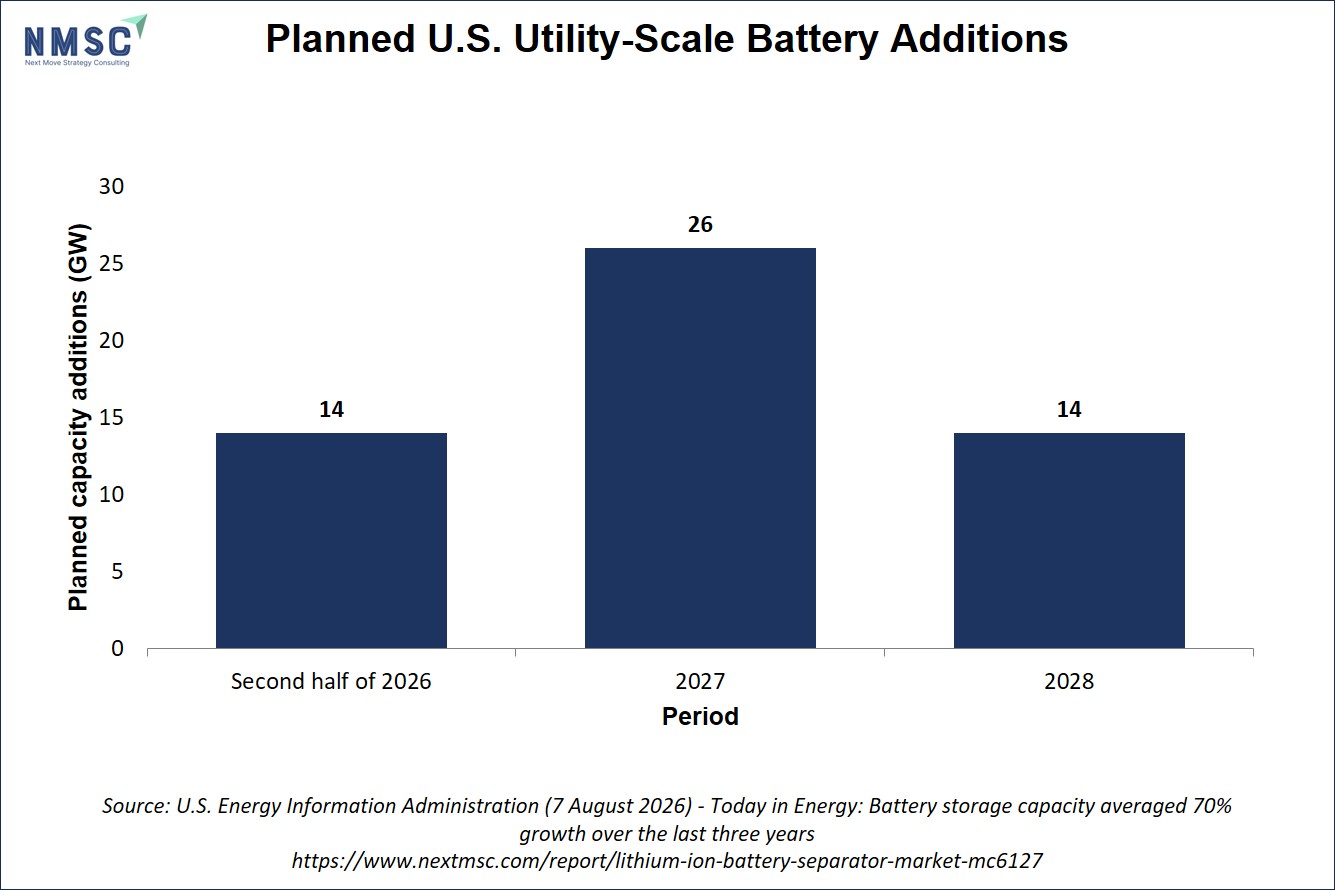
Stationary storage is the second pull on separator supply, and the U.S. data shows how quickly it is scaling. The U.S. Energy Information Administration (7 August 2026) reported that utility-scale battery storage capacity in the United States grew at an average annual rate of 70% over the previous three years. Operational capacity stood at 43.6 gigawatts at the end of 2025, a further 8.3 gigawatts was added in the first half of 2026, and nameplate capacity reached nearly 52 gigawatts by mid-2026. Developers have 54 gigawatts of additions planned over the next two and a half years, led by 26 gigawatts in 2027.
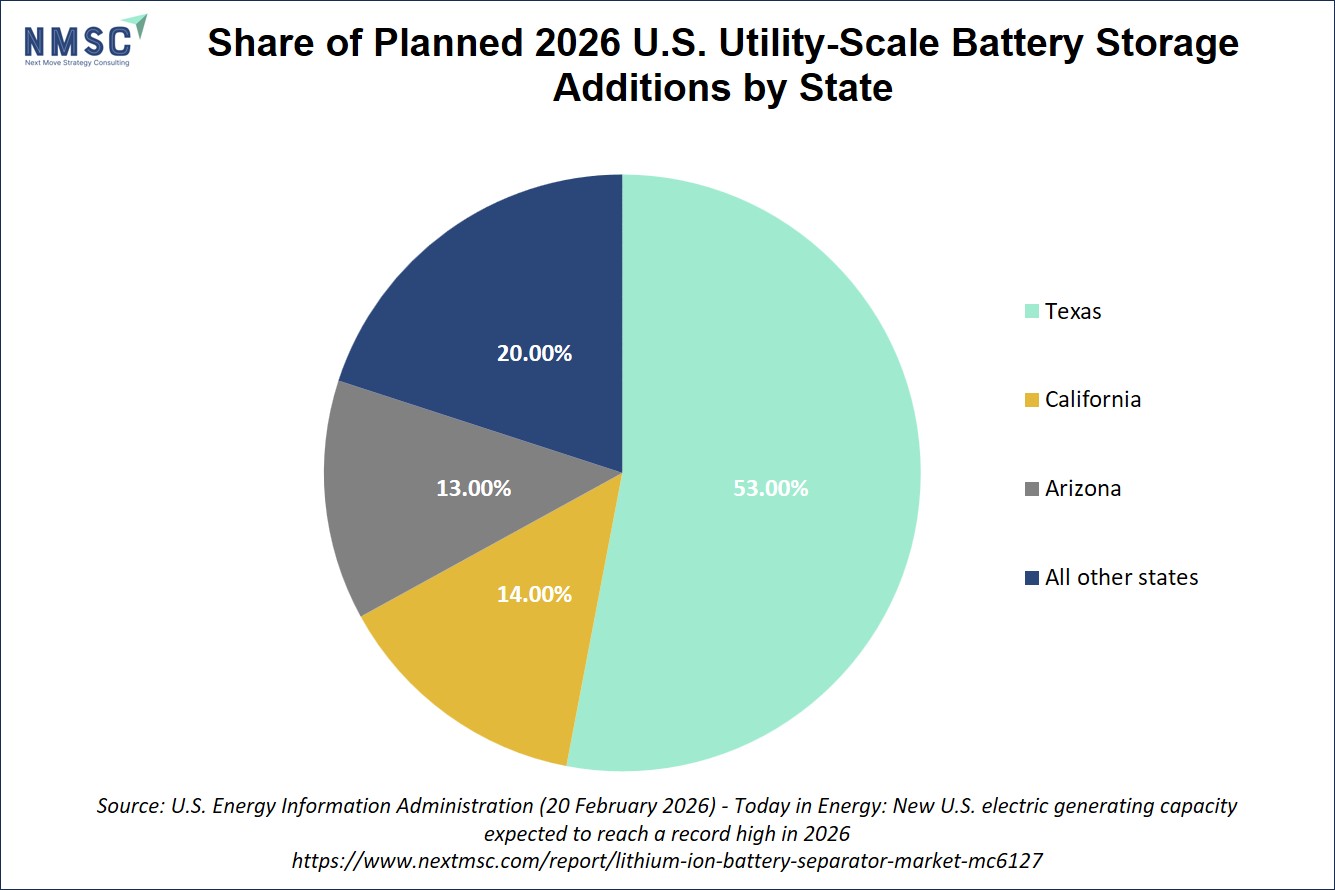
Concentration within that pipeline is high. In an earlier release, the U.S. Energy Information Administration (20 February 2026) reported that 24 gigawatts of utility-scale battery storage was planned for 2026, after a record 15 gigawatts was added in 2025, with Texas accounting for 53% of the 2026 plan, California for 14% and Arizona for 13%. For a separator producer qualifying supply for U.S. cell and storage programmes, that distribution means demand is tied to a small number of grid regions and project developers.
Key Industry Developments: Four Capacity Commitments in Six Months
Senior’s agreement is one of four separator commitments announced between May and November 2026, and the four differ in what they lock in. In a press release dated 26 August 2026, Asahi Kasei announced that it had opened a Hipore wet-process separator coating line at its existing Celgard plant in Charlotte, North Carolina, with commercial production due in the second half of fiscal 2026. The company said the investment decision dates to 2023 and that Toyota Tsusho Corporation has entered a capacity rights agreement related to the facility. Capacity and investment were not disclosed. Ryu Taniguchi, President of Asahi Kasei Battery Separator Corporation, described the line as a key milestone in building the company’s North American supply platform for electric vehicles and energy storage systems.
On 3 June 2026, UBE MAXELL announced that it would expand separator base film capacity at its Sakai Works in Kyoto, Japan, by about 50% once two phases are complete, with construction of the first phase starting in fiscal 2026 and the second scheduled for fiscal 2029. UBE MAXELL also has a separate base film facility at the same site under construction and due for completion in autumn 2026. In China, Yicai Global reported on 11 May 2026 that Mingzhu Plastic would invest about CNY 3.4 billion, or USD 497.4 million, in a new base in the Zengcheng Economic and Technological Development Zone in Guangzhou. The plan includes eight wet-process separator lines and would lift the company’s designed annual separator capacity to 4.2 billion square metres from 740 million square metres the previous year.
Four Separator Capacity and Supply Commitments, May to November 2026
|
Company |
Announced |
Development |
Disclosed scale |
|
Senior Technology Material (Swedish subsidiary) and a Volkswagen Group battery subsidiary |
5 Nov 2026 |
Second nomination agreement for wet-process coated separator, supply period 2027 to 2034 |
About 1.558 billion sq m forecast; value not disclosed |
|
Asahi Kasei, Celgard plant, Charlotte, North Carolina |
26 Aug 2026 |
Hipore wet-process coating line opened; commercial production in the second half of fiscal 2026 |
Capacity and investment not disclosed |
|
UBE MAXELL, Sakai Works, Kyoto |
3 Jun 2026 |
Separator base film expansion in two phases, fiscal 2026 and fiscal 2029 |
Base film capacity up about 50% after both phases |
|
Mingzhu Plastic, Zengcheng, Guangzhou |
11 May 2026 |
New base with eight wet-process separator lines |
CNY 3.4 billion (USD 497.4 million); designed capacity 4.2 billion sq m a year, from 740 million sq m |
Two details in the Senior announcement deserve attention. First, the new forecast of 1.558 billion square metres over eight years averages about 195 million square metres a year, against about 261 million a year implied by the 2.09 billion square metres of the 2024 nomination, a simple per-year average that is roughly 25% lower. The announcements do not say whether the product scope of the two agreements is identical, so the comparison indicates direction rather than a like-for-like change. Second, together the two nominations represent a combined forecast of roughly 3.65 billion square metres, which only converts to revenue if the customer’s purchase orders follow.
Segment Dynamics: Wet-Process Coated Separator Is Where Capacity Is Going
According to NextMSC primary research and analysis, the wet-process segment accounted for about 68% of the market in 2025, at USD 4.69 billion, and is projected to reach USD 19.65 billion by 2035 at a 15.4% CAGR. The dry-process segment was valued at USD 2.21 billion in 2025 and is projected to reach USD 6.90 billion by 2035 at a 12.1% CAGR. Coated separators held about 58% of the market, or USD 4.00 billion, and are the fastest-growing coating sub-segment at a 16.6% CAGR. Three of the four commitments above sit in the wet-process and coated categories: Senior’s agreement is for wet-process coated separator, Asahi Kasei’s new line is a wet-process coating line, and Mingzhu’s Guangzhou base is built around eight wet-process lines.
On the application side, NextMSC primary research and analysis shows electric vehicles holding about 72% of the market in 2025, at USD 4.96 billion, while energy storage systems are the fastest-growing application at a 19.7% CAGR. By material, PE/PP multilayer separators led with about 44% (USD 3.03 billion) and ceramic-coated separators are the fastest-growing material at 18.9%. By battery chemistry, NMC and NCA cells held about 54% (USD 3.72 billion) in 2025, while LFP is the fastest-growing at 18.1%. The IEA’s finding that LFP made up more than 90% of global stationary storage installations in 2025 links two of the fastest-growing segments: energy storage systems and LFP chemistry.
Regional Outlook: Asia-Pacific Dominates, North America and India Grow Fastest
NextMSC primary research and analysis values Asia-Pacific at USD 5.10 billion in 2025, about 74% of the global market, and projects USD 18.59 billion by 2035 at a 13.8% CAGR. Within the region, China is valued at USD 3.06 billion in 2025 and projected to reach USD 10.04 billion by 2035 at a 12.6% CAGR. India is the fastest-growing country in NextMSC’s forecast, rising from USD 305.9 million in 2025 to USD 2.42 billion by 2035 at a 23.0% CAGR.
North America is the fastest-growing region, from USD 0.69 billion in 2025 to USD 3.45 billion by 2035 at a 17.5% CAGR, with the United States rising from USD 537.4 million to USD 2.49 billion at 16.5%. Europe is projected to grow from USD 0.76 billion to USD 3.19 billion at a 15.4% CAGR. Middle East and Africa (USD 0.21 billion to USD 0.80 billion, 14.4% CAGR) and Latin America (USD 0.14 billion to USD 0.53 billion, 14.4% CAGR) remain small bases. Asahi Kasei’s Charlotte line and Senior’s European nomination target the two regions where NextMSC projects growth above the global rate of 14.5%.
Growth Drivers and Restraints
The growth drivers in NextMSC’s model are gigafactory capacity build-out and EV sales growth, ceramic-coated separator adoption for safety compliance, grid-scale energy storage deployment, U.S. Section 45X production credits and the shift toward LFP chemistry. The external evidence cited above supports the first and third of these directly: the IEA’s 1.2 terawatt-hour 2025 deployment figure and its more than 4 terawatt-hour cell capacity estimate for the first, and the EIA’s 54 gigawatts of planned U.S. storage additions for the third.
The restraints in NextMSC’s model are Chinese overcapacity compressing selling prices, the high capital intensity of wet-process manufacturing, and long cell-maker qualification cycles. Mingzhu’s expansion illustrates the first two: a CNY 3.4 billion investment that would raise designed capacity from 740 million to 4.2 billion square metres a year adds supply at a scale that tests pricing, and the cost is committed before any customer volume is confirmed. Qualification cycles explain why nomination agreements carry weight. A supplier that has completed qualification and been nominated for a cell programme can plan production for 2027 to 2034, which is the longer-term production planning in Europe that the Senior agreement is reported to support.
NMSC Strategic Perspective: Competition Is Shifting From Price per Square Metre to Qualified Supply Near the Cell Plant
NextMSC primary research and analysis reads the 2026 announcements as evidence that the competitive unit in separators is moving from the factory to the qualified supply relationship. Capacity in China is being added at a pace that tests pricing, as the Mingzhu plan shows. The commitments with the most durable value are the ones that pair coating capability with a named cell-maker programme in a region where cell capacity is growing, which is the structure of the Senior agreement in Europe and the Asahi Kasei line in North America.
NextMSC’s analysis also separates announced volume from realised revenue. Senior’s 1.558 billion square metres is a forecast with no disclosed contract value, UBE MAXELL’s second expansion phase is scheduled for fiscal 2029, and Asahi Kasei has not disclosed Charlotte’s capacity. The indicators worth tracking are Charlotte’s commercial start in the second half of fiscal 2026, the completion of UBE MAXELL’s base film facility in autumn 2026, and whether purchase orders under the Senior nominations follow the forecast schedule. A shortfall against the forecast would show most clearly in the 2027 delivery year.
For investors, NextMSC’s forecast points to the pairing of wet-process coated separator with the segments growing fastest: energy storage systems at a 19.7% CAGR, LFP chemistry at 18.1%, ceramic-coated material at 18.9%, North America at 17.5% and India at 23.0%. The USD 18.70 billion of absolute growth NextMSC projects between 2026 and 2035 falls mostly in Asia-Pacific by value, but the regions with the fastest growth rates are the ones where separator supply must be built or qualified from a lower base.
Competitive Landscape
The four companies in this article occupy different positions. Shenzhen Senior Technology Material is extending a Europe-focused relationship with a Volkswagen Group battery subsidiary through a Swedish subsidiary, with two nominations covering a combined forecast of roughly 3.65 billion square metres. Asahi Kasei is combining its Celgard dry-process base in Charlotte with a new Hipore wet-process coating line, backed by a Toyota Tsusho capacity rights agreement. UBE MAXELL is expanding separator base film at Sakai Works in two phases. Mingzhu Plastic has disclosed the most detailed capacity plan of the four, with a designed annual capacity of 4.2 billion square metres once the Guangzhou base is complete. Each event is traceable to the company’s announcement or to the Yicai Global report cited in the table above.
Bottom Line
Senior Technology Material’s second nomination from a Volkswagen Group battery subsidiary, covering a forecast 1.558 billion square metres from 2027 to 2034, is the latest sign that separator supply is being committed years ahead and close to cell production. The IEA reports cell capacity growing about 50% in both the European Union and the United States in 2025, and the EIA reports 54 gigawatts of planned U.S. storage additions through 2028. Asahi Kasei, UBE MAXELL and Mingzhu Plastic have each announced wet-process or coating capacity in 2026. NextMSC projects the global market growing from USD 6.89 billion in 2025 to USD 26.55 billion by 2035 at a 14.5% CAGR, with wet-process, coated, energy storage and LFP segments growing fastest. The risks are equally specific: forecast volumes are not purchase orders, Chinese capacity additions test pricing, and qualification cycles delay revenue. The signals to watch are Charlotte’s commercial start, UBE MAXELL’s autumn 2026 completion and the 2027 purchase orders under the Senior nominations.
About Next Move Strategy Consulting
Next Move Strategy Consulting is a premier market research and management consulting firm that has been committed to provide strategically analysed well documented latest research reports to its clients. The research industry is flooded with many firms to choose from, what makes NMSC different from the rest is its top-quality research and the obsession of turning data into knowledge by dissecting every bit of it and providing fact-based research recommendation that is supported by information collected from over 500 million websites, paid databases, industry journals and one on one consultations with industry experts across a diverse range of industry sectors. The high-quality customized research reports with actionable insights and excellent end-to-end customer service help our clients to take critical business decisions that enables them to move beyond time and have competitive edge in the industry.
We have been servicing over 1000 customers globally that includes 90% of the Fortune 500 companies over a decade. Our analysts are constantly tracking various high growth markets and identifying hidden opportunities in each sector or the industry. We provide one of the industry’s best quality syndicate as well as custom research reports across 10 different industry verticals. We are committed to deliver high quality research solutions in accordance to your business needs. Our industry standard delivery solutions that ranges from the pre consultation to after-sales services, provide an excellent client experience and ensure right strategic decision making for businesses.
For more information, please contact:
Next Move Strategy Consulting
5th Floor 867 Boylston St, STE 500,
Boston, MA 02116, U.S.
E-Mail: [email protected]
Direct: +1-217-650-7991
Website: www.nextmsc.com
About the Author
 Sanyukta Deb
— Sanyukta Deb is Digital Marketing Team Lead at Next Move Strategy Consulting, where she has led content strategy and technical SEO for the firm's B2B market research publications for over 2 years. Her editorial process translates NextMSC's primary and secondary research — spanning technology, industrial, and consumer sectors — into commercial narratives, backed by search-intent, keyword, and competitive analysis. She brings 5 years of overall experience in digital marketing and content strategy.
About the Reviewer
 Debashree Dey
— Debashree Dey is Assistant Manager at Next Move Strategy Consulting, where she supports cross-vertical market content and communications across diverse industries for 6 years. Her professional background includes senior content writing, communications, and published manuscript authorship, with experience developing audience-focused business narratives and maintaining clear, consistent messaging. Her role supports research-led content development and editorial quality across NextMSC publications.











Add Comment