RadNet’s €230M Gleamer Deal Reshapes Medical Imaging with AI
RadNet's €230M Gleamer Acquisition, FDA Breakthrough Designations, and a Wave of AI Consolidation Redefine the Global Medical Imaging Services Landscape
In March 2026, RadNet, Inc. — the United States' largest operator of outpatient diagnostic imaging centers — announced the acquisition of Gleamer, a Paris-based clinical AI company, for up to €230 million. Gleamer's portfolio spans X-ray, CT, MRI, and mammography modalities and will be fully integrated into RadNet's DeepHealth health informatics platform, extending the platform's clinical AI coverage across core imaging workflows while simultaneously establishing RadNet's first significant commercial footprint in the European market. The transaction, reported by Signify Research on is the single largest AI-specific acquisition in the outpatient imaging sector to date and marks a structural inflection point: the consolidation of AI capability is no longer a peripheral strategy for imaging service providers — it is the primary competitive battleground.
Against this backdrop of accelerating structural change, the global medical imaging services market is on a sustained growth trajectory. According to Next Move Strategy Consulting's Medical Imaging Services Market report, the global medical imaging services market is projected to reach USD 933.30 billion by 2030, growing at a CAGR of 5.9% from 2024 to 2030. This expansion is being driven by a convergence of three measurable forces: the rising global burden of chronic disease requiring repeat imaging, the accelerating integration of AI into diagnostic workflows, and a wave of M&A consolidation that is concentrating imaging capacity and AI capability within a smaller number of scaled operators.
For More Information: Download FREE Sample on Medical Imaging Services Market Report
The Chronic Disease Imperative: Why Imaging Volume Is Structurally Non-Cyclical
The demand underpinning the medical imaging services market is not discretionary. According to the World Heart Federation's World Heart Report, more than half a billion people worldwide are currently living with cardiovascular disease, which accounted for 20.5 million deaths in 2021 — a patient population that requires serial imaging for diagnosis, treatment planning, and ongoing monitoring.
In the United States alone, the National Center for Health Statistics recorded 1,958,310 new cancer cases and 609,820 cancer-related deaths in 2023, each of which generates multiple imaging encounters across the care continuum — from initial detection through staging, treatment response assessment, and surveillance. The Centers for Medicare & Medicaid Services (CMS) reported that U.S. healthcare expenditure reached USD 4.5 trillion in 2022 — a 4.1% year-on-year increase equating to USD 13,493 per capita — providing the fiscal infrastructure that sustains investment in advanced imaging technology at the institutional level.
In Asia-Pacific, the Economic and Social Commission for Asia and the Pacific (ESCAP) has documented that the region is home to 630 million individuals aged 60 and above — representing 60% of the world's elderly population — a demographic cohort whose age-related comorbidities generate disproportionately high imaging utilization rates. This demographic reality, combined with the region's rapid expansion of hospital infrastructure and its emergence as a global medical tourism hub — with Singapore ranked among the top six healthcare systems globally by the World Health Organization — positions Asia-Pacific as the fastest-growing regional segment within the NMSC forecast period.
AI Integration: From Pilot Programs to Platform Infrastructure
The most consequential structural shift in the medical imaging services market in 2026 is not volume growth — it is the transition of artificial intelligence from a point-solution add-on to the core infrastructure layer of imaging operations. As of early 2026, more than 300 AI algorithms have received FDA clearance for use in medical imaging, covering applications ranging from fracture detection and stroke triage to mammography screening assistance and cardiac function analysis, according to Braid Health's clinical AI overview published in 2026.
The academic frontier is advancing in parallel. On December 1, 2025, researchers at the University of California, Berkeley and the University of California, San Francisco released The Pillar-0 material identifies 366 radiologic findings and reports mean AUCs of 86.4, 88.0, 90.1 and 82.9 across the four evaluated datasets/modalities, outperforming publicly available models from Google (MedGemma, 0.76 AUC), Microsoft (MI2, 0.75 AUC), and Alibaba (Lingshu, 0.70 AUC).
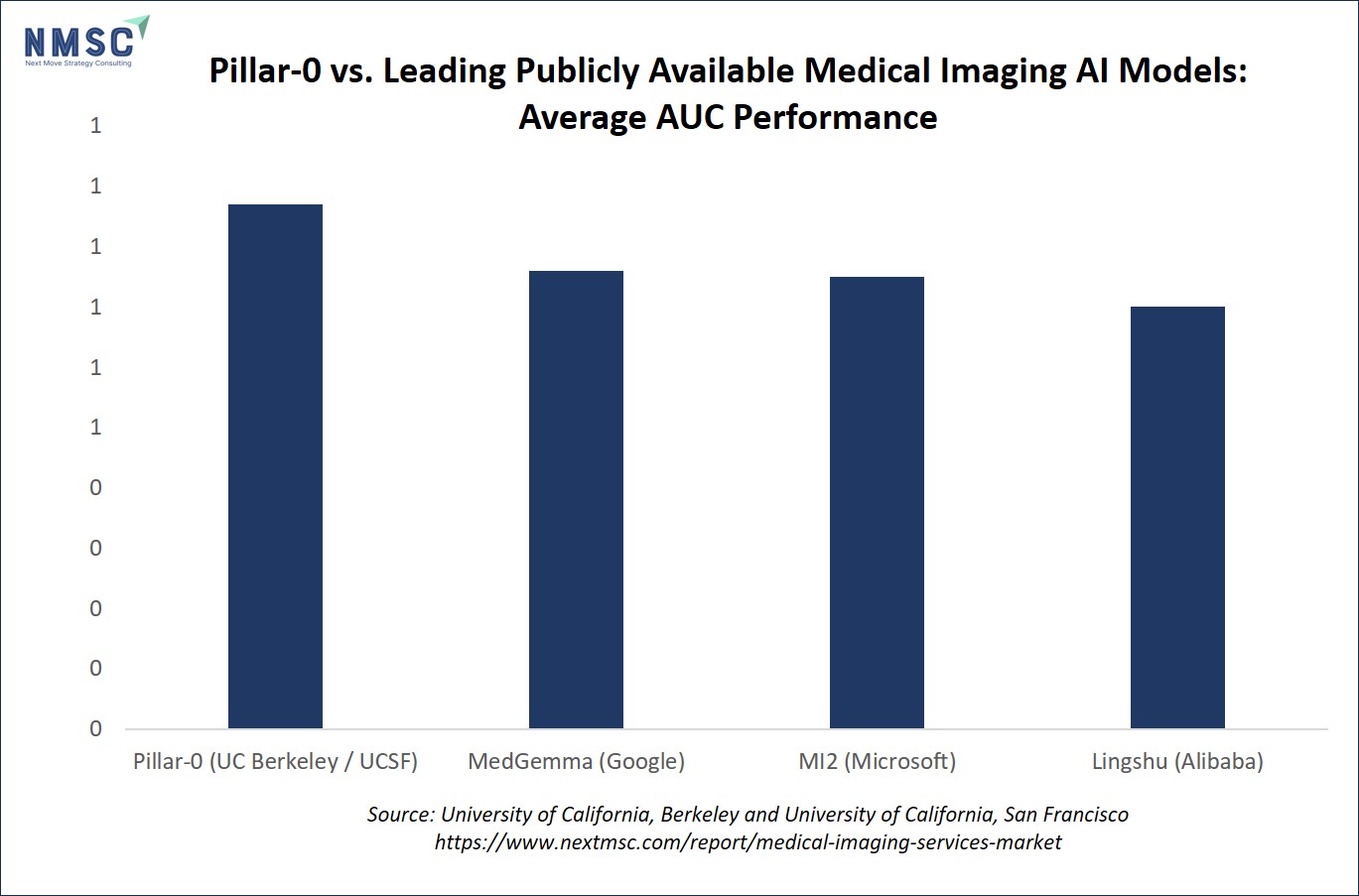
"Pillar-0 marks a major milestone in our mission to push the frontier of AI for radiology," said Adam Yala, Assistant Professor of Computational Precision Health at UC Berkeley and UCSF, in a statement published by Imaging Technology News on December 10, 2025. "Pillar-0 outperforms leading models from Google, Microsoft and Alibaba by over 10% across 366 tasks and four diverse modalities; Pillar-0 also runs an order of magnitude faster, finetunes with minimal effort, and drives large downstream performance gains."
The architectural innovation enabling this performance was explained by Kumar Krishna Agrawal, PhD Candidate in Computer Science at UC Berkeley and first author of the Pillar-0 research: "Leading foundation models for radiology have relied on processing 2D slices independently, because they are too inefficient to scale to the full imaging volumes. To enable Pillar-0 to effectively process 3D volumes, we implemented innovations across data, pretraining and neural network architectures. Our novel Atlas neural network architecture is over 150x faster than traditional vision transformers at processing an abdomen CT, allowing us to train models at a fraction of the cost."
At the commercial deployment level, the March 2026 European Congress of Radiology (ECR) produced a cluster of AI integration announcements that collectively illustrate how imaging IT vendors are shifting from bilateral partnerships to platform-based ecosystem strategies. Sectra announced the acquisition of Oxipit — whose CE Class IIb-certified ChestLink software autonomously identifies and clears high-confidence normal chest X-rays from radiologist worklists — marking the first major acquisition by an imaging IT vendor of an autonomous AI company. Separately, Cortechs.ai announced a partnership with Siemens Healthineers to integrate its NeuroQuant Lesion Surveillance software — which provides automated lesion segmentation and longitudinal tracking from brain MRI — into the Siemens Healthineers Digital Marketplace, extending quantitative neuroimaging tools to Siemens' global installed base.
Harrison.ai's Open Platform, first announced at RSNA, added four new partners at ECR — AIRAmed, Koios Medical, Lunit, and Nanox AI — expanding its vendor-neutral aggregation of imaging AI applications across X-ray, CT, MRI, and ultrasound modalities. In the same reporting period, Harrison.ai received FDA 510(k) clearance for acute infarct triage on non-contrast CT brain scans, adding to its existing portfolio of six FDA-cleared neurology-based findings.
FDA Regulatory Momentum: Generative AI Enters the Clearance Pipeline
The most consequential regulatory development in the medical imaging AI sector in 2026 is Radiology Partners' receipt of FDA Breakthrough Device Designation for its Cognita Chest X-ray (CXR) solution across multiple indications. Unlike prior FDA-cleared imaging AI tools — which perform discrete detection tasks — Cognita uses a generative vision-language model (VLM) to interpret chest X-rays and draft complete radiology results for physician review. The Breakthrough Device Designation enables closer collaboration with the FDA during the review process and signals the agency's willingness to engage with generative AI approaches that extend beyond detection toward automated interpretation and reporting — a category that, if cleared at scale, would materially alter the economics of high-volume chest X-ray reading.
Simultaneously, the legislative environment governing radiology reimbursement is undergoing its most significant reform attempt in over a decade. The Provider Reimbursement Stability Act of 2026 (H.R. 8163), which has advanced out of the House Ways and Means Committee with 36 cosponsors, would cap year-on-year variance in the Medicare Physician Fee Schedule conversion factor at 2.5%, adjust the budget neutrality threshold from 20% (set in 1992) to 54.3% beginning in 2027, and mandate simultaneous update of all direct cost inputs at least once every five years. The bill is supported by all major radiology specialty societies, according to Sandy Coffta, Vice President of Client Services at Healthcare Administrative Partners, writing in AuntMinnie on May 28, 2026.
The Medicare Access to Radiology Care Act (MARCA) of 2026, reintroduced in the Senate on May 21, 2026, would allow physicians to submit Medicare claims for nondiagnostic services performed by registered radiologist assistants under direct physician supervision — a provision that, if enacted, would directly address the documented shortage of radiologists in the United States and expand the billable capacity of existing radiology practices without requiring additional physician headcount.
The proposed 2027 Medicare Physician Fee Schedule rule, released by CMS in July 2026, would increase reimbursement by 2% for radiology, 2% for nuclear medicine, 3% for interventional radiology, and 3% for radiation oncology — the first meaningful upward adjustment for the specialty in several years, according to AuntMinnie's reporting on July 15, 2026.
M&A Consolidation: Outpatient Imaging Operators Scale for AI-Enabled Competition
The RadNet-Gleamer transaction is the most prominent but not the only consolidation event reshaping the competitive structure of the outpatient imaging services sector. On January 7, 2026, Envision Radiology announced the completed acquisition of Rezolut — a national diagnostic imaging organization operating across multiple U.S. states — with the transaction finalized on December 31, 2025.
"This is more than an acquisition — it is a partnership in purpose," said Aaron Ramsay, CEO of Envision Radiology, in a statement published by Radiology Business on January 6, 2026. "By bringing our teams together, we are expanding access to world-class imaging and strengthening our ability to deliver compassionate, consistent, high-quality care. We are stronger as one, and we are excited to have Rezolut team members join the Envision family."
At ECR in March 2026, Medimaps Group and Radiobotics announced a strategic merger combining their respective musculoskeletal (MSK) imaging AI portfolios across X-ray and DXA modalities. The combined offering spans fracture detection, bone quality assessment, and risk prediction — creating a unified MSK-focused AI solution that reflects the broader pattern of specialization-driven consolidation within imaging AI sub-segments, as reported by Signify Research on March 30, 2026.
In the infrastructure segment, Siemens Healthineers completed a USD 43.6 million construction and renovation project at its Tennessee Molecular Imaging Complex in September 2026, expanding its domestic manufacturing and research capacity for molecular imaging systems, according to Imaging Technology News reporting on September 14, 2026.
Key M&A, Regulatory, and Technology Developments in Medical Imaging Services (January–September 2026)
|
Date |
Event |
Parties Involved |
Significance |
|
January 7, 2026 |
Acquisition finalized |
Envision Radiology acquires Rezolut |
Expands national outpatient imaging footprint across multiple U.S. states |
|
March 2026 (ECR) |
Acquisition announced |
RadNet acquires Gleamer for up to €230M |
Integrates multi-modality AI into DeepHealth platform; establishes European market presence |
|
March 2026 (ECR) |
Acquisition announced |
Sectra acquires Oxipit (ChestLink) |
First imaging IT vendor to acquire an autonomous AI company; CE Class IIb-certified |
|
March 2026 (ECR) |
Strategic merger |
Medimaps Group + Radiobotics |
Unified MSK imaging AI portfolio across X-ray and DXA |
|
March 2026 (ECR) |
FDA Breakthrough Device Designation |
Radiology Partners — Cognita CXR |
Generative VLM for chest X-ray interpretation and report drafting |
|
March 2026 (ECR) |
FDA 510(k) Clearance |
Harrison.ai — acute infarct triage on non-contrast CT |
Expands CT brain triage portfolio to seven FDA-cleared neurology findings |
|
May 21, 2026 |
Legislation reintroduced |
Medicare Access to Radiology Care Act (MARCA) |
Would enable Medicare billing for radiologist assistant services; addresses radiologist shortage |
|
May 28, 2026 |
Legislation advancing |
Provider Reimbursement Stability Act (H.R. 8163) |
36 cosponsors; caps Medicare fee schedule variance at 2.5% annually |
|
July 2026 |
Proposed rule released |
CMS — 2027 Medicare Physician Fee Schedule |
Proposes 2–3% reimbursement increases across radiology subspecialties |
|
September 2026 |
Infrastructure expansion |
Siemens Healthineers — Tennessee Molecular Imaging Complex |
USD 43.6 million construction and renovation completed |
Regional Analysis: North America Leads, Asia-Pacific Accelerates
North America retains the dominant share of the global medical imaging services market, underpinned by the United States' USD 4.5 trillion healthcare expenditure base, its concentration of advanced imaging infrastructure, and its position as the primary regulatory jurisdiction for AI clearance — a status that gives U.S.-based operators first-mover advantage in deploying FDA-cleared AI tools at scale. The convergence of the Envision-Rezolut consolidation, the RadNet-Gleamer acquisition, and the pending MARCA and H.R. 8163 legislation collectively indicate that the U.S. outpatient imaging sector is entering a period of structural rationalization in which scale, AI capability, and reimbursement optimization will determine competitive viability.
Asia-Pacific's growth trajectory is anchored in demographic inevitability: with 630 million individuals aged 60 and above — 60% of the world's elderly population, per ESCAP data — the region's imaging utilization rates will continue to rise independent of technology adoption cycles. Singapore's healthcare system, ranked among the top six globally by the World Health Organization, positions the city-state as a reference market for AI-integrated imaging services within the region's medical tourism ecosystem. India, Malaysia, and South Korea are similarly expanding their hospital networks and attracting international patients seeking advanced diagnostic services at competitive price points — a dynamic that is drawing investment from both domestic operators and international imaging chains seeking regional scale.
Europe is emerging as the next major theater of AI-driven consolidation, as evidenced by RadNet's strategic rationale for the Gleamer acquisition: the company explicitly identified European market establishment as a primary objective of the transaction, using acquisition-led expansion to build regional scale in a market that remains fragmented across national healthcare systems and regulatory jurisdictions.
NMSC Strategic Perspective: The Convergence of AI, Consolidation, and Reimbursement Reform
NextMSC primary research and analysis identifies three structural dynamics that will determine which operators capture disproportionate value within the USD 933.30 billion market projected for 2030.
First, AI capability is becoming a prerequisite for competitive differentiation, not a premium feature. The transition from 300+ FDA-cleared point-solution algorithms to platform-level AI infrastructure — exemplified by RadNet's DeepHealth, Harrison.ai's Open Platform, and Sectra's integration of Oxipit's autonomous chest X-ray clearance — means that imaging service providers without a coherent AI integration strategy will face structural disadvantage in both clinical quality metrics and operational throughput. The Pillar-0 model's demonstration that open-source 3D imaging AI can outperform proprietary models from Google, Microsoft, and Alibaba by 10–17% across 366 tasks signals that the performance ceiling for AI-assisted radiology is rising faster than most operators' deployment timelines.
Second, the M&A wave is not primarily about geographic expansion — it is about AI asset acquisition. The RadNet-Gleamer transaction's €230 million valuation for a clinical AI portfolio, and Sectra's acquisition of Oxipit as the first imaging IT vendor to purchase an autonomous AI company, establish a new valuation framework in which AI algorithm portfolios command acquisition premiums that reflect their potential to reduce per-read costs and expand radiologist throughput at scale. Operators that have not yet built or acquired AI capability will face increasing pressure to do so through M&A, as organic development timelines extend beyond competitive windows.
Third, the U.S. reimbursement environment is shifting in a direction that rewards outpatient, AI-enabled imaging over hospital-based services. CMS's proposed 2027 Medicare Physician Fee Schedule increases of 2–3% across radiology subspecialties, combined with the Site-Neutral Payment Expansion policy that continues to shift Medicare reimbursement toward non-hospital settings, structurally advantages independent imaging centers and outpatient operators — precisely the segment where AI-driven efficiency gains are most readily monetizable. The pending MARCA legislation, if enacted, would further expand the billable capacity of outpatient radiology practices by enabling Medicare reimbursement for radiologist assistant services, directly addressing the radiologist shortage that currently constrains volume growth in high-demand markets.
NextMSC proprietary research and estimates project that the intersection of these three dynamics — AI platform consolidation, M&A-driven scale, and reimbursement reform favoring outpatient settings — will concentrate market share growth within a smaller number of scaled, AI-integrated operators over the 2024–2030 forecast period, while creating selective opportunities for specialized AI developers whose clinical validation data supports premium positioning within specific modality or disease-area segments.
Competitive Landscape
The medical imaging services market's competitive structure is bifurcating between large-scale outpatient imaging operators — RadNet, Sonic Healthcare, Dignity Health, Novant Health, Life Healthcare Group, InHealth Group, Medica Group, Global Diagnostics, Healthcare Imaging Services Pty Ltd., and Concord Medical Services Holdings Limited — and a growing ecosystem of AI developers whose technology is being integrated into, or acquired by, these operators. According to NextMSC proprietary research and estimates, these ten key players are actively pursuing joint venture strategies and cross-regional acquisitions to maintain competitive positioning within a market where AI integration has become the primary differentiator.
RadNet's November 2023 introduction of the DeepHealth health informatics portfolio — now significantly expanded through the Gleamer acquisition — represents the most advanced example of a large-scale imaging operator building a proprietary AI platform rather than relying on third-party integrations. This vertical integration strategy, if successfully executed across Gleamer's multi-modality portfolio, would give RadNet a structural cost and quality advantage in markets where AI-assisted reads can be demonstrated to reduce turnaround times and miss rates relative to non-AI-assisted competitors.
Bottom Line
The global medical imaging services market, valued at USD 624.81 billion in 2023 and projected by NextMSC proprietary research and estimates to reach USD 933.30 billion by 2030 at a 5.9% CAGR, is undergoing a structural transformation that extends well beyond volume growth. The March 2026 ECR conference produced a concentrated burst of M&A activity — led by RadNet's €230 million acquisition of Gleamer — alongside FDA Breakthrough Device Designation for generative AI-based chest X-ray interpretation and 510(k) clearance for AI-driven stroke triage, collectively signaling that AI is transitioning from a supplementary tool to the core infrastructure of competitive imaging operations. Simultaneously, the U.S. legislative environment is shifting toward outpatient imaging operators through proposed reimbursement increases, site-neutral payment expansion, and the pending MARCA legislation. Asia-Pacific's 630 million-strong elderly population and North America's USD 4.5 trillion healthcare expenditure base provide the demand foundation that will sustain this growth through 2030. Operators that successfully integrate AI platform capability, pursue disciplined M&A to achieve scale, and position for the reimbursement environment favoring outpatient settings will capture the largest share of the incremental USD 308 billion in market value projected over the forecast period.
About Next Move Strategy Consulting
Next Move Strategy Consulting is a premier market research and management consulting firm that has been committed to provide strategically analysed well documented latest research reports to its clients. The research industry is flooded with many firms to choose from, what makes NMSC different from the rest is its top-quality research and the obsession of turning data into knowledge by dissecting every bit of it and providing fact-based research recommendation that is supported by information collected from over 500 million websites, paid databases, industry journals and one on one consultations with industry experts across a diverse range of industry sectors. The high-quality customized research reports with actionable insights and excellent end-to-end customer service help our clients to take critical business decisions that enables them to move beyond time and have competitive edge in the industry.
We have been servicing over 1000 customers globally that includes 90% of the Fortune 500 companies over a decade. Our analysts are constantly tracking various high growth markets and identifying hidden opportunities in each sector or the industry. We provide one of the industry's best quality syndicate as well as custom research reports across 10 different industry verticals. We are committed to deliver high quality research solutions in accordance to your business needs. Our industry standard delivery solutions that ranges from the pre consultation to after-sales services, provide an excellent client experience and ensure right strategic decision making for businesses.
For more information, please contact:
Next Move Strategy Consulting
5th Floor 867 Boylston St, STE 500,
Boston, MA 02116, U.S.
E-Mail: [email protected]
Direct: +1-217-650-7991
Website: www.nextmsc.com
About the Author
 Sanyukta Deb
— Sanyukta Deb is Digital Marketing Team Lead at Next Move Strategy Consulting, where she has led content strategy and technical SEO for the firm's B2B market research publications for over 2 years. Her editorial process translates NextMSC's primary and secondary research — spanning technology, industrial, and consumer sectors — into commercial narratives, backed by search-intent, keyword, and competitive analysis. She brings 5 years of overall experience in digital marketing and content strategy.
Sanyukta Deb
— Sanyukta Deb is Digital Marketing Team Lead at Next Move Strategy Consulting, where she has led content strategy and technical SEO for the firm's B2B market research publications for over 2 years. Her editorial process translates NextMSC's primary and secondary research — spanning technology, industrial, and consumer sectors — into commercial narratives, backed by search-intent, keyword, and competitive analysis. She brings 5 years of overall experience in digital marketing and content strategy.
About the Reviewer
 Debashree Dey
— Debashree Dey is Assistant Manager at Next Move Strategy Consulting, where she supports cross-vertical market content and communications across diverse industries for 6 years. Her professional background includes senior content writing, communications, and published manuscript authorship, with experience developing audience-focused business narratives and maintaining clear, consistent messaging. Her role supports research-led content development and editorial quality across NextMSC publications.
Debashree Dey
— Debashree Dey is Assistant Manager at Next Move Strategy Consulting, where she supports cross-vertical market content and communications across diverse industries for 6 years. Her professional background includes senior content writing, communications, and published manuscript authorship, with experience developing audience-focused business narratives and maintaining clear, consistent messaging. Her role supports research-led content development and editorial quality across NextMSC publications.
















Add Comment