Ransom Demands Surge 47% as AI Risks Reshape the Cyber Insurance Market

Ransom Demands Surge 47% and the Jaguar Land Rover Hack Costs the UK Economy $2.5 Billion — Cyber Insurance Enters Its Defining Growth Phase
When Jaguar Land Rover — the United Kingdom's largest automotive manufacturer — suffered a devastating cyberattack in August 2025 that halted global production for five weeks, disrupted more than 5,000 suppliers, and inflicted £196 million (approximately USD 260 million) in direct cyber-related costs, the incident did not merely expose the fragility of interconnected digital supply chains. It crystallised, with unprecedented clarity, why the global cybersecurity insurance market is now one of the fastest-expanding segments in financial services. The UK government's subsequent £1.5 billion (approximately USD 2 billion) loan guarantee to stabilise the supply chain underscored that cyber risk has graduated from a corporate IT concern to a matter of national economic policy.
According to Next Move Strategy Consulting's Cybersecurity Insurance Market report, the global cybersecurity insurance market was valued at USD 21.37 billion in 2024 and is projected to reach USD 64.49 billion by 2030, growing at a CAGR of 20.21% between 2025 and 2030, with the market already estimated at USD 25.69 billion in 2025. This trajectory is not driven by generic digital adoption; it is being shaped by a specific and measurable escalation in attack severity, a structural shift in regulatory enforcement, and the emergence of AI-specific liability exposures that existing policy frameworks were never designed to absorb.
For More Information: Download FREE Sample on Cybersecurity Insurance Market Report
Coalition's 2026 Cyber Claims Report: The Anatomy of a Market-Defining Threat Surge
Coalition's 2026 Cyber Claims Report — drawn from real claims data across more than 100,000 global policyholders covering the full calendar year 2025 — provides the most granular institutional evidence of why premium volumes and policy demand are accelerating simultaneously.
Initial ransom demands surged 47% to an average of over USD 1 million per incident, yet 86% of businesses hit by ransomware refused to pay the demand — a behavioural shift that reflects both improved incident response capabilities and the growing role of active insurance models in negotiating outcomes. Coalition's incident response teams negotiated ransom payments down by an average of 65% and recovered USD 21.8 million in stolen funds, averaging USD 202,000 per incident — a direct demonstration of the financial value that integrated cyber insurance delivers beyond simple indemnification.
Critically, business email compromise (BEC) and funds transfer fraud (FTF) accounted for 58% of all claims, with 71% of all FTF claims resulting directly from social engineering — a vector that AI-generated deepfakes and hyper-personalised phishing are making exponentially more effective. Meanwhile, 70% of ransomware events involved simultaneous encryption and data exfiltration, a double-extortion tactic that routinely doubles incident cost and expands liability exposure from first-party business interruption into third-party privacy and regulatory claims.
The WEF and Munich Re Consensus: AI Is Rewriting the Risk Calculus
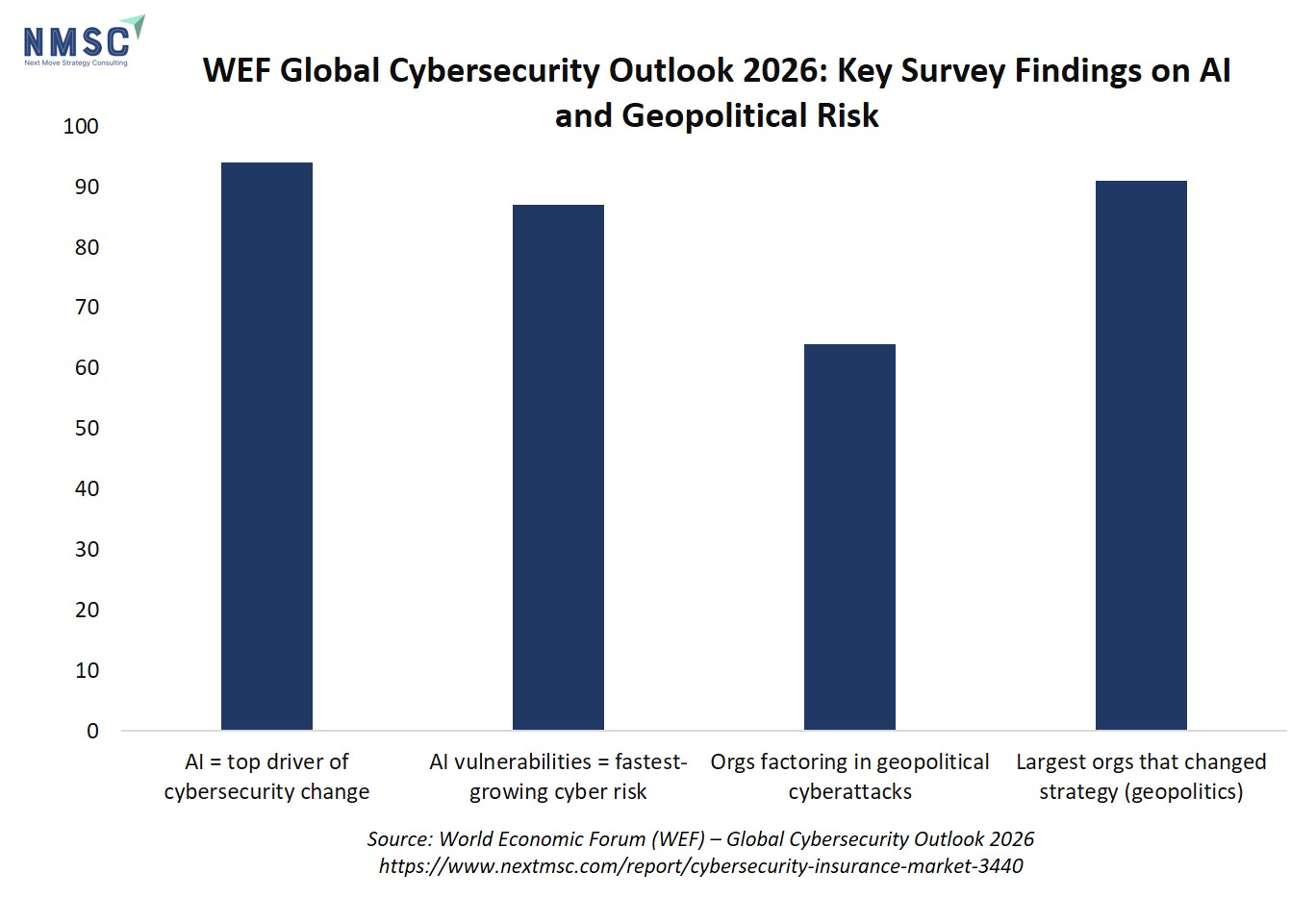
The World Economic Forum's Global Cybersecurity Outlook 2026, published in January 2026, surveyed 804 qualified participants from 92 countries and found that 94% of respondents identified AI as the most significant driver of change in cybersecurity in the year ahead. Separately, 87% identified AI-related vulnerabilities as the fastest-growing cyber risk over the course of 2025, with data leaks associated with generative AI (34%) and the advancement of adversarial capabilities (29%) ranking as the leading concerns for the period ahead.
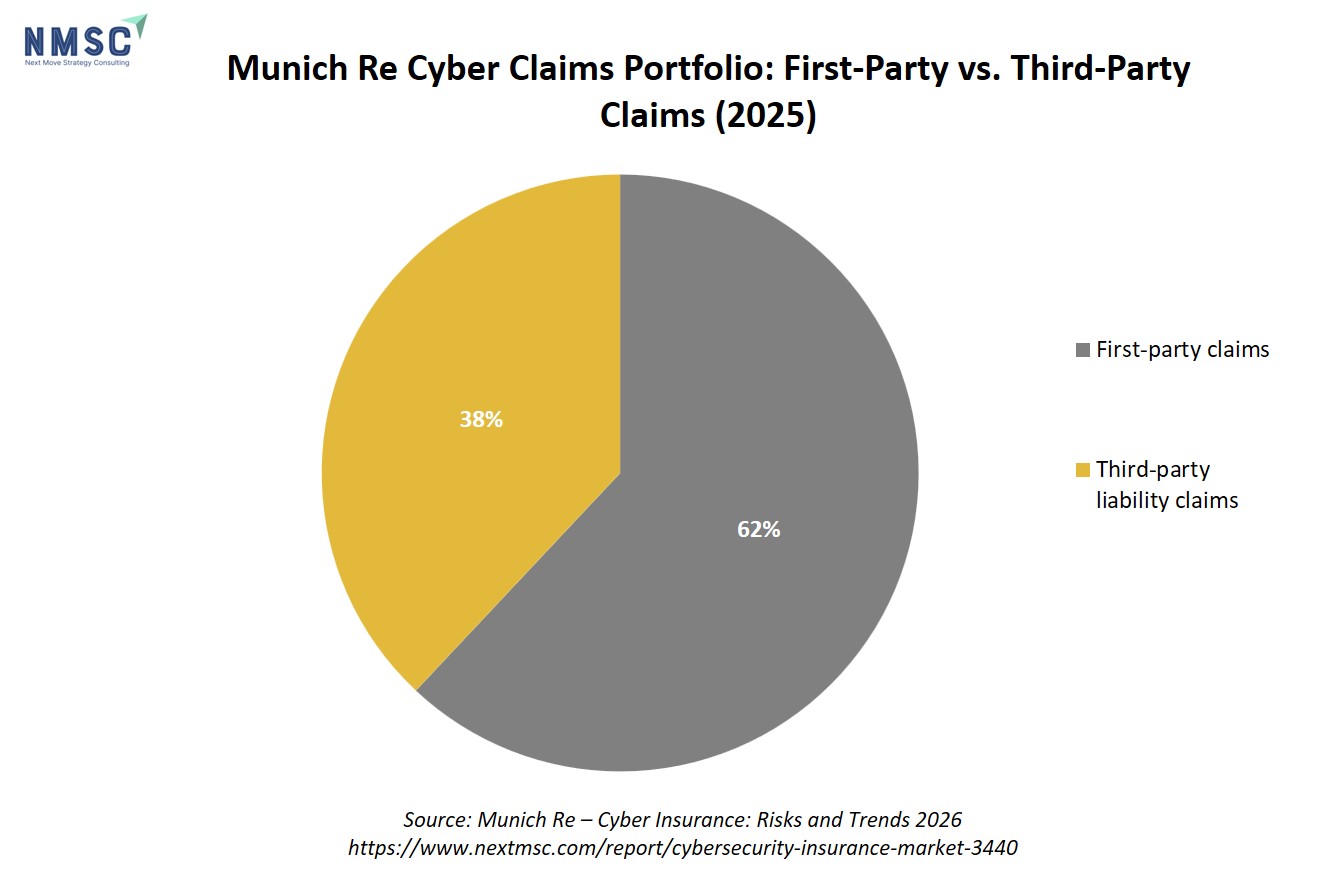
Munich Re's Cyber Insurance: Risks and Trends 2026, published in March 2026, reinforces this assessment with portfolio-level claims data. First-party claims — covering losses suffered directly by an organisation, including business interruption, incident response, and data restoration — remain dominant at 62% of all actively managed claims, while third-party liability claims account for the remaining 38%. Munich Re's analysis projects that cybercrime will impose a global cost of USD 14 trillion by 2028 — a figure that would make it the third-largest economy in the world, surpassing the combined GDP of Germany, Japan, and India.
"Cyber insurance is more relevant and cyber risks are more vibrant than ever," said Thomas Blunck, CEO Reinsurance at Munich Re, in the firm's March 2026 report. "Our unchanged goal: to help clients secure their business opportunities in a hyper-connected world."
The protection gap remains the market's most consequential structural feature. Nearly 9 out of 10 C-level respondents do not feel their company is adequately protected against cyberattacks, according to Munich Re's Global Cyber Risk and Insurance Survey 2026. "I take this as a call for insurers to step up their efforts," said Jürgen Reinhart, Chief Underwriter Cyber at Munich Re. "Cyber insurance is relevant, has proven its effectiveness, and is ready to grow."
Geopolitical Volatility: From Background Risk to Underwriting Variable
The WEF's Global Cybersecurity Outlook 2026 documents a structural shift in how organisations classify cyber risk: 64% of organisations are now explicitly accounting for geopolitically motivated cyberattacks — including disruption of critical infrastructure and espionage — in their overall cyber risk mitigation strategies. Among the largest organisations, 91% have changed their cybersecurity strategies specifically due to geopolitical volatility.
The April 2025 hacking of a Norwegian hydropower dam — which opened a floodgate and released 500 litres of water per second for four hours in what Norwegian officials described as a deliberate act of sabotage — illustrated how state-linked cyber operations are now targeting physical infrastructure with consequences that extend well beyond data loss. A September 2025 cyberattack on airport check-in and boarding systems across multiple major European hubs caused cascading flight delays and cancellations, exposing the systemic fragility of interconnected digital supply chains in critical transport infrastructure.
For insurers, these events are not merely claims events — they are underwriting signals. Munich Re's Stefan Golling, Board of Management, Global Clients and North America, stated in the firm's March 2026 report: "In response to powerful geopolitical, technological and economic stressors, companies need to focus equally strongly on resilience and protection. Operating in the digital era involves threats that no business leader can afford to neglect."
Regulatory Enforcement as a Structural Demand Driver
Regulatory pressure is converting cyber insurance from a discretionary risk-transfer tool into a compliance necessity. The U.S. Department of Health and Human Services Office for Civil Rights levied USD 143.98 million in HIPAA civil money penalties across 148 enforcement actions as of October 31, 2024, targeting failures to protect electronic patient records — a penalty volume that directly expands the addressable market for healthcare-sector cyber coverage.
The WEF's Global Cybersecurity Outlook 2026 found that 74% of respondents hold a positive view of the effectiveness of cyber-related regulations, and that compliance imperatives now rank among the top motivations for purchasing cyber insurance. The United Nations General Assembly's adoption of the Convention against Cybercrime in December 2024 — the first universal framework for investigating and prosecuting online offences — signals that the regulatory architecture underpinning cyber insurance demand will continue to expand across jurisdictions.
K. Krithivasan, Chief Executive Officer and Managing Director of Tata Consultancy Services, captured the strategic imperative in the WEF's January 2026 report: "With AI doubling in compute every three months or so, the risks of technology-enabled sophisticated cybercrimes have never been greater in human history. No matter how high your walls, every business faces an elevated risk of being breached. The businesses that thrive in the future will not be those that have never been hit by cyber hacks or crimes, but those which have built the strongest capability to recover from them."
Key Market Developments: Product Innovation and Geographic Expansion
The competitive landscape in cybersecurity insurance is being reshaped by a wave of product launches and regional expansions that reflect both the broadening of insurable risk categories and the intensification of demand in previously underserved markets.
In July 2025, QBE North America launched AI-focused cyber insurance solutions covering AI regulatory compliance and LLMjacking — a novel attack vector targeting cloud-hosted large language models — helping clients manage fines, defence costs, and retraining expenses. Meredith Brown, Head of U.S. Cyber & E&O at QBE, stated that "these targeted coverages fill gaps in traditional cyber policies amid evolving AI regulations," building on QBE's 2023 QCyberProtect policy framework.
In June 2025, Marsh launched Cyber Unity on June 26, 2025, offering up to €5 million in primary capacity in primary capacity with pre-negotiated claims handling and incident response services — directly addressing the underwriting gap for SMEs in markets such as France and Spain.
In May 2025, Resilience announced the launch of its cyber risk platform in Germany and Austria, marking its seventh European market and combining tailored underwriting with integrated risk management services. In April 2025, Chubb unveiled its Premier Life Science multi-line policy across Singapore, Australia, Hong Kong, and South Korea, bundling product liability, clinical trials insurance, professional indemnity, and cyber coverage to address the life sciences sector's complex digital and regulatory exposures.
Key Cyber Threats and Events Shaping Cybersecurity Insurance Demand (2025–2028)
|
Cyber Threat / Event |
Quantified Impact |
Insurance Implication |
|
JLR Cyberattack (Aug 2025) |
£196M direct costs; £1.9B UK economic loss; 5,000+ suppliers disrupted |
Expanded demand for supply chain cyber coverage and business interruption endorsements |
|
Ransom Demand Surge (2025) |
47% increase; avg demand >USD 1M |
Higher policy limits required; active response services now a differentiating underwriting factor |
|
BEC/FTF Claims (2025) |
58% of all claims; avg FTF loss USD 112K |
Social engineering coverage now a baseline policy requirement, not an add-on |
|
AI Vulnerability Growth |
87% of executives cite as fastest-growing risk |
New AI-specific endorsements (QBE LLMjacking, July 2025) addressing coverage gaps |
|
HIPAA Enforcement (to Oct 2024) |
USD 143.98M in civil penalties; 148 actions |
Healthcare sector cyber insurance now a compliance-driven purchase, not discretionary |
|
Cybercrime Global Cost Projection |
USD 14 trillion by 2028 |
Structural underinsurance gap creates long-term premium growth runway |
Regional Analysis
North America maintains its position as the dominant regional market, driven by the highest concentration of regulatory enforcement actions, the deepest e-commerce penetration, and the most mature broker infrastructure. Mexico's domestic e-commerce market reached USD 39.3 billion in 2024, marking over 20% growth from 2023, according to the Mexican Association of Online Sales — a volume of digital transaction activity that directly expands the addressable market for ransomware and data breach coverage across the region.
Europe commands approximately one-fifth of global cyber insurance premiums. Marsh's June 2025 launch of Cyber Unity specifically targets the SME protection gap in France and Spain, while Resilience's May 2025 expansion into Germany and Austria reflects the intensifying competitive pressure to capture mid-market share ahead of the EU's evolving NIS2 Directive enforcement cycle.
Asia-Pacific is positioned for steady growth, anchored by China's 1.1 billion internet users — representing a 78% penetration rate as of June 2024, according to the International Association of Accounting Professionals — and Japan's healthcare expenditure per capita of USD 4,676 in 2021, a 23.3% increase from 2011, according to the World Bank Group, which is driving investment in electronic health records and, consequently, demand for healthcare cyber coverage. Coalition's October 2024 multi-year capacity agreement with Mitsui Sumitomo Insurance, which brought its Active Cyber Insurance to over 1,400 Australian SMEs from January 2025, exemplifies the region's accelerating institutional engagement.
Rest of World markets remain constrained by lower digital adoption — only 38% of Sub-Saharan Africa residents were online in 2024, compared with over 90% in high-income economies — and nascent data protection regulatory frameworks, though the UN Convention against Cybercrime's adoption in December 2024 is expected to accelerate legislative development across emerging markets.
NMSC Strategic Perspective: The Three Structural Forces Redefining Cyber Insurance Underwriting
NextMSC primary research and analysis identifies three structural forces that distinguish the current phase of cybersecurity insurance market growth from prior expansion cycles — and that will determine which carriers, brokers, and technology providers capture disproportionate share through 2030.
First, the shift from frequency-driven to severity-driven loss modelling. The 47% surge in average ransom demands documented in Coalition's 2026 Cyber Claims Report, combined with the JLR incident's USD 260 million direct cost and USD 2.5 billion economy-wide impact, signals that tail-risk scenarios are no longer theoretical. Carriers that have invested in proprietary accumulation modelling — particularly for supply chain contagion events — will be able to price and structure limits that competitors cannot, creating a durable underwriting advantage.
Second, the emergence of AI liability as a distinct and uninsured exposure class. McKinsey's State of AI Global Survey (March 2025) found that 78% of organisations deploy AI in at least one business function, yet the Council of Europe's Framework Convention on Artificial Intelligence — adopted in May 2024 — has created a new category of regulatory liability (model manipulation, data poisoning, non-compliance with AI governance frameworks) that falls entirely outside traditional cyber policy language. QBE's July 2025 launch of LLMjacking coverage is the first meaningful product response to this gap, but NextMSC analysis indicates that the majority of the AI liability protection gap remains unaddressed, representing a multi-billion-dollar addressable market for carriers willing to develop actuarially sound AI-specific endorsements.
Third, the SME coverage gap as the market's highest-growth segment. Munich Re's March 2026 analysis confirms that the majority of cyber incidents and claims by volume affect micro-companies and SMEs — yet this segment remains systematically underinsured due to complexity of application, premium sensitivity, and limited broker access. Marsh's Cyber Unity facility and Coalition's Active Insurance model represent two distinct structural responses to this gap: the former through pre-negotiated capacity aggregation, the latter through technology-integrated risk monitoring that reduces underwriting uncertainty. NextMSC analysis projects that SME-focused cyber insurance will account for a disproportionate share of new premium growth through 2030, as regulatory mandates and supply chain security requirements cascade from large enterprises to their smaller vendor ecosystems.
Bottom Line
The global cybersecurity insurance market is undergoing a structural transformation that extends well beyond premium growth. The 47% surge in ransom demands, the USD 2.5 billion economic cost of the Jaguar Land Rover cyberattack, and the WEF's finding that 87% of executives now identify AI-related vulnerabilities as the fastest-growing cyber risk collectively define a threat environment in which the financial consequences of underinsurance are no longer abstract. According to NextMSC primary research and analysis, the market is projected to grow from USD 25.69 billion in 2025 to USD 64.49 billion by 2030 at a CAGR of 20.21% — a trajectory underpinned by regulatory enforcement escalation, AI-specific liability gaps, and the systematic expansion of SME coverage capacity. Carriers that invest in proprietary accumulation modelling, AI endorsement frameworks, and integrated risk monitoring platforms will be best positioned to capture the structural premium growth that this threat environment is generating. The protection gap — with nearly 9 in 10 C-level executives reporting inadequate coverage — remains the market's most consequential and commercially significant feature.
About Next Move Strategy Consulting
Next Move Strategy Consulting is a premier market research and management consulting firm that has been committed to provide strategically analysed well documented latest research reports to its clients. The research industry is flooded with many firms to choose from, what makes NMSC different from the rest is its top-quality research and the obsession of turning data into knowledge by dissecting every bit of it and providing fact-based research recommendation that is supported by information collected from over 500 million websites, paid databases, industry journals and one on one consultations with industry experts across a diverse range of industry sectors. The high-quality customized research reports with actionable insights and excellent end-to-end customer service help our clients to take critical business decisions that enables them to move beyond time and have competitive edge in the industry.
We have been servicing over 1000 customers globally that includes 90% of the Fortune 500 companies over a decade. Our analysts are constantly tracking various high growth markets and identifying hidden opportunities in each sector or the industry. We provide one of the industry's best quality syndicate as well as custom research reports across 10 different industry verticals. We are committed to deliver high quality research solutions in accordance to your business needs. Our industry standard delivery solutions that ranges from the pre consultation to after-sales services, provide an excellent client experience and ensure right strategic decision making for businesses.
For more information, please contact:
Next Move Strategy Consulting
5th Floor 867 Boylston St, STE 500,
Boston, MA 02116, U.S.
E-Mail: [email protected]
Direct: +1-217-650-7991
Website: www.nextmsc.com
About the Author
 Sanyukta Deb
— Sanyukta Deb is Digital Marketing Team Lead at Next Move Strategy Consulting, where she has led content strategy and technical SEO for the firm's B2B market research publications for over 2 years. Her editorial process translates NextMSC's primary and secondary research — spanning technology, industrial, and consumer sectors — into commercial narratives, backed by search-intent, keyword, and competitive analysis. She brings 5 years of overall experience in digital marketing and content strategy.
Sanyukta Deb
— Sanyukta Deb is Digital Marketing Team Lead at Next Move Strategy Consulting, where she has led content strategy and technical SEO for the firm's B2B market research publications for over 2 years. Her editorial process translates NextMSC's primary and secondary research — spanning technology, industrial, and consumer sectors — into commercial narratives, backed by search-intent, keyword, and competitive analysis. She brings 5 years of overall experience in digital marketing and content strategy.
About the Reviewer
 Debashree Dey
— Debashree Dey is Assistant Manager at Next Move Strategy Consulting, where she supports cross-vertical market content and communications across diverse industries for 6 years. Her professional background includes senior content writing, communications, and published manuscript authorship, with experience developing audience-focused business narratives and maintaining clear, consistent messaging. Her role supports research-led content development and editorial quality across NextMSC publications.
Debashree Dey
— Debashree Dey is Assistant Manager at Next Move Strategy Consulting, where she supports cross-vertical market content and communications across diverse industries for 6 years. Her professional background includes senior content writing, communications, and published manuscript authorship, with experience developing audience-focused business narratives and maintaining clear, consistent messaging. Her role supports research-led content development and editorial quality across NextMSC publications.


















Add Comment