Home Insurance Market Faces Climate-Driven Stress

NAIC's Landmark Report Signals Structural Stress in Global Home Insurance as Climate Losses and Premium Surges Reshape the Market
On August 5, 2026, the National Association of Insurance Commissioners (NAIC) released what it described as a first-of-its-kind national analysis of homeowners insurance market trends — the most comprehensive regulatory examination of the U.S. homeowners insurance sector ever conducted using state-collected data. The report, formally titled Examining Homeowner Property Insurance Market Dynamics: An Assessment of Countrywide State-Level Data From 2018 to 2024, drew on seven years of Market Conduct Annual Statement (MCAS) data submitted by insurers to state regulators across all 50 states, the District of Columbia, and five U.S. territories.
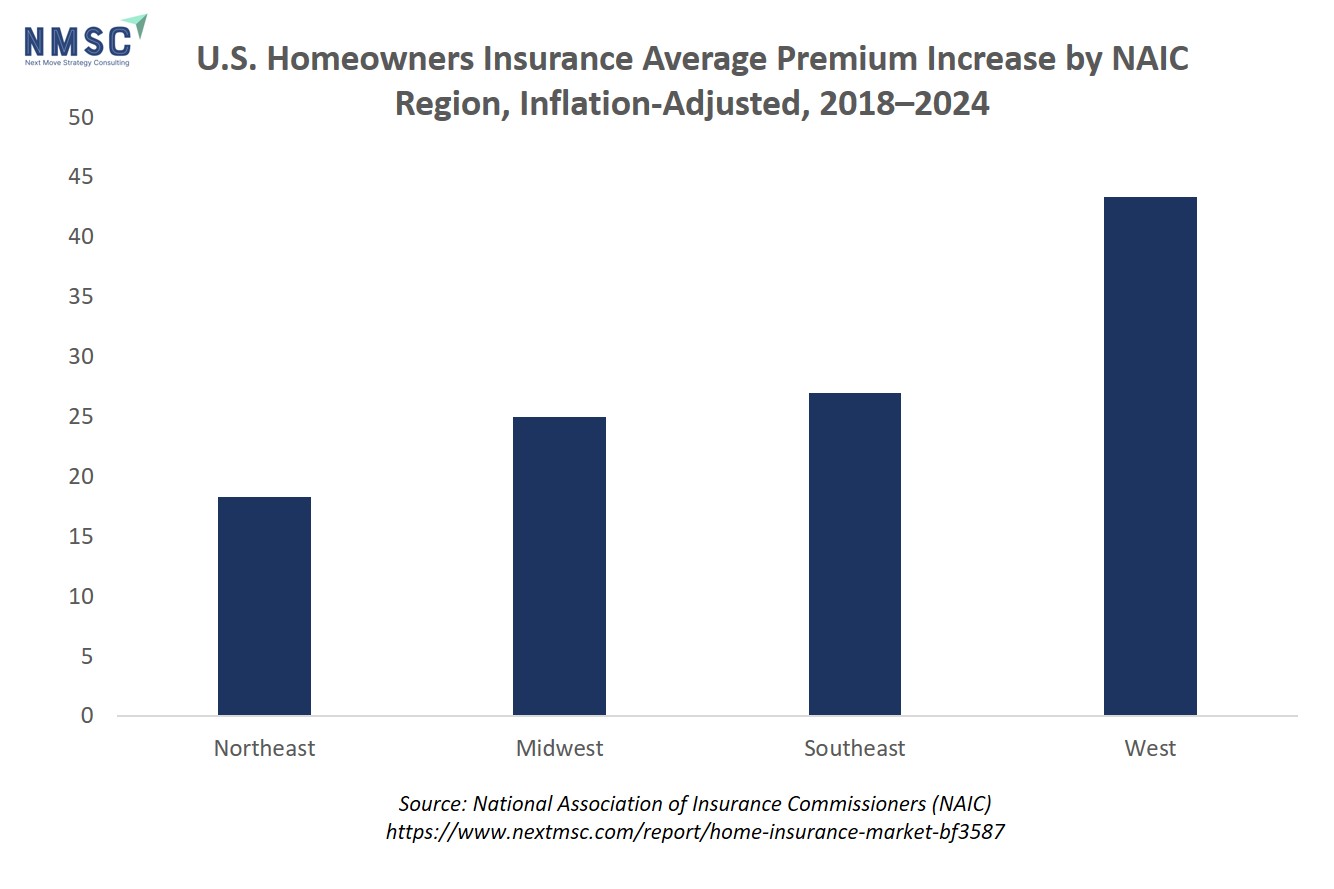
The findings were unambiguous in their severity. Average homeowners insurance premiums rose faster than inflation across every NAIC geographic region between 2018 and 2024, with inflation-adjusted increases ranging from 18.3 percent in the Northeast to 43.3 percent in the West. In absolute terms, average premiums in the Southeast — the region most exposed to hurricane and flood risk — reached $1,818 per year in 2024, while the Northeast recorded the lowest regional average at $1,396. Company-initiated non-renewal rates — instances where insurers declined to renew existing policies — increased between 96 percent and 216 percent depending on region over the same period. As of 2024, 715 companies were writing homeowners coverage across the United States, with 103 million policies in force.
"The data tells the story of a homeowners insurance market that is overall operationally robust but nonetheless under pressure and exhibiting signs of stress," wrote the report's co-authors, Jeffrey Czajkowski and Paula Harms. The NAIC report arrives as a defining regulatory and market intelligence event for the global Home Insurance Market, which is simultaneously navigating accelerating catastrophe losses, digital transformation, and a structural repricing of climate risk across every major geography.
For More Information: Download FREE Sample on Home Insurance Market Report
The Climate Loss Imperative: Swiss Re and Munich Re Data Confirm Structural Escalation
The NAIC's findings do not exist in isolation. They are corroborated by concurrent data from the world's two largest reinsurance groups, both of which published authoritative natural catastrophe assessments in July and August 2026.
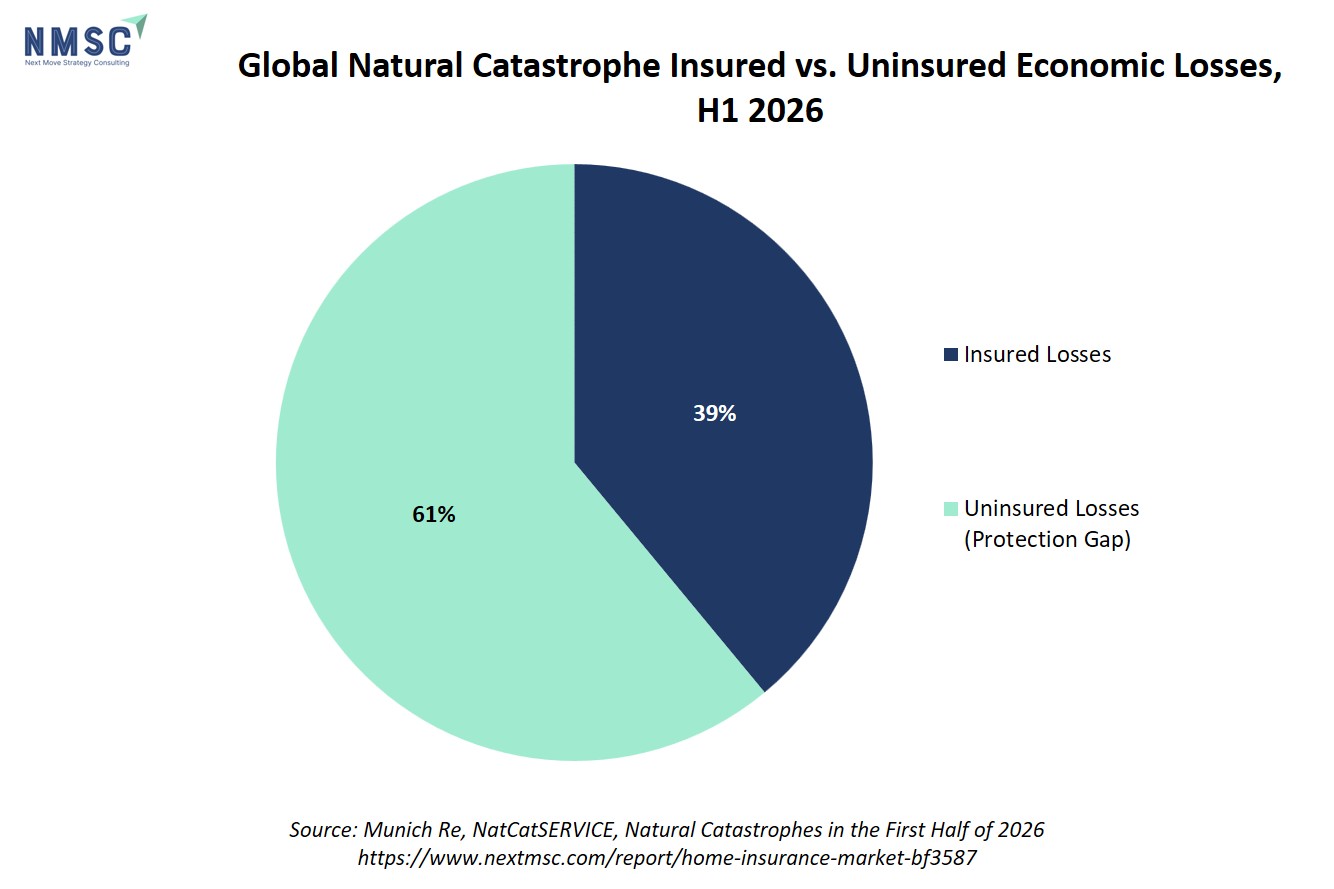
According to Munich Re's NatCatSERVICE analysis, published July 30, 2026, natural disasters caused worldwide losses estimated at nearly USD 112 billion in the first half of 2026. Of those losses, only USD 44 billion were insured — representing an insurance protection gap of 60 percent. While total losses were slightly below the inflation-adjusted ten-year average of USD 113 billion for the first half of the year, they remained significantly below the five-year average of USD 136 billion, reflecting a relatively moderate first half rather than any structural reduction in risk.
Swiss Re Institute's parallel assessment, published August 11, 2026, placed global insured natural catastrophe losses at USD 42 billion in the first half of 2026 — the lowest first-half total since 2020 and well below the long-term trend estimate of USD 66 billion. Severe convective storms, primarily in the United States, were the dominant loss driver, generating USD 28 billion in insured losses. Insurance covered approximately 42 percent of total economic losses from natural catastrophes in the period, above the 30-year average of 33 percent, reflecting the concentration of damage in highly insured markets.
Swiss Re Institute estimates that structural drivers — including growing exposure in hazard-prone areas, rising asset values, and changing hazard patterns — could contribute to long-term insured loss growth of approximately 5 to 7 percent annually, even as annual figures fluctuate significantly from year to year.
Global Insurance Market Context: A USD 6.9 Trillion Industry Under Transformation
The structural pressures documented by the NAIC and the reinsurance sector are unfolding within a global insurance industry that reached a record premium pool of EUR 6.9 trillion in 2025, according to the Allianz Global Insurance Report 2026, published May 28, 2026. The global insurance industry grew by 7.1 percent in 2025, adding EUR 456 billion to the global premium pool, though growth moderated from the exceptional 9.4 percent recorded in 2024. The ten-year compound annual growth rate stood at 5.6 percent, confirming that the industry's structural growth drivers remain intact.
Within the global premium pool, life insurance remained the largest segment at EUR 2,861 billion, followed by property and casualty (P&C) at EUR 2,320 billion and health insurance at EUR 1,688 billion. The P&C segment — which encompasses home insurance — grew by 3.8 percent in 2025, well below the prior year's 8.5 percent expansion and the segment's ten-year CAGR of 5.6 percent, as pricing cycles matured and claims inflation began to stabilize. North America retained its position as the dominant P&C market, accounting for 52 percent of global P&C premiums, though growth slowed sharply to 2.2 percent from 9.7 percent in 2024.
Looking ahead, Allianz Research projects the global insurance market to grow at an annual rate of 5.3 percent over the next ten years, slightly above economic output. For P&C specifically, global annual growth of 4.7 percent is projected through 2036, with the global premium pool expected to expand by EUR 5,260 billion in absolute terms over the decade.
Global Natural Catastrophe Economic and Insured Losses, 2024–2025
|
Loss Category |
2025 (USD bn) |
2024 (USD bn) |
10-Year Average (USD bn) |
% Change vs. 10-Year Avg. |
|
Total Economic Losses |
233 |
338 |
280 |
–17% |
|
— Natural Catastrophe |
220 |
327 |
267 |
–18% |
|
— Man-Made |
13 |
11 |
13 |
— |
|
Total Insured Losses |
118 |
151 |
121 |
–3% |
|
— Natural Catastrophe |
107 |
141 |
111 |
–3% |
|
— Man-Made |
11 |
9 |
10 |
+5% |
The Protection Gap: A Persistent Structural Vulnerability
The 60 percent insurance protection gap documented by Munich Re for the first half of 2026 represents one of the home insurance market's most consequential structural challenges. In Latin America, approximately 92 percent of properties remain uninsured, leaving millions of households financially exposed to natural disasters. Indonesia faces a comparable situation, with approximately 92 percent of properties unprotected. In Africa, natural disasters caused USD 2 billion in economic losses in the first half of 2026, yet only a fraction of those losses were insured, with insurance uptake remaining below 1 percent in many markets.
The Venezuela earthquake sequence of June 24, 2026 — the country's strongest seismic event since 1900, consisting of a Mw7.2 foreshock followed by a Mw7.5 mainshock — caused economic damage estimated at approximately USD 20 to 30 billion, making it Latin America's costliest natural catastrophe since the 2010 Chile earthquake. Yet insured losses are expected to represent only a small fraction of total losses, given Venezuela's persistently low insurance penetration. The event underscores the systemic consequences of the protection gap: when catastrophe strikes underinsured markets, the financial burden falls entirely on governments, households, and international aid systems.
Technology and Digitalization: The Market's Structural Growth Engine
Against the backdrop of escalating climate losses and premium pressures, the home insurance market is undergoing a parallel transformation driven by the integration of artificial intelligence, Internet of Things (IoT) connectivity, and embedded distribution models. According to market intelligence from Next Move Strategy Consulting, the global home insurance market was valued at USD 323.24 billion in 2024 and is projected to reach USD 560.87 billion by 2030, expanding at a CAGR of 9.62 percent between 2025 and 2030.
IoT-enabled smart home devices — including leak sensors, fire alarms, and smart thermostats — are shifting claims dynamics by detecting risks before they escalate into large losses. The global IoT-connected device base stood at 18.8 billion in 2024 and is forecast to reach 36.5 billion by 2029, creating an expanding data infrastructure that insurers are leveraging to refine risk pools, reward safer behavior through dynamic discounts, and integrate device-level insights into underwriting workflows.
Artificial intelligence is simultaneously accelerating automation across first notice of loss, damage triage, and fraud detection. Generative AI tools have demonstrated the capacity to boost agent productivity by 15 percent and reduce the time agents spend drafting outreach materials by 50 percent, according to industry research cited in the NMSC analysis. These efficiency gains are enabling insurers to expand market reach, process higher policy volumes, and deliver more personalized customer experiences — all of which support premium growth and market penetration.
The embedded insurance model — integrating home insurance into mortgage origination, real estate transactions, and smart-home retail checkouts — is expanding rapidly, turning insurance from a separate purchase into a contextual element of the home-buying process. Ageas's 2025 acquisition of UK home and auto insurer esure, specifically targeting online and comparison-site distribution strength, exemplifies the strategic consolidation underway as incumbents seek to capture digital distribution channels.
Global Insurance Market Premium Pool by Segment, 2025
|
Insurance Segment |
Premium Pool 2025 (EUR bn) |
YoY Growth 2025 (%) |
10-Year CAGR (%) |
North America Share (%) |
|
Life Insurance |
2,861 |
+6.9 |
— |
— |
|
Property & Casualty (P&C) |
2,320 |
+3.8 |
+5.6 |
52 |
|
Health Insurance |
1,688 |
+12.3 |
— |
>70 (US alone) |
|
Total Global Insurance |
6,900 |
+7.1 |
+5.6 |
~46 |
Regional Dynamics: North America Under Pressure, Asia-Pacific Accelerating
North America remains the world's largest and most mature home insurance market, but it is also the region experiencing the most acute structural stress. The NAIC report confirms that the U.S. market recorded improved underwriting results in 2024 — a function of widespread premium repricing — but availability constraints in wildfire and coastal flood zones persist. The U.S. Treasury Department's Federal Insurance Office previously documented that average premiums per policy increased 8.7 percent faster than the rate of inflation from 2018 to 2022, a trend that has continued and intensified through 2024.
In Canada, insured losses reached a record USD 6.21 billion in 2024, with approximately 228,000 claims filed during the summer alone. Premiums rose nationally by approximately 4.8 percent year-over-year, with Alberta recording an 11.6 percent increase. In Europe, the first half of 2026 was defined by record-breaking heatwaves — June 2026 was the hottest on record for western Europe — and nine winter storms that swept across Portugal and Spain, with Storm Kristin alone causing losses of approximately USD 7.7 billion. Europe is the world's fastest-warming continent, with average surface temperatures during 2015–2024 approximately 2.2°C above pre-industrial levels, compared with approximately 1.2°C globally.
The Asia-Pacific region presents the market's most compelling growth opportunity. Low insurance penetration — Indonesia's protection gap exceeds 92 percent — combined with rapid urbanization, rising property ownership, and heightened climate risk awareness is creating structural demand for home insurance products. Flood insurance in Asia-Pacific is projected to expand at a CAGR of 19.7 percent, reflecting the region's escalating climate-related exposures. India's Insurance Regulatory and Development Authority (IRDAI) has implemented measures to enhance retail penetration and simplify product offerings, while digital platforms are expanding access to affordable home insurance products across the subcontinent.
Competitive Landscape and Strategic Developments
The global home insurance market features a bifurcated competitive structure dominated by national full-service carriers and specialists focused on catastrophe, high-net-worth, or digital distribution. Key participants identified in the NMSC market analysis include State Farm, Allstate, Liberty Mutual, AXA, Allianz, Zurich, Chubb, Travelers, USAA, Progressive, Nationwide, Aviva, Tokio Marine Group, American International Group, and Generali.
Strategic activity in the market has accelerated. In February 2025, Aon, Swiss Re Corporate Solutions, and parametric specialist Floodbase created a parametric insurance solution targeting storm surge risk along U.S. coasts, designed to bridge protection gaps in traditional policies for coastal exposures. In August 2024, AXA launched a market-first Heatwave Parametric Insurance product to protect outdoor workers during extreme heat events — a direct response to the escalating frequency of heat-related climate events documented by Swiss Re and Munich Re. Parametric structures, which pay out based on objective triggers such as wind speed, rainfall levels, or flood gauges, are gaining traction as a mechanism to reduce assessment costs, accelerate payments, and expand coverage into markets where traditional indemnity products are unaffordable or inaccessible.
Global insurtech funding in Q3 2024 reached USD 1.38 billion, led by larger rounds, with mega-deals exceeding USD 100 million accounting for more than half of the total. The average valuation multiple for insurtechs in 2024 stood at approximately 9.7 times revenue, reflecting increased investor selectivity following the post-pandemic cooling period.
Bottom Line
The global home insurance market is at a structural inflection point. The NAIC's landmark August 2026 report — the most comprehensive regulatory analysis of the U.S. homeowners insurance sector ever published — confirms that premium escalation, non-renewal acceleration, and availability constraints are no longer cyclical phenomena but structural features of a market being permanently reshaped by climate risk. With global insured natural catastrophe losses exceeding USD 100 billion for the sixth consecutive year in 2025, and a 60 percent protection gap persisting globally in the first half of 2026, the industry faces simultaneous pressure to reprice risk, expand coverage, and maintain affordability.
According to Next Move Strategy Consulting, the global home insurance market is projected to grow from USD 323.24 billion in 2024 to USD 560.87 billion by 2030, at a CAGR of 9.62 percent. The primary growth engines are climate-driven demand for comprehensive coverage, IoT and AI-enabled product innovation, embedded distribution expansion, and rising insurance penetration in Asia-Pacific and Latin America. Key risks include premium unaffordability in high-hazard zones, regulatory intervention constraining pricing flexibility, cybersecurity vulnerabilities in digital platforms, and the potential for a catastrophic second-half 2026 event — particularly given the looming Super El Niño conditions flagged by Munich Re. For investors and strategic planners, the market's most compelling opportunities lie in parametric product developers, AI-driven insurtech platforms, and carriers with disciplined underwriting capabilities and established positions in underpenetrated emerging markets.
About Next Move Strategy Consulting:
Next Move Strategy Consulting is a premier market research and management consulting firm that has been committed to provide strategically analysed well documented latest research reports to its clients. The research industry is flooded with many firms to choose from, what makes NMSC different from the rest is its top-quality research and the obsession of turning data into knowledge by dissecting every bit of it and providing fact-based research recommendation that is supported by information collected from over 500 million websites, paid databases, industry journals and one on one consultations with industry experts across a diverse range of industry sectors. The high-quality customized research reports with actionable insights and excellent end-to-end customer service help our clients to take critical business decisions that enables them to move beyond time and have competitive edge in the industry.
We have been servicing over 1000 customers globally that includes 90% of the Fortune 500 companies over a decade. Our analysts are constantly tracking various high growth markets and identifying hidden opportunities in each sector or the industry. We provide one of the industry's best quality syndicate as well as custom research reports across 10 different industry verticals. We are committed to deliver high quality research solutions in accordance to your business needs. Our industry standard delivery solutions that ranges from the pre consultation to after-sales services, provide an excellent client experience and ensure right strategic decision making for businesses.
For more information, please contact:
Next Move Strategy Consulting
5th Floor 867
Boylston St, STE 500,
Boston, MA 02116, U.S.
E-Mail: [email protected]
Direct: +1-217-650-7991
Website: www.nextmsc.com
About the Author
 Sanyukta Deb
— Sanyukta Deb is Digital Marketing Team Lead at Next Move Strategy Consulting, where she has led content strategy and technical SEO for the firm's B2B market research publications for over 2 years. Her editorial process translates NextMSC's primary and secondary research — spanning technology, industrial, and consumer sectors — into commercial narratives, backed by search-intent, keyword, and competitive analysis. She brings 5 years of overall experience in digital marketing and content strategy.
Sanyukta Deb
— Sanyukta Deb is Digital Marketing Team Lead at Next Move Strategy Consulting, where she has led content strategy and technical SEO for the firm's B2B market research publications for over 2 years. Her editorial process translates NextMSC's primary and secondary research — spanning technology, industrial, and consumer sectors — into commercial narratives, backed by search-intent, keyword, and competitive analysis. She brings 5 years of overall experience in digital marketing and content strategy.
About the Reviewer
 Debashree Dey
— Debashree Dey is Assistant Manager at Next Move Strategy Consulting, where she supports cross-vertical market content and communications across diverse industries for 6 years. Her professional background includes senior content writing, communications, and published manuscript authorship, with experience developing audience-focused business narratives and maintaining clear, consistent messaging. Her role supports research-led content development and editorial quality across NextMSC publications.
Debashree Dey
— Debashree Dey is Assistant Manager at Next Move Strategy Consulting, where she supports cross-vertical market content and communications across diverse industries for 6 years. Her professional background includes senior content writing, communications, and published manuscript authorship, with experience developing audience-focused business narratives and maintaining clear, consistent messaging. Her role supports research-led content development and editorial quality across NextMSC publications.


















Add Comment