Renewable Energy Insurance Market Enters New Era
Amwins Raises Catastrophe Facility to $50M as Global Renewable Capacity Hits 5,149 GW, Reshaping the Underwriting Landscape for Clean Energy Risk Transfer
On August 7, 2026, Amwins Global Risks — the specialist wholesale insurance broking arm of Amwins — announced a material expansion of its dedicated natural catastrophe facility for renewable energy projects, raising available capacity to USD $50 million per placement while simultaneously broadening the range of covered perils and extending the facility's global availability.
The facility, originally introduced to provide supplementary Severe Convective Storm protection for renewable energy developments in the United States, now offers excess catastrophe protection against earthquake, flood, wildfire, windstorm, and other major natural catastrophe risks for renewable energy assets and associated transmission infrastructure on a worldwide basis.
"Renewable energy projects are becoming larger, more valuable and increasingly exposed to a broader range of natural catastrophe risks," said Harry Downes, Director at Amwins Global Risks. "Expanding the facility allows us to provide clients with greater flexibility and higher catastrophe limits wherever those exposures exist."
The announcement is a direct market response to the structural forces reshaping the global Renewable Energy Insurance Market: an unprecedented surge in insurable renewable asset values, a widening gap between primary market capacity and total project exposure, and the growing prioritization of catastrophe resilience by lenders and institutional investors financing the global energy transition.
For More Information: Download FREE Sample on Renewable Energy Insurance Market Report
The Macro Foundation: A $3.4 Trillion Global Energy Investment Cycle
The Amwins facility expansion does not exist in isolation. It is embedded within the largest energy investment cycle in recorded history. According to the International Energy Agency's World Energy Investment 2026 report, total global energy investment is projected to reach USD 3.4 trillion in 2026 — a 5 percent increase from 2025 — with approximately USD 2.2 trillion directed collectively toward renewables, nuclear, electricity grids, storage, low-emissions fuels, and energy efficiency.
Investments in electricity supply and infrastructure alone are expected to reach USD 1.6 trillion in 2026, rising toward USD 2 trillion when spending on end-use electrification is included. Electricity-related spending already constitutes nearly 60 percent of all global energy investment — a structural shift that is directly expanding the insurable asset base for renewable energy underwriters across every major geography.
China leads global energy investment with USD 940 billion in 2026, followed by the United States at USD 615 billion and the European Union at USD 440 billion.
Record Renewable Capacity Expansion Drives Insurable Asset Growth
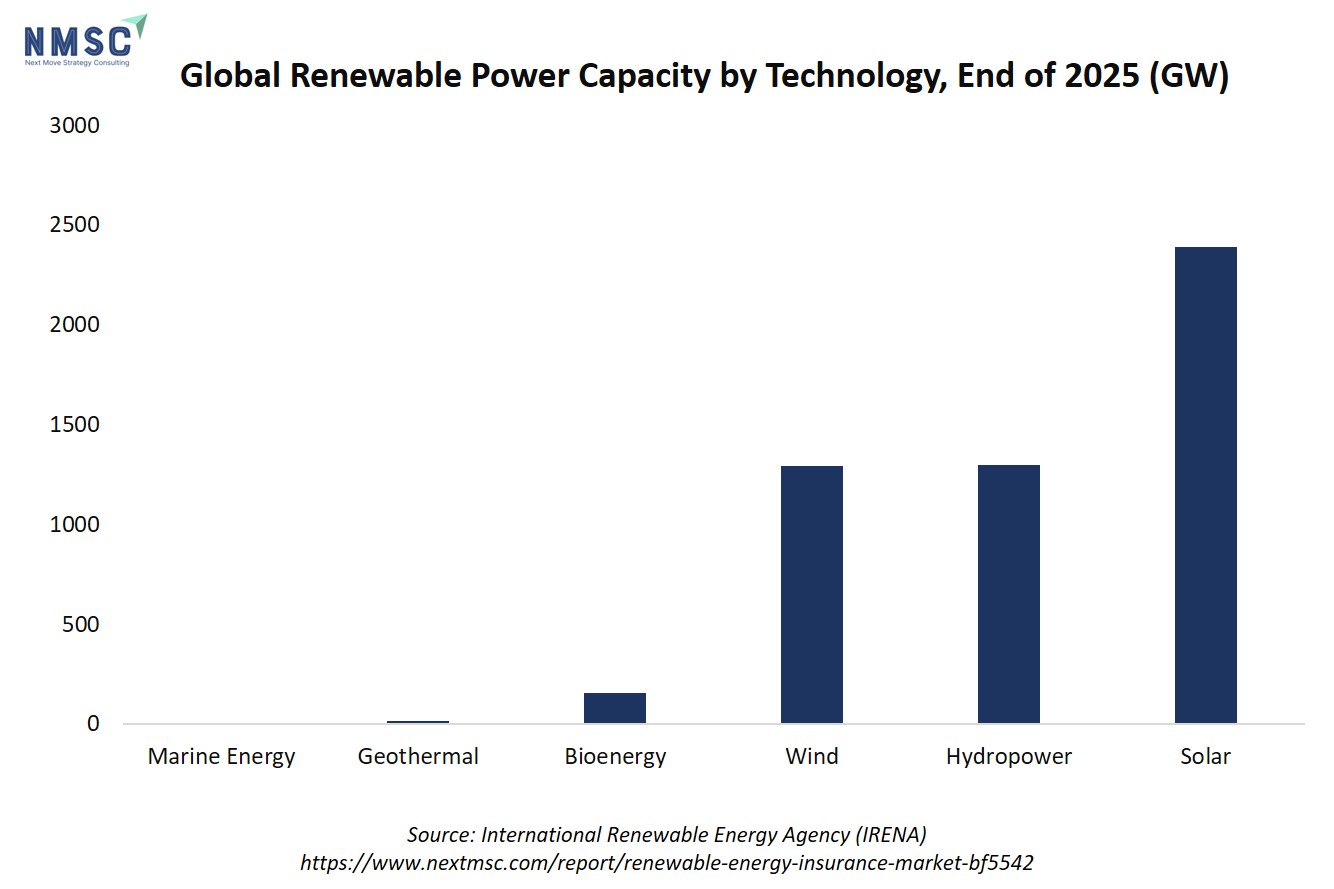
The physical scale of the renewable energy buildout — and by extension, the insurable asset base — reached a historic milestone in 2025. According to IRENA's Renewable Capacity Highlights published March 31, 2026, global renewable power capacity reached 5,149 GW at the end of 2025, representing a 15.5 percent year-on-year increase — the highest annual increase in renewable generation capacity ever recorded, and the highest growth rate in percentage terms on record.
Solar energy dominated capacity expansion, adding 511 GW (+27.2%) in 2025, while wind energy contributed 159 GW (+14.0%) — a record annual addition for the wind sector. Together, solar and wind accounted for 96.8 percent of all net renewable additions in 2025.
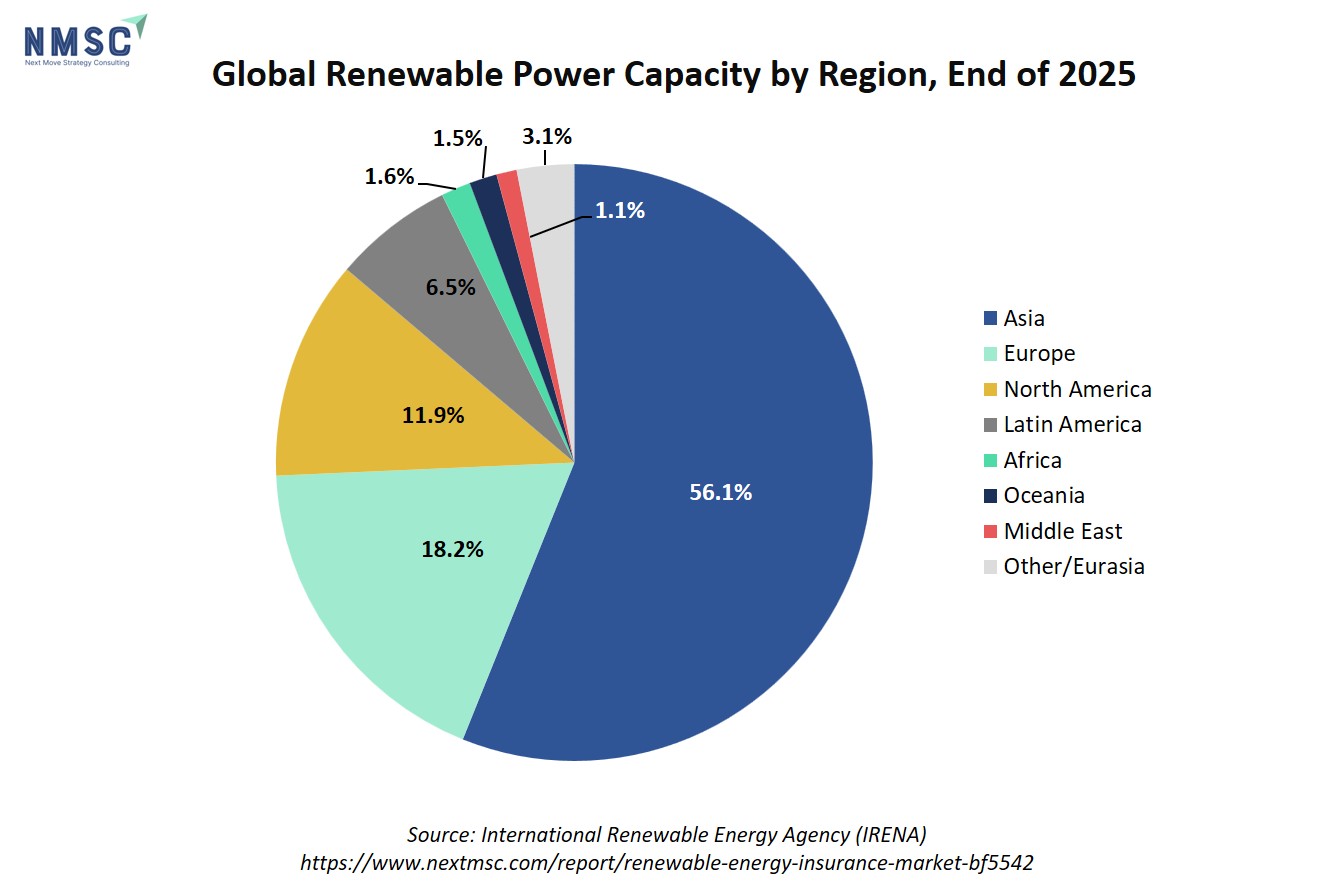
Asia accounted for 74.2 percent of new renewable capacity additions in 2025, increasing its installed base by 513.3 GW to reach 2,891 GW — equivalent to 56.1 percent of total global renewable capacity. The majority of this increase occurred in China, which added 440.1 GW of renewable capacity in a single year. Europe expanded its renewable capacity by 76.8 GW (+9.0%), with Germany contributing more than 20.5 GW of additions. North America expanded by 42.1 GW (+7.4%), driven by installations in the United States. Africa recorded its largest growth on record, with 11.3 GW of additions (+15.9%).
Each gigawatt of newly commissioned renewable capacity generates recurring insurable value across construction, property, and business interruption lines — directly expanding the addressable premium base for underwriters operating across covered geographies.
The Insurance Market in 2026: Softening Rates, Rising Complexity
Against this backdrop of accelerating asset growth, the renewable energy insurance market is navigating a pronounced softening cycle — one that is simultaneously creating procurement opportunities for project developers and introducing structural discipline challenges for underwriters.
Willis Towers Watson's Renewable Energy Market Review 2026, published in June 2026, documents the defining market dynamic: a surge of underwriting capacity and intensifying competition are driving rates downward across most renewable energy placements, with most programs now oversubscribed. For well-engineered, data-rich Tier 1 risks, rate reductions of 20 to 30 percent are being achieved at renewal. Tier 2 risks — clean but lower premium income — are seeing reductions of 10 to 15 percent. Loss-affected programs face renewal terms contingent on the quantum of prior losses.
The WTW review identifies three structural forces shaping property risk in renewable energy: rapid technology innovation introducing new component failure risks; persistent natural catastrophe exposure — with the last "quiet" year for natural catastrophe losses now six years in the past; and the growing scale of hybrid and multi-site projects that amplify aggregation and dependency risks.
Gallagher's Energy, Power and Renewables Global Insurance Market Update H1 2026, published June 17, 2026, reinforces this assessment, noting that the insurance market continues to favor buyers, with reduced premium pools creating cost savings opportunities. However, Gallagher's Head of Energy Pacific, Ryan Mansom, cautioned that "rising claims costs and the cyclical nature of the industry signal potential shifts ahead. Historically, the insurance market alternates between soft and hard conditions, and companies must prepare for the possibility of increased premiums and stricter underwriting in the future."
Regional Market Dynamics: Divergent Risk Profiles Across Geographies
The WTW review provides granular regional intelligence that illuminates the geographic complexity of the renewable energy insurance market.
Asia continues to set the pace of the global energy transition, accounting for 74.2 percent of new renewable capacity additions in 2025 and increasing installed capacity by 513.3 GW to reach 2,891 GW — or 56.1 percent of total global renewable capacity. China's withdrawal of export-linked VAT rebates for solar PV and battery products from April 2026 onward marks a structural inflection point, establishing a higher global price floor for solar and storage components that will reverberate across regional insurance pricing.
North America continues to grow, anchored by the Inflation Reduction Act, corporate climate commitments, and accelerating electricity demand driven by AI and cloud computing data center buildout. A benign catastrophe year in 2025 supported continued property market softening, though a notable eastward shift in "Tornado Alley" and growing scrutiny of battery system performance are reinforcing a more technical underwriting approach.
Latin America maintains a renewable share above 65 percent of the total energy mix, with total electricity generation reaching 153 TWh in 2025 — a year-on-year increase of 2.7 percent. Rate reductions of 20 to 30 percent are available for well-managed risks with strong loss records. WTW is monitoring a strong probability of an El Niño-level event toward Q4 2026, which could amplify drought and flood exposures across sub-regions and reshape near-term underwriting dynamics.
Australia saw renewables surpass 50 percent of National Electricity Market supply over a full quarter for the first time in late 2025, with renewables accounting for approximately 36 percent of total national electricity generation by 2025. The insurance market remains supportive but highly selective, with natural catastrophe exposure — particularly hail, wind, bushfire, and floods — remaining a primary driver of underwriting decisions.
The CEEMEA region continues to attract strong capital flows in 2026, with established players expanding lines and new entrants arriving through mergers, acquisitions, and regional branch openings, drawn by large complex risks, compelling premium levels, and historically favorable natural catastrophe profiles.
Global Energy Investment by Region, 2026
|
Region |
Energy Investment (USD Billion) |
Notes |
|
China |
940 |
Largest single-country energy investor globally |
|
United States |
615 |
Anchored by IRA clean energy incentives |
|
European Union |
440 |
Driven by REPowerEU and offshore wind buildout |
|
Middle East |
195 |
Energy security diversification programs |
|
Latin America |
190 |
Wind, hydro, and solar capacity expansion |
|
India |
170 |
Aggressive solar and wind capacity targets |
|
Eurasia |
130 |
Fossil fuel and grid infrastructure investment |
|
Japan & Korea |
120 |
Offshore wind and nuclear recommissioning |
|
Africa |
110 |
Record renewable additions; grid constraints persist |
|
Southeast Asia |
105 |
Rapid solar and storage deployment |
|
Global Total |
~3,400 |
5% increase from 2025 |
Technology Segmentation: Battery Storage and Offshore Wind Lead Growth
According to Next Move Strategy Consulting's analysis of the global Renewable Energy Insurance Market, the sector is projected to advance from USD 19.4 billion in 2025 to USD 44.3 billion by 2035, registering a CAGR of 8.7 percent over the forecast period. Europe led the market with an approximate 34 percent share in 2025, while Asia-Pacific is the fastest-growing region at a 10.3 percent CAGR through 2035.
Within the technology segmentation, Battery Energy Storage Systems represent the fastest-growing segment at a 13.2 percent CAGR from 2026 to 2035, propelled by rapid capacity build-out and evolving fire-safety underwriting standards. Offshore Wind follows at 11.9 percent CAGR, driven by large single-asset exposures requiring significant marine cargo and construction risk capacity from specialist underwriters. Utility-Scale Solar PV leads by absolute market size, expanding from USD 5.9 billion in 2025 to USD 13.9 billion by 2035.
The Amwins facility expansion directly addresses the battery storage and offshore wind risk gap. With property insurance rates continuing to soften, many project owners are redirecting premium savings toward securing higher catastrophe limits, while lenders and investors continue to prioritize stronger protection for high-value infrastructure.
IRENA Renewable Capacity Additions by Region, 2025
Global Renewable Power Capacity Additions by Region, 2025
|
Region |
Cumulative Capacity (GW) |
New Additions 2025 (GW) |
Growth Rate (%) |
Global Share (%) |
|
Asia |
2,891 |
513.3 |
+21.6% |
56.1% |
|
Europe |
937 |
76.8 |
+9.0% |
18.2% |
|
North America |
612 |
42.1 |
+7.4% |
11.9% |
|
Latin America |
333 |
19.6 |
+6.3% |
6.5% |
|
Middle East |
57 |
12.7 |
+28.9% |
1.1% |
|
Africa |
82 |
11.3 |
+15.9% |
1.6% |
|
Oceania |
76 |
6.1 |
+8.6% |
1.5% |
|
Central America & Caribbean |
21 |
1.8 |
+9.5% |
0.4% |
|
Global Total |
5,149 |
692 |
+15.5% |
100% |
Structural Trends Reshaping Underwriting Practice
Four structural trends are materially altering underwriting practice and product design across the renewable energy insurance market.
Parametric Insurance Adoption: Parametric weather-index products are gaining adoption because they settle claims against pre-agreed wind speed, irradiance, or precipitation triggers rather than through lengthy loss adjustment processes. Swiss Re has expanded parametric renewable energy solutions covering solar irradiance and wind resource shortfalls for utility-scale projects, reflecting broader industry migration from indemnity-only structures toward index-linked coverage for both construction and operational phases.
Offshore Wind Risk Pool Expansion: Offshore wind capacity additions are increasing exposure to cable failure, foundation damage, and marine logistics risk, prompting insurers to pool capacity through consortium placements. Munich Re and AXA XL have both expanded dedicated offshore wind underwriting teams to address rising claims severity from subsea cable losses — a trend that is improving available capacity for larger projects while tightening underwriting scrutiny on construction methodology and vessel scheduling.
Battery Storage Underwriting Evolution: Thermal runaway incidents at battery energy storage system sites have driven insurers to introduce fire suppression and battery chemistry underwriting requirements before binding coverage. AIG and Zurich Insurance Group have both published updated risk engineering guidelines for lithium-ion storage facilities, with underwriters increasingly conditioning coverage on NFPA 855 compliance and third-party safety certification.
Technology-Enabled Risk Monitoring: Insurers are integrating satellite imagery, drone inspection data, and SCADA feeds into underwriting and claims workflows to improve exposure visibility across distributed renewable portfolios. Beazley and Chubb have both invested in digital risk engineering platforms supporting real-time monitoring of insured renewable energy infrastructure across multiple regions — a capability that is compressing claims settlement timelines and enabling dynamic premium adjustment for operational assets.
The WTW review underscores that in this softening market, insurers are rewarding accounts that demonstrate discipline: "Strong engineering information, robust maintenance records, sophisticated catastrophe analytics, and clear scenario-based modelling all help support optimal terms in negotiations."
Competitive Landscape: Consolidation and Specialist Positioning
The renewable energy insurance market is served by a moderately consolidated group of global reinsurers and specialty carriers. Munich Reinsurance Company, Swiss Re Ltd, Allianz SE, American International Group, Zurich Insurance Group, AXA SE, Tokio Marine Holdings, AXIS Capital Holdings, Liberty Mutual Insurance Company, Chubb Limited, and Beazley plc represent the leading providers of underwriting capacity across covered geographies.
Two competitive archetypes dominate industry structure: diversified global reinsurers offering broad balance-sheet capacity, and specialist monoline underwriters built around dedicated renewable energy risk engineering expertise. This differentiation explains why large offshore projects typically syndicate coverage across both carrier types — balancing financial strength with granular technical underwriting judgment.
Consolidation continues as diversified insurance groups acquire specialist renewable underwriting capability, following the precedent set by Tokio Marine HCC's acquisition of GCube. The December 2025 launch by Munich Re, Germany's Federal Ministry for Economic Affairs and Energy, and KfW of an innovative financing and insurance program for deep geothermal projects illustrates the expanding frontier of renewable energy risk transfer products entering the market.
The Amwins facility expansion reflects a parallel trend: specialist wholesale brokers are building proprietary capacity structures that sit above primary programs, addressing the gap between available market capacity and the full value of increasingly large and complex renewable energy projects.
Regulatory and Bankability Drivers
Lender-mandated bankability insurance requirements are structurally reinforcing premium demand independent of short-term commodity price cycles. Project finance lenders increasingly require comprehensive insurance packages as a condition of debt disbursement, embedding coverage requirements directly into loan covenants. The U.S. Department of Energy Loan Programs Office publishes financing guidelines requiring insurance evidence for supported renewable projects — a regulatory mechanism that is creating durable, non-cyclical demand across construction and operational phases.
The IEA's projection that global energy investment will reach USD 3.4 trillion in 2026 — with the majority directed toward clean energy — means that the pipeline of bankability-driven insurance requirements will continue to expand materially through the forecast period.
Bottom Line
The global Renewable Energy Insurance Market is entering a structurally consequential phase defined by three simultaneous forces: a record-breaking renewable capacity buildout that reached 5,149 GW globally at end-2025, a pronounced market softening cycle delivering rate reductions of 20 to 30 percent for well-engineered risks, and a widening catastrophe protection gap that is compelling specialist brokers — most recently Amwins Global Risks — to expand dedicated facility capacity to $50 million per placement. The IEA's projection of USD 3.4 trillion in global energy investment for 2026, with USD 2.2 trillion directed toward clean energy, confirms that the insurable asset base will continue expanding at a pace that outstrips current underwriting capacity for complex offshore wind and battery storage exposures. For investors and industry participants, the near-term opportunity set is concentrated in Battery Energy Storage Systems (13.2% CAGR), Offshore Wind (11.9% CAGR), and Asia-Pacific regional growth (10.3% CAGR). Key risks include rising natural catastrophe claims severity, reinsurance capacity constraints for large offshore placements, and the cyclical risk of a market hardening cycle as loss experience accumulates. Strategic positioning in parametric product development, digital risk engineering platforms, and decommissioning phase coverage for aging wind fleets represents the most defensible long-term growth trajectory within this market through 2035.
About Next Move Strategy Consulting
Next Move Strategy Consulting is a premier market research and management consulting firm that has been committed to provide strategically analysed well documented latest research reports to its clients. The research industry is flooded with many firms to choose from, what makes NMSC different from the rest is its top-quality research and the obsession of turning data into knowledge by dissecting every bit of it and providing fact-based research recommendation that is supported by information collected from over 500 million websites, paid databases, industry journals and one on one consultations with industry experts across a diverse range of industry sectors. The high-quality customized research reports with actionable insights and excellent end-to-end customer service help our clients to take critical business decisions that enables them to move beyond time and have competitive edge in the industry.
We have been servicing over 1000 customers globally that includes 90% of the Fortune 500 companies over a decade. Our analysts are constantly tracking various high growth markets and identifying hidden opportunities in each sector or the industry. We provide one of the industry's best quality syndicate as well as custom research reports across 10 different industry verticals. We are committed to deliver high quality research solutions in accordance to your business needs. Our industry standard delivery solutions that ranges from the pre consultation to after-sales services, provide an excellent client experience and ensure right strategic decision making for businesses.
For more information, please contact:
Next Move Strategy Consulting
5th Floor 867 Boylston St, STE 500,
Boston, MA 02116, U.S.
E-Mail: [email protected]
Direct: +1-217-650-7991
Website: www.nextmsc.com
About the Author
 Sanyukta Deb
— Sanyukta Deb is Digital Marketing Team Lead at Next Move Strategy Consulting, where she has led content strategy and technical SEO for the firm's B2B market research publications for over 2 years. Her editorial process translates NextMSC's primary and secondary research — spanning technology, industrial, and consumer sectors — into commercial narratives, backed by search-intent, keyword, and competitive analysis. She brings 5 years of overall experience in digital marketing and content strategy.
Sanyukta Deb
— Sanyukta Deb is Digital Marketing Team Lead at Next Move Strategy Consulting, where she has led content strategy and technical SEO for the firm's B2B market research publications for over 2 years. Her editorial process translates NextMSC's primary and secondary research — spanning technology, industrial, and consumer sectors — into commercial narratives, backed by search-intent, keyword, and competitive analysis. She brings 5 years of overall experience in digital marketing and content strategy.
About the Reviewer
 Debashree Dey
— Debashree Dey is Assistant Manager at Next Move Strategy Consulting, where she supports cross-vertical market content and communications across diverse industries for 6 years. Her professional background includes senior content writing, communications, and published manuscript authorship, with experience developing audience-focused business narratives and maintaining clear, consistent messaging. Her role supports research-led content development and editorial quality across NextMSC publications.
Debashree Dey
— Debashree Dey is Assistant Manager at Next Move Strategy Consulting, where she supports cross-vertical market content and communications across diverse industries for 6 years. Her professional background includes senior content writing, communications, and published manuscript authorship, with experience developing audience-focused business narratives and maintaining clear, consistent messaging. Her role supports research-led content development and editorial quality across NextMSC publications.


















Add Comment