Organic Herbicides Market Global Industry Analysis and Forecast (2026–2035)

Organic Herbicides Market size was USD 1.81 Billion in 2025, projected to reach USD 2.69 Billion by 2035, growing at a CAGR of 3.94% from 2026 to 2035. Key drivers include jurisdiction-specific restrictions on synthetic herbicide use, expanding certified organic farmland globally, and growing demand for organic-compliant weed management across turf, landscape, and residential applications, with North America leading the market.

Download Free Sample PDF
Base Year (2025)
$1.81 Billion
Forecast (2035)
$2.69 Billion
CAGR (2026-2035)
3.9%
Top Region
North America

What Is the Organic Herbicides Market Size?

The Organic Herbicides Market was valued at USD 1.81 Billion in 2025 and is estimated at USD 1.90 Billion in 2026, advancing to USD 2.69 Billion by 2035 at a CAGR of 3.94% from 2026 to 2035. North America commands approximately 42% of 2025 global market share, driven by restrictions on selected synthetic herbicide uses and a strong certified organic production base. Single-Source Herbicides are the dominant product type, accounting for approximately 70% of 2025 global revenue, anchored by fatty acid, organic acid, and botanical herbicide products across commercial and consumer end-use segments.

Organic Herbicides Market Global Industry Analysis and Forecast (2026–2035) Revenue Forecast

Values in USD Billion

2025 $1.81 Billion
2025
2026 $1.90 Billion
2026
2027 $1.97 Billion
2027
2028 $2.05 Billion
2028
2029 $2.13 Billion
2029
2030 $2.22 Billion
2030
2031 $2.30 Billion
2031
2032 $2.40 Billion
2032
2033 $2.49 Billion
2033
2034 $2.59 Billion
2034
2035 $2.69 Billion
2035

Key Takeaways

By Product Type: Single-Source Herbicides held the largest share, expanding from USD 1.27 billion in 2025 to USD 1.78 billion by 2035; Multi-Source Herbicides is the fastest-growing sub-segment at a 5.40% CAGR from 2026–2035.

By Formulation: Liquid Formulations held the largest share, accounting for the largest volume share across consumer and commercial channels; Solid Formulations is the fastest-growing sub-segment, supported by growing adoption of granules in turfgrass and precision applications.

By Application Method: Foliar Application held the largest share, representing a widely used method for post-emergence weed control; Soil Application is the fastest-growing sub-segment, supported by the development of pre-emergence organic herbicides.

By End-Use Sector: Crop Agriculture held the largest end-use segment by volume and revenue globally; Turf and Landscape is the fastest-growing sub-segment, driven by municipal and commercial organic-compliance requirements.
By Route to Market: Agricultural Distribution held the largest share, serving as the primary channel for commercial crop and turf markets; Retail and E-Commerce is the fastest-growing sub-segment, driven by residential and urban gardening demand.

Dominant Region: North America dominated with approximately 42% revenue share in 2025, valued at USD 0.76 billion.

Fastest-Growing Region: Asia-Pacific is expected to register the highest CAGR of 5.27% during 2026–2035.

Dominant Country: The U.S. led the market, valued at approximately USD 0.670 Billion in 2025.

Fastest-Growing Country: India is the fastest-growing country, registering approximately 7.26% CAGR during 2026–2035.

This market trajectory represents an absolute investment opportunity of approximately USD 0.79 Billion between 2026 and 2035, calculated as the difference between the 2035 forecast of USD 2.69 Billion and the 2026 base of USD 1.90 Billion.

According to NMSC analysis, restrictions on synthetic herbicide use in selected European and North American jurisdictions, together with certified organic farmland expansion, support demand for organic herbicide products. The pace and scale of this demand will depend on local regulation, product eligibility, and field performance.

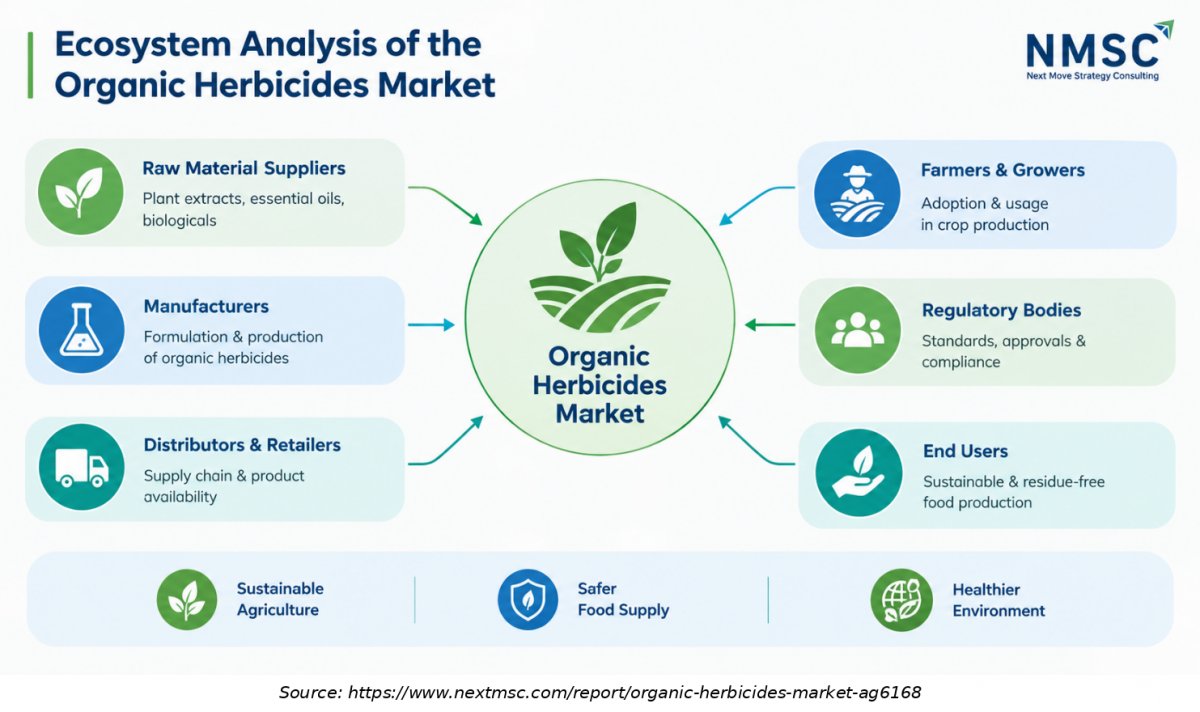
Ecosystem Analysis of the Organic Herbicides Industry

The above infographic presents an ecosystem analysis of the organic herbicides market, mapping its structure with authoritative clarity. It identifies six key stakeholders, including raw material suppliers, manufacturers, distributors, farmers, regulatory bodies, and end users. The analysis demonstrates how this interconnected network collectively promotes sustainable agriculture, a safer food supply, and a healthier environment.


What Does the Organic Herbicides Market Encompass?

The Organic Herbicides Market encompasses the research, development, manufacturing, and commercial sale of finished herbicide products that are legally marketed for organic production under the applicable jurisdictional standard or are explicitly positioned and documented by the manufacturer for organic production, with active ingredients and formulations meeting the applicable organic-use requirements. The market covers qualifying single-source herbicides, including microbial, botanical, fatty acid, organic acid, and eligible mineral or salt formulations, and multi-source herbicide combinations blending two or more eligible active types. Products span liquid, solid, and other formulation formats sold through agricultural distribution, retail, specialty, direct, and private-label channels for application in certified organic crop agriculture, horticulture, turf management, residential gardening, and non-crop vegetation management.
The market has evolved from a specialized input category toward a broader category shaped by organic-input compliance requirements and adoption by conventional growers, municipalities, and residential users seeking reduced reliance on synthetic herbicides. Regulatory frameworks, including the U.S. USDA National Organic Program, the EU organic production framework, and third-party input-listing systems such as OMRI, influence which products and ingredients may be used in certified organic production. Technology adoption in precision application, adjuvant science, and bio-based formulation chemistry may improve the efficacy and application precision of eligible organic herbicide products.

Market Parameters

Parameter Details
Market Size in 2025 USD 1.81 Billion
Market Size in 2026 USD 1.90 Billion
Revenue Forecast in 2035 USD 2.69 Billion
Growth Rate CAGR of 3.94% from 2026 to 2035
Analysis Period 2025–2035
Base Year Considered 2025
Forecast Period 2026–2035
Market Size Estimation USD Billion
Companies Profiled 20
Countries Covered 38
Market Share Available for Top 10 Companies
Source www.nextmsc.com

Market Drivers & Dynamics

Interactive Dataset
Restrictions on synthetic herbicide use in selected jurisdictions driver +1.4% Europe, North America, Australia 2026–2032
Certified organic farmland expansion and crop-input compliance mandates driver +1.2% Global, strongest in North America and Europe 2026–2035
Growth of eligible organic-compliant turf, landscape, and municipal vegetation management driver +0.9% North America, Europe, Australia 2026–2035
Innovation in bio-based formulations and eligible multi-source combination herbicides driver +0.7% Global 2027–2035
Consumer demand for organic agricultural produce driver +0.5% Europe, North America, Japan 2026–2035
Lower field efficacy relative to some synthetic herbicide alternatives restraint -1.3% Global 2026–2035
High per-unit cost in cost-sensitive commodity crop segments restraint -0.8% Asia-Pacific, Latin America, Middle East & Africa 2026–2035
Shelf-life and environmental sensitivity of some formulations restraint -0.5% Global, especially high-temperature regions 2026–2035
Regulatory approval requirements for new active ingredients restraint -0.4% EU, North America 2026–2030
Source: Next Move Strategy Consulting

Growth Drivers

What is the Primary Growth Driver of the Organic Herbicides Market?

Restrictions on selected synthetic herbicides and organic-input compliance requirements are key structural growth drivers for the Organic Herbicides Market. EU Member State restrictions, national product authorizations, and pesticide reassessment programs can create substitution opportunities for organic-compliant products. In the U.S., EPA biopesticide registration pathways and state-level pesticide review processes influence the timing and availability of lower-risk and biological alternatives.

How is Organic Farmland Expansion Driving Organic Herbicides Market Growth?

Consistent growth in certified organic farmland can generate baseline demand for organic herbicide products by expanding the population of operations that must use eligible crop inputs. USDA data show 3.6 million acres of certified organic cropland in the United States in 2021, up from 2011. The EU Organic Farming Action Plan's target of 25% organic land by 2030 represents a policy driver for European organic agriculture. The resulting demand for herbicides depends on crop mix, weed-management practices, and permitted product availability.

Growth Inhibitors

What is Restraining the Organic Herbicides Market Expansion?

Lower field efficacy relative to some synthetic herbicide alternatives is a primary restraint on Organic Herbicides Market growth. Organic active ingredients, including acetic acid, fatty acid, and essential oil compounds, may require higher application rates or more frequent reapplication than synthetic alternatives to achieve commercially acceptable weed control. The magnitude of the efficacy gap varies by formulation, weed species, application timing, and conditions.

What Are the Growth Opportunities?

How Can Producers Capture the Growing Municipal and Non-Crop Organic Mandate Market?

Municipal restrictions on synthetic pesticide use in public spaces, enacted across selected European cities and some North American local-government procurement policies, create potential opportunities for commercial organic herbicide products used in non-crop vegetation management. Acetic acid, iron-based, and fatty acid formulations qualified for hard surfaces, pathways, and public green spaces may be commercially relevant. Landscape contractors serving municipal programmes represent a potential buyer segment for professional-grade organic herbicide products.

What Growth Potential Does the Asia-Pacific Organic Export Crop Sector Represent?

Asia-Pacific is forecast to be the fastest-growing regional market for organic herbicides at a 5.27% CAGR from 2026 to 2035, driven by expansion of certified organic produce for export in India, China, and Southeast Asia. Organic certification requirements can influence access to export markets, while domestic demand for certified organic fruit, vegetables, and tea may expand organic acreage and input spending. APEDA reported 2.25 million hectares of certified organic cultivated area under NPOP in 2024–25, excluding in-conversion and wild-collection area.

How Does the Expansion of Residential and Urban Gardening Create Organic Herbicide Opportunity?

The sustained growth of residential gardening, community gardens, and urban farming supports demand for ready-to-use and small-pack organic herbicide formulations. Residential buyers may prioritize ease of use, family and pet considerations, and reduced reliance on synthetic chemical inputs, making appropriately listed or registered products commercially attractive.

Segmentation Analysis

2025 (USD Billion)
2035 (USD Billion)
Single-Source Herbicides 2025: $1.27 Billion | 2035: $1.78 Billion
Single-Sourc
Multi-Source Herbicides 2025: $0.54 Billion | 2035: $0.91 Billion
Multi-Source
Single-Source Herbicides $1.27 Billion $1.78 Billion 3.26%
Multi-Source Herbicides $0.54 Billion $0.91 Billion 5.40%

Which Product Type Dominates the Organic Herbicides Market?

Single-Source Herbicides retain the dominant market position at USD 1.27 Billion in 2025, accounting for approximately 70% of the global Organic Herbicides Market total, supported by established availability of fatty acid, organic acid, botanical, and eligible mineral-based herbicide formulations. Multi-Source Herbicides are the fastest-growing segment at an estimated 5.40% CAGR from 2026 to 2035, driven by formulation innovation that can improve or broaden weed-control performance where permitted by organic standards.

2025 (USD Billion)
2035 (USD Billion)
Liquid Formu
Concentrates
Ready-to-Use
Solid Formul
Granules
Segment Item 2025 (USD Billion) 2035 (USD Billion) CAGR
Liquid Formulations $10.0 USD Billion $40.0 USD Billion 25.0%
Concentrates $17.1 USD Billion $51.1 USD Billion 11.0%
Ready-to-Use Liquids $24.2 USD Billion $62.2 USD Billion 25.0%
Solid Formulations $31.3 USD Billion $73.3 USD Billion 11.0%
Granules $38.4 USD Billion $84.4 USD Billion 16.0%

Segment-wise data is locked

Unlock complete segment-wise numbers for By Formulation.

Unlock Full Data
2025 (USD Billion)
2035 (USD Billion)
Foliar Appli
Soil Applica
Stem Injecti
Other Target
Segment Item 2025 (USD Billion) 2035 (USD Billion) CAGR
Foliar Application $10.0 USD Billion $40.0 USD Billion 27.0%
Soil Application $17.1 USD Billion $51.1 USD Billion 9.0%
Stem Injection $24.2 USD Billion $62.2 USD Billion 19.0%
Other Targeted Application $31.3 USD Billion $73.3 USD Billion 17.0%

Segment-wise data is locked

Unlock complete segment-wise numbers for By Application Method.

Unlock Full Data
2025 (USD Billion)
2035 (USD Billion)
Crop Agricul
Horticulture
Turf and Lan
Residential
Non-Crop Veg
Segment Item 2025 (USD Billion) 2035 (USD Billion) CAGR
Crop Agriculture $10.0 USD Billion $40.0 USD Billion 14.0%
Horticulture $17.1 USD Billion $51.1 USD Billion 24.0%
Turf and Landscape $24.2 USD Billion $62.2 USD Billion 22.0%
Residential Gardening $31.3 USD Billion $73.3 USD Billion 12.0%
Non-Crop Vegetation Management $38.4 USD Billion $84.4 USD Billion 27.0%

Segment-wise data is locked

Unlock complete segment-wise numbers for By End-Use Sector.

Unlock Full Data
2025 (USD Billion)
2035 (USD Billion)
Direct Comme
Agricultural
Specialty Di
Retail and E
Private-Labe
Segment Item 2025 (USD Billion) 2035 (USD Billion) CAGR
Direct Commercial Sales $10.0 USD Billion $40.0 USD Billion 24.0%
Agricultural Distribution $17.1 USD Billion $51.1 USD Billion 22.0%
Specialty Distribution $24.2 USD Billion $62.2 USD Billion 20.0%
Retail and E-Commerce $31.3 USD Billion $73.3 USD Billion 22.0%
Private-Label Sales $38.4 USD Billion $84.4 USD Billion 13.0%

Segment-wise data is locked

Unlock complete segment-wise numbers for By Route to Market.

Unlock Full Data

Growth Opportunities

Our analysis identifies three distinct high-priority growth opportunities within the Organic Herbicides Market that represent potential pathways for commercial expansion through 2035.

How Can Producers Capture the Growing Municipal and Non-Crop Organic Mandate Market?

Municipal restrictions on synthetic pesticide use in public spaces, enacted across selected European cities and some North American local-government procurement policies, create potential opportunities for commercial organic herbicide products used in non-crop vegetation management. Acetic acid, iron-based, and fatty acid formulations qualified for hard surfaces, pathways, and public green spaces may be commercially relevant. Landscape contractors serving municipal programmes represent a potential buyer segment for professional-grade organic herbicide products.

What Growth Potential Does the Asia-Pacific Organic Export Crop Sector Represent?

Asia-Pacific is forecast to be the fastest-growing regional market for organic herbicides at a 5.27% CAGR from 2026 to 2035, driven by expansion of certified organic produce for export in India, China, and Southeast Asia. Organic certification requirements can influence access to export markets, while domestic demand for certified organic fruit, vegetables, and tea may expand organic acreage and input spending. APEDA reported 2.25 million hectares of certified organic cultivated area under NPOP in 2024–25, excluding in-conversion and wild-collection area.

How Does the Expansion of Residential and Urban Gardening Create Organic Herbicide Opportunity?

The sustained growth of residential gardening, community gardens, and urban farming supports demand for ready-to-use and small-pack organic herbicide formulations. Residential buyers may prioritize ease of use, family and pet considerations, and reduced reliance on synthetic chemical inputs, making appropriately listed or registered products commercially attractive.

Regional Outlook

2025 (USD Billion)
2035 (USD Billion)
North Americ
Europe
Asia-Pacific
Middle East
Latin Americ
Region 2025 (USD Billion) 2035 (USD Billion) CAGR (%)
North America $10.0 USD Billion $40.0 USD Billion 9.0%
Europe $17.1 USD Billion $51.1 USD Billion 27.0%
Asia-Pacific $24.2 USD Billion $62.2 USD Billion 25.0%
Middle East & Africa $31.3 USD Billion $73.3 USD Billion 23.0%
Latin America $38.4 USD Billion $84.4 USD Billion 12.0%

Regional data is locked

Unlock complete regional numbers for this market.

Unlock Full Data

North America

North America commands the largest share of the Organic Herbicides Market at USD 0.76 Billion in 2025, advancing toward USD 1.08 Billion by 2035 at a 3.42% CAGR. The U.S. dominates regional revenue, supported by a large organic production base, the USDA National Organic Program framework, and demand for organic-compliant vegetation management in selected applications. Canada adds demand through certified organic crop production and specialty horticultural channels. The market is served by specialty biopesticide companies, garden-care brands, and agricultural distributors.

Europe

Europe is the second-largest regional market at USD 0.54 Billion in 2025, projected to reach USD 0.82 Billion by 2035 at a 4.19% CAGR, driven by the EU's target of at least 25% organic agricultural land by 2030 and restrictions on pesticide use in selected public spaces. Glyphosate remains approved in the EU through 15 December 2033, subject to conditions and restrictions, so the regional narrative should focus on jurisdiction-specific restrictions rather than a generalized EU-wide phase-out. Germany, France, and the UK are identified as the largest national markets, with organic farming and professional landscape-management activity supporting demand.

Asia-Pacific

Asia-Pacific is the fastest-growing regional market for organic herbicides at USD 0.33 Billion in 2025, forecast to reach USD 0.55 Billion by 2035 at a 5.27% CAGR. The region is at an early commercial development stage, with certified organic production concentrated in export-oriented specialty crops where organic-input compliance can be a market-access requirement. India and China are identified as key national markets, driven by organic export production and farmland certification programmes. Australia contributes a professional turf and landscape segment.

Middle East & Africa

The Middle East & Africa region represents USD 0.05 Billion in 2025, advancing to USD 0.07 Billion by 2035 at a 3.25% CAGR. Market demand is concentrated in institutional and government-funded landscape-management programmes in GCC countries and South Africa, where organic and environmentally sensitive herbicides may be specified for public green spaces and sensitive environments. Organic produce export sectors in Israel, Morocco, and Kenya generate additional potential demand, although overall penetration remains limited by price sensitivity and product availability.

Latin America

Latin America accounts for USD 0.13 Billion in 2025, growing to USD 0.17 Billion by 2035 at a 2.47% CAGR, reflecting the predominantly conventional crop-agriculture model in Brazil and Argentina. Organic herbicide demand is concentrated in export-oriented specialty and horticultural crop sectors where certification may enable price premiums. The regional market is described as import-dependent, creating logistics-cost barriers relative to synthetic alternatives.

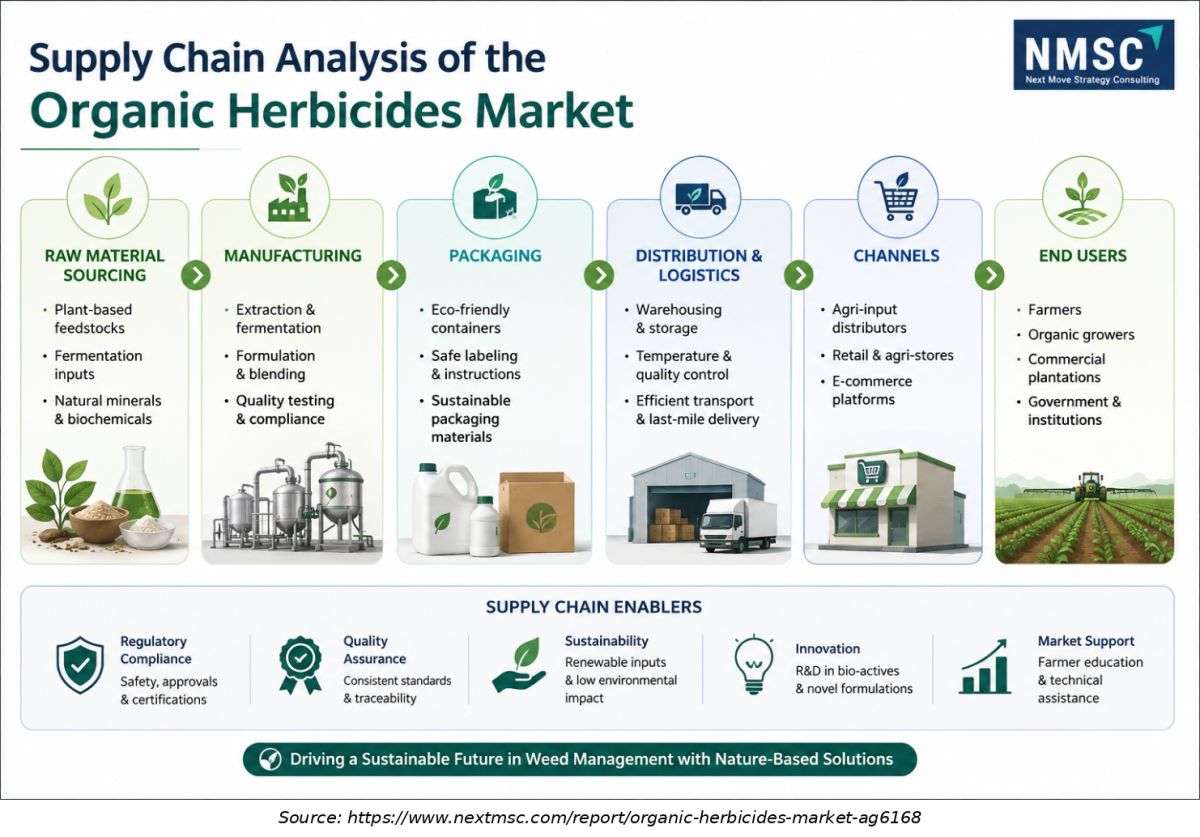
Supply Chain Analysis of the Organic Herbicides Industry

Supply Chain Analysis of the Organic Herbicides Industry
The above illustrates the supply chain analysis of the organic herbicides market, tracing its progression from raw material sourcing and manufacturing to packaging, distribution, sales channels, and end users, including farmers and institutions. The analysis highlights regulatory compliance, quality assurance, and sustainability as relevant considerations for eligible products.

Competitive Landscape

Based on research conducted by NMSC, the Organic Herbicides Market is characterized by high fragmentation and a specialized competitive structure in which organic-use eligibility, formulation efficacy, and regulatory coverage create primary competitive advantages.

Dimension Description
Dimension Assessment
Market Structure Highly fragmented specialty market; top 5 players hold approximately 35% of global revenue; strong participation from specialty biopesticide companies, garden-care brands, and organic agricultural-input suppliers
Innovation Focus Multi-source combination formulations, rainfastness adjuvant development, precision robotic delivery integration, OMRI listing expansion, and e-commerce channel investment for residential and professional markets
M&A Activity Low to moderate; selective acquisitions of regional biopesticide formulators; Certis USA and BioSafe Systems expanding product lines through partnership and in-licensing of microbial and botanical active ingredients

How Do Leading Companies Compete in the Organic Herbicides Industry?

Competition in the Organic Herbicides Market operates across three tiers. Commercial biopesticide specialists, including Certis USA, BioSafe Systems, and BioWorks, compete on certification breadth, commercial-grade formulation performance, and agricultural distribution network coverage. Consumer organic garden-care brands, including W. Neudorff, Bonide Products, Dr. Earth, and Woodstream, compete on brand trust, packaging convenience, retail presence, and online visibility. Regional specialists, including Seipasa, AlphaBio Control, and Bioherbicide Australia, compete on geographic regulatory expertise and specialty active-ingredient positioning.

Which Competitive Archetypes Dominate the Organic Herbicides Market?

Two competitive archetypes define the landscape. Certification-led specialists, including BioSafe Systems and Certis USA, compete on OMRI, NOP, and EU organic listing portfolios that provide buyers with compliance information across regulatory environments. Performance-innovation leaders, including Seipasa and W. Neudorff, compete on formulation technology, adjuvant optimization, multi-source combinations, and rainfastness improvements. Precision weed detection and targeted treatment systems may become an innovation area for suppliers working with robotic-weeding developers.

How Are Innovation and Differentiation Driving Competitive Positioning in the Market?

Innovation focus is divided between formulation chemistry and certification portfolio expansion. Commercial-grade producers, including Certis USA and BioSafe Systems, are investing in combination herbicide development targeting broadleaf and grass weeds in organic crop agriculture. Consumer brands, including Dr. Earth and Woodstream, invest in digital marketing, e-commerce optimization, and packaging. W. Neudorff and COMPO GmbH maintain brand differentiation through new product launches and pack formats for professional and residential garden-care markets.

What M&A Activity is Shaping the Organic Herbicides Market?

The Organic Herbicides Market has experienced relatively limited M&A activity compared with broader biopesticide categories, reflecting fragmentation and the specialized regulatory expertise required for product development and organic listing maintenance. Certis USA has in-licensed and distributed botanical and microbial herbicide actives from development programmes, while BioWorks has expanded its product line through specialty ingredient licensing. Larger biopesticide companies may seek specialist formulators with established organic listing portfolios.

Key Market Players

The report profiles the following 20 companies. Their inclusion in the competitive list does not by itself establish that every product they sell falls within the defined organic-herbicide market.

W. Neudorff GmbH KG Certis USA LLC SAN Group Biotech USA, Inc. BioSafe Systems, LLC SBM Company Emery Oleochemicals LLC COMPO GmbH Seipasa S.A. Woodstream Corporation Bonide Products LLC OHP, Inc. Soil Technologies Corp. BioWorks, Inc. Dr. Earth, Inc. Herbanatur Inc. Evergreen Garden Care UK Ltd. AlphaBio Control Ltd Bioherbicide Australia Pty Ltd Kittrich Corporation Voluntary Purchasing Groups, Inc.

Latest Developments

Our findings suggest that 2024–2026 has been a period of product registration, formulation innovation, and commercial-channel activity across the organic herbicide and broader natural weed-control landscape.

Date Event
March 2026 SBM Life Science and Harpe Bioherbicide Solutions entered a strategic development agreement to co-develop and commercialize natural weed-control products for home and garden consumers.
March 2026 Seipasa officially launched Seithor, a herbicide of natural origin, in Portugal after obtaining plant-protection authorization from DGAV.

Investment Opportunities

Where Are Capital Inflows Concentrated in the Organic Herbicides Market?

Capital inflows into the Organic Herbicides Market concentrate across producer R&D for multi-source formulation development and precision delivery; regulatory investment in organic listings and registrations for new active ingredients; and distribution infrastructure for residential and professional channels. Venture capital and corporate investment may target biopesticide platform companies developing botanical and microbial herbicide actives, where protection around biological organisms or extraction processes can support competitive advantage.

What Infrastructure Investment Dynamics Favor the Organic Herbicides Market?

Controlled-environment storage and formulation infrastructure can be important for commercial organic herbicide producers when biological or botanical active ingredients are sensitive to temperature, UV exposure, or humidity. Producers investing in domestic formulation and fill-finish capability may reduce logistics exposure and improve supply reliability. Precision-application infrastructure may also create downstream demand for formulations suitable for targeted treatment.

How Do ESG Considerations Shape Investment in the Organic Herbicides Market?

Environmental, Social, and Governance criteria influence investment decisions in agricultural inputs and sustainable food systems. Corporate buyers may evaluate suppliers on ecological profile, environmental impact, and supply-chain transparency. Third-party product listings and relevant industry memberships can be part of a supplier's credentials, but their effect on access to capital depends on investor-specific criteria.

Key Benefits for Stakeholders

How Does This Report Benefit Agrochemical Producers and Organic Crop Input Suppliers?

Organic herbicide manufacturers, biopesticide formulators, botanical-extract suppliers, and organic crop-input distributors can use the report's segmentation by product type, formulation, route to market, application method, and end-use sector, alongside market sizing and CAGR data. Multi-Source Herbicide growth estimates can inform formulation R&D priorities. The competitive landscape provides intelligence on product innovation, certification strategies, and distribution channels.

How Does This Report Support Investors and Financial Analysts Evaluating the Organic Herbicides Market?

Investors and financial analysts evaluating organic crop-input producers, biopesticide platforms, agricultural sustainability funds, or specialty chemical businesses can use the report's demand-driver analysis, market expansion estimate, and competitive assessment. The estimated USD 0.79 billion expansion between 2026 and 2035, combined with a 3.94% CAGR, provides a forecast framework for evaluating the category. Regional growth differentials, led by Asia-Pacific at 5.27% CAGR, may inform geographic prioritization.

What Value Does This Report Deliver to Agricultural Distributors and Retail Buyers in the Organic Herbicides Market?

Agricultural distributors, cooperative buying groups, garden-center buyers, and e-commerce category managers can use the distribution-channel and end-use segmentation to evaluate organic herbicide category opportunities across crop agriculture, turf and landscape, and residential gardening. The Retail and E-Commerce channel is identified as the fastest-growing route to market. Regional and country-level market estimates can help compare local demand with global growth rates and prioritize supplier partnerships.

Key Market Segments Evaluated

By Region

  • North America 
    • U.S.
    • Canada
    • Mexico
  • Europe 
    • UK
    • Germany
    • France
    • Italy
    • Spain
    • Sweden
    • Denmark
    • Finland
    • Netherlands
    • Rest of Europe
  • Asia-Pacific 
    • China
    • India
    • Japan
    • South Korea
    • Taiwan
    • Indonesia
    • Vietnam
    • Australia
    • Philippines
    • Malaysia
    • Rest of APAC
  • Middle East & Africa 
    • Saudi Arabia
    • UAE
    • Egypt
    • Israel
    • Turkey
    • Nigeria
    • South Africa
    • Rest of MEA
  • Latin America 
    • Brazil
    • Argentina
    • Chile
    • Colombia
    • Rest of LATAM

Conclusion & Recommendations

The Organic Herbicides Market is positioned for steady growth from USD 1.81 Billion in 2025 to USD 2.69 Billion by 2035 at a CAGR of 3.94% from 2026 to 2035, calculated using the 2026 base of USD 1.90 Billion and 2035 forecast of USD 2.69 Billion over nine years. The long-term outlook reflects regulatory-driven substitution in selected jurisdictions, compliance-driven demand from certified organic farmland expansion, and product innovation. Growth will depend on whether formulation improvements and precision delivery make organic herbicide use viable across more commercial applications.

What Strategic Positioning Do We Recommend?

Producers should prioritize multi-source herbicide development where formulation evidence supports improved weed-control efficacy and commercial viability. Certification portfolio expansion and maintenance of current organic-use listings should be treated as important commercial enablers. Geographic expansion into Asia-Pacific, particularly India, China, and Southeast Asia, may offer growth opportunities for producers able to adapt formulations and registration strategies to regional regulations and buyer expectations.

How Attractive Is the Organic Herbicides Market for Investment?

The Organic Herbicides Market presents a moderate-to-attractive investment proposition supported by organic-production requirements, demand for alternative weed management, and formulation innovation. The USD 0.79 Billion absolute market expansion between 2026 and 2035 reflects the supplied forecast endpoints and a 3.94% CAGR. Biopesticide companies with established distribution networks and formulation pipelines may be positioned to benefit from the market's primary growth drivers.

What Are the Key Market Shifts and Risks?

The primary market shift to monitor is the pace of jurisdiction-specific restrictions on synthetic herbicides. Glyphosate remains approved in the EU through 15 December 2033, subject to conditions and restrictions. Formulation efficacy, botanical raw-material sourcing, product registration, and input costs are additional risks that could affect product availability and growth.

What Are the Primary Growth Pathways Through 2035?

Three growth pathways offer commercial expansion potential through 2035. Precision-delivery integration can connect organic herbicide formulations with robotic weeding and spot-treatment systems. Municipal and institutional vegetation-management programmes may create recurring demand for eligible alternatives in jurisdictions with pesticide restrictions. Asia-Pacific certified export-crop production offers potential growth where organic certification supports access to export markets.

FAQs

About the Author

Mayurima Roy

Mayurima Roy

Mayurima Roy is Research Analyst at Next Move Strategy Consulting, where she has spent 4 years working across the firm's full industry coverage rather than a single fixed vertical. Her work centers on structured research, ongoing trend tracking, competitive assessment, and insight-led content development, translating complex market data into clear, decision-ready narratives that support informed client decision-making across diverse global industries, market sectors, and world regions every day.

About the Reviewer

Supradip Baul

Supradip Baul

Supradip Baul is an accomplished business consultant and strategist with over a decade of rich experience in market intelligence, strategy, technology, and business transformation. His work has included rigorous qualitative and quantitative analysis across multiple industries, helping clients shape investment decisions and long-term roadmaps. Earlier in his career, he was associated with Gartner, where he contributed to industry-leading reports and market share analyses. He has worked with leading global companies and holds an MBA with a dual specialization in Marketing and Finance.

Download Free Sample

Nishant Awate

NISHANT AWATE

Business Development Global Sales

Zehnder Group Deutschland GmbH

Our experience working with Next Move Strategy Consulting was positive. The team was responsive, professional, and open to incorporating our specific requirements throughout the project. The India AHU market study was comprehensive and well structured, covering market value and volume forecasts, product and application segments, and key industry trends. The inclusion of both AHU and residential MVHR market insights made the study particularly relevant for our strategic market assessment. Overall, the report provides a solid foundation for evaluating market potential, identifying priority segments, and supporting business-development decisions in India.

Gaurav Jaiswal

GAURAV JAISWAL

Founder & CEO

Yano Charge Private Limited

The EV Charging market research report provided by the NextMSC was exceptionally detailed and insightful. It offered a comprehensive analysis that proved to be a game-changer for our strategic planning. Truly a testament to the NextMSC’s expertise and thoroughness in EV market landscape & analysis.

Amos Chang

AMOS CHANG

Strategy Consultant

Kardex Group

I have bought the intralogistics market reports from NMSC two times so far. Joseph and his team are always very helpful and flexible in responding to any customization requirements on the report. Their expertise in market reports really helps us steer the day-to-day business. I will definitely recommend and come back myself whenever there is a need.

Robert Sean Trevino

ROBERT SEAN TREVINO

Sr. Director, Head of Strategic Insights & Analytics

Foundation Medicine

I realized that it was a reliable source of information. These days, there are many people who are looking for authentic data, and this is one of the only sources that can offer them with what they need;

Mohit Agarwal

MOHIT AGARWAL

Chief Manager

DryChem India Pvt. Ltd.

Next Move Strategy Consulting is an amazing team of consultants. We required a market study report for our investors on top priority and the team went above and beyond our expectations to deliver the same with ample supporting data within a short time span enabling us to secure the investments and keep our project timeline maintained. Their professionalism, attention to detail, and timely delivery of actionable recommendations have left a lasting impression on our organization.

Custom Market Research Services

We will customize the research for you if the listed report does not fully match your requirements.

Get 30% Free Customization

Select License

This website uses cookies to ensure you get the best experience on our website. Learn more

✖