SAP Expands AI Agents Across Supply Chain Operations
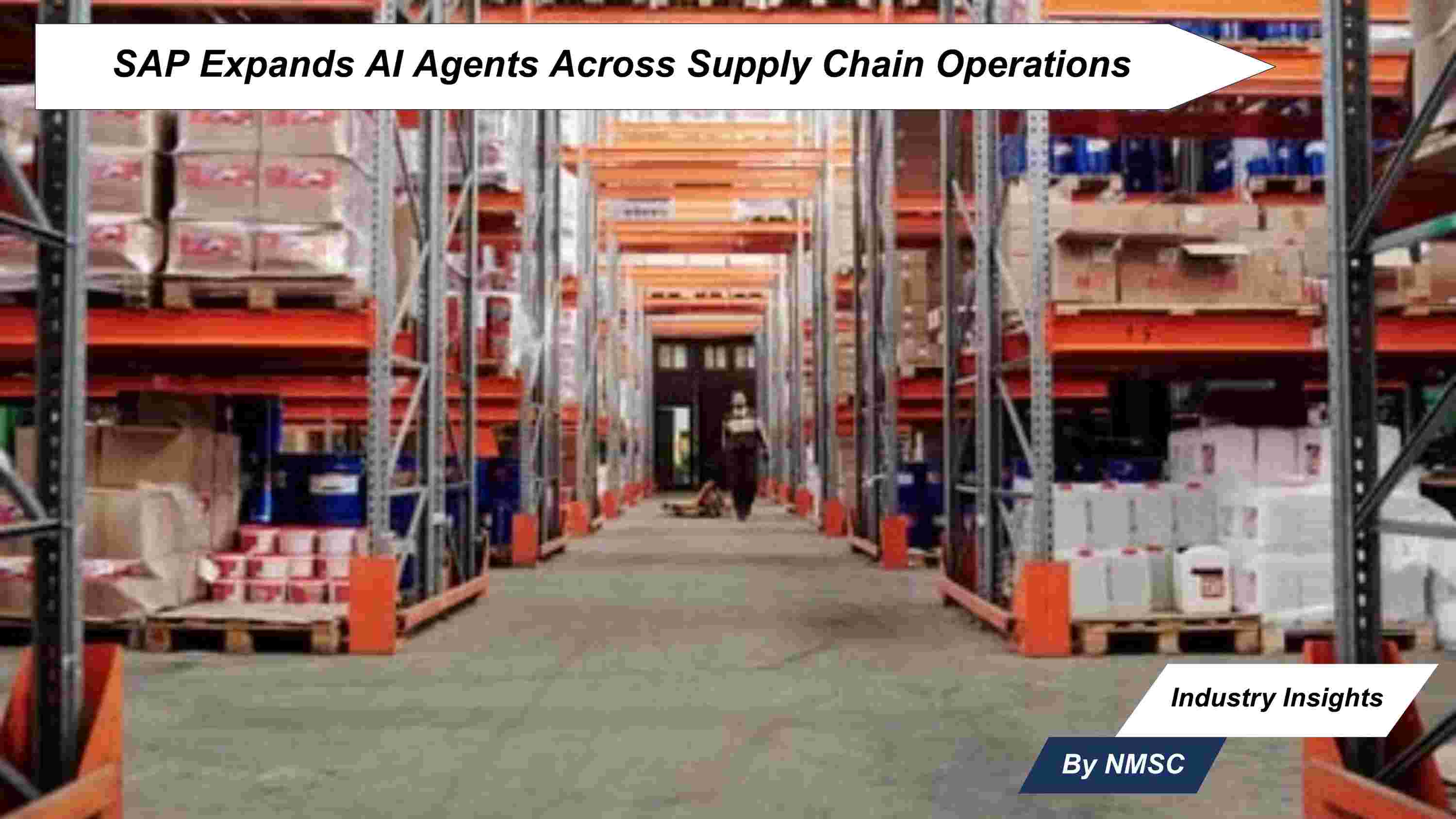
SAP Deploys New Joule Assistants and Agents to Advance Autonomous Supply Chain Management
WALLDORF, Germany October 8, 2026 SAP SE has announced a significant expansion of its Joule Assistants and specialized Joule Agents designed to advance Autonomous Supply Chain Management, deploying domain-specific artificial intelligence across planning, manufacturing, logistics, asset operations, and supplier collaboration. The announcement, made at SAP Connect 2026, positions the enterprise software giant at the forefront of the rapidly expanding AI supply chain market, which is valued at USD 13.50 billion in 2026 and projected to reach USD 108.06 billion by 2035, growing at a compound annual growth rate of 26.0%.
The rollout extends the capabilities of six Joule Assistants first introduced at SAP Sapphire 2026, adding a new layer of specialized agents capable of executing critical supply chain tasks with greater autonomy. According to Devesh Mishra, General Manager and Chief Product Officer for SAP Supply Chain Management, the initiative is designed to address what he terms "decision velocity" the speed at which organizations can recognize change and coordinate a governed response across interconnected supply chain processes.
"AI can automate individual tasks, but isolated intelligence only creates isolated value," Mishra stated. "Agents need to understand how a decision in one domain affects the next." General availability for the newly announced capabilities is planned for Q4 2026, with the expanded suite grounded in SAP's existing supply chain application portfolio to ensure business context, process connectivity, and governance controls.
Key Highlights:
-
Supply Chain Planning Assistant: Enables planners to sense, simulate, and resolve exceptions within a single workspace, helping teams assess downstream impacts and address disruptions before they propagate across the enterprise.
-
Logistics and Manufacturing Agents: New agentic capabilities span warehousing, outbound optimization, fulfillment, and transportation dispatching, while the Manufacturing Assistant supports real-time response to plant-floor disruptions.
-
Asset Operations and Business Network Assistants: The Asset Operations Assistant translates equipment and maintenance signals into actionable maintenance requests, while the Business Network Assistant enhances collaboration with suppliers and logistics partners in sourcing, contracting, and exception handling.
-
Validated Customer Deployments: Takeda Pharmaceuticals is adopting the Supply Chain Planning Assistant for AI-detected root cause analysis and self-healing planning capability; Doehler GmbH reports its logistics team has recovered approximately one-third of time previously lost to manual troubleshooting through the Logistics Issue Resolution Agent.
Analyst Insight:
According to analysts at Next Move Strategy Consulting, SAP's expansion of multi-agent orchestration across supply chain domains reflects a structural shift in enterprise AI adoption from isolated task automation toward coordinated, autonomous decision-making. The firm's research indicates that Generative and Agentic AI is the fastest-growing technology sub-segment within the AI supply chain market, registering a 32.5% CAGR from 2026 to 2035, underscoring the strategic alignment of SAP's current product direction with the market's most accelerated growth vector.
NMSC analysts further note that the deployment of domain-specific assistants capable of cross-functional coordination spanning planning, manufacturing, logistics, and supplier networks — directly addresses the enterprise demand for end-to-end orchestration platforms. As large enterprises, which held approximately 75% of the AI supply chain market in 2025, continue to prioritize agentic AI adoption, vendors demonstrating credible autonomous decision-making depth are positioned to capture premium contract value through the forecast period.
Industry Outlook:
SAP's latest expansion at SAP Connect 2026 signals a broader industry transition from AI-assisted planning tools toward systems capable of autonomous, governed action across the full supply chain lifecycle. With general availability of the new Joule Agents targeted for Q4 2026, enterprise customers across manufacturing, pharmaceuticals, food and beverage, and logistics sectors are expected to accelerate adoption timelines for agentic supply chain platforms.
The competitive landscape is intensifying as enterprise resource planning incumbents and AI-native specialists alike invest in orchestration depth and autonomous exception-handling capability. For supply chain leaders, the practical measure of this shift will be the degree to which AI-driven decision velocity translates into measurable reductions in disruption response time, operational cost, and manual exception management outcomes that early adopters such as Doehler GmbH are already beginning to quantify.
Source: SAP News Center
For More Information – Download FREE Sample on AI Supply Chain Market Report
Prepared By: Sanyukta Deb
About the Author
 Sanyukta Deb
— Sanyukta Deb is Digital Marketing Team Lead at Next Move Strategy Consulting, where she has led content strategy and technical SEO for the firm's B2B market research publications for over 2 years. Her editorial process translates NextMSC's primary and secondary research — spanning technology, industrial, and consumer sectors — into commercial narratives, backed by search-intent, keyword, and competitive analysis. She brings 5 years of overall experience in digital marketing and content strategy.
Sanyukta Deb
— Sanyukta Deb is Digital Marketing Team Lead at Next Move Strategy Consulting, where she has led content strategy and technical SEO for the firm's B2B market research publications for over 2 years. Her editorial process translates NextMSC's primary and secondary research — spanning technology, industrial, and consumer sectors — into commercial narratives, backed by search-intent, keyword, and competitive analysis. She brings 5 years of overall experience in digital marketing and content strategy.
About the Reviewer
 Debashree Dey
— Debashree Dey is Assistant Manager at Next Move Strategy Consulting, where she supports cross-vertical market content and communications across diverse industries for 6 years. Her professional background includes senior content writing, communications, and published manuscript authorship, with experience developing audience-focused business narratives and maintaining clear, consistent messaging. Her role supports research-led content development and editorial quality across NextMSC publications.
Debashree Dey
— Debashree Dey is Assistant Manager at Next Move Strategy Consulting, where she supports cross-vertical market content and communications across diverse industries for 6 years. Her professional background includes senior content writing, communications, and published manuscript authorship, with experience developing audience-focused business narratives and maintaining clear, consistent messaging. Her role supports research-led content development and editorial quality across NextMSC publications.















Add Comment