AI Supply Chain Market Global Industry Analysis and Forecast (2026-2035)

AI Supply Chain Market size was USD 13.50 billion in 2026, projected to reach USD 108.06 billion by 2035, growing at a CAGR of 26.0% from 2026 to 2035. Key drivers include enterprise adoption of generative and agentic AI, rising supply chain disruption and tariff volatility management needs, and cloud infrastructure expansion, with North America leading the market.
Download Free Sample PDF
Base Year (2025)
$10.50 Billion
Forecast (2035)
$108.06 Billion
CAGR (2026-2035)
26.0%
Top Region
North America

What Is the AI Supply Chain Market Size?
The global AI supply chain industry size was valued at USD 10.50 billion in 2025 and is estimated at USD 13.50 billion in 2026, forecast to reach USD 108.06 billion by 2035, expanding at a 26.0% CAGR between 2026 and 2035. North America leads with approximately 42% share, while software dominates all other components with approximately 68% share.

We observed that growth is broad-based across every segmentation axis, with agentic AI adoption and cloud deployment driving the dominant structural shifts through 2035.

AI Supply Chain Market Global Industry Analysis and Forecast (2026-2035) Revenue Forecast
Values in USD Billion

2025 $10.50 Billion
2025
2026 $13.23 Billion
2026
2027 $16.67 Billion
2027
2028 $21.00 Billion
2028
2029 $26.46 Billion
2029
2030 $33.35 Billion
2030
2031 $42.02 Billion
2031
2032 $52.94 Billion
2032
2033 $66.70 Billion
2033
2034 $84.05 Billion
2034
2035 $108.06 Billion
2035

Key Takeaways

By Component: Software held the largest share of approximately 68% (USD 7.14 billion) in 2025; Hardware is the fastest-growing sub-segment at 32.4% CAGR from 2026–2035.

By Application: Demand Forecasting and Planning held the largest share of approximately 28% (USD 2.94 billion) in 2025; Logistics and Transportation Optimization is the fastest-growing sub-segment at 27.3% CAGR from 2026–2035.

By Deployment Mode: Cloud held the largest share of approximately 80% (USD 8.40 billion) in 2025; Hybrid is the fastest-growing sub-segment at 27.8% CAGR from 2026–2035.

By Technology: Machine Learning and Predictive Analytics held the largest share of approximately 51% (USD 5.36 billion) in 2025; Generative and Agentic AI is the fastest-growing sub-segment at 32.5% CAGR from 2026–2035.

By Organization Size: Large Enterprises held the largest share of approximately 75% (USD 7.88 billion) in 2025; Small and Medium Enterprises is the fastest-growing sub-segment at 27.6% CAGR from 2026–2035.

By End-Use Industry: Retail and E-commerce held the largest share of approximately 28% (USD 2.94 billion) in 2025; Healthcare and Life Sciences is the fastest-growing sub-segment at 29.2% CAGR from 2026–2035.

Dominant Region: North America dominated with approximately 42% revenue share (USD 4.39 billion) in 2025.

Fastest-Growing Region: Middle East & Africa is expected to register the highest CAGR of 30.7% during 2026–2035.

Dominant Country: U.S. led with approximately USD 3.65 billion in 2025.

Fastest-Growing Country: India is the fastest-growing country at approximately 32.6% CAGR from 2026–2035.

What Does the AI Supply Chain Market Encompass?

The AI supply chain industry encompasses software platforms, professional services, and supporting hardware that apply machine learning, generative AI, and agentic AI to plan, execute, and optimize the flow of goods, information, and capital across manufacturing, distribution, and retail networks. Our assessment indicates that the scope spans demand forecasting, inventory and warehouse management, logistics optimization, procurement risk management, and production planning applications deployed across cloud, on-premise, and hybrid environments for enterprises of all sizes. The category has evolved from rules-based planning tools into autonomous, agent-driven orchestration platforms capable of independent decision-making.

Data privacy frameworks such as the European Union's General Data Protection Regulation shape how AI models process supplier and customer data across cross-border supply chains, while the EU AI Act's risk-based classification system increasingly influences deployment requirements for high-impact planning and logistics applications. We observed that technology adoption is shifting rapidly from predictive analytics toward generative and agentic AI capable of autonomous exception handling. NMSC's analysis indicates that this structural shift, combined with persistent GPU compute constraints, is redefining vendor selection criteria across the AI supply chain market.

Market Drivers & Dynamics

Interactive Dataset
Enterprise adoption of generative and agentic AI planning tools driver +8.2% Global 2026-2035
Rising supply chain disruption and tariff volatility management needs driver +5.4% North America, Asia-Pacific 2026-2032
Cloud infrastructure expansion supporting AI workload scaling driver +4.1% Global 2026-2035
Growth of e-commerce-driven demand forecasting complexity driver +3.3% North America, Asia-Pacific 2026-2035
Expansion of AI investment across Middle East economic diversification programs driver +2.6% Middle East & Africa 2026-2033
Vendor consolidation of planning and execution platforms driver +1.9% Global 2026-2033
GPU and compute infrastructure supply constraints restraint -3.2% Global 2026-2029
Data privacy and AI governance compliance requirements restraint -2.1% Europe 2026-2032
Legacy system integration complexity among established enterprises restraint -1.8% Global 2026-2030
Source: Next Move Strategy Consulting

Growth Drivers

What Is the Primary Growth Driver of the AI Supply Chain Market?

Enterprise adoption of generative and agentic AI planning tools is the primary driver of the market. Kinaxis reported that its fiscal 2025 software as a service revenue grew 17% for the full year, with fourth-quarter SaaS revenue up 19%, driven substantially by customer expansion into AI-enabled Maestro modules. We observed that this SaaS-led growth, reinforced by record annual recurring revenue expansion, continues to anchor baseline demand for agentic AI capabilities across large, complex enterprise supply chains.

How Is Tariff Volatility Driving AI Supply Chain Market Growth?

Rising tariff volatility and supply chain disruption is accelerating market growth as enterprises seek AI tools capable of rapid scenario response. Kinaxis disclosed that despite tariff-related uncertainty creating massive volatility across global markets in 2025, its fiscal year guidance remained firmly in sight, reflecting sustained customer demand for disruption-management capability. Our assessment indicates that this volatility-driven urgency, combined with expanding annual recurring revenue among AI-native vendors, is compressing enterprise adoption timelines for scenario-planning and orchestration platforms.

Growth Inhibitors

What Is Restraining AI Supply Chain Market Expansion?

GPU and compute infrastructure supply constraints restrain deployment timelines for AI supply chain platforms requiring intensive model training and inference capacity. Industry disclosures indicate that persistent graphics processing unit shortages are extending deployment timelines and shifting enterprise focus toward compute-efficient architectures. We found that this restraint disproportionately affects enterprises deploying computer-vision-based warehouse automation, as hardware allocation constraints limit the pace of large-scale rollout across distribution networks.

What Are the Growth Opportunities?

How Can Agentic AI Orchestration Unlock Value for Mid-Market Enterprises?

Agentic AI orchestration presents a whitespace opportunity for vendors seeking to extend enterprise-grade planning capability to mid-market manufacturers and distributors historically underserved by complex legacy platforms. Vendors that offer rapid-deployment, pre-configured agentic modules stand to capture recurring subscription revenue as smaller enterprises seek AI capability without lengthy implementation cycles.

Where Does Tariff Scenario Modeling Create New Demand?

Enterprises managing cross-border manufacturing and distribution networks represent an underpenetrated opportunity for vendors offering dedicated tariff and trade-policy scenario-modeling capability. Vendors that develop validated, rapidly updatable trade-impact simulation tools can secure long-term contracts as procurement and logistics teams navigate sustained global trade policy volatility.

How Can Edge-AI Hardware Benefit Compute-Constrained Warehouse Operators?

Warehouse and distribution facility operators facing centralized compute constraints create an opportunity for suppliers offering edge-AI hardware capable of localized inference for time-sensitive automation decisions. Early movers that combine edge computing devices with compatible software orchestration can differentiate with logistics operators pursuing latency-reduction goals across high-throughput fulfillment environments.

Segmentation Analysis

2025 (USD Billion)
2035 (USD Billion)
Software 2025: $7.14 Billion | 2035: $68.62 Billion
Software
Services 2025: $2.52 Billion | 2035: $25.93 Billion
Services
Hardware 2025: $0.84 Billion | 2035: $13.51 Billion
Hardware
Software $7.14 Billion $68.62 Billion 25.0%
Services $2.52 Billion $25.93 Billion 26.0%
Hardware $0.84 Billion $13.51 Billion 32.4%

Which Component Dominates the AI Supply Chain Market?

Software, spanning planning, execution, and risk and visibility platforms, led the market with USD 7.14 billion in 2025, supported by rapid enterprise adoption of cloud-native planning and orchestration tools. We observed that Hardware is the fastest-growing component, expanding at a 32.4% CAGR from 2026 to 2035, as enterprises invest in edge computing devices and sensors to support latency-sensitive warehouse automation and compute-constrained AI inference at distribution facilities.

2025 (USD Billion)
2035 (USD Billion)
Demand Forec
Inventory an
Logistics an
Procurement
Production a
Segment Item 2025 (USD Billion) 2035 (USD Billion) CAGR
Demand Forecasting and Planning $10.0 USD Billion $40.0 USD Billion 25.0%
Inventory and Warehouse Management $17.1 USD Billion $51.1 USD Billion 11.0%
Logistics and Transportation Optimization $24.2 USD Billion $62.2 USD Billion 25.0%
Procurement and Supplier Risk Management $31.3 USD Billion $73.3 USD Billion 11.0%
Production and Manufacturing Planning $38.4 USD Billion $84.4 USD Billion 16.0%

Segment-wise data is locked

Unlock complete segment-wise numbers for By Application.

Unlock Full Data

Which Application Segment Leads AI Supply Chain Market Demand?

Demand Forecasting and Planning remained the leading application, valued at USD 2.94 billion in 2025 on sustained enterprise investment in AI-enabled forecast accuracy improvements across volatile demand environments. Our findings suggest that Logistics and Transportation Optimization is the fastest-growing application, registering a 27.3% CAGR from 2026 to 2035, as tariff volatility and cross-border trade complexity drive demand for AI-powered routing and scenario-modeling capability.

2025 (USD Billion)
2035 (USD Billion)
Cloud
On-Premise
Hybrid
Segment Item 2025 (USD Billion) 2035 (USD Billion) CAGR
Cloud $10.0 USD Billion $40.0 USD Billion 27.0%
On-Premise $17.1 USD Billion $51.1 USD Billion 9.0%
Hybrid $24.2 USD Billion $62.2 USD Billion 19.0%

Segment-wise data is locked

Unlock complete segment-wise numbers for By Deployment Mode.

Unlock Full Data

Which Deployment Mode Leads AI Supply Chain Market Adoption?

Cloud remained the dominant deployment mode, valued at USD 8.40 billion in 2025 on enterprise preference for subscription-based access to continuously updated AI models and orchestration capabilities. Based on research conducted by NMSC, we found that Hybrid deployment is the fastest-growing mode, at a 27.8% CAGR from 2026 to 2035, as enterprises balance cloud-based AI processing with on-premise data residency requirements for sensitive supplier and customer information.

2025 (USD Billion)
2035 (USD Billion)
Machine Lear
Generative a
Computer Vis
Natural Lang
Segment Item 2025 (USD Billion) 2035 (USD Billion) CAGR
Machine Learning and Predictive Analytics $10.0 USD Billion $40.0 USD Billion 14.0%
Generative and Agentic AI $17.1 USD Billion $51.1 USD Billion 24.0%
Computer Vision $24.2 USD Billion $62.2 USD Billion 22.0%
Natural Language Processing $31.3 USD Billion $73.3 USD Billion 12.0%

Segment-wise data is locked

Unlock complete segment-wise numbers for By Technology.

Unlock Full Data
2025 (USD Billion)
2035 (USD Billion)
Large Enterp
Small and Me
Segment Item 2025 (USD Billion) 2035 (USD Billion) CAGR
Large Enterprises $10.0 USD Billion $40.0 USD Billion 24.0%
Small and Medium Enterprises $17.1 USD Billion $51.1 USD Billion 22.0%

Segment-wise data is locked

Unlock complete segment-wise numbers for By Organization Size.

Unlock Full Data
2025 (USD Billion)
2035 (USD Billion)
Retail and E
Manufacturin
Automotive
Healthcare a
Food and Bev
Segment Item 2025 (USD Billion) 2035 (USD Billion) CAGR
Retail and E-commerce $10.0 USD Billion $40.0 USD Billion 23.0%
Manufacturing $17.1 USD Billion $51.1 USD Billion 9.0%
Automotive $24.2 USD Billion $62.2 USD Billion 19.0%
Healthcare and Life Sciences $31.3 USD Billion $73.3 USD Billion 13.0%
Food and Beverage $38.4 USD Billion $84.4 USD Billion 10.0%

Segment-wise data is locked

Unlock complete segment-wise numbers for By End-Use Industry.

Unlock Full Data

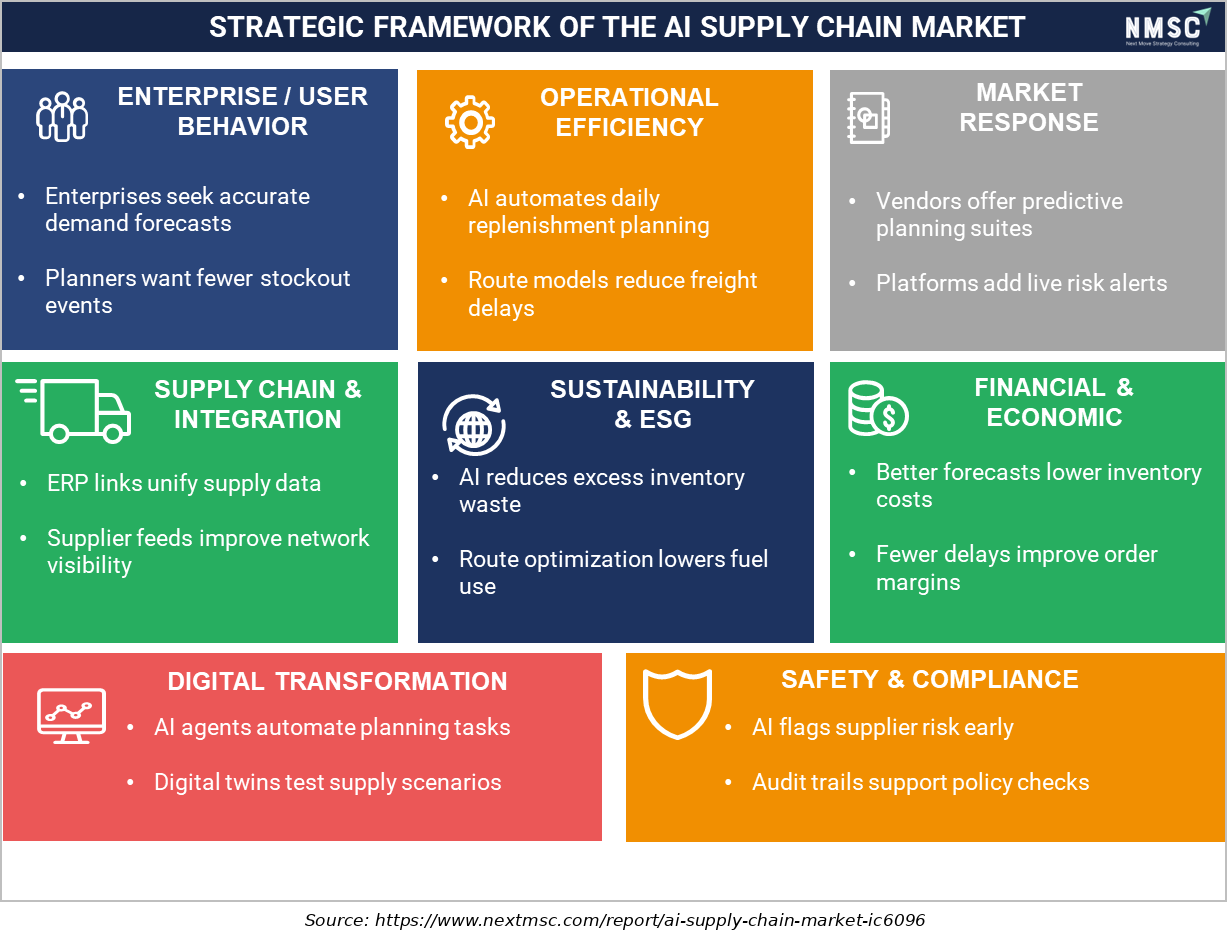
Strategic Framework of the AI Supply Chain Market

Strategic Framework of the AI Supply Chain Market

The AI supply chain market is shaped by enterprise demand for accurate forecasting, efficient operations, responsive planning, and improved resilience. AI-driven tools support inventory optimization, procurement automation, logistics management, and supplier analytics. By connecting data across the supply chain, these solutions can improve visibility, reduce costs, strengthen decision-making, and support scalable digital transformation.

Growth Opportunities

Our analysis shows that three forward-looking opportunities stand out for stakeholders positioning within the AI supply chain market over the 2026-2035 forecast period.

How Can Agentic AI Orchestration Unlock Value for Mid-Market Enterprises?

Agentic AI orchestration presents a whitespace opportunity for vendors seeking to extend enterprise-grade planning capability to mid-market manufacturers and distributors historically underserved by complex legacy platforms. Vendors that offer rapid-deployment, pre-configured agentic modules stand to capture recurring subscription revenue as smaller enterprises seek AI capability without lengthy implementation cycles.

Where Does Tariff Scenario Modeling Create New Demand?

Enterprises managing cross-border manufacturing and distribution networks represent an underpenetrated opportunity for vendors offering dedicated tariff and trade-policy scenario-modeling capability. Vendors that develop validated, rapidly updatable trade-impact simulation tools can secure long-term contracts as procurement and logistics teams navigate sustained global trade policy volatility.

How Can Edge-AI Hardware Benefit Compute-Constrained Warehouse Operators?

Warehouse and distribution facility operators facing centralized compute constraints create an opportunity for suppliers offering edge-AI hardware capable of localized inference for time-sensitive automation decisions. Early movers that combine edge computing devices with compatible software orchestration can differentiate with logistics operators pursuing latency-reduction goals across high-throughput fulfillment environments.

Regional Outlook

2025 (USD Billion)
2035 (USD Billion)
North Americ
Asia-Pacific
Europe
Middle East
Latin Americ
Region 2025 (USD Billion) 2035 (USD Billion) CAGR (%)
North America $10.0 USD Billion $40.0 USD Billion 9.0%
Asia-Pacific $17.1 USD Billion $51.1 USD Billion 27.0%
Europe $24.2 USD Billion $62.2 USD Billion 25.0%
Middle East & Africa $31.3 USD Billion $73.3 USD Billion 23.0%
Latin America $38.4 USD Billion $84.4 USD Billion 12.0%

Regional data is locked

Unlock complete regional numbers for this market.

Unlock Full Data

Competitive Landscape

We observed that the AI supply chain market features a moderately fragmented competitive landscape, with diversified enterprise software giants competing alongside AI-native supply chain specialists on orchestration depth, deployment speed, and agentic capability.

Dimension Description
Market Structure Moderately fragmented; SAP, Oracle, and Microsoft maintain the broadest enterprise resource planning-integrated footprints, while AI-native specialists including Kinaxis, o9 Solutions, and Blue Yonder compete on orchestration and agentic planning depth.
Innovation Focus Agentic AI orchestration, generative AI-enabled scenario planning, and tariff and trade-policy simulation capability dominate current investment priorities across leading suppliers.
M&A Activity Selective platform consolidation, exemplified by continued private equity ownership restructuring across the sector, including Coupa Software and Anaplan operating under Thoma Bravo ownership following prior public-to-private transactions.

How Do Companies Compete in the AI Supply Chain Market?

Companies compete primarily on orchestration breadth, deployment speed, and depth of agentic AI capability across the industry. Enterprise resource planning incumbents such as SAP and Oracle leverage deep existing system integration to serve large multinational enterprises, while AI-native specialists including Kinaxis and o9 Solutions compete on concurrent planning architecture and faster time-to-value for complex, disruption-prone supply chains.

Which Competitive Archetypes Dominate the AI Supply Chain Market?

Two archetypes dominate the market: enterprise resource planning-integrated platforms offering embedded AI within broader business software suites, and AI-native orchestration specialists built specifically for supply chain planning. SAP and Oracle exemplify the integrated archetype through deep financial and operational system connectivity, while Kinaxis and o9 Solutions exemplify the AI-native archetype through purpose-built concurrent planning and digital twin architectures.

How Are Companies Differentiating Through Innovation in AI Supply Chain?

Innovation and differentiation strategy increasingly center on agentic AI capable of autonomous exception handling and rapid scenario simulation. Kinaxis's Maestro Agents and its dedicated Tariff Response offering both illustrate this shift toward AI systems that act rather than merely advise. Our analysis shows that suppliers unable to demonstrate credible agentic capability risk losing enterprise contracts to more innovation-focused competitors as customers increasingly evaluate platforms on autonomous decision-making depth.

What M&A and Expansion Activity Is Shaping the AI Supply Chain Market?

Private equity ownership and platform consolidation continue to reshape supplier strategy within the industry. Coupa Software's and Anaplan's continued operation under private ownership following prior take-private transactions illustrates how investors are consolidating capital around AI-enabled planning platforms outside public market scrutiny, while Kinaxis's partnership with Workday to unify operational, finance, and workforce data illustrates how suppliers are expanding integration breadth to strengthen competitive positioning.

Key Market Players

Our assessment indicates that the following 20 companies are actively shaping product innovation, agentic AI capability, and enterprise adoption strategy within the global AI supply chain market.

SAP SE Oracle Corporation Microsoft Corporation IBM Corporation Amazon.com, Inc. NVIDIA Corporation Kinaxis Inc. o9 Solutions, Inc. Blue Yonder Group, Inc. E2open Parent Holdings, Inc. Manhattan Associates, Inc. RELEX Solutions Aera Technology, Inc. Coupa Software Incorporated Anaplan, Inc. Infor, Inc. Logility, Inc. C3.ai, Inc. Alphabet Inc. SymphonyAI

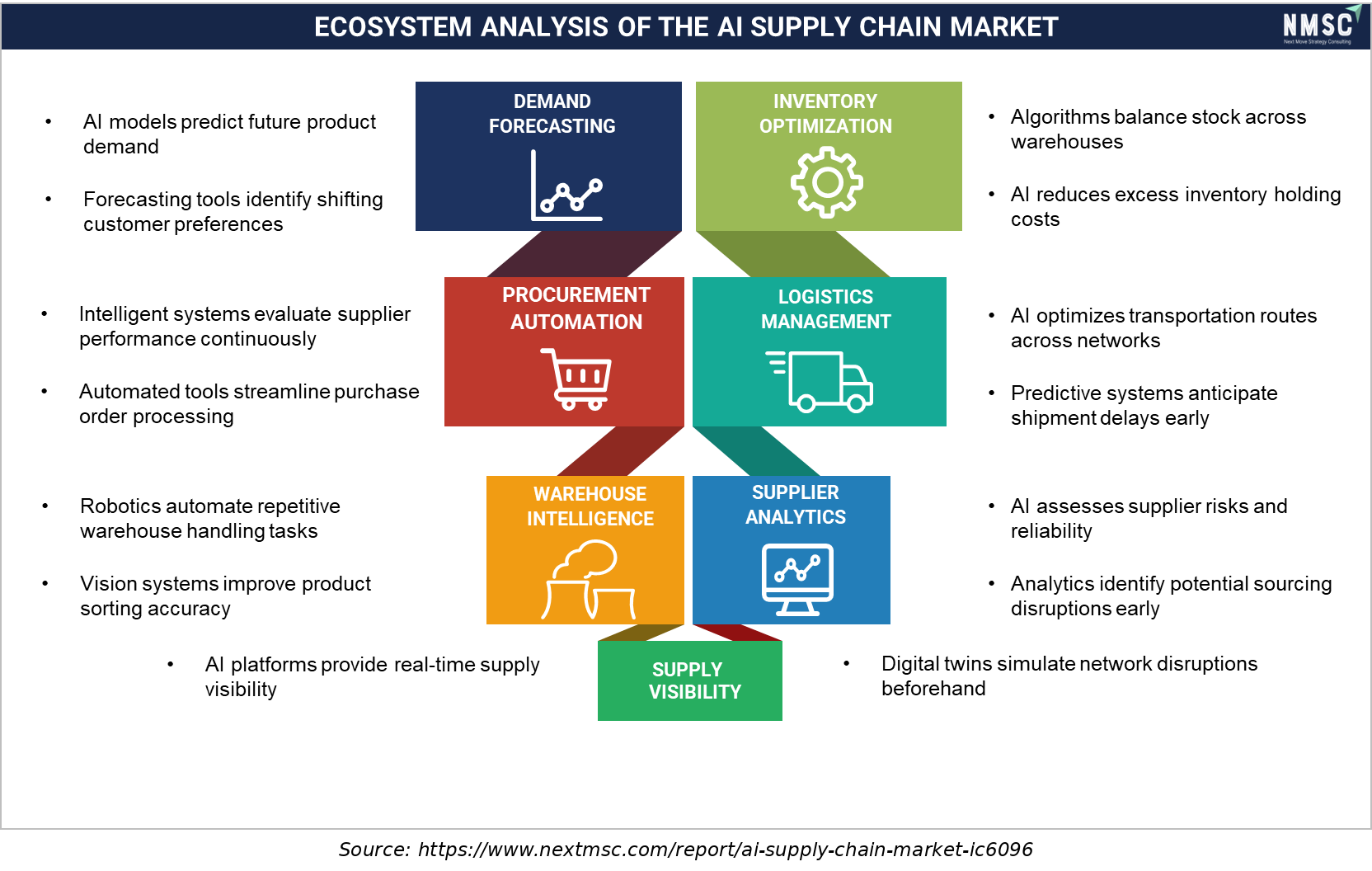
Ecosystem Analysis of the AI Supply Chain Market
The AI supply chain ecosystem brings together demand forecasting, inventory optimization, procurement automation, logistics management, warehouse intelligence, supplier analytics, and supply visibility. These interconnected capabilities enable organizations to analyze data and respond more effectively to changing conditions. Successful adoption depends on reliable data integration, technology interoperability, skilled implementation, and measurable operational outcomes.

Latest Developments

We found that recent product and partnership activity within the AI supply chain market is concentrated on agentic AI launches and disruption-response capability, reflecting the industry's shift toward autonomous, real-time orchestration.

Date Event
May 2026 SAP introduced Autonomous Supply Chain Management at SAP Sapphire 2026, embedding Joule Assistants and industry AI scenarios across planning, manufacturing, logistics, engineering and asset management. The assistants share context and data, moving supply-chain operations toward governed autonomous execution rather than isolated AI copilots.
May 2026 RELEX introduced RELEX Open, an extensible architecture allowing retailers, manufacturers and wholesalers to deploy RELEX planning capabilities, connect their own AI agents and systems, and build additional workflows directly on the platform. The architecture is designed to combine governed planning capabilities with customer-developed AI.

Investment Opportunities

What Capital Inflows Are Targeting the AI Supply Chain Market?

Capital inflows into the AI supply chain market are increasingly directed toward agentic AI development and annual recurring revenue expansion among AI-native vendors. Kinaxis reported its recurring revenue balance approaching USD 1 billion in related performance obligations as of early 2025, reflecting sustained enterprise commitment to multi-year AI platform contracts. We observed that investors favor vendors demonstrating rising SaaS revenue growth and expanding installed base penetration, viewing these metrics as a proxy for durable competitive positioning.

How Is Infrastructure Investment Supporting AI Supply Chain Deployment?

Infrastructure investment is expanding cloud and compute capacity to support growing enterprise AI supply chain workloads amid persistent GPU supply constraints. Our findings suggest that vendors are increasingly investing in compute-efficient model architectures to manage deployment costs while maintaining service performance, a critical consideration as agentic AI adoption scales across large, complex enterprise customer bases.

What ESG Considerations Are Shaping AI Supply Chain Investment Decisions?

Environmental, social, and governance considerations are increasingly relevant to investment decisions, with data governance compliance and AI model transparency cited as key criteria. The European Union's AI Act risk-based classification framework continues to shape how vendors document and disclose AI decision-making processes for high-impact supply chain applications. We found that investors increasingly favor vendors with credible AI governance frameworks, treating this capability as a governance-linked differentiator for enterprises operating under strict European data protection requirements.

Key Benefits for Stakeholders

How Does This Report Benefit Enterprise and Industry Leaders?

Enterprise and industry leaders gain access to validated segmentation, competitive benchmarking, and regional demand forecasts that support platform-selection and deployment-strategy decisions across the AI supply chain industry. Our analysis shows that detailed component, application, and deployment mode breakdowns help procurement and operations teams align investment with agentic AI adoption timelines while identifying underserved applications for platform expansion.

How Does This Report Benefit Investors and Financial Analysts?

Investors and financial analysts benefit from consistent, single-point market size and CAGR estimates that support valuation and capital-allocation decisions across the AI supply chain supply chain. We observed that the report's regional and segment-level growth differentials help identify which vendors are best positioned to capture above-market growth in Middle Eastern markets and hardware-enabled edge-AI categories through 2035.

How Does This Report Benefit Technology Vendors and Product Teams?

Technology vendors and product teams gain insight into emerging agentic AI, scenario-modeling, and compute-efficiency requirements that are reshaping the industry. Our findings suggest that this analysis helps R&D teams prioritize development roadmaps around tariff-response simulation and autonomous exception handling increasingly required by enterprises managing volatile, disruption-prone global supply networks.

Key Market Segments Evaluated

By Component

  • Software
  • Services
  • Hardware

By Application

  • Demand Forecasting and Planning
  • Inventory and Warehouse Management
  • Logistics and Transportation Optimization
  • Procurement and Supplier Risk Management
  • Production and Manufacturing Planning
  • Order Management and Fulfillment

By Deployment Mode

  • Cloud
  • On-Premise
  • Hybrid

By Technology

  • Machine Learning and Predictive Analytics
  • Generative and Agentic AI
  • Computer Vision
  • Natural Language Processing

By Organization Size

  • Large Enterprises
  • Small and Medium Enterprises

By End-Use Industry

  • Retail and E-commerce
  • Manufacturing
  • Automotive
  • Healthcare and Life Sciences
  • Food and Beverage
  • Technology and Electronics
  • Other Industries

Conclusion & Recommendations

The long-term outlook for the market remains strongly positive, with global revenue projected to grow from USD 10.50 billion in 2025 to USD 108.06 billion by 2035 at a 26.0% CAGR. We observed that sustained agentic AI adoption, tariff-driven scenario-planning demand, and expanding cloud infrastructure will continue underpinning demand across planning, execution, and risk management applications through the forecast period.

What Strategic Positioning Should AI Supply Chain Suppliers Pursue?

Suppliers should prioritize agentic AI capability while pursuing deeper execution-system integration to secure long-term enterprise contracts. Our assessment indicates that vendors investing early in autonomous exception-handling and tariff-response simulation will be best positioned to capture premium enterprise adoption within the AI supply chain market.

How Attractive Is the AI Supply Chain Market for New Investment?

The AI supply chain industry presents an attractive investment case, supported by a USD 94.56 billion absolute dollar opportunity between 2026 and 2035 and above-average growth in Middle Eastern and hardware categories. We found that investment attractiveness is highest for vendors combining agentic AI depth with scaled cloud infrastructure, positioning them to serve both large enterprise and expanding mid-market segments simultaneously.

What Market Shifts and Key Risks Should Stakeholders Monitor?

Stakeholders should monitor GPU and compute supply constraints, data governance compliance requirements, and legacy system integration complexity as key risks to the AI supply chain market. Our analysis shows that suppliers unable to demonstrate compute-efficient architectures risk deployment delays, particularly within Europe's increasingly regulated AI governance environment under the EU AI Act.

What Are the Key Growth Pathways for the AI Supply Chain Market?

Key growth pathways include expanding agentic AI orchestration capability, scaling edge-AI hardware for compute-constrained environments, and deepening mid-market enterprise penetration through rapid-deployment platforms. NMSC's analysis indicates that suppliers pursuing these pathways while maintaining data governance compliance will be best positioned to capture the AI supply chain market's projected growth through 2035.

FAQs

About the Author

Mihul Sharma

Mihul Sharma

Mihul Sharma is Research Associate at Next Move Strategy Consulting, where he has covered technology, industrial, and healthcare markets for 3 years. His work applies structured business research, market analysis, and secondary-source review to assess market trends, competitive developments, and growth opportunities. He supports report development by fully synthesizing industry data, company information, and market signals into concise findings for strategy and investment-focused research teams.

About the Reviewer

Supradip Baul

Supradip Baul

Supradip Baul is an accomplished business consultant and strategist with over a decade of rich experience in market intelligence, strategy, technology, and business transformation. His work has included rigorous qualitative and quantitative analysis across multiple industries, helping clients shape investment decisions and long-term roadmaps. Earlier in his career, he was associated with Gartner, where he contributed to industry-leading reports and market share analyses. He has worked with leading global companies and holds an MBA with a dual specialization in Marketing and Finance.

Download Free Sample

Pratyush Kumar Das

PRATYUSH KUMAR DAS

Assistant Manager

Polycab India Limited

We would like to express our appreciation for the data and insights provided by nextmsc. We are very pleased with the quality and depth of the information, which has proven to be highly valuable and beneficial for our business decision-making.

Robert Sean Trevino

ROBERT SEAN TREVINO

Sr. Director, Head of Strategic Insights & Analytics

Foundation Medicine

I realized that it was a reliable source of information. These days, there are many people who are looking for authentic data, and this is one of the only sources that can offer them with what they need;

Kevin Coker

KEVIN COKER

Founder, CEO and Board Diector

Proxima Clinical Research

I have been using Next MSC reports for product positioning in a new geography for a long time. They have by far the best reports I have found and the price is reasonable too!

Semih Kavaklioglu

SEMIH KAVAKLIOGLU

Co-Founder & Sales Manager

Decortie

I work a lot in the marketing industry and I know that research is an essential part of any campaign. I have used Market research reports for my own products and I found them to be very informative and well-researched. The team here produces insightful reports for a good price

Melanie Samko

MELANIE SAMKO

Director of Marketing

TOSOH BIOSCIENCE, INC.

The information provided by NMSC is incredibly valuable, thank you so much for such a excellent work. I really appreciate it. I will make sure to reference all of it, in my summary document.

Custom Market Research Services

We will customize the research for you if the listed report does not fully match your requirements.

Get 30% Free Customization

Select License

This website uses cookies to ensure you get the best experience on our website. Learn more

✖