Website Builder Software Market Global Industry Analysis and Forecast (2026–2035)

Small business digitalization, AI assisted site creation and ecommerce migration lift the market from USD 11.57 Billion in 2025 to USD 79.58 Billion by 2035, a 17.7% CAGR over 2026 to 2035, driven by small business digitalization tied to online selling and accelerating adoption of AI-powered website creation tools, with North America leading today and Asia-Pacific advancing fastest.

Download Free Sample PDF
Base Year (2025)
$11.57 Billion
Forecast (2035)
$79.58 Billion
CAGR (2026-2035)
17.7%
Top Region
North America

What Is the Website Builder Software Market Size?

The global Website Builder Software Market reached USD 11.57 Billion in 2025 and is estimated at USD 18.37 Billion in 2026. It is forecast to reach USD 79.58 Billion by 2035, expanding at a 17.7% CAGR from 2026 to 2035. North America leads with about 36% share, and software platforms account for about 78% of revenue.

Our analysis shows that the leading sub segments and regions below set the commercial centre of gravity for the forecast period.

Website Builder Software Market Global Industry Analysis and Forecast (2026–2035) Revenue Forecast

Values in USD Billion

2025 $11.57 Billion
2025
2026 $18.37 Billion
2026
2027 $21.62 Billion
2027
2028 $25.45 Billion
2028
2029 $29.95 Billion
2029
2030 $35.25 Billion
2030
2031 $41.49 Billion
2031
2032 $48.84 Billion
2032
2033 $57.48 Billion
2033
2034 $67.66 Billion
2034
2035 $79.58 Billion
2035

Key Takeaways

By Offering: Software platform held the largest share, expanding from USD 9.14 Billion in 2025 to USD 57.30 Billion by 2035; Services is the fastest growing at 20.9% CAGR from 2026–2035.

By Application: Business and corporate websites held the largest share, expanding from USD 4.17 Billion in 2025 to USD 23.08 Billion by 2035; Ecommerce and online stores is the fastest growing at 20.1% CAGR from 2026–2035.

By End user: Small and medium enterprises held the largest share, expanding from USD 6.24 Billion in 2025 to USD 37.40 Billion by 2035; Large enterprises is the fastest growing at 21.5% CAGR from 2026–2035.

Dominant Region: North America led with USD 6.62 Billion in 2026, rising from USD 4.29 Billion in 2025 to USD 23.87 Billion by 2035.

Fastest-Growing Region: Asia-Pacific is the fastest growing at 21.6% CAGR from 2026–2035, reaching USD 26.67 Billion by 2035.

Dominant Country: The U.S. led with USD 5.30 Billion in 2026, projected to reach USD 18.38 Billion by 2035.

Fastest-Growing Country: India leads growth at a 27.8% CAGR from 2026–2035, expanding from USD 0.21 Billion in 2025 to USD 3.73 Billion by 2035.

The market offers an absolute opportunity of approximately USD 61.21 Billion between 2026 and 2035, a strong signal for vendors and growth capital.

According to NMSC analysis, managed design, migration and optimization services are scaling faster than core software because customers want finished outcomes.

Ecosystem Analysis of the Website Builder Software Industry

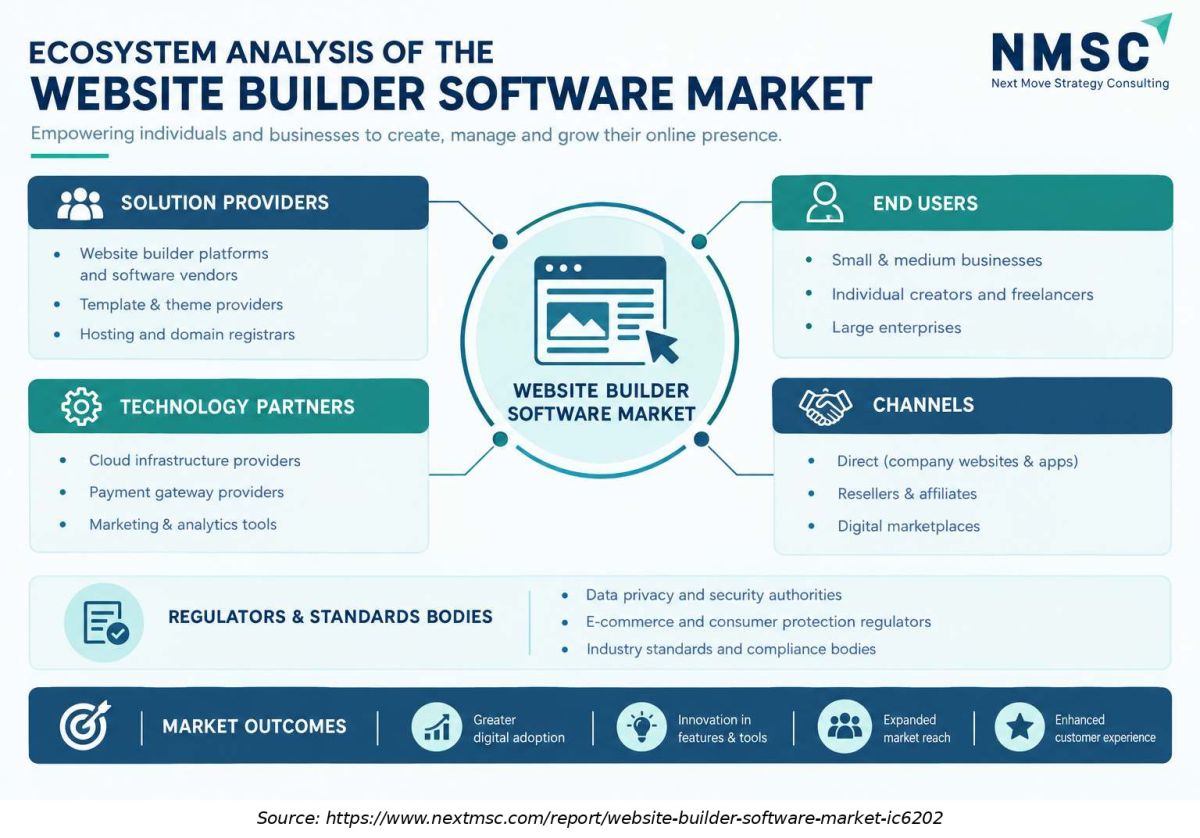
The above infographic provides a detailed ecosystem analysis of the website builder software market, mapping out key stakeholders from solution providers and technology partners to end users. It illustrates how these interconnected players, supported by regulatory bodies, empower individuals and businesses to establish and grow their online presence. The analysis further highlights crucial market channels, including direct sales and digital marketplaces. Ultimately, it demonstrates how this collaborative ecosystem drives greater digital adoption, fosters innovation, and enhances the overall customer experience.

What Does the Website Builder Software Market Encompass?

The Website Builder Software Market covers cloud delivered platforms that let businesses, creators and agencies design, publish and manage websites through visual editors, templates, hosting and increasingly AI assistants. The scope includes the software platform and the professional and managed services sold around it, across business sites, online stores, portfolios and campaign pages.

Our assessment indicates that the category has moved from template based hobby tools toward full commerce, marketing and application platforms. Accessibility and data protection requirements now shape product design, while AI generation reaches a growing share of new sites, with Hostinger reporting that around 80% of its builder clients begin with AI.

Market Drivers & Dynamics

Interactive Dataset
Small business digitalization and ecommerce migration driver +3.4% Global, strongest in Asia-Pacific 2026–2035
AI assisted and prompt based site generation driver +4.1% North America, Europe 2026–2030
Agency and professional partner channels driver +1.8% North America, Europe 2026–2032
Composable website platforms in large enterprises driver +2.2% North America, Europe, Asia-Pacific 2027–2035
Price competition and free entry tiers restraint −1.9% Global 2026–2030
Accessibility and data protection compliance costs restraint −1.1% Europe, North America 2026–2035
Vendor lock in and migration friction restraint −1.3% Global 2026–2032
Source: Next Move Strategy Consulting

Growth Drivers

What Is the Primary Growth Driver in the Website Builder Software Market?

Small business digitalization tied to online selling is the primary structural driver of the Website Builder Software Market. The U.S. Census Bureau reported that retail ecommerce sales reached USD 340.2 Billion in the second quarter of 2026, up 12.2% from a year earlier, and equal to 17.1% of total retail sales. Each additional online seller needs a storefront, which converts retail migration directly into platform subscriptions.

How Is AI Adoption Driving Market Growth?

We observed that AI lowers the skill and time needed to launch a site, which widens the buyer pool and raises conversion from free trials. Wix reported total revenue of USD 0.56 Billion in the second quarter of 2026, up 15%, and Hostinger says about 80% of its builder clients start with AI. Our industry-derived estimates indicate that AI-assisted site creation serves as the largest single contributor to forecast market expansion.

Growth Inhibitors

What Is Restraining the Website Builder Software Market?

Price competition is the primary restraint, because free tiers and bundled hosting offers compress average revenue per site, particularly among individuals and freelancers. Wix disclosed a total GAAP gross margin of 66% against 80% for creative subscriptions, showing that commerce and partner offerings dilute profitability. Our industry derived estimate suggests this pressure trims about 1.9 percentage points from the forecast growth rate.

What Are the Growth Opportunities?

Can Ecommerce Native Builders Capture Marketplace and Social Merchants?

Merchants who sell through marketplaces and social channels increasingly want an owned storefront to protect margin and customer data. Builders that bundle checkout, payments and inventory can move these sellers onto subscription plans. The ecommerce and online stores segment is projected to grow from USD 5.51 Billion in 2026 to USD 28.65 Billion by 2035, which makes it the largest beneficiary.

Does the Agency and Partner Channel Unlock Mid Market and Enterprise Demand?

Agencies and freelance professionals build and manage sites for clients who prefer outsourced delivery. Vendors that supply advanced design tools, client management and revenue sharing win recurring seats without direct sales effort. Wix partner revenue of USD 0.21 Billion in the second quarter of 2026 illustrates the scale, and large enterprises, growing at 21.5% CAGR, are the main beneficiary segment.

Can Service Bundles Convert Free Users Into Paying Subscribers?

Many users start on free or low priced plans and stall before launch. Paid onboarding, migration, search optimization and managed updates convert that intent into revenue and reduce churn. Services is projected to rise from USD 4.04 Billion in 2026 to USD 22.28 Billion by 2035, and individuals and small businesses are the beneficiary segments.

Segmentation Analysis

2025 (USD Billion)
2035 (USD Billion)
Software platform 2025: $9.14 Billion | 2035: $57.30 Billion
Software pla
Services 2025: $2.43 Billion | 2035: $22.28 Billion
Services
Software platform $9.14 Billion $57.30 Billion 16.6%
Services $2.43 Billion $22.28 Billion 20.9%

Segment Sizing: By Offering

2025 (USD Billion)
2035 (USD Billion)
Business and
Ecommerce an
Portfolios a
Landing page
Segment Item 2025 (USD Billion) 2035 (USD Billion) CAGR
Business and corporate websites $10.0 USD Billion $40.0 USD Billion 18.0%
Ecommerce and online stores $17.1 USD Billion $51.1 USD Billion 16.0%
Portfolios and blogs $24.2 USD Billion $62.2 USD Billion 22.0%
Landing pages and campaign sites $31.3 USD Billion $73.3 USD Billion 12.0%

Segment-wise data is locked

Unlock complete segment-wise numbers for By Application.

Unlock Full Data

Segment Sizing: By Application

2025 (USD Billion)
2035 (USD Billion)
Small and me
Large enterp
Individuals
Segment Item 2025 (USD Billion) 2035 (USD Billion) CAGR
Small and medium enterprises $10.0 USD Billion $40.0 USD Billion 26.0%
Large enterprises $17.1 USD Billion $51.1 USD Billion 16.0%
Individuals and freelancers $24.2 USD Billion $62.2 USD Billion 18.0%

Segment-wise data is locked

Unlock complete segment-wise numbers for By End user.

Unlock Full Data

Segment Sizing: By End user

Growth Opportunities

Our analysis shows that three whitespace opportunities are positioned to generate disproportionate revenue gains as the Website Builder Software Market scales.

Can Ecommerce Native Builders Capture Marketplace and Social Merchants?

Merchants who sell through marketplaces and social channels increasingly want an owned storefront to protect margin and customer data. Builders that bundle checkout, payments and inventory can move these sellers onto subscription plans. The ecommerce and online stores segment is projected to grow from USD 5.51 Billion in 2026 to USD 28.65 Billion by 2035, which makes it the largest beneficiary.

Does the Agency and Partner Channel Unlock Mid Market and Enterprise Demand?

Agencies and freelance professionals build and manage sites for clients who prefer outsourced delivery. Vendors that supply advanced design tools, client management and revenue sharing win recurring seats without direct sales effort. Wix partner revenue of USD 0.21 Billion in the second quarter of 2026 illustrates the scale, and large enterprises, growing at 21.5% CAGR, are the main beneficiary segment.

Can Service Bundles Convert Free Users Into Paying Subscribers?

Many users start on free or low priced plans and stall before launch. Paid onboarding, migration, search optimization and managed updates convert that intent into revenue and reduce churn. Services is projected to rise from USD 4.04 Billion in 2026 to USD 22.28 Billion by 2035, and individuals and small businesses are the beneficiary segments.

Regional Outlook

2025 (USD Billion)
2035 (USD Billion)
North Americ
Europe
Asia-Pacific
Middle East
Latin Americ
Region 2025 (USD Billion) 2035 (USD Billion) CAGR (%)
North America $10.0 USD Billion $40.0 USD Billion 9.0%
Europe $17.1 USD Billion $51.1 USD Billion 27.0%
Asia-Pacific $24.2 USD Billion $62.2 USD Billion 25.0%
Middle East & Africa $31.3 USD Billion $73.3 USD Billion 23.0%
Latin America $38.4 USD Billion $84.4 USD Billion 12.0%

Regional data is locked

Unlock complete regional numbers for this market.

Unlock Full Data

Competitive Landscape

Based on research conducted by NMSC, we found that the competitive Industry blends listed platforms, European hosting groups and AI entrants.

Dimension Description
Market Structure Moderately concentrated at the top, with long tail of private and regional vendors
Innovation Focus AI site generation, agentic management, integrated commerce and payments
M&A Activity Selective acquisitions of AI and developer tooling, plus share repurchases at listed leaders

How Do Companies Compete in the Website Builder Software Market?

Competition runs on three fronts: speed to a publishable site, depth of commerce and marketing tools, and total cost including hosting and domains. Our analysis shows that vendors with large installed bases price builders as add ons, while specialists differentiate on design control and agency tooling. Geographic expansion centers on local language support, regional payment methods and in country support teams.

How Are Vendors Differentiating Through Innovation?

During our market evaluation, we noticed that innovation spending is concentrated on AI. Wix has built Base44 into its creative subscriptions business, GoDaddy launched Airo as a small business assistant, and Hostinger offers Horizons for prompt based web apps. Vendors that control hosting and data can fix errors automatically, personalize content and bundle services, which strengthens retention.

What Is the M&A Outlook for the Website Builder Software Market?

Our assessment indicates that consolidation will focus on capability gaps rather than scale. Targets include AI generation, animation and developer tooling, localization, and commerce add ons. Listed leaders such as GoDaddy also return capital through substantial share buybacks. We expect more regional hosting groups to acquire builder technology to defend their installed bases.

Key Market Players

Our findings suggest that five vendors, validated against official filings and company materials, lead the market in qualitative order of disclosed scale.

Wix.com Ltd. Shopify Inc. GoDaddy Inc. IONOS SE Hostinger Squarespace, Inc. Automattic Inc. Webflow, Inc. Duda, Inc. Weebly HubSpot, Inc. Elementor Ltd. Zoho Corporation Jimdo GmbH Web.com Strikingly, Inc. SITE123 Webnode AG Yola, Inc. BigCommerce, Inc.

Consumer Behaviour Analysis of the Website Builder Software Industry

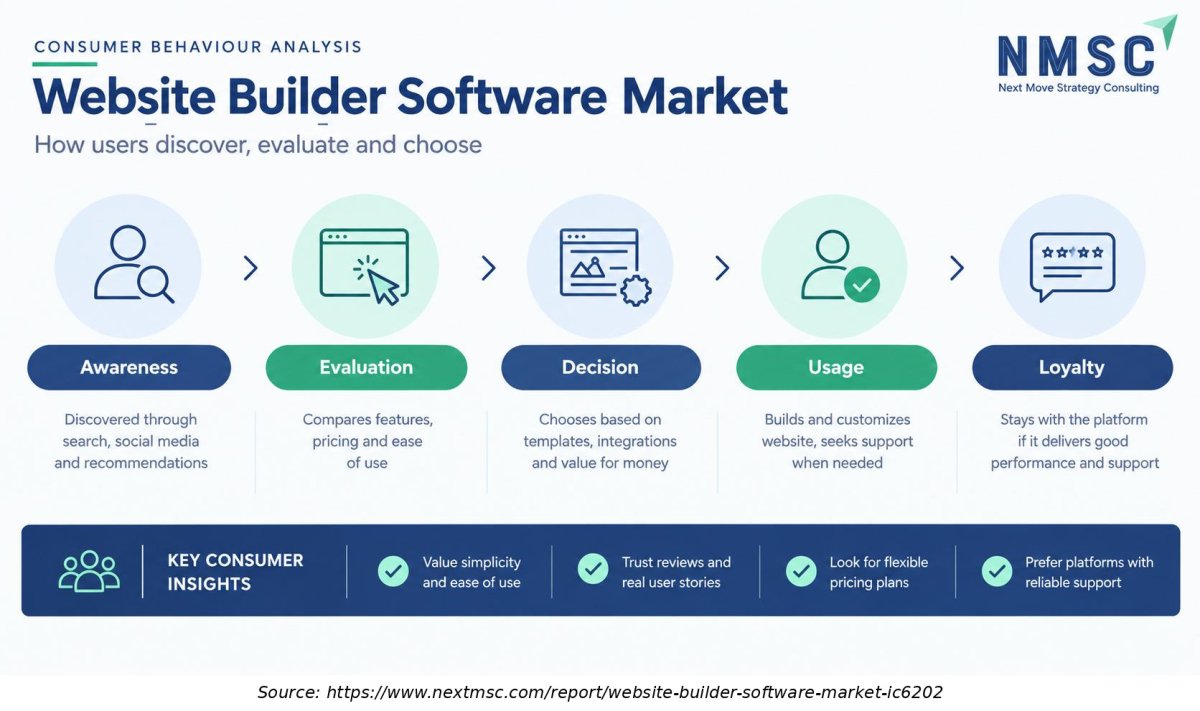
The above infographic provides a detailed consumer behavior analysis of the website builder software market, mapping out the five-stage journey from awareness to loyalty. It illustrates how users discover platforms through search and social media, evaluate them based on ease of use, and make decisions heavily influenced by pricing and value. The analysis further highlights key consumer insights, noting that users prioritize simplicity, trust real user reviews, and seek flexible pricing plans with reliable support. Ultimately, it demonstrates that delivering strong performance and ongoing support is essential for retaining customers and building long-term loyalty.

Latest Developments

We observed that recent company disclosures confirm AI and commerce as the main areas of commercial momentum.

Date Event
October 2026 Shopify launched Canvas, a visual workspace that enables merchants to design entire online stores with Shopify’s Sidekick AI agent.
September 2026 WordPress.com upgraded its AI website builder to generate custom themes on Premium and Business plans.
June 2026 Framer introduced Framer 3.0, featuring AI agents for designing, writing, analyzing, and organizing websites.

Expert Insights

Itai Sadan

Itai Sadan

Co-founder and CEO | Duda

"AI makes it easier to create a starting point, but businesses will continue to rely on agencies to deliver secure, high-performing websites that are easily found by LLMs and drive results."

Analyst Interpretation

The statement highlights a shift in website builder software from basic site creation toward integrated platforms that support performance, security, search visibility, customization, and business outcomes. As AI reduces the effort required to generate initial website designs, competitive differentiation increasingly depends on the capabilities that take a website from a draft to a reliable, discoverable, business-ready digital presence. This strengthens the value proposition of platforms that combine AI-assisted creation with professional-grade infrastructure and management tools.

Investment Opportunities

Where Is Capital Flowing in the Website Builder Software Market?

Capital is flowing toward AI generation, commerce infrastructure and partner ecosystems. Listed vendors are funding product development and buybacks from strong cash generation, with GoDaddy describing substantial share buybacks alongside its AI investment. Private capital targets AI first entrants, and we estimate that ecommerce and services receive the largest share of incremental investment through 2035.

What Infrastructure Investments Support Platform Growth?

Infrastructure spending centers on compute for AI inference, regional hosting and payment processing. IONOS positions sovereign European cloud capacity beside its web presence offering, while Hostinger integrates hosting with its Horizons builder. We estimate that AI inference compute is a rising cost line, so efficiency gains from proprietary models are a priority. Investors should favor vendors that control hosting, data and payments.

How Do ESG Considerations Influence Investment in the Market?

ESG factors center on accessibility, data privacy and energy efficient hosting. Platforms that bake accessibility checks into templates reduce legal exposure for small business customers, and regional data hosting supports privacy compliance. AI compute raises energy intensity, which increases scrutiny of data center sourcing. We found that vendors with transparent privacy practices gain trust among enterprise buyers and agencies.

Key Benefits for Stakeholders

How Does the Report Benefit Enterprise and Industry Leaders?

Enterprise and industry leaders gain a segment level view of demand across offerings, applications and end users, with forecasts to 2035. The analysis clarifies where large enterprises, growing at 21.5% CAGR, adopt composable platforms, and which services reduce time to launch. Leaders can use the regional and country outlook to prioritize localization and partner investments in the Website Builder Software Market.

How Does the Report Benefit Investors and Financial Analysts?

Investors and financial analysts receive a reconciled sizing framework that ties USD 11.57 Billion in 2025 to USD 79.58 Billion in 2035. The risk matrix quantifies drivers and restraints in percentage points of CAGR, helping to stress test valuation cases. Regional growth differences, led by Asia-Pacific at 21.6% CAGR, highlight where incremental revenue is likely to be concentrated.

How Does the Report Benefit Technology Vendors and Product Teams?

Technology vendors and product teams can benchmark their roadmaps against the main trends in AI generation, agentic management and integrated commerce. The competitive section outlines archetypes and differentiation themes, while the segment analysis shows which applications grow fastest. Product leaders can align pricing, onboarding and service bundles with customer groups that are expanding most quickly.

Key Market Segments Evaluated

By Offering

  • Software platform
  • Services

By Application

  • Business and corporate websites
  • Ecommerce and online stores
  • Portfolios and blogs
  • Landing pages and campaign sites

By End user

  • Small and medium enterprises
  • Large enterprises
  • Individuals and freelancers

By Region

  • North America 
    • U.S.
    • Canada
    • Mexico.
  • Europe 
    • UK
    • Germany
    • France
    • Italy
    • Spain
    • Sweden
    • Denmark
    • Finland
    • Netherlands
    • Rest of Europe.
  • Asia-Pacific 
    • China
    • India
    • Japan
    • South Korea
    • Taiwan
    • Indonesia
    • Vietnam
    • Australia
    • Philippines
    • Malaysia
    • Rest of APAC.
  • Middle East & Africa 
    • Saudi Arabia
    • UAE
    • Egypt
    • Israel
    • Turkey
    • Nigeria
    • South Africa
    • Rest of MEA.
  • Latin America 
    • Brazil
    • Argentina
    • Chile
    • Colombia
    • Rest of LATAM

Conclusion & Recommendations

NMSC's analysis indicates that the market will grow from USD 18.37 Billion in 2026 to USD 79.58 Billion by 2035, with momentum shifting from software seats toward services, commerce and managed outcomes. Asia-Pacific is projected to overtake North America in value by the end of the period. Growth will remain durable as small business digitalization continues and AI shortens the path to launch.

What Strategic Positioning Recommendations Does NMSC Offer?

We recommend that vendors anchor positioning on outcomes rather than editors. Bundle commerce, payments, hosting and agentic management into a single subscription, and invest in localization for Asia-Pacific, the Middle East and Latin America. Build partner programs for agencies, which supply recurring seats. Platforms should also expose AI generation through transparent pricing to avoid margin erosion from compute costs.

What Does Investment Attractiveness Look Like in the Market?

Our assessment indicates high investment attractiveness, supported by a USD 61.21 Billion revenue opportunity between 2026 and 2035. The most attractive pockets are ecommerce and online stores at 20.1% CAGR, services at 20.9% CAGR and large enterprises at 21.5% CAGR. Vendors with installed customer bases, integrated payments and efficient AI inference are best placed to convert growth into profit.

What Are the Market Shifts and Key Risks to Watch Through 2035?

We observed that the main shifts are the move from tools to agents, the rise of commerce native platforms and regional diversification. Key risks include price competition, margin pressure from AI compute, regulatory compliance costs and lock in concerns that slow customer switching. Search behavior changes driven by large language models may also alter how new customers discover builders.

What Are the Primary Growth Pathways Through 2035?

Our findings suggest four growth pathways. First, convert free users into paying subscribers through services bundles. Second, expand ecommerce functionality and payments. Third, scale partner channels with agencies and developers. Fourth, localize aggressively in Asia-Pacific, which grows at 21.6% CAGR. Vendors that execute across these pathways can outpace the 17.7% market growth rate.

FAQs

Sources & References

1.

Wix.com Ltd., Form 6-K, Second Quarter 2026 Results (U.S. SEC)

sec.gov
2.

GoDaddy Inc., Form 8-K, Second Quarter 2026 Results (U.S. SEC)

sec.gov
3.

GoDaddy Inc., Form 10-Q, Quarter Ended June 30, 2026 (U.S. SEC)

sec.gov
4.

Shopify Inc., Form 10-Q, Quarter Ended June 30, 2026 (U.S. SEC)

sec.gov
5.

IONOS Group SE, Half Year 2026 Results Release

ionos-group.com
6.

IONOS Group SE, First Quarter 2026 Announcement

ionos-group.com
7.

Hostinger, What's New at Hostinger: 2026 Product Updates

hostinger.com/blog
8.

U.S. Census Bureau, Quarterly Retail E-Commerce Sales

census.gov

About the Author

Mayurima Roy

Mayurima Roy

Mayurima Roy is Research Analyst at Next Move Strategy Consulting, where she has spent 4 years working across the firm's full industry coverage rather than a single fixed vertical. Her work centers on structured research, ongoing trend tracking, competitive assessment, and insight-led content development, translating complex market data into clear, decision-ready narratives that support informed client decision-making across diverse global industries, market sectors, and world regions every day.

About the Reviewer

Supradip Baul

Supradip Baul

Supradip Baul is an accomplished business consultant and strategist with over a decade of rich experience in market intelligence, strategy, technology, and business transformation. His work has included rigorous qualitative and quantitative analysis across multiple industries, helping clients shape investment decisions and long-term roadmaps. Earlier in his career, he was associated with Gartner, where he contributed to industry-leading reports and market share analyses. He has worked with leading global companies and holds an MBA with a dual specialization in Marketing and Finance.

Download Free Sample

Melanie Samko

MELANIE SAMKO

Director of Marketing

TOSOH BIOSCIENCE, INC.

The information provided by NMSC is incredibly valuable, thank you so much for such a excellent work. I really appreciate it. I will make sure to reference all of it, in my summary document.

Kishu Kanda

KISHU KANDA

Strategy Analyst

Accenture

We purchased the AI Consumer Market Report from this company. Not only did they customize the report to meet our specific requirements, but they also showed great flexibility in accommodating our budget. The report we received fully met our expectations. Additionally, they provided prompt and thorough responses to both our pre-purchase and follow-up questions. We look forward to working with this company again in the future.

Pratyush Kumar Das

PRATYUSH KUMAR DAS

Assistant Manager

Polycab India Limited

We would like to express our appreciation for the data and insights provided by nextmsc. We are very pleased with the quality and depth of the information, which has proven to be highly valuable and beneficial for our business decision-making.

Robert Sean Trevino

ROBERT SEAN TREVINO

Sr. Director, Head of Strategic Insights & Analytics

Foundation Medicine

I realized that it was a reliable source of information. These days, there are many people who are looking for authentic data, and this is one of the only sources that can offer them with what they need;

Gaurav Jaiswal

GAURAV JAISWAL

Founder & CEO

Yano Charge Private Limited

The EV Charging market research report provided by the NextMSC was exceptionally detailed and insightful. It offered a comprehensive analysis that proved to be a game-changer for our strategic planning. Truly a testament to the NextMSC’s expertise and thoroughness in EV market landscape & analysis.

Custom Market Research Services

We will customize the research for you if the listed report does not fully match your requirements.

Get 30% Free Customization

Select License

This website uses cookies to ensure you get the best experience on our website. Learn more

✖