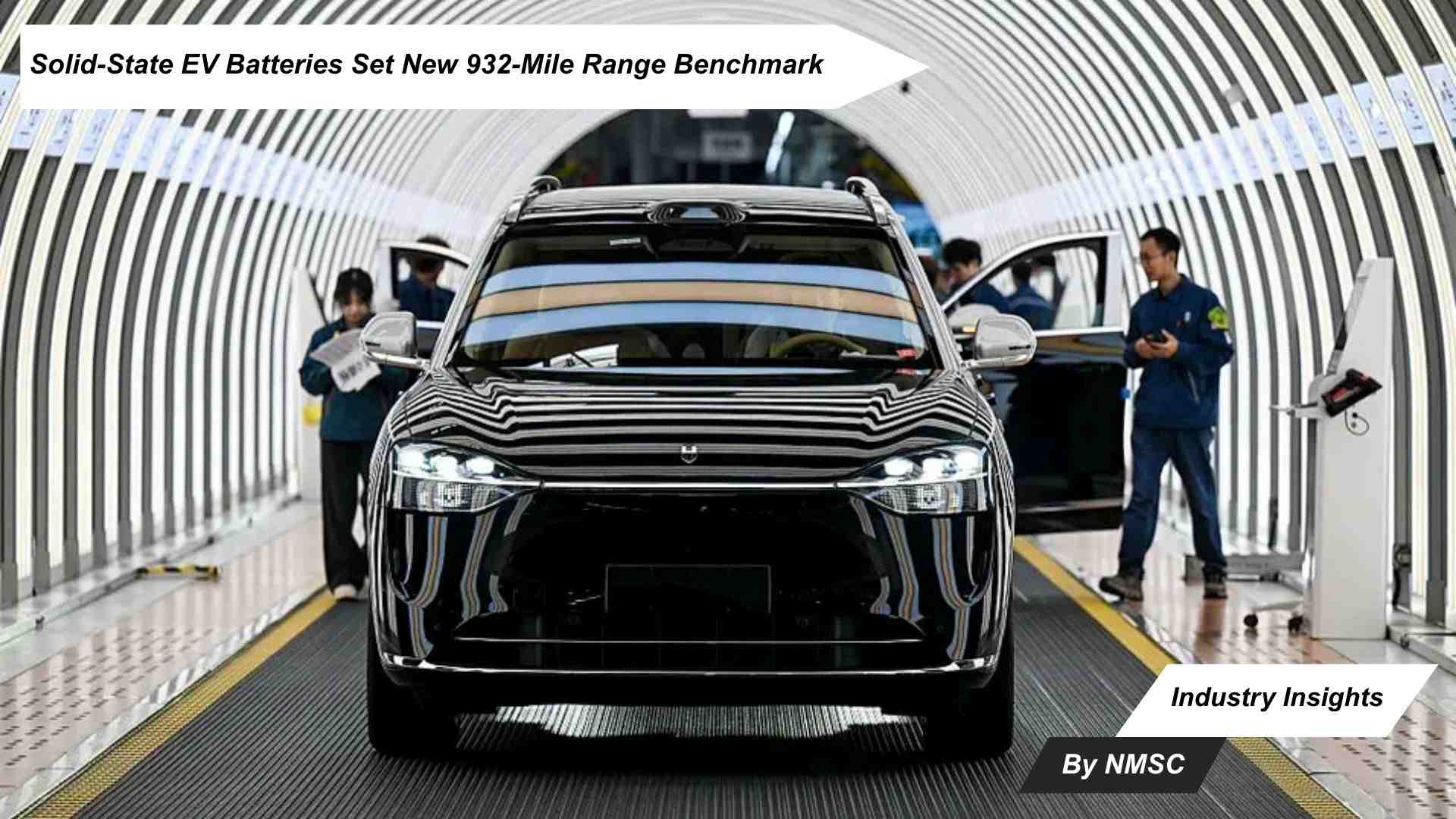
Solid-State EV Batteries Set New 932-Mile Range Benchmark
Industry Insights from Next Move Strategy Consulting
As the global automotive industry intensifies its shift toward electrification, the unveiling of advanced solid-state electric vehicle (EV) batteries marks a pivotal moment in battery innovation. With automakers reporting potential driving ranges of up to 932 miles, the latest developments signal a transformative leap in performance, safety, and efficiency positioning solid-state technology as a cornerstone of the future EV ecosystem.
A Breakthrough in Battery Innovation
Leading automakers are accelerating efforts to commercialize solid-state and semi-solid battery technologies, moving beyond the limitations of conventional lithium-ion systems. Chinese manufacturers, including Dongfeng Motors, Chery, and Changan Automobile, are at the forefront of this transition, actively conducting trials on high-capacity battery packs designed to redefine EV performance standards.
Dongfeng has initiated testing of its 620-mile battery under extreme cold conditions, demonstrating durability across challenging environments. Meanwhile, Chery’s Rhino-series battery aims to deliver an industry-leading range of up to 932 miles, with production targeted as early as next year. Changan is also advancing its Golden Bell all-solid battery, which offers comparable range capabilities and is scheduled for in-vehicle testing later this year.
These developments reflect a broader industry push toward achieving longer driving ranges and accelerating the transition to mass-market EV adoption.
Why Solid-State Batteries Could Transform the EV Market
Solid-state batteries represent a fundamental shift in battery architecture. By replacing flammable liquid electrolytes with solid materials, these systems offer enhanced safety, reduced fire risk, and improved structural stability.
In addition to safety benefits, solid-state batteries are lighter and capable of significantly faster charging, addressing two of the most critical barriers to widespread EV adoption. The improved energy density enables vehicles to travel much farther on a single charge, while also contributing to potential cost reductions over time as the technology matures.
Complementing these technological advancements, China is introducing a nationwide battery traceability system alongside a structured recycling infrastructure. This initiative aims to ensure responsible end-of-life battery management and establish a more circular and sustainable supply chain for next-generation EV batteries.
Industry and Policy Dynamics Shape Competition
The race to dominate solid-state battery technology is not limited to technological innovation alone it is also influenced by global trade dynamics and policy frameworks. Chinese manufacturers currently account for a significant share of global lithium-ion battery production, yet regulatory and trade policies have restricted the widespread entry of their EV technologies into markets such as the United States.
Recent discussions between automotive and political leaders suggest the possibility of selective market access under strategic conditions, highlighting the growing intersection of geopolitics and clean energy technologies.
At the same time, collaborations between technology firms and automakers are accelerating innovation across regions. For instance, Boston-based Factorial is working alongside Mercedes-Benz on advanced battery prototypes, while new EV concepts showcased at the 2026 New York Auto Show underscore the competitive momentum across global markets.
Path to Commercialization
Despite promising advancements, the journey toward large-scale deployment of solid-state batteries remains complex. Chery plans to validate and begin production of its Rhino-series batteries next year, while Changan’s Golden Bell battery will undergo in-car testing within the same timeframe.
Factorial has already demonstrated a 745-mile battery in a modified Mercedes EQS, offering a glimpse into the near-term feasibility of high-range EVs. However, scaling production continues to present challenges, particularly in terms of manufacturing complexity and cost efficiency.
Regulatory developments, including China’s battery recycling mandates and traceability requirements, are expected to play a crucial role in shaping how quickly these technologies can be adopted on a global scale.
Next Move Strategy Consulting’s View
According to Next Move Strategy Consulting, the rapid advancements in solid-state battery technology are poised to redefine the competitive landscape of the Electric Vehicle Battery Market. The transition toward safer, higher-capacity, and faster-charging batteries is expected to accelerate EV adoption while driving long-term innovation across the automotive value chain.
The firm highlights that sustainability initiatives, such as battery recycling systems and traceability frameworks, will be critical in supporting the scalability of next-generation batteries. Furthermore, increasing collaboration between automakers and technology developers is likely to shorten development cycles and enhance commercialization prospects.
Redefining the Future of Electric Mobility
The emergence of solid-state EV batteries represents more than a technological upgrade it signals a paradigm shift in how energy is stored, managed, and utilized within electric vehicles. With extended driving ranges, improved safety, and evolving policy support, these batteries have the potential to address longstanding challenges in the EV market.
As automakers continue to refine and scale these innovations, solid-state technology is set to become a defining force in the next era of electric mobility bringing the industry closer to a future where high-performance, long-range EVs are accessible to the mass market.
Source: MSN
Prepared By: Next Move Strategy Consulting
About the Author
 Sanyukta Deb
— Sanyukta Deb is Digital Marketing Team Lead at Next Move Strategy Consulting, where she has led content strategy and technical SEO for the firm's B2B market research publications for over 2 years. Her editorial process translates NextMSC's primary and secondary research — spanning technology, industrial, and consumer sectors — into commercial narratives, backed by search-intent, keyword, and competitive analysis. She brings 5 years of overall experience in digital marketing and content strategy.
Sanyukta Deb
— Sanyukta Deb is Digital Marketing Team Lead at Next Move Strategy Consulting, where she has led content strategy and technical SEO for the firm's B2B market research publications for over 2 years. Her editorial process translates NextMSC's primary and secondary research — spanning technology, industrial, and consumer sectors — into commercial narratives, backed by search-intent, keyword, and competitive analysis. She brings 5 years of overall experience in digital marketing and content strategy.
About the Reviewer
 Debashree Dey
— Debashree Dey is Assistant Manager at Next Move Strategy Consulting, where she supports cross-vertical market content and communications across diverse industries for 6 years. Her professional background includes senior content writing, communications, and published manuscript authorship, with experience developing audience-focused business narratives and maintaining clear, consistent messaging. Her role supports research-led content development and editorial quality across NextMSC publications.
Debashree Dey
— Debashree Dey is Assistant Manager at Next Move Strategy Consulting, where she supports cross-vertical market content and communications across diverse industries for 6 years. Her professional background includes senior content writing, communications, and published manuscript authorship, with experience developing audience-focused business narratives and maintaining clear, consistent messaging. Her role supports research-led content development and editorial quality across NextMSC publications.

















Add Comment