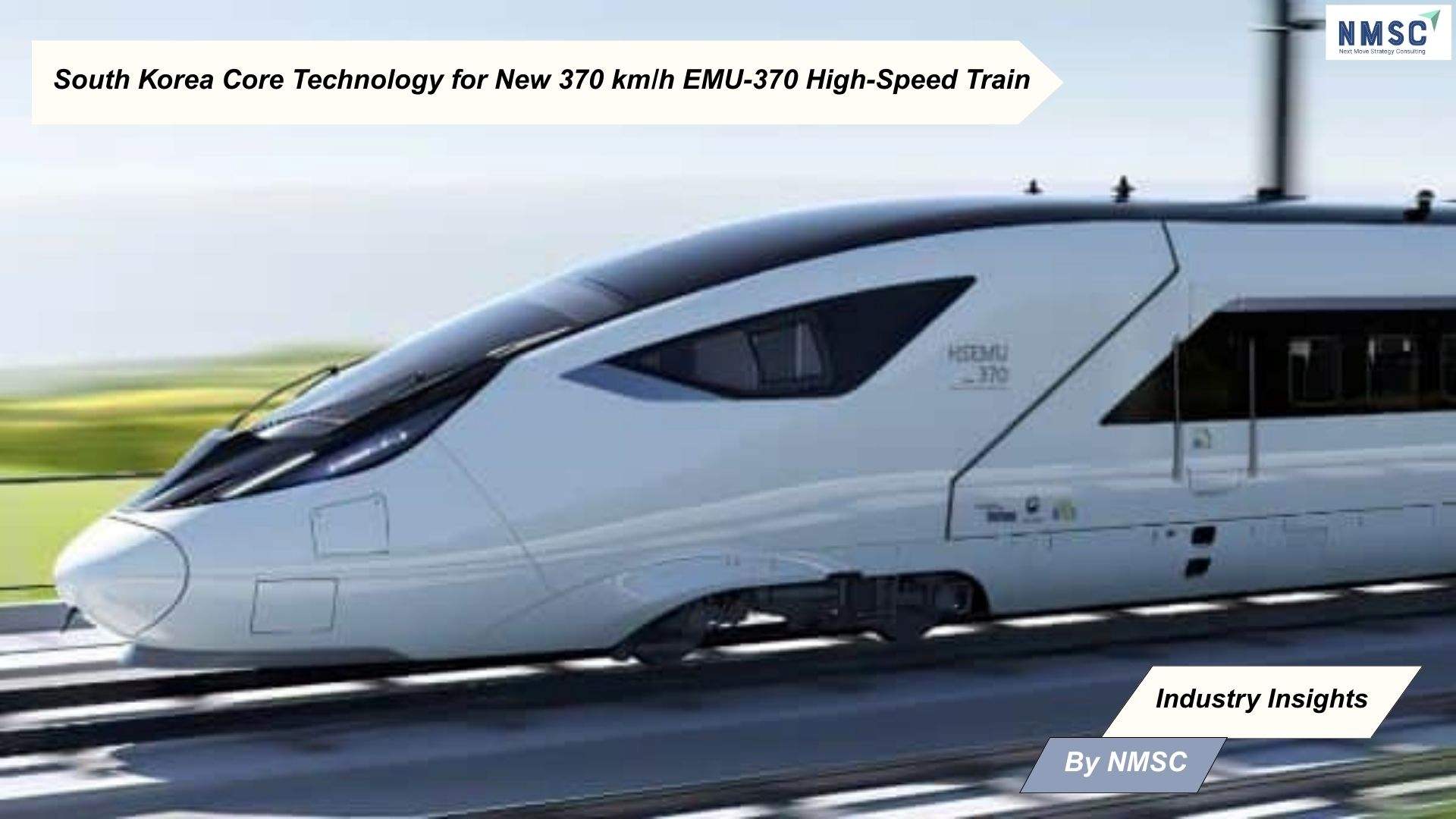
South Korea Core Technology for New 370 km/h EMU-370 High-Speed Train
Industry Insights from Next Move Strategy Consulting
South Korea's completion of core technologies for its next-generation EMU-370 high-speed train represents a pivotal development with significant implications for the global bullet train market. According to an announcement from the Ministry of Land, Infrastructure and Transport (MOLIT), this achievement advances the country's position in an increasingly competitive sector defined by technological sovereignty and export potential.
Advancing High-Speed Rail Performance
The new train, designated EMU-370, builds directly upon the technology of the current KTX-Cheongryong (EMU-320), which operates at up to 320 km/h. The four-year R&D project, which ran from April 2022 to December 2025, specifically targeted the technical challenges of operating at higher speeds, such as increased aerodynamic resistance, vibration, and noise. The programme was led by the Korea Railroad Research Institute and involved seven organizations from the public and private sectors, with a total investment of 22.5 billion KRW.
Key Technological Developments
The project successfully developed six core technologies that enable the enhanced performance of the EMU-370:
-
Increased Propulsion Power: A new 560 kW traction motor provides a 47.4% increase in output compared to the 380 kW motors of the EMU-320. Each eight-car trainset will be equipped with 24 of these motors.
-
Enhanced Aerodynamics: Modifications to the train's nose shape, the addition of bogie covers, and reduced rooftop equipment have lowered the aerodynamic drag coefficient by 12.3%.
-
Improved Ride Stability: Optimization of the suspension system has reduced lateral vibration acceleration to below 6 m/s², confirming dynamic stability at speeds over 400 km/h in tests.
-
Reduced Interior Noise: The use of optimized body structures and composite sound insulation materials has lowered cabin noise levels by approximately 2 dB compared to the EMU-320.
-
Localized Component Production: The project achieved the localization of airtight passenger doors for high-speed operation, reducing reliance on imported parts.
-
New Performance Standards: The programme developed performance evaluation and safety verification criteria for trains operating at speeds up to 400 km/h, addressing a gap in existing European technical standards.
Path to Implementation
With core technology development complete, the project now moves toward manufacturing and testing. Korea Railroad Corporation (Korail) is expected to order the first one to two trainsets, totaling 16 cars, in the first half of 2026. Production will begin that same year, with test operations on designated sections of line, such as the Pyeongtaek–Osong corridor, scheduled to commence in early 2030.
According to Next Move Strategy Consulting, the completion of the EMU-370's core technology represents a significant milestone in South Korea's strategic positioning within the global high-value rail industry. This sovereign capability in ultra-high-speed train development not only enhances domestic infrastructure but also creates a potential new export sector in advanced railway systems and components. The project demonstrates how targeted national R&D can build competitive industrial advantage in a technologically intensive market.
Conclusion
The successful development of the EMU-370's core systems marks a concrete step in South Korea's rail technology progression. By achieving key performance enhancements and localizing critical components, the programme strengthens the country's industrial base and prepares for the next phase of its high-speed rail network.
Source: Railway News
Prepared by: Next Move Strategy Consulting
About the Author
 Sanyukta Deb
— Sanyukta Deb is Digital Marketing Team Lead at Next Move Strategy Consulting, where she has led content strategy and technical SEO for the firm's B2B market research publications for over 2 years. Her editorial process translates NextMSC's primary and secondary research — spanning technology, industrial, and consumer sectors — into commercial narratives, backed by search-intent, keyword, and competitive analysis. She brings 5 years of overall experience in digital marketing and content strategy.
Sanyukta Deb
— Sanyukta Deb is Digital Marketing Team Lead at Next Move Strategy Consulting, where she has led content strategy and technical SEO for the firm's B2B market research publications for over 2 years. Her editorial process translates NextMSC's primary and secondary research — spanning technology, industrial, and consumer sectors — into commercial narratives, backed by search-intent, keyword, and competitive analysis. She brings 5 years of overall experience in digital marketing and content strategy.
About the Reviewer
 Debashree Dey
— Debashree Dey is Assistant Manager at Next Move Strategy Consulting, where she supports cross-vertical market content and communications across diverse industries for 6 years. Her professional background includes senior content writing, communications, and published manuscript authorship, with experience developing audience-focused business narratives and maintaining clear, consistent messaging. Her role supports research-led content development and editorial quality across NextMSC publications.
Debashree Dey
— Debashree Dey is Assistant Manager at Next Move Strategy Consulting, where she supports cross-vertical market content and communications across diverse industries for 6 years. Her professional background includes senior content writing, communications, and published manuscript authorship, with experience developing audience-focused business narratives and maintaining clear, consistent messaging. Her role supports research-led content development and editorial quality across NextMSC publications.

















Add Comment