SSE’s Cyberhawk Deal Shows Autonomous Grid Inspection Moving Past Pilots

Ondas Unit Wins Three-Year SSEN Inspection Contract as Near-USD 550 Billion Grid Spending and a Pending U.S. Beyond-Visual-Line-of-Sight Rule Reshape Utility Budgets
On September 28, 2026, Ondas Inc. announced that its subsidiary Cyberhawk had secured a new three-year agreement, with an option to extend for two further years, to provide drone inspection and surveying services across the British electricity networks of SSEN Transmission and SSEN Distribution, the regulated networks businesses of SSE plc. The award includes Lot 2 for offshore wind turbine inspection and sits alongside a separate renewal of Cyberhawk’s iHawk as a Service data agreement with SSE. It is the third long-term contract between the two companies after two earlier five-year agreements, which shows a utility buying inspection as a recurring multi-year service backed by a data platform rather than as a sequence of pilot flights.
According to Next Move Strategy Consulting’s Autonomous Grid Inspection Market report, the global autonomous grid inspection market was valued at USD 1.10 billion in 2025 and is projected to reach USD 6.20 billion by 2035, growing at a CAGR of 18.8% from 2026 to 2035. NextMSC primary research and analysis puts the 2026 value at USD 1.32 billion and identifies North America as the largest region, valued at USD 0.41 billion in 2025, which is about 37% of global revenue.
For More Information: Download FREE Sample on Autonomous Grid Inspection Market Report
The Financial Logic: Grid Capital Spending Is Outrunning Crew Capacity
The budget behind the Cyberhawk award is large and still rising. The International Energy Agency’s World Energy Investment 2026 report, released on May 28, 2026, projects that spending on electricity grids will approach USD 550 billion in 2026, up nearly 20% year on year, within nearly USD 1.6 trillion of investment in electricity supply and infrastructure. A larger and younger asset base multiplies the number of towers, spans and substations that need a condition record, while utilities cannot add line crews at the same pace as capital programmes, so inspection that runs on schedule without a climb or a helicopter sortie becomes the practical way to widen coverage inside a fixed operating budget.
Global energy investment by segment, IEA projections for 2026
|
Investment segment |
2026 investment as published by the IEA |
IEA note |
|
Electricity grids |
Approaching USD 550 billion |
Up nearly 20% year on year |
|
Renewable power |
Around USD 665 billion |
USD 365 billion of this is solar |
|
Natural gas |
USD 330 billion |
Highest level in a decade |
|
Coal |
USD 180 billion |
Highest level since 2012 |
|
Energy efficiency |
Around USD 350 billion |
Invested worldwide each year |
|
Battery storage |
More than USD 100 billion |
Battery energy storage investment |
|
Nuclear |
More than USD 80 billion |
Close to 80 GW under construction in 15 countries |
|
Oil |
Below USD 500 billion |
Third consecutive annual decline |
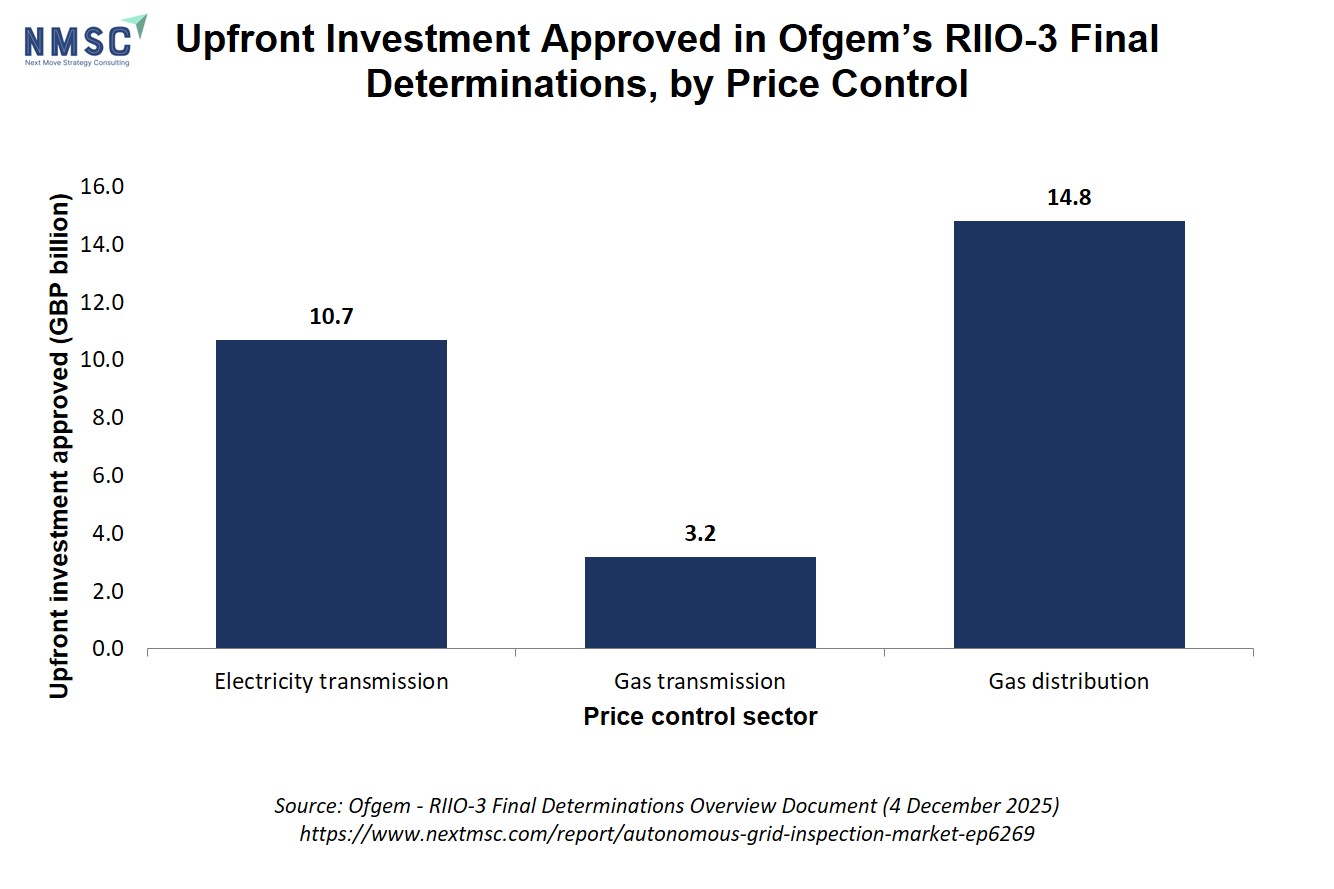
The regulated network model shows the same pattern at national scale. In its RIIO-3 Final Determinations Overview Document of December 4, 2025, Ofgem approved GBP 28.7 billion of upfront investment across electricity transmission, gas transmission and gas distribution for the five-year period from April 1, 2026 to March 31, 2031. Electricity transmission received GBP 10.7 billion of that baseline funding, and Ofgem stated that more than GBP 70 billion of electricity transmission investment may be required across the period, of which at least GBP 44 billion is already committed. SSE, whose networks Cyberhawk will now inspect, plans to invest GBP 33 billion in energy infrastructure by 2030, according to the Ondas announcement.
Key Industry Developments: Contracts, Platforms and Docks
Cyberhawk’s SSE award bundles field services with a data layer. Ondas described iHawk as a system of record that aggregates imagery, geospatial information and AI-assisted analytics into an asset-centred view supporting risk prioritisation and workflow management. The pairing matters commercially because a multi-year service contract and a platform renewal with the same customer lock in two revenue streams at once.
“…a strong testament to the value and trust we have built together.”
- Chris Fleming, Chief Executive Officer, Cyberhawk, Ondas Inc. press release, September 28, 2026.
Percepto announced on June 22, 2026 a next-generation inspection intelligence platform for energy infrastructure that combines its Percepto Air drones, onboard autonomy, contextual AI, AIM asset intelligence and managed remote operations. The company positioned the launch as a response to rising inspection demand and limited access to experienced field expertise. DJI had earlier introduced Dock 3 on February 27, 2025, its first vehicle-mountable drone-in-a-box system for 24/7 remote operations, with an optional obstacle sensing module aimed at 12 mm power-grid line wires and complex substation layouts.
The Regulatory Gate: Part 108 Remains Under White House Review
In the United States, routine beyond-visual-line-of-sight flight depends on a rule that has not yet been issued. Reginfo.gov, the federal regulatory review register run by the U.S. General Services Administration and the Office of Management and Budget, lists the Federal Aviation Administration’s final rule, Normalizing Unmanned Aircraft Systems Beyond Visual Line of Sight Operations (RIN 2120-AL82), as received on July 10, 2026 with a status of Pending Review and no concluded date recorded as of November 16, 2026. The agency’s own abstract describes performance-based regulations for low-altitude operations, including aerial surveying and the traffic management services that support them. NextMSC primary research and analysis notes that, until the final text is published, operators continue to rely on waivers and exemptions, which keeps approval timelines uneven across utilities.
Part 108 rulemaking record, RIN 2120-AL82
|
Date |
Milestone |
Record |
|
August 7, 2025 |
Proposed rule published |
90 FR 38212 |
|
October 6, 2025 |
Public comment period ended |
Unified Agenda entry |
|
January 16, 2026 |
Statutory final-rule deadline listed |
Unified Agenda entry |
|
July 2026 |
Final-rule date targeted by the agency |
Unified Agenda entry |
|
July 10, 2026 |
Final rule received for executive order review |
EO review record |
|
November 16, 2026 |
Status shown: Pending Review, no concluded date |
EO review record |
Segment Dynamics: Analytics Software Outgrows Hardware
NextMSC primary research and analysis shows autonomous drone systems as the largest offering, rising from USD 0.49 billion in 2025 to USD 2.45 billion by 2035. AI inspection analytics software is the fastest-growing offering at a 22.7% CAGR over 2026 to 2035, moving from USD 0.25 billion to USD 1.95 billion. Inspection as a service grows from USD 0.28 billion to USD 1.25 billion, and ground and crawler robots from USD 0.08 billion to USD 0.55 billion. NextMSC’s figures imply analytics software expands 7.8-fold across the decade against five-fold for drone systems, which is the same direction as the SSE contract: the customer is renewing the data platform alongside the flights.
Regional Outlook: North America Leads, Middle East & Africa Grows Fastest
NextMSC primary research and analysis values North America at USD 0.41 billion in 2025, rising to USD 2.05 billion by 2035. Europe is projected to grow from USD 0.28 billion to USD 1.45 billion at a 17.9% CAGR, and Asia-Pacific from USD 0.27 billion to USD 1.80 billion at 20.7%. Middle East & Africa is the fastest-growing region at 22.3%, rising from USD 0.07 billion to USD 0.55 billion, while Latin America moves from USD 0.07 billion to USD 0.35 billion at 17.8%. At country level, NextMSC values the UK at USD 0.06 billion in 2025 and USD 0.33 billion by 2035, and identifies India as the fastest-growing country at a 24.5% CAGR, from USD 0.04 billion to USD 0.36 billion.
Growth Drivers and Restraints
Two externally documented drivers stand out. The first is capital: the International Energy Agency’s projection of grid spending approaching USD 550 billion and Ofgem’s GBP 10.7 billion electricity transmission baseline both enlarge the asset base that utilities must inspect. The second is contract structure: the SSE award runs three years with a two-year extension option, giving the vendor visibility that a one-off pilot cannot provide.
The restraints are also documented. The first is the unpublished Part 108 rule, which leaves U.S. operators on case-by-case approvals. The second is financing cost. The International Energy Agency warned in the same report that the Middle East conflict has pushed up long-term financing costs, which could disproportionately affect capital-intensive energy technologies, particularly in emerging and developing economies. NextMSC primary research and analysis reads this as a point in favour of subscription inspection services, because a utility that rents an outcome carries less up-front capital than one that buys docks and fleets.
NMSC Strategic Perspective: Utilities Are Buying Outcomes, Not Aircraft
NextMSC primary research and analysis draws three conclusions from the evidence assembled above. First, the unit of purchase is shifting from aircraft to outcomes. SSE’s decision to pair a three-year inspection contract with a renewed data-platform agreement is consistent with NextMSC’s view that inspection as a service and AI analytics together reach USD 3.20 billion by 2035, which is 52% of the USD 6.20 billion forecast and above the USD 2.45 billion forecast for drone systems alone.
Second, hardware vendors face margin pressure while analytics vendors gain pricing power. When the same customer renews both field services and analytics, the differentiator becomes the accuracy of defect classification and the integration with the asset register, not airframe specifications. Vendors that bundle docks, aircraft and analytics under one subscription are better placed than those selling aircraft alone.
Third, regulation is the swing factor for North America and the gating item for scale. A published Part 108 rule would let docked remote operations move from waiver-based approvals to a standard pathway, and NextMSC expects that to pull forward distribution-feeder programmes, where feeders far outnumber transmission lines. Europe, where the UK Civil Aviation Authority and its peers approve complex operations case by case, is advancing through standards-led contracts of the kind SSE has just signed.
Competitive Landscape
NextMSC profiles five companies in its report: Skydio, Inc., SZ DJI Technology Co., Ltd., Percepto Robotics Ltd., eSmart Systems AS and Cyberhawk Innovations Limited. The three documented events in this article show the competitive axes. Cyberhawk competes through engineering-led services and the iHawk platform, as the SSE award confirms. Percepto competes by bundling docks with an inspection intelligence platform and managed remote operations, per its June 22, 2026 announcement. DJI competes on dock hardware and sensing, as its February 27, 2025 Dock 3 launch shows. Alliances are more common than acquisitions at present, and NextMSC expects consolidation to follow once the U.S. beyond-visual-line-of-sight rule is published.
Bottom Line
The Cyberhawk award from SSE shows where autonomous grid inspection is heading: multi-year service contracts bundled with data platforms, funded from grid budgets that the International Energy Agency expects to approach USD 550 billion in 2026. Next Move Strategy Consulting’s forecast of USD 1.10 billion in 2025 rising to USD 6.20 billion by 2035 reflects that shift, with AI inspection analytics software growing fastest at a 22.7% CAGR and inspection as a service scaling alongside it. The main near-term swing factor is regulatory: the FAA’s beyond-visual-line-of-sight final rule has been under White House review since July 10, 2026, so U.S. operators still depend on case-by-case approvals. Vendors that can show regulatory readiness, utility references and analytics depth are better placed than those competing on airframes alone. Utilities should treat docked drone pilots at substations and multi-year inspection contracts as the practical path while the rulemaking concludes.
About Next Move Strategy Consulting
Next Move Strategy Consulting is a premier market research and management consulting firm that has been committed to provide strategically analysed well documented latest research reports to its clients. The research industry is flooded with many firms to choose from, what makes NMSC different from the rest is its top-quality research and the obsession of turning data into knowledge by dissecting every bit of it and providing fact-based research recommendation that is supported by information collected from over 500 million websites, paid databases, industry journals and one on one consultations with industry experts across a diverse range of industry sectors. The high-quality customized research reports with actionable insights and excellent end-to-end customer service help our clients to take critical business decisions that enables them to move beyond time and have competitive edge in the industry.
We have been servicing over 1000 customers globally that includes 90% of the Fortune 500 companies over a decade. Our analysts are constantly tracking various high growth markets and identifying hidden opportunities in each sector or the industry. We provide one of the industry’s best quality syndicate as well as custom research reports across 10 different industry verticals. We are committed to deliver high quality research solutions in accordance to your business needs. Our industry standard delivery solutions that ranges from the pre consultation to after-sales services, provide an excellent client experience and ensure right strategic decision making for businesses.
For more information, please contact:
Next Move Strategy Consulting
5th Floor 867 Boylston St, STE 500,
Boston, MA 02116, U.S.
E-Mail: [email protected]
Direct: +1-217-650-7991
Website: www.nextmsc.com
About the Author
 Sanyukta Deb
— Sanyukta Deb is Digital Marketing Team Lead at Next Move Strategy Consulting, where she has led content strategy and technical SEO for the firm's B2B market research publications for over 2 years. Her editorial process translates NextMSC's primary and secondary research — spanning technology, industrial, and consumer sectors — into commercial narratives, backed by search-intent, keyword, and competitive analysis. She brings 5 years of overall experience in digital marketing and content strategy.
About the Reviewer
 Debashree Dey
— Debashree Dey is Assistant Manager at Next Move Strategy Consulting, where she supports cross-vertical market content and communications across diverse industries for 6 years. Her professional background includes senior content writing, communications, and published manuscript authorship, with experience developing audience-focused business narratives and maintaining clear, consistent messaging. Her role supports research-led content development and editorial quality across NextMSC publications.

















Add Comment