Autonomous Grid Inspection Market Analysis and Forecast (2026–2035)

Autonomous Grid Inspection Market size is USD 1.10 Billion in 2025 and is forecast to climb to USD 6.20 Billion by 2035 at an 18.8% CAGR over 2026–2035, led by North America as grid capital spending, ageing line assets and docked drone programs expand.

Download Free Sample PDF
Base Year (2025)
$1.10 Billion
Forecast (2035)
$6.20 Billion
CAGR (2026-2035)
18.8%
Top Region
North America

What Is the Autonomous Grid Inspection Market Size?
The global Autonomous Grid Inspection Market was valued at USD 1.10 Billion in 2025 and is estimated at USD 1.32 Billion in 2026, rising to USD 6.20 Billion by 2035 at an 18.8% CAGR from 2026 to 2035. North America holds roughly 37% share, while autonomous drone systems lead the offering segment with about 44% share.

Our analysis shows that docked autonomy and AI defect analytics are changing how utilities allocate inspection budgets, and the key takeaways below summarise the segments and geographies that lead growth.

Autonomous Grid Inspection Market Analysis and Forecast (2026–2035) Revenue Forecast

Values in USD Billion

2025 $1.10 Billion
2025
2026 $1.32 Billion
2026
2027 $1.57 Billion
2027
2028 $1.86 Billion
2028
2029 $2.21 Billion
2029
2030 $2.63 Billion
2030
2031 $3.12 Billion
2031
2032 $3.71 Billion
2032
2033 $4.41 Billion
2033
2034 $5.24 Billion
2034
2035 $6.20 Billion
2035

Key Takeaways

By Offering: Autonomous drone systems held the largest share, expanding from USD 0.49 Billion in 2025 to USD 2.45 Billion by 2035; AI inspection analytics software is the fastest growing at 22.7% CAGR from 2026–2035.

By Asset Type: Transmission lines held the largest share, expanding from USD 0.46 Billion in 2025 to USD 2.40 Billion by 2035; distribution lines are the fastest growing at 19.6% CAGR from 2026–2035.

By Operating Mode: Field deployed mission automation held the largest share, expanding from USD 0.79 Billion in 2025 to USD 3.30 Billion by 2035; docked remote operations are the fastest growing at 23.9% CAGR from 2026–2035.

Dominant Region: North America, valued at USD 0.41 Billion in 2025 and projected to reach USD 2.05 Billion by 2035.

Fastest-Growing Region: Middle East & Africa at 22.3% CAGR from 2026–2035, rising from USD 0.07 Billion in 2025 to USD 0.55 Billion by 2035.

Dominant Country: U.S., valued at USD 0.34 Billion in 2025 and projected to reach USD 1.72 Billion by 2035.

Fastest-Growing Country: India at 24.5% CAGR from 2026–2035, rising from USD 0.04 Billion in 2025 to USD 0.36 Billion by 2035.

The market presents an absolute investment opportunity of USD 4.88 Billion between 2026 and 2035, which investors can read as a signal that inspection autonomy is moving from pilot budgets into recurring utility operating spend.

Centralised drone dispatch can help utilities coordinate inspection activities across multiple sites. Integrated offerings combining aircraft, docking systems and analytics may simplify procurement, although the extent of vendor consolidation requires supporting market evidence

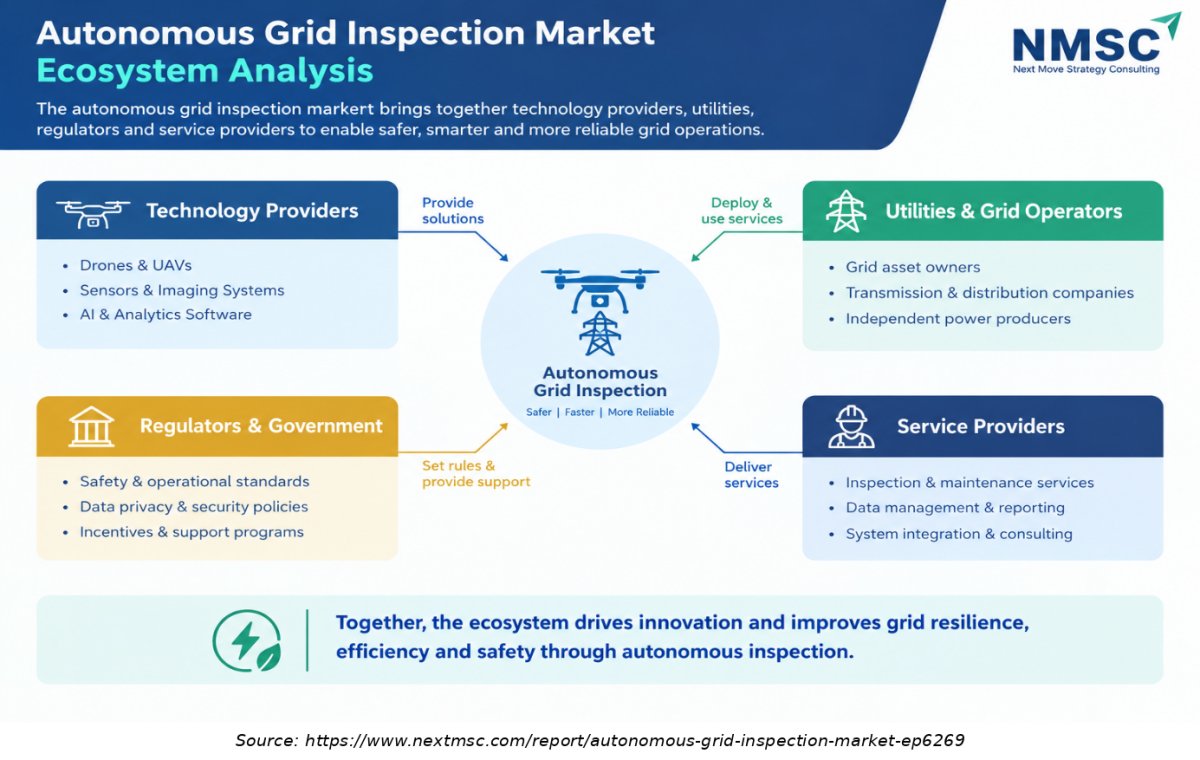
Ecosystem Analysis of the Autonomous Grid Inspection Market

The Autonomous Grid Inspection Market ecosystem connects technology providers, utilities, regulators, and service providers. These stakeholders work together to improve grid monitoring, inspection accuracy, operational efficiency, and infrastructure reliability

What Does the Autonomous Grid Inspection Market Encompass?

The Autonomous Grid Inspection Market covers autonomous and highly automated systems that capture, analyse and report the condition of transmission lines, distribution lines and substations without routine human climbs or helicopter sorties. It includes drone aircraft and docking stations, ground and crawler robots, AI analytics software, and inspection delivered as a managed service. Our findings suggest that a digital twin of each asset is becoming the common data layer that links repeat inspections to maintenance work orders.

The regulatory environment is led by aviation authorities, because most utility corridors require flights beyond visual line of sight. In the United States, the FAA and TSA published a proposed rule on beyond-visual-line-of-sight drone operations in August 2025. The final rule subsequently entered review by the Office of Information and Regulatory Affairs in July 2026; its status should be presented with a dated reference to the official regulatory record. Meanwhile, operators continue to rely on waivers, exemptions and special flight certificates, which keeps approval timelines and mission scale uneven across regions.

Market Drivers & Dynamics

Interactive Dataset
Grid capital expenditure surge driver +3.2% Global 2026–2035
Ageing transmission and distribution assets driver +2.6% North America, Europe 2026–2032
Wildfire and storm resilience programs driver +2.1% North America, Australia 2026–2030
Docked drone and remote operations maturity driver +2.8% United States, Europe, Asia-Pacific 2026–2035
AI defect detection accuracy driver +1.9% Global 2026–2033
Delay in final Part 108 rule restraint −1.8% United States 2026–2028
Procurement screening of drone hardware restraint −1.4% North America, Europe 2026–2029
Shortage of analysts and integration skills restraint −1.1% Global 2026–2031
Source: Next Move Strategy Consulting

Growth Drivers

What Is the Primary Growth Driver of the Autonomous Grid Inspection Market?

Grid capital spending is the primary driver. The International Energy Agency projected that global electricity-grid investment would approach USD 550 billion in 2026, nearly 20% above 2025 levels. This investment outlook supports the broader case for grid modernisation but does not directly quantify expenditure on autonomous inspection systems. Larger asset bases need more frequent inspection, and electricity transmission infrastructure owners cannot add crews at the same pace. We found that autonomy is the practical way to widen inspection coverage inside fixed operating budgets.

How Is Wildfire and Storm Resilience Driving Autonomous Grid Inspection Market Growth?

Utilities face growing pressure to prove that lines are inspected before fire and storm seasons. Utilities use drone inspections to support wildfire mitigation and grid maintenance. Cyberhawk reported inspecting more than 30,000 transmission towers in California in 2021. Rapid post storm patrols also matter, because PSEG Long Island notes that its autonomous drone pilot can speed damage assessment and restoration.

Growth Inhibitors

What Is Restraining the Autonomous Grid Inspection Market?

Regulatory timing is the main restraint. The proposed Part 108 framework is intended to establish a more standardised pathway for beyond-visual-line-of-sight drone operations. As of the regulatory status checked for this review, the final rule was pending OIRA review following receipt on July 10, 2026. Any statement about missed deadlines should be supported by a specific, dated regulatory source. Until it publishes, operators still depend on waivers, which slows rollout of remote BVLOS drone programs. Our analysis shows this uncertainty trims about 1.8% from the forecast growth rate.

What Are the Growth Opportunities?

How Can Distribution Network Autonomy Unlock New Demand?

Distribution feeders vastly outnumber transmission lines, yet most are still inspected by ground patrol. Docked drones placed at substations can cover nearby feeders on a schedule, and PSEG Long Island is testing this model with weekly autonomous flights. Vendors that package low-cost docks with analytics benefit most, while municipal utilities gain access to the Autonomous Grid Inspection Market through subscription plans.

What Role Can Sensor Fusion Play in Expanding Inspection Depth?

Visual images alone miss internal faults, so thermal, LiDAR and acoustic payloads are being combined with camera data. Platforms that apply sensor fusion can flag hotspots, vegetation encroachment and conductor sag in a single mission. Analytics vendors and payload makers are the main beneficiaries, because richer data supports condition-based maintenance and lets utilities defer premature asset replacement.

How Can Smart Metering and Inspection Data Be Connected?

Utilities with advanced metering infrastructure already hold outage and voltage signals that point to likely fault locations. Linking that data to autonomous dispatch lets a drone reach a suspect span before a crew is assigned. Software vendors and inspection service providers gain a recurring revenue stream, and utilities improve outage restoration metrics without enlarging patrol teams.

Segmentation Analysis

2025 (USD Billion)
2035 (USD Billion)
Autonomous drone systems 2025: $0.49 Billion | 2035: $2.45 Billion
Autonomous d
Ground and crawler robots 2025: $0.08 Billion | 2035: $0.55 Billion
Ground and c
AI inspection analytics software 2025: $0.25 Billion | 2035: $1.95 Billion
AI inspectio
Inspection as a service 2025: $0.28 Billion | 2035: $1.25 Billion
Inspection a
Autonomous drone systems $0.49 Billion $2.45 Billion 17.4%
Ground and crawler robots $0.08 Billion $0.55 Billion 20.9%
AI inspection analytics software $0.25 Billion $1.95 Billion 22.7%
Inspection as a service $0.28 Billion $1.25 Billion 15.9%

Which Offering Leads the Autonomous Grid Inspection Market?

Autonomous drone systems held the largest offering share at about 44% of 2026 revenue, growing from USD 0.49 Billion in 2025 to USD 2.45 Billion by 2035. AI inspection analytics software is the fastest growing offering at 22.7% CAGR from 2026 to 2035, because every additional flight multiplies image volume. Our findings suggest that buyers increasingly judge vendors on drone software and analytics depth rather than airframe specifications alone.

2025 (USD Billion)
2035 (USD Billion)
Transmission
Distribution
Substations
Segment Item 2025 (USD Billion) 2035 (USD Billion) CAGR
Transmission lines $10.0 USD Billion $40.0 USD Billion 13.0%
Distribution lines $17.1 USD Billion $51.1 USD Billion 11.0%
Substations $24.2 USD Billion $62.2 USD Billion 13.0%

Segment-wise data is locked

Unlock complete segment-wise numbers for By Asset Type.

Unlock Full Data
2025 (USD Billion)
2035 (USD Billion)
Docked remot
Field deploy
Segment Item 2025 (USD Billion) 2035 (USD Billion) CAGR
Docked remote operations $10.0 USD Billion $40.0 USD Billion 24.0%
Field deployed mission automation $17.1 USD Billion $51.1 USD Billion 26.0%

Segment-wise data is locked

Unlock complete segment-wise numbers for By Operating Mode.

Unlock Full Data

Growth Opportunities

Based on research conducted by NMSC, we found that three opportunities offer the clearest route to incremental revenue for vendors, utilities and service providers over the forecast period.

How Can Distribution Network Autonomy Unlock New Demand?

Distribution feeders vastly outnumber transmission lines, yet most are still inspected by ground patrol. Docked drones placed at substations can cover nearby feeders on a schedule, and PSEG Long Island is testing this model with weekly autonomous flights. Vendors that package low-cost docks with analytics benefit most, while municipal utilities gain access to the Autonomous Grid Inspection Market through subscription plans.

What Role Can Sensor Fusion Play in Expanding Inspection Depth?

Visual images alone miss internal faults, so thermal, LiDAR and acoustic payloads are being combined with camera data. Platforms that apply sensor fusion can flag hotspots, vegetation encroachment and conductor sag in a single mission. Analytics vendors and payload makers are the main beneficiaries, because richer data supports condition-based maintenance and lets utilities defer premature asset replacement.

How Can Smart Metering and Inspection Data Be Connected?

Utilities with advanced metering infrastructure already hold outage and voltage signals that point to likely fault locations. Linking that data to autonomous dispatch lets a drone reach a suspect span before a crew is assigned. Software vendors and inspection service providers gain a recurring revenue stream, and utilities improve outage restoration metrics without enlarging patrol teams.

Regional Outlook

2025 (USD Billion)
2035 (USD Billion)
North Americ
Europe
Asia-Pacific
Middle East
Latin Americ
Region 2025 (USD Billion) 2035 (USD Billion) CAGR (%)
North America $10.0 USD Billion $40.0 USD Billion 9.0%
Europe $17.1 USD Billion $51.1 USD Billion 27.0%
Asia-Pacific $24.2 USD Billion $62.2 USD Billion 25.0%
Middle East & Africa $31.3 USD Billion $73.3 USD Billion 23.0%
Latin America $38.4 USD Billion $84.4 USD Billion 12.0%

Regional data is locked

Unlock complete regional numbers for this market.

Unlock Full Data

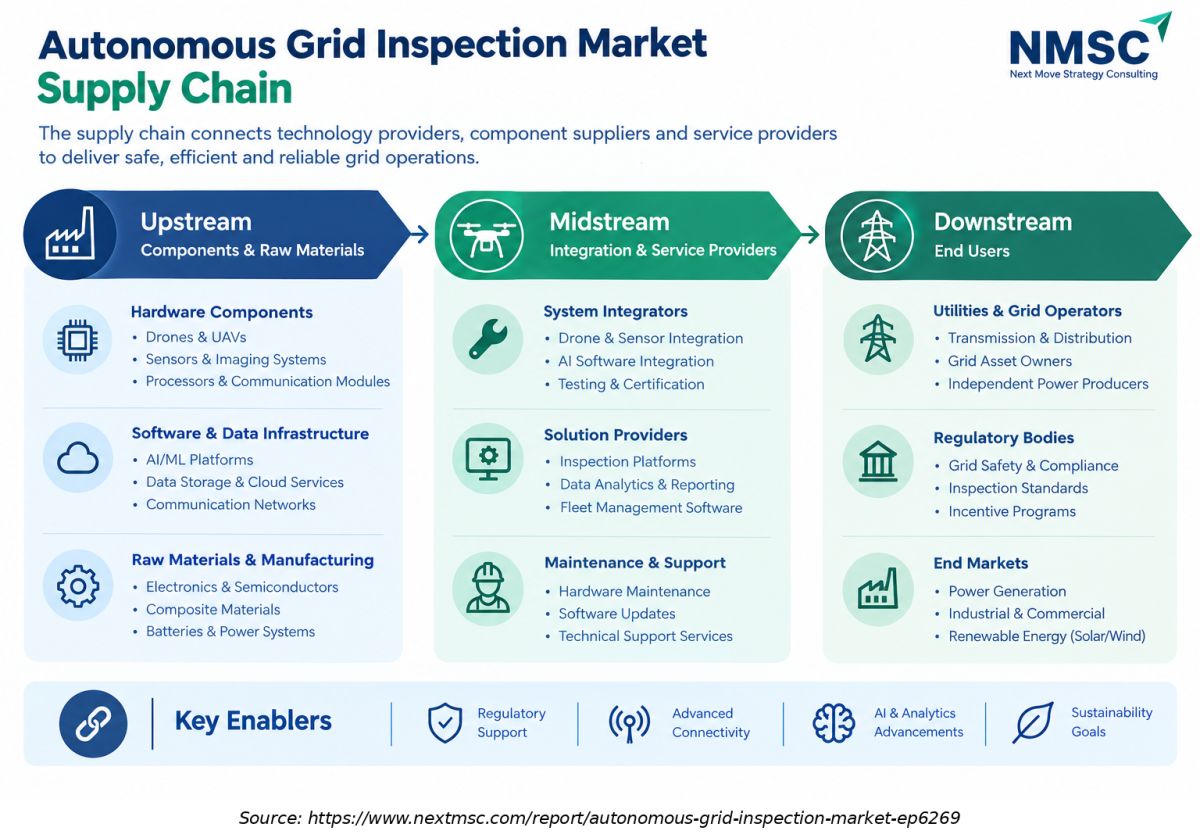
Supply Chain of the Autonomous Grid Inspection Market

Supply Chain of the Autonomous Grid Inspection Market

The Autonomous Grid Inspection Market supply chain spans component suppliers, technology developers, system integrators, and end users. Collaboration across these stages supports the deployment, integration, maintenance, and effective use of autonomous inspection solutions for power grid infrastructure

Competitive Landscape

Our analysis shows that competition is split between aircraft makers, analytics specialists and service firms, and the strongest suppliers are widening into adjacent layers through partnerships.

How Do Companies Compete in the Autonomous Grid Inspection Market?

Competition centres on autonomy reliability, regulatory approvals, analytics accuracy and installed utility references. Skydio and DJI compete on aircraft and docks, while Percepto bundles docks with an inspection platform and eSmart Systems focuses on analytics. Cyberhawk competes through engineering led services and its iHawk platform. In the Autonomous Grid Inspection Market, utility references and approvals count as much as hardware performance when contracts are awarded.

Which Company Archetypes Dominate the Market?

Three archetypes dominate: platform manufacturers, analytics software specialists and inspection service providers. Manufacturers such as Skydio and DJI sell aircraft and docks, analytics specialists such as eSmart Systems sell AI review, and service firms such as Cyberhawk deliver outcomes. A fourth group emerges around ground robots, where Percepto integrates Boston Dynamics Spot for substations, linked to the broader autonomous unmanned ground vehicle ecosystem.

How Are Companies Differentiating Through Innovation?

Differentiation focuses on navigation near energised conductors, weather hardened docks, thermal imaging and faster defect classification. DJI added an obstacle sensing module for fine line wires, Skydio built its dock around remote operations, and Percepto launched new inspection intelligence in June 2026. Accurate positioning through real time kinematics helps repeat missions align, and edge computer vision reduces data sent to the cloud.

What Is the Level of M&A and Partnership Activity?

Alliances are more common than acquisitions at present. Skydio's integration with Levatas analytics illustrates hardware-software collaboration, while Project VOLT involved Skyports Drone Services and SP Electricity North West (SP ENW). We expect consolidation once Part 108 clarifies standards, because analytics specialists will seek hardware partners and aircraft makers will seek software depth. Pricing is shifting toward subscriptions that bundle hardware and services.

Key Market Players

Based on research conducted by NMSC, we found that the following companies, ranked on qualitative evidence of utility deployments and product breadth, lead the market.

Skydio, Inc. SZ DJI Technology Co., Ltd. Percepto Robotics Ltd. eSmart Systems AS Cyberhawk Innovations Limited

Latest Developments

We observed that the most material recent events combine product launches by leading vendors with regulatory milestones that shape remote flight approvals.

Date Event
September 2024 Skydio launches Dock for X10, built for beyond visual line of sight flight and targeted at energy utilities and public safety
February 2025 DJI launches Dock 3 with Matrice 4D and 4TD drones and an optional obstacle sensing module for 12 mm power line wires
August 2025 FAA and TSA publish the proposed Part 108 rule to normalise beyond visual line of sight drone operations
October 2026 Cyberhawk secures a multi-year agreement to provide drone inspection and surveying across SSE electricity networks in Britain

Expert Insights

Kathryn Fairhurst

Overhead Line Operations Director | National Grid

"By handling non-intrusive inspection tasks, this technology enables our highly skilled line workers to focus more efficiently on the complex, hands-on work that requires human expertise."

Analyst Interpretation

Fairhurst highlighted how autonomous drone inspections can improve electricity network asset management and support maintenance teams.

What Are the Investment Opportunities in the Autonomous Grid Inspection Market?

Where Are Capital Inflows Concentrating in the Autonomous Grid Inspection Market?

Capital is flowing toward companies that combine autonomy hardware with analytics subscriptions, since recurring revenue is easier to value. Funding activity among inspection technology providers may support product development and commercial expansion. Our assessment indicates that further rounds will favour firms with multiple utility references and approvals for remote operations.

What Infrastructure Investments Support Market Expansion?

Dock networks, secure connectivity and cloud analytics are the main infrastructure needs. Utilities install docks at substations, where power and fibre already exist, and link them to control rooms. Integrating drone-inspection data with substation monitoring systems can provide engineers with a more comprehensive view of asset condition and support maintenance planning.

How Do ESG Considerations Shape Investment in the Market?

Replacing selected helicopter patrols or vehicle-based inspections with electric drones may reduce fuel consumption and emissions. The magnitude of any reduction depends on the aircraft, mission, energy source and displaced inspection method and should be supported by comparative evidence. Safer inspection also lowers the number of workers climbs near energised equipment. Wildfire prevention adds a social benefit, and lenders increasingly link grid resilience to green finance eligibility, which supports funding for utilities that adopt autonomous inspection at scale.

Key Benefits for Stakeholders

What Value Does the Report Offer Utility and Industry Leaders?

Utility executives gain segment level forecasts that help them decide between owned fleets, docked systems and managed services. The analysis of the Autonomous Grid Inspection Market highlights how asset type, operating mode and region change adoption speed. It also clarifies regulatory timing, enabling planners to sequence waivers, pilot sites and analytics contracts so that autonomy delivers measurable reliability benefits rather than isolated demonstrations.

How Does the Report Help Investors and Financial Analysts?

Investors receive a reconciled view of revenue by offering, asset type, mode and geography from 2025 to 2035, along with CAGR figures calculated from 2026. The report identifies where growth is fastest, such as AI analytics at 22.7% CAGR, and which restraints could delay returns. This supports valuation work, portfolio screening and diligence on vendors with exposure to utility inspection budgets.

What Insights Do Technology Vendors and Product Teams Gain?

Vendors learn which capabilities matter most to utility buyers, including navigation near conductors, weather hardened docks, thermal analytics and integration with asset management systems. Competitive analysis shows how peers pair hardware, software and services. Regional sizing and country paragraphs help product teams prioritise certification, partner selection and localisation, so engineering effort aligns with markets that are growing fastest.

Key Market Segments Evaluated

By Offering

  • Autonomous drone systems
  • Ground and crawler robots
  • AI inspection analytics software
  • Inspection as a service

By Asset Type

  • Transmission lines
  • Distribution lines
  • Substations

By Operating Mode

  • Docked remote operations
  • Field deployed mission automation

By Region

  • North America 
    • U.S.
    • Canada
    • Mexico
  • Europe 
    • UK
    • Germany
    • France
    • Rest of Europe
  • Asia-Pacific 
    • China
    • India
    • Japan
    • South Korea
    • Australia
    • Rest of APAC
  • Middle East & Africa 
    • UAE
    • Saudi Arabia
    • South Africa
    • Rest of MEA
  • Latin America 
    • Brazil
    • Argentina
    • Rest of LATAM

Conclusion & Recommendations

What Is the Long-Term Outlook for the Autonomous Grid Inspection Market?

The Autonomous Grid Inspection Market is set to grow from USD 1.32 Billion in 2026 to USD 6.20 Billion by 2035, an 18.8% CAGR, as inspection moves from periodic projects to continuous autonomous monitoring. Growth is supported by grid capital spending and wildfire and storm resilience needs. The pace will depend on how quickly aviation rules permit routine remote flight and how fast utilities integrate analytics into maintenance workflows.

What Strategic Positioning Recommendations Does NMSC Offer?

We recommend that vendors build around utility outcomes rather than hardware, combining aircraft, docks and analytics with transparent pricing. Priority actions include securing approvals early, partnering for substation and distribution coverage, and localising analytics models. Utilities should start with docked pilots at substations, define data standards upfront and negotiate service terms that allow switching hardware without losing historical inspection records.

How Attractive Is the Autonomous Grid Inspection Market for Investment?

Attractiveness is high but selective. Recurring analytics and service revenue offers visibility, while hardware faces pricing pressure from large aircraft makers. The Middle East & Africa and Asia-Pacific regions show the fastest growth, though from smaller bases, and North America offers the largest near-term pool. Investors should favour companies with multiple utility references, regulatory approvals and clear paths to subscription revenue.

What Are the Key Market Shifts and Risks in the Autonomous Grid Inspection Market?

The main shift is from manual flight to docked, remote operation, which concentrates risk in connectivity, cybersecurity and airspace approvals. Key risks include delay of the final Part 108 rule, procurement screening of drone hardware, data privacy objections and a shortage of analysts who can validate AI findings. Utilities that plan for these issues early will avoid costly rework and stalled pilots.

What Are the Primary Growth Pathways Through 2035?

Growth pathways include extending docked drones to distribution feeders, adding thermal and LiDAR fusion for deeper diagnostics, and integrating inspection findings with work order systems. Inspection as a service widens access for smaller utilities, and emerging regions add volume as new transmission is built. Together these paths lift the market toward USD 6.20 Billion by 2035, as our forecast shows.

Delivered Customizations

We have successfully delivered the following deep-dive customizations:

Client Request Customization Delivered Value Adds
Historical Market Revenue Analysis
  • Historical revenue analysis of autonomous grid inspection by offering (hardware, software, services), asset type, and operating mode, 2020 to 2025 base year.
  • Establishes a verified baseline for the 2026-2035 forecast and shows which offerings and asset types are already scaling.
Addressable Inspection Market Sizing

  • TAM, SAM, and VAM sizing of grid inspection spend by offering, asset type, and operating mode, linked to grid inspection scope and utility asset counts.
  • Shows the serviceable and obtainable opportunity by segment to prioritize market entry and capacity planning.
Vendor Platform Share Analysis
  • Company-level share of autonomous inspection platforms and service providers by operating mode (aerial, ground, submersible) and asset type, based on disclosed revenue and deployment data.
  • Identifies share leaders and white-space niches to guide competitive positioning and partnership choices.
Asset-Level Inspection Demand Mapping
  • Demand mapping of inspection requirements across transmission lines, substations, and distribution networks by utility ownership and regulatory inspection cycles.
  • Pinpoints which asset classes and utility segments generate recurring inspection demand for targeted sales focus.
Operating Mode Adoption Pathway Assessment
  • Country-wise assessment of the shift from remotely piloted to beyond-visual-line-of-sight and fully autonomous inspection, tied to aviation and regulatory approval milestones.
  • Times product roadmap and market entry decisions to regulatory approval windows for autonomous operating modes.
Inspection Cost Economics Benchmarking
  • Cost-per-kilometer and cost-per-asset benchmarking of autonomous versus manual inspection by asset type, using utility tender data and regulatory rate filings.
  • Quantifies the payback case for autonomous inspection to support utility procurement and pricing strategy.

FAQs

Sources & References

1.

International Energy Agency, World Energy Investment 2026

iea.org
2.

Federal Register, FAA and TSA, Normalizing Unmanned Aircraft Systems Beyond Visual Line of Sight Operations (proposed rule, August 7, 2025)

federalregister.gov
3.

GovInfo, Federal Register, reopening of the Part 108 comment period (January 28, 2026)

govinfo.gov
4.

Vertical Aviation International, Part 108 final rule sent to OIRA for review (July 15, 2026)

verticalavi.org
5.

PSEG Long Island, Pilot Drone Program

psegliny.com
6.

Skydio, Utilities solutions

skydio.com/solutions/utilities
7.

Skydio, Dock for X10 and DFR Command press release (Business Wire)

businesswire.com
8.

DJI, Dock 3 launch announcement (February 27, 2025)

dji.com
9.

Percepto, News and press releases

percepto.co/news
10.

Percepto, nationwide FAA waiver press release (PR Newswire)

prnewswire.com
11.

Cyberhawk, wildfire mitigation inspection press release (PR Newswire, July 13, 2021)

prnewswire.com

About the Author

Mayurima Roy

Mayurima Roy

Mayurima Roy is Research Analyst at Next Move Strategy Consulting, where she has spent 4 years working across the firm's full industry coverage rather than a single fixed vertical. Her work centers on structured research, ongoing trend tracking, competitive assessment, and insight-led content development, translating complex market data into clear, decision-ready narratives that support informed client decision-making across diverse global industries, market sectors, and world regions every day.

About the Reviewer

Supradip Baul

Supradip Baul

Supradip Baul is an accomplished business consultant and strategist with over a decade of rich experience in market intelligence, strategy, technology, and business transformation. His work has included rigorous qualitative and quantitative analysis across multiple industries, helping clients shape investment decisions and long-term roadmaps. Earlier in his career, he was associated with Gartner, where he contributed to industry-leading reports and market share analyses. He has worked with leading global companies and holds an MBA with a dual specialization in Marketing and Finance.

Download Free Sample

Pratyush Kumar Das

PRATYUSH KUMAR DAS

Assistant Manager

Polycab India Limited

We would like to express our appreciation for the data and insights provided by nextmsc. We are very pleased with the quality and depth of the information, which has proven to be highly valuable and beneficial for our business decision-making.

Mohit Agarwal

MOHIT AGARWAL

Chief Manager

DryChem India Pvt. Ltd.

Next Move Strategy Consulting is an amazing team of consultants. We required a market study report for our investors on top priority and the team went above and beyond our expectations to deliver the same with ample supporting data within a short time span enabling us to secure the investments and keep our project timeline maintained. Their professionalism, attention to detail, and timely delivery of actionable recommendations have left a lasting impression on our organization.

Nishant Awate

NISHANT AWATE

Business Development Global Sales

Zehnder Group Deutschland GmbH

Our experience working with Next Move Strategy Consulting was positive. The team was responsive, professional, and open to incorporating our specific requirements throughout the project. The India AHU market study was comprehensive and well structured, covering market value and volume forecasts, product and application segments, and key industry trends. The inclusion of both AHU and residential MVHR market insights made the study particularly relevant for our strategic market assessment. Overall, the report provides a solid foundation for evaluating market potential, identifying priority segments, and supporting business-development decisions in India.

Rishabh Jogani

RISHABH JOGANI

Strategy Analyst

Accenture Japan

We are incredibly impressed with the market report on the real estate market in India provided by Next Move Strategy Consulting. The report was thorough, insightful, and well-structured, offering deep analysis and actionable recommendations. It not only captured the current trends and dynamics but also provided a forward-looking perspective that has been invaluable for our strategic planning. Their team demonstrated exceptional professionalism, attention to detail, and a profound understanding of the industry. The data-driven insights and clarity of presentation exceeded our expectations, making complex market trends easy to understand. We highly recommend Next Move Strategy Consulting to anyone looking for reliable and comprehensive market research services. Their expertise has given us the confidence to navigate the complexities of the Indian real estate market with clarity and foresight.

Ross J Mckenzie

ROSS J MCKENZIE

Business Insight Manager

Staysure Group

“Next MSC have been incredibly helpful in providing detailed & robust information on our market, alongside quantifying growth by different segments. The process to procure was simple and easy, with sample reports and regular contact to ensure we had what we needed. Succinct detail on their sources & methodologies is also greatly received, allowing transparency in this respect helps build trust in the detail you pay for. Joseph in particular was fantastic, and helped ensure efficient provision of the insight pack – thank you NMSC!”.

Custom Market Research Services

We will customize the research for you if the listed report does not fully match your requirements.

Get 30% Free Customization

Select License

This website uses cookies to ensure you get the best experience on our website. Learn more

✖