Starlink V2’s 5G From Space Set to Transform Global Connectivity
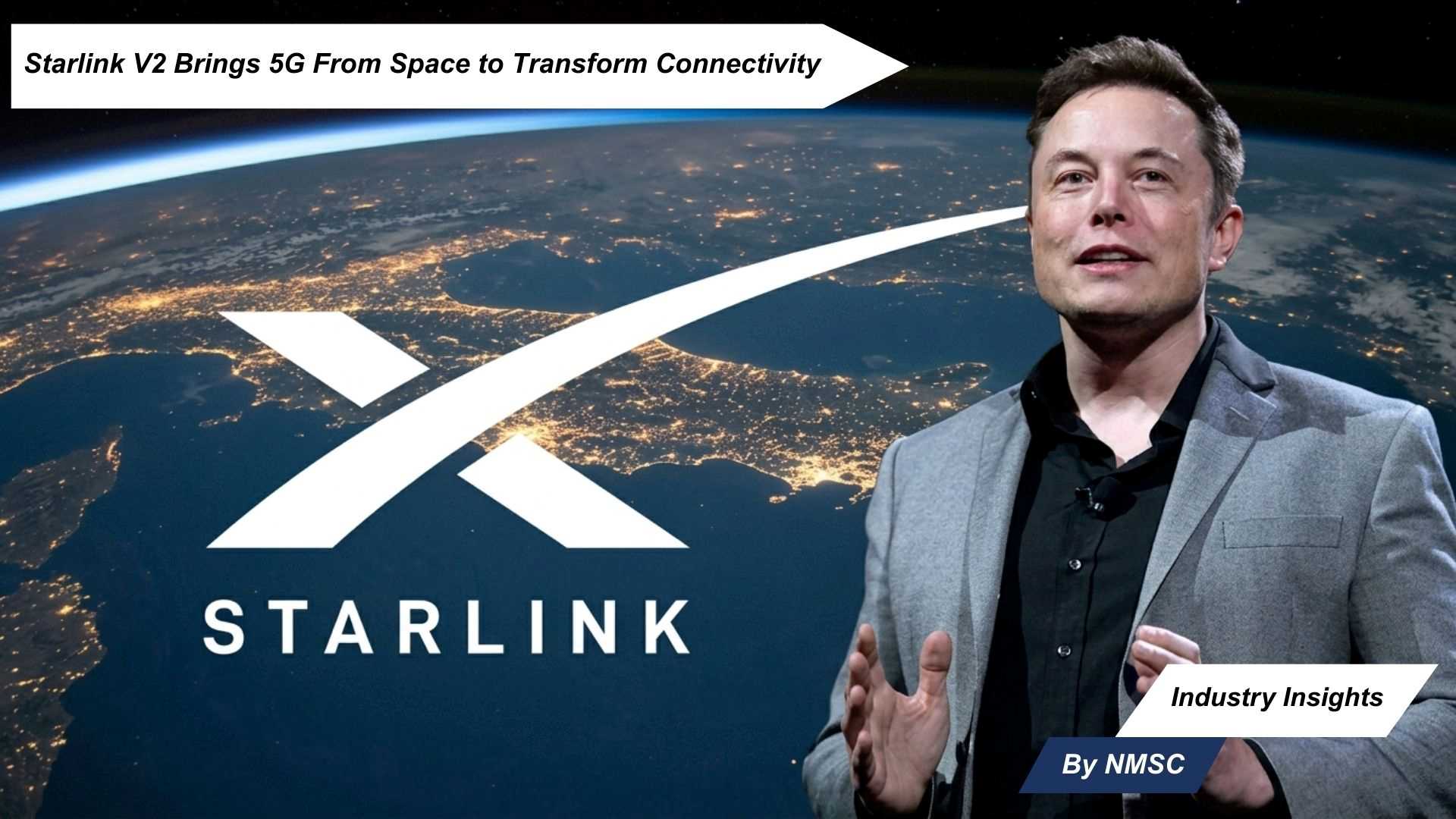
Industry Insights from Next Move Strategy Consulting
As demand for faster and more reliable internet access intensifies worldwide, the upcoming launch of Starlink V2 marks a significant milestone in satellite-powered communications. Developed by SpaceX, the new space-based 5G network is designed to deliver broadband connectivity directly from low Earth orbit, potentially redefining how mobile internet services reach users beyond the limits of traditional ground infrastructure.
With projected download speeds of up to 150 Mbps, the system aims to provide high-performance internet without relying on terrestrial base transceiver stations (BTS). This approach represents a major step toward expanding connectivity to remote and underserved communities where conventional telecommunications infrastructure remains limited.
Advancing the Performance of Satellite Internet
The Starlink V2 network introduces major improvements in both speed and capacity compared with earlier satellite systems. According to Michael Nichols, Senior Vice President of Engineering at Starlink, the network is engineered to deliver download speeds comparable to fiber-optic or cable broadband, reaching peak levels of around 150 Mbps.
In addition to faster speeds, the new satellites significantly expand data capacity. The system is designed to achieve up to 100 times greater data density than its predecessors. Each satellite is also capable of delivering roughly 20 times higher throughput, enabling the network to support a far larger number of users simultaneously while maintaining reliable performance.
Operating in low Earth orbit, the satellites effectively function as space-based cellular towers, extending broadband coverage to regions where traditional mobile networks may not reach.
Direct Connectivity to Everyday Smartphones
A key innovation of Starlink V2 is its ability to connect directly to hundreds of existing LTE smartphone models without requiring specialized antennas or additional hardware.
This capability allows users to maintain connectivity through a seamless transition between terrestrial cellular networks and the satellite-based 5G system. As individuals travel through areas with weak or non-existent ground network coverage, the technology enables continuous communication without common disruptions such as dropped calls or interrupted data sessions.
By integrating satellite connectivity directly with standard mobile devices, the system introduces a new level of flexibility in how internet services can be delivered globally.
Global Partnerships Driving Expansion
To strengthen network coverage and accelerate adoption, SpaceX is establishing strategic collaborations with telecommunications operators across multiple regions.
One notable partnership with Deutsche Telekom aims to introduce Starlink V2 services throughout Europe by 2028. The initiative focuses on addressing connectivity challenges in rural and geographically complex areas where building fiber or cable infrastructure is often difficult or costly.
In the United States, the company is also working with T-Mobile to integrate satellite-enabled 5G services with existing mobile networks. This collaboration seeks to improve connectivity in remote environments, including polar regions that frequently experience network disruptions.
Deployment Roadmap and Technical Challenges
The rollout of the Starlink V2 constellation is expected to begin in mid-2027. The full network will eventually consist of approximately 15,000 satellites deployed in batches of more than 50 per mission.
Successful deployment will depend heavily on the capabilities of Starship, the rocket system designed to carry the larger satellites into orbit efficiently. Accelerated launch schedules will be critical to achieving the planned scale, data capacity, and global coverage of the constellation.
If these milestones are achieved, the network could significantly reshape the competitive landscape between satellite internet services and traditional wired broadband providers.
Key Features of the Starlink V2 Network
-
Download speeds reaching up to 150 Mbps
-
Reduced dependence on terrestrial BTS infrastructure
-
Data density improvements of up to 100 times compared with earlier systems
-
Approximately 20 times higher throughput per satellite
-
Compatibility with hundreds of existing LTE smartphones
-
Planned deployment of around 15,000 satellites starting mid-2027
-
Strategic collaborations with global telecom operators
-
Focus on remote, rural, and polar connectivity
Next Move Strategy Consulting’s View
According to Next Move Strategy Consulting, the emergence of 5G From Space Market signals a pivotal shift in the evolution of global telecommunications infrastructure. By enabling direct connectivity between satellites and standard mobile devices, these systems have the potential to extend broadband services far beyond the reach of conventional terrestrial networks.
Such developments highlight a growing convergence between satellite communications and mobile telecommunications ecosystems. As integration between these technologies progresses, space-enabled connectivity solutions are expected to play an increasingly important role in addressing global coverage gaps and supporting reliable communication in geographically challenging regions.
Redefining the Boundaries of Internet Access
The development of Starlink V2 represents a major step toward delivering high-speed internet directly from space. Through advanced satellite capabilities, strategic telecom partnerships, and direct smartphone compatibility, SpaceX is positioning its next-generation network to broaden global connectivity in unprecedented ways.
As deployment progresses in the coming years, space-based 5G could reshape how internet services are delivered worldwide, opening new opportunities to connect communities that remain beyond the reach of traditional infrastructure.
Prepared by: Next Move Strategy Consulting
Source: Qoo Media
About the Author
 Sanyukta Deb
— Sanyukta Deb is Digital Marketing Team Lead at Next Move Strategy Consulting, where she has led content strategy and technical SEO for the firm's B2B market research publications for over 2 years. Her editorial process translates NextMSC's primary and secondary research — spanning technology, industrial, and consumer sectors — into commercial narratives, backed by search-intent, keyword, and competitive analysis. She brings 5 years of overall experience in digital marketing and content strategy.
Sanyukta Deb
— Sanyukta Deb is Digital Marketing Team Lead at Next Move Strategy Consulting, where she has led content strategy and technical SEO for the firm's B2B market research publications for over 2 years. Her editorial process translates NextMSC's primary and secondary research — spanning technology, industrial, and consumer sectors — into commercial narratives, backed by search-intent, keyword, and competitive analysis. She brings 5 years of overall experience in digital marketing and content strategy.
About the Reviewer
 Debashree Dey
— Debashree Dey is Assistant Manager at Next Move Strategy Consulting, where she supports cross-vertical market content and communications across diverse industries for 6 years. Her professional background includes senior content writing, communications, and published manuscript authorship, with experience developing audience-focused business narratives and maintaining clear, consistent messaging. Her role supports research-led content development and editorial quality across NextMSC publications.
Debashree Dey
— Debashree Dey is Assistant Manager at Next Move Strategy Consulting, where she supports cross-vertical market content and communications across diverse industries for 6 years. Her professional background includes senior content writing, communications, and published manuscript authorship, with experience developing audience-focused business narratives and maintaining clear, consistent messaging. Her role supports research-led content development and editorial quality across NextMSC publications.

















Add Comment